Shabbat 104b: Talmud study for Daf Yomi
Daf Yomi is the daily study of one Talmud folio. Explore 37 tractates with scans, Hebrew text, Sefaria English and AI-generated French translations where annotated.
Passage selection and English or AI-generated French translation are available where the scan has annotations. Daf Study is independent of Torah-Box and Sefaria.
Browse Shabbat · שבת · All tractatesShabbat 104b text and translations
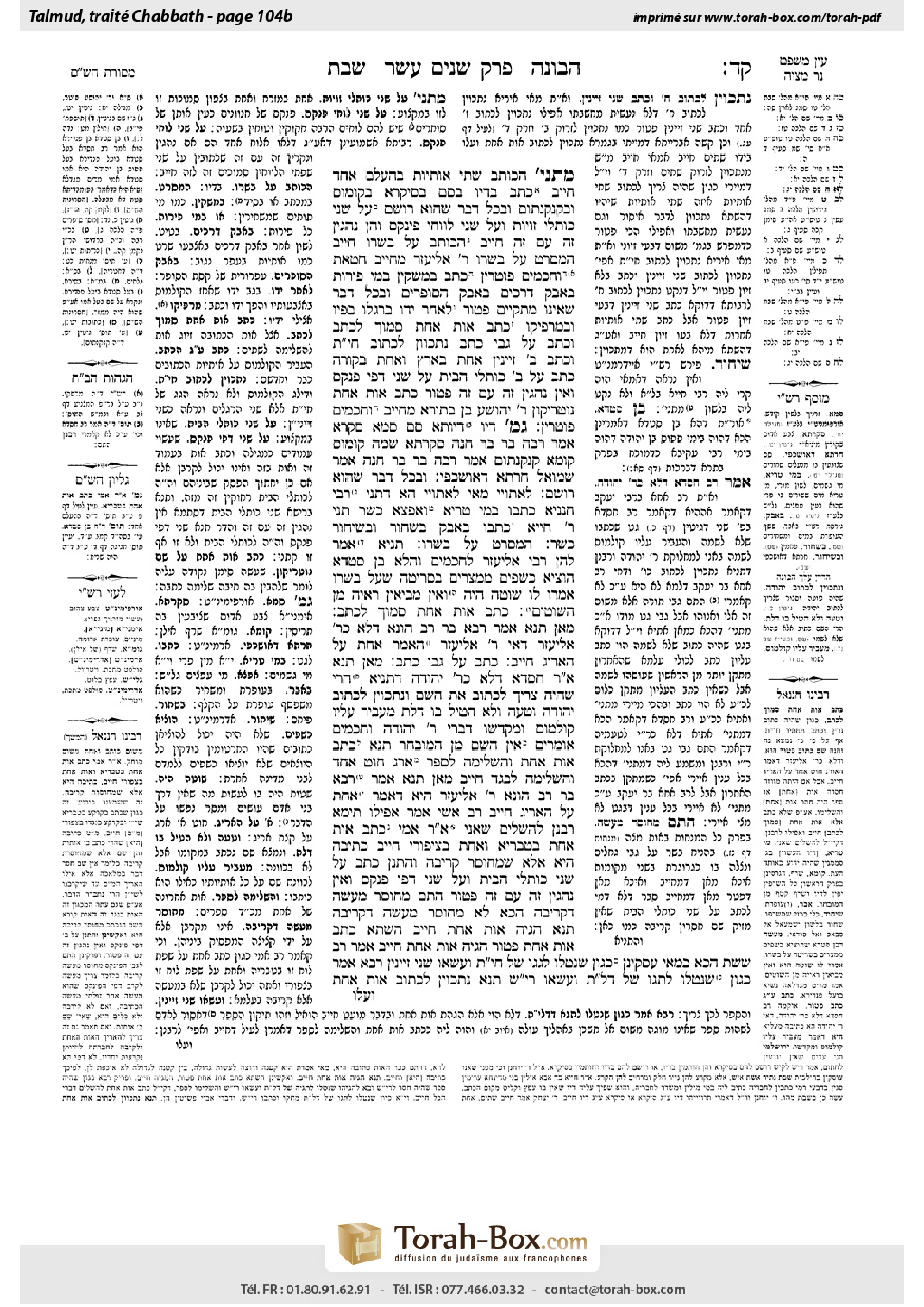
This page of Shabbat includes the Aramaic text, an English translation and an AI-generated French translation, alongside the scan above.
שבת ק״ד ב · Aramaic and Hebrew text
מַתְנִי׳ הַכּוֹתֵב שְׁתֵּי אוֹתִיּוֹת בְּהֶעְלֵם אֶחָד — חַיָּיב. כָּתַב בִּדְיוֹ בְּסַם בְּסִיקְרָא בְּקוֹמוֹס וּבְקַנְקַנְתּוֹם וּבְכׇל דָּבָר שֶׁהוּא רוֹשֵׁם. עַל שְׁנֵי כּוֹתְלֵי זָוִיּוֹת וְעַל שְׁנֵי לוּחֵי פִינְקָס וְהֵן נֶהֱגִין זֶה עִם זֶה — חַיָּיב. הַכּוֹתֵב עַל בְּשָׂרוֹ — חַיָּיב. הַמְסָרֵט עַל בְּשָׂרוֹ — רַבִּי אֱלִיעֶזֶר מְחַיֵּיב חַטָּאת וַחֲכָמִים פּוֹטְרִין.
כָּתַב בְּמַשְׁקִין בְּמֵי פֵּירוֹת, בַּאֲבַק דְּרָכִים בַּאֲבַק הַסּוֹפְרִים וּבְכׇל דָּבָר שֶׁאֵינוֹ מִתְקַיֵּים — פָּטוּר. לְאַחַר יָדוֹ בְּרַגְלוֹ בְּפִיו וּבְמַרְפְּקוֹ, כָּתַב אוֹת אַחַת סָמוּךְ לַכְּתָב, וּכְתָב עַל גַּבֵּי כְּתָב, נִתְכַּוֵּון לִכְתּוֹב חֵי״ת וְכָתַב שְׁתֵּי זַיְינִין, אַחַת בָּאָרֶץ וְאַחַת בַּקּוֹרָה, כָּתַב עַל שְׁנֵי כּוֹתְלֵי הַבַּיִת, עַל שְׁנֵי דַּפֵּי פִנְקָס וְאֵין נֶהֱגִין זֶה עִם זֶה — פָּטוּר. כָּתַב אוֹת אַחַת נוֹטָרִיקוֹן — רַבִּי יְהוֹשֻׁעַ בֶּן בְּתֵירָא מְחַיֵּיב וַחֲכָמִים פּוֹטְרִין.
גְּמָ׳ דְּיוֹ — דְּיוֹתָא. סַם — סַמָּא. סִקְרָא — אָמַר רַבָּה בַּר בַּר חָנָה: סְקַרְתָּא שְׁמָהּ. קוֹמוֹס — קוֹמָא. קַנְקַנְתּוֹם — אָמַר רַבָּה בַּר בַּר חָנָה אָמַר שְׁמוּאֵל: חַרְתָּא דְאוּשְׁכָּפֵי.
וּבְכׇל דָּבָר שֶׁהוּא רוֹשֵׁם. לְאֵתוֹיֵי מַאי? לְאֵתוֹיֵי הָא דְתָנֵי רַבִּי חֲנַנְיָא: כְּתָבוֹ בְּמֵי טַרְיָא וְאַפְצָא — כָּשֵׁר. תָּנֵי רַבִּי חִיָּיא: כְּתָבוֹ בַּאֲבָר בִּשְׁחוֹר וּבְשִׁיחוֹר — כָּשֵׁר.
הַמְסָרֵט עַל בְּשָׂרוֹ. תַּנְיָא, אָמַר לָהֶן רַבִּי אֱלִיעֶזֶר לַחֲכָמִים: וַהֲלֹא בֶּן סָטָדָא הוֹצִיא כְּשָׁפִים מִמִּצְרַיִם בִּסְרִיטָה שֶׁעַל בְּשָׂרוֹ? אָמְרוּ לוֹ: שׁוֹטֶה הָיָה, וְאֵין מְבִיאִין רְאָיָה מִן הַשּׁוֹטִים. ״בֶּן סָטָדָא״? בֶּן פַּנְדִּירָא הוּא! אָמַר רַב חִסְדָּא: בַּעַל ״סָטָדָא״, בּוֹעֵל ״פַּנְדִּירָא״. בַּעַל פַּפּוּס בֶּן יְהוּדָה הוּא? אֶלָּא אִמּוֹ ״סָטָדָא״. אִמּוֹ מִרְיָם מְגַדְּלָא שְׂעַר נְשַׁיָּא הֲוַאי? אֶלָּא כִּדְאָמְרִי בְּפוּמְבְּדִיתָא: סְטָת דָּא מִבַּעְלַהּ.
כָּתַב אוֹת אַחַת סָמוּךְ לַכְּתָב. מַאן תַּנָּא? אָמַר רָבָא בַּר רַב הוּנָא: דְּלָא כְּרַבִּי אֱלִיעֶזֶר, דְּאִי רַבִּי אֱלִיעֶזֶר, הָאָמַר: אַחַת עַל הָאָרִיג — חַיָּיב.
כְּתָב עַל גַּבֵּי כְּתָב. מַאן תַּנָּא? אָמַר רַב חִסְדָּא: דְּלָא כְּרַבִּי יְהוּדָה. דְּתַנְיָא: הֲרֵי שֶׁהָיָה צָרִיךְ לִכְתּוֹב אֶת הַשֵּׁם, וְנִתְכַּוֵּין לִכְתּוֹב ״יְהוּדָה״, וְטָעָה וְלֹא הֵטִיל בּוֹ דָּלֶת — מַעֲבִיר עָלָיו קוּלְמוֹס וּמְקַדְּשׁוֹ, דִּבְרֵי רַבִּי יְהוּדָה. וַחֲכָמִים אוֹמְרִים: אֵין הַשֵּׁם מִן הַמּוּבְחָר.
תָּנָא: כָּתַב אוֹת אַחַת וְהִשְׁלִימָהּ לְסֵפֶר, אָרַג חוּט אֶחָד וְהִשְׁלִימוֹ לְבֶגֶד — חַיָּיב. מַאן תַּנָּא? אָמַר רָבָא בַּר רַב הוּנָא: רַבִּי אֱלִיעֶזֶר הִיא, דְּאָמַר אַחַת עַל הָאָרִיג — חַיָּיב. רַב אָשֵׁי אָמַר: אֲפִילּוּ תֵּימָא רַבָּנַן, לְהַשְׁלִים שָׁאנֵי.
אָמַר רַבִּי אַמֵּי: כָּתַב אוֹת אַחַת בִּטְבֶרְיָא וְאַחַת בְּצִיפּוֹרִי — חַיָּיב, כְּתִיבָה הִיא, אֶלָּא שֶׁמְחוּסָּר קְרִיבָה. וְהָתְנַן: כָּתַב עַל שְׁנֵי כּוֹתְלֵי הַבַּיִת וְעַל שְׁנֵי דַּפֵּי פִנְקָס וְאֵין נֶהֱגִין זֶה עִם זֶה — פָּטוּר! הָתָם מְחוּסָּר מַעֲשֶׂה דִקְרִיבָה, הָכָא לֹא מְחוּסָּר מַעֲשֶׂה דִקְרִיבָה.
תָּנָא: הִגִּיהַּ אוֹת אַחַת — חַיָּיב. הַשְׁתָּא כָּתַב אוֹת אַחַת — פָּטוּר, הִגִּיהַּ אוֹת אַחַת חַיָּיב?! אָמַר רַב שֵׁשֶׁת: הָכָא בְּמַאי עָסְקִינַן — כְּגוֹן שֶׁנְּטָלוֹ לְגַגּוֹ שֶׁל חֵי״ת וַעֲשָׂאוֹ שְׁנֵי זַיְינִין. רָבָא אָמַר: כְּגוֹן שֶׁנְּטָלוֹ לְתָגוֹ שֶׁל דָּלֶ"ת וַעֲשָׂאוֹ רֵי״שׁ.
תָּנָא: נִתְכַּוֵּין לִכְתּוֹב אוֹת אַחַת
Shabbat 104b · English translation
MISHNA: One who writes two letters on Shabbat during one lapse of awareness is liable. The following substances used as ink are explained in the Gemara. One is liable if he wrote with deyo, with sam, with sikra, with gum [komos], or with copper sulfate [kankantom] or with any substance that makes a mark. If one wrote on two walls of a house that form a corner, or on two parts of a writing tablet, and the two items are read together, he is liable. One who writes on his flesh on Shabbat is liable. If one unwittingly scratches letters on his flesh on Shabbat, Rabbi Eliezer deems him liable to bring a sin-offering and the Sages deem him exempt.
If one wrote with liquids or with fruit juice, or if one drew letters with road dust, with scribes’ dust that they use to dry the ink, or with any substance with which the writing does not endure, he is exempt. Similarly, if one wrote by holding the pen on the back of his hand, with his foot, with his mouth, or with his elbow; if one wrote only a single letter, even if it was adjacent to other preexisting writing; or if one wrote over other writing; if one meant to write the letter ḥet and instead wrote the two halves of the ḥet as two instances of the letter zayin; if one wrote one letter on the ground and one on a rafter; if one wrote one letter on two walls of a house, or on two parts of a writing tablet that are not read together, he is exempt. If one wrote one letter as an abbreviation representing an entire word, Rabbi Yehoshua ben Beteira deems him liable to bring a sin-offering, and the Rabbis deem him exempt.
GEMARA: The Gemara defines the terms used in the mishna. Deyo is deyota made from soot. Sam is samma, which is yellow-tinged arsenic. Sikra, Rabba bar bar Ḥana said: It is called sikreta in Aramaic and is a lead-based red paint. Komos is koma in Aramaic, and it is an ink made with gum Arabic from the sap of a tree. Kankantom, Rabba bar bar Ḥana said that Shmuel said: This is the black substance used by cobblers, copper sulfate.
And we learned in the mishna that one who writes with any substance that makes a mark is liable. The Gemara asks: What does this statement come to include? The Gemara answers: It comes to include that which Rabbi Ḥananya taught with regard to writing a bill of divorce: If one wrote it with the juice of the fruit called teriya, or with gallnut juice instead of ink, it is valid. Similarly, Rabbi Ḥiyya taught: If one wrote a bill of divorce with lead, with soot (ge’onim), or with shoeblack, it is valid. Since those substances leave a permanent mark, one who writes with them on Shabbat is liable.
We learned in the mishna: If one unwittingly scratches letters on his flesh on Shabbat, Rabbi Eliezer deems him liable to bring a sin-offering and the Sages deem him exempt. It was taught in a baraita that Rabbi Eliezer said to the Rabbis: Didn’t the infamous ben Stada take magic spells out of Egypt in a scratch on his flesh? They said to him: He was a fool, and you cannot cite proof from a fool. That is not the way that most people write. Incidentally, the Gemara asks: Why did they call him ben Stada, when he was the son of Pandeira? Rav Ḥisda said: His mother’s husband, who acted as his father, was named Stada, but the one who had relations with his mother and fathered him was named Pandeira. The Gemara asks: Wasn’t his mother’s husband Pappos ben Yehuda? Rather, his mother was named Stada and he was named ben Stada after her. The Gemara asks: But wasn’t his mother Miriam, who braided women’s hair? The Gemara explains: That is not a contradiction. Rather, Stada was merely a nickname, as they say in Pumbedita: This one strayed [setat da] from her husband.
We learned in the mishna: If one wrote only a single letter, even if it was adjacent to other preexisting writing, he is exempt. The Gemara asks: Who is the tanna whose opinion is cited in the mishna? Rava bar Rav Huna said: This halakha is not in accordance with the opinion of Rabbi Eliezer, as if it were in accordance with the opinion of Rabbi Eliezer, didn’t he say: One who adds a single thread to a previously woven fabric is liable for weaving? In his opinion, although a single thread or letter is insignificant in and of itself, one is liable because adding even a small measure to existing material is significant.
We learned in the mishna: If one wrote over other writing he is exempt. The Gemara asks: Who is the tanna whose opinion is cited in the mishna? Rav Ḥisda said: This halakha is not in accordance with the opinion of Rabbi Yehuda, as it was taught in a baraita: If one needed to write the Tetragrammaton, the name of God, in a Torah scroll, and became confused and intended instead to write the name Yehuda, and while intending to write Yehuda he erred and omitted the letter dalet, thereby writing the name of God, he should do the following. He passes a quill with more ink over the name and sanctifies it, i.e., he writes it with the intention required when writing a holy name. This is the statement of Rabbi Yehuda. And the Rabbis say: Even if he adds ink over what he wrote, this writing of God’s name is not ideal. Apparently, according to Rabbi Yehuda, writing over other writing is considered writing anew.
A tanna taught in a baraita: If one wrote a single letter and thereby completed a book, or if one wove a single thread and thereby completed an entire garment, he is liable. The Gemara asks: Who is the tanna whose opinion is cited in the baraita? Rava bar Rav Huna said: It is the opinion of Rabbi Eliezer, who said: One who adds a single thread to a previously woven fabric is liable for weaving. Rav Ashi said: Even if you say that in accordance with the opinion of the Rabbis, one who does so to complete a garment is different. Even if he is not liable for weaving, he is liable at least for striking a blow with a hammer to complete the production process of a vessel.
Rabbi Ami said: If one wrote one letter on paper in Tiberias and one letter on paper in Tzippori, he is liable because he performed a full-fledged act of writing that is lacking only in proximity. When the two pieces of paper are brought together he will have written two associated letters. The Gemara asks: Didn’t we learn in the mishna: If one wrote one letter on two walls of a house, or on two parts of a writing tablet that are not read together, he is exempt? All the more so that this is the halakha with regard to one who wrote in two different cities. The Gemara answers: There, in the case of the parts of a tablet, there is the lack of an additional act of cutting or tearing to facilitate bringing the letters together. However, here, in the case of two cities, even though they are distant from one another, there is no lack of an additional act to facilitate bringing them together.
A tanna taught in the Tosefta: If one emended a single letter on Shabbat, he is liable. The Gemara wonders: Now, if one wrote a single letter on Shabbat he is exempt; is it possible that if one emends a single letter he is liable? Rav Sheshet said: With what are we dealing here? We are dealing with a case where one removed the roof of a ḥet and transformed it into two instances of the letter zayin, effectively writing two letters with a single correction. Rava said: It is not necessarily referring to that specific case. It could even be referring to a case where one removed the protrusion from the back of a dalet and transformed it into a reish, thereby emending the written text. One who did so is liable for performing the prohibited labor of striking a blow with a hammer to complete the production process of a vessel.
A tanna taught: If one intended to write one letter on Shabbat
Shabbat 104b · Traduction française (IA)
MICHNA : Celui qui écrit deux lettres pendant Chabbat au cours d’un même accès d’inattention est passible. La Guemara explique les substances utilisées comme encre. On est passible si l’on écrit avec du deyo, du sam, du sikra, de la gomme [komos], du sulfate de cuivre [kankantom] ou toute substance qui laisse une marque. Si l’on écrit sur deux murs d’une maison formant un angle, ou sur deux parties d’une tablette d’écriture, de sorte que les deux éléments se lisent ensemble, on est passible. Celui qui écrit sur sa chair pendant Chabbat est passible. Si, sans le vouloir, quelqu’un grave des lettres sur sa chair pendant Chabbat, Rabbi Eliezer le juge passible d’apporter un sacrifice expiatoire, tandis que les Sages le déclarent quitte.
Si l’on écrit avec des liquides ou du jus de fruit, ou si l’on trace des lettres avec de la poussière de route, avec la poudre dont les scribes se servent pour sécher l’encre, ou avec toute substance qui ne permet pas à l’écriture de durer, on est quitte. De même, on est quitte si l’on écrit en tenant la plume sur le dos de la main, avec le pied, avec la bouche ou avec le coude ; si l’on écrit une seule lettre, même accolée à une écriture préexistante ; si l’on écrit par-dessus une autre écriture ; si l’on entend écrire la lettre ḥet mais que l’on trace à la place les deux moitiés du ḥet sous la forme de deux lettres zayin ; si l’on écrit une lettre par terre et l’autre sur une poutre ; ou si l’on écrit une lettre sur chacun de deux murs d’une maison, ou sur deux parties d’une tablette d’écriture qui ne se lisent pas ensemble. Si l’on écrit une lettre servant d’abréviation pour un mot entier, Rabbi Yehoshua ben Beteira le juge passible d’apporter un sacrifice expiatoire, tandis que les Rabbins le déclarent quitte.
GUEMARA : La Guemara définit les termes employés dans la Michna. Deyo est le deyota, fabriqué à partir de suie. Sam est le samma, un arsenic jaunâtre. À propos du sikra, Rabba bar bar Ḥana dit qu’en araméen on l’appelle sikreta et qu’il s’agit d’une peinture rouge à base de plomb. Komos est le koma en araméen ; c’est une encre fabriquée avec de la gomme arabique provenant de la sève d’un arbre. À propos du kankantom, Rabba bar bar Ḥana dit au nom de Shmuel qu’il s’agit de la substance noire employée par les cordonniers, le sulfate de cuivre.
Nous avons appris dans la Michna que celui qui écrit avec toute substance qui laisse une marque est passible. La Guemara demande : Qu’est-ce que cette formulation vient inclure ? Elle répond : Elle inclut ce que Rabbi Ḥananya a enseigné au sujet de la rédaction d’un acte de divorce : si l’on écrit celui-ci avec le jus du fruit appelé teriya ou avec du jus de noix de galle au lieu d’encre, il est valide. De même, Rabbi Ḥiyya a enseigné que si l’on écrit un acte de divorce avec du plomb, de la suie (ge’onim) ou du cirage, il est valide. Puisque ces substances laissent une marque durable, celui qui écrit avec elles pendant Chabbat est passible.
Nous avons appris dans la Michna : si, sans le vouloir, quelqu’un grave des lettres sur sa chair pendant Chabbat, Rabbi Eliezer le juge passible d’apporter un sacrifice expiatoire, tandis que les Sages le déclarent quitte. Il a été enseigné dans une baraïta que Rabbi Eliezer dit aux Rabbins : « Le tristement célèbre ben Stada n’a-t-il pas fait sortir d’Égypte des formules magiques, gravées sur sa chair ? » Ils lui répondirent : « C’était un imbécile, et l’on ne peut tirer de preuve du cas d’un imbécile. Ce n’est pas ainsi que la plupart des gens écrivent. » À ce propos, la Guemara demande : Pourquoi l’appelait-on ben Stada, alors qu’il était le fils de Pandeira ? Rav Ḥisda dit : Le mari de sa mère, qui faisait office de père, s’appelait Stada, tandis que celui qui avait eu des relations avec sa mère et l’avait engendré s’appelait Pandeira. La Guemara demande : Le mari de sa mère n’était-il pas Pappos ben Yehuda ? Il faut plutôt dire que sa mère s’appelait Stada et qu’il fut appelé ben Stada d’après elle. La Guemara demande : Mais sa mère n’était-elle pas Miriam, qui tressait les cheveux des femmes ? La Guemara explique qu’il n’y a pas de contradiction : Stada n’était qu’un sobriquet, car à Pumbedita, on dit : « Celle-ci s’est écartée [setat da] de son mari. »
Nous avons appris dans la Michna : si l’on écrit une seule lettre, même accolée à une écriture préexistante, on est quitte. La Guemara demande : De quel tanna la Michna rapporte-t-elle l’opinion ? Rava bar Rav Huna dit : Cette halakha n’est pas conforme à l’opinion de Rabbi Eliezer. En effet, si elle était conforme à son opinion, n’a-t-il pas dit que celui qui ajoute un seul fil à un tissu déjà tissé est passible pour avoir tissé ? Selon lui, même si un fil ou une lettre pris isolément est insignifiant, on est passible, car l’ajout, même d’une petite quantité, à un matériau existant est significatif.
Nous avons appris dans la Michna : si l’on écrit par-dessus une autre écriture, on est quitte. La Guemara demande : De quel tanna la Michna rapporte-t-elle l’opinion ? Rav Ḥisda dit : Cette halakha n’est pas conforme à l’opinion de Rabbi Yehuda, car il a été enseigné dans une baraïta : si quelqu’un devait écrire le Tétragramme, le nom de Dieu, dans un rouleau de Torah, mais qu’il se trompe et ait l’intention d’écrire à la place le nom Yehuda, puis qu’en voulant écrire Yehuda il se trompe et omette la lettre dalet, écrivant ainsi le nom de Dieu, il doit procéder comme suit : il passe une plume chargée d’encre sur le nom et le sanctifie, c’est-à-dire qu’il le réécrit avec l’intention requise pour écrire un nom sacré. Telle est la déclaration de Rabbi Yehuda. Les Rabbins disent : même s’il ajoute de l’encre par-dessus ce qu’il a écrit, cette écriture du nom de Dieu n’est pas idéale. Il apparaît donc que, selon Rabbi Yehuda, écrire par-dessus une autre écriture est considéré comme une nouvelle écriture.
Un tanna a enseigné dans une baraïta : si l’on écrit une seule lettre et que l’on achève ainsi un livre, ou si l’on tisse un seul fil et que l’on achève ainsi un vêtement entier, on est passible. La Guemara demande : De quel tanna la baraïta rapporte-t-elle l’opinion ? Rava bar Rav Huna dit : C’est l’opinion de Rabbi Eliezer, qui a dit que celui qui ajoute un seul fil à un tissu déjà tissé est passible pour avoir tissé. Rav Ashi dit : Même si l’on affirme que cela est conforme à l’opinion des Rabbins, achever un vêtement constitue un cas différent. Même si l’on n’est pas passible pour avoir tissé, on l’est au moins pour avoir donné le coup de marteau qui achève la fabrication d’un objet.
Rabbi Ami dit : Si l’on écrit une lettre sur une feuille à Tibériade et une lettre sur une feuille à Tsippori, on est passible, car on a accompli un véritable acte d’écriture auquel seule manque la proximité. Lorsque les deux feuilles sont rapprochées, on a écrit deux lettres liées l’une à l’autre. La Guemara demande : N’avons-nous pas appris dans la Michna que si l’on écrit une lettre sur chacun de deux murs d’une maison, ou sur deux parties d’une tablette d’écriture qui ne se lisent pas ensemble, on est quitte ? À plus forte raison en va-t-il ainsi de celui qui écrit dans deux villes différentes. La Guemara répond : dans le cas des parties d’une tablette, il manque un acte supplémentaire de découpage ou de déchirure pour permettre de rapprocher les lettres. En revanche, dans le cas de deux villes, bien qu’elles soient éloignées l’une de l’autre, aucun acte supplémentaire ne manque pour permettre de les rapprocher.
Un tanna a enseigné dans la Tosefta : si l’on corrige une seule lettre pendant Chabbat, on est passible. La Guemara s’étonne : si celui qui écrit une seule lettre pendant Chabbat est quitte, est-il possible que celui qui corrige une seule lettre soit passible ? Rav Sheshet dit : De quoi s’agit-il ici ? D’un cas où quelqu’un a supprimé le toit d’un ḥet et l’a transformé en deux lettres zayin, écrivant ainsi deux lettres au moyen d’une seule correction. Rava dit : Il n’est pas nécessaire qu’il s’agisse précisément de ce cas. Il peut même s’agir de quelqu’un qui a supprimé la protubérance à l’arrière d’un dalet et l’a transformé en reish, corrigeant ainsi le texte écrit. Celui qui fait cela est passible pour avoir accompli le travail interdit consistant à donner le coup de marteau qui achève la fabrication d’un objet.
Un tanna a enseigné : si l’on avait l’intention d’écrire une lettre pendant Chabbat
Traduction française générée par IA à partir de l’édition anglaise de Sefaria. Vérifie toujours un passage avec le texte source.
Text from Sefaria: William Davidson Edition - Vocalized Aramaic (CC BY NC); William Davidson Edition - English (CC BY NC).