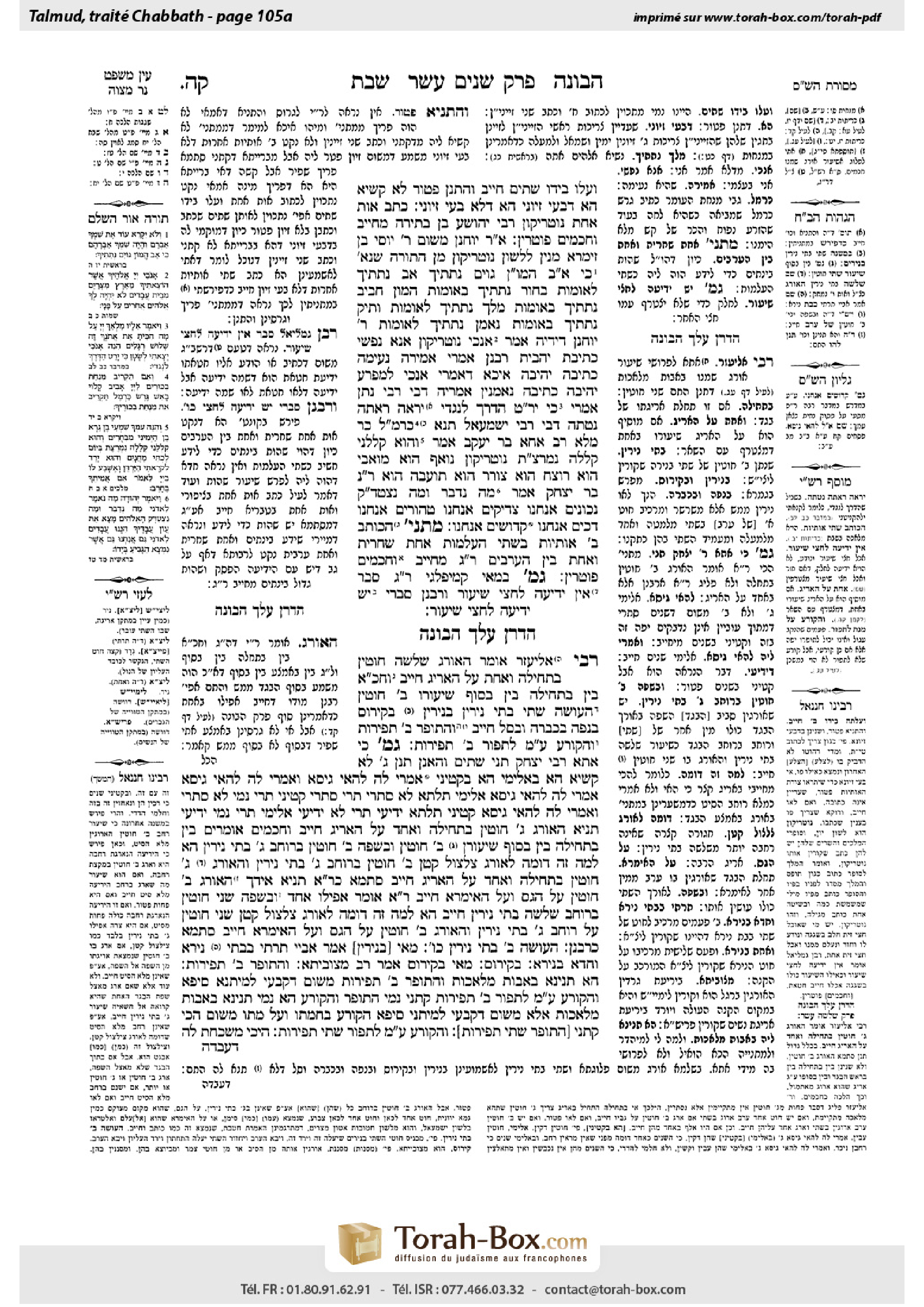
Shabbat 105a: Talmud study for Daf Yomi
Daf Yomi is the daily study of one Talmud folio. Explore 37 tractates with scans, Hebrew text, Sefaria English and AI-generated French translations where annotated.
Passage selection and English or AI-generated French translation are available where the scan has annotations. Daf Study is independent of Torah-Box and Sefaria.
Browse Shabbat · שבת · All tractatesShabbat 105a text and translations
This page of Shabbat includes the Aramaic text, an English translation and an AI-generated French translation, alongside the scan above.
שבת ק״ה א · Aramaic and Hebrew text
וְעָלוּ בְּיָדוֹ שְׁתַּיִם — חַיָּיב. וְהָתְנַן פָּטוּר! לָא קַשְׁיָא: הָא דְּבָעֵי זַיּוֹנֵי, הָא דְּלָא בָּעֵי זַיּוֹנֵי.
כָּתַב אוֹת אַחַת נוֹטָרִיקוֹן, רַבִּי יְהוֹשֻׁעַ בֶּן בְּתִירָה מְחַיֵּיב וַחֲכָמִים פּוֹטְרִין. אָמַר רַבִּי יוֹחָנָן מִשּׁוּם רַבִּי יוֹסֵי בֶּן זִימְרָא: מִנַּיִן לִלְשׁוֹן נוֹטָרִיקוֹן מִן הַתּוֹרָה, שֶׁנֶּאֱמַר: ״כִּי אַב הֲמוֹן גּוֹיִם נְתַתִּיךָ״ — אָב נְתַתִּיךָ לָאוּמּוֹת, בָּחוּר נְתַתִּיךָ בָּאוּמּוֹת, הֲמוֹן חָבִיב נְתַתִּיךָ בָּאוּמּוֹת, מֶלֶךְ נְתַתִּיךָ לָאוּמּוֹת, וָתִיק נְתַתִּיךָ בָּאוּמּוֹת, נֶאֱמָן נְתַתִּיךָ לָאוּמּוֹת.
רַבִּי יוֹחָנָן דִּידֵיהּ אָמַר: ״אָנֹכִי״, נוֹטָרִיקוֹן: אֲנָא נַפְשִׁי כְּתַבִית יְהַבִית. רַבָּנַן אָמְרִי: אֲמִירָה נְעִימָה כְּתִיבָה יְהִיבָה. אִיכָּא דְּאָמְרִי ״אָנֹכִי״ לְמַפְרֵעַ: יְהִיבָה כְּתִיבָה נֶאֱמָנִין אֲמָרֶיהָ.
דְּבֵי רַבִּי נָתָן אָמְרִי: ״כִּי יָרַט הַדֶּרֶךְ לְנֶגְדִּי״ — יָרְאָה, רָאֲתָה, נָטְתָה. דְּבֵי רַבִּי יִשְׁמָעֵאל תָּנָא: ״כַּרְמֶל״ — כַּר מָלֵא. רַב אַחָא בַּר יַעֲקֹב אָמַר: ״וְהוּא קִלְלַנִי קְלָלָה נִמְרֶצֶת״, נוֹטָרִיקוֹן: נוֹאֵף הוּא, מוֹאָבִי הוּא, רוֹצֵחַ הוּא, צוֹרֵר הוּא, תּוֹעֵבָה הוּא.
רַב נַחְמָן בַּר יִצְחָק אָמַר: ״מַה נְּדַבֵּר וּמַה נִּצְטַדָּק״ — נְכוֹנִים אֲנַחְנוּ, צַדִּיקִים אֲנַחְנוּ, טְהוֹרִים אֲנַחְנוּ, דַּכִּים אֲנַחְנוּ, קְדוֹשִׁים אֲנַחְנוּ.
מַתְנִי׳ הַכּוֹתֵב שְׁתֵּי אוֹתִיּוֹת בִּשְׁתֵּי הֶעְלֵמוֹת, אַחַת שַׁחֲרִית וְאַחַת בֵּין הָעַרְבַּיִם, רַבָּן גַּמְלִיאֵל מְחַיֵּיב וַחֲכָמִים פּוֹטְרִין.
גְּמָ׳ בְּמַאי קָמִיפַּלְגִי? רַבָּן גַּמְלִיאֵל סָבַר אֵין יְדִיעָה לַחֲצִי שִׁיעוּר, וְרַבָּנַן סָבְרִי יֵשׁ יְדִיעָה לַחֲצִי שִׁיעוּר.
הדרן עלך הבונה
מַתְנִי׳ רַבִּי אֱלִיעֶזֶר אוֹמֵר: הָאוֹרֵג שְׁלֹשָׁה חוּטִין בַּתְּחִילָּה וְאַחַת עַל הָאָרִיג — חַיָּיב. וַחֲכָמִים אוֹמְרִים: בֵּין בַּתְּחִילָּה בֵּין בַּסּוֹף — שִׁיעוּרוֹ שְׁנֵי חוּטִין. הָעוֹשֶׂה שְׁתֵּי בָתֵּי נִירִין בַּנִּירַיִם, בַּקֵּירוֹס, בַּנָּפָה, בַּכְּבָרָה וּבַסַּל — חַיָּיב. וְהַתּוֹפֵר שְׁתֵּי תְפִירוֹת, וְהַקּוֹרֵעַ עַל מְנָת לִתְפּוֹר שְׁתֵּי תְפִירוֹת.
גְּמָ׳ כִּי אֲתָא רַבִּי יִצְחָק תָּנֵי: ״שְׁתַּיִם״. וְהָאֲנַן תְּנַן: ״שָׁלֹשׁ״! לָא קַשְׁיָא: הָא בְּאַלִּימֵי, הָא בְּקַטִּינֵי. אָמְרִי לַהּ לְהַאי גִּיסָא, וְאָמְרִי לַהּ לְהַאי גִּיסָא. אָמְרִי לַהּ לְהַאי גִּיסָא: אַלִּימֵי — תְּלָתָא לָא סָתְרִי, תְּרֵי סָתְרִי. קַטִּינֵי — תְּרֵי נָמֵי לָא סָתְרִי. וְאָמְרִי לַהּ לְהַאי גִּיסָא: קַטִּינֵי — תְּלָתָא יְדִיעִי, תְּרֵי לָא יְדִיעִי. אַלִּימֵי — תְּרֵי נָמֵי יְדִיעִי.
תַּנְיָא: הָאוֹרֵג שְׁלֹשָׁה חוּטִין בַּתְּחִילָּה וְאֶחָד עַל הָאָרִיג — חַיָּיב. וַחֲכָמִים אוֹמְרִים: בֵּין בַּתְּחִילָּה בֵּין בַּסּוֹף — שִׁיעוּרָן שְׁנֵי חוּטִין. וּבַשָּׂפָה — שְׁנֵי חוּטִין בְּרוֹחַב שְׁלֹשָׁה בָּתֵּי נִירִין. הָא לְמָה זֶה דּוֹמֶה? לְאוֹרֵג צִלְצוֹל קָטָן, שְׁנֵי חוּטִין בְּרוֹחַב שְׁלֹשָׁה בָּתֵּי נִירִין. וְהָאוֹרֵג שְׁלֹשָׁה חוּטִין בַּתְּחִילָּה וְאֶחָד עַל הָאָרִיג חַיָּיב, סְתָמָא כְּרַבִּי אֱלִיעֶזֶר.
תַּנְיָא אִידַּךְ: הָאוֹרֵג שְׁנֵי חוּטִין עַל הַגַּס? וְעַל הָאִימְרָא — חַיָּיב. רַבִּי אֱלִיעֶזֶר אוֹמֵר: אֲפִילּוּ אֶחָד. וּבַשָּׂפָה, שְׁנֵי חוּטִין בְּרוֹחַב שְׁלֹשָׁה בָתֵּי נִירִין — חַיָּיב. הָא לְמָה זֶה דּוֹמֶה — לְאוֹרֵג צִלְצוֹל קָטָן שְׁנֵי חוּטִין עַל רוֹחַב שְׁלֹשָׁה בָּתֵּי נִירִין: וְהָאוֹרֵג שְׁנֵי חוּטִין עַל הַגַּס וְעַל הָאִימְרָא חַיָּיב — סְתָמָא כְּרַבָּנַן.
הָעוֹשֶׂה שְׁנֵי בָתֵּי נִירִין כּוּ׳. מַאי בַּנִּירַיִם? אָמַר אַבָּיֵי: תַּרְתֵּי בְּבַת נִירָא וַחֲדָא בְּנִירָא. בְּקֵירוֹס. מַאי בְּקֵירוֹס? אָמַר רַב: מְצוֹבִיתָא.
וְהַתּוֹפֵר שְׁתֵּי תְפִירוֹת. הָא תְּנֵינָא בַּאֲבוֹת מְלָאכוֹת: וְהַתּוֹפֵר שְׁתֵּי תְפִירוֹת! מִשּׁוּם דְּקָבָעֵי לְמִיתְנָא סֵיפָא: ״וְהַקּוֹרֵעַ עַל מְנָת לִתְפּוֹר שְׁתֵּי תְפִירוֹת״, קָתָנֵי נָמֵי הַתּוֹפֵר. וְהַקּוֹרֵעַ. הָא נָמֵי תְּנֵינָא בַּאֲבוֹת מְלָאכוֹת! אֶלָּא מִשּׁוּם דְּקָבָעֵי לְמִיתְנֵי סֵיפָא, הַקּוֹרֵעַ בַּחֲמָתוֹ וְעַל מֵתוֹ, מִשּׁוּם הָכִי קָתָנֵי [הַתּוֹפֵר שְׁתֵּי תְפִירוֹת].
וְהַקּוֹרֵעַ עַל מְנָת לִתְפּוֹר שְׁתֵּי תְפִירוֹת. הֵיכִי מַשְׁכַּחַתְּ לַהּ?
Shabbat 105a · English translation
and managed to write two letters, he is liable. The Gemara asks: Didn’t we learn in the mishna that one is exempt in that case? The Gemara answers: This is not difficult: That case where we learned that he is exempt is referring to a case where the letters require crowns. This is referring to a case where they do not require crowns, and he is liable. If the letters already had their requisite ornamentation and an individual separated them, it is as if he wrote two letters.
We learned in the mishna If one wrote one letter as an abbreviation [notarikon] representing an entire word, Rabbi Yehoshua ben Beteira deems him liable to bring a sin-offering, and the Rabbis deem him exempt. Rabbi Yoḥanan said in the name of Rabbi Yosei ben Zimra: From where is it derived that the language of abbreviation is employed in the Torah? As it is stated: “Neither shall your name any more be called Abram, but your name shall be Abraham; for the father of a multitude of nations [av hamon goyim] have I made you” (Genesis 17:5). The verse itself contracts av hamon into Abraham [Avraham]. The words av hamon themselves are interpreted as an abbreviation: I have made you a father [av] for the nations, I have made you chosen [baḥur] among the nations, I have made you beloved [ḥaviv] among the nations, I have made you king [melekh] for the nations, I have made you distinguished [vatik] for the nations, I have made you trusted [ne’eman] for the nations.
Rabbi Yoḥanan himself said that the word anokhi that begins the Ten Commandments is an abbreviation for: I myself wrote and gave [ana nafshi ketivat yehavit]. The Rabbis said it is an abbreviation for: A pleasant statement was written and given [amira ne’ima ketiva yehiva]. Some say the word anokhi can be interpreted backwards: It was written, it was given, its statements are faithful [yehiva ketiva ne’emanim amareha].
The school of Rabbi Natan said that there is another abbreviation in the Torah. In the verse: “And the angel of the Lord said to him: Why did you hit your donkey these three times? Behold I have come out as an adversary because your way is contrary [yarat] against me” (Numbers 22:32). Yarat is an abbreviation for: The donkey feared [yare’a], it saw [ra’ata], and it turned aside [nateta]. The school of Rabbi Yishmael taught: The word karmel in the verse: “And bread, and toasted grain flour, and toasted grain [karmel]” (Leviticus 23:14) means: A full kernel [kar maleh], i.e., the seed fills the stalk. Rav Aḥa bar Ya’akov said in King David’s words: “And behold, with you is Shimi ben Gera from Benjamin, of Bahurim, who cursed me with a grievous [nimretzet] curse on the day that I went to Mahanaim” (I Kings 2:8). The word nimretzet is an abbreviation for: He is an adulterer [noef], he is a Moabite [Moavi], he is a murderer [rotze’aḥ], he is an oppressor [tzorer], he is an abomination [to’eva].
Rav Naḥman bar Yitzḥak said that there is another abbreviation in the Bible: “And Judah said: What can we say to my master, what can we speak, and how can we justify [nitztadak]” (Genesis 44:16), which stands for: We are honest [nekhonim], we are righteous [tzaddikim], we are pure [tehorim], we are innocent [dakkim], we are holy [kedoshim].
MISHNA: With regard to one who writes two letters on Shabbat in two separate lapses of awareness separated by a period of awareness that the day was Shabbat, writing one letter in the morning and one letter in the afternoon, Rabban Gamliel deems him liable to bring a sin-offering like someone who has unintentionally performed a full-fledged prohibited labor, and the Rabbis deem him exempt.
GEMARA: The Gemara asks: With regard to what do they disagree? Rabban Gamliel holds: There is no awareness for half a measure. One is not liable to bring a sacrifice for half a measure; therefore, the fact that he became aware between performance of the two halves of the prohibited labor is of no significance. His awareness does not demarcate between one act of writing a letter and the second act of writing a letter with regard to liability to bring a sin-offering. And the Rabbis hold: There is awareness for half a measure. If an individual became aware of his transgression between the two parts of the prohibited labor, each individual part is independent of the other, and the two halves of the prohibited labor do not join together to create liability.
MISHNA: Rabbi Eliezer says: One who weaves on Shabbat is liable to bring a sin-offering if he wove three threads at the beginning of something new, or if he adds one thread to a preexisting woven fabric. And the Rabbis say: Both at the beginning and at the end, its measure for liability is two threads. One who makes two meshes, i.e., ties the threads of the warp, attaching them to either the nirin or the keiros, which will be explained in the Gemara, in a winnow, sieve, or basket, is liable for making meshes. And one who sews is liable if he sews two stitches. And one who tears is liable if he tears enough fabric in order to sew two stitches to repair it.
GEMARA: When Rabbi Yitzḥak came from Eretz Yisrael to Babylonia, he taught that Rabbi Eliezer said: Two threads is the measure that determines liability for beginning a weave. The Gemara asks: Didn’t we learn three in the mishna? The Gemara answers: This is not difficult, because this source is referring to thick threads and that source is referring to thin threads. Some say it this way, that one is liable when weaving two thick threads, and some say it that way, that one is liable when weaving two thin threads. The Gemara elaborates: Some say it this way: One who weaves thick threads, three threads will not unravel, but two will unravel. With regard to thin threads, two will also not unravel. And some say it this way: One who weaves thin threads, three threads are conspicuous, two are not conspicuous. With regard to thick threads, two are also conspicuous.
It was taught in a baraita: One who weaves three threads at the beginning or one thread onto a preexisting woven fabric is liable. And the Rabbis say: Both at the beginning and at the end, its measure for liability is two threads. And if one weaves a hem with a thread or color different from the original garment, he is liable for weaving two threads across a width of three meshes, i.e., three threads of the warp. Why is one liable in that case? To what is this similar? It is similar to weaving a small belt in which one weaves two threads across a width of three meshes, the width of the belt. And when it is taught in the baraita: One who weaves three threads at the beginning or one thread onto a preexisting woven fabric is liable, that unattributed baraita is in accordance with the opinion of Rabbi Eliezer.
It was taught in another baraita: One who weaves two threads onto a large fabric or onto the border of a fabric alongside the woof on Shabbat is liable. Rabbi Eliezer says: One is liable even if he weaves one thread. And along the edge of the warp, one who weaves two threads across a width of three meshes is liable. To what is this similar? It is similar to weaving a small belt in which one weaves two threads across a width of three meshes. The Gemara comments: When it was taught in the baraita: One who weaves two threads onto a large fabric or onto the border is liable, that unattributed baraita is in accordance with the opinion of the Rabbis.
We learned in the mishna that one who makes two meshes, attaching them to either the nirin or the keiros, is liable. The Gemara asks: What is the meaning of to the nirin? Abaye said: One ties two to the meshes, the thread of the warp, and ties one to the crosspiece, the thread that extends from the weaving rod. We learned in the mishna that one is liable for attaching the meshes to the keiros, and the Gemara asks: What is a keiros? Rav said: It refers to the slips, the parts that go up and down on a stationary loom and are parallel to the pole.
And we also learned in the mishna that one who sews on Shabbat is liable if he sews two stitches. The Gemara asks: We already learned that on the list of primary categories of prohibited labor: And one who sews two stitches is liable. The Gemara answers: Since the mishna wanted to teach in the latter clause: And one who tears in order to sew two stitches, it also taught the halakha of one who sews. And one who tears, did we not also learn this in the mishna enumerating the list of primary categories of prohibited labor? Since the mishna wanted to teach a new halakha in the latter clause, namely: One who tears in his anger or for his dead relative, therefore, it also taught the halakha of one who sews two stitches.
With regard to what we learned in the mishna: And one who tears in order to sew two stitches, the Gemara asks: Where do you find that case where it is necessary to tear a garment in order to sew it?
Shabbat 105a · Traduction française (IA)
et parvient à écrire deux lettres, il est passible. La Guemara demande : N’avons-nous pas appris dans la Michna qu’il est exempt dans ce cas ? La Guemara répond : Il n’y a pas de difficulté : le cas où nous avons appris qu’il est exempt concerne des lettres qui nécessitent des couronnes. Ici, il s’agit de lettres qui n’en nécessitent pas, et il est passible. Si les lettres comportaient déjà leurs ornements requis et qu’une personne les a séparées, c’est comme si elle avait écrit deux lettres.
Nous avons appris dans la Michna : Si quelqu’un écrit une lettre comme abréviation [notarikon] représentant un mot entier, Rabbi Yehoshua ben Beteira le considère passible d’apporter un sacrifice expiatoire, tandis que les Sages le considèrent exempt. Rabbi Yoḥanan a dit au nom de Rabbi Yosei ben Zimra : D’où déduit-on que la Torah emploie des abréviations ? Comme il est dit : « Ton nom ne sera plus Abram, mais ton nom sera Abraham, car je t’ai établi père d’une multitude de nations [av hamon goyim] » (Genèse 17, 5). Le verset lui-même contracte av hamon en Abraham [Avraham]. Les mots av hamon sont eux-mêmes interprétés comme une abréviation : je t’ai établi père [av] des nations, je t’ai établi choisi [baḥur] parmi les nations, je t’ai établi aimé [ḥaviv] parmi les nations, je t’ai établi roi [melekh] des nations, je t’ai établi éminent [vatik] parmi les nations, je t’ai établi digne de confiance [ne’eman] parmi les nations.
Rabbi Yoḥanan lui-même a dit que le mot anokhi, qui ouvre les Dix Commandements, est une abréviation de : Moi-même, j’ai écrit et donné [ana nafshi ketivat yehavit]. Les Sages ont dit qu’il s’agit d’une abréviation de : Une parole agréable a été écrite et donnée [amira ne’ima ketiva yehiva]. Selon certains, le mot anokhi peut s’interpréter à rebours : elle a été donnée, elle a été écrite, ses paroles sont fidèles [yehiva ketiva ne’emanim amareha].
L’école de Rabbi Natan a enseigné qu’il existe une autre abréviation dans la Torah. Dans le verset : « L’ange de l’Éternel lui dit : Pourquoi as-tu frappé ton ânesse ces trois fois ? Voici, je suis sorti pour m’opposer à toi, car ta voie est contraire [yarat] à la mienne » (Nombres 22, 32). Yarat est une abréviation de : L’ânesse a craint [yare’a], elle a vu [ra’ata] et elle s’est détournée [nateta]. L’école de Rabbi Yishmael a enseigné que le mot karmel, dans le verset : « du pain, de la farine de grain grillé et du grain grillé [karmel] » (Lévitique 23, 14), signifie : un grain plein [kar maleh], c’est-à-dire que le grain remplit l’épi. Rav Aḥa bar Ya’akov a dit, à propos des paroles du roi David : « Et voici, Shimi ben Gera, de Benjamin, de Bahurim, est avec toi ; il m’a maudit d’une malédiction violente [nimretzet] le jour où je me rendais à Mahanaïm » (I Rois 2, 8). Le mot nimretzet est une abréviation de : C’est un adultère [noef], c’est un Moabite [Moavi], c’est un meurtrier [rotze’aḥ], c’est un oppresseur [tzorer], c’est une abomination [to’eva].
Rav Naḥman bar Yitzḥak a dit qu’il existe une autre abréviation dans la Bible : « Juda dit : Que pouvons-nous dire à mon seigneur, que pouvons-nous lui parler et comment nous justifier [nitztadak] ? » (Genèse 44, 16), ce qui signifie : Nous sommes honnêtes [nekhonim], nous sommes justes [tzaddikim], nous sommes purs [tehorim], nous sommes innocents [dakkim], nous sommes saints [kedoshim].
MICHNA : Celui qui écrit deux lettres pendant Chabbat, au cours de deux périodes distinctes d’inattention séparées par un moment où il sait que c’est Chabbat, en écrivant une lettre le matin et une lettre l’après-midi, est considéré par Rabban Gamliel comme passible d’apporter un sacrifice expiatoire, comme quelqu’un qui a accompli involontairement un travail interdit à part entière ; les Sages, eux, le considèrent exempt.
GUEMARA : La Guemara demande : Sur quoi portent leurs divergences ? Rabban Gamliel estime qu’il n’y a pas de prise de conscience pour une demi-mesure. On n’est pas passible d’apporter un sacrifice pour une demi-mesure ; par conséquent, le fait qu’il ait pris conscience de sa faute entre l’accomplissement des deux moitiés du travail interdit n’a aucune importance. Sa prise de conscience ne sépare pas le premier acte d’écriture d’une lettre du second acte d’écriture d’une lettre en ce qui concerne l’obligation d’apporter un sacrifice expiatoire. Les Sages, eux, estiment qu’il y a prise de conscience pour une demi-mesure. Si une personne a pris conscience de sa transgression entre les deux parties du travail interdit, chacune est indépendante de l’autre, et les deux moitiés du travail interdit ne s’additionnent pas pour entraîner une obligation.
MICHNA : Rabbi Eliezer dit : Celui qui tisse pendant Chabbat est passible d’apporter un sacrifice expiatoire s’il tisse trois fils au début d’un nouvel ouvrage, ou s’il ajoute un fil à un tissu déjà tissé. Les Sages disent : au début comme à la fin, la mesure qui rend passible est de deux fils. Celui qui réalise deux mailles, c’est-à-dire qui noue les fils de chaîne en les attachant soit aux nirin, soit aux keiros, qui seront expliqués dans la Guemara, sur un van, un tamis ou un panier, est passible pour avoir réalisé des mailles. Celui qui coud est passible s’il fait deux points. Celui qui déchire est passible s’il déchire une quantité de tissu suffisante pour y faire deux points afin de le réparer.
GUEMARA : Lorsque Rabbi Yitzḥak est venu d’Eretz Israël en Babylonie, il a enseigné que Rabbi Eliezer disait : La mesure qui rend passible pour commencer un tissage est de deux fils. La Guemara demande : N’avons-nous pas appris qu’il en faut trois dans la Michna ? La Guemara répond : Il n’y a pas de difficulté, car une source parle de fils épais et l’autre de fils fins. Selon certains, il faut comprendre ainsi : on est passible lorsqu’on tisse deux fils épais ; selon d’autres, on est passible lorsqu’on tisse deux fils fins. La Guemara développe : Selon certains, quand on tisse des fils épais, trois fils ne se défont pas, mais deux se défont. Quant aux fils fins, deux fils ne se défont pas non plus. Selon d’autres, quand on tisse des fils fins, trois fils sont visibles, tandis que deux ne le sont pas. Quant aux fils épais, deux sont également visibles.
Il a été enseigné dans une baraïta : Celui qui tisse trois fils au début d’un ouvrage, ou un fil sur un tissu déjà tissé, est passible. Les Sages disent : au début comme à la fin, la mesure qui rend passible est de deux fils. Si quelqu’un tisse un ourlet avec un fil ou une couleur différents de ceux du vêtement d’origine, il est passible s’il tisse deux fils sur une largeur de trois mailles, c’est-à-dire trois fils de chaîne. Pourquoi est-il passible dans ce cas ? À quoi cela ressemble-t-il ? Cela ressemble au tissage d’une petite ceinture, où l’on tisse deux fils sur une largeur de trois mailles, qui correspond à la largeur de la ceinture. Lorsque la baraïta enseigne que celui qui tisse trois fils au début d’un ouvrage, ou un fil sur un tissu déjà tissé, est passible, cette baraïta anonyme suit l’opinion de Rabbi Eliezer.
Il a été enseigné dans une autre baraïta : Celui qui tisse deux fils sur une grande pièce de tissu ou sur le bord d’un tissu, le long de la trame, pendant Chabbat, est passible. Rabbi Eliezer dit : on est passible même si l’on ne tisse qu’un fil. Le long du bord de la chaîne, celui qui tisse deux fils sur une largeur de trois mailles est passible. À quoi cela ressemble-t-il ? Cela ressemble au tissage d’une petite ceinture, où l’on tisse deux fils sur une largeur de trois mailles. La Guemara fait remarquer : Lorsque la baraïta enseigne que celui qui tisse deux fils sur une grande pièce de tissu ou sur le bord d’un tissu est passible, cette baraïta anonyme suit l’opinion des Sages.
Nous avons appris dans la Michna que celui qui réalise deux mailles en les attachant soit aux nirin, soit aux keiros, est passible. La Guemara demande : Que signifie « aux nirin » ? Abaye a dit : On en noue deux aux mailles, c’est-à-dire aux fils de chaîne, et on en noue un à la traverse, le fil qui s’étend depuis le bâton de tissage. Nous avons appris dans la Michna qu’on est passible si l’on attache les mailles aux keiros, et la Guemara demande : Qu’est-ce qu’un keiros ? Rav a dit : Cela désigne les lices, les éléments qui montent et descendent sur un métier à tisser fixe et qui sont parallèles à la barre.
Nous avons également appris dans la Michna que celui qui coud pendant Chabbat est passible s’il fait deux points. La Guemara demande : Ne l’avons-nous pas déjà appris dans la liste des catégories principales de travaux interdits : celui qui coud deux points est passible ? La Guemara répond : Puisque la Michna voulait enseigner dans la clause suivante celui qui déchire afin de faire deux points, elle a également enseigné la halakha de celui qui coud. Et concernant celui qui déchire, ne l’avons-nous pas également appris dans la Michna qui énumère la liste des catégories principales de travaux interdits ? Puisque la Michna voulait enseigner une nouvelle halakha dans la clause suivante, à savoir que celui qui déchire sous l’effet de la colère ou à cause de la mort d’un proche est passible, elle a également enseigné la halakha de celui qui coud deux points.
À propos de ce que nous avons appris dans la Michna : « Celui qui déchire afin de faire deux points », la Guemara demande : Dans quel cas est-il nécessaire de déchirer un vêtement pour le coudre ?
Traduction française générée par IA à partir de l’édition anglaise de Sefaria. Vérifie toujours un passage avec le texte source.
Text from Sefaria: William Davidson Edition - Vocalized Aramaic (CC BY NC); William Davidson Edition - English (CC BY NC).