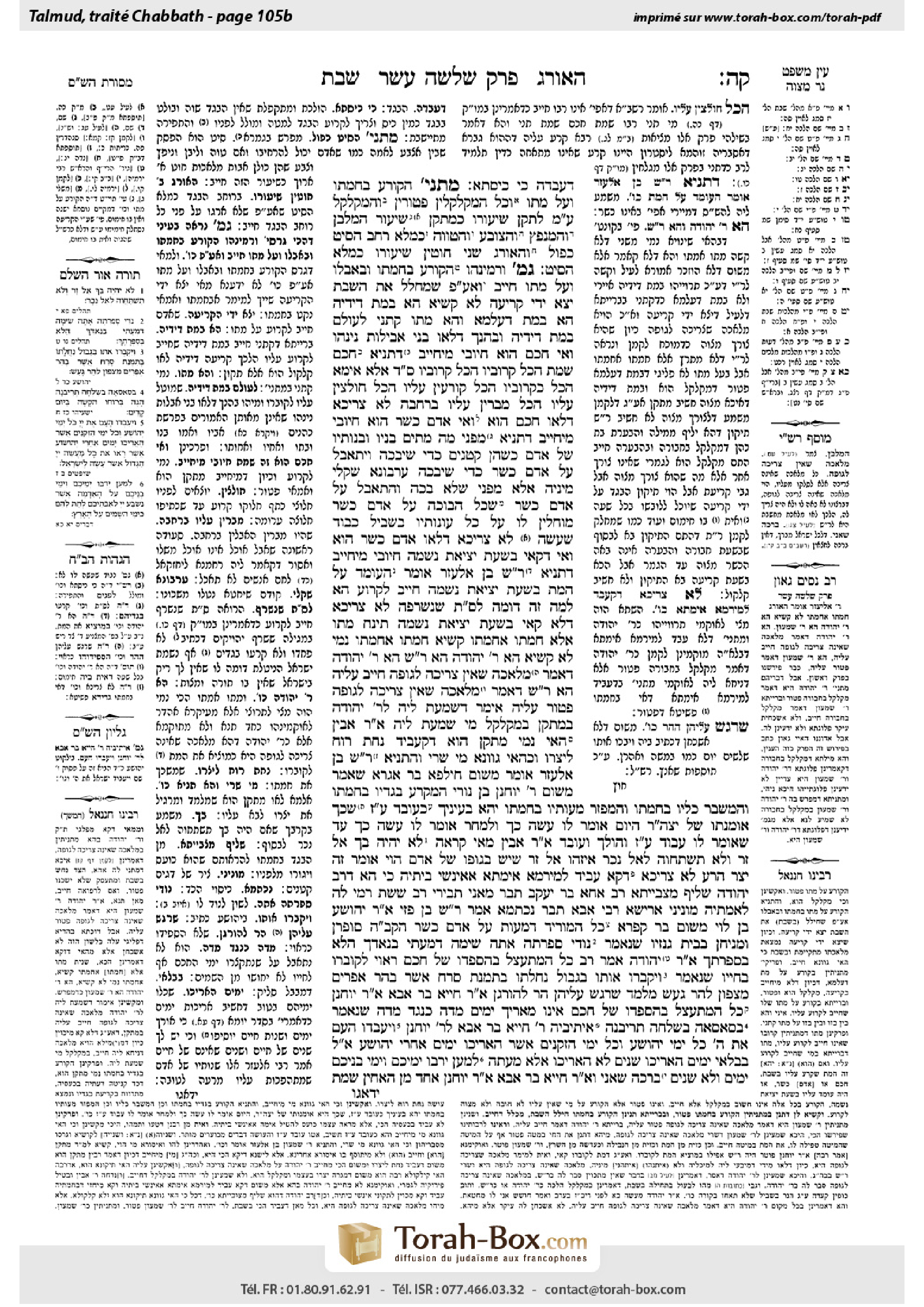
Shabbat 105b: Talmud study for Daf Yomi
Daf Yomi is the daily study of one Talmud folio. Explore 37 tractates with scans, Hebrew text, Sefaria English and AI-generated French translations where annotated.
Passage selection and English or AI-generated French translation are available where the scan has annotations. Daf Study is independent of Torah-Box and Sefaria.
Browse Shabbat · שבת · All tractatesShabbat 105b text and translations
This page of Shabbat includes the Aramaic text, an English translation and an AI-generated French translation, alongside the scan above.
שבת ק״ה ב · Aramaic and Hebrew text
דְּעַבְדַהּ כִּי כִיסְתָּא.
מַתְנִי׳ הַקּוֹרֵעַ בַּחֲמָתוֹ וְעַל מֵתוֹ, וְכׇל הַמְקַלְקְלִין — פְּטוּרִין. וְהַמְקַלְקֵל עַל מְנָת לְתַקֵּן — שִׁיעוּרוֹ כִּמְתַקֵּן. שִׁיעוּר הַמְלַבֵּן וְהַמְנַפֵּץ וְהַצּוֹבֵעַ וְהַטּוֹוֶה — כִּמְלֹא רֹחַב הַסִּיט כָּפוּל, וְהָאוֹרֵג שְׁנֵי חוּטִין — שִׁיעוּרוֹ כִּמְלֹא הַסִּיט.
גְּמָ׳ וּרְמִינְהוּ: הַקּוֹרֵעַ בַּחֲמָתוֹ וּבְאֶבְלוֹ וְעַל מֵתוֹ — חַיָּיב, וְאַף עַל פִּי שֶׁמְּחַלֵּל אֶת הַשַּׁבָּת, יָצָא יְדֵי קְרִיעָה! לָא קַשְׁיָא: הָא בְּמֵת דִּידֵיהּ, הָא בְּמֵת דְּעָלְמָא.
וְהָא ״מֵתוֹ״ קָתָנֵי! לְעוֹלָם בְּמֵת דִּידֵיהּ, וּבְהָנָךְ דְּלָאו בְּנֵי אֲבֵילוּת נִינְהוּ. וְאִי חָכָם הוּא — חַיּוֹבֵי מִיחַיַּיב, דְּתַנְיָא: חָכָם שֶׁמֵּת — הַכֹּל קְרוֹבָיו. הַכֹּל קְרוֹבָיו סָלְקָא דַּעְתָּךְ?! אֶלָּא אֵימָא: הַכֹּל כִּקְרוֹבָיו, הַכֹּל קוֹרְעִין עָלָיו, הַכֹּל חוֹלְצִין עָלָיו, הַכֹּל מַבְרִין עָלָיו בָּרְחָבָה. לָא צְרִיכָא, דְּלָאו חָכָם הוּא.
וְאִי אָדָם כָּשֵׁר הוּא חַיּוֹבֵי מִיחַיַּיב, דְּתַנְיָא: מִפְּנֵי מָה מֵתִים בָּנָיו וּבְנוֹתָיו שֶׁל אָדָם כְּשֶׁהֵן קְטַנִּים — כְּדֵי שֶׁיִּבְכֶּה וְיִתְאַבֵּל עַל אָדָם כָּשֵׁר. כְּדֵי שֶׁיִּבְכֶּה?! עֶרְבוֹנָא שָׁקְלִי מִינֵּיהּ?! אֶלָּא: מִפְּנֵי שֶׁלֹּא בָּכָה וְהִתְאַבֵּל עַל אָדָם כָּשֵׁר, שֶׁכׇּל הַבּוֹכֶה עַל אָדָם כָּשֵׁר מוֹחֲלִין לוֹ עַל כׇּל עֲוֹנוֹתָיו בִּשְׁבִיל כָּבוֹד שֶׁעָשָׂה. לָא צְרִיכָא, דְּלָאו אָדָם כָּשֵׁר הוּא.
וְאִי דְּקָאֵי בִּשְׁעַת יְצִיאַת נְשָׁמָה — חַיּוֹבֵי מִיחַיַּיב, דְּתַנְיָא: רַבִּי שִׁמְעוֹן בֶּן אֶלְעָזָר אוֹמֵר: הָעוֹמֵד עַל הַמֵּת בִּשְׁעַת יְצִיאַת נְשָׁמָה — חַיָּיב לִקְרוֹעַ, הָא לְמָה זֶה דּוֹמֶה — לְסֵפֶר תּוֹרָה שֶׁנִּשְׂרָף! לָא צְרִיכָא, דְּלָא קָאֵי בִּשְׁעַת יְצִיאַת נְשָׁמָה.
תִּינַח מֵתוֹ, אֶלָּא חֲמָתוֹ אַחֲמָתוֹ קַשְׁיָא! חֲמָתוֹ אַחֲמָתוֹ נָמֵי לָא קַשְׁיָא, הָא — רַבִּי יְהוּדָה, הָא — רַבִּי שִׁמְעוֹן. הָא רַבִּי יְהוּדָה, דְּאָמַר מְלָאכָה שֶׁאֵין צְרִיכָה לְגוּפָהּ — חַיָּיב עָלֶיהָ. הָא רַבִּי שִׁמְעוֹן, דְּאָמַר מְלָאכָה שֶׁאֵין צְרִיכָה לְגוּפָהּ — פָּטוּר עָלֶיהָ.
אֵימַר דְּשָׁמְעַתְּ לֵיהּ לְרַבִּי יְהוּדָה בִּמְתַקֵּן, בִּמְקַלְקֵל מִי שָׁמְעַתְּ לֵיהּ? אָמַר רַבִּי אָבִין: הַאי נָמֵי מְתַקַּן הוּא, דְּקָעָבֵיד נַחַת רוּחַ לְיִצְרוֹ. וּכְהַאי גַּוְונָא מִי שְׁרֵי? וְהָתַנְיָא, רַבִּי שִׁמְעוֹן בֶּן אֶלְעָזָר אוֹמֵר מִשּׁוּם חִילְפָא בַּר אַגְרָא שֶׁאָמַר מִשּׁוּם רַבִּי יוֹחָנָן בֶּן נוּרִי: הַמְקָרֵע בְּגָדָיו בַּחֲמָתוֹ, וְהַמְשַׁבֵּר כֵּלָיו בַּחֲמָתוֹ, וְהַמְפַזֵּר מְעוֹתָיו בַּחֲמָתוֹ, יְהֵא בְּעֵינֶיךָ כְּעוֹבֵד עֲבוֹדָה זָרָה. שֶׁכָּךְ אוּמָּנוּתוֹ שֶׁל יֵצֶר הָרָע: הַיּוֹם אוֹמֵר לוֹ עֲשֵׂה כָּךְ, וּלְמָחָר אוֹמֵר לוֹ עֲשֵׂה כָּךְ, עַד שֶׁאוֹמֵר לוֹ עֲבוֹד עֲבוֹדָה זָרָה וְהוֹלֵךְ וְעוֹבֵד. אָמַר רַבִּי אָבִין: מַאי קְרָאָה — ״לֹא יִהְיֶה בְךָ אֵל זָר וְלֹא תִשְׁתַּחֲוֶה לְאֵל נֵכָר״, אֵיזֶהוּ אֵל זָר שֶׁיֵּשׁ בְּגוּפוֹ שֶׁל אָדָם? הֱוֵי אוֹמֵר, זֶה יֵצֶר הָרָע.
לָא צְרִיכָא, דְּקָא עָבֵיד לְמִירְמָא אֵימְתָא אַאִינָשֵׁי בֵּיתֵיהּ. כִּי הָא דְּרַב יְהוּדָה שָׁלֵיף מְצָבְיָיתָא, רַב אַחָא בַּר יַעֲקֹב תָּבַר מָאנֵי תְּבִירֵי, רַב שֵׁשֶׁת רָמֵי לַהּ לְאַמְתֵּיהּ מוֹנִינֵי אַרֵישָׁא, רַבִּי אַבָּא תָּבַר נִכְתְּמָא.
אָמַר רַבִּי שִׁמְעוֹן בֶּן פַּזִּי, אָמַר רַבִּי יְהוֹשֻׁעַ בֶּן לֵוִי, מִשּׁוּם בַּר קַפָּרָא: כָּל הַמּוֹרִיד דְּמָעוֹת עַל אָדָם כָּשֵׁר, הַקָּדוֹשׁ בָּרוּךְ הוּא סוֹפְרָן וּמַנִּיחָן בְּבֵית גְּנָזָיו, שֶׁנֶּאֱמַר: ״נֹדִי סָפַרְתָּה אָתָּה שִׂימָה דִמְעָתִי בְנֹאדֶךָ הֲלֹא בְּסִפְרָתֶךָ״. אָמַר רַב יְהוּדָה אָמַר רַב: כׇּל הַמִּתְעַצֵּל בְּהֶסְפֵּדוֹ שֶׁל חָכָם — רָאוּי לְקוֹבְרוֹ בְּחַיָּיו, שֶׁנֶּאֱמַר: ״וַיִּקְבְּרוּ אוֹתוֹ בִּגְבוּל נַחֲלָתוֹ בְּתִמְנַת סֶרַח אֲשֶׁר בְּהַר אֶפְרָיִם מִצְּפוֹן לְהַר גָּעַשׁ״, מְלַמֵּד שֶׁרָגַשׁ עֲלֵיהֶן הַר לְהוֹרְגָן. אָמַר רַבִּי חִיָּיא בַּר אַבָּא אָמַר רַבִּי יוֹחָנָן: כׇּל הַמִּתְעַצֵּל בְּהֶסְפֵּדוֹ שֶׁל חָכָם, אֵינוֹ מַאֲרִיךְ יָמִים — מִדָּה כְּנֶגֶד מִדָּה, שֶׁנֶּאֱמַר: ״בְּסַאסְּאָה בְּשַׁלְּחָהּ תְּרִיבֶנָּה״.
אֵיתִיבֵיהּ רַבִּי חִיָּיא בַּר אַבָּא לְרַבִּי יוֹחָנָן: ״וַיַּעַבְדוּ הָעָם אֶת ה׳ כֹּל יְמֵי יְהוֹשֻׁעַ וְכֹל יְמֵי הַזְּקֵנִים אֲשֶׁר הֶאֱרִיכוּ יָמִים אַחֲרֵי יְהוֹשֻׁעַ״! אֲמַר לֵיהּ, בַּבְלַאי: יָמִים הֶאֱרִיכוּ, שָׁנִים לֹא הֶאֱרִיכוּ. אֶלָּא מֵעַתָּה: ״לְמַעַן יִרְבּוּ יְמֵיכֶם וִימֵי בְנֵיכֶם״ — יָמִים וְלֹא שָׁנִים? בְּרָכָה שָׁאנֵי.
וְאָמַר רַבִּי חִיָּיא בַּר אַבָּא אָמַר רַבִּי יוֹחָנָן: אֶחָד מִן הָאַחִין שֶׁמֵּת —
Shabbat 105b · English translation
The Gemara explains: It is found in a case where a pocketlike protrusion impedes sewing. Therefore, one tears the garment and tucks the protruding portion under the seam.
MISHNA: One who rends his garment in his anger or in anguish over his dead relative is exempt. And anyone else who performs labors destructively on Shabbat is exempt. And one who performs a labor destructively in order to repair is liable, and his measure for liability is equivalent to the measure for one who performs that labor constructively. The measure that determines liability for one who whitens, or one who combs, or one who dyes, or one who spins wool is the full width of a double sit, which is the distance between the forefinger and the middle finger. And for one who weaves two threads, the measure that determines liability is one sit.
GEMARA: We learned in the mishna: One who rends his garment in anger or in anguish over his dead relative is exempt. The Gemara raises a contradiction to this based on a baraita: One who rends his garment in his anger or in his mourning or in his anguish over his dead relative is liable for performing a prohibited labor on Shabbat. And even though he desecrates Shabbat by tearing his garment, he nevertheless fulfilled his obligation of rending his garment in mourning. Apparently, one is liable for rending his garment in anguish over the dead. The Gemara answers: This is not difficult, as this mishna, which states one is liable for rending his garment, is referring to his own dead relative for whom he is obligated to tear his garment. And that mishna, which states one is exempt for rending his garment, is referring to any unrelated dead person.
The Gemara asks: Didn’t we learn in the mishna: Over his dead relative? The Gemara answers: Actually, the mishna, which says that he is exempt, is referring to his own dead; however, it is referring to those relatives who are not subject to the obligation of mourning by Torah law. The Gemara asks: And even so, if the dead person is a Torah scholar, one is obligated to rend one’s garment in anguish over his death, as it was taught in a baraita: When a Torah scholar dies, everyone is his relative. The Gemara asks: Does it enter your mind that everyone is his relative? Rather, say: Everyone is considered to be like his relative, in the sense that everyone rends his garment in anguish over him, and everyone bares his shoulder over him in mourning, and everyone eats the mourner’s meal over him in the public square as mourners do. The death of a Torah scholar is a personal loss for every Jew. The Gemara answers: It was only necessary for the mishna to teach this halakha in a case where the dead person is not a Torah scholar.
The Gemara asks: And if he was an upright person, aren’t all those present at his death obligated to rend their garments over his death? As it was taught in a baraita: Why do a person’s sons and daughters die when they are young? They die so that he will cry and mourn over the death of an upright worthy person. The Gemara asks: They die so that he will cry? Is security taken from him in advance to ensure that he fulfills his obligation? Rather, emend the statement and say: It is because he did not cry or mourn over an upright person who died, as anyone who cries over an upright person who died, they forgive him for all his transgressions because of the honor he accorded to the deceased. Nevertheless, it is difficult, as one is required to rend his clothing over the death of an upright person. The Gemara answers: It was only necessary for the mishna to teach this halakha in a case where the deceased was not an upright person.
The Gemara asks: And if one is standing close to the deceased when the soul leaves the body, he is obligated to rend his garment, as it was taught in a baraita: Rabbi Shimon ben Elazar says: One who is standing over the deceased at the time of the departure of the soul is obligated to rend his garment. To what is this similar? It is similar to a Torah scroll that was burned. The Gemara answers: It was only necessary for the mishna to teach this halakha in a case where he is not standing there at the time of the departure of the soul.
The Gemara asks further: This works out well in terms of resolving the contradiction with regard to his dead relative. However, the contradiction between the ruling in the mishna that one who rends his garment in his anger is not liable, and the ruling in the baraita that one who rends his garment in his anger is liable, is still difficult. The mishna exempts one who rends garments in anger, while the baraita deems him liable. The Gemara answers: The contradiction between his anger in the mishna and his anger in the baraita is also not difficult, as this ruling in the baraita that deems him liable is in accordance with the opinion of Rabbi Yehuda, and that ruling in the mishna that exempts him is in accordance with the opinion of Rabbi Shimon. The Gemara elaborates: This ruling in the baraita follows Rabbi Yehuda, who said that one who performs a prohibited labor on Shabbat that is not needed for its own sake is liable for performing it. Therefore, one who rends his garment in anger is liable. That ruling in the mishna which exempts him is in accordance with the opinion of Rabbi Shimon, who said that one who performs a labor that is not needed for its own sake is exempt for performing it.
The Gemara asks: Say that you heard that Rabbi Yehuda rules that one is liable for performing a labor not needed for its own sake in the case of a constructive act; did you hear him deem one liable in the case of a destructive act? Rabbi Avin said: This case, where one rends his garment in anger, is also constructive, because in doing so he assuages his anger. Rending his garment calms him; therefore, it can be said that he derives benefit from the act of rending, and it is consequently a constructive act. The Gemara asks: And is it at all permitted to tear in that manner? Wasn’t it taught in a baraita that Rabbi Shimon ben Elazar says in the name of Ḥilfa bar Agra, who said in the name of Rabbi Yoḥanan ben Nuri: One who rends his garments in his anger, or who breaks his vessels in his anger, or who scatters his money in his anger, should be like an idol worshipper in your eyes, as that is the craft of the evil inclination. Today it tells him do this, and tomorrow it tells him do that, until eventually, when he no longer controls himself, it tells him worship idols and he goes and worships idols. Rabbi Avin said: What verse alludes to this? “There shall not be a strange god within you, and you shall not bow to a foreign god” (Psalms 81:10). What is the strange god that is within a person’s body? Say that it is the evil inclination. One may not rend his garments in anger, because in doing so he is deriving pleasure from satisfying the evil inclination.
The Gemara answers: It is only necessary to discuss this in a case where one does so to instill fear in the members of his household. In order to show them that he is very angry, he tears and breaks objects even though he is not that angry. In that case he maintains control of himself and is not in danger of succumbing to the evil inclination. It is like the incident where Rav Yehuda sought to display his anger and he pulled threads off his garment. Rav Aḥa bar Ya’akov smashed broken vessels, Rav Sheshet threw small fish on his maidservant’s head, and Rabbi Abba broke the lid of a jug. All of these Sages caused minimal damage in creating the impression that they were angry.
Apropos the laws of mourning for an upright person and a Torah scholar, the Gemara cites that which Rabbi Shimon ben Pazi said that Rabbi Yehoshua ben Levi said in the name of Bar Kappara: Anyone who sheds tears over an upright person, the Holy One, Blessed be He, counts his tears and places them in His treasury, as it is stated: “You have counted my wanderings, put my tears into your bottle, are they not in your book?” (Psalms 56:9). Rav Yehuda said that Rav said: Anyone who is lazy in eulogizing a Torah scholar, it is fitting to bury him alive, as it is stated: “And they buried him in the border of his inheritance in Timnat-seraḥ, which is in the hill-country of Ephraim, on the north of the mountain of Ga’ash” (Joshua 24:30). This teaches that the mountain raged against them to kill them because they did not eulogize him appropriately. Rabbi Ḥiyya bar Abba said that Rabbi Yoḥanan said: Whoever is lazy in eulogizing a Sage does not live a long life, and his punishment is measure for measure. Since he was unconcerned with the death of the Sage, in the heavens they will be unconcerned with his death. The Holy One, Blessed be He, conducts Himself in this manner, as it is stated: “In full measure [besase’a], when You send her away You contend with her” (Isaiah 27:8), and the Sages derived that God punishes from the words: “You contend with her,” and He does so measure for measure, se’a for se’a, from the word sase’a in the verse above.
Rabbi Ḥiyya bar Abba raised an objection to Rabbi Yoḥanan: It is stated: “And the nation worshipped the Lord all the days of Joshua and all the days of the Elders, who lived many days after Joshua” (Judges 2:7), indicating that the Elders lived long lives even though they did not eulogize Joshua properly. Rabbi Yoḥanan said to him: Babylonian, you should be more precise in your reading. They indeed lived many days; however, they did not live many years. In fact, they did not live to the end of that year. Again he asked: But then with regard to the verse “So that your days and the days of your children will multiply on the land which the Lord your God swore to give to your fathers, as the days of the heavens over the earth” (Deuteronomy 11:21), would you also say that here the reward is to live many days but not years? He answered him: A blessing is different and should be interpreted in its most expansive sense.
And Rabbi Ḥiyya bar Abba said that Rabbi Yoḥanan said: If one of the brothers dies,
Shabbat 105b · Traduction française (IA)
La Guemara explique : Il s’agit d’un cas où une saillie en forme de poche gêne la couture. On déchire donc le vêtement et l’on glisse la partie saillante sous la couture.
MICHNA : Celui qui déchire son vêtement sous l’effet de la colère ou dans le chagrin causé par la mort d’un proche est exempt. Quiconque accomplit d’autres travaux de manière destructrice le Chabbat est exempt. En revanche, celui qui accomplit un travail de manière destructrice afin de réparer est passible ; la mesure qui le rend passible est la même que celle qui s’applique à celui qui accomplit ce travail de manière constructive. La mesure qui rend passible celui qui blanchit, peigne, teint ou file de la laine est la largeur d’un double sit, c’est-à-dire la distance entre l’index et le majeur. Pour celui qui tisse deux fils, la mesure qui le rend passible est un sit.
GUEMARA : Nous avons appris dans la Michna : Celui qui déchire son vêtement sous l’effet de la colère ou dans le chagrin causé par la mort d’un proche est exempt. La Guemara soulève une contradiction à partir d’une baraïta : Celui qui déchire son vêtement sous l’effet de la colère, pendant son deuil ou dans le chagrin causé par la mort d’un proche est passible d’avoir accompli un travail interdit le Chabbat. Bien qu’il profane le Chabbat en déchirant son vêtement, il s’est néanmoins acquitté de son obligation de déchirer son vêtement en signe de deuil. Il semble donc que l’on soit passible lorsqu’on déchire son vêtement dans le chagrin causé par la mort d’un proche. La Guemara répond : Il n’y a pas de difficulté, car cette Michna, qui dit qu’il est passible d’avoir déchiré son vêtement, parle de la mort de son propre proche, pour lequel il est tenu de déchirer son vêtement. L’autre Michna, qui dit qu’il est exempt d’avoir déchiré son vêtement, parle de la mort de quelqu’un qui ne lui est pas apparenté.
La Guemara demande : N’avons-nous pas appris dans la Michna : « son proche » ? La Guemara répond : En réalité, la Michna qui dit qu’il est exempt parle de la mort de l’un de ses propres proches ; toutefois, il s’agit de proches pour lesquels la Torah n’impose pas d’obligation de deuil. La Guemara demande : Et malgré cela, si le défunt est un érudit de la Torah, n’est-on pas tenu de déchirer son vêtement dans le chagrin causé par sa mort, comme il a été enseigné dans une baraïta : Quand un érudit de la Torah meurt, tout le monde est son proche. La Guemara demande : Peut-on penser que tout le monde est son proche ? Il faut plutôt dire : Tout le monde est considéré comme son proche, en ce sens que chacun déchire son vêtement dans le chagrin causé par sa mort, découvre son épaule en signe de deuil et prend le repas des endeuillés en son honneur sur la place publique, comme le font les endeuillés. La mort d’un érudit de la Torah est une perte personnelle pour chaque Juif. La Guemara répond : La Michna devait seulement enseigner cette halakha dans le cas où le défunt n’est pas un érudit de la Torah.
La Guemara demande : Et s’il s’agissait d’un homme intègre, toutes les personnes présentes au moment de sa mort ne sont-elles pas tenues de déchirer leur vêtement à cause de son décès ? Comme il a été enseigné dans une baraïta : Pourquoi les fils et les filles d’un homme meurent-ils jeunes ? Ils meurent afin qu’il pleure et porte le deuil d’un homme intègre et digne qui est décédé. La Guemara demande : Ils meurent pour qu’il pleure ? Lui prend-on une garantie à l’avance afin de s’assurer qu’il s’acquitte de son obligation ? Il faut plutôt corriger l’énoncé et dire : C’est parce qu’il n’a pas pleuré ni porté le deuil d’un homme intègre qui est mort ; car quiconque pleure la mort d’un homme intègre voit toutes ses transgressions pardonnées, en raison de l’honneur qu’il a rendu au défunt. Néanmoins, la difficulté demeure, car il faut déchirer son vêtement à la mort d’un homme intègre. La Guemara répond : La Michna devait seulement enseigner cette halakha dans le cas où le défunt n’était pas un homme intègre.
La Guemara demande : Et si l’on se tient près du défunt au moment où son âme quitte son corps, on est tenu de déchirer son vêtement, comme il a été enseigné dans une baraïta : Rabbi Shimon ben Elazar dit : Celui qui se tient auprès du défunt au moment où son âme quitte son corps est tenu de déchirer son vêtement. À quoi cela ressemble-t-il ? À un rouleau de Torah qui a été brûlé. La Guemara répond : La Michna devait seulement enseigner cette halakha dans le cas où il ne se tenait pas là au moment où l’âme quittait le corps du défunt.
La Guemara demande encore : Cela permet de résoudre la contradiction concernant la mort de son proche. Cependant, la contradiction entre la décision de la Michna selon laquelle celui qui déchire son vêtement sous l’effet de la colère n’est pas passible et celle de la baraïta selon laquelle il l’est demeure difficile. La Michna exempte celui qui déchire son vêtement sous l’effet de la colère, tandis que la baraïta le déclare passible. La Guemara répond : Il n’y a pas non plus de difficulté entre la colère dont parle la Michna et celle dont parle la baraïta, car la décision de la baraïta qui le déclare passible est conforme à l’opinion de Rabbi Yehuda, tandis que celle de la Michna qui l’exempte est conforme à l’opinion de Rabbi Shimon. La Guemara précise : La décision de la baraïta suit Rabbi Yehuda, qui dit que celui qui accomplit le Chabbat un travail qui n’est pas requis pour lui-même est passible. Par conséquent, celui qui déchire son vêtement sous l’effet de la colère est passible. La décision de la Michna qui l’exempte est conforme à l’opinion de Rabbi Shimon, qui dit que celui qui accomplit un travail qui n’est pas requis pour lui-même en est exempt.
La Guemara demande : Tu as entendu Rabbi Yehuda déclarer passible celui qui accomplit un travail qui n’est pas requis pour lui-même dans le cas d’un acte constructif ; l’as-tu entendu le déclarer passible dans le cas d’un acte destructeur ? Rav Avin dit : Le cas de celui qui déchire son vêtement sous l’effet de la colère est lui aussi constructif, car il apaise ainsi sa colère. Déchirer son vêtement le calme ; on peut donc dire qu’il tire profit de l’acte de déchirer, qui est par conséquent constructif. La Guemara demande : Et est-il permis de déchirer de cette manière ? N’a-t-il pas été enseigné dans une baraïta que Rabbi Shimon ben Elazar dit au nom de Ḥilfa bar Agra, qui l’a dit au nom de Rabbi Yoḥanan ben Nuri : Celui qui déchire ses vêtements sous l’effet de la colère, brise ses objets sous l’effet de la colère ou disperse son argent sous l’effet de la colère doit être à vos yeux comme un idolâtre, car telle est l’œuvre du mauvais penchant. Aujourd’hui, il lui dit : « Fais ceci », et demain : « Fais cela », jusqu’à ce que, finalement, lorsqu’il ne se maîtrise plus, il lui dise d’adorer des idoles, et il va les adorer. Rav Avin dit : Quel verset y fait allusion ? « Qu’il n’y ait pas en toi de dieu étranger, et ne te prosterne pas devant un dieu étranger » (Psaumes 81:10). Quel est le dieu étranger qui se trouve à l’intérieur du corps d’une personne ? Il faut dire que c’est le mauvais penchant. On ne doit pas déchirer ses vêtements sous l’effet de la colère, car on prend ainsi plaisir à satisfaire le mauvais penchant.
La Guemara répond : Il faut seulement parler du cas où l’on agit ainsi pour inspirer la crainte aux membres de son foyer. Pour leur montrer qu’on est très en colère, on déchire et brise des objets alors qu’on n’est pas si en colère. Dans ce cas, on garde le contrôle de soi et on ne risque pas de succomber au mauvais penchant. Cela rappelle l’incident où Rav Yehuda voulut manifester sa colère et arracha des fils de son vêtement. Rav Aḥa bar Ya’akov brisa des objets déjà cassés, Rav Sheshet jeta de petits poissons sur la tête de sa servante et Rabbi Abba brisa le couvercle d’une cruche. Tous ces Sages causèrent des dégâts minimes pour donner l’impression qu’ils étaient en colère.
À propos des lois du deuil d’un homme intègre et d’un érudit de la Torah, la Guemara rapporte ce que Rabbi Shimon ben Pazi a dit au nom de Rabbi Yehoshua ben Levi, au nom de Bar Kappara : Quiconque verse des larmes pour un homme intègre, le Saint, béni soit-Il, compte ses larmes et les dépose dans Son trésor, comme il est dit : « Tu as compté mes errances, mets mes larmes dans ton outre ; ne sont-elles pas dans ton livre ? » (Psaumes 56:9). Rav Yehuda a dit au nom de Rav : Quiconque néglige de faire l’éloge funèbre d’un érudit de la Torah mérite d’être enterré vivant, comme il est dit : « On l’enterra dans le territoire de son héritage, à Timnat-Sérah, dans la montagne d’Éphraïm, au nord du mont Gaash » (Josué 24:30). Cela enseigne que la montagne se déchaîna contre eux pour les tuer, parce qu’ils n’avaient pas fait son éloge funèbre comme il convenait. Rabbi Ḥiyya bar Abba a dit au nom de Rabbi Yoḥanan : Quiconque néglige de faire l’éloge funèbre d’un Sage ne vit pas longtemps, et sa punition est mesure pour mesure. Puisqu’il ne s’est pas soucié de la mort du Sage, au Ciel on ne se souciera pas de sa mort. Le Saint, béni soit-Il, agit ainsi, comme il est dit : « En pleine mesure [besase’a], lorsqu’elle est renvoyée, Tu la contestes » (Isaïe 27:8). Les Sages déduisent que Dieu punit à partir des mots « Tu la contestes » et qu’Il le fait mesure pour mesure, séa pour séa, à partir du mot sase’a dans le verset ci-dessus.
Rabbi Ḥiyya bar Abba souleva une objection à Rabbi Yoḥanan : Il est dit : « Le peuple servit le Seigneur tous les jours de Josué et tous les jours des Anciens qui vécurent de nombreux jours après Josué » (Juges 2:7), ce qui indique que les Anciens vécurent longtemps, alors qu’ils n’avaient pas fait l’éloge funèbre de Josué comme il convenait. Rabbi Yoḥanan lui dit : Babylonien, tu devrais lire avec plus de précision. Ils vécurent en effet de nombreux jours ; toutefois, ils ne vécurent pas de nombreuses années. En fait, ils ne vécurent pas jusqu’à la fin de cette année-là. Il demanda encore : Mais alors, à propos du verset « Afin que vos jours et les jours de vos enfants se multiplient sur la terre que le Seigneur votre Dieu a juré de donner à vos pères, comme les jours des cieux au-dessus de la terre » (Deutéronome 11:21), dirais-tu aussi que la récompense consiste à vivre de nombreux jours, mais pas de nombreuses années ? Il lui répondit : Une bénédiction est différente et doit être interprétée dans son sens le plus large.
Et Rabbi Ḥiyya bar Abba a dit au nom de Rabbi Yoḥanan : Si l’un des frères meurt,
Traduction française générée par IA à partir de l’édition anglaise de Sefaria. Vérifie toujours un passage avec le texte source.
Text from Sefaria: William Davidson Edition - Vocalized Aramaic (CC BY NC); William Davidson Edition - English (CC BY NC).