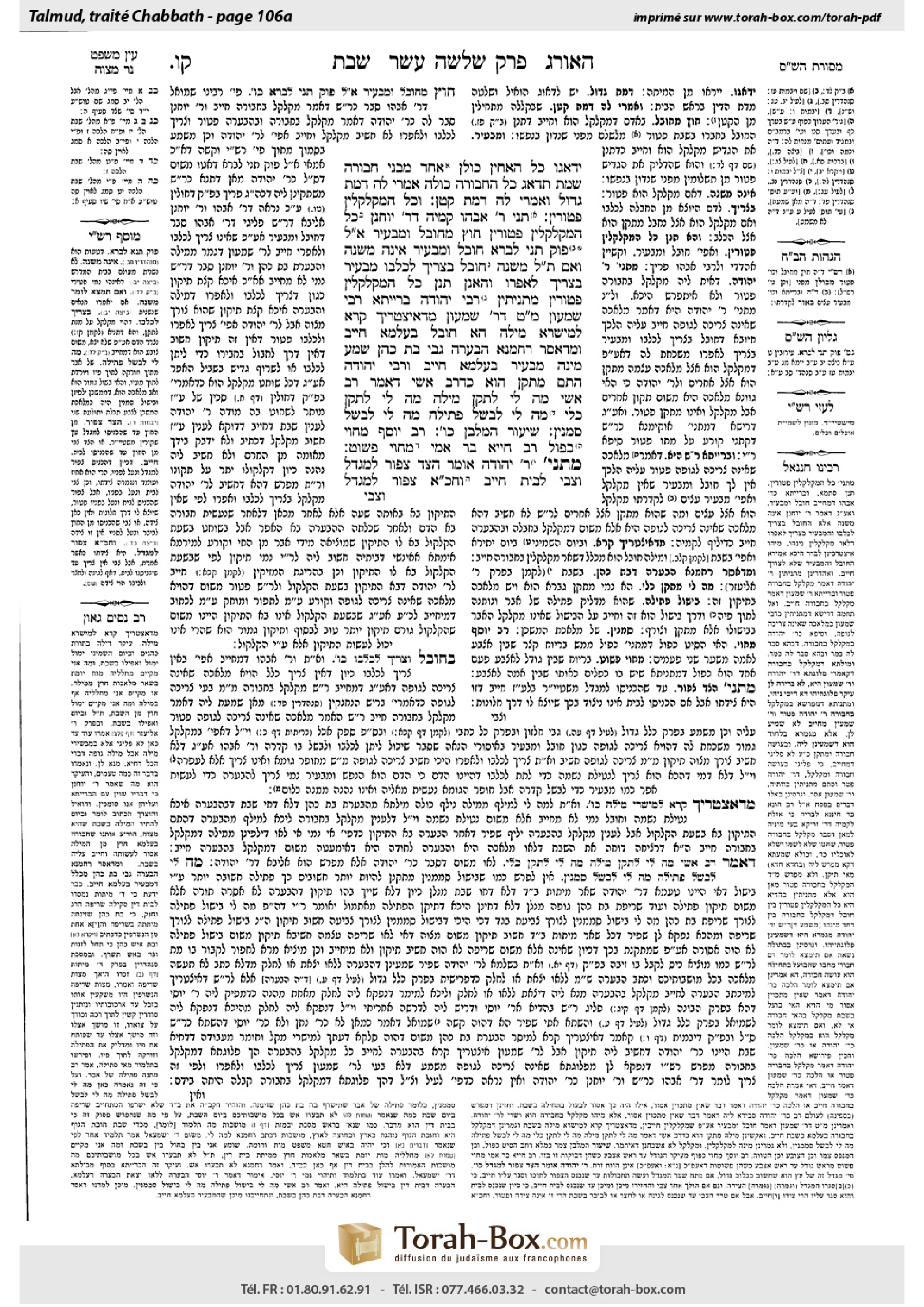
Shabbat 106a: Talmud study for Daf Yomi
Daf Yomi is the daily study of one Talmud folio. Explore 37 tractates with scans, Hebrew text, Sefaria English and AI-generated French translations where annotated.
Passage selection and English or AI-generated French translation are available where the scan has annotations. Daf Study is independent of Torah-Box and Sefaria.
Browse Shabbat · שבת · All tractatesShabbat 106a text and translations
This page of Shabbat includes the Aramaic text, an English translation and an AI-generated French translation, alongside the scan above.
שבת ק״ו א · Aramaic and Hebrew text
יִדְאֲגוּ כׇּל הָאַחִין כּוּלָּן. אֶחָד מִבְּנֵי חֲבוּרָה שֶׁמֵּת — תִּדְאַג כָּל הַחֲבוּרָה כּוּלָּהּ. אָמְרִי לַהּ דְּמֵת גָּדוֹל, וְאָמְרִי לַהּ דְּמֵת קָטָן.
וְכׇל הַמְקַלְקְלִין פְּטוּרִין. תָּנֵי רַבִּי אֲבָהוּ קַמֵּיהּ דְּרַבִּי יוֹחָנָן: כׇּל הַמְקַלְקְלִין פְּטוּרִין חוּץ מֵחוֹבֵל וּמַבְעִיר. אֲמַר לֵיהּ: פּוֹק תָּנֵי לְבַרָּא, חוֹבֵל וּמַבְעִיר אֵינָהּ מִשְׁנָה. וְאִם תִּמְצָא לוֹמַר מִשְׁנָה — חוֹבֵל בְּצָרִיךְ לְכַלְבּוֹ, מַבְעִיר בְּצָרִיךְ לְאֶפְרוֹ.
וְהָאֲנַן תְּנַן: כׇּל הַמְקַלְקְלִין פְּטוּרִין! מַתְנִיתִין רַבִּי יְהוּדָה, בָּרָיְיתָא רַבִּי שִׁמְעוֹן. מַאי טַעְמָא דְּרַבִּי שִׁמְעוֹן: מִדְּאִיצְטְרִיךְ קְרָא לְמִישְׁרֵא מִילָה, הָא חוֹבֵל בְּעָלְמָא חַיָּיב.
וּמִדַּאֲסַר רַחֲמָנָא הַבְעָרָה גַּבֵּי בַּת כֹּהֵן, שְׁמַע מִינַּהּ מַבְעִיר בְּעָלְמָא חַיָּיב.
וְרַבִּי יְהוּדָה? הָתָם — מְתַקֵּן הוּא, כִּדְרַב אָשֵׁי. דְּאָמַר רַב אָשֵׁי: מַה לִּי לְתַקֵּן מִילָּה, מַה לִּי לְתַקֵּן כְּלִי. מַה לִּי לְבַשֵּׁל פְּתִילָה, מַה לִּי לְבַשֵּׁל סַמָּנִין.
שִׁיעוּר הַמְלַבֵּן כּוּ׳. רַב יוֹסֵף מַחְוֵי כָּפוּל, רַב חִיָּיא בַּר אַמֵּי מַחְוֵי פָּשׁוּט.
מַתְנִי׳ רַבִּי יְהוּדָה אוֹמֵר: הַצָּד צִפּוֹר לַמִּגְדָּל, וּצְבִי לַבַּיִת — חַיָּיב. וַחֲכָמִים אוֹמְרִים: צִפּוֹר לַמִּגְדָּל
Shabbat 106a · English translation
all of the brothers should be concerned, lest their death be approaching. Similarly, if one member of a group dies, the entire group should be concerned. Some say the concern is greatest if the eldest dies. If he, despite his virtues, could not avoid punishment, others will certainly not be saved. And some say the concern is greatest if the youngest dies, because the least significant people are punished first, and perhaps this is the start of a punishment for the entire group.
We learned in the mishna: And anyone who performs labors destructively on Shabbat is exempt. Rabbi Abbahu taught this baraita before Rabbi Yoḥanan: Anyone who performs labors destructively on Shabbat is exempt, except for one who inflicts a wound or kindles a fire. Rabbi Yoḥanan said to him: Go teach that outside. This baraita is not fit for discussion in the study hall. The opinion that deems one liable for inflicting a wound or kindling a fire on Shabbat is not an accepted teaching and should be ignored. And if you want to say that it is a legitimate teaching, one who inflicts a wound would only be liable in a case where he needed the blood to give to his dog, and one who kindles a fire would only be liable in a case where he needs its ashes.
The Gemara asks: How could Rabbi Abbahu teach this baraita? Didn’t we learn explicitly in the mishna: Anyone who performs labors destructively on Shabbat is exempt, including one who inflicts a wound or who kindles a fire? The Gemara answers: In his opinion, the mishna is in accordance with the opinion of Rabbi Yehuda, who deems one liable for performing labor which is not needed for its own sake, whereas the baraita is in accordance with the opinion of Rabbi Shimon, who exempts in that case. The Gemara explains: What is the reason that Rabbi Shimon deems one who inflicts a wound or kindles a fire on Shabbat liable even though these are destructive acts? From the fact that a verse was necessary to permit circumcision on Shabbat, by inference, in general, one who inflicts a wound is liable. If inflicting a wound was not prohibited on Shabbat, there would be no need to permit circumcision.
Similarly, from the fact that the Torah prohibited kindling a fire on Shabbat even with regard to the execution by burning of a priest’s daughter who committed adultery, conclude from it that in general, one who ignites a fire on Shabbat is liable.
The Gemara asks: And how does Rabbi Yehuda address this proof? The Gemara answers: There, that is a case of a constructive labor in accordance with the explanation of Rav Ashi. For Rav Ashi said: What difference is there to me between repairing the child through circumcision and repairing a vessel? They are both constructive acts. And what difference is there to me between cooking a lead wick, as a melted lead wick was poured down the throat of the criminal sentenced to execution by burning, and cooking herbs used to produce dyes in the Tabernacle? The Torah addressed these cases specifically because they are constructive, and nothing can be derived from them with regard to liability for performance of destructive labors.
We learned in the mishna: The measure that determines liability for one who whitens and for similar prohibited labors is the full width of a double sit. Rav Yosef would demonstrate the width of a double sit by indicating the distance between the index and middle fingers and instructing the onlookers to double the measure. Rabbi Ḥiyya bar Ami would demonstrate in a simple manner, as he calculated that the distance between the thumb and the forefinger is equal to a double sit.
MISHNA: Rabbi Yehuda says: One who traps a bird into a closet or cage, and one who traps a deer into a house is liable. The Rabbis say: One is liable for trapping a bird into a closet
Shabbat 106a · Traduction française (IA)
Tous les frères doivent craindre que leur mort ne soit proche. De même, si un membre d’un groupe meurt, tout le groupe doit s’inquiéter. Certains disent que l’inquiétude est plus grande lorsque c’est l’aîné qui meurt : s’il n’a pas pu éviter le châtiment malgré ses mérites, les autres ne seront certainement pas épargnés. D’autres disent que l’inquiétude est plus grande lorsque c’est le plus jeune qui meurt, car les personnes les moins importantes sont punies les premières ; peut-être est-ce le début d’un châtiment visant tout le groupe.
Nous avons appris dans la Michna : quiconque accomplit des travaux de manière destructive le Chabbat est exempt. Rabbi Abbahou enseigna cette baraïta devant Rabbi Yoḥanan : quiconque accomplit des travaux de manière destructive le Chabbat est exempt, à l’exception de celui qui inflige une blessure ou allume un feu. Rabbi Yoḥanan lui dit : « Va enseigner cela ailleurs. » Cette baraïta n’a pas sa place dans la maison d’étude. L’avis qui rend passible celui qui inflige une blessure ou allume un feu le Chabbat n’est pas un enseignement admis et doit être écarté. Et si tu veux dire qu’il s’agit d’un enseignement valable, celui qui inflige une blessure ne serait passible que s’il a besoin du sang pour le donner à son chien, et celui qui allume un feu ne serait passible que s’il a besoin des cendres.
La Guemara demande : comment Rabbi Abbahou a-t-il pu enseigner cette baraïta ? N’avons-nous pas appris explicitement dans la Michna : quiconque accomplit des travaux de manière destructive le Chabbat est exempt, y compris celui qui inflige une blessure ou allume un feu ? La Guemara répond : selon lui, la Michna suit l’avis de Rabbi Yehouda, qui rend passible celui qui accomplit un travail qui n’est pas nécessaire en soi, tandis que la baraïta suit l’avis de Rabbi Shimon, qui l’en exempte dans ce cas. La Guemara explique : pour quelle raison Rabbi Shimon rend-il passible celui qui inflige une blessure ou allume un feu le Chabbat, bien qu’il s’agisse d’actes destructeurs ? Du fait qu’un verset était nécessaire pour autoriser la circoncision le Chabbat, on déduit qu’en règle générale, celui qui inflige une blessure est passible. Si infliger une blessure n’était pas interdit le Chabbat, il ne serait pas nécessaire d’autoriser la circoncision.
De même, du fait que la Torah a interdit d’allumer un feu le Chabbat, même pour l’exécution par le feu de la fille d’un prêtre qui a commis l’adultère, conclus qu’en règle générale, celui qui allume un feu le Chabbat est passible.
La Guemara demande : et comment Rabbi Yehouda répond-il à cette preuve ? La Guemara répond : dans ce cas, il s’agit d’un travail constructif, conformément à l’explication de Rav Ashi. Car Rav Ashi a dit : quelle différence y a-t-il pour moi entre réparer l’enfant par la circoncision et réparer un ustensile ? Ce sont dans les deux cas des actes constructifs. Et quelle différence y a-t-il pour moi entre faire cuire une mèche de plomb — car du plomb fondu était versé dans la gorge du condamné à être exécuté par le feu — et faire cuire des herbes servant à produire les teintures dans le Tabernacle ? La Torah a spécifiquement mentionné ces cas parce qu’ils sont constructifs ; on ne peut rien en déduire quant à la responsabilité pour l’accomplissement de travaux destructeurs.
Nous avons appris dans la Michna : la mesure qui détermine la responsabilité de celui qui blanchit, ainsi que pour les travaux interdits similaires, est la largeur d’un double sit. Rav Yossef montrait la largeur d’un double sit en indiquant la distance entre l’index et le majeur, puis en demandant aux spectateurs de doubler cette mesure. Rabbi Ḥiyya bar Ami la montrait simplement, car il estimait que la distance entre le pouce et l’index équivaut à un double sit.
MICHNA : Rabbi Yehouda dit : celui qui piège un oiseau dans un placard ou une cage, et celui qui piège un cerf dans une maison, est passible. Les Sages disent : on est passible pour avoir piégé un oiseau dans un placard
Traduction française générée par IA à partir de l’édition anglaise de Sefaria. Vérifie toujours un passage avec le texte source.
Text from Sefaria: William Davidson Edition - Vocalized Aramaic (CC BY NC); William Davidson Edition - English (CC BY NC).