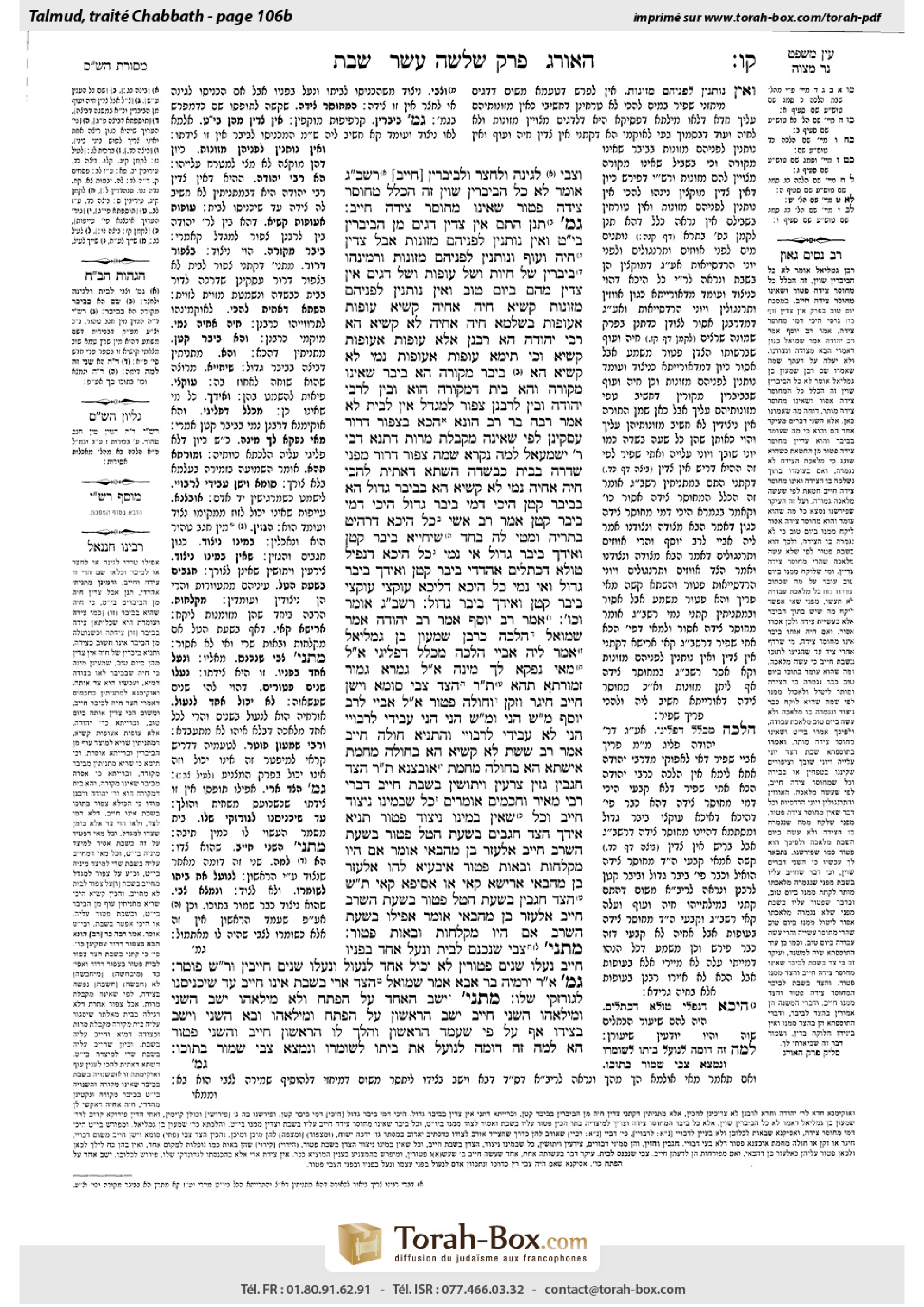
Shabbat 106b: Talmud study for Daf Yomi
Daf Yomi is the daily study of one Talmud folio. Explore 37 tractates with scans, Hebrew text, Sefaria English and AI-generated French translations where annotated.
Passage selection and English or AI-generated French translation are available where the scan has annotations. Daf Study is independent of Torah-Box and Sefaria.
Browse Shabbat · שבת · All tractatesShabbat 106b text and translations
This page of Shabbat includes the Aramaic text, an English translation and an AI-generated French translation, alongside the scan above.
שבת ק״ו ב · Aramaic and Hebrew text
וּצְבִי לַגִּינָּה וְלֶחָצֵר וְלַבֵּיבָרִין — [חַיָּיב]. רַבָּן שִׁמְעוֹן בֶּן גַּמְלִיאֵל אוֹמֵר: לֹא כָּל הַבֵּיבָרִין שָׁוִין. זֶה הַכְּלָל: מְחוּסָּר צִידָה — פָּטוּר, שֶׁאֵינוֹ מְחוּסָּר צִידָה — חַיָּיב.
גְּמָ׳ תְּנַן הָתָם: אֵין צָדִין דָּגִים מִן הַבֵּיבָרִין בְּיוֹם טוֹב, וְאֵין נוֹתְנִין לִפְנֵיהֶם מְזוֹנוֹת. אֲבָל צָדִין חַיָּה וָעוֹף, וְנוֹתְנִין לִפְנֵיהֶם מְזוֹנוֹת. וּרְמִינְהוּ: בֵּיבָרִין שֶׁל חַיּוֹת וְשֶׁל עוֹפוֹת וְשֶׁל דָּגִים — אֵין צָדִין מֵהֶם בְּיוֹם טוֹב, וְאֵין נוֹתְנִין לִפְנֵיהֶם מְזוֹנוֹת. קַשְׁיָא חַיָּה אַחַיָּה, קַשְׁיָא עוֹפוֹת אַעוֹפוֹת.
בִּשְׁלָמָא חַיָּה אַחַיָּה לָא קַשְׁיָא: הָא רַבִּי יְהוּדָה, הָא רַבָּנַן.
אֶלָּא עוֹפוֹת אַעוֹפוֹת קַשְׁיָא! וְכִי תֵּימָא, עוֹפוֹת אַעוֹפוֹת נָמֵי לָא קַשְׁיָא: הָא בֵּיבָר מְקוֹרֶה, הָא בֵּיבָר שֶׁאֵינוֹ מְקוֹרֶה — וְהָא בַּיִת דִּמְקוֹרֶה הוּא, וּבֵין לְרַבִּי יְהוּדָה וּבֵין לְרַבָּנַן צִפּוֹר לַמִּגְדָּל — אִין, לַבַּיִת — לָא!
אָמַר רַבָּה בַּר רַב הוּנָא: הָכָא בְּצִפּוֹר דְּרוֹר עָסְקִינַן, לְפִי שֶׁאֵינָהּ מְקַבֶּלֶת מָרוּת. דְּתָנָא דְּבֵי רַבִּי יִשְׁמָעֵאל: לָמָּה נִקְרָא שְׁמָהּ ״צִפּוֹר דְּרוֹר״ — מִפְּנֵי שֶׁדָּרָה בַּבַּיִת כְּבַשָּׂדֶה. הַשְׁתָּא דְּאָתֵית לְהָכִי — חַיָּה אַחַיָּה נָמֵי לָא קַשְׁיָא, הָא בְּבֵיבָר גָּדוֹל, הָא בְּבֵיבָר קָטָן.
הֵיכִי דָּמֵי בֵּיבָר גָּדוֹל, הֵיכִי דָּמֵי בֵּיבָר קָטָן? אָמַר רַב אָשֵׁי: כׇּל הֵיכָא דְּרָהֵיט בָּתְרֵיהּ וּמָטֵי לֵהּ בְּחַד שִׁיחְיָיא — בֵּיבָר קָטָן, וְאִידַּךְ — בֵּיבָר גָּדוֹל. אִי נָמֵי: כׇּל הֵיכָא דְּנָפֵיל טוּלָּא דִכְתָלִים אַהֲדָדֵי — בֵּיבָר קָטָן, וְאִידַּךְ — בֵּיבָר גָּדוֹל. וְאִי נָמֵי: כׇּל הֵיכָא דְּלֵיכָּא עוּקְצֵי עוּקְצֵי — בֵּיבָר קָטָן, וְאִידַּךְ — בֵּיבָר גָּדוֹל.
רַבָּן שִׁמְעוֹן בֶּן גַּמְלִיאֵל אוֹמֵר וְכוּ׳. אָמַר רַב יוֹסֵף אָמַר רַב יְהוּדָה אָמַר שְׁמוּאֵל: הֲלָכָה כְּרַבָּן שִׁמְעוֹן בֶּן גַּמְלִיאֵל. אֲמַר לֵיהּ אַבָּיֵי: הֲלָכָה, מִכְּלָל דִּפְלִיגִי? אֲמַר לֵיהּ מַאי נָפְקָא לָךְ מִינַּהּ? אֲמַר לֵיהּ גְּמָרָא גְּמוֹר זְמוֹרְתָּא תְּהֵא?
תָּנוּ רַבָּנַן: הַצָּד צְבִי סוֹמֵא וְיָשֵׁן — חַיָּיב. חִיגֵּר, וְזָקֵן וְחוֹלֶה — פָּטוּר. אֲמַר לֵיהּ אַבָּיֵי לְרַב יוֹסֵף: מַאי שְׁנָא הָנֵי, וּמַאי שְׁנָא הָנֵי? הָנֵי עֲבִידִי לְרַבּוֹיֵי, הָנֵי לָא עֲבִידִי לְרַבּוֹיֵי. וְהָתַנְיָא: חוֹלֶה חַיָּיב! אָמַר רַב שֵׁשֶׁת, לָא קַשְׁיָא: הָא בְּחוֹלֶה מֵחֲמַת אִישָּׁתָא, הָא בְּחוֹלֶה מֵחֲמַת אוּבְצָנָא.
תָּנוּ רַבָּנַן: הַצָּד חֲגָבִין, גַּזִּין, צְרָעִין וְיַתּוּשִׁין בְּשַׁבָּת — חַיָּיב, דִּבְרֵי רַבִּי מֵאִיר. וַחֲכָמִים אוֹמְרִים: כׇּל שֶׁבְּמִינוֹ נִיצּוֹד — חַיָּיב, וְכֹל שֶׁאֵין בְּמִינוֹ נִיצּוֹד — פָּטוּר. תַּנְיָא אִידַּךְ: הַצָּד חֲגָבִים בִּשְׁעַת הַטַּל — פָּטוּר, בִּשְׁעַת הַשָּׁרָב — חַיָּיב. אֶלְעָזָר בֶּן מַהֲבַאי אוֹמֵר: אִם הָיוּ מְקַלְּחוֹת וּבָאוֹת — פָּטוּר. אִיבַּעְיָא לְהוּ: אֶלְעָזָר בֶּן מַהֲבַאי אַרֵישָׁא קָאֵי, אוֹ אַסֵּיפָא קָאֵי? תָּא שְׁמַע: הַצָּד חֲגָבִין בִּשְׁעַת הַטַּל — פָּטוּר, בִּשְׁעַת הַשָּׁרָב — חַיָּיב, אֶלְעָזָר בֶּן מַהֲבַאי אוֹמֵר: אֲפִילּוּ בִּשְׁעַת הַשָּׁרָב, אִם הָיוּ מְקַלְּחוֹת וּבָאוֹת — פָּטוּר.
מַתְנִי׳ צְבִי שֶׁנִּכְנַס לַבַּיִת וְנָעַל אֶחָד בְּפָנָיו — חַיָּיב. נָעֲלוּ שְׁנַיִם — פְּטוּרִין. לֹא יָכוֹל אֶחָד לִנְעוֹל וְנָעֲלוּ שְׁנַיִם — חַיָּיבִין. וְרַבִּי שִׁמְעוֹן פּוֹטֵר.
גְּמָ׳ אָמַר רַבִּי יִרְמְיָה בַּר אַבָּא אָמַר שְׁמוּאֵל: הַצָּד אֲרִי בְּשַׁבָּת — אֵינוֹ חַיָּיב עַד שֶׁיַּכְנִיסֶנּוּ לַגּוּרְזָקִי שֶׁלּוֹ.
מַתְנִי׳ יָשַׁב הָאֶחָד עַל הַפֶּתַח וְלֹא מִילְּאָהוּ, יָשַׁב הַשֵּׁנִי וּמִילְּאָהוּ — הַשֵּׁנִי חַיָּיב. יָשַׁב הָרִאשׁוֹן עַל הַפֶּתַח וּמִילְּאָהוּ, וּבָא הַשֵּׁנִי וְיָשַׁב בְּצִידּוֹ, אַף עַל פִּי שֶׁעָמַד הָרִאשׁוֹן וְהָלַךְ לוֹ — הָרִאשׁוֹן חַיָּיב וְהַשֵּׁנִי פָּטוּר. הָא לְמָה זֶה דּוֹמֶה — לְנוֹעֵל אֶת בֵּיתוֹ לְשׁוֹמְרוֹ וְנִמְצָא צְבִי שָׁמוּר בְּתוֹכוֹ.
Shabbat 106b · English translation
and for trapping a deer into a garden, or into a courtyard, or into an enclosure [bivar], he is liable. Rabban Shimon ben Gamliel says: Not all enclosures are identical. This is the principle: If the trapping of the animal is inadequate and it is still necessary to pursue and apprehend it, one is not liable. However, if one trapped a deer into an enclosure in which the trapping is not inadequate, he is liable.
GEMARA: We learned in the mishna there in tractate Beitza: One may not trap fish from the enclosures on a Festival, nor may one place food before them, because it is prohibited to feed an animal that may not be eaten on the Festival. However, one may trap an animal or a bird from its enclosures and slaughter them, and one may also place food before them. The Gemara raises a contradiction from that which was taught in the Tosefta: From enclosures of animals, of birds, and of fish, one may not trap on a Festival, nor may one place food before them. This is difficult due to a contradiction between the ruling with regard to an animal in the mishna and the ruling with regard to an animal in the Tosefta. This is similarly difficult due to the contradiction between the ruling with regard to birds in the mishna and the ruling with regard to birds in the Tosefta.
The Gemara says: Granted, with regard to the contradiction between the ruling concerning an animal in the mishna and the ruling concerning an animal in the Tosefta, it is not difficult, because this, the Tosefta that prohibits trapping and feeding the animals in the enclosures, is in accordance with the opinion of Rabbi Yehuda cited in the mishna that an animal trapped into an enclosure whose trapping is inadequate, i.e., it is still necessary to pursue and apprehend the animal, is not considered trapped. That, i.e., the mishna in Beitza, which permits trapping and feeding the animals in the enclosures, is in accordance with the opinion of the Rabbis, who said that animals in an enclosure are considered trapped.
However, concerning the contradiction between the ruling with regard to birds in the mishna and the ruling with regard to birds in the Tosefta, it is difficult. And if you say that the contradiction between the ruling with regard to birds in the mishna and the ruling with regard to birds in the Tosefta is also not difficult because this, the mishna, which permits trapping, is referring to a roofed enclosure, in which a bird is considered trapped, and therefore there is no prohibition against apprehending it on Shabbat; and that the Tosefta, which prohibits trapping, is referring to an unroofed enclosure in which a bird is not considered trapped and apprehending it is prohibited, that does not resolve the contradiction. As with regard to a house, which is roofed, there is no dispute, and according to both Rabbi Yehuda and the Rabbis, trapping a bird into a closet, yes, it is considered trapped, while trapping it into a house, no, it is not considered trapped.
Rabba bar Rav Huna said: Here, in the mishna, according to which a bird in a house is not considered trapped, we are dealing with a free bird, a sparrow, because it does not accept authority. That bird is not intimidated and evades capture even in a house, as the school of Rabbi Yishmael taught: Why is it called a free bird [tzippor dror]? Because it dwells [dara] in a house as it does in a field. Therefore, the distinction between a roofed and unroofed enclosure resolves the apparent contradiction between the mishna and the Tosefta. The Gemara says: Now that you have arrived at this understanding, that the difference between the rulings in the two sources is predicated on different circumstances and not on a tannaitic dispute, the apparent contradiction between the ruling with regard to an animal in the mishna and the ruling with regard to an animal in the Tosefta is also not difficult. This, the ruling in the Tosefta which prohibits apprehending the animal, is referring to a large enclosure from which the animal cannot escape, but it can still avoid being apprehended. Therefore, the trapping is considered inadequate, and apprehending the animal constitutes trapping. That, the ruling in the mishna that permits apprehending the animal, is referring to a small enclosure in which the animal cannot evade its pursuers and requires no further trapping.
The Gemara asks: What are the circumstances of a large enclosure and what are the circumstances of a small enclosure? Rav Ashi said: Any enclosure where one can run after an animal and reach it in one lunge is a small enclosure. And any other is a large enclosure. Or perhaps: Any enclosure where the shadows from the different walls fall upon each other is a small enclosure, as all enclosures had a uniform height. And any other is a large enclosure. Or perhaps: Any enclosure that does not have a series of corners in which the animal could evade capture is a small enclosure, and any other is a large enclosure.
We learned in the mishna that Rabban Shimon ben Gamliel says: Not all enclosures are identical. It depends whether the trapping of the animal is inadequate, in which case one is liable for trapping, or whether the trapping is not inadequate, in which case one is exempt. Rav Yosef said that Rav Yehuda said that Shmuel said: The halakha is in accordance with the opinion of Rabban Shimon ben Gamliel in this matter. Abaye said to him: If you rule the halakha in accordance with his opinion, does that mean by inference that the Rabbis disagree, or perhaps there is no dispute and everyone accepts the opinion of Rabban Shimon ben Gamliel? Rav Yosef said to him: What difference is there to you whether or not the Rabbis disagree? In either case the halakha is in accordance with the opinion of Rabban Shimon ben Gamliel. He answered him using a folk expression: Is it simply learn the lesson, let it be like a song? In other words, is it sufficient to simply parrot the halakhic ruling? Rather, it is necessary to examine the issue to understand it even if it does not yield a practical halakhic difference.
The Sages taught in a baraita: One who traps a deer on Shabbat that is blind or sleeping is liable. One who traps a lame, old, or sick deer is exempt. Abaye said to Rav Yosef: What is different about these cases and what is different about those cases? Rav Yosef answered: These, the blind or sleeping deer, are likely to run away when they feel that they are being touched; therefore, they require trapping. However, these, the crippled, old, and sick deer, are not likely to run away and are therefore considered to be already trapped. The Gemara asks: Wasn’t it taught in a baraita that one who traps a sick deer is liable? Rav Sheshet said: This is not difficult. This baraita, in which a sick deer is not considered trapped and one who traps it is liable is referring to a deer that is sick due to a fever, which can still flee; that baraita, in which the deer is considered trapped and one who traps it is exempt is referring to a deer that is sick with fatigue and is incapable of fleeing.
The Sages taught in a baraita: One who traps locusts, cicadas, hornets, or mosquitoes on Shabbat is liable. This is the statement of Rabbi Meir. And the Rabbis say: Not every insect is the same in this matter. If one traps any insect whose species is typically trapped for personal use, he is liable, and if one traps any insect whose species is typically not trapped for personal use, he is exempt. It was taught in another baraita: One who traps locusts when there is dew is exempt. Since it is cold at that time, the locusts are paralyzed. If one traps them when it is hot, he is liable. Elazar ben Mehavai says: If the locusts were swarming, one is exempt for trapping them, because no effort is necessary to apprehend them. A dilemma was raised before them: Does the statement of Elazar ben Mehavai apply to the first clause of the baraita, ruling stringently that one is liable for trapping locusts even when there is dew unless they are swarming; or does it apply to the latter clause of the baraita, ruling leniently that one is exempt when trapping locusts, even in the heat when they are swarming? Come and hear a resolution to this dilemma based on a source that addresses the point explicitly: One who traps locusts when there is dew is exempt; one who traps locusts when it is hot is liable. Elazar ben Mehavai says: Even when it is hot, if they were swarming, one is exempt.
MISHNA: If a deer entered a house on its own and one locked the door before it, he is liable for trapping. If two people locked the door, they are exempt, because neither performed a complete labor. If one person is incapable of locking the door and two people locked it, they are liable because that is the typical manner of performing that labor. And Rabbi Shimon deems them exempt as he holds that two people who perform a single labor are never liable by Torah law.
GEMARA: Rabbi Yirmeya bar Abba said that Shmuel said: One who traps a lion on Shabbat is not liable for trapping unless he traps it in its cage, and until that point it is not considered trapped.
MISHNA: If one person sat in the entrance of a courtyard in which there is a deer, but did not fill the entire doorway, and a second person sat and filled it, the second person is liable because he completed the labor of trapping. However, if the first person sat in the doorway and filled it, and a second person came and sat next to him, the first person is liable and the second is exempt even if the first person stood and went away, leaving the second one to secure the deer. The mishna explains: To what is this second person’s action similar? To one who locks his house to secure it, and it turns out a deer that was trapped before Shabbat is also secured inside it. In that case, he is exempt even though he enhances security on the deer, because he did not trap the animal.
Shabbat 106b · Traduction française (IA)
Et s’il capture un cerf dans un jardin, une cour ou un enclos [bivar], il est passible. Rabban Shimon ben Gamliel dit : Les enclos ne sont pas tous identiques. Voici le principe : si la capture de l’animal est insuffisante et qu’il faut encore le poursuivre et s’en emparer, on n’est pas passible. En revanche, si l’on capture un cerf dans un enclos où la capture est suffisante, on est passible.
GUEMARA : Nous avons appris dans la Michna du traité Beitsa : Il est interdit de capturer des poissons dans les viviers pendant un jour de fête, et il est également interdit de leur donner à manger, car il est interdit de nourrir un animal qui ne peut pas être consommé pendant le jour de fête. En revanche, on peut capturer un animal ou un oiseau dans son enclos et l’abattre, et on peut aussi leur donner à manger. La Guemara soulève une contradiction à partir de ce qui a été enseigné dans la Tosefta : Dans les enclos d’animaux, d’oiseaux et de poissons, il est interdit de capturer pendant un jour de fête et il est également interdit de leur donner à manger. Il est difficile de concilier la règle concernant les animaux dans la Michna avec celle concernant les animaux dans la Tosefta. La même difficulté se pose entre la règle concernant les oiseaux dans la Michna et celle concernant les oiseaux dans la Tosefta.
La Guemara dit : Certes, la contradiction entre la règle concernant les animaux dans la Michna et celle concernant les animaux dans la Tosefta ne pose pas de difficulté, car la Tosefta, qui interdit de capturer et de nourrir les animaux dans les enclos, suit l’opinion de Rabbi Yehuda citée dans la Michna : un animal capturé dans un enclos où la capture est insuffisante, c’est-à-dire qu’il faut encore le poursuivre et s’en emparer, n’est pas considéré comme capturé. La Michna de Beitsa, qui permet de capturer et de nourrir les animaux dans les enclos, suit l’opinion des Rabbins, qui considèrent que les animaux dans un enclos sont déjà capturés.
Cependant, la contradiction entre la règle concernant les oiseaux dans la Michna et celle concernant les oiseaux dans la Tosefta pose une difficulté. Et si tu dis que cette contradiction ne pose pas non plus de difficulté, car la Michna, qui permet de capturer, parle d’un enclos couvert, où l’oiseau est considéré comme capturé et où il n’est donc pas interdit de s’en emparer pendant Chabbat, tandis que la Tosefta, qui interdit de capturer, parle d’un enclos découvert, où l’oiseau n’est pas considéré comme capturé et où il est interdit de s’en emparer, cela ne résout pas la contradiction. En effet, s’agissant d’une maison, qui est couverte, il n’y a pas de désaccord : selon Rabbi Yehuda comme selon les Rabbins, un oiseau capturé dans un placard est considéré comme capturé, mais un oiseau capturé dans une maison ne l’est pas.
Rabba bar Rav Huna dit : Ici, dans la Michna, selon laquelle un oiseau dans une maison n’est pas considéré comme capturé, il s’agit d’un oiseau libre, un moineau, car il ne se soumet à aucune autorité. Cet oiseau ne se laisse pas intimider et échappe à la capture, même dans une maison, comme l’enseignait l’école de Rabbi Yishmael : Pourquoi l’appelle-t-on « oiseau libre » [tzippor dror] ? Parce qu’il habite [dara] dans une maison comme dans un champ. La distinction entre un enclos couvert et un enclos découvert résout donc la contradiction apparente entre la Michna et la Tosefta. La Guemara dit : À présent que tu as compris que la différence entre les règles des deux sources tient à des circonstances différentes et non à un désaccord entre tannaïm, la contradiction apparente entre la règle concernant les animaux dans la Michna et celle concernant les animaux dans la Tosefta ne pose pas non plus de difficulté. La règle de la Tosefta, qui interdit de s’emparer de l’animal, concerne un grand enclos dont il ne peut pas sortir, mais où il peut encore éviter d’être capturé. La capture est donc insuffisante, et s’emparer de l’animal constitue une capture. La règle de la Michna, qui permet de s’emparer de l’animal, concerne un petit enclos où l’animal ne peut pas échapper à ceux qui le poursuivent et où aucune capture supplémentaire n’est nécessaire.
La Guemara demande : Quelles sont les caractéristiques d’un grand enclos et celles d’un petit enclos ? Rav Ashi dit : Tout enclos où l’on peut courir après un animal et le rejoindre d’un seul bond est un petit enclos. Tout autre enclos est grand. Ou peut-être faut-il dire : Tout enclos où les ombres projetées par les différents murs se rejoignent est un petit enclos, car tous les enclos avaient la même hauteur. Tout autre enclos est grand. Ou peut-être faut-il dire : Tout enclos qui ne comporte pas une série de coins où l’animal pourrait échapper à la capture est un petit enclos. Tout autre enclos est grand.
Nous avons appris dans la Michna que Rabban Shimon ben Gamliel dit : Les enclos ne sont pas tous identiques. Tout dépend de savoir si la capture de l’animal est insuffisante, auquel cas on est passible pour l’avoir capturé, ou si elle est suffisante, auquel cas on est exempt. Rav Yosef rapporte que Rav Yehuda a dit au nom de Shmuel : La halakha suit l’opinion de Rabban Shimon ben Gamliel sur cette question. Abaye lui dit : Si tu établis la halakha selon son opinion, faut-il en déduire que les Rabbins sont en désaccord, ou peut-être n’y a-t-il pas de désaccord et tous acceptent l’opinion de Rabban Shimon ben Gamliel ? Rav Yosef lui dit : Quelle différence cela te fait-il que les Rabbins soient ou non en désaccord ? Dans les deux cas, la halakha suit l’opinion de Rabban Shimon ben Gamliel. Il lui répondit par une expression populaire : Suffit-il d’apprendre la leçon pour qu’elle devienne une chanson ? Autrement dit, suffit-il de répéter la décision halakhique ? Il faut plutôt examiner la question pour la comprendre, même si cela ne conduit à aucune différence pratique en matière de halakha.
Les Sages ont enseigné dans une baraïta : Celui qui capture pendant Chabbat un cerf aveugle ou endormi est passible. Celui qui capture un cerf boiteux, vieux ou malade est exempt. Abaye dit à Rav Yosef : En quoi ces cas diffèrent-ils des autres ? Rav Yosef répondit : Les cerfs aveugles ou endormis sont susceptibles de s’enfuir dès qu’ils sentent qu’on les touche ; il faut donc les capturer. En revanche, les cerfs boiteux, vieux ou malades ne sont pas susceptibles de s’enfuir et sont donc considérés comme déjà capturés. La Guemara demande : N’a-t-il pas été enseigné dans une baraïta que celui qui capture un cerf malade est passible ? Rav Sheshet dit : Il n’y a pas de difficulté. La baraïta selon laquelle un cerf malade n’est pas considéré comme capturé et celui qui le capture est passible concerne un cerf fiévreux, qui peut encore s’enfuir ; l’autre baraïta, selon laquelle le cerf est considéré comme capturé et celui qui le capture est exempt, concerne un cerf épuisé par la fatigue, incapable de s’enfuir.
Les Sages ont enseigné dans une baraïta : Celui qui capture des sauterelles, des cigales, des frelons ou des moustiques pendant Chabbat est passible. Telle est la déclaration de Rabbi Meir. Les Rabbins disent : Les insectes ne sont pas tous identiques à cet égard. Si l’on capture un insecte d’une espèce que l’on a généralement l’habitude de capturer pour son usage personnel, on est passible ; si l’on capture un insecte d’une espèce que l’on n’a généralement pas l’habitude de capturer pour son usage personnel, on est exempt. Il a été enseigné dans une autre baraïta : Celui qui capture des sauterelles lorsqu’il y a de la rosée est exempt. Comme il fait froid à ce moment-là, les sauterelles sont paralysées. Si on les capture lorsqu’il fait chaud, on est passible. Elazar ben Mehavai dit : Si les sauterelles étaient en essaim, on est exempt de les capturer, car aucun effort n’est nécessaire pour s’en emparer. Un dilemme leur fut soumis : La déclaration d’Elazar ben Mehavai s’applique-t-elle à la première partie de la baraïta, statuant avec rigueur qu’on est passible de capturer des sauterelles même lorsqu’il y a de la rosée, à moins qu’elles ne soient en essaim ? Ou s’applique-t-elle à la dernière partie de la baraïta, statuant avec indulgence qu’on est exempt de capturer les sauterelles, même lorsqu’il fait chaud et qu’elles sont en essaim ? Venez entendre la réponse à ce dilemme, tirée d’une source qui traite explicitement ce point : Celui qui capture des sauterelles lorsqu’il y a de la rosée est exempt ; celui qui les capture lorsqu’il fait chaud est passible. Elazar ben Mehavai dit : Même lorsqu’il fait chaud, si elles étaient en essaim, on est exempt.
MICHNA : Si un cerf est entré de lui-même dans une maison et qu’on en ferme la porte devant lui, on est passible pour l’avoir capturé. Si deux personnes ferment la porte, elles sont exemptes, car aucune n’a accompli à elle seule un travail complet. Si une personne est incapable de fermer la porte et que deux personnes la ferment, elles sont passibles, car c’est la manière habituelle d’accomplir ce travail. Rabbi Shimon les déclare exemptes, car, selon lui, deux personnes qui accomplissent un même travail ne sont jamais passibles au regard de la Torah.
GUEMARA : Rabbi Yirmeya bar Abba rapporte que Shmuel a dit : Celui qui capture un lion pendant Chabbat n’est passible pour l’avoir capturé que s’il le capture dans sa cage ; jusque-là, il n’est pas considéré comme capturé.
MICHNA : Si une personne s’assoit à l’entrée d’une cour où se trouve un cerf, sans obstruer toute l’ouverture, puis qu’une deuxième personne s’assoit et la bouche entièrement, la deuxième personne est passible, car elle a achevé le travail de capture. En revanche, si la première personne s’assoit dans l’entrée et la bouche entièrement, puis qu’une deuxième personne arrive et s’assoit à côté d’elle, la première personne est passible et la deuxième est exemptée, même si la première se lève et s’en va, laissant la deuxième empêcher le cerf de s’échapper. À quoi l’action de cette deuxième personne est-elle comparable ? À celle de quelqu’un qui ferme sa maison pour la sécuriser et découvre qu’un cerf capturé avant Chabbat s’y trouve également enfermé. Dans ce cas, il est exempt, même s’il renforce la sécurité autour du cerf, car il ne l’a pas capturé.
Traduction française générée par IA à partir de l’édition anglaise de Sefaria. Vérifie toujours un passage avec le texte source.
Text from Sefaria: William Davidson Edition - Vocalized Aramaic (CC BY NC); William Davidson Edition - English (CC BY NC).