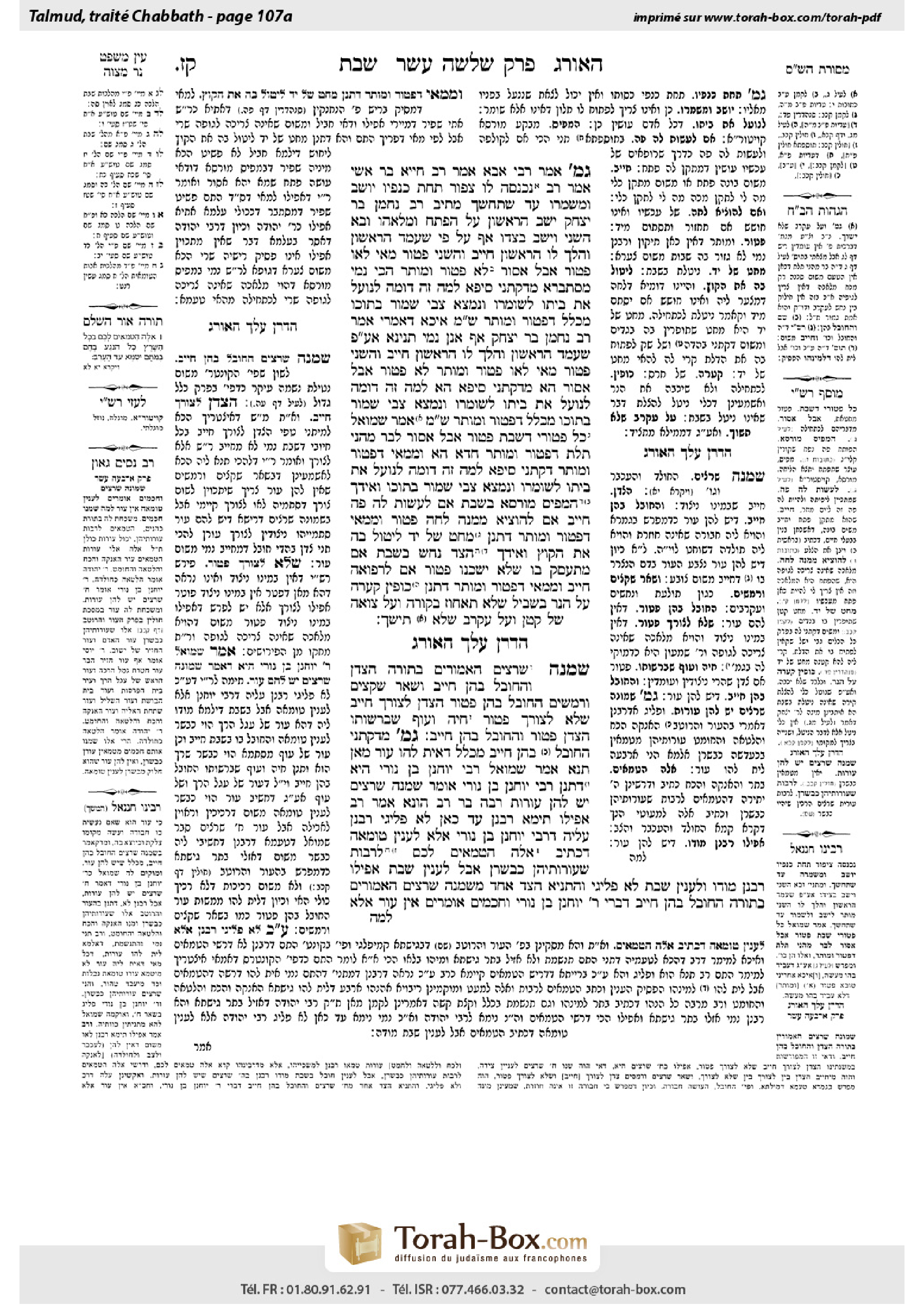
Shabbat 107a: Talmud study for Daf Yomi
Daf Yomi is the daily study of one Talmud folio. Explore 37 tractates with scans, Hebrew text, Sefaria English and AI-generated French translations where annotated.
Passage selection and English or AI-generated French translation are available where the scan has annotations. Daf Study is independent of Torah-Box and Sefaria.
Browse Shabbat · שבת · All tractatesShabbat 107a text and translations
This page of Shabbat includes the Aramaic text, an English translation and an AI-generated French translation, alongside the scan above.
שבת ק״ז א · Aramaic and Hebrew text
גְּמָ׳ אָמַר רַבִּי אַבָּא אָמַר רַב חִיָּיא בַּר אָשֵׁי אָמַר רַב: נִכְנְסָה לוֹ צִפּוֹר תַּחַת כְּנָפָיו — יוֹשֵׁב וּמְשַׁמְּרָהּ עַד שֶׁתֶּחְשַׁךְ. מֵתִיב רַב נַחְמָן בַּר יִצְחָק: יָשַׁב הָרִאשׁוֹן עַל הַפֶּתַח וּמִלְּאָהוּ, וּבָא הַשֵּׁנִי וְיָשַׁב בְּצִדּוֹ, אַף עַל פִּי שֶׁעָמַד הָרִאשׁוֹן וְהָלַךְ לוֹ — הָרִאשׁוֹן חַיָּיב וְהַשֵּׁנִי פָּטוּר. מַאי לָאו, פָּטוּר אֲבָל אָסוּר? לָא, פָּטוּר וּמוּתָּר. הָכִי נָמֵי מִסְתַּבְּרָא, מִדְּקָתָנֵי סֵיפָא: לְמָה זֶה דּוֹמֶה — לְנוֹעֵל אֶת בֵּיתוֹ לְשׁוֹמְרוֹ וְנִמְצָא צְבִי שָׁמוּר בְּתוֹכוֹ, מִכְּלָל דְּפָטוּר וּמוּתָּר! שְׁמַע מִינַּהּ.
אִיכָּא דְּאָמְרִי, אָמַר רַב נַחְמָן בַּר יִצְחָק: אַף אֲנַן נָמֵי תְּנֵינָא: אַף עַל פִּי שֶׁעָמַד הָרִאשׁוֹן וְהָלַךְ לוֹ — הָרִאשׁוֹן חַיָּיב וְהַשֵּׁנִי פָּטוּר, מַאי לָאו פָּטוּר וּמוּתָּר? לָא, פָּטוּר אֲבָל אָסוּר. הָא מִדְּקָתָנֵי סֵיפָא: הָא לְמָה זֶה דּוֹמֶה — לְנוֹעֵל אֶת בֵּיתוֹ לְשׁוֹמְרוֹ, וְנִמְצָא צְבִי שָׁמוּר בְּתוֹכוֹ, מִכְּלָל דְּפָטוּר וּמוּתָּר. שְׁמַע מִינַּהּ.
אָמַר שְׁמוּאֵל: כֹּל פְּטוּרֵי דְשַׁבָּת פָּטוּר אֲבָל אָסוּר, לְבַר מֵהָנֵי תְּלָת דְּפָטוּר וּמוּתָּר: חֲדָא הָא, וּמִמַּאי דְּפָטוּר וּמוּתָּר? — דְּקָתָנֵי סֵיפָא לְמָה זֶה דּוֹמֶה — לְנוֹעֵל אֶת בֵּיתוֹ לְשׁוֹמְרוֹ, וְנִמְצָא צְבִי שָׁמוּר בְּתוֹכוֹ. וְאִידַּךְ: הַמֵּפִיס מוּרְסָא בְּשַׁבָּת, אִם לַעֲשׂוֹת לָהּ פֶּה — חַיָּיב, אִם לְהוֹצִיא מִמֶּנָּה לֵחָה — פָּטוּר. וּמִמַּאי דְּפָטוּר וּמוּתָּר? דִּתְנַן: מַחַט שֶׁל יָד — לִיטּוֹל בָּהּ אֶת הַקּוֹץ. וְאִידַּךְ: הַצָּד נָחָשׁ בְּשַׁבָּת, אִם מִתְעַסֵּק בּוֹ שֶׁלֹּא יִשְּׁכֶנּוּ — פָּטוּר, אִם לִרְפוּאָה — חַיָּיב, וּמִמַּאי דְּפָטוּר וּמוּתָּר? — דִּתְנַן: כּוֹפִין קְעָרָה עַל הַנֵּר בִּשְׁבִיל שֶׁלֹּא תֶּאֱחוֹז בַּקּוֹרָה, וְעַל צוֹאָה שֶׁל קָטָן, וְעַל עַקְרָב שֶׁלֹּא תִּישֹּׁךְ.
הדרן עלך האורג
מַתְנִי׳ שְׁמֹנָה שְׁרָצִים הָאֲמוּרִים בַּתּוֹרָה, הַצָּדָן וְהַחוֹבֵל בָּהֶן חַיָּיב, וּשְׁאָר שְׁקָצִים וּרְמָשִׂים, הַחוֹבֵל בָּהֶן פָּטוּר, הַצָּדָן לְצוֹרֶךְ — חַיָּיב, שֶׁלֹּא לְצוֹרֶךְ — פָּטוּר. חַיָּה וָעוֹף שֶׁבִּרְשׁוּתוֹ, הַצָּדָן — פָּטוּר, וְהַחוֹבֵל בָּהֶן — חַיָּיב.
גְּמָ׳ מִדְּקָתָנֵי ״הַחוֹבֵל בָּהֶן חַיָּיב״ מִכְּלָל דְּאִית לְהוּ עוֹר. מַאן תַּנָּא? אָמַר שְׁמוּאֵל: רַבִּי יוֹחָנָן בֶּן נוּרִי הִיא, דִּתְנַן, רַבִּי יוֹחָנָן בֶּן נוּרִי אוֹמֵר: שְׁמֹנָה שְׁרָצִים יֵשׁ לָהֶן עוֹרוֹת. רַבָּה בַּר רַב הוּנָא אָמַר רַב: אֲפִילּוּ תֵּימָא רַבָּנַן, עַד כָּאן לָא פְּלִיגִי רַבָּנַן עֲלֵיהּ דְּרַבִּי יוֹחָנָן בֶּן נוּרִי אֶלָּא לְעִנְיַן טוּמְאָה, דִּכְתִיב: ״אֵלֶּה הַטְּמֵאִים לָכֶם״, לְרַבּוֹת שֶׁעוֹרוֹתֵיהֶן כִּבְשָׂרָן, אֲבָל לְעִנְיַן שַׁבָּת — אֲפִילּוּ רַבָּנַן מוֹדוּ.
וּלְעִנְיַן שַׁבָּת לָא פְּלִיגִי?! וְהָתַנְיָא: הַצָּד אֶחָד מִשְּׁמֹנָה שְׁרָצִים הָאֲמוּרִים בַּתּוֹרָה, הַחוֹבֵל בָּהֶן — חַיָּיב, דִּבְרֵי רַבִּי יוֹחָנָן בֶּן נוּרִי, וַחֲכָמִים אוֹמְרִים: אֵין עוֹר אֶלָּא
Shabbat 107a · English translation
GEMARA: Rabbi Abba said that Rav Ḥiyya bar Ashi said that Rav said: If a bird flew under the flaps of one’s clothing on Shabbat and cannot get out, he may sit and secure it until dark and then take it. Rav Naḥman bar Yitzḥak raised an objection based on that which we learned in the mishna: If the first person sat in the doorway and filled it, and a second person came and sat next to him, the first person is liable and the second is exempt, even if the first person stood and went. What, does this not mean here, as it does throughout tractate Shabbat, that he is exempt after the fact, but it is prohibited to do so ab initio? How then could Rav say one may sit and secure the bird ab initio? The Gemara rejects this: No, the statement in the mishna means that he is exempt and it is permitted ab initio. The Gemara adds: So too, it is reasonable to explain the mishna that way from the fact that it was taught in the latter clause of the mishna: To what is this second person’s action similar? To one who locks his house to secure it, and it turns out a deer that was trapped before Shabbat is also secured inside it. By inference, he is exempt and it is permitted, just like one who locks the door to his house. The Gemara concludes: Indeed, learn from it that it is so.
Some say a slightly different version. Rav Naḥman bar Yitzḥak said: We too learned support for Rav’s statement in the mishna: Even if the first person stood and went, the first person is liable and the second is exempt. What, does this not mean that he is exempt, and it is permitted? The Gemara rejects this: No, he is exempt and it is prohibited. Rav Naḥman said: That is impossible, from the fact that it is taught in the latter clause of the mishna: To what is this second person’s action similar? To one who locks his house to secure it and it turns out a deer that was trapped before Shabbat is also secured inside it. By inference, he is exempt and it is permitted, just like one who locks the door to his house. The Gemara concludes: Indeed, learn from it that it is so.
With regard to this issue Shmuel said: With regard to all exempt rulings in the halakhot of Shabbat, although one who performs the action is exempt by Torah law, his action is prohibited by rabbinic law, with the exception of these three for which he is exempt and it is permitted to perform the action.
One is this case of the deer. And from what source do we conclude that one is exempt and it is permitted? From the fact that it was taught in the latter clause of the mishna: To what is this second person’s action similar? To one who locks his house to secure it and it turns out a deer that was trapped before Shabbat is also secured inside.
And another example where he is exempt and it is permitted is: One who drains an abscess containing pus on Shabbat, if he did so to create a permanent opening in it, he is liable. However, if he did so to drain fluid from it, he is exempt. And from what source do we conclude that one is exempt and it is permitted? As we learned in a mishna: A hand needle used for sewing clothes may be moved on Shabbat to remove a thorn. Apparently, removing a thorn on Shabbat is permitted ab initio to the extent that one is even permitted to move a needle for that purpose.
And another case is: One who traps a snake on Shabbat, if he deals with it so that it will not bite him and in doing so traps it, he is exempt. However, if he traps it for medicinal purposes, he is liable. And from what source do we conclude that one is exempt and it is permitted? As we learned in a mishna: One may overturn a bowl on top of a lamp ab initio on Shabbat so that the fire will not take hold in the ceiling beam; and similarly, one may overturn a bowl on top of a child’s feces so that he will not touch it and dirty himself, and on top of a scorpion so it will not bite, and the ruling is the same with regard to a snake.
MISHNA: With regard to any of the eight creeping animals mentioned in the Torah, one who traps them or wounds them on Shabbat is liable. The Torah states: “The following shall be impure for you among the creeping animals that swarm upon the earth: The weasel, and the mouse, and the dab lizard of every variety; and the gecko, and the land-crocodile, and the lizard, and the skink, and the chameleon” (Leviticus 11:29–30). With regard to other abominations and crawling things, one who wounds them is exempt. One who traps them for a specific need is liable; one who traps them for no specific need is exempt. With regard to animals or birds that are in his possession, i.e., an animal that is domesticated and under someone’s control, one who traps them is exempt; and, however, one who wounds them is liable.
GEMARA: The Gemara asks: From the fact that it is taught in the mishna: One who wounds them is liable, by inference they have skins. One is liable for inflicting a wound only when there is skin covering the flesh and the blood pools beneath it. Who is the tanna who teaches this? Shmuel said: It is Rabbi Yoḥanan ben Nuri, as we learned in a mishna that Rabbi Yoḥanan ben Nuri says: The eight creeping animals that are listed in the Torah have skins. Their flesh transmits impurity, but their skin does not transmit impurity. The Rabbis say that both the skin and the flesh of some creeping animals transmit impurity. Rabba bar Rav Huna said that Rav said: Even if you say that the mishna is in accordance with the opinion of the Rabbis, the Rabbis disagree with Rabbi Yoḥanan ben Nuri only with regard to the matter of impurity, as it is written after the Torah lists the creeping animals: “Those are for you the impure among the creeping animals, whoever touches them when they are dead shall become impure until evening” (Leviticus 11:31). The Rabbis derive from the extraneous term: “Those are for you the impure,” to include the fact that the skins of the creatures in the second verse transmit impurity just as their flesh does. However, with regard to the halakhot of Shabbat, even the Rabbis concede that their skin is distinct from their flesh.
The Gemara asks: And, with regard to Shabbat, they do not disagree? Wasn’t the following taught in a baraita? One who traps one of the eight creeping animals mentioned in the Torah or one who wounds them is liable; this is the statement of Rabbi Yoḥanan ben Nuri. And the Rabbis say: The term skin is utilized only
Shabbat 107a · Traduction française (IA)
GUEMARA : Rabbi Abba a dit que Rav Ḥiyya bar Ashi a dit que Rav a dit : Si, pendant Chabbat, un oiseau s’est glissé sous les pans de son vêtement et ne peut en sortir, on peut s’asseoir et le maintenir prisonnier jusqu’à la nuit, puis le prendre. Rav Naḥman bar Yitzḥak objecta en s’appuyant sur ce que nous avons appris dans la Michna : Si le premier s’assit dans l’entrée et l’obstrua, puis qu’un second vint s’asseoir à côté de lui, le premier est passible et le second est exempt, même si le premier se leva et partit. Cela ne signifie-t-il pas ici, comme partout dans le traité Chabbat, qu’il est exempt a posteriori, mais qu’il est interdit d’agir ainsi a priori ? Comment Rav pourrait-il alors dire qu’on peut s’asseoir et maintenir l’oiseau prisonnier a priori ? La Guemara rejette cette interprétation : Non, la Michna signifie qu’il est exempt et que cela est permis a priori. La Guemara ajoute : Il est également raisonnable d’interpréter ainsi la Michna, puisque sa dernière clause enseigne : À quoi l’action de ce second est-elle comparable ? À celle de quelqu’un qui ferme sa maison pour la sécuriser et découvre qu’un cerf, piégé avant Chabbat, se trouve lui aussi enfermé à l’intérieur. On en déduit qu’il est exempt et que cela est permis, comme lorsqu’on ferme la porte de sa maison. La Guemara conclut : En effet, apprends-en que c’est bien ainsi.
Certains rapportent une version légèrement différente. Rav Naḥman bar Yitzḥak dit : Nous aussi, nous avons trouvé un appui à la déclaration de Rav dans la Michna : Même si le premier se leva et partit, le premier est passible et le second est exempt. Cela ne signifie-t-il pas qu’il est exempt et que cela est permis ? La Guemara rejette cette interprétation : Non, il est exempt, mais cela est interdit. Rav Naḥman dit : C’est impossible, puisque la dernière clause de la Michna enseigne : À quoi l’action de ce second est-elle comparable ? À celle de quelqu’un qui ferme sa maison pour la sécuriser et découvre qu’un cerf, piégé avant Chabbat, se trouve lui aussi enfermé à l’intérieur. On en déduit qu’il est exempt et que cela est permis, comme lorsqu’on ferme la porte de sa maison. La Guemara conclut : En effet, apprends-en que c’est bien ainsi.
À propos de cette question, Chmouel dit : Dans tous les cas où les règles de Chabbat déclarent quelqu’un exempt, bien que celui qui accomplit l’action soit exempt au regard de la Torah, son action est interdite par décret rabbinique, à l’exception de ces trois cas où il est exempt et où l’action est permise. Le premier est le cas du cerf. De quelle source déduisons-nous que l’on est exempt et que cela est permis ? Du fait que la dernière clause de la Michna enseigne : À quoi l’action de ce second est-elle comparable ? À celle de quelqu’un qui ferme sa maison pour la sécuriser et découvre qu’un cerf, piégé avant Chabbat, se trouve lui aussi enfermé à l’intérieur. Un autre cas où l’on est exempt et où cela est permis est celui de quelqu’un qui évacue, pendant Chabbat, un abcès contenant du pus : s’il le fait pour créer une ouverture permanente, il est passible. En revanche, s’il le fait pour en évacuer le liquide, il est exempt. De quelle source déduisons-nous que l’on est exempt et que cela est permis ? Comme nous l’avons appris dans une Michna : On peut déplacer pendant Chabbat une aiguille à coudre pour retirer une épine. Il apparaît donc que retirer une épine pendant Chabbat est permis a priori, au point qu’on peut même déplacer une aiguille à cette fin. Un autre cas est celui de quelqu’un qui capture un serpent pendant Chabbat : s’il le fait pour qu’il ne le morde pas et le capture ce faisant, il est exempt. En revanche, s’il le capture à des fins médicinales, il est passible. De quelle source déduisons-nous que l’on est exempt et que cela est permis ? Comme nous l’avons appris dans une Michna : On peut, a priori, renverser un bol sur une lampe pendant Chabbat, afin que le feu ne se propage pas à la poutre du plafond ; de même, on peut renverser un bol sur les excréments d’un enfant, afin qu’il ne les touche pas et ne se salisse pas, et sur un scorpion, afin qu’il ne pique pas. La même règle s’applique à un serpent.
MICHNA : Pour chacun des huit animaux rampants mentionnés dans la Torah, celui qui le capture ou le blesse pendant Chabbat est passible. La Torah dit : « Voici ceux qui seront impurs pour vous parmi les animaux rampants qui grouillent sur la terre : la belette, la souris, le lézard fouisseur de toute espèce, le gecko, le varan, le lézard, le scinque et le caméléon » (Lévitique 11, 29-30). Pour les autres créatures abominables et rampantes, celui qui les blesse est exempt. Celui qui les capture pour un besoin précis est passible ; celui qui les capture sans besoin précis est exempt. Quant aux animaux ou aux oiseaux qui sont en sa possession, c’est-à-dire aux animaux domestiqués et placés sous le contrôle de quelqu’un, celui qui les capture est exempt ; en revanche, celui qui les blesse est passible.
GUEMARA : La Guemara demande : Puisque la Michna enseigne que celui qui les blesse est passible, on en déduit qu’ils ont une peau. On n’est passible d’avoir infligé une blessure que lorsque la chair est recouverte d’une peau et que le sang s’accumule sous celle-ci. Quel est le tanna qui enseigne cela ? Chmouel dit : C’est Rabbi Yoḥanan ben Nuri, comme nous l’avons appris dans une Michna : Rabbi Yoḥanan ben Nuri dit que les huit animaux rampants énumérés dans la Torah ont une peau. Leur chair transmet l’impureté, mais leur peau ne la transmet pas. Les Sages disent que, chez certains animaux rampants, la peau comme la chair transmettent l’impureté. Rabba bar Rav Huna a dit que Rav a dit : Même si tu dis que la Michna suit l’opinion des Sages, ceux-ci ne sont en désaccord avec Rabbi Yoḥanan ben Nuri qu’en matière d’impureté, car il est écrit, après l’énumération des animaux rampants dans la Torah : « Ceux-là sont pour vous les impurs parmi les animaux rampants ; quiconque les touche lorsqu’ils sont morts sera impur jusqu’au soir » (Lévitique 11, 31). Les Sages déduisent du terme superflu « ceux-là sont pour vous les impurs » que la peau des créatures mentionnées dans le second verset transmet elle aussi l’impureté, tout comme leur chair. Toutefois, en ce qui concerne les règles de Chabbat, même les Sages reconnaissent que leur peau se distingue de leur chair.
La Guemara demande : Et, en ce qui concerne Chabbat, ne sont-ils pas en désaccord ? N’a-t-on pas enseigné dans une baraïta : Celui qui capture l’un des huit animaux rampants mentionnés dans la Torah ou qui le blesse est passible ; telle est l’opinion de Rabbi Yoḥanan ben Nuri. Et les Sages disent : Le terme « peau » n’est employé que
Traduction française générée par IA à partir de l’édition anglaise de Sefaria. Vérifie toujours un passage avec le texte source.
Text from Sefaria: William Davidson Edition - Vocalized Aramaic (CC BY NC); William Davidson Edition - English (CC BY NC).