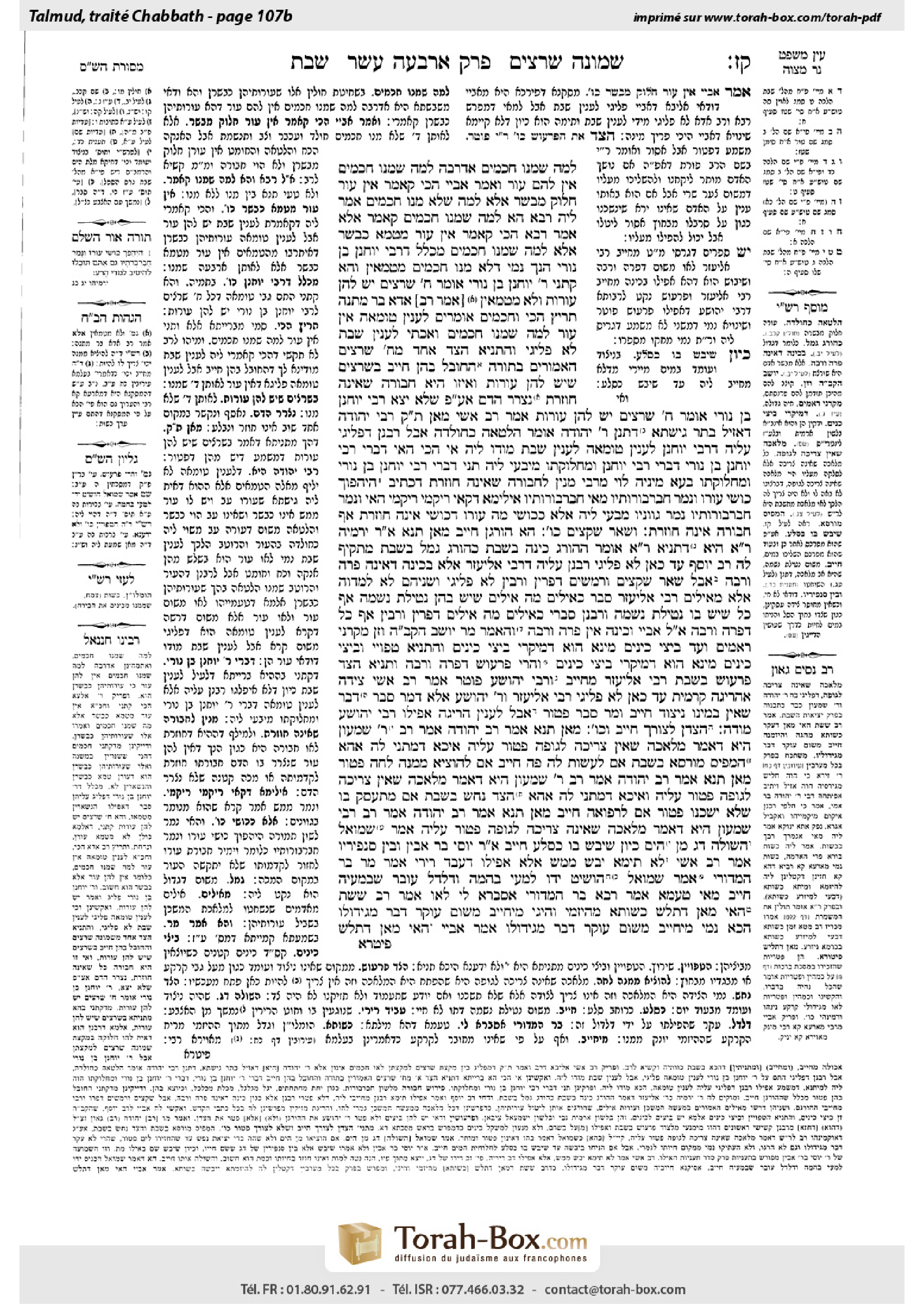
Shabbat 107b: Talmud study for Daf Yomi
Daf Yomi is the daily study of one Talmud folio. Explore 37 tractates with scans, Hebrew text, Sefaria English and AI-generated French translations where annotated.
Passage selection and English or AI-generated French translation are available where the scan has annotations. Daf Study is independent of Torah-Box and Sefaria.
Browse Shabbat · שבת · All tractatesShabbat 107b text and translations
This page of Shabbat includes the Aramaic text, an English translation and an AI-generated French translation, alongside the scan above.
שבת ק״ז ב · Aramaic and Hebrew text
לְמַה שֶּׁמָּנוּ חֲכָמִים. אַדְּרַבָּה, לְמַה שֶּׁמָּנוּ חֲכָמִים אֵין לָהֶם עוֹר! וְאָמַר אַבָּיֵי, הָכִי קָאָמַר: אֵין עוֹר חָלוּק מִבָּשָׂר אֶלָּא לְמַה שֶּׁלֹּא מָנוּ חֲכָמִים, אֲמַר לֵיהּ רָבָא: הָא ״לְמַה שֶּׁמָּנוּ חֲכָמִים״ קָאָמַר? אֶלָּא אָמַר רָבָא, הָכִי קָאָמַר: אֵין עוֹר מְטַמֵּא כְּבָשָׂר אֶלָּא לְמַה שֶּׁמָּנוּ חֲכָמִים. מִכְּלָל דְּרַבִּי יוֹחָנָן בֶּן נוּרִי הָנָךְ נָמֵי דְּלֹא מָנוּ חֲכָמִים מְטַמְּאִין? וְהָא קָתָנֵי, רַבִּי יוֹחָנָן בֶּן נוּרִי אוֹמֵר: שְׁמֹנָה שְׁרָצִים יֵשׁ לָהֶן עוֹרוֹת וְלֹא מְטַמְּאִין! [אָמַר רַב] אַדָּא בַּר מַתְנָה: תָּרֵיץ הָכִי, וַחֲכָמִים אוֹמְרִים: לְעִנְיַן טוּמְאָה אֵין עוֹר לְמַה שֶּׁמָּנוּ חֲכָמִים.
וְאַכַּתִּי, לְעִנְיַן שַׁבָּת לָא פְּלִיגִי? וְהָתַנְיָא: הַצָּד אֶחָד מִשְּׁמֹנָה שְׁרָצִים הָאֲמוּרִים בַּתּוֹרָה, הַחוֹבֵל בָּהֶן — חַיָּיב, בִּשְׁרָצִים שֶׁיֵּשׁ לָהֶן עוֹרוֹת. וְאֵיזוֹ הִיא חַבּוּרָה שֶׁאֵינָהּ חוֹזֶרֶת — נִצְרַר הַדָּם אַף עַל פִּי שֶׁלֹּא יָצָא. רַבִּי יוֹחָנָן בֶּן נוּרִי אוֹמֵר: שְׁמֹנָה שְׁרָצִים יֵשׁ לָהֶן עוֹרוֹת.
אָמַר רַב אָשֵׁי: מַאן תַּנָּא קַמָּא — רַבִּי יְהוּדָה דְּאָזֵיל בָּתַר גִּישְׁתָּא. דִּתְנַן, רַבִּי יְהוּדָה אוֹמֵר: הַלְּטָאָה כְּחוּלְדָּה. אֲבָל רַבָּנַן דִּפְלִיגִי עֲלֵיהּ דְּרַבִּי יוֹחָנָן לְעִנְיַן טוּמְאָה, לְעִנְיַן שַׁבָּת מוֹדוּ לֵיהּ. אִי הָכִי, הַאי ״דִּבְרֵי רַבִּי יוֹחָנָן בֶּן נוּרִי״, ״דִּבְרֵי רַבִּי יוֹחָנָן וּמַחְלוּקְתּוֹ״ מִיבְּעֵי לֵיהּ! תְּנִי: ״דִּבְרֵי רַבִּי יוֹחָנָן בֶּן נוּרִי וּמַחְלוּקְתּוֹ״.
בְּעָא מִינֵּיהּ לֵוִי מֵרַבִּי: מִנַּיִן לְחַבּוּרָה שֶׁאֵינָהּ חוֹזֶרֶת? דִּכְתִיב: ״הֲיַהֲפוֹךְ כּוּשִׁי עוֹרוֹ וְנָמֵר חֲבַרְבֻּרֹתָיו״. מַאי ״חֲבַרְבֻּרֹתָיו״? אִילֵּימָא דְּקָאֵי רִיקְמֵי רִיקְמֵי — הַאי ״וְנָמֵר חֲבַרְבֻּרֹתָיו״, ״נָמֵר גְּווֹנָיו״ מִבְּעֵי לֵיהּ! אֶלָּא — כְּכוּשִׁי: מָה עוֹרוֹ דְּכוּשִׁי אֵינָהּ חוֹזֶרֶת, אַף חַבּוּרָה אֵינָהּ חוֹזֶרֶת.
וּשְׁאָר שְׁקָצִים כּוּ׳. הָא הוֹרְגָן — חַיָּיב. מַאן תַּנָּא? אָמַר רַבִּי יִרְמְיָה: רַבִּי אֱלִיעֶזֶר הִיא. דְּתַנְיָא, רַבִּי אֱלִיעֶזֶר אוֹמֵר: הַהוֹרֵג כִּינָּה בְּשַׁבָּת — כְּהוֹרֵג גָּמָל בְּשַׁבָּת. מַתְקִיף לַהּ רַב יוֹסֵף: עַד כָּאן לָא פְּלִיגִי רַבָּנַן עֲלֵיהּ דְּרַבִּי אֱלִיעֶזֶר אֶלָּא בְּכִינָּה, דְּאֵינָהּ פָּרָה וְרָבָה. אֲבָל שְׁאָר שְׁקָצִים וּרְמָשִׂים דְּפָרִין וְרָבִין — לָא פְּלִיגִי.
וּשְׁנֵיהֶם לֹא לְמָדוּהָ אֶלָּא מֵאֵילִים. רַבִּי אֱלִיעֶזֶר סָבַר כְּאֵילִים: מָה אֵילִים שֶׁיֵּשׁ בָּהֶן נְטִילַת נְשָׁמָה — אַף כֹּל שֶׁיֵּשׁ בּוֹ נְטִילַת נְשָׁמָה. וְרַבָּנַן סָבְרִי כְּאֵילִים: מָה אֵילִים דְּפָרִין וְרָבִין — אַף כֹּל דְּפָרֶה וְרָבֶה. אֲמַר לֵיהּ אַבָּיֵי: וְכִינָּה אֵין פָּרָה וְרָבָה? וְהָאָמַר מָר: יוֹשֵׁב הַקָּדוֹשׁ בָּרוּךְ הוּא וְזָן מִקַּרְנֵי רֵאמִים וְעַד בֵּיצֵי כִינִּים! מִינָא הוּא דְּמִיקְּרֵי ״בֵּיצֵי כִינִּים״.
וְהָתַנְיָא: טִפּוּיִין וּבֵיצֵי כִינִּים! מִינָא הוּא דְּמִיקְּרֵי ״בֵּיצֵי כִינִּים״. וַהֲרֵי פַּרְעוֹשׁ דְּפָרֶה וְרָבֶה, וְתַנְיָא: הַצָּד פַּרְעוֹשׁ בְּשַׁבָּת, רַבִּי אֱלִיעֶזֶר מְחַיֵּיב וְרַבִּי יְהוֹשֻׁעַ פּוֹטֵר! אָמַר רַב אָשֵׁי: צֵידָה אַהֲרִיגָה קָרָמֵית?! עַד כָּאן לָא פְּלִיגִי רַבִּי אֱלִיעֶזֶר וְרַבִּי יְהוֹשֻׁעַ, אֶלָּא דְּמָר סָבַר: דָּבָר שֶׁאֵין בְּמִינוֹ נִיצּוֹד — חַיָּיב, וּמָר סָבַר: פָּטוּר. אֲבָל לְעִנְיַן הֲרִיגָה — אֲפִילּוּ רַבִּי יְהוֹשֻׁעַ מוֹדֶה.
הַצָּדָן לְצוֹרֶךְ חַיָּיב וְכוּ׳. מַאן תַּנָּא? אָמַר רַב יְהוּדָה אָמַר רַב: רַבִּי שִׁמְעוֹן הִיא, דְּאָמַר מְלָאכָה שֶׁאֵין צְרִיכָה לְגוּפָהּ — פָּטוּר עָלֶיהָ.
אִיכָּא דְּמַתְנֵי לַהּ אַהָא: הַמֵּפִיס מוּרְסָא בְּשַׁבָּת, אִם לַעֲשׂוֹת לָהּ פֶּה — חַיָּיב, אִם לְהוֹצִיא מִמֶּנָּה לֵחָה — פָּטוּר. מַאן תַּנָּא? אָמַר רַב יְהוּדָה אָמַר רַב: רַבִּי שִׁמְעוֹן הִיא, דְּאָמַר מְלָאכָה שֶׁאֵין צְרִיכָה לְגוּפָהּ — פָּטוּר עָלֶיהָ.
וְאִיכָּא דְּמַתְנֵי לַהּ אַהָא: הַצָּד נָחָשׁ בְּשַׁבָּת, אִם מִתְעַסֵּק בּוֹ שֶׁלֹּא יִשְּׁכֶנּוּ — פָּטוּר, אִם לִרְפוּאָה — חַיָּיב. מַאן תַּנָּא? אָמַר רַב יְהוּדָה אָמַר רַב: רַבִּי שִׁמְעוֹן הִיא, דְּאָמַר מְלָאכָה שֶׁאֵינָהּ צְרִיכָה לְגוּפָהּ פָּטוּר עָלֶיהָ.
אָמַר שְׁמוּאֵל: הַשּׁוֹלֶה דָּג מִן הַיָּם, כֵּיוָן שֶׁיָּבֵשׁ בּוֹ כְּסֶלַע — חַיָּיב. אָמַר רַבִּי יוֹסֵי בַּר אָבִין: וּבֵין סְנַפִּירָיו. אָמַר רַב אָשֵׁי: לָא תֵּימָא יָבֵשׁ מַמָּשׁ, אֶלָּא אֲפִילּוּ דְּעָבֵד רִירֵי.
אָמַר מָר בַּר הַמְדּוּרֵי אָמַר שְׁמוּאֵל: הוֹשִׁיט יָדוֹ לִמְעֵי בְּהֵמָה וְדִלְדֵּל עוּבָּר שֶׁבְּמֵעֶיהָ — חַיָּיב. מַאי טַעְמָא? אָמַר רָבָא: בַּר הַמְדּוּרֵי אַסְבְּרַהּ לִי, לָאו אָמַר רַב שֵׁשֶׁת: הַאי מַאן דִּתְלַשׁ כְּשׁוּתָא מֵהִיזְמֵי וְהִיגֵי מִיחַיַּיב מִשּׁוּם עוֹקֵר דָּבָר מִגִּידּוּלוֹ. הָכָא נָמֵי, מִיחַיַּיב מִשּׁוּם עוֹקֵר דָּבָר מִגִּידּוּלוֹ. אָמַר אַבָּיֵי: הַאי מַאן דִּתְלַשׁ
Shabbat 107b · English translation
with regard to those animals enumerated by the Sages as having skin, since their skin is considered by the Sages to be similar to their flesh. The Gemara asks: On the contrary, those that the Sages enumerated, whose skin and flesh are equated, do not have skins. And Abaye said: This is what the tanna in the baraita is saying: Only those that the Sages did not enumerate have skin discrete from their flesh. Rava said to him: Doesn’t the baraita say the opposite: That those enumerated by the Sages have skin discrete from their flesh? Rather, Rava said: This is what the baraita is saying: Only the skin of those animals enumerated by the Sages transmits impurity like flesh. The Gemara asks: Is that to say by inference that Rabbi Yoḥanan ben Nuri holds that even the creeping animals not enumerated by the Sages also transmit impurity? Isn’t the opposite taught, that Rabbi Yoḥanan ben Nuri says: The eight creeping animals have skin that does not transmit impurity? Rav Adda bar Mattana said to resolve it this way: And the Rabbis say: With regard to impurity, those animals enumerated by the Sages do not have skin. According to this explanation, Rabbi Yoḥanan ben Nuri and the Rabbis disagree only with regard to the laws of impurity.
But still, is it clear that they do not disagree with regard to the matter of Shabbat? Wasn’t it taught in a baraita: One who traps one of the eight creeping animals mentioned in the Torah on Shabbat is liable, as is one who wounds them, if they are creeping animals that have skins? And what is considered to be an irreversible wound? It is a wound where the blood collects in a single spot beneath the skin, even if it does not emerge. Rabbi Yoḥanan ben Nuri says: The eight creeping animals have skins. Apparently, there is disagreement with regard to Shabbat as well.
Rav Ashi said: Who is the first tanna? It is Rabbi Yehuda, who follows the texture of the skin. He does not distinguish between those creeping animals whose skin is considered like flesh and those whose skin is discrete from the flesh as the verses may imply; rather, creeping animals are distinguished based on the texture of their skin, as we learned in a mishna that Rabbi Yehuda says: Even though the lizard is mentioned in the verse, it has the same ruling as the weasel because the weasel has skin discrete from its flesh. However, the Rabbis, who disagree with Rabbi Yoḥanan with regard to impurity, concede with regard to Shabbat and hold that all creeping animals have skins. The Gemara asks: If so, the phrase in the baraita: This is the statement of Rabbi Yoḥanan ben Nuri, is difficult. It should have said: This is the statement of Rabbi Yoḥanan ben Nuri and those who disagree with him, as the Rabbis who disagree with him with regard to impurity concede to him with regard to the laws of Shabbat. The Gemara responds: This is not difficult. Emend the baraita and teach: The statement of Rabbi Yoḥanan ben Nuri and those who disagree with him.
Levi raised a dilemma before Rabbi Yehuda HaNasi: From where is it derived that a wound is defined as something irreversible? He answered him that it is derived as it is written: “Can a Cushite change his skin, or a leopard its spots [ḥavarburotav]?” (Jeremiah 13:23). The Gemara explains: What does ḥavarburotav mean? If you say that they are spotted marks on the leopard’s skin, that phrase: Or a leopard its spots, should have been: Or a leopard its colors. Rather, ḥavarburotav means wounds, and they are similar to the skin of a Cushite: Just like the skin of a Cushite will not change its color to white, so too a wound is something that does not reverse.
We learned in the mishna: And one who traps other abominations is exempt. The Gemara infers: If one kills them he is liable. The Gemara asks: Who is the tanna who holds this opinion? Rabbi Yirmeya said: It is the opinion of Rabbi Eliezer, as it was taught in a baraita that Rabbi Eliezer says: One who kills lice on Shabbat is akin to one who kills a camel on Shabbat. Apparently, he is the Sage who holds that one is liable for killing any living creature. Rav Yosef strongly objects to this: Perhaps this is not so, as the Rabbis disagree with Rabbi Eliezer only with regard to lice, which do not procreate. However, with regard to other abominations and crawling things that procreate, they do not disagree with him.
And fundamentally they both derived this halakha from the reddened ram skins used to cover the Tabernacle. Rabbi Eliezer holds that liability for killing an animal on Shabbat exists only with regard to animals like rams. Just as rams have their lives taken and die, so too, one is liable for killing any animal whose life is taken, including lice. And the Rabbis also hold that liability for killing an animal on Shabbat exists only with regard to animals like rams. Just as rams procreate, so too, one is liable for killing any creature that procreates. One is not liable for killing lice, which do not procreate. Abaye said to Rav Yosef: And lice do not procreate? Didn’t the Master say: The Holy One, Blessed be He, sits and sustains everything from the horns of wild oxen to the eggs of lice? Apparently, lice reproduce by laying eggs. Rav Yosef answered him: There is a species of insect that is called lice eggs, but lice themselves do not actually lay eggs.
Again he asked: And wasn’t it taught in the baraita that lists types of creeping animals: Tefuyei, a type of insect, and lice eggs? He answered him: There is a species of insect called lice eggs. Again he asked: And still, there is the issue of a flea, which procreates according to all opinions, and nevertheless, it was taught in a baraita: With regard to one who traps a flea on Shabbat, Rabbi Eliezer deems him liable and Rabbi Yehoshua deems him exempt. Rav Ashi said: Are you raising a contradiction between trapping with killing? Rabbi Eliezer and Rabbi Yehoshua disagree only in that one Sage, Rabbi Eliezer, holds that one is liable for trapping even a species that is not typically trapped; and one Sage, Rabbi Yehoshua, holds that one is exempt in that case. However, with regard to killing, even Rabbi Yehoshua concedes that one is liable.
We learned in the mishna that one who traps creeping animals for a specific need is liable, but one who traps them for no specific need is exempt. The Gemara asks: Who is the tanna who holds this way? Rav Yehuda said that Rav said: It is Rabbi Shimon, who said that for a prohibited labor performed not for its own sake, one is exempt.
Some taught the statement of Rav in reference to this: With regard to one who drains an abscess in a boil containing pus on Shabbat, if his intention is to create an opening for it he is liable; if his intention is to remove pus from it he is exempt. The Gemara asks: Who is the tanna who holds this way? Rav Yehuda said that Rav said: It is Rabbi Shimon, who said that for a prohibited labor performed not for its own sake, one is exempt.
Some teach the statement of Rav as referring to this: With regard to one who traps a snake on Shabbat, if he engages in its trapping so it does not bite him, he is exempt; if he does so for medicinal purposes he is liable. The Gemara asks: Who is the tanna who holds this way? Rav Yehuda said that Rav said: It is Rabbi Shimon, who said that for a prohibited labor performed not for its own sake, one is exempt.
Shmuel said: With regard to one who removes a fish from the sea, when an area on the skin of the fish has dried up the size of a sela, he is liable. A fish in that condition cannot survive, and therefore the individual who removed it from the water is liable for killing it. Rabbi Yosei bar Avin said: That is so as long as the skin that dried is between its fins. Rav Ashi said: Do not say that this halakha applies only in a case where it actually dried. Rather, it applies even if the fish has dried to the extent that mucus has formed, and if one were to touch that area it would stick to his fingers.
Mar bar Hamdurei said that Shmuel said: One who reached his hand into the innards of an animal on Shabbat and detached a fetus that was in its womb is liable. The Gemara asks: What is the reason for this? It does not make sense to consider the fetus as a full-fledged living creature. Rava said: Bar Hamdurei explained this to me. Didn’t Rav Sheshet say: One who detaches hops on Shabbat from the shrubs and thorns on which they are growing is liable for uprooting an object from its place of growth? Here, too, in the case of the fetus, one is liable for uprooting an object from its place of growth. Abaye said: One who detached
Shabbat 107b · Traduction française (IA)
à propos des animaux que les Sages ont énumérés comme ayant une peau, puisque leur peau est considérée par les Sages comme semblable à leur chair. La Guemara demande : Au contraire, ceux que les Sages ont énumérés, dont la peau et la chair sont assimilées, n’ont pas de peau. Abaye dit : Voici ce que dit le tanna de la baraïta : seuls ceux que les Sages n’ont pas énumérés ont une peau distincte de leur chair. Rava lui dit : La baraïta ne dit-elle pas le contraire, à savoir que ceux que les Sages ont énumérés ont une peau distincte de leur chair ? Rava dit plutôt : Voici ce que dit la baraïta : seule la peau des animaux énumérés par les Sages transmet l’impureté comme la chair. La Guemara demande : Faut-il en déduire que Rabbi Yoḥanan ben Nuri considère que même les animaux rampants non énumérés par les Sages transmettent aussi l’impureté ? N’est-il pas enseigné le contraire, à savoir que Rabbi Yoḥanan ben Nuri dit : « Les huit animaux rampants ont une peau qui ne transmet pas l’impureté » ? Rav Adda bar Mattana résout la difficulté ainsi : les Rabbins disent que, du point de vue de l’impureté, les animaux énumérés par les Sages n’ont pas de peau. Selon cette explication, Rabbi Yoḥanan ben Nuri et les Rabbins ne sont en désaccord que sur les lois de l’impureté.
Mais est-il malgré tout certain qu’ils ne sont pas en désaccord au sujet du Chabbat ? N’a-t-il pas été enseigné dans une baraïta : « Celui qui capture l’un des huit animaux rampants mentionnés dans la Torah le Chabbat est passible, tout comme celui qui les blesse, s’il s’agit d’animaux rampants ayant une peau. » Et qu’est-ce qu’une blessure irréversible ? C’est une blessure où le sang s’accumule en un seul endroit sous la peau, même s’il ne s’écoule pas. Rabbi Yoḥanan ben Nuri dit : « Les huit animaux rampants ont une peau. » Apparemment, ils sont aussi en désaccord au sujet du Chabbat.
Rav Ashi dit : Qui est le premier tanna ? C’est Rabbi Yehuda, qui se fonde sur la texture de la peau. Il ne distingue pas entre les animaux rampants dont la peau est considérée comme leur chair et ceux dont la peau est distincte de la chair, comme les versets pourraient le laisser entendre. Les animaux rampants sont plutôt distingués selon la texture de leur peau, comme nous l’avons appris dans une Michna où Rabbi Yehuda dit : « Bien que le lézard soit mentionné dans le verset, il a le même statut que la belette, car celle-ci a une peau distincte de sa chair. » Cependant, les Rabbins, qui sont en désaccord avec Rabbi Yoḥanan au sujet de l’impureté, concèdent, pour le Chabbat, que tous les animaux rampants ont une peau. La Guemara demande : Dans ce cas, la formule de la baraïta, « telle est l’opinion de Rabbi Yoḥanan ben Nuri », pose problème. Elle aurait dû dire : « Telle est l’opinion de Rabbi Yoḥanan ben Nuri et de ceux qui sont en désaccord avec lui », puisque les Rabbins, qui sont en désaccord avec lui au sujet de l’impureté, lui donnent raison concernant les lois du Chabbat. La Guemara répond : Il n’y a pas de difficulté. Corrige la baraïta et enseigne : « Telle est l’opinion de Rabbi Yoḥanan ben Nuri et de ceux qui sont en désaccord avec lui. »
Lévi posa une question à Rabbi Yehuda HaNassi : De quelle source déduit-on qu’une blessure se définit par son caractère irréversible ? Il lui répondit que cela se déduit de ce qui est écrit : « Un Koushite peut-il changer sa peau, ou un léopard ses taches [ḥavarburotav] ? » (Jérémie 13, 23). La Guemara explique : Que signifie ḥavarburotav ? Si tu dis qu’il s’agit des taches sur la peau du léopard, l’expression « ou un léopard ses taches » aurait dû être : « ou un léopard ses couleurs ». Ḥavarburotav signifie donc « blessures », et celles-ci sont comparables à la peau d’un Koushite : de même que la peau d’un Koushite ne peut pas devenir blanche, de même une blessure est quelque chose qui ne disparaît pas.
Nous avons appris dans la Michna : « Celui qui capture d’autres créatures répugnantes est exempt. » La Guemara en déduit que s’il les tue, il est passible. La Guemara demande : Quel est le tanna qui soutient cette opinion ? Rabbi Yirmeya dit : C’est l’opinion de Rabbi Eliezer, comme il a été enseigné dans une baraïta où Rabbi Eliezer dit : « Celui qui tue des poux le Chabbat est semblable à celui qui tue un chameau le Chabbat. » Apparemment, c’est le Sage qui considère qu’on est passible lorsqu’on tue n’importe quelle créature vivante. Rav Yosef s’y oppose vivement : Peut-être n’en est-il pas ainsi, car les Rabbins ne sont en désaccord avec Rabbi Eliezer qu’au sujet des poux, qui ne se reproduisent pas. En revanche, ils ne sont pas en désaccord avec lui concernant les autres créatures répugnantes et rampantes qui se reproduisent.
En réalité, tous deux déduisent cette halakha des peaux de béliers teintes en rouge utilisées pour couvrir le Tabernacle. Rabbi Eliezer considère qu’on est passible pour avoir tué un animal le Chabbat uniquement s’il s’agit d’un animal comme le bélier. De même que les béliers meurent lorsqu’on leur ôte la vie, de même on est passible pour avoir tué tout animal auquel on ôte la vie, y compris les poux. Les Rabbins considèrent eux aussi qu’on est passible pour avoir tué un animal le Chabbat uniquement s’il s’agit d’un animal comme le bélier. De même que les béliers se reproduisent, de même on est passible pour avoir tué toute créature qui se reproduit. On n’est pas passible pour avoir tué des poux, qui ne se reproduisent pas. Abaye dit à Rav Yosef : Les poux ne se reproduisent-ils pas ? Le Maître n’a-t-il pas dit : « Le Saint, béni soit-Il, siège et nourrit toutes les créatures, des cornes des aurochs jusqu’aux œufs des poux » ? Apparemment, les poux se reproduisent en pondant des œufs. Rav Yosef lui répondit : Il existe une espèce d’insecte appelée « œufs de poux », mais les poux eux-mêmes ne pondent pas réellement d’œufs.
Il demanda encore : N’a-t-il pas été enseigné dans la baraïta qui énumère les espèces d’animaux rampants : « Tefuyei, une sorte d’insecte, et les œufs de poux » ? Il lui répondit : Il existe une espèce d’insecte appelée « œufs de poux ». Il demanda encore : Il reste pourtant le cas de la puce, qui se reproduit selon tous les avis ; néanmoins, il a été enseigné dans une baraïta : « Celui qui capture une puce le Chabbat, Rabbi Eliezer le déclare passible et Rabbi Yehoshua l’en déclare exempt. » Rav Ashi dit : Opposes-tu la capture au fait de tuer ? Rabbi Eliezer et Rabbi Yehoshua ne sont en désaccord que sur ce point : Rabbi Eliezer considère qu’on est passible même lorsqu’on capture une espèce qu’on n’a pas l’habitude de capturer, tandis que Rabbi Yehoshua considère qu’on en est exempt dans ce cas. En revanche, lorsqu’il s’agit de tuer, même Rabbi Yehoshua reconnaît qu’on est passible.
Nous avons appris dans la Michna que celui qui capture des animaux rampants dans un but précis est passible, tandis que celui qui les capture sans but précis est exempt. La Guemara demande : Quel est le tanna qui soutient cette opinion ? Rav Yehuda dit au nom de Rav : C’est Rabbi Shimon, qui a dit que, lorsqu’un travail interdit est accompli sans que ce soit son but, on est exempt.
Certains enseignent la déclaration de Rav à propos de ce cas : celui qui draine un abcès rempli de pus le Chabbat est passible s’il a l’intention de créer une ouverture ; s’il a l’intention d’en retirer le pus, il est exempt. La Guemara demande : Quel est le tanna qui soutient cette opinion ? Rav Yehuda dit au nom de Rav : C’est Rabbi Shimon, qui a dit que, lorsqu’un travail interdit est accompli sans que ce soit son but, on est exempt.
Certains rapportent la déclaration de Rav à propos de ce cas : celui qui capture un serpent le Chabbat est exempt s’il le fait pour l’empêcher de le mordre ; s’il le fait à des fins médicinales, il est passible. La Guemara demande : Quel est le tanna qui soutient cette opinion ? Rav Yehuda dit au nom de Rav : C’est Rabbi Shimon, qui a dit que, lorsqu’un travail interdit est accompli sans que ce soit son but, on est exempt.
Shmuel dit : Celui qui retire un poisson de la mer est passible dès qu’une zone de sa peau de la taille d’un sela a séché. Un poisson dans cet état ne peut pas survivre ; celui qui l’a retiré de l’eau est donc passible pour l’avoir tué. Rabbi Yosei bar Avin dit : Cela est vrai tant que la zone de peau desséchée se trouve entre ses nageoires. Rav Ashi dit : Ne dis pas que cette halakha ne s’applique que lorsque la peau a effectivement séché. Elle s’applique même si le poisson a séché au point qu’une substance visqueuse s’est formée et que, si l’on touchait cette zone, elle collerait aux doigts.
Mar bar Hamdurei dit au nom de Shmuel : Celui qui introduit sa main dans les entrailles d’un animal le Chabbat et en détache un fœtus qui se trouve dans son ventre est passible. La Guemara demande : Quelle en est la raison ? Il n’est pas logique de considérer le fœtus comme une créature vivante à part entière. Rava dit : Bar Hamdurei me l’a expliqué. Rav Sheshet n’a-t-il pas dit : « Celui qui détache le Chabbat des houblons des arbustes et des épines sur lesquels ils poussent est passible pour avoir arraché un objet de son lieu de croissance » ? Ici aussi, dans le cas du fœtus, on est passible pour avoir arraché un objet de son lieu de croissance. Abaye dit : Celui qui détache
Traduction française générée par IA à partir de l’édition anglaise de Sefaria. Vérifie toujours un passage avec le texte source.
Text from Sefaria: William Davidson Edition - Vocalized Aramaic (CC BY NC); William Davidson Edition - English (CC BY NC).