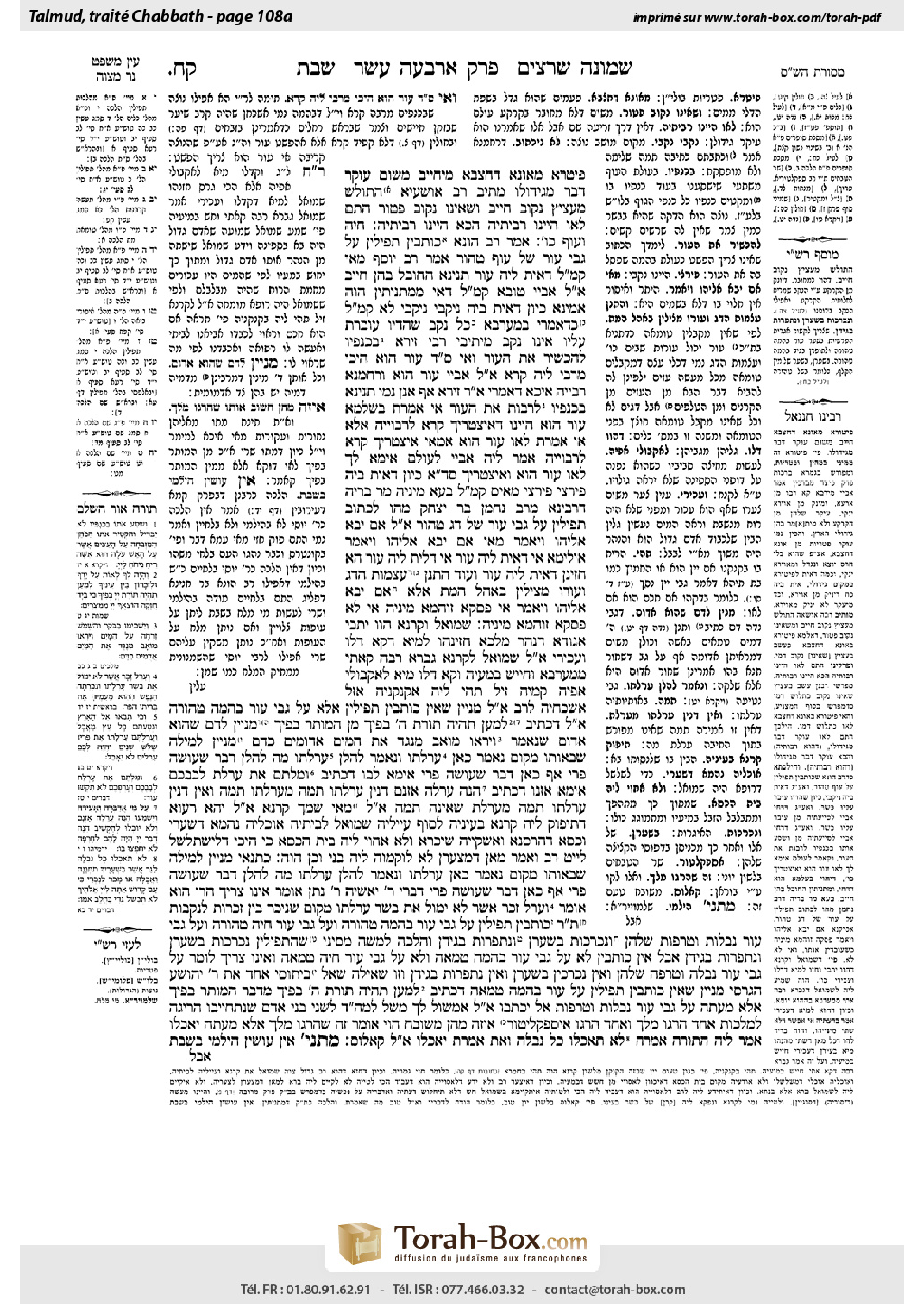
Shabbat 108a: Talmud study for Daf Yomi
Daf Yomi is the daily study of one Talmud folio. Explore 37 tractates with scans, Hebrew text, Sefaria English and AI-generated French translations where annotated.
Passage selection and English or AI-generated French translation are available where the scan has annotations. Daf Study is independent of Torah-Box and Sefaria.
Browse Shabbat · שבת · All tractatesShabbat 108a text and translations
This page of Shabbat includes the Aramaic text, an English translation and an AI-generated French translation, alongside the scan above.
שבת ק״ח א · Aramaic and Hebrew text
פִּיטְרָא מֵאוּנָּא דְחַצְבָּא — מִיחַיַּיב מִשּׁוּם עוֹקֵר דָּבָר מִגִּידּוּלוֹ. מֵתִיב רַב אוֹשַׁעְיָא: הַתּוֹלֵשׁ מֵעָצִיץ נָקוּב — חַיָּיב, וְשֶׁאֵינוֹ נָקוּב — פָּטוּר. הָתָם — לָאו הַיְינוּ רְבִיתֵיהּ, הָכָא — הַיְינוּ רְבִיתֵיהּ.
חַיָּה וָעוֹף כּוּ׳. אָמַר רַב הוּנָא: כּוֹתְבִין תְּפִילִּין עַל גַּבֵּי עוֹר שֶׁל עוֹף טָהוֹר. אָמַר רַב יוֹסֵף: מַאי קָמַשְׁמַע לַן? דְּאִית לֵיהּ עוֹר — תְּנֵינָא: הַחוֹבֵל בָּהֶן — חַיָּיב! אֲמַר לֵיהּ אַבָּיֵי: טוּבָא קָמַשְׁמַע לַן, דְּאִי מִמַּתְנִיתִין, הֲוָה אָמֵינָא כֵּיוָן דְּאִית בֵּיהּ נִיקְבֵי נִיקְבֵי לָא, קָמַשְׁמַע לַן כִּדְאָמְרִי בְּמַעְרְבָא: כׇּל נֶקֶב שֶׁהַדְּיוֹ עוֹבֶרֶת עָלָיו — אֵינוֹ נֶקֶב.
מֵיתִיב רַבִּי זֵירָא: ״בִּכְנָפָיו״, לְהַכְשִׁיר אֶת הָעוֹר. וְאִי סָלְקָא דַּעְתָּךְ עוֹר הוּא, הֵיכִי מְרַבֵּי לֵיהּ קְרָא? אֲמַר לֵיהּ אַבָּיֵי: עוֹר הוּא וְרַחֲמָנָא רַבְּיֵיהּ.
אִיכָּא דְאָמְרִי, אָמַר רַבִּי זֵירָא: אַף אֲנַן נָמֵי תְּנֵינָא, ״בִּכְנָפָיו״ — לְרַבּוֹת אֶת הָעוֹר. אִי אָמְרַתְּ בִּשְׁלָמָא עוֹר הוּא — הַיְינוּ דְּאִיצְטְרִיךְ קְרָא לְרַבּוֹיֵיהּ. אֶלָּא אִי אָמְרַתְּ לָאו עוֹר הוּא — אַמַּאי אִיצְטְרִיךְ קְרָא לְרַבּוֹיֵיהּ? אֲמַר לֵיהּ אַבָּיֵי: לְעוֹלָם אֵימָא לָךְ לָאו עוֹר הוּא, וְאִיצְטְרִיךְ: סָלְקָא דַּעְתָּךְ אָמֵינָא כֵּיוָן דְּאִית בֵּיהּ פִּירְצֵי פִּירְצֵי מְאִיס — קָמַשְׁמַע לַן.
בְּעָא מִינֵּיהּ מָר בְּרֵיהּ דְּרָבִינָא מֵרַב נַחְמָן בַּר יִצְחָק: מַהוּ לִכְתּוֹב תְּפִילִּין עַל גַּבֵּי עוֹר שֶׁל דָּג טָהוֹר? אֲמַר לֵיהּ: אִם יָבֹא אֵלִיָּהוּ וְיֹאמַר. מַאי ״אִם יָבֹא אֵלִיָּהוּ וְיֹאמַר״? אִילֵּימָא אִי דְּאִית לֵיהּ עוֹר, אִי דְּלֵית לֵיהּ עוֹר — הָא חָזֵינַן דְּאִית לֵיהּ עוֹר! וְעוֹד, הָתְנַן: עַצְמוֹת הַדָּג וְעוֹרוֹ מַצִּילִין בְּאֹהֶל הַמֵּת! אֶלָּא אִם יָבֹא אֵלִיָּהוּ וְיֹאמַר אִי פְּסַקָא זוּהֲמָא מִינֵּיהּ, אִי לָא פְּסַקָא זוּהֲמָא מִינֵּיהּ.
שְׁמוּאֵל וְקַרְנָא הֲווֹ יָתְבִי אַגּוּדָּא דִּנְהַר מַלְכָּא. חֲזוֹנְהוּ לְמַיָּא דְּקָא דְּלוּ וַעֲכִירִי. אֲמַר לֵיהּ שְׁמוּאֵל לְקַרְנָא: גַּבְרָא רַבָּה קָאָתֵי מִמַּעְרְבָא וְחָיֵישׁ בִּמְעֵיהּ, וְקָא דְּלוּ מַיָּא לְאַקְבּוֹלֵי אַפֵּיהּ (קַמֵּיהּ), זִיל תְּהִי לֵיהּ אַקַּנְקַנֵּיהּ. אֲזַל אַשְׁכְּחֵיהּ לְרַב. אֲמַר לֵיהּ: מִנַּיִין שֶׁאֵין כּוֹתְבִין תְּפִילִּין אֶלָּא עַל גַּבֵּי עוֹר בְּהֵמָה טְהוֹרָה? אֲמַר לֵיהּ: דִּכְתִיב: ״לְמַעַן תִּהְיֶה תּוֹרַת ה׳ בְּפִיךָ״ — מִן הַמּוּתָּר בְּפִיךְ. מִנַּיִין לַדָּם שֶׁהוּא אָדוֹם? שֶׁנֶּאֱמַר: ״וַיִּרְאוּ מוֹאָב מִנֶּגֶד אֶת הַמַּיִם אֲדֻמִּים כַּדָּם״.
מִנַּיִין לַמִּילָה שֶׁבְּאוֹתוֹ מָקוֹם? נֶאֱמַר כָּאן ״עׇרְלָתוֹ״, וְנֶאֱמַר לְהַלָּן ״עׇרְלָתוֹ״, מַה לְּהַלָּן דָּבָר שֶׁעוֹשֶׂה פְּרִי — אַף כָּאן דָּבָר שֶׁעוֹשֶׂה פְּרִי. אֵימָא לִבּוֹ, דִּכְתִיב: ״וּמַלְתֶּם אֵת עׇרְלַת לְבַבְכֶם״?! אֵימָא אׇזְנוֹ, דִּכְתִיב: ״הִנֵּה עֲרֵלָה אׇזְנָם״?! דָּנִין ״עׇרְלָתוֹ״ תַּמָּה מֵ״עׇרְלָתוֹ״ תַּמָּה, וְאֵין דָּנִין ״עׇרְלָתוֹ״ תַּמָּה מֵ״עׇרְלָתוֹ״ שֶׁאֵינָהּ תַּמָּה.
אֲמַר לֵיהּ: מַאי שְׁמָךְ? קַרְנָא. אֲמַר לֵיהּ: יְהֵא רַעֲוָא דְּתִיפּוֹק לֵיהּ קַרְנָא בְּעֵינֵיהּ.
לְסוֹף עַיְּילֵיהּ שְׁמוּאֵל לְבֵיתֵיהּ, אוֹכְלֵיהּ נַהֲמָא דִשְׂעָרֵי וְכָסָא דְהַרְסָנָא וְאַשְׁקְיֵיהּ שִׁיכְרָא וְלָא אַחְוִי לֵיהּ בֵּית הַכִּסֵּא כִּי הֵיכִי דְּלִישְׁתַּלְשַׁל. לָט רַב וַאֲמַר: מַאן דִּמְצַעֲרַן — לָא לִיקַיְּימוּ לֵיהּ בְּנֵי, וְכֵן הֲוָה.
כְּתַנָּאֵי: מִנַּיִין לַמִּילָה שֶׁבְּאוֹתוֹ מָקוֹם? נֶאֱמַר כָּאן ״עׇרְלָתוֹ״, וְנֶאֱמַר לְהַלָּן ״עׇרְלָתוֹ״. מַה לְּהַלָּן דָּבָר שֶׁעוֹשֶׂה פְּרִי, אַף כָּאן דָּבָר שֶׁעוֹשֶׂה פְּרִי — דִּבְרֵי רַבִּי יֹאשִׁיָּה. רַבִּי נָתָן אוֹמֵר: אֵינוֹ צָרִיךְ, הֲרֵי הוּא אוֹמֵר ״וְעָרֵל זָכָר אֲשֶׁר לֹא יִמּוֹל אֶת בְּשַׂר עׇרְלָתוֹ״ — מְקוֹם שֶׁנִּיכָּר בֵּין זַכְרוּת לְנַקְבוּת.
תָּנוּ רַבָּנַן: כּוֹתְבִין תְּפִילִּין עַל גַּבֵּי עוֹר בְּהֵמָה טְהוֹרָה, וְעַל גַּבֵּי עוֹר חַיָּה טְהוֹרָה, וְעַל גַּבֵּי עוֹר נְבֵלוֹת וּטְרֵפוֹת שֶׁלָּהֶן. וְנִכְרָכוֹת בְּשַׂעֲרָן וְנִתְפָּרוֹת בְּגִידָן, וַהֲלָכָה לְמֹשֶׁה מִסִּינַי שֶׁהַתְּפִילִּין נִכְרָכוֹת בְּשַׂעֲרָן וְנִתְפָּרוֹת בְּגִידָן. אֲבָל אֵין כּוֹתְבִין לֹא עַל גַּבֵּי עוֹר בְּהֵמָה טְמֵאָה, וְלֹא עַל גַּבֵּי עוֹר חַיָּה טְמֵאָה, וְאֵינוֹ צָרִיךְ לוֹמַר עַל גַּבֵּי עוֹר נְבֵלָה וּטְרֵפָה שֶׁלָּהֶן. וְאֵין נִכְרָכוֹת בְּשַׂעֲרָן, וְאֵין נִתְפָּרוֹת בְּגִידָן.
וְזוֹ שְׁאֵילָה שָׁאַל בַּיְתּוֹסִי אֶחָד אֶת רַבִּי יְהוֹשֻׁעַ הַגַּרְסִי: מִנַּיִין שֶׁאֵין כּוֹתְבִין תְּפִילִּין עַל עוֹר בְּהֵמָה טְמֵאָה? דִּכְתִיב: ״לְמַעַן תִּהְיֶה תּוֹרַת ה׳ בְּפִיךָ״ — מִדָּבָר הַמּוּתָּר בְּפִיךְ. אֶלָּא מֵעַתָּה, עַל גַּבֵּי עוֹר נְבֵלוֹת וּטְרֵפוֹת אַל יִכָּתְבוּ! אָמַר לוֹ: אֶמְשׁוֹל לְךָ מָשָׁל, הָא לְמָה הַדָּבָר דּוֹמֶה — לִשְׁנֵי בְּנֵי אָדָם שֶׁנִּתְחַיְּיבוּ הֲרִיגָה לַמַּלְכוּת. אֶחָד הֲרָגוֹ מֶלֶךְ וְאֶחָד הֲרָגוֹ אִיסְפַּקְלָטוֹר, אֵיזֶה מֵהֶן מְשׁוּבָּח — הֱוֵי אוֹמֵר זֶה שֶׁהֲרָגוֹ מֶלֶךְ. אֶלָּא מֵעַתָּה יֵאָכְלוּ! אֲמַר לֵיהּ: הַתּוֹרָה אָמְרָה ״לֹא תֹאכְלוּ כׇל נְבֵלָה״, וְאַתְּ אָמְרַתְּ יֵאָכְלוּ?! אֲמַר לֵיהּ: קָאלוֹס.
מַתְנִי׳ אֵין עוֹשִׂין הֵילְמֵי בְּשַׁבָּת,
Shabbat 108a · English translation
a mushroom from the handle of a pitcher on Shabbat is liable for uprooting an object from its place of growth. Rav Oshaya raised an objection from that which we learned: One who detaches a plant on Shabbat from a perforated flowerpot is liable, and one who detaches a plant from an imperforate pot is exempt. A plant that grows in an imperforate pot is not considered connected to the ground. One who detaches it is not uprooting it from its place of growth. The Gemara answers: There, in the case of an imperforate pot, that is not the way a plant grows. Plants are generally planted in the ground; a plant in an imperforate pot is disconnected from the ground. Whereas here, in the case of a mushroom growing from the handle of a pitcher, that is the way it grows. The plant is considered connected to the ground.
We learned in the mishna: One who wounds an animal or a bird on Shabbat is liable. Rav Huna said: One may write phylacteries on the skin of a kosher bird. Rav Yosef said: What is he teaching us with this statement? If he is teaching us that a bird has skin, we already learned that: One who wounds an animal or a bird is liable. Since there is liability only if a wound forms beneath the skin, apparently a bird has skin. Abaye said to him: He is teaching us many things, for if I had only learned from the mishna, I would have said the following: Since the skin of a bird has many holes from which the feathers grow, one should not be allowed to write sacred matters on it. Therefore, he teaches us as they say in the West, i.e., in Eretz Yisrael: Any hole over which ink passes and does not penetrate it, is not considered a hole that invalidates the writing.
Rabbi Zeira raised an objection to the conclusion that the skin of a bird is considered skin. Didn’t we learn in a baraita that the verse: “And he shall rend it by its wings without creating a division, and the priest shall burn it upon the altar on the wood that is on the fire” (Leviticus 1:17), teaches that the priest must prepare even the skin to make it acceptable for the altar? That is not the case when animals are offered, as their skin is flayed before they are sacrificed. And if it should enter your mind that the skin of a bird is skin, how does the verse include it among that which the priest prepares for the altar? Abaye said: This is not difficult. Indeed, it is skin, and nevertheless, the Torah includes it as a biblical decree, specifying that the skin of a bird is sacrificed.
Some say that Rabbi Zeira said: We, too, have also learned support for this halakha: The verse: “By its wings,” comes to include the skin. Granted, if you say that the skin of a bird is skin, that is the reason that the verse needs to explicitly include it. The verse is teaching us that even though the bird’s skin is skin, it must still be sacrificed. However, if you say that the skin of a bird is not skin, why is a verse necessary to include it? Clearly, it is sacrificed. Abaye said to him: That is not proof. Actually, I can say to you that it is not skin and, nevertheless, it must be included in the verse. Had the skin of the bird not been specifically included, it might have entered your mind to say that since there are many holes in it, it is repulsive and unfit for the altar. Therefore, the verse teaches us that it is sacrificed. There is no proof that the skin of a bird is considered skin.
Mar, son of Ravina, raised a dilemma before Rav Naḥman bar Yitzhak: What is the halakha with regard to writing phylacteries on the skin of a kosher fish? Rav Naḥman bar Yitzhak said to him: If Elijah comes and says. The Gemara asks: What does the phrase: If Elijah comes and says, mean? What requires clarification? If you say that whether a fish has skin or whether it does not have skin requires clarification, we see that it has skin. And furthermore, we learned in a mishna: Fish bones and skin protect the objects covered with them from becoming impure under a tent with a corpse. Since fish bones and skin do not contract impurity, they constitute a barrier to impurity. Apparently, fish have skin. Rather, if Elijah comes and says whether its foul smell has ceased from it or whether its foul smell has not ceased from it.
It was reported: Shmuel and Karna were sitting on the bank of the Malka River. They saw that the water was rising and was murky. Shmuel said to Karna: A great man is coming from the West, Eretz Yisrael, and his intestines are aching, and the water is rising to greet him. Go sniff out his container, i.e., see if he is a Torah scholar. Karna went and found Rav, who was the Sage that came from Eretz Yisrael, and he asked him several questions to test him. He said to him: From where is it derived that one may write phylacteries only on the hide of a kosher animal? Rav said to him that this halakha is as it is written: “And it shall be a sign for you on your arm, and a reminder between your eyes, so that God’s Torah will be in your mouth” (Exodus 13:9). Only hide from those animals that are permitted to be placed in your mouth, i.e., may be eaten, may be used for phylacteries. Karna then asked him: From where is it derived that prohibited blood is red? Karna asked Rav this to determine which shades of menstrual blood are impure. Rav said to him that it is as it is stated: “And the Moabites saw the water from afar, red like blood” (II Kings 3:22).
Karna also asked: From where is derived that circumcision is performed in that place? Rav answered him: It is stated here, with regard to circumcision: “And on the eighth day he shall circumcise the flesh of his foreskin [orlato]” (Leviticus 12:3), and it is stated there, with regard to recently planted trees: “And when you come to the land and plant all types of fruit trees, and you shall count the fruit thereof as forbidden [orlato]; three years shall it be as forbidden unto you, it shall not be eaten.” (Leviticus 19:23). Just as there the Torah is referring to a tree, which is an item that bears fruit, here, too, in the case of circumcision, orla is referring to an item that bears fruit. He asked him: Say that circumcision should be performed on one’s heart, as it is written: “And you shall circumcise the foreskin of [orlat] your heart” (Deuteronomy 10:16)? Say that circumcision should be performed on one’s ear, as it is written: “Behold, their ear is dull [areila] and they cannot listen” (Jeremiah 6:10)? Rav said to him: One derives the meaning of the complete form orlato from another instance of the complete form orlato; and one does not derive the complete form orlato from the incomplete form orlat, which modifies another word, as is also the case with the word areila.
Since Rav understood that Karna came to test him, he said to him: What is your name? He told him: Karna. He said to him: May it be the will of God that a horn [karna] will emerge in his eyes.
Ultimately, Shmuel brought him into his house. He fed him barley bread and small fried fish, and gave him beer to drink, and he did not show him the lavatory so he would suffer from diarrhea. Shmuel was a doctor and he wanted to relieve Rav’s intestinal suffering by feeding him food that would relieve him. Since Rav was unaware of Shmuel’s intention, he became angry at him. Rav cursed Shmuel and said: Whoever causes me suffering, let his children not survive. Although Rav eventually discovered Shmuel’s good intentions, his curse was fulfilled, and so it was that Shmuel’s children did not survive long.
The Gemara comments: The issue mentioned above is in fact a dispute between tanna’im. It was asked in a baraita: From where is it derived that circumcision is performed in that place? It is stated here, in the case of circumcision, orlato. And it is stated there, with regard to trees, orlato. Just as there the Torah is referring to a tree, which is an item that bears fruit, here too, orla is referring to an item that bears fruit; this is the statement of Rabbi Yoshiya. Rabbi Natan says: This verbal analogy is not necessary, as it says: “And an uncircumcised man who does not circumcise the flesh of his foreskin [orlato], his soul will be cut off from his nation, he has broken My covenant” (Genesis 17:14). From the fact that it says: An uncircumcised man, it is derived that circumcision is in the place that distinguishes between a male and a female.
The Gemara cites similar proofs. The Sages taught: One may write phylacteries on the hide of a kosher domesticated animal, and on the hide of a kosher non-domesticated animal, and on the hides of their unslaughtered carcasses [neveilot], and on the hides of animals with a condition that will cause them to die within twelve months [tereifot]. And one may wrap the parchment with the hair of these animals and sew them with their sinews; and it is a halakha transmitted to Moses from Sinai that the parchment of phylacteries may be wrapped with the hair of these animals and sewn with their sinews. But one may not write on the hide of a non-kosher animal, or on the hide of a non-kosher undomesticated animal, and it goes without saying that one may not write on their skins when they are neveilot or tereifot. And one may not wrap the parchment with the hair of non-kosher animals, nor may one sew them with their sinews.
And this question was asked by a Boethusian to Rabbi Yehoshua HaGarsi: From where is it derived that one may not write phylacteries on the hide of a non-kosher animal? He said to him, it is as it is written: “So that God’s Torah will be in your mouth.” The Rabbis derived that one may write the passages only on an item that is permitted to be placed in one’s mouth, i.e., eaten. He said to him: If that is so, on the skin of neveilot and tereifot coming from kosher animals, one should not write phylacteries, as they may not be eaten. He said to him: I will tell you a parable. To what is this similar? To two people who were sentenced to death by the king. One was killed by the king himself, and one was killed by an executioner [ispaklitor]. Which one is more praiseworthy? You must say: The one that the king himself killed. Therefore, an animal that died at the hands of Heaven and not by a human action is superior. He said to him: If so, then the neveilot and tereifot should be eaten, as they were killed by the king. He said to him: The Torah said: “Do not eat any neveila” (Deuteronomy 14:20) and you say they should be eaten? A Torah decree determines that they may not be eaten, but that does not mean they are inferior. The Boethusian said to him: Well put [kalos].
MISHNA: One may not make brine [hilmei] on Shabbat,
Shabbat 108a · Traduction française (IA)
Celui qui arrache un champignon poussant sur l’anse d’une cruche pendant Chabbat est passible pour avoir déraciné un objet de son lieu de croissance. Rav Oshaya souleva une objection à partir de ce que nous avons appris : Celui qui détache une plante d’un pot de fleurs percé pendant Chabbat est passible, tandis que celui qui détache une plante d’un pot non percé est exempt. Une plante qui pousse dans un pot non percé n’est pas considérée comme reliée au sol. Celui qui l’arrache ne la déracine donc pas de son lieu de croissance. La Guemara répond : Dans le cas d’un pot non percé, ce n’est pas ainsi qu’une plante pousse. Les plantes sont généralement plantées en pleine terre ; une plante dans un pot non percé est séparée du sol. En revanche, ici, dans le cas d’un champignon qui pousse sur l’anse d’une cruche, c’est bien ainsi qu’il pousse. La plante est considérée comme reliée au sol.
Nous avons appris dans la Michna : Celui qui blesse un animal ou un oiseau pendant Chabbat est passible. Rav Houna a dit : On peut écrire des phylactères sur la peau d’un oiseau cachère. Rav Yossef lui dit : Que nous apprend-il par cette déclaration ? S’il nous apprend qu’un oiseau a une peau, nous l’avons déjà appris : Celui qui blesse un animal ou un oiseau est passible. Puisqu’il n’y a responsabilité que si une blessure se forme sous la peau, il apparaît qu’un oiseau a une peau. Abayé lui dit : Il nous apprend plusieurs choses. En effet, si je ne l’avais appris que de la Michna, j’aurais dit ceci : puisque la peau d’un oiseau est percée de nombreux trous d’où poussent les plumes, il ne faudrait pas permettre d’y écrire des textes sacrés. Il nous enseigne donc ce que l’on dit en Occident, c’est-à-dire en terre d’Israël : Tout trou sur lequel l’encre passe sans y pénétrer n’est pas considéré comme un trou qui invalide l’écriture.
Rabbi Zeïra souleva une objection à la conclusion selon laquelle la peau d’un oiseau est considérée comme une peau. N’avons-nous pas appris dans une baraïta que le verset : « Il le déchirera par les ailes, sans créer de séparation, et le prêtre le brûlera sur l’autel, sur le bois qui est sur le feu » (Lévitique 1:17), enseigne que le prêtre doit préparer même la peau afin de rendre l’oiseau propre à être offert sur l’autel ? Ce n’est pas le cas pour les animaux offerts, car leur peau est écorchée avant leur sacrifice. Et s’il devait te venir à l’esprit que la peau d’un oiseau est une peau, pourquoi le verset l’inclurait-il parmi ce que le prêtre prépare pour l’autel ? Abayé dit : Ce n’est pas difficile. En effet, c’est une peau et, néanmoins, la Torah l’inclut par décret biblique, en précisant que la peau d’un oiseau est sacrifiée.
Certains disent que Rabbi Zeïra a dit : Nous aussi, nous avons appris un appui à cette halakha : le verset « par ses ailes » vient inclure la peau. Il est compréhensible que, si l’on dit que la peau d’un oiseau est une peau, le verset ait besoin de l’inclure explicitement. Le verset nous enseigne que, bien que la peau de l’oiseau soit une peau, elle doit néanmoins être sacrifiée. Mais si l’on dit que la peau d’un oiseau n’est pas une peau, pourquoi un verset serait-il nécessaire pour l’inclure ? Il est évident qu’elle est sacrifiée. Abayé lui dit : Ce n’est pas une preuve. En réalité, je peux te dire qu’elle n’est pas une peau et qu’elle doit néanmoins être incluse dans le verset. Si la peau de l’oiseau n’avait pas été spécifiquement incluse, on aurait pu penser qu’en raison de ses nombreux trous, elle est répugnante et impropre à l’autel. Le verset nous enseigne donc qu’elle est sacrifiée. Il n’y a là aucune preuve que la peau d’un oiseau est considérée comme une peau.
Mar, fils de Ravina, posa une question à Rav Naḥman bar Yitsḥak : Quelle est la halakha concernant l’écriture de phylactères sur la peau d’un poisson cachère ? Rav Naḥman bar Yitsḥak lui répondit : « Si Élie vient et le dit. » La Guemara demande : Que signifie l’expression « Si Élie vient et le dit » ? Qu’est-ce qui nécessite une clarification ? Si tu dis qu’il faut clarifier si un poisson a une peau ou non, nous voyons qu’il a une peau. De plus, nous avons appris dans une Michna : Les arêtes et la peau des poissons protègent les objets qu’elles recouvrent contre l’impureté sous une tente où se trouve un cadavre. Puisque les arêtes et la peau des poissons ne contractent pas l’impureté, elles constituent une barrière contre l’impureté. Il apparaît donc que les poissons ont une peau. Il faut plutôt comprendre : « Si Élie vient et dit » si son odeur fétide a disparu ou non.
Il a été rapporté : Shmuel et Karna étaient assis sur la rive du fleuve Malka. Ils virent que l’eau montait et qu’elle était trouble. Shmuel dit à Karna : Un grand homme arrive d’Occident, c’est-à-dire de la terre d’Israël ; ses intestins lui font mal et l’eau monte pour l’accueillir. Va renifler son récipient, c’est-à-dire vérifie s’il est un érudit en Torah. Karna partit et trouva Rav, le Sage venu de la terre d’Israël, puis lui posa plusieurs questions pour le mettre à l’épreuve. Il lui dit : D’où apprend-on qu’on ne peut écrire des phylactères que sur la peau d’un animal cachère ? Rav lui répondit que cette halakha découle de ce qui est écrit : « Ce sera pour toi un signe sur ton bras et un rappel entre tes yeux, afin que la Torah de Dieu soit dans ta bouche » (Exode 13:9). Seule la peau des animaux qu’il est permis de mettre dans sa bouche, c’est-à-dire de manger, peut être utilisée pour les phylactères. Karna lui demanda ensuite : D’où apprend-on que le sang interdit est rouge ? Karna posa cette question à Rav afin de déterminer quelles nuances de sang menstruel sont impures. Rav lui répondit que cela est énoncé ainsi : « Les Moabites virent de loin l’eau, rouge comme du sang » (II Rois 3:22).
Karna demanda aussi : D’où apprend-on que la circoncision se pratique à cet endroit ? Rav lui répondit : Il est écrit ici, à propos de la circoncision : « Le huitième jour, on circoncira la chair de son prépuce [orlato] » (Lévitique 12:3), et il est écrit là, à propos des arbres nouvellement plantés : « Quand vous serez entrés dans le pays et que vous aurez planté toutes sortes d’arbres fruitiers, vous considérerez leur fruit comme interdit [orlato] ; pendant trois ans, il vous sera interdit, il ne sera pas mangé » (Lévitique 19:23). De même que là, la Torah parle d’un arbre, c’est-à-dire d’un élément qui porte du fruit, ici aussi, dans le cas de la circoncision, orla désigne un élément qui porte du fruit. Il lui demanda : Ne pourrait-on pas dire que la circoncision doit se pratiquer sur le cœur, comme il est écrit : « Vous circoncirez le prépuce [orlat] de votre cœur » (Deutéronome 10:16) ? Ou qu’elle doit se pratiquer sur l’oreille, comme il est écrit : « Voici, leur oreille est bouchée [areila] et ils ne peuvent écouter » (Jérémie 6:10) ? Rav lui dit : On déduit le sens de la forme complète orlato d’un autre emploi de la forme complète orlato ; on ne le déduit pas de la forme incomplète orlat, qui modifie un autre mot, comme c’est aussi le cas du mot areila.
Comme Rav comprit que Karna était venu le mettre à l’épreuve, il lui dit : Quel est ton nom ? Il lui répondit : Karna. Rav lui dit : Puisse Dieu vouloir qu’une corne [karna] lui pousse dans les yeux.
Finalement, Shmuel le fit entrer chez lui. Il lui servit du pain d’orge et de petits poissons frits, lui donna de la bière à boire, mais ne lui montra pas les latrines, afin qu’il souffre de diarrhée. Shmuel était médecin et voulait soulager les douleurs intestinales de Rav en lui donnant des aliments qui le soulageraient. Rav ignorait l’intention de Shmuel et se mit en colère contre lui. Rav maudit Shmuel en disant : Que les enfants de celui qui me fait souffrir ne survivent pas. Bien que Rav ait fini par découvrir les bonnes intentions de Shmuel, sa malédiction se réalisa : les enfants de Shmuel ne vécurent pas longtemps.
La Guemara fait remarquer que la question mentionnée plus haut fait en réalité l’objet d’un désaccord entre tannaïm. Une baraïta demande : D’où apprend-on que la circoncision se pratique à cet endroit ? Dans le cas de la circoncision, il est écrit ici orlato ; et à propos des arbres, il est écrit là orlato. De même que là, la Torah parle d’un arbre, c’est-à-dire d’un élément qui porte du fruit, ici aussi, orla désigne un élément qui porte du fruit. Telle est l’opinion de Rabbi Yoshiya. Rabbi Natan dit : Cette analogie verbale n’est pas nécessaire, car il est écrit : « Un incirconcis qui ne circoncira pas la chair de son prépuce [orlato], son âme sera retranchée de son peuple ; il a rompu Mon alliance » (Genèse 17:14). Du fait que le texte dit « un incirconcis », on déduit que la circoncision se pratique à l’endroit qui distingue un mâle d’une femelle.
Les Sages ont enseigné : On peut écrire des phylactères sur la peau d’un animal domestique cachère, sur la peau d’un animal sauvage cachère, ainsi que sur les peaux de leurs carcasses non abattues rituellement [neveilot] et sur celles d’animaux atteints d’un défaut qui les fera mourir dans les douze mois [tereifot]. On peut envelopper le parchemin avec le poil de ces animaux et le coudre avec leurs tendons ; c’est une halakha transmise à Moïse au Sinaï que le parchemin des phylactères peut être enveloppé avec le poil de ces animaux et cousu avec leurs tendons. Mais on ne peut pas écrire sur la peau d’un animal non cachère ni sur celle d’un animal sauvage non cachère ; à plus forte raison, on ne peut pas écrire sur leurs peaux lorsqu’il s’agit de neveilot ou de tereifot. On ne peut pas non plus envelopper le parchemin avec le poil d’animaux non cachères, ni le coudre avec leurs tendons.
Un Boéthusien posa cette question à Rabbi Yehoshua HaGarsi : D’où apprend-on qu’on ne peut pas écrire des phylactères sur la peau d’un animal non cachère ? Il lui répondit que cela est écrit : « Afin que la Torah de Dieu soit dans ta bouche. » Les Sages en déduisirent que les passages ne peuvent être écrits que sur un objet qu’il est permis de mettre dans sa bouche, c’est-à-dire de manger. Il lui dit : Si tel est le cas, on ne devrait pas écrire de phylactères sur les peaux de neveilot et de tereifot provenant d’animaux cachères, puisqu’on ne peut pas les manger. Il lui répondit : Je vais te raconter une parabole. À quoi cela ressemble-t-il ? À deux hommes condamnés à mort par le roi. L’un fut tué par le roi lui-même, l’autre par un bourreau [ispaklitor]. Lequel est le plus estimable ? Il faut répondre : celui que le roi lui-même a tué. Un animal mort de la main du Ciel, et non à la suite d’un acte humain, est donc supérieur. Il lui dit : Si c’est ainsi, les neveilot et les tereifot devraient être mangées, puisque c’est le roi qui les a tuées. Il lui répondit : La Torah a dit : « Ne mangez aucune neveila » (Deutéronome 14:21), et toi, tu dis qu’on devrait les manger ? Un décret de la Torah interdit de les manger, mais cela ne signifie pas qu’elles sont inférieures. Le Boéthusien lui dit : Bien répondu [kalos].
MICHNA : Il est interdit de préparer de la saumure [hilmei] pendant Chabbat,
Traduction française générée par IA à partir de l’édition anglaise de Sefaria. Vérifie toujours un passage avec le texte source.
Text from Sefaria: William Davidson Edition - Vocalized Aramaic (CC BY NC); William Davidson Edition - English (CC BY NC).