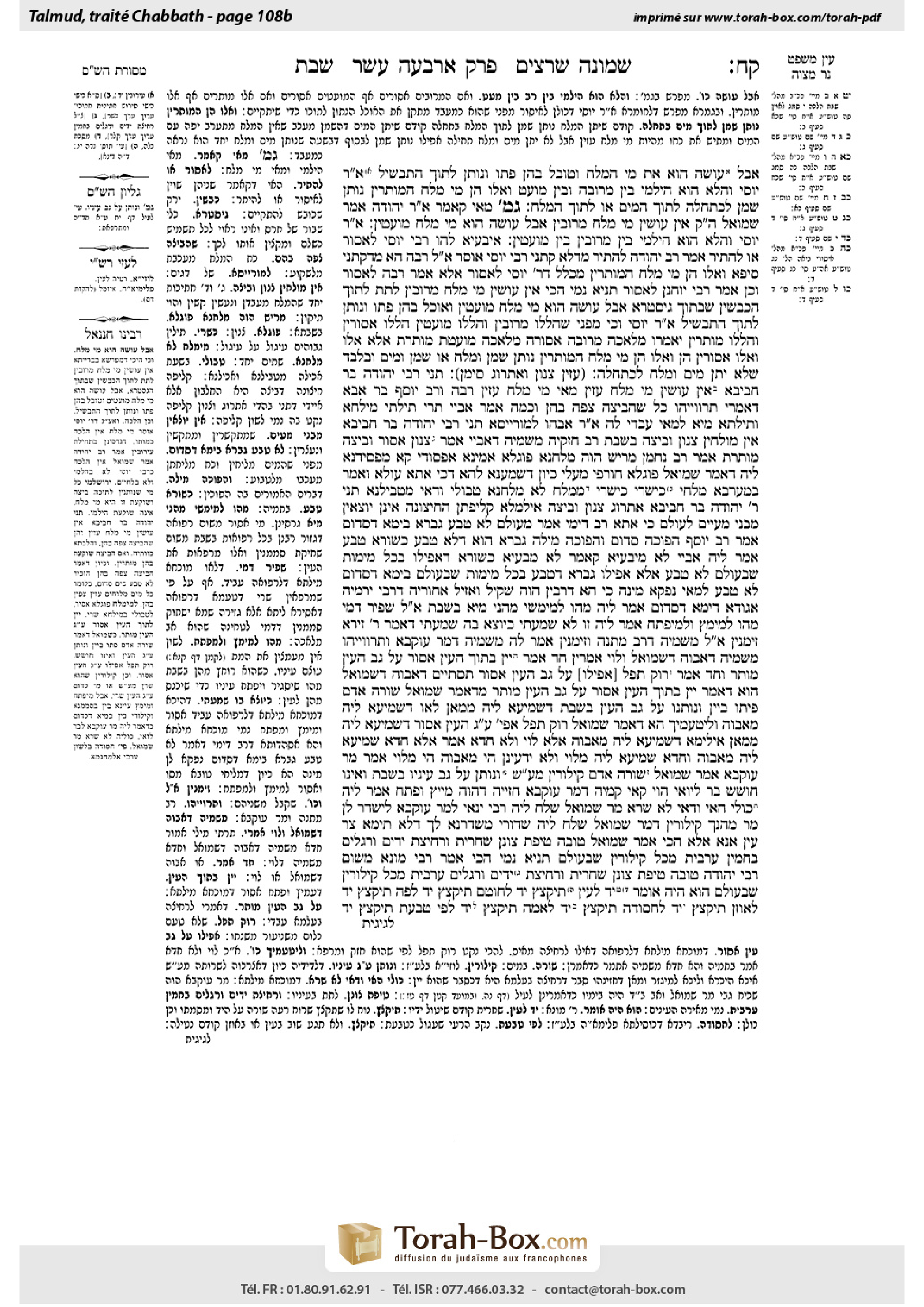
Shabbat 108b: Talmud study for Daf Yomi
Daf Yomi is the daily study of one Talmud folio. Explore 37 tractates with scans, Hebrew text, Sefaria English and AI-generated French translations where annotated.
Passage selection and English or AI-generated French translation are available where the scan has annotations. Daf Study is independent of Torah-Box and Sefaria.
Browse Shabbat · שבת · All tractatesShabbat 108b text and translations
This page of Shabbat includes the Aramaic text, an English translation and an AI-generated French translation, alongside the scan above.
שבת ק״ח ב · Aramaic and Hebrew text
אֲבָל עוֹשֶׂה הוּא אֶת מֵי הַמֶּלַח, וְטוֹבֵל בָּהֶן פִּתּוֹ, וְנוֹתֵן לְתוֹךְ הַתַּבְשִׁיל. אָמַר רַבִּי יוֹסֵי: וַהֲלֹא הוּא הֵילְמֵי, בֵּין מְרוּבֶּה וּבֵין מוּעָט! וְאֵלּוּ הֵן מֵי מֶלַח הַמּוּתָּרִין — נוֹתֵן שֶׁמֶן לְכַתְּחִלָּה לְתוֹךְ הַמַּיִם אוֹ לְתוֹךְ הַמֶּלַח.
גְּמָ׳ מַאי קָאָמַר? אָמַר רַב יְהוּדָה אָמַר שְׁמוּאֵל, הָכִי קָאָמַר: אֵין עוֹשִׂין מֵי מֶלַח מְרוּבִּין, אֲבָל עוֹשֶׂה הוּא מֵי מֶלַח מוּעָטִין.
אָמַר רַבִּי יוֹסֵי: וַהֲלֹא הוּא הֵילְמֵי, בֵּין מְרוּבִּין בֵּין מוּעָטִין. אִיבַּעְיָא לְהוּ: רַבִּי יוֹסֵי לֶאֱסוֹר אוֹ לְהַתִּיר? אָמַר רַב יְהוּדָה: לְהַתִּיר. מִדְּלָא קָתָנֵי ״רַבִּי יוֹסֵי אוֹסֵר״. אֲמַר לֵיהּ רַבָּה: הָא מִדְּקָתָנֵי סֵיפָא וְאֵלּוּ הֵן מֵי מֶלַח הַמּוּתָּרִין, מִכְּלָל דְּרַבִּי יוֹסֵי לֶאֱסוֹר. אֶלָּא אָמַר רַבָּה: לֶאֱסוֹר. וְכֵן אָמַר רַבִּי יוֹחָנָן: לֶאֱסוֹר.
תַּנְיָא נָמֵי הָכִי: אֵין עוֹשִׂין מֵי מֶלַח מְרוּבִּין לָתֵת לְתוֹךְ הַכְּבָשִׁין שֶׁבְּתוֹךְ גִּיסְטְרָא. אֲבָל עוֹשֶׂה הוּא מֵי מֶלַח מוּעָטִין, וְאוֹכֵל בָּהֶן פִּתּוֹ, וְנוֹתֵן לְתוֹךְ הַתַּבְשִׁיל. אָמַר רַבִּי יוֹסֵי: וְכִי מִפְּנֵי שֶׁהַלָּלוּ מְרוּבִּין וְהַלָּלוּ מוּעָטִין הַלָּלוּ אֲסוּרִין וְהַלָּלוּ מוּתָּרִין? יֹאמְרוּ: מְלָאכָה מְרוּבָּה — אֲסוּרָה, מְלָאכָה מוּעֶטֶת — מוּתֶּרֶת! אֶלָּא אֵלּוּ וָאֵלּוּ אֲסוּרִין הֵן. וְאֵלּוּ הֵן מֵי מֶלַח הַמּוּתָּרִין — נוֹתֵן שֶׁמֶן וּמֶלַח אוֹ שֶׁמֶן וּמַיִם, וּבִלְבַד שֶׁלֹּא יִתֵּן מַיִם וּמֶלַח לְכַתְּחִלָּה.
עַזִּין צְנוֹן וְאֶתְרוֹג סִימָן.
תָּנֵי רַבִּי יְהוּדָה בַּר חֲבִיבָא: אֵין עוֹשִׂין מֵי מֶלַח עַזִּין. מַאי מֵי מֶלַח עַזִּין? רַבָּה וְרַב יוֹסֵף בַּר אַבָּא דְאָמְרִי תַּרְוַויְיהוּ: כֹּל שֶׁהַבֵּיצָה צָפָה בָּהֶן. וְכַמָּה? אָמַר אַבָּיֵי: תְּרֵי תִּילְתֵי מִילְחָא וְתִילְתָּא מַיָּא.
לְמַאי עָבְדִי לַהּ? אָמַר רַבִּי אֲבָהוּ: לְמוּרְיְיסָא. תָּנֵי רַבִּי יְהוּדָה בַּר חֲבִיבָא: אֵין מוֹלְחִין צְנוֹן וּבֵיצָה בְּשַׁבָּת. רַב חִזְקִיָּה מִשְּׁמֵיהּ דְּאַבָּיֵי אָמַר: צְנוֹן — אָסוּר, וּבֵיצָה — מוּתֶּרֶת. אָמַר רַב נַחְמָן: מֵרֵישׁ הֲוָה מָלַחְנָא פּוּגְלָא, אָמֵינָא: אַפְסוֹדֵי קָא מַפְסֵידְנָא לֵיהּ, דַּאֲמַר שְׁמוּאֵל: פּוּגְלָא חוּרְפֵּיהּ מְעַלֵּי. כֵּיוָן דִּשְׁמַעְנָא לְהָא, דְּכִי אֲתָא עוּלָּא וְאָמַר בְּמַעְרְבָא מָלְחִי כִּישְׁרֵי כִּישְׁרֵי, מִמְלָח לָא מָלַחְנָא, טַבּוֹלֵי וַדַּאי מְטַבֵּילְנָא.
תָּנֵי רַבִּי יְהוּדָה בַּר חֲבִיבָא: אֶתְרוֹג צְנוֹן וּבֵיצָה, אִילְמָלֵא קְלִיפָּתָן הַחִיצוֹנָה אֵינָן יוֹצְאִין מִבְּנֵי מֵעַיִים לְעוֹלָם.
כִּי אֲתָא רַב דִּימִי אֲמַר: מֵעוֹלָם לָא טְבַע גַּבְרָא בְּיַמָּא דִסְדוֹם. אֲמַר רַב יוֹסֵף: הֲפִיכָא סְדוֹם, וַהֲפִיכָאן מִילַּהָא. גַּבְרָא הוּא דְּלָא טָבַע, כְּשׁוּרָא טָבַע?! אֲמַר לֵיהּ אַבָּיֵי, לָא מִיבַּעְיָא קָאָמַר: לָא מִבַּעְיָא כְּשׁוּרָא דַּאֲפִילּוּ בְּכׇל מֵימוֹת שֶׁבָּעוֹלָם לָא טָבַע, אֶלָּא אֲפִילּוּ גַּבְרָא דְּטָבַע בְּכׇל מֵימוֹת שֶׁבָּעוֹלָם, בְּיַמָּא דִסְדוֹם לָא טָבַע. לְמַאי נָפְקָא מִינַּהּ? כִּי הָא דְּרָבִין הֲוָה שָׁקֵיל וְאָזֵיל אֲחוֹרֵיהּ דְּרַבִּי יִרְמְיָה אַגּוּדָּא דְּיַמָּא דִסְדוֹם. אֲמַר לֵיהּ: מַהוּ לְמִימְשֵׁי מֵהָנֵי מַיָּא בְּשַׁבְּתָא. אֲמַר לֵיהּ: שַׁפִּיר דָּמֵי.
מַהוּ לְמִימַּץ וּלְמִיפְתַּח? אֲמַר לֵיהּ: זוֹ לֹא שָׁמַעְתִּי, כַּיּוֹצֵא בָּהּ שָׁמַעְתִּי. דְּאָמַר רַבִּי זֵירָא, זִימְנִין אָמַר לַהּ מִשְּׁמֵיהּ דְּרַב מַתְנָה וְזִימְנִין אָמַר לַהּ מִשְּׁמֵיהּ דְּמָר עוּקְבָא, וְתַרְוַויְיהוּ מִשְּׁמֵיהּ דַּאֲבוּהּ דִּשְׁמוּאֵל וְלֵוִי אָמְרִין, חַד אָמַר: יַיִן, בְּתוֹךְ הָעַיִן — אָסוּר, עַל גַּב הָעַיִן — מוּתָּר. וְחַד אָמַר: רוֹק תָּפֵל [אֲפִילּוּ] עַל גַּב הָעַיִן — אָסוּר.
תִּסְתַּיֵּים דַּאֲבוּהּ דִּשְׁמוּאֵל הוּא דְּאָמַר יַיִן בְּתוֹךְ הָעַיִן — אָסוּר, עַל גַּב הָעַיִן — מוּתָּר, מִדְּאָמַר שְׁמוּאֵל: שׁוֹרֶה אָדָם פִּיתּוֹ בְּיַיִן וְנוֹתְנוֹ עַל גַּב הָעַיִן בְּשַׁבָּת. דִּשְׁמִיעָא לֵיהּ מִמַּאן — לָאו דִּשְׁמִיעָא לֵיהּ מֵאֲבוּהּ? וְלִיטַעְמָיךְ, הָא דְּאָמַר שְׁמוּאֵל: רוֹק תָּפֵל אֲפִילּוּ עַל גַּבֵּי הָעַיִן אָסוּר, דִּשְׁמִיעָא לֵיהּ מִמַּאן? אִילֵּימָא דִּשְׁמִיעָא לֵיהּ מֵאֲבוּהּ, אֶלָּא לֵוִי — וְלָא חֲדָא אָמַר?! אֶלָּא: חֲדָא שְׁמִיעָא לֵיהּ מֵאֲבוּהּ וַחֲדָא שְׁמִיעָא לֵיהּ מִלֵּוִי, וְלָא יָדְעִינַן הֵי מֵאֲבוּהּ הֵי מִלֵּוִי.
אָמַר מָר עוּקְבָא אָמַר שְׁמוּאֵל: שׁוֹרֶה אָדָם קִילוֹרִין מֵעֶרֶב שַׁבָּת וְנוֹתֵן עַל גַּב עֵינָיו בְּשַׁבָּת, וְאֵינוֹ חוֹשֵׁשׁ. בַּר לֵוַאי הֲוָה קָאֵי קַמֵּיהּ דְּמָר עוּקְבָא. חַזְיֵיהּ דַּהֲוָה עָמֵיץ וּפָתַח. אֲמַר לֵיהּ: כּוּלֵּי הַאי וַדַּאי לָא שְׁרָא מָר שְׁמוּאֵל. שְׁלַח לֵיהּ רַבִּי יַנַּאי לְמָר עוּקְבָא: לִישַׁדַּר לַן מָר מֵהָנָךְ קִילוֹרִין דְּמָר שְׁמוּאֵל. שְׁלַח לֵיהּ: שַׁדּוֹרֵי מְשַׁדַּרְנָא לָךְ, דְּלָא תֵּימָא צַר עַיִן אֲנָא, אֶלָּא הָכִי אָמַר שְׁמוּאֵל: טוֹבָה טִיפַּת צוֹנֵן שַׁחֲרִית וּרְחִיצַת יָדַיִם וְרַגְלַיִם בְּחַמִּין עַרְבִית מִכׇּל קִילוֹרִין שֶׁבָּעוֹלָם. תַּנְיָא נָמֵי הָכִי, אָמַר רַבִּי מוּנָא מִשּׁוּם רַבִּי יְהוּדָה: טוֹבָה טִיפַּת צוֹנֵן שַׁחֲרִית וּרְחִיצַת יָדַיִם וְרַגְלַיִם עַרְבִית מִכׇּל קִילוֹרִין שֶׁבָּעוֹלָם.
הוּא הָיָה אוֹמֵר: יָד לָעַיִן — תִּיקָּצֵץ. יָד לַחוֹטֶם — תִּיקָּצֵץ. יָד לַפֶּה — תִּיקָּצֵץ. יָד לָאוֹזֶן — תִּיקָּצֵץ. יָד לַחֲסוּדָה — תִּיקָּצֵץ. יָד לָאַמָּה — תִּיקָּצֵץ. יָד לְפִי טַבַּעַת — תִּיקָּצֵץ. יָד
Shabbat 108b · English translation
but one may make salt water and dip one’s bread in it, and place it in cooked food. Rabbi Yosei said: But isn’t it still brine, whether it is a large quantity or whether it is a small quantity? And this is the type of salt water that is permitted: Salt water in which one places oil initially into the water or into the salt. This is salt water prepared not in the usual manner.
GEMARA: With regard to that which was stated in the mishna, the Gemara asks: What is the tanna saying with regard to the distinction between brine and salt water? Rav Yehuda said that Shmuel said: This is what he is saying: One may not prepare a large quantity of salt water, brine, on Shabbat, but one may prepare a small quantity of salt water.
We learned in the mishna that Rabbi Yosei said: But isn’t it still brine whether it is a large quantity or a small quantity? A dilemma was raised before the Sages: When Rabbi Yosei said that there is no difference between a large and small quantity of salt water, was his intention to prohibit preparing any salt water on Shabbat or to permit doing so? Rav Yehuda said: His intention is to permit doing so, which is understood from the fact that the mishna is not teaching: Rabbi Yosei prohibits. Rabba said to him: From the fact that it is taught in the latter clause of the mishna: And this is the type of salt water that is permitted, by inference, Rabbi Yosei intended to prohibit preparing salt water. Rather, Rabba said: Rabbi Yosei intended to prohibit preparing any salt water on Shabbat. And similarly, Rabbi Yoḥanan said: Rabbi Yosei’s intention was to prohibit.
That was also taught in a baraita: One may not prepare a large quantity of salt water to add to the pickled vegetables that are inside a flat earthenware shard used for pickling [gistera]. However, one may prepare a small quantity of salt water and eat his bread with it and add it to cooked food. Rabbi Yosei said: Is it because this is a large quantity and this is a small quantity that this is prohibited and this is permitted? People will learn from this and say: A large amount of labor is prohibited on Shabbat, but a small amount of labor is permitted. Rather, certainly they are both prohibited. And this is the type of salt water that is permitted: One may place oil and salt together or oil and water and then add salt to the mixture, and this halakha applies provided one does not place water and salt together ab initio.
Strong, radish, and citron are a mnemonic for the following halakhot.
Rabbi Yehuda bar Ḥaviva taught: One may not prepare strong salt water on Shabbat. The Gemara asks: What is strong salt water? Rabba and Rav Yosef bar Abba both said: Any water in which an egg can float. The Gemara asks: And how much salt is in this salt water? Abaye said: Two-thirds salt and one-third water.
The Gemara asks: For what purpose is this salt water prepared? Rabbi Abbahu said: It is prepared for fish brine [muraisa]. And Rabbi Yehuda bar Ḥaviva taught with regard to salting: One may not salt a radish or an egg on Shabbat because by salting them he performs a labor that improves them. Rav Ḥizkiya said in the name of Abaye: Preparing a radish is prohibited, and preparing an egg is permitted. Rav Naḥman said: Initially, I would salt radishes on Shabbat, as I said: I am ruining it by doing so, as Shmuel said: Sharpness is good for radishes; since salt reduces their sharpness, one who adds salt ruins the radish. However, once I heard this, that when Ulla came from Eretz Yisrael to Babylonia he said that in the West, i.e., Eretz Yisrael, they salt many piles of radishes throughout the week, I do not salt them on Shabbat anymore, but I certainly dip them in salt because that is not considered to be an improvement.
The Gemara cites that which Rabbi Yehuda bar Ḥaviva taught with regard to radishes and eggs: With regard to a citron, a radish, and an egg, if it were not for their outer peel, or egg white, they would never emerge from the intestines, because they are extremely hard to digest.
When Rav Dimi came from Eretz Yisrael to Babylonia he said: No person has ever drowned in the Sea of Sodom, the Dead Sea. Since there is so much salt, people easily float in it. Rav Yosef said: Sodom is overturned and Rav Dimi’s statement is backward. Is his statement saying that it is a man who does not drown in the Dead Sea, but a plank sinks? Abaye said to him: He is saying his statement utilizing the style of: It is not necessary: It is not necessary to mention a plank because it does not sink in any body of water in the world. But even a man, who drowns in other bodies of water in the world, does not drown in the Sea of Sodom. The Gemara asks: What are the practical consequences of this halakha? The Gemara explains: This halakha is relevant in a case of this kind: Ravin was walking after Rabbi Yirmeya on the shore of the Sea of Sodom. Ravin said to Rabbi Yirmeya: What is the ruling? Is it permitted to wash oneself with this water on Shabbat, or perhaps it is prohibited because it has healing properties? Rabbi Yirmeya said to him: One may well do so.
Ravin asked another question: When one washes himself on Shabbat in water from the Dead Sea, what is the halakha? Is it permitted for him to close and open his eyes in the water so that the water gets inside? Rabbi Yirmeya said to him: That case I did not hear; however, with regard to a similar case, placing wine in one’s eye on Shabbat, I did hear. As Rabbi Zeira said, sometimes he said it in the name of Rav Mattana and sometimes he said it in the name of Mar Ukva, and they both said it in the name of Shmuel’s father and in the name of Levi: One of them said: With regard to placing wine inside the eye on Shabbat, it is prohibited because it heals; on the eye, it is permitted. And one of them said: Bland saliva, saliva from one who has not eaten since waking, even placing it on the eye on Shabbat is prohibited because it is commonly used as medicine.
The Gemara comments: Conclude that Shmuel’s father is the one who said that placing wine inside the eye is prohibited but on the eye is permitted, from the fact that Shmuel said: A person may soak his bread in wine and place it on his eye on Shabbat. He said this after he heard this halakha from whom? Is it not that he heard it from his father? The Gemara rejects this: And according to your reasoning, that halakha which Shmuel said: It is prohibited to place bland saliva even on the eye on Shabbat, he said this after he heard this halakha from whom? If we say that he heard it from his father, then Levi, who was cited together with Shmuel’s father in the list of those who stated the halakhot, did he himself not say even one halakha? Rather, one halakha Shmuel heard from his father, and one halakha he heard one from Levi, and we do not know which he heard from his father and which he heard from Levi.
Mar Ukva said that Shmuel said: One may soak eye salves from Shabbat eve and place them on his eyes on Shabbat, and he need not be concerned that he is violating the prohibition against healing on Shabbat. The Gemara relates: Bar Liva’ei was standing before Mar Ukva on Shabbat. He saw Mar Ukva, who was opening and closing his eyes while applying a salve to them. Bar Liva’ei said to him: Master Shmuel certainly did not permit doing all of this. Rabbi Yannai sent a message to Mar Ukva: Can the master send us some of Master Shmuel’s eye salves? Mar Ukva sent him in response: I will send it to you so that you do not say I am miserly, but be aware that this is what Shmuel said: For healing the eyes, better a drop of cold water in the morning and washing the hands and feet with hot water in the evening than all the eye salves in the world. Follow these instructions and you will need nor other cures. That was also taught in a baraita: Rabbi Mona said in the name of Rabbi Yehuda: Better a drop of cold water in the morning and washing the hands and feet in the evening than all the eye salves in the world.
Apropos Rabbi Mona’s statement with regard to healing, the text cites what he would say about other matters that require special attention: A hand that touches the eye should be severed because it harms the eye. A hand that touches the nose should be severed. A hand that touches the mouth should be severed. A hand that touches the ear should be severed. A hand that touches one’s wound should be severed. A hand that touches one’s member should be severed, lest one arouse himself. A hand that touches one’s anus should be severed, lest one make himself ill. A hand
Shabbat 108b · Traduction française (IA)
mais on peut préparer de l’eau salée, y tremper son pain et en ajouter à un mets cuit. Rabbi Yosei dit : Mais n’est-ce pas toujours de la saumure, qu’elle soit en grande ou en petite quantité ? Voici le type d’eau salée qu’il est permis de préparer : une eau salée à laquelle on ajoute d’abord de l’huile, soit dans l’eau, soit dans le sel. Cette eau salée est préparée d’une manière inhabituelle.
GUEMARA : À propos de ce qui a été enseigné dans la Michna, la Guemara demande : Que veut dire le tanna en distinguant la saumure de l’eau salée ? Rav Yehouda a dit au nom de Shmuel : Voici ce qu’il veut dire : On ne peut pas préparer le Chabbat une grande quantité d’eau salée, c’est-à-dire de saumure, mais on peut en préparer une petite quantité.
Nous avons appris dans la Michna que Rabbi Yosei a dit : Mais n’est-ce pas toujours de la saumure, qu’elle soit en grande ou en petite quantité ? Les Sages ont soulevé une question : Lorsque Rabbi Yosei a dit qu’il n’y a pas de différence entre une grande et une petite quantité d’eau salée, voulait-il interdire d’en préparer le Chabbat ou le permettre ? Rav Yehouda a dit : Il voulait le permettre, comme on le comprend du fait que la Michna n’enseigne pas : « Rabbi Yosei interdit. » Rabba lui dit : Puisqu’il est enseigné dans la dernière clause de la Michna : « Et voici le type d’eau salée qu’il est permis de préparer », il s’ensuit que Rabbi Yosei voulait interdire d’en préparer. Rabba a donc dit : Rabbi Yosei voulait interdire la préparation de toute eau salée le Chabbat. De même, Rabbi Yoḥanan a dit que Rabbi Yosei voulait l’interdire.
Cela a également été enseigné dans une baraïta : On ne peut pas préparer une grande quantité d’eau salée pour l’ajouter aux légumes en saumure qui se trouvent dans un récipient plat en terre cuite utilisé pour le saumurage [gistera]. En revanche, on peut préparer une petite quantité d’eau salée, manger son pain avec et en ajouter à un mets cuit. Rabbi Yosei dit : Est-ce parce que l’une est une grande quantité et l’autre une petite quantité que l’une est interdite et l’autre permise ? Les gens en déduiront et diront : Un travail important est interdit le Chabbat, mais un petit travail est permis. Au contraire, elles sont toutes deux certainement interdites. Voici le type d’eau salée qu’il est permis de préparer : on peut mélanger de l’huile et du sel, ou de l’huile et de l’eau, puis ajouter du sel au mélange ; cette halakha s’applique à condition de ne pas mélanger d’abord l’eau et le sel.
Forte, radis et cédrat sont les mots mnémotechniques des halakhot suivantes.
Rabbi Yehuda bar Ḥaviva enseignait : On ne peut pas préparer d’eau fortement salée le Chabbat. La Guemara demande : Qu’est-ce qu’une eau fortement salée ? Rabba et Rav Yosef bar Abba ont tous deux dit : Toute eau dans laquelle un œuf peut flotter. La Guemara demande : Quelle quantité de sel contient cette eau salée ? Abaye a dit : Deux tiers de sel et un tiers d’eau.
La Guemara demande : À quoi sert cette eau salée ? Rabbi Abbahu a dit : Elle sert à préparer de la saumure de poisson [muraisa]. Rabbi Yehuda bar Ḥaviva enseignait également, au sujet du salage : On ne peut pas saler un radis ni un œuf le Chabbat, car en les salant, on accomplit un travail qui les améliore. Rav Ḥizkiya a dit au nom d’Abaye : Saler un radis est interdit, tandis que saler un œuf est permis. Rav Naḥman a dit : Au début, je salais des radis le Chabbat, car je me disais que je les gâtais ainsi, puisque Shmuel a dit : Le piquant est bénéfique aux radis ; comme le sel atténue leur piquant, celui qui ajoute du sel abîme le radis. Mais après avoir entendu qu’Ulla, à son arrivée d’Eretz Israël en Babylonie, avait dit qu’en Occident, c’est-à-dire en Eretz Israël, on sale de nombreux tas de radis tout au long de la semaine, je ne les sale plus le Chabbat ; toutefois, je les trempe bien dans le sel, car cela n’est pas considéré comme une amélioration.
La Guemara rapporte ce que Rabbi Yehuda bar Ḥaviva enseignait à propos des radis et des œufs : Quant au cédrat, au radis et à l’œuf, sans leur enveloppe extérieure — ou, pour l’œuf, sans son blanc — ils ne quitteraient jamais les intestins, car ils sont extrêmement difficiles à digérer.
Lorsque Rav Dimi est arrivé d’Eretz Israël en Babylonie, il a dit : Personne ne s’est jamais noyé dans la mer de Sodome, la mer Morte. Comme elle contient beaucoup de sel, les gens y flottent facilement. Rav Yosef a dit : Sodome est renversée, et la déclaration de Rav Dimi est à l’envers. Sa déclaration signifie-t-elle qu’un homme ne se noie pas dans la mer Morte, mais qu’une planche, elle, coule ? Abaye lui dit : Il s’exprime selon la formule « il n’est même pas nécessaire de mentionner » : il n’est pas nécessaire de mentionner une planche, puisqu’elle ne coule dans aucun plan d’eau au monde. Mais même un homme, qui se noie dans les autres plans d’eau du monde, ne se noie pas dans la mer de Sodome. La Guemara demande : Quelles sont les conséquences pratiques de cette halakha ? La Guemara explique : Cette halakha est pertinente dans un cas de ce genre : Ravin marchait derrière Rabbi Yirmeya sur le rivage de la mer de Sodome. Ravin demanda à Rabbi Yirmeya : Quelle est la halakha ? Est-il permis de se laver avec cette eau le Chabbat, ou est-ce interdit parce qu’elle a des propriétés curatives ? Rabbi Yirmeya lui répondit : On peut tout à fait le faire.
Ravin posa une autre question : Lorsqu’on se lave le Chabbat avec l’eau de la mer Morte, quelle est la halakha ? Est-il permis de fermer et d’ouvrir les yeux dans l’eau afin qu’elle y pénètre ? Rabbi Yirmeya lui répondit : Je n’ai pas entendu ce qui concerne ce cas ; cependant, j’ai entendu parler d’un cas semblable : mettre du vin dans l’œil le Chabbat. Rabbi Zeira disait parfois au nom de Rav Mattana et parfois au nom de Mar Ukva, et tous deux le disaient au nom du père de Shmuel et au nom de Levi. L’un d’eux a dit : Mettre du vin dans l’œil le Chabbat est interdit, car cela guérit ; en mettre sur l’œil est permis. L’autre a dit : Même appliquer sur l’œil le Chabbat de la salive fade — celle d’une personne qui n’a pas mangé depuis son réveil — est interdit, car on l’utilise couramment comme remède.
La Guemara fait remarquer : Conclus que c’est le père de Shmuel qui a dit qu’il est interdit de mettre du vin dans l’œil, mais permis d’en mettre sur l’œil, puisque Shmuel a dit : Une personne peut tremper son pain dans du vin et l’appliquer sur son œil le Chabbat. De qui a-t-il appris cette halakha ? Ne l’a-t-il pas apprise de son père ? La Guemara rejette cet argument : Et selon ton raisonnement, la halakha énoncée par Shmuel, selon laquelle il est interdit d’appliquer de la salive fade même sur l’œil le Chabbat, de qui l’a-t-il apprise ? Si nous disons qu’il l’a apprise de son père, alors Levi, cité avec le père de Shmuel parmi ceux qui ont transmis ces halakhot, n’aurait-il lui-même enseigné aucune halakha ? En réalité, Shmuel a appris une halakha de son père et une autre de Levi, mais nous ne savons pas laquelle il a apprise de son père et laquelle de Levi.
Mar Ukva a dit au nom de Shmuel : On peut faire tremper des pommades pour les yeux depuis la veille du Chabbat et les appliquer sur ses yeux le Chabbat, sans craindre de transgresser l’interdiction de guérir le Chabbat. La Guemara rapporte : Bar Liva’ei se tenait devant Mar Ukva le Chabbat. Il vit Mar Ukva ouvrir et fermer les yeux tout en leur appliquant une pommade. Bar Liva’ei lui dit : Maître, Shmuel n’a certainement pas permis tout cela. Rabbi Yannai envoya un message à Mar Ukva : Le maître peut-il nous envoyer quelques-unes des pommades pour les yeux de maître Shmuel ? Mar Ukva lui répondit : Je t’en enverrai, afin que tu ne dises pas que je suis avare ; mais sache que voici ce qu’a dit Shmuel : Pour soigner les yeux, une goutte d’eau froide le matin et se laver les mains et les pieds à l’eau chaude le soir valent mieux que toutes les pommades pour les yeux du monde. Suivez ces instructions et vous n’aurez besoin d’aucun autre remède. Cela a également été enseigné dans une baraïta : Rabbi Mona a dit au nom de Rabbi Yehuda : Une goutte d’eau froide le matin et se laver les mains et les pieds le soir valent mieux que toutes les pommades pour les yeux du monde.
À propos de la déclaration de Rabbi Mona concernant les soins, le texte rapporte ce qu’il disait au sujet d’autres choses qui nécessitent une attention particulière : Il faut couper une main qui touche l’œil, car elle lui fait du mal. Il faut couper une main qui touche le nez. Il faut couper une main qui touche la bouche. Il faut couper une main qui touche l’oreille. Il faut couper une main qui touche une plaie. Il faut couper une main qui touche son membre, de peur de s’exciter. Il faut couper une main qui touche son anus, de peur de se rendre malade. Une main
Traduction française générée par IA à partir de l’édition anglaise de Sefaria. Vérifie toujours un passage avec le texte source.
Text from Sefaria: William Davidson Edition - Vocalized Aramaic (CC BY NC); William Davidson Edition - English (CC BY NC).