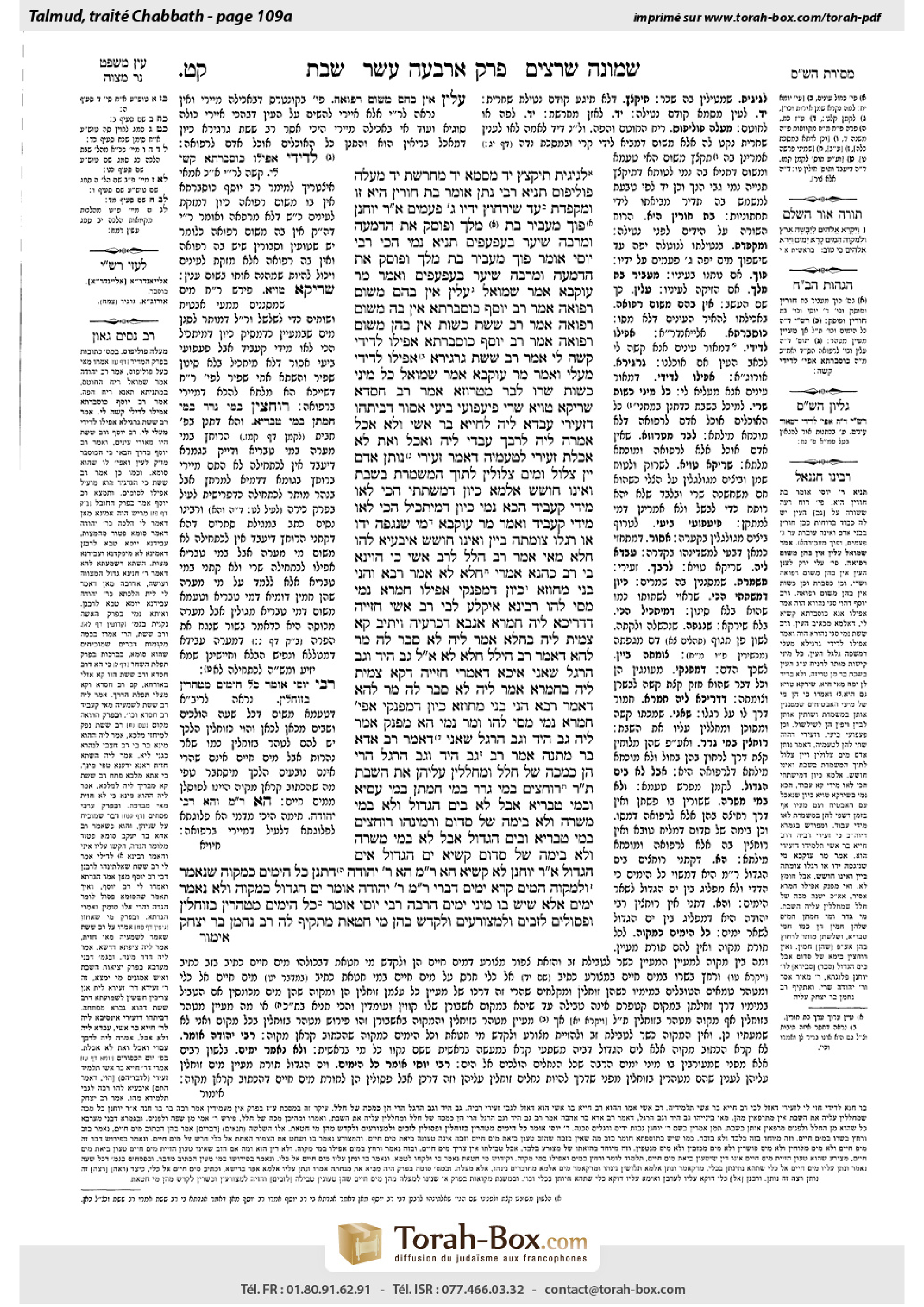
Shabbat 109a: Talmud study for Daf Yomi
Daf Yomi is the daily study of one Talmud folio. Explore 37 tractates with scans, Hebrew text, Sefaria English and AI-generated French translations where annotated.
Passage selection and English or AI-generated French translation are available where the scan has annotations. Daf Study is independent of Torah-Box and Sefaria.
Browse Shabbat · שבת · All tractatesShabbat 109a text and translations
This page of Shabbat includes the Aramaic text, an English translation and an AI-generated French translation, alongside the scan above.
שבת ק״ט א · Aramaic and Hebrew text
לַגִּיגִית — תִּיקָּצֵץ, יָד מְסַמָּא, יָד מַחְרֶשֶׁת, יָד מַעֲלָה פּוֹלִיפּוּס. תַּנְיָא, רַבִּי נָתָן אוֹמֵר: בַּת חוֹרִין הִיא זוֹ וּמַקְפֶּדֶת עַד שֶׁיִּרְחוֹץ יָדָיו שָׁלֹשׁ פְּעָמִים. אָמַר רַבִּי יוֹחָנָן: פּוּךְ מַעֲבִיר בַּת מֶלֶךְ, וּפוֹסֵק אֶת הַדִּמְעָה, וּמַרְבֶּה שֵׂיעָר בָּעַפְעַפַּיִים. תַּנְיָא נָמֵי הָכִי, רַבִּי יוֹסֵי אוֹמֵר: פּוּךְ מַעֲבִיר בַּת מֶלֶךְ, וּפוֹסֵק אֶת הַדִּמְעָה, וּמַרְבֶּה שֵׂיעָר בָּעַפְעַפַּיִם.
וְאָמַר מָר עוּקְבָא אָמַר שְׁמוּאֵל: עָלִין אֵין בָּהֶם מִשּׁוּם רְפוּאָה. אָמַר רַב יוֹסֵף: כּוּסְבַּרְתָּא אֵין בָּהּ מִשּׁוּם רְפוּאָה. אָמַר רַב שֵׁשֶׁת: כְּשׁוּת אֵין בָּהֶן מִשּׁוּם רְפוּאָה. אָמַר רַב יוֹסֵף: כּוּסְבַּרְתָּא, אֲפִילּוּ לְדִידִי קַשְׁיָא לִי. אָמַר רַב שֵׁשֶׁת: גַּרְגִּירָא, אֲפִילּוּ לְדִידִי מְעַלֵּי [לִי]. וְאָמַר מָר עוּקְבָא אָמַר שְׁמוּאֵל: כׇּל מִינֵי כְּשׁוּת שְׁרוּ לְבַר מִטָּרוֹזָא.
אָמַר רַב חִסְדָּא: שִׁירְקָא טַוְיָא — שְׁרֵי, פִּיעְפּוּעֵי בֵיעֵי — אָסוּר. דְּבֵיתְהוּ דִּזְעֵירִי עֲבַדָא לֵיהּ לְחִיָּיא בַּר אָשֵׁי, וְלָא אֲכַל. אֲמַרָה לֵיהּ: לְרַבָּךְ עֲבַדִי לֵיהּ וַאֲכַל, וְאַתְּ לָא אָכְלַתְּ?! זְעֵירִי לְטַעְמֵיהּ, דְּאָמַר זְעֵירִי: נוֹתֵן אָדָם יַיִן צָלוּל וּמַיִם צְלוּלִין לְתוֹךְ הַמְשַׁמֶּרֶת בְּשַׁבָּת וְאֵינוֹ חוֹשֵׁשׁ. אַלְמָא כֵּיוָן דְּמִשְׁתְּתֵי הָכִי — לָאו מִידֵּי קָעָבֵיד, הָכָא נָמֵי כֵּיוָן דְּמִיתְּכִיל הָכִי — לָאו מִידֵּי קָעָבֵיד.
וְאָמַר מָר עוּקְבָא: מִי שֶׁנִּגְּפָה יָדוֹ אוֹ רַגְלוֹ, צוֹמְתָהּ בְּיַיִן וְאֵינוֹ חוֹשֵׁשׁ. אִיבַּעְיָא לְהוּ: חַלָּא מַאי? אָמַר רַב הִלֵּל לְרַב אָשֵׁי: כִּי הֲוֵינָא בֵּי רַב כָּהֲנָא אָמְרִי חַלָּא לָא. אָמַר רָבָא: וְהָנֵי בְּנֵי מָחוֹזָא, כֵּיוָן דִּמְפַנְּקִי — אֲפִילּוּ חַמְרָא נָמֵי מַסֵּי לְהוּ.
רָבִינָא אִיקְּלַע לְבֵי רַב אָשֵׁי, חַזְיֵיהּ דִּדְרִיכָא לֵיהּ חֲמָרָא אַגַּבָּא דְכַרְעֵיהּ, וְיָתֵיב קָא צָמֵית לֵיהּ בְּחַלָּא. אֲמַר לֵיהּ: לָא סָבַר לַהּ מָר לְהָא דְּאָמַר רַב הִילֵּל חַלָּא לָא? אֲמַר לֵיהּ: גַּב הַיָּד וְגַב הָרֶגֶל שָׁאנֵי.
אִיכָּא דְאָמְרִי, חַזְיֵיהּ דְּקָא צָמֵית לֵיהּ בְּחַמְרָא. אֲמַר לֵיהּ: לָא סָבַר לַהּ מָר לְהָא דְּאָמַר רָבָא: הָנֵי בְּנֵי מָחוֹזָא כֵּיוָן דִּמְפַנְּקִי — אֲפִילּוּ חַמְרָא נָמֵי מַסֵּי לְהוּ? וּמָר נָמֵי הָא מְפַנַּק! אֲמַר לֵיהּ: גַּב הַיָּד וְגַב הָרֶגֶל שָׁאנֵי. דְּאָמַר רַב אַדָּא בַּר מַתְנָה אָמַר רַב: גַּב הַיָּד וְגַב הָרֶגֶל הֲרֵי הֵן כְּמַכָּה שֶׁל חָלָל וּמְחַלְּלִין עֲלֵיהֶן אֶת הַשַּׁבָּת.
תָּנוּ רַבָּנַן: רוֹחֲצִים בְּמֵי גְרָר, בְּמֵי חַמָּתָן, בְּמֵי עַסְיָא וּבְמֵי טְבֶרְיָא, אֲבָל לֹא בַּיָּם הַגָּדוֹל וְלֹא בְּמֵי מִשְׁרָה וְלֹא בְּיַמָּהּ שֶׁל סְדוֹם.
וּרְמִינְהוּ: רוֹחֲצִים בְּמֵי טְבֶרְיָא וּבַיָּם הַגָּדוֹל, אֲבָל לֹא בְּמֵי מִשְׁרָה וְלֹא בְּיַמָּהּ שֶׁל סְדוֹם — קַשְׁיָא יָם הַגָּדוֹל אַיָּם הַגָּדוֹל!
אָמַר רַבִּי יוֹחָנָן, לָא קַשְׁיָא: הָא — רַבִּי מֵאִיר, הָא — רַבִּי יְהוּדָה. דִּתְנַן: כָּל הַיַּמִּים כְּמִקְוֶה, שֶׁנֶּאֱמַר: ״וּלְמִקְוֵה הַמַּיִם קָרָא יַמִּים״, דִּבְרֵי רַבִּי מֵאִיר. רַבִּי יְהוּדָה אוֹמֵר: יָם הַגָּדוֹל כְּמִקְוֶה, וְלֹא נֶאֱמַר ״יַמִּים״, אֶלָּא שֶׁיֵּשׁ בּוֹ מִינֵי יַמִּים הַרְבֵּה.
רַבִּי יוֹסֵי אוֹמֵר: כׇּל הַיַּמִּים מְטַהֲרִין בְּזוֹחֲלִין, וּפְסוּלִים לְזָבִים וְלִמְצוֹרָעִים וּלְקַדֵּשׁ בָּהֶן מֵי חַטָּאת. מַתְקֵיף לַהּ רַב נַחְמָן בַּר יִצְחָק:
Shabbat 109a · English translation
that is placed into a barrel of beer should be severed because the beer will not ferment. A hand that frequently touches the eye causes blindness. A hand that frequently touches the ear causes deafness. A hand that touches the nose or mouth causes polyps [polypus]. It was taught in a baraita that Rabbi Natan says: She is a liberated entity, this evil spirit that rests on one’s hands before they are washed in the morning, and she refuses to leave until one washes his hands three times. Rabbi Yoḥanan said: When eye shadow is placed on the eyes it causes the evil spirit called the Daughter of the King to pass, and it stops tears and causes eyelashes to grow. That was also taught in a baraita: Rabbi Yosei says: Eye shadow causes the Daughter of the King to pass, and stops tears and causes eyelashes to grow.
And Mar Ukva said that Shmuel said: Leaves that are placed on the eye (Rabbeinu Ḥananel) contain no element of healing, and therefore one may place them on his eyes on Shabbat.
Rav Yosef said: Coriander contains no element of healing.
Rav Sheshet said: Hops contain no element of healing.
Rav Yosef said: Even for me, who is blind, coriander is harmful. He overstated coriander’s inefficacy, asserting that it is in fact harmful.
Rav Sheshet said: Arugula even for me, despite my blindness, is beneficial.
And Mar Ukva also said that Shmuel said: All types of hops may be eaten on Shabbat except for teruza, which is used exclusively for medicinal purposes.
Rav Ḥisda said: Melon juice, which is beneficial for the intestines, may be strained and drunk on Shabbat (ge’onim). The juice of pipuim, which are a type of vegetable (Rashba), may not be drunk on Shabbat. The Gemara relates: Ze’iri’s wife made melon juice for Ḥiyya bar Ashi and he did not consume it. She said to him: I made it for your Rabbi, Ze’iri, and he ate it, and you do not eat it? The Gemara explains: Ze’iri followed his own reasoning in permitting this drink, as Ze’iri said: One may place clear wine and clear water into a strainer used to strain dregs from wine on Shabbat without concern. Apparently, since the wine and water are drunk even with what little dregs may remain, one is doing nothing to improve them. Here, too, since melon juice is consumed this way, without being strained and for non-medical purposes, one is doing nothing and it is permitted.
And Mar Ukva also said: One whose hand or foot was wounded may immerse it in wine on Shabbat to stop the flow of blood, and he need not be concerned that he is violating the prohibition against healing on Shabbat. A dilemma was raised before the Sages: With regard to vinegar, what is the ruling? May one immerse a wound in it? Rav Hillel said to Rav Ashi: When we were in Rav Kahana’s house they said that vinegar is not permitted, as it is considered actual medicine. Rava said: And these people from Meḥoza, since they are delicate, even wine heals them. Therefore, they may not immerse their wounds in wine.
The Gemara relates: Ravina happened to come to the house of Rav Ashi. He saw that a donkey stepped on the back of Rav Ashi’s foot, and Rav Ashi sat and immersed his foot in vinegar on Shabbat. Ravina said to Rav Ashi: Does the Master not hold according to that which Rav Hillel stated, that vinegar is not permitted? He said to him: The back of the hand and the back of the foot are different because their wounds are dangerous.
Some say that Ravina saw that Rav Ashi immersed his foot in wine. Ravina said to him: Does the Master not hold according to that which Rava said: These people from Meḥoza, since they are delicate, even wine heals them? And the Master is also delicate. Rav Ashi said to him: The back of the hand and the back of the foot are different, as Rav Adda bar Mattana said that Rav said: A wound on the back of the hand or the back of the foot is like a fatal wound, and one may desecrate Shabbat for it.
The Sages taught in a baraita: On Shabbat, one may bathe in the therapeutic hot springs of the waters of Gerar, in the waters of Ḥamatan, in the waters of Asya, and in the waters of Tiberias; however, one may not bathe in the Great Sea, namely, the Mediterranean sea, nor in water in which flax was soaked, nor in the Sea of Sodom, because people bathe in those bodies of water only for medicinal purposes.
And the Gemara raises a contradiction based on that which was taught in another baraita: One may bathe in the waters of Tiberias on Shabbat and in the Great Sea; but one may not bathe in water in which flax was soaked, nor in the Sea of Sodom. This is difficult because in the first baraita the Sages prohibit bathing in the Great Sea, and in this baraita they permit bathing in the Great Sea.
Rabbi Yoḥanan said: This is not difficult, because this baraita, which permits bathing in the Great Sea, is in accordance with the opinion of Rabbi Meir, who deems all seas equal. That baraita, which prohibits bathing there, is in accordance with the opinion of Rabbi Yehuda, who holds that the Great Sea is unlike other seas. As we learned in a mishna: All seas purify like a ritual bath [mikve], as it is stated: “And God called the dry land earth, and the gathering together of the waters [mikve] He called seas” (Genesis 1:10); this is the statement of Rabbi Meir. Rabbi Yehuda says: Only the Great Sea purifies like a ritual bath, and the verse states seas only because there are many seas in the Great Sea, not because all seas purify.
Rabbi Yosei says: All seas purify like a ritual bath. They actually purify even more than a ritual bath, as they purify even when they are flowing. Immersion in a sea is purifying not only when its waters are still, but even when they are flowing. That is not the case with a ritual bath, whose waters only purify when still. And sea water is invalid for purifying zavim and lepers and for sanctifying purification water to mix the ashes of the red heifer with it. Those cases require spring water. Rav Naḥman bar Yitzḥak strongly objects to this explanation:
Shabbat 109a · Traduction française (IA)
celui qu’on place dans un tonneau de bière doit être coupé, car la bière ne fermentera pas. Une main qui touche fréquemment l’œil entraîne la cécité. Une main qui touche fréquemment l’oreille entraîne la surdité. Une main qui touche le nez ou la bouche provoque des polypes [polypus]. Une baraïta enseigne que Rabbi Natan dit : « C’est une entité affranchie, cet esprit mauvais qui repose sur les mains avant qu’on les lave le matin ; il refuse de partir tant qu’on ne s’est pas lavé les mains trois fois. » Rabbi Yoḥanan dit : « Quand on applique du khôl sur les yeux, cela fait partir l’esprit mauvais appelé la Fille du Roi, arrête les larmes et fait pousser les cils. » Une baraïta enseigne également que Rabbi Yosei dit : « Le khôl fait partir la Fille du Roi, arrête les larmes et fait pousser les cils. »
Mar Ukva dit également au nom de Shmuel : les feuilles qu’on pose sur l’œil (Rabbeinu Ḥananel) n’ont aucun effet médicinal ; on peut donc les poser sur les yeux pendant Chabbat. Rav Yosef dit : « La coriandre n’a aucun effet médicinal. » Rav Sheshet dit : « Le houblon n’a aucun effet médicinal. » Rav Yosef dit : « Même pour moi, qui suis aveugle, la coriandre est nocive. » Il exagéra l’absence d’efficacité de la coriandre, affirmant qu’elle est en réalité nocive. Rav Sheshet dit : « La roquette est bénéfique même pour moi, malgré ma cécité. » Mar Ukva dit également au nom de Shmuel : on peut manger pendant Chabbat toutes les sortes de houblon, à l’exception du teruza, qui est utilisé exclusivement à des fins médicinales.
Rav Ḥisda dit : le jus de melon, bénéfique pour les intestins, peut être filtré et bu pendant Chabbat (ge’onim). Le jus de pipuim, qui sont une sorte de légume (Rashba), ne peut pas être bu pendant Chabbat. La Guemara raconte : la femme de Ze’iri prépara du jus de melon pour Ḥiyya bar Ashi, mais celui-ci n’en but pas. Elle lui dit : « Je l’ai préparé pour ton maître, Ze’iri, et lui en a bu ; pourquoi n’en bois-tu pas ? » La Guemara explique que Ze’iri suivait son propre raisonnement en autorisant cette boisson, car Ze’iri dit : « On peut verser du vin clair et de l’eau claire dans une passoire servant à filtrer les lies du vin pendant Chabbat, sans inquiétude. » Apparemment, puisque le vin et l’eau se boivent même avec le peu de lies qui peut y rester, on ne fait rien pour les améliorer. Ici aussi, puisque le jus de melon se consomme ainsi, sans être filtré et à des fins non médicinales, on ne fait rien et cela est permis.
Mar Ukva dit également : celui dont la main ou le pied a été blessé peut le plonger dans du vin pendant Chabbat pour arrêter l’écoulement du sang, sans craindre d’enfreindre l’interdiction de soigner pendant Chabbat. Les Sages posèrent la question suivante : quel est le statut du vinaigre ? Peut-on y plonger une blessure ? Rav Hillel dit à Rav Ashi : « Lorsque nous étions chez Rav Kahana, on disait que le vinaigre n’est pas permis, car il est considéré comme un véritable médicament. » Rava dit : « Quant à ces habitants de Meḥoza, puisqu’ils sont délicats, même le vin les soigne. Ils ne peuvent donc pas plonger leurs blessures dans du vin. »
La Guemara raconte : Ravina arriva par hasard chez Rav Ashi. Il vit qu’un âne avait marché sur le dessus du pied de Rav Ashi, et que celui-ci était assis en train de plonger son pied dans du vinaigre pendant Chabbat. Ravina dit à Rav Ashi : « Le Maître ne suit-il pas l’avis de Rav Hillel, selon lequel le vinaigre n’est pas permis ? » Rav Ashi lui répondit : « Le dessus de la main et le dessus du pied sont différents, car les blessures à ces endroits sont dangereuses. »
Selon certains, Ravina vit Rav Ashi tremper son pied dans du vin. Ravina lui dit : « Le Maître ne suit-il pas l’avis de Rava, qui a dit que ces habitants de Meḥoza, parce qu’ils sont délicats, sont même soignés par le vin ? Le Maître aussi est délicat. » Rav Ashi lui répondit : « Le dessus de la main et le dessus du pied sont différents, car Rav Adda bar Mattana a dit au nom de Rav : une blessure sur le dessus de la main ou du pied est comme une blessure mortelle, et l’on peut transgresser le Chabbat pour la soigner. »
Les Sages ont enseigné dans une baraïta : le Chabbat, on peut se baigner dans les sources chaudes thérapeutiques de Gerar, dans les eaux de Ḥamatan, dans celles d’Asya et dans celles de Tibériade ; cependant, on ne peut se baigner ni dans la Grande Mer, c’est-à-dire la mer Méditerranée, ni dans l’eau où l’on a fait tremper du lin, ni dans la mer de Sodome, car les gens ne se baignent dans ces eaux qu’à des fins médicinales.
La Guemara soulève une contradiction à partir de ce qui a été enseigné dans une autre baraïta : on peut se baigner le Chabbat dans les eaux de Tibériade et dans la Grande Mer, mais on ne peut se baigner ni dans l’eau où l’on a fait tremper du lin, ni dans la mer de Sodome. Cela pose difficulté, car la première baraïta interdit de se baigner dans la Grande Mer, tandis que cette baraïta le permet.
Rabbi Yoḥanan dit : cela ne pose pas de difficulté, car cette baraïta, qui permet de se baigner dans la Grande Mer, suit l’opinion de Rabbi Meïr, qui considère toutes les mers comme équivalentes. L’autre baraïta, qui interdit de s’y baigner, suit l’opinion de Rabbi Yehouda, selon laquelle la Grande Mer est différente des autres mers. En effet, nous avons appris dans une Michna : toutes les mers purifient comme un bain rituel [mikve], ainsi qu’il est dit : « Dieu appela la terre ferme “terre”, et le rassemblement des eaux [mikve], Il l’appela “mers” » (Genèse 1:10) ; telle est la position de Rabbi Meïr. Rabbi Yehouda dit : « Seule la Grande Mer purifie comme un bain rituel, et le verset parle de “mers” uniquement parce que la Grande Mer contient de nombreuses mers, et non parce que toutes les mers purifient. »
Rabbi Yosei dit : toutes les mers purifient comme un bain rituel. En réalité, elles purifient même davantage qu’un bain rituel, car elles purifient même lorsque leurs eaux sont courantes. L’immersion dans la mer purifie non seulement lorsque ses eaux sont stagnantes, mais aussi lorsqu’elles sont courantes. Il n’en va pas de même pour un bain rituel, dont les eaux ne purifient que lorsqu’elles sont stagnantes. L’eau de mer ne convient pas pour purifier les zavim et les lépreux, ni pour préparer l’eau de purification à laquelle on mêle les cendres de la vache rousse. Dans ces cas, il faut de l’eau de source. Rav Naḥman bar Yitzḥak s’oppose vivement à cette explication :
Traduction française générée par IA à partir de l’édition anglaise de Sefaria. Vérifie toujours un passage avec le texte source.
Text from Sefaria: William Davidson Edition - Vocalized Aramaic (CC BY NC); William Davidson Edition - English (CC BY NC).