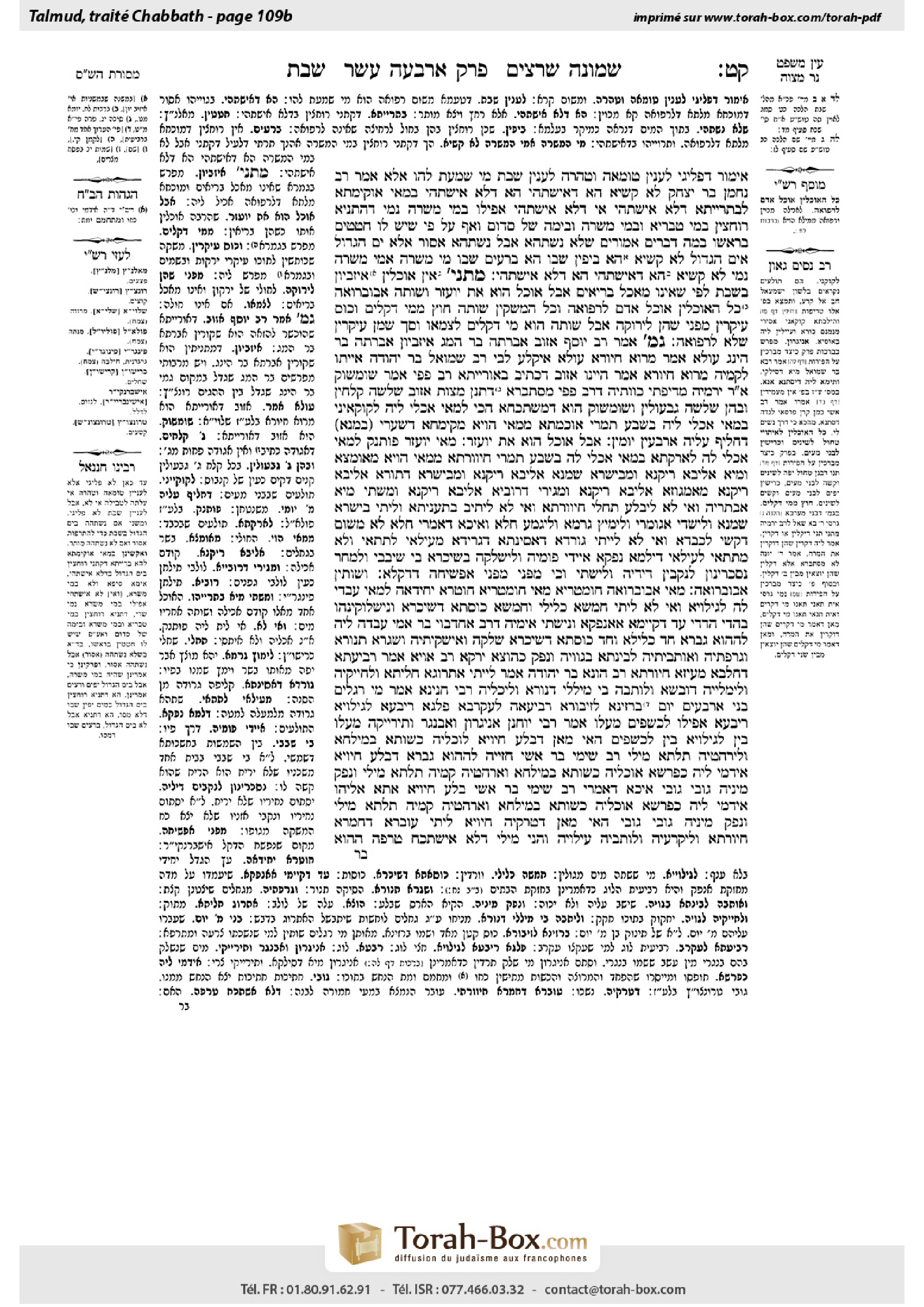
Shabbat 109b: Talmud study for Daf Yomi
Daf Yomi is the daily study of one Talmud folio. Explore 37 tractates with scans, Hebrew text, Sefaria English and AI-generated French translations where annotated.
Passage selection and English or AI-generated French translation are available where the scan has annotations. Daf Study is independent of Torah-Box and Sefaria.
Browse Shabbat · שבת · All tractatesShabbat 109b text and translations
This page of Shabbat includes the Aramaic text, an English translation and an AI-generated French translation, alongside the scan above.
שבת ק״ט ב · Aramaic and Hebrew text
אֵימוֹר דִּפְלִיגִי לְעִנְיַן טוּמְאָה וְטׇהֳרָה, לְעִנְיַן שַׁבָּת מִי שָׁמְעַתְּ לְהוּ? אֶלָּא אָמַר רַב נַחְמָן בַּר יִצְחָק, לָא קַשְׁיָא: הָא דְּאִישְׁתַּהִי, הָא דְּלָא אִישְׁתַּהִי.
בְּמַאי אוֹקֵימְתָּא לְבָתְרָיְיתָא — דְּלָא אִישְׁתַּהִי, אִי דְּלָא אִישְׁתַּהִי — אֲפִילּוּ בְּמֵי מִשְׁרָה נָמֵי. דְּהָתַנְיָא: רוֹחֲצִין בְּמֵי טְבֶרְיָא וּבְמֵי מִשְׁרָה וּבְיַמָּה שֶׁל סְדוֹם, וְאַף עַל פִּי שֶׁיֵּשׁ לוֹ חֲטָטִים בְּרֹאשׁוֹ. בַּמֶּה דְּבָרִים אֲמוּרִים — שֶׁלֹּא נִשְׁתַּהָא, אֲבָל נִשְׁתַּהָא — אָסוּר.
אֶלָּא יָם הַגָּדוֹל אַיָּם הַגָּדוֹל לָא קַשְׁיָא: הָא — בְּיָפִין שֶׁבּוֹ, הָא — בְּרָעִים שֶׁבּוֹ. מֵי מִשְׁרָה אַמֵּי מִשְׁרָה נָמֵי לָא קַשְׁיָא: הָא — דְּאִישְׁתַּהִי, הָא — דְּלָא אִישְׁתַּהִי.
מַתְנִי׳ אֵין אוֹכְלִין אֵיזֹבְיוֹן בְּשַׁבָּת לְפִי שֶׁאֵינוֹ מַאֲכַל בְּרִיאִים, אֲבָל אוֹכֵל הוּא אֶת יוֹעֶזֶר, וְשׁוֹתֶה אַבּוּבְרוֹאֶה. כׇּל הָאוֹכָלִין — אוֹכֵל אָדָם לִרְפוּאָה, וְכׇל הַמַּשְׁקִין — שׁוֹתֶה, חוּץ מִמֵּי דְקָלִים וְכוֹס עִיקָּרִין, מִפְּנֵי שֶׁהֵן לִירוֹקָה. אֲבָל שׁוֹתֶה הוּא מֵי דְקָלִים לִצְמָאוֹ, וְסָךְ שֶׁמֶן עִיקָּרִין שֶׁלֹּא לִרְפוּאָה.
גְּמָ׳ אָמַר רַב יוֹסֵף: אֵזוֹב — ״אַבְרָתָה בַּר הֲמַג״, אֵיזֹבְיוֹן — ״אַבְרָתָה בַּר הִינְג״. עוּלָּא אָמַר: מָרְוָא חִיוָּרָא. עוּלָּא אִיקְּלַע לְבֵי רַב שְׁמוּאֵל בַּר יְהוּדָה, אַיְיתוֹ לְקַמֵּיהּ מָרְוָא חִיוָּרָא. אֲמַר: הַיְינוּ אֵזוֹב דִּכְתִיב בְּאוֹרָיְיתָא. רַב פַּפֵּי אָמַר: שׁוּמְשׁוּק. אָמַר רַב יִרְמְיָה מִדִּיפְתִּי: כְּווֹתֵיהּ דְּרַב פַּפֵּי מִסְתַּבְּרָא, דִּתְנַן: מִצְוַת אֵזוֹב שְׁלֹשָׁה קְלָחִין וּבָהֶן שְׁלֹשָׁה גִבְעוֹלִין, וְשׁוּמְשׁוּק הוּא דְּמִשְׁתַּכְחָא הָכִי. לְמַאי אָכְלִי לֵיהּ — לְקוּקְאיָנֵי. בְּמַאי אָכְלִי לֵיהּ — בִּשְׁבַע תַּמְרֵי אוּכָּמָתָא. מִמַּאי הָוְיָא — מִקִּימְחָא דִשְׂעָרֵי בְּמָנָא דַּחֲלֵיף עֲלֵיהּ אַרְבְּעִין יוֹמִין.
אֲבָל אוֹכֵל הוּא אֶת יוֹעֶזֶר. מַאי יוֹעֶזֶר? פּוּתַּנְק. לְמַאי אָכְלִי לַהּ — לְאַרְקָתָא. בְּמַאי אָכְלִי לַהּ — בִּשְׁבַע תַּמְרֵי חִיוּוֹרָתָא. מִמַּאי הָוְיָא — מֵאוּמְצָא וּמַיָּא אַלִּיבָּא רֵיקָנָא, וּמִבִּישְׂרָא שַׁמִּינָא אַלִּיבָּא רֵיקָנָא, וּמִבִּישְׂרָא דְתוֹרָא אַלִּיבָּא רֵיקָנָא, מֵאַמְגּוּזָא אַלִּיבָּא רֵיקָנָא, וּמִגִּירֵי דְרוּבְיָא אַלִּיבָּא רֵיקָנָא וּמִשְׁתֵּי מַיָּא אַבָּתְרֵיהּ.
וְאִי לָא — לִיבְלַע תַּחְלֵי חִיוּוֹרָתָא. וְאִי לָא — לִיתִּיב בְּתַעֲנִיתָא, וְלַיְתֵי בִּישְׂרָא שַׁמִּינָא וְלִישְׁדֵּי אַגּוּמְרֵי, וְלִימֵיץ גַּרְמָא, וְלִיגַמַּע חַלָּא. וְאִיכָּא דְאָמְרִי: חַלָּא לָא, מִשּׁוּם דְּקָשֵׁי לְכַבְדָּא. וְאִי לָא — לַיְיתֵי גִּירְדָּא דַאֲסִינְתָּא דִּגְרִידָא מֵעִילַּאי לְתַתַּאי, וְלָא מִתַּתַּאי לְעִילַּאי, דִּילְמָא נָפְקָא אַיְּידֵי פּוּמֵּיהּ, וְלִישְׁלְקַהּ בְּשִׁיכְרָא בֵּי שִׁיבָבֵי, וּלְמָחָר נִסְכְּרִינּוּן לְנִקְבִין דִּידֵיהּ וְלִישְׁתֵּי, וְכִי מִפְּנֵי — מִפְּנֵי אַפְּשִׁיחָא דְּדִקְלָא.
וְשׁוֹתִין אַבּוּבְרוֹאֶה. מַאי אַבּוּבְרוֹאֶה? חוּמַטְרִיָּא. מַאי חוּמַטְרִיָּא? חוּטְרָא יְחִידָאָה. לְמַאי עָבְדִי לַהּ — לְגִילּוּיָא. וְאִי לָא — לַיְתֵי חַמְשָׁא כְּלִילֵי וְחַמְשָׁא כּוֹסָתָא דְשִׁיכְרָא, וְנִישְׁלוֹקִינְהוּ בַּהֲדֵי הֲדָדֵי עַד דְּקַיְימָא אַאַנְפָּקָא, וְנִישְׁתֵּי.
אִימֵּיהּ דְּרַב אַחָדְבוּי בַּר אַמֵּי עֲבַדָה לֵיהּ לְהָהוּא גַּבְרָא חַד כְּלִילָא וְחַד כּוֹסְתָּא דְשִׁיכְרָא. שְׁלַקָה וְאַישְׁקִיתֵיהּ, וּשְׁגַרָא תַּנּוּרָא וּגְרַפְתֵּיהּ, (ואותביתיה לבינתא) [וְאוֹתִיבָה בֵּיהּ לְבֵינְתָּא, וְאוֹתִיבְתֵּיהּ] בְּגַוֵּויהּ, וּנְפַק [מִינֵּיהּ] כְּהוּצָא יַרְקָא.
רַב אַוְיָא אָמַר: רְבִיעֵתָא דַחֲלָבָא מֵעִיזָּא חִיוָּרְתָּא. רַב הוּנָא בַּר יְהוּדָה אָמַר: לַיְיתֵי אֶתְרוֹגָא חֲלִיתָא וְלִחַיְּיקֵיהּ וְלִימַלְּיֵיהּ דּוּבְשָׁא, וְלוֹתְבֵהּ בֵּי מִילְלֵי דְנוּרָא, וְלֵיכְלֵיהּ. רַבִּי חֲנִינָא אָמַר, מֵי רַגְלַיִם בְּנֵי אַרְבָּעִים יוֹם: בַּרְזִינָא — לְזִיבּוּרָא, רְבִיעֵתָא — לְעַקְרַבָּא, פַּלְגָא רִיבְעָא — לְגִילּוּיָא, רִיבְעָא — אֲפִילּוּ לִכְשָׁפִים מְעַלּוּ. אָמַר רַבִּי יוֹחָנָן: אֲנִיגְרוֹן, וַאֲבַנְגַּר, וְתִירְיָיקָה — מְעַלּוּ בֵּין לְגִילּוּיָא בֵּין לִכְשָׁפִים.
הַאי מַאן דִּבְלַע חִיוְיָא — לוֹכְלֵיהּ כְּשׁוּתָא בְּמִילְחָא, וְלַירְהֲטֵיהּ תְּלָתָא מִילֵּי. רַב שִׁימִי בַּר אָשֵׁי חַזְיֵיהּ לְהָהוּא גַּבְרָא דִּבְלַע חִיוְיָא. אִידְּמִי לֵיהּ כְּפַרָּשָׁא. אוֹכְלֵיהּ כְּשׁוּתָא בְּמִילְחָא וְאַרְהֲטֵיהּ קַמֵּיהּ תְּלָתָא מִילֵּי, וּנְפַק מִינֵּיהּ גּוּבֵּי גּוּבֵּי. אִיכָּא דְאָמְרִי: רַב שִׁימִי בַּר אָשֵׁי בְּלַע חִיוְיָא, אֲתָא אֵלִיָּהוּ אִידְּמִי לֵיהּ כְּפַרָּשָׁא. אוֹכְלֵיהּ כְּשׁוּתָא בְּמִילְחָא וְאַרְהֲטֵיהּ קַמֵּיהּ תְּלָתָא מִילֵּי וּנְפַק מִינֵּיהּ גּוּבֵּי גּוּבֵּי. הַאי מַאן דְּטַרְקֵיהּ חִיוְיָא — לֵיתֵי עוּבָּרָא דַחֲמָרָא חִיוָּרְתִּי, וְלִיקְרְעֵיהּ, וְלוֹתְבֵיהּ עִילָּוֵיהּ. וְהָנֵי מִילֵּי דְּלָא אִישְׁתְּכַח טְרֵפָה. הָהוּא
Shabbat 109b · English translation
Say that they disagree over the status of the Mediterranean Sea with regard to impurity and purity, but with regard to Shabbat did you hear that they disagree? Rather, Rav Naḥman bar Yitzḥak said: The contradiction between the two baraitot is not difficult. This baraita, which prohibits bathing in the Mediterranean, is referring to a case where one remained in the water and thereby indicated that he bathed in the Mediterranean for its curative effects. That baraita, which permits bathing, is referring to a case where one did not remain in the water, and thereby indicated that he bathed in the Mediterranean for non-medical purposes.
The Gemara asks: And how did you establish this last baraita? Do you say that it is referring to a case where one did not remain in the water? If it is referring to a case where one did not remain in the water, it would be permitted to bathe even in water in which flax was soaked, as it was taught in a baraita: One may bathe on Shabbat in the waters of Tiberias, and in water in which flax was soaked, and in the Sodom Sea, and this is even though one has wounds on his head that are healed by bathing in these waters. In what case is this statement said? In a case where one did not remain in the water, since it appears that he entered the water to cool himself. However, if one remained in the water it is prohibited.
Rather, the contradiction between the baraita that permits bathing in the Great Sea on Shabbat and the baraita that prohibits bathing in the Great Sea on Shabbat is not difficult. There is a distinction between the two. This baraita, which permits doing so, is referring to the pure water in it, i.e., the area in the Great Sea in which one bathes for pleasure during the week. That baraita, which prohibits bathing, is referring to the polluted water in it, which people enter only for medicinal purposes. And with regard to the contradiction between one statement with regard to the water in which flax was soaked and the other statement about water in which flax was soaked, it is also not difficult. There is a distinction between the two statements. This baraita, which prohibits bathing on Shabbat in water in which flax was soaked, is referring to a case where one remained in the water and thereby indicated that he was bathing for medicinal purposes. That baraita, which permits bathing on Shabbat in water in which flax was soaked, is referring to a case where one did not remain there. It is permitted to bathe in that water for non-medical purposes.
MISHNA: One may not eat eizoveyon on Shabbat because healthy people do not eat it, and therefore it is clear that anyone eating it is doing so for its medicinal value. However, one may eat a plant called yo’ezer and may drink abuvro’e. Furthermore, all types of food that healthy people eat may be eaten by a person even for medicinal purposes. And one may drink all drinks except for water from palm trees and a kos ikarin because they are known as a remedy for jaundice. Therefore, it is prohibited to drink them on Shabbat for curative purposes. However, one may drink palm tree water on Shabbat in order to quench his thirst, and one may smear ikarin oil on himself for non-medical purposes.
GEMARA: Rav Yosef said: Unspecified hyssop mentioned in the Torah is called abarta bar hamag in Babylonia, and eizoveyon is called abarta bar hing. Ulla said: The hyssop mentioned in the Torah is white sage. The Gemara relates: Ulla happened to come to the house of Rav Shmuel bar Yehuda. They brought white sage before him. He said: This is the hyssop that is written in the Torah. Rav Pappi said: Hyssop is the root called shumeshuk. Rav Yirmeya of Difti said: In accordance with the opinion of Rav Pappi it is reasonable, as we learned in a mishna: The mitzva of hyssop is that one take three branches each with three stems, and shumeshuk is the species that is found with that configuration of three stems on each of its branches. The Gemara says: For what purpose do people eat it? It is eaten for curing intestinal worms. And with what is it eaten? It is eaten with seven black dates. From what do worms come into being in the intestines? They come into being from eating barley flour from a vessel that held the flour for forty days since it was ground.
We learned in the mishna: However, one may eat the yo’ezer plant. The Gemara asks: What is yo’ezer? The Gemara answers: It is the vegetable known as potnak. For what is it eaten? It is eaten to cure liver worms. With what is it eaten? It is eaten with seven white dates. From what do worms come into being in the liver? From eating raw meat with water on an empty stomach, and from eating fatty meat on an empty stomach, and from eating ox meat on an empty stomach, and from eating nuts on an empty stomach, and from eating fenugreek shoots on an empty stomach and drinking water thereafter.
And if one has liver worms but does not have any potnak handy, or if one has taken potnak and it did not help, he should swallow white cress. And if he does not have that or if it did not help him, he should sit in fast, and take fatty meat and place it on coals and suck the bone and swallow vinegar. And some say: One should not drink vinegar because it is harmful to the liver. And if none of those options are available, let one take the sawdust that was scraped from the shell of a thorn bush from top to bottom, and not from bottom to top, as perhaps then the worms will come out through his mouth. And let one then boil the scrapings in beer at twilight and the next day close his nostrils and drink it. And when he defecates, he should defecate on the trunk of a palm tree.
We learned the mishna: And one may drink abuvro’e on Shabbat. The Gemara asks: What is abuvro’e? The Gemara answers: It is the plant known as ḥumtareya. The Gemara asks: What is ḥumtareya? It is that which is called the lonely staff. The Gemara asks: For what purpose is it used? It is used for one who drank exposed water from which we suspect a snake drank and left behind its venom. And if one does not have the lonely staff, or if it was ineffective, let him take five roses and five cups of beer and cook them together until there is a quarter of a log of liquid and then drink it.
The Gemara relates: Rav Aḥadvoi bar Ami’s mother made this remedy for a certain man who had drunk exposed water suspected of having venom in it. She took one rose and one cup of beer and she boiled them. She gave it to him to drink, and lit the oven, and swept out the coals, and placed a brick inside it on which he could sit and not get burned. And something that appeared like a green leaf emerged, i.e., he vomited the venom.
Rav Avya said: The remedy for one who has swallowed venom is to drink a quarter of a log of milk from a white goat. Rav Huna bar Yehuda said: Let one bring a sweet citron and make a hole in it, and fill it with honey, and place it among burning coals, and eat it. Rabbi Ḥanina said: Urine that is forty days old is an effective remedy for several maladies: A very small cupful is beneficial in treating a hornet sting. A quarter of a log is beneficial in treating a scorpion bite. Half a log is effective in treating one who drank exposed water. A log is even effective in counteracting witchcraft. Rabbi Yoḥanan said: Water in which spinach was boiled [anigron], and water in which banagri grass was boiled [avangar], and balsam are effective for both one who drank exposed water and as an antidote for witchcraft.
One who swallowed a snake should be fed hops in salt, and then he should be made to run a distance of three mil. The Gemara relates: Rav Shimi bar Ashi saw a person who swallowed a snake, and Rav Ashi appeared to that person as a horseman. Rav Shimi fed him hops with salt and made him run in front of him for three mil, and the snake came out of him in pieces. Some say that Rav Shimi bar Ashi was the one who swallowed a snake, and Elijah came and appeared to Rav Ashi as a horseman. He fed him hops with salt and made him run in front of him for three mil, and the snake came out of him in pieces. One who was bitten by a snake should have the fetus of a white donkey brought to him, and it should be torn open and placed on the snakebite. The Gemara says: And this applies only when the mother does not have a condition that will cause it to die within twelve months [tereifa]. The Gemara relates: There was a certain
Shabbat 109b · Traduction française (IA)
Supposons qu’ils soient en désaccord sur le statut de la mer Méditerranée en matière d’impureté et de pureté ; mais as-tu entendu dire qu’ils soient en désaccord au sujet du Chabbat ? Rav Naḥman bar Yitzḥak dit plutôt : la contradiction entre les deux baraïtot n’est pas difficile à résoudre. La baraïta qui interdit de se baigner dans la mer Méditerranée concerne le cas où l’on reste dans l’eau, indiquant ainsi que l’on s’y baigne pour ses vertus curatives. La baraïta qui permet de s’y baigner concerne le cas où l’on ne reste pas dans l’eau, indiquant ainsi que l’on s’y baigne pour des raisons non médicales.
La Guemara demande : et comment as-tu établi le cas de cette dernière baraïta ? Dis-tu qu’elle concerne le cas où l’on ne reste pas dans l’eau ? Si tel était le cas, il serait permis de se baigner même dans l’eau où l’on a fait tremper du lin, comme cela a été enseigné dans une baraïta : on peut se baigner le Chabbat dans les eaux de Tibériade, dans l’eau où l’on a fait tremper du lin et dans la mer de Sodome, même si l’on a des plaies à la tête que ces eaux guérissent. Dans quel cas cette déclaration s’applique-t-elle ? Dans le cas où l’on ne reste pas dans l’eau, car il semble alors qu’on y soit entré pour se rafraîchir. En revanche, si l’on reste dans l’eau, cela est interdit.
La contradiction entre la baraïta qui permet de se baigner dans la Grande Mer le Chabbat et celle qui l’interdit n’est donc pas difficile à résoudre : il existe une distinction entre les deux. La baraïta qui le permet concerne l’eau pure qui s’y trouve, c’est-à-dire la partie de la Grande Mer où l’on se baigne pour le plaisir pendant la semaine. L’autre baraïta, qui interdit de s’y baigner, concerne l’eau polluée qui s’y trouve, dans laquelle on ne pénètre qu’à des fins médicinales. Quant à la contradiction entre un énoncé concernant l’eau où l’on a fait tremper du lin et l’autre énoncé sur cette même eau, elle n’est pas non plus difficile à résoudre : il existe une distinction entre les deux. La baraïta qui interdit de se baigner le Chabbat dans l’eau où l’on a fait tremper du lin concerne le cas où l’on reste dans l’eau, indiquant ainsi que l’on se baigne à des fins médicinales. L’autre baraïta, qui permet de s’y baigner le Chabbat, concerne le cas où l’on n’y reste pas. Il est permis de s’y baigner pour des raisons non médicales.
Michna : On ne peut pas manger d’eizoveyon le Chabbat, car les personnes en bonne santé n’en mangent pas ; il est donc clair que quiconque en mange le fait pour ses vertus médicinales. En revanche, on peut manger une plante appelée yo’ezer et boire de l’abuvro’e. En outre, toute sorte d’aliment que les personnes en bonne santé consomment peut être mangée, même à des fins médicinales. On peut boire toutes les boissons, à l’exception de l’eau de palmiers et d’une préparation appelée kos ikarin, car elles sont connues comme des remèdes contre la jaunisse. Il est donc interdit de les boire le Chabbat à des fins curatives. Cependant, on peut boire de l’eau de palmiers le Chabbat pour étancher sa soif, et l’on peut s’enduire d’huile d’ikarim pour des raisons non médicales.
Guemara : Rav Yosef dit : en Babylonie, l’hysope non spécifiée mentionnée dans la Torah est appelée abarta bar hamag, et l’eizoveyon, abarta bar hing. Ulla dit : l’hysope mentionnée dans la Torah est la sauge blanche. La Guemara rapporte : Ulla arriva par hasard chez Rav Shmuel bar Yehuda. On lui apporta de la sauge blanche. Il dit : « C’est l’hysope mentionnée dans la Torah. » Rav Pappi dit : l’hysope est la racine appelée shumeshuk. Rav Yirmeya de Difti dit : l’opinion de Rav Pappi est plausible, car nous avons appris dans une Michna : la mitsva de l’hysope consiste à prendre trois branches, chacune portant trois tiges, et le shumeshuk est l’espèce dont les branches présentent chacune cette configuration de trois tiges. La Guemara demande : dans quel but les gens en mangent-ils ? On en mange pour soigner les vers intestinaux. Avec quoi le mange-t-on ? On le mange avec sept dattes noires. D’où viennent les vers qui se forment dans les intestins ? Ils proviennent de la consommation de farine d’orge issue d’un récipient où elle a été conservée pendant quarante jours après avoir été moulue.
Nous avons appris dans la Michna : en revanche, on peut manger la plante yo’ezer. La Guemara demande : qu’est-ce que le yo’ezer ? La Guemara répond : c’est le légume appelé potnak. Dans quel but le mange-t-on ? On le mange pour soigner les vers du foie. Avec quoi le mange-t-on ? On le mange avec sept dattes blanches. D’où viennent les vers qui se forment dans le foie ? Ils proviennent de la consommation de viande crue accompagnée d’eau à jeun, de viande grasse à jeun, de viande de bœuf à jeun, de noix à jeun, ainsi que de pousses de fenugrec à jeun, suivie de la consommation d’eau.
Et si quelqu’un a des vers du foie mais n’a pas de potnak sous la main, ou s’il en a pris sans que cela l’aide, qu’il avale du cresson blanc. S’il n’en a pas ou si cela ne l’a pas aidé, qu’il jeûne, prenne de la viande grasse, la place sur des braises, en suce l’os et avale du vinaigre. Certains disent : il ne faut pas boire de vinaigre, car cela est nocif pour le foie. Si aucune de ces possibilités n’est disponible, qu’il prenne la sciure raclée de haut en bas sur l’écorce d’un buisson épineux, et non de bas en haut, car les vers pourraient alors sortir par sa bouche. Qu’il fasse ensuite bouillir les raclures dans de la bière au crépuscule et, le lendemain, qu’il se bouche les narines et boive la préparation. Lorsqu’il défèque, qu’il le fasse sur le tronc d’un palmier.
Nous avons appris dans la Michna : on peut boire de l’abuvro’e le Chabbat. La Guemara demande : qu’est-ce que l’abuvro’e ? La Guemara répond : c’est la plante appelée ḥumtareya. La Guemara demande : qu’est-ce que le ḥumtareya ? C’est ce qu’on appelle le bâton solitaire. La Guemara demande : à quoi sert-il ? Il sert à celui qui a bu de l’eau laissée à découvert, dont on soupçonne qu’un serpent a bu et dans laquelle il a laissé son venin. Si l’on n’a pas de bâton solitaire, ou si celui-ci n’a pas été efficace, qu’on prenne cinq roses et cinq coupes de bière, qu’on les fasse cuire ensemble jusqu’à ce qu’il ne reste qu’un quart de log de liquide, puis qu’on boive la préparation.
La Guemara rapporte : la mère de Rav Aḥadvoi bar Ami prépara ce remède pour un homme qui avait bu de l’eau laissée à découvert et soupçonnée de contenir du venin. Elle prit une rose et une coupe de bière, puis les fit bouillir. Elle lui donna la préparation à boire, alluma le four, en retira les braises et y plaça une brique sur laquelle il pouvait s’asseoir sans se brûler. Quelque chose qui ressemblait à une feuille verte en sortit, c’est-à-dire qu’il vomit le venin.
Rav Avya dit : le remède pour celui qui a avalé du venin consiste à boire un quart de log de lait de chèvre blanche. Rav Huna bar Yehuda dit : qu’on prenne un cédrat doux, qu’on y fasse un trou, qu’on le remplisse de miel, qu’on le place parmi des braises ardentes et qu’on le mange. Rabbi Ḥanina dit : l’urine vieille de quarante jours est un remède efficace contre plusieurs maux : une très petite coupe en est bénéfique pour traiter une piqûre de frelon ; un quart de log est bénéfique pour traiter une morsure de scorpion ; un demi-log est efficace pour celui qui a bu de l’eau laissée à découvert ; un log est même efficace pour neutraliser la sorcellerie. Rabbi Yoḥanan dit : l’eau dans laquelle des épinards ont bouilli [anigron], l’eau dans laquelle l’herbe banagri a bouilli [avangar] et le baume sont efficaces aussi bien pour celui qui a bu de l’eau laissée à découvert que comme antidote à la sorcellerie.
Celui qui a avalé un serpent doit manger du houblon avec du sel, puis courir sur une distance de trois mil. La Guemara rapporte : Rav Shimi bar Ashi vit un homme qui avait avalé un serpent, et Rav Ashi apparut à cet homme sous l’aspect d’un cavalier. Rav Shimi lui donna du houblon avec du sel et le fit courir devant lui sur une distance de trois mil ; le serpent sortit de lui en morceaux. Certains disent que ce fut Rav Shimi bar Ashi qui avala un serpent, et qu’Élie vint et apparut à Rav Ashi sous l’aspect d’un cavalier. Il lui donna du houblon avec du sel et le fit courir devant lui sur une distance de trois mil ; le serpent sortit de lui en morceaux. Celui qui a été mordu par un serpent doit recevoir le fœtus d’une ânesse blanche ; on doit l’ouvrir et le placer sur la morsure du serpent. La Guemara dit : cela ne s’applique que si la mère n’est pas atteinte d’une affection qui la fera mourir dans les douze mois [tereifa]. La Guemara rapporte : il y avait un certain
Traduction française générée par IA à partir de l’édition anglaise de Sefaria. Vérifie toujours un passage avec le texte source.
Text from Sefaria: William Davidson Edition - Vocalized Aramaic (CC BY NC); William Davidson Edition - English (CC BY NC).