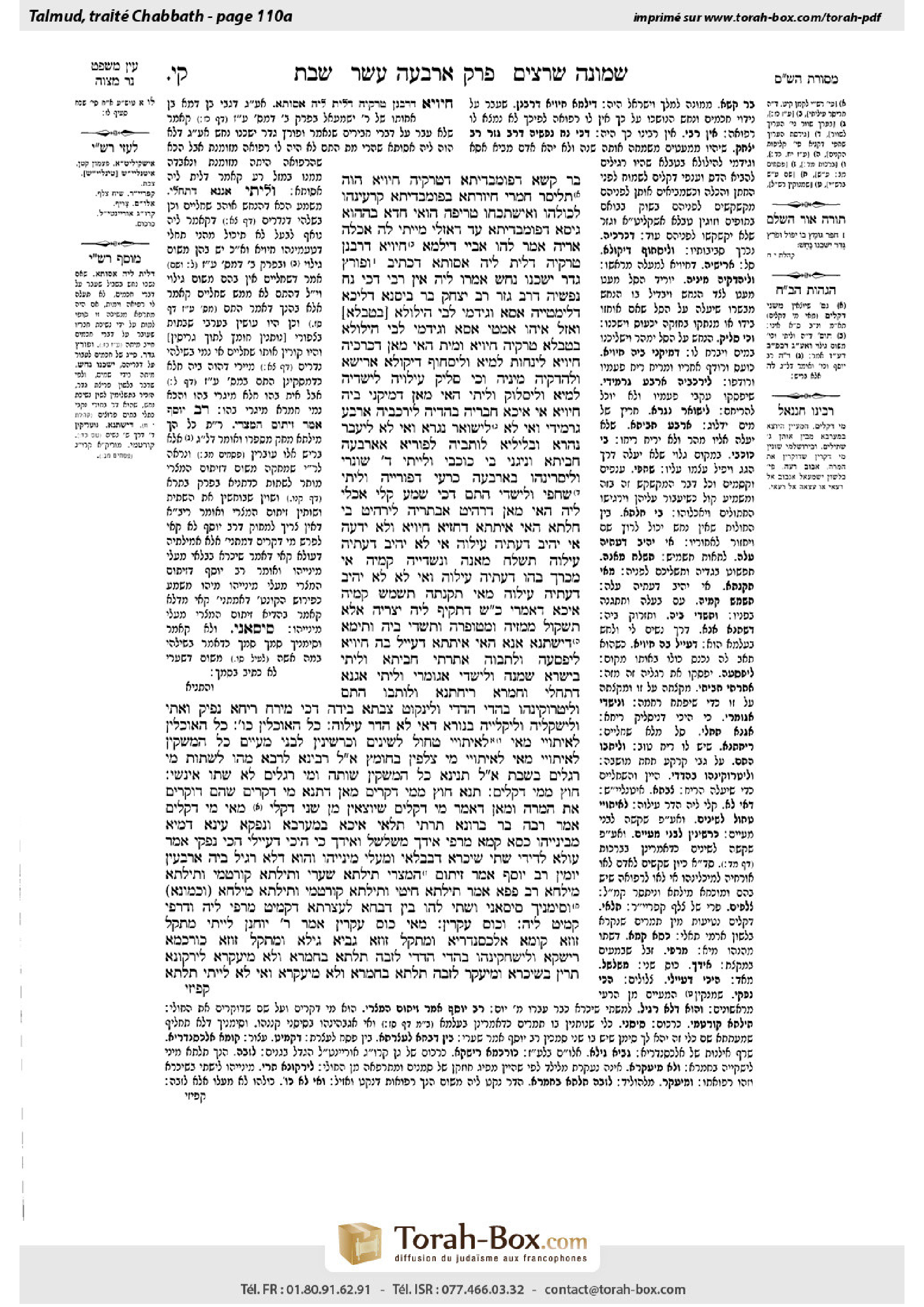
Shabbat 110a: Talmud study for Daf Yomi
Daf Yomi is the daily study of one Talmud folio. Explore 37 tractates with scans, Hebrew text, Sefaria English and AI-generated French translations where annotated.
Passage selection and English or AI-generated French translation are available where the scan has annotations. Daf Study is independent of Torah-Box and Sefaria.
Browse Shabbat · שבת · All tractatesShabbat 110a text and translations
This page of Shabbat includes the Aramaic text, an English translation and an AI-generated French translation, alongside the scan above.
שבת ק״י א · Aramaic and Hebrew text
בַּר קַשָּׁא דְפוּמְבְּדִיתָא דְּטַרְקֵיהּ חִיוְיָא, הֲוָה תְּלֵיסְרֵי חֲמָרֵי חִיוָּרָתָא בְּפוּמְבְּדִיתָא, קַרְעִינְהוּ לְכוּלְּהוּ, וְאִישְׁתְּכַחוּ טְרֵיפָה. הֲוַאי חֲדָא בְּהָהוּא גִּיסָא דְּפוּמְבְּדִיתָא, עַד דְּאָזְלִי מַיְיתִי לַהּ אַכְלַהּ אַרְיָא. אֲמַר לְהוּ אַבָּיֵי: דִילְמָא חִיוְיָא דְּרַבָּנַן טַרְקֵיהּ, דְּלֵית לֵיהּ אָסְוָתָא, דִּכְתִיב: ״וּפֹרֵץ גָּדֵר יִשְּׁכֶנּוּ נָחָשׁ״. אֲמַרוּ לֵיהּ: אִין רַבִּי, דְּכִי נָח נַפְשֵׁיהּ דְּרַב, גְּזַר רַב יִצְחָק בַּר בִּיסְנָא דְּלֵיכָּא דְּלַימְטֵי אַסָּא וְגִידְמֵי לְבֵי הִילּוּלָא [בְּטַבְלָא], וַאֲזַל אִיהוּ אַמְטִי אַסָּא וְגִידְמֵי לְבֵי הִילּוּלָא בְּטַבְלָא. טַרְקֵיהּ חִיוְיָא, וּמִית.
הַאי מַאן דְּכַרְכֵיהּ חִיוְיָא — לִינְחוֹת לְמַיָּא וְלִיסְחוֹף דִּיקּוּלָא אַרֵישֵׁיהּ וּלְהַדְּקֵיהּ מִינֵּיהּ, וְכִי סָלֵיק עִילָּוֵיהּ — לִישְׁדְּיֵהּ לְמַיָּא וְלִיסְלוֹק וְלֵיתֵי. הַאי מַאן דְּמִיקַּנֵּי בֵּיהּ חִיוְיָא, אִי אִיכָּא חַבְרֵיהּ בַּהֲדֵיהּ — לַירְכְּבֵיהּ אַרְבַּע גַּרְמִידֵי, וְאִי לָא — לִישְׁוַאר נִגְרָא, וְאִי לָא — לִיעְבַּר נַהֲרָא, וּבְלֵילְיָא — לוֹתְבֵיהּ לְפֻרְיֵהּ — אַאַרְבַּע חָבְיָתָא, וְנִיגְנֵי בֵּי כוֹכְבֵי, וְלַיְיתֵי אַרְבְּעָה שׁוּנָּרֵי וְלֵיסְרִינְהוּ בְּאַרְבְּעָה כַּרְעֵי דְפוּרְיֵיהּ, וְלַיְתֵי שַׁחֲפֵי וְלִישְׁדֵּי הָתָם, דְּכִי שָׁמְעִי קָלֵיהּ אָכְלִי לֵיהּ. הַאי מַאן דְּרָהֵיט אַבָּתְרֵיהּ — לִירְהוֹט בֵּי חָלָתָא.
הַאי אִיתְּתָא דְּחָזְיָא חִיוְיָא, וְלָא יָדְעָה אִי יָהֵיב דַּעְתֵּיהּ עִילָּוַהּ אִי לָא יָהֵיב דַּעְתֵּיהּ עִילָּוַהּ — תִּשְׁלַח מָאנַהּ וְתִשְׁדֵּי קַמֵּיהּ, אִי מִכְרַךְ בְּהוּ דַּעְתֵּיהּ עִילָּוַהּ, וְאִי לָא — לָא יָהֵיב דַּעְתֵּיהּ עִילָּוַהּ.
מַאי תַּקַּנְתֵּהּ תְּשַׁמֵּשׁ קַמֵּיהּ. אִיכָּא דְאָמְרִי: כׇּל שֶׁכֵּן דְּתָקֵיף לֵיהּ יִצְרֵיהּ! אֶלָּא תִּשְׁקוֹל מִמַּזְּיַהּ וּמִטּוּפְרַהּ וְתִשְׁדֵּי בֵּיהּ, וְתֵימָא: ״דִּישְׁתָּנָא אֲנָא״. הַאי אִיתְּתָא דְּעָיֵיל בַּהּ חִיוְיָא, לִיפַסְּעוּהָ וְלוֹתְבוּהָ אַתַּרְתֵּי חָבְיָתָא, וְלַיְתֵי בִּישְׂרָא שַׁמִּינָה וְלִישְׁדֵּי אַגּוּמְרֵי, וְלַיְתֵי אַגָּנָא דְּתַחְלֵי וְחַמְרָא רֵיחְתָנָא וְלוֹתְבוּ הָתָם, וְלִיטְרוֹקִינְהוּ בַּהֲדֵי הֲדָדֵי, וְלִינְקוֹט צְבָתָא בִּידֵהּ, דְּכִי מוֹרַח רֵיחָא — נָפֵיק וְאָתֵי, וְלִישְׁקְלֵיהּ וְלִיקְלְיֵיהּ בְּנוּרָא, דְּאִי לָא — הָדַר עִילָּוַהּ.
כׇּל הָאוֹכָלִין כּוּ׳. כׇּל הָאוֹכָלִין לְאֵיתוֹיֵי מַאי? לְאֵיתוֹיֵי טְחוֹל לַשִּׁינַּיִם וְכַרְשִׁינִין לִבְנֵי מֵעַיִים. כׇּל הַמַּשְׁקִין לְאֵיתוֹיֵי מַאי? לְאֵיתוֹיֵי מֵי צְלָפִין בְּחוֹמֶץ. אֲמַר לֵיהּ רָבִינָא לְרָבָא: מַהוּ לִשְׁתּוֹת מֵי רַגְלַיִם בְּשַׁבָּת? אֲמַר לֵיהּ, תְּנֵינָא: ״כׇּל הַמַּשְׁקִין שׁוֹתֶה״, וּמֵי רַגְלַיִם לָא שָׁתוּ אִינָשֵׁי.
חוּץ מִמֵּי דְקָלִים. תָּנָא: חוּץ מִמֵּי דְקָרִים. מַאן דִּתְנָא ״מֵי דְקָרִים״ — שֶׁהֵם דּוֹקְרִים אֶת הַמָּרָה, וּמַאן דְּאָמַר ״מֵי דְקָלִים״ — שֶׁיּוֹצְאִין מִן שְׁנֵי דִקְלֵי. מַאי מֵי דְקָלִים? אָמַר רַבָּה בַּר בְּרוֹנָא: תַּרְתֵּי תָּלֵאי אִיכָּא בְּמַעְרְבָא, וְנָפְקָא עֵינָא דְמַיָּא מִבֵּינַיְיהוּ. כָּסָא קַמָּא — מְרַפֵּי, אִידַּךְ — מְשַׁלְשֵׁל, וְאִידַּךְ — כִּי הֵיכִי דְּעָיְילִי הָכִי נָפְקִי. אָמַר עוּלָּא: לְדִידִי שְׁתֵי [לִי] שִׁיכְרָא דְּבַבְלָאֵי, וּמְעַלֵּי מִינַּיְיהוּ. וְהוּא דְּלָא רְגִיל בֵּיהּ אַרְבְּעִין יוֹמִין.
רַב יוֹסֵף אָמַר: זֵיתוֹם הַמִּצְרִי תִּילְתָּא שְׂעָרֵי, וְתִילְתָּא קוּרְטְמֵי, וְתִילְתָּא מִילְחָא. רַב פָּפָּא אָמַר: תִּילְּתָא חִיטֵּי, וְתִילְתָּא קוּרְטְמֵי, וְתִילְתָּא מִילְחָא וְכַמּוֹנָא, וְסִימָנָיךְ — סִיסָאנֵי. וְשָׁתֵי לְהוּ בֵּין דִּבְחָא לַעֲצַרְתָּא, דִּקְמִיט — מְרַפֵּי לֵיהּ, וְדִרְפֵי — קָמֵיט לֵיהּ.
וְכוֹס עִקָּרִין. מַאי כּוֹס עִקָּרִין? אָמַר רַבִּי יוֹחָנָן: לַיְיתֵי מַתְקַל זוּזָא קוּמָא אֲלֶכְּסַנְדְּרָיָא, וּמַתְקַל זוּזָא גַּבְיָא גִּילָא, וּמַתְקַל זוּזָא כּוּרְכְּמָא רִישְׁקָא, וְלִישְׁחֲקִינְהוּ בַּהֲדֵי הֲדָדֵי. לְזָבָה — תְּלָתָא בְּחַמְרָא, וְלָא מִיעַקְרָא. לְיַרְקוֹנָא — תְּרֵין בְּשִׁיכְרָא, וּמִיעֲקַר. לְזָבָה תְּלָתָא בְּחַמְרָא, וְלָא מִיעַקְרָא. וְאִי לָא — לַיְיתֵי תְּלָתָא
Shabbat 110a · English translation
Jewish official in Pumbedita that was bitten by a snake. There were thirteen white donkeys in Pumbedita and they tore them all open and they were found to be tereifot. There was one donkey on the other side of Pumbedita, and until they went to bring it, a lion ate it. Abaye said to them: Since all of these things have happened, perhaps a snake of the Rabbis bit him, for which there is no cure, as it is written: “One that digs a pit will fall into it, and one who breaches a fence will be bitten by a snake” (Ecclesiastes 10:8). Perhaps this person violated a rabbinic decree, also known as a fence, and was bitten by a snake as punishment. That bite has no cure. They said to him: Yes, my teacher, it is so, as when Rav died Rav Yitzḥak bar Bisna ruled that one may not bring myrtle and palm branches to a wedding hall to accompany bells, and he went and brought myrtle and palm branches to the wedding hall with bells. Therefore, a snake bit him. And it is reported that ultimately the official died.
The Gemara cites additional information about the dangers posed by snakes and how to deal with them. One whom a snake encircled should descend into water and place a basket on his head and remove the snake slowly from him into the basket. And once the snake goes into the basket, let him throw it into the water and climb and emerge. One at whom a snake is angry and is being pursued by a snake, if he has another with him, let him ride him four cubits. And if not, let him jump over a ditch. And if not, let him cross a river. And at night let him place his bed on four barrels and sleep outside beneath the stars. And let one bring four cats and let one tie them to the four legs of the bed. And let one bring twigs and branches and throw them there so that when the cats hear the sound of the snake crawling they will eat it. One who is being pursued by a snake, let him run in sand because a snake cannot move as quickly in sand as a person can.
A woman who is seen by a snake and does not know whether it has directed his attention toward her or whether it has not directed his attention toward her, she should remove her garment and throw it before the snake. If the snake wraps itself in the garments, it is an indication that it has directed his attention toward her; and if not, it is an indication that it has not directed his attention toward her.
What is her remedy so the snake will leave her alone? She should have relations with her husband before the snake. Some say: If she has relations in front of the snake, all the more so that its desire will become stronger. Rather, she should take from her hair and her nails and throw them at the snake, and say the following to it as an incantation: I am a menstruating woman [dishtana]. A woman whom a snake has entered, let them spread her legs and place her on two barrels, and let them bring fatty meat and throw it onto coals. And let them bring her a bowl of cress and fragrant wine and place them there and mix them together. And she should take tongs in her hand, as when the snake smells the fragrance it emerges. And then one should take the snake and burn it in the fire, as if it is not burned, it will come back onto her.
We learned in the mishna: All types of food that healthy people eat may be eaten by one eating them for medicinal purposes on Shabbat. The Gemara asks: The phrase: All foods, what does it come to include? The Gemara answers: It comes to include spleen for healing teeth and vetch for healing intestines, although they are not common foods. We also learned in the mishna: And one may drink all drinks on Shabbat. The Gemara asks: The phrase: All drinks, what does it come to include? The Gemara answers: It comes to include mixing water in which capers have soaked, with vinegar. Ravina said to Rava: What is the ruling with regard to drinking urine on Shabbat? Rava said to him: We already learned in the mishna: One may drink all drinks, and people do not drink urine and is not considered a drink. It is only consumed for medical purposes and is therefore prohibited.
We learned in the mishna: One may drink anything on Shabbat except for palm tree water [mei dekalim]. It was taught slightly differently in the Tosefta: Water that stabs [mei dekarim]. The Gemara explains: The one who taught water that stabs means that the waters pierce the gall bladder; and the one who said palm tree water means that they come from two palm trees. In order to explain what palm tree water is, Rabba bar Beruna said: There are two palm trees in Eretz Yisrael, and a spring of water emerges from between them. The first cup one drinks of this water loosens the intestines, another cup causes diarrhea, and another, a third cup, just as it entered as water, so too it emerges. Ulla said: For me, I drink Babylonian beer, and it is more effective than palm tree water in causing diarrhea. The Gemara comments: And this is true. It is effective for the stomach when the person who drinks it has not become accustomed to beer for forty days.
Rav Yosef said: Water that stabs is Egyptian zitom, which is made from one-third barley, and one-third saffron, and one-third salt. Rav Pappa said: It is one-third wheat, and one-third saffron, and one-third salt and cumin. And this is your mnemonic to remember which said zitom is made from barley: A basket which is called sisanei, a word with two samekhs. This word alludes to the fact that Rav Yosef, who has a samekh in his name, is the one who says that Egyptian zitom is made from barley [se’orim], which has the letter sin. Sin is interchangeable with samekh. And one should drink it between Passover and Shavuot. For one whose intestines are blocked, it will loosen his intestines and cure him; and for one whose bowels are loose, it will block him and cure him as well.
And we also learned about a kos ikarin in the mishna. The Gemara asks: What is a kos ikarin? Rabbi Yoḥanan said: Let one bring the weight of a zuz of Alexandrian gum, and a weight of a zuz of alum, and a weight of a zuz of garden saffron, and let one grind them together. The procedure for treating a zava is that she should drink these three ingredients with wine, and she will be cured of her emission and will not become barren. For treating jaundice one should drink two of these ingredients with beer; however, one will become sterile from it. It was said that for treating a zava, she should drink these three ingredients with wine and she will be healed from her emission and will not become barren. And if it is not effective, let one bring three
Shabbat 110a · Traduction française (IA)
Un dignitaire juif de Poumbedita fut mordu par un serpent. Il y avait treize ânes blancs à Poumbedita ; on les éventra tous et on constata qu’ils étaient tereifot. Il y avait un âne de l’autre côté de Poumbedita, mais, le temps qu’on aille le chercher, un lion le dévora. Abayé leur dit : « Puisque toutes ces choses sont arrivées, peut-être a-t-il été mordu par un serpent des rabbins, contre lequel il n’existe aucun remède, comme il est écrit : “Celui qui creuse une fosse y tombera, et celui qui démolit une clôture sera mordu par un serpent” (Ecclésiaste 10, 8). Peut-être cet homme a-t-il enfreint un décret rabbinique, également appelé clôture, et a-t-il été mordu par un serpent en guise de punition. Cette morsure est incurable. » Ils lui dirent : « Oui, notre maître, c’est bien cela. Car, lorsque Rav mourut, Rav Yitzḥak bar Bisna décréta qu’il était interdit d’apporter des branches de myrte et de palmier dans une salle de mariage pour accompagner des clochettes. Or, il alla apporter des branches de myrte et de palmier dans la salle de mariage avec des clochettes. C’est pourquoi un serpent l’a mordu. » Et l’on rapporte que, finalement, le dignitaire mourut.
La Guemara cite d’autres renseignements sur les dangers que représentent les serpents et sur la manière de les affronter. Si un serpent s’est enroulé autour de quelqu’un, que celui-ci descende dans l’eau, place un panier sur sa tête et fasse lentement passer le serpent de son corps dans le panier. Une fois que le serpent est entré dans le panier, qu’il le jette dans l’eau, puis qu’il remonte et sorte. Si un serpent est irrité contre quelqu’un et le poursuit, et que cette personne a quelqu’un d’autre avec elle, qu’elle chevauche cette personne sur quatre coudées. Sinon, qu’elle saute par-dessus un fossé. Sinon, qu’elle traverse une rivière. La nuit, qu’elle place son lit sur quatre tonneaux et dorme dehors, sous les étoiles. Qu’on apporte quatre chats et qu’on les attache aux quatre pieds du lit. Qu’on apporte des brindilles et des branches et qu’on les jette là, afin que, lorsque les chats entendront le bruit du serpent qui rampe, ils le dévorent. Si un serpent poursuit quelqu’un, que celui-ci coure dans le sable, car le serpent ne peut pas s’y déplacer aussi vite qu’un être humain.
Une femme qu’un serpent a aperçue, sans qu’elle sache s’il a dirigé son attention vers elle ou non, doit enlever son vêtement et le jeter devant le serpent. Si le serpent s’enroule dans le vêtement, cela indique qu’il a dirigé son attention vers elle ; sinon, cela indique qu’il ne l’a pas dirigée vers elle.
Quel remède peut-elle employer pour que le serpent la laisse tranquille ? Elle doit avoir des relations avec son mari devant le serpent. Certains disent : « Si elle a des relations devant le serpent, son désir n’en sera que plus intense. » Elle doit plutôt arracher quelques cheveux et ongles et les jeter au serpent, en lui récitant cette incantation : « Je suis une femme menstruée [dishtana]. » Si un serpent est entré dans une femme, qu’on lui écarte les jambes et qu’on la place sur deux tonneaux ; qu’on apporte de la viande grasse et qu’on la jette sur des braises. Qu’on lui apporte un bol de cresson et du vin parfumé, qu’on les place là et qu’on les mélange. Elle doit prendre des tenailles dans la main, car lorsque le serpent sentira le parfum, il sortira. On devra alors saisir le serpent et le brûler au feu ; s’il n’est pas brûlé, il reviendra sur elle.
Nous avons appris dans la Michna : Tous les aliments que les personnes en bonne santé mangent peuvent être consommés le Chabbat par quelqu’un qui les prend à des fins médicinales. La Guemara demande : Que vient inclure l’expression « tous les aliments » ? La Guemara répond : Elle inclut la rate, qui soigne les dents, et la vesce, qui soigne les intestins, bien que ces aliments ne soient pas courants. Nous avons également appris dans la Michna : Et l’on peut boire toutes les boissons le Chabbat. La Guemara demande : Que vient inclure l’expression « toutes les boissons » ? La Guemara répond : Elle inclut un mélange d’eau dans laquelle des câpres ont trempé et de vinaigre. Ravina dit à Rava : « Quelle est la halakha concernant le fait de boire de l’urine le Chabbat ? » Rava lui répondit : « Nous avons déjà appris dans la Michna qu’on peut boire toutes les boissons. Or, les gens ne boivent pas d’urine, qui n’est donc pas considérée comme une boisson. Elle n’est consommée qu’à des fins médicinales et il est par conséquent interdit d’en boire. »
Nous avons appris dans la Michna : On peut boire n’importe quoi le Chabbat, à l’exception de l’eau des palmiers [mei dekalim]. La baraïta enseigne une formulation légèrement différente dans la Tosefta : l’eau qui transperce [mei dekarim]. La Guemara explique : Celui qui enseigne « l’eau qui transperce » veut dire que cette eau perce la vésicule biliaire ; et celui qui parle de l’eau des palmiers veut dire qu’elle provient de deux palmiers. Pour expliquer ce qu’est l’eau des palmiers, Rabba bar Beruna dit : « Il y a deux palmiers en terre d’Israël, et une source jaillit entre eux. Le premier verre de cette eau détend les intestins, un autre verre provoque la diarrhée, et un autre, le troisième, ressort tel qu’il est entré, sous forme d’eau. » Oulla dit : « Pour ma part, je bois de la bière babylonienne, qui est plus efficace que l’eau des palmiers pour provoquer la diarrhée. » La Guemara fait remarquer : Et cela est exact. Elle est efficace pour l’estomac si la personne qui la boit n’a pas pris l’habitude de boire de la bière depuis quarante jours.
Rav Yossef dit : « L’eau qui transperce, c’est le zitom égyptien, composé d’un tiers d’orge, d’un tiers de safran et d’un tiers de sel. » Rav Pappa dit : « Il est composé d’un tiers de blé, d’un tiers de safran et, pour le dernier tiers, de sel et de cumin. » Voici un moyen mnémotechnique pour retenir qui dit que le zitom est composé d’orge : un panier appelé sisanei, mot qui comporte deux samekh. Ce mot rappelle que Rav Yossef, dont le nom contient un samekh, affirme que le zitom égyptien est composé d’orge [se’orim], mot dont la première lettre est un sin. Le sin et le samekh sont interchangeables. Il faut en boire entre Pessaḥ et Chavouot. Pour celui dont les intestins sont bloqués, cela les débloquera et le guérira ; pour celui qui a la diarrhée, cela les bloquera et le guérira également.
Nous avons également appris dans la Michna au sujet d’une kos ikarin. La Guemara demande : Qu’est-ce qu’une kos ikarin ? Rabbi Yoḥanan dit : « Qu’on prenne une mesure équivalant à une pièce de zuz de gomme alexandrine, une mesure équivalant à une pièce de zuz d’alun et une mesure équivalant à une pièce de zuz de safran des jardins, et qu’on les broie ensemble. » Pour traiter une zava, elle doit boire ces trois ingrédients avec du vin ; elle sera alors guérie de son écoulement et ne deviendra pas stérile. Pour traiter la jaunisse, on boit deux de ces ingrédients avec de la bière ; cependant, cela rendra stérile. Il a été enseigné que, pour traiter une zava, elle doit boire ces trois ingrédients avec du vin : elle sera guérie de son écoulement et ne deviendra pas stérile. Et si cela n’est pas efficace, qu’on apporte trois
Traduction française générée par IA à partir de l’édition anglaise de Sefaria. Vérifie toujours un passage avec le texte source.
Text from Sefaria: William Davidson Edition - Vocalized Aramaic (CC BY NC); William Davidson Edition - English (CC BY NC).