Shabbat 110b: Talmud study for Daf Yomi
Daf Yomi is the daily study of one Talmud folio. Explore 37 tractates with scans, Hebrew text, Sefaria English and AI-generated French translations where annotated.
Passage selection and English or AI-generated French translation are available where the scan has annotations. Daf Study is independent of Torah-Box and Sefaria.
Browse Shabbat · שבת · All tractatesShabbat 110b text and translations
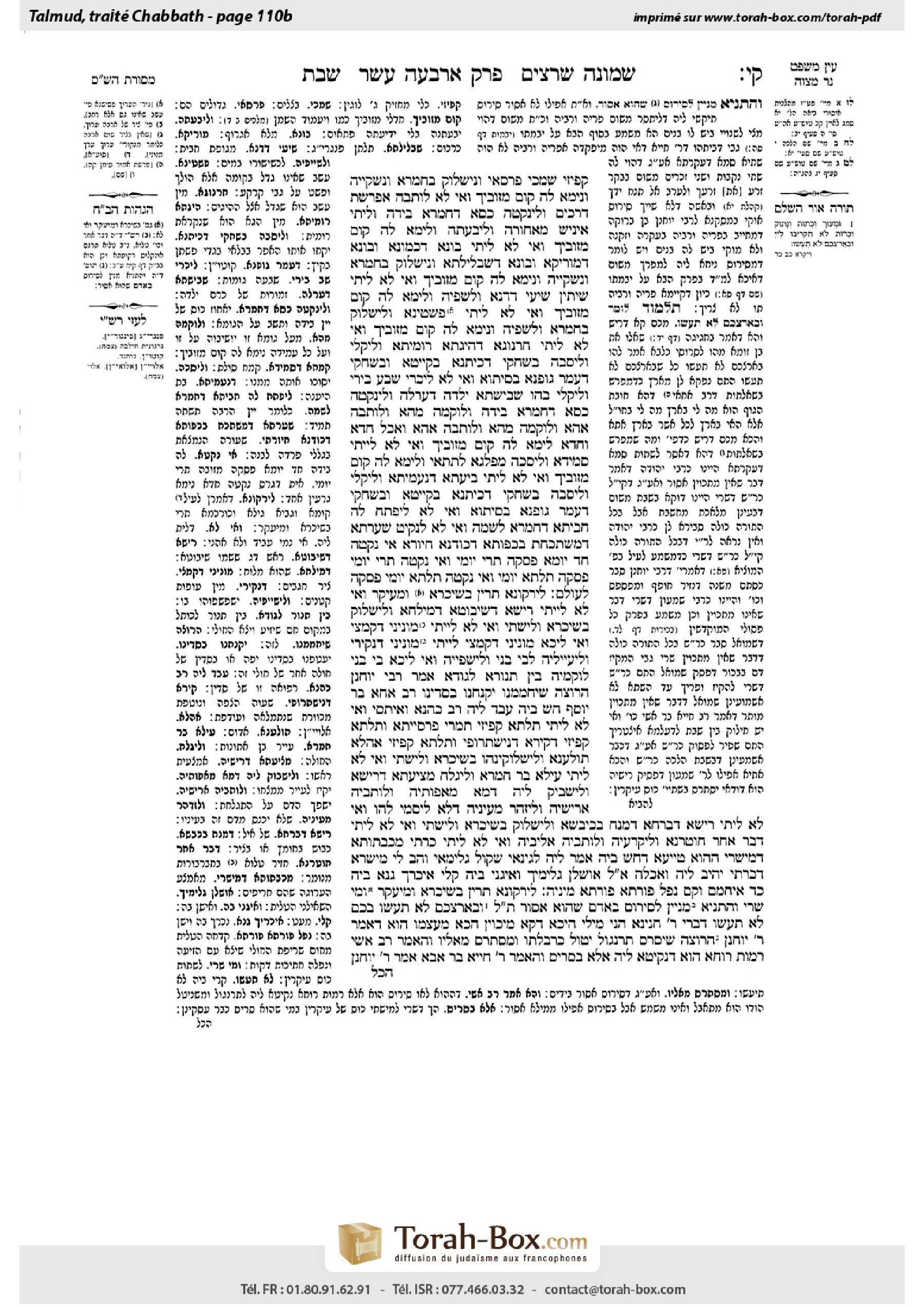
This page of Shabbat includes the Aramaic text, an English translation and an AI-generated French translation, alongside the scan above.
שבת ק״י ב · Aramaic and Hebrew text
קְפִיזֵי שַׁמְכֵי פָרְסָאֵי, וְנִישְׁלוֹק בְּחַמְרָא, וְנַשְׁקְיַיהּ, וְנֵימָא לַהּ: קוּם מִזּוֹבִיךְ. וְאִי לָא — לוֹתְבַהּ אַפָּרָשַׁת דְּרָכִים, וְלַנְקְטַהּ כָּסָא דְחַמְרָא בִּידַהּ, וְלַיְתֵי אִינִישׁ מֵאֲחוֹרַהּ וְלִיבַעֲתַהּ, וְלֵימָא לַהּ: קוּם מִזּוֹבִיךְ. וְאִי לָא — לַיְתֵי בּוּנָא דְכַמּוֹנָא וּבוּנָא דְמוֹרִיקָא וּבוּנָא דְשַׁבְּלִילְתָּא, וְנִישְׁלוֹק בְּחַמְרָא, וְנַשְׁקְיַיהּ, וְנֵימָא לַהּ: קוּם מִזּוֹבִיךְ. וְאִי לָא — לַיְתֵי שִׁיתִּין שִׁיעֵי דְּדַנָּא, וְלַשְׁפְּיַהּ, וְלֵימָא לַהּ: קוּם מִזּוֹבִיךְ. וְאִי לָא — לַיְתֵי פְּשִׁיטְנָא, וְלִישְׁלוֹק בְּחַמְרָא, וְלִשְׁפְּיַהּ, וְנֵימָא לַהּ: קוּם מִזּוֹבִיךְ. וְאִי לָא — לַיְתֵי חַרְנוּגָא דְּהִיגְתָּא רוֹמִיתָא, וְלִיקְלֵי, וְלִיסְּבַהּ בְּשַׁחֲקֵי דְכִיתָּנָא בְּקַיְיטָא וּבְשַׁחֲקֵי דַּעֲמַר גּוּפְנָא בְּסִיתְוָא.
וְאִי לָא — לִיכְרֵי שְׁבַע בֵּירֵי, וְלִיקְלֵי בְּהוּ שְׁבִישָׁתָא (יַלְדָּה) דְעׇרְלָה, וְלַינְקְטַהּ כָּסָא דְחַמְרָא בִּידַהּ, וְלוֹקְמַהּ מֵהָא וְלוֹתְבַהּ אַהָא, וְלוֹקְמַהּ מֵהָא וְלוֹתְבַהּ אַהָא, וְאַכֹּל חֲדָא וַחֲדָא לֵימָא לַהּ: קוּם מִזּוֹבִיךְ. וְאִי לָא — לַיְיתֵי סְמִידָא, וְלֵיסְכַהּ מִפַּלְגָא לְתַתַּאי, וְלֵימָא לַהּ: קוּם מִזּוֹבִיךְ. וְאִי לָא — לַיְתֵי בֵּיעֲתָא דְנַעָמִיתָא, וְלִיקְלֵי, וְלִיסְּבַהּ בְּשַׁחֲקֵי דְכִיתָּנָא בְּקַיְיטָא וּבְשַׁחֲקֵי דַעֲמַר גּוּפְנָא בְּסִיתְוָא. וְאִי לָא — לִיפְתַּח לַהּ חָבִיתָא דְחַמְרָא לִשְׁמַהּ. וְאִי לָא — לִנְקִיט שְׂעָרְתָּא דְּמִשְׁתַּכְחָא בִּכְפוּתָא דְּכוּדַנְיָא חִיוָּרְתָּא, אִי נָקְטָה חַד יוֹמָא — פָּסְקָה תְּרֵי יוֹמֵי, וְאִי נָקְטָה תְּרֵי יוֹמֵי — פָּסְקָה תְּלָתָא יוֹמֵי, וְאִי נָקְטָה תְּלָתָא יוֹמֵי — פָּסְקָה לְעוֹלָם.
לְיַרְקוֹנָא תְּרֵין בְּשִׁיכְרָא, וּמִיעֲקַר. וְאִי לָא — לַיְיתֵי רֵישָׁא דְשִׁיבּוּטָא דְּמִילְחָא וְלִישְׁלוֹק בְּשִׁיכְרָא, וְלִישְׁתֵּי. וְאִי לָא — לַיְיתֵי מוֹנִינֵי דְקַמְצֵי. וְאִי לֵיכָּא מוֹנִינֵי דְקַמְצֵי — לַיְיתֵי מוֹנִינֵי דִּנְקִירֵי, וְלִיעַיְילֵיהּ לְבֵי בָנֵי וְלִישְׁפְּיֵיהּ. וְאִי לֵיכָּא בֵּי בָנֵי — לוֹקְמֵיהּ בֵּין תַּנּוּרָא לְגוּדָּא. אָמַר רַבִּי יוֹחָנָן: הָרוֹצֶה שֶׁיְּחַמְּמֶנּוּ — יְקַנְּחֶנּוּ בִּסְדִינוֹ. רַב אַחָא בַּר יוֹסֵף חַשׁ בֵּיהּ, עֲבַד לֵיהּ רַב כָּהֲנָא, וְאִיתַּסִּי.
וְאִי לָא — לַיְתֵי תְּלָתָא קְפִיזִי תַּמְרֵי פָּרְסְיָיתָא, וּתְלָתָא קְפִיזֵי דְקִירָא דְּנִישְׁתְּרוּפֵי, וּתְלָתָא קְפִיזֵי אַהֲלָא תּוֹלְעָנָא, וְלִישְׁלוֹקִינְהוּ בְּשִׁיכְרָא, וְלִישְׁתֵּי. וְאִי לָא — לַיְתֵי עִילָא בַּר חֲמָרָא, וְלִיגַלַּח מְצִיעֲתָא דְרֵישָׁא, וְלִישְׁבּוֹק לֵיהּ דְּמָא מֵאַפּוּתֵיהּ, וְלוֹתְבֵיהּ אַרֵישֵׁיהּ, וְלִיזְדְּהַר מֵעֵינֵיהּ דְּלָא לִיסַּמֵּי לְהוּ. וְאִי לָא — לַיְתֵי רֵישָׁא דְּבַרְחָא דְּמַנַּח בְּכִיבְשָׁא, וְלִישְׁלוֹק בְּשִׁיכְרָא, וְלִישְׁתֵּי. וְאִי לָא — לַיְתֵי דָּבָר אַחֵר חוּטְרָנָא, וְלִיקְרְעֵיהּ, וְלוֹתְבֵיהּ אַלִּיבֵּיהּ. וְאִי לָא — לַיְתֵי כַּרָּתֵי מִכַּבְתְּוָתָא דְּמֵישָׁרֵי.
הָהוּא טַיָּיעָא דְּחַשׁ בֵּיהּ, אֲמַר לֵיהּ לְגִינַּאי: שְׁקוֹל גְּלִימַאי וְהַב לִי מֵישָׁרָא דְכַרָּתֵי. יְהַב לֵיהּ וְאַכְלַהּ. אֲמַר לֵיהּ: אוֹשְׁלַן גְּלִימָיךְ וְאֶיגְנֵי בֵּיהּ קַלִּי. אִיכְּרַךְ גְּנָא בֵּיהּ. כַּד אִיחַמַּם וְקָם, נְפַל פּוּרְתָּא פּוּרְתָּא מִינֵּיהּ.
לְיַרְקוֹנָא תְּרֵין בְּשִׁיכְרָא, וּמִיעֲקַר. וּמִי שְׁרֵי? וְהָתַנְיָא, מִנַּיִין לַסֵּירוּס בָּאָדָם שֶׁהוּא אָסוּר — תַּלְמוּד לוֹמַר: ״וּבְאַרְצְכֶם לֹא תַעֲשׂוּ״ — בָּכֶם לֹא תַעֲשׂוּ, דִּבְרֵי רַבִּי חֲנִינָא. הָנֵי מִילֵּי — הֵיכָא דְּקָא מִיכַּוֵּין, הָכָא — מֵעַצְמוֹ הוּא. דְּאָמַר רַבִּי יוֹחָנָן: הָרוֹצֶה שֶׁיְּסָרֵס תַּרְנְגוֹל — יִטּוֹל כַּרְבׇּלְתּוֹ, וּמִסְתָּרֵס מֵאֵלָיו. וְהָאָמַר רַב אָשֵׁי: רָמוּת רוּחָא הוּא דִּנְקִיטָא לֵיהּ. אֶלָּא בְּסָרִיס.
וְהָאָמַר רַבִּי חִיָּיא בַּר אַבָּא אָמַר רַבִּי יוֹחָנָן:
Shabbat 110b · English translation
vessels full of Persian onions, and boil them in wine, and give it to her to drink. And we say to her: Stop emitting your discharge. And if that is not effective, seat her at a crossroads, and she should take a cup of wine in her hand, and let a person come from behind her and frighten her and say to her: Stop emitting your discharge. And if this is also not effective, bring her a fistful [buna] of cumin, and a fistful of saffron, and a fistful of fenugreek, and cook them in wine, and give it to her to drink, and say to her: Stop emitting your discharge. And if this is not effective, let one bring sixty barrel seals, soak them, and then spread it on her and say to her: Stop emitting your discharge. And if this is also does not effective, let one bring pashtina, a type of grass, boil it in wine, and then spread it on her and say to her: Stop emitting your discharge. And if this is not effective, let one bring a thistle that grows on Roman thorns and burn it, and place its ashes in rags from linen clothing in the summer and in rags from cotton clothing in the winter.
And if this is not effective, let one dig seven pits and burn young grape shoots in them from vines that are orla, and place a cup of wine in her hand and raise her up from that pit and sit her in another pit, and raise her from that pit and sit her in this pit, and raise her from that pit and sit her in this other pit. And each and every time say to her: Stop emitting your discharge. And if this is not effective, let one bring fine flour and place it on the bottom half of her body and say to her: Stop emitting your discharge. And if this is not effective, let one bring an ostrich egg and burn it, and place its ashes in linen rags during the summer, and in cotton rags during the winter. And if this is also not effective, let one open a barrel of wine for her, and let her drink it. And if this is not effective, let one hold a barley grain that is found in the dung of a white donkey. If she holds it for one day her discharge will cease for two days; and if she holds it for two days it will cease for three days, and if she holds it for three days it will cease forever.
The Gemara states: For jaundice, one should drink two of the three ingredients mentioned together with beer, and one becomes sterile from it. The Gemara continues to discuss this remedy: And if one does not have these ingredients, i.e., Alexandrian gum, saffron, and alum, or if the remedy did not work, let one bring the head of a salted shibuta fish and boil it in beer and drink it. And if this is not effective, let one bring grasshopper brine and drink it. And if one does not have grasshopper brine, let one bring brine of small birds, and enter the bathhouse, and smear himself with it. And if there is no bathhouse, have him stand between the oven and the wall and sweat out his disease. Rabbi Yoḥanan said: One who seeks to warm this patient up should wrap him tightly in his sheet. Rav Aḥa bar Yosef was sick with this disease, and Rav Kahana performed this remedy for him and he was healed.
The Gemara continues: And if this remedy is not effective, let one bring three vessels of Persian dates, and three vessels of dripping wax [kira], and three vessels of red aloe, and boil them in beer and drink it. And if this remedy is not effective, let one bring a donkey foal, and shave the middle of its head, and let blood from the donkey’s forehead, and place it on his own head. And he should take care not to let the blood enter his eyes lest it blind him. And if this is not effective, let one bring a pickled ram’s head and boil it in beer and drink it. And if this is not effective, let him bring a striped something else, i.e., a pig, and tear it open and place it on his heart. And if this is not effective, let him bring leeks from the middle of the row, which are very sharp.
It is reported that a certain Arab was sick with jaundice. He said to the gardener: Take my cloak and give me a row of leeks in exchange. The gardener gave him the row and he ate it. The Arab said to the gardener: Lend me your cloak and I will sleep in it for a short while. The gardener gave it to him and he wrapped himself in it and slept. When he got hot and stood up pieces fell from the cloak bit by bit because the cloak had become very hot from the Arab’s sweat. The Arab tricked the gardener, who ultimately received nothing.
The Gemara discussed the remedy for jaundice, saying that one should drink two of the ingredients mentioned together with beer, and one becomes sterile from it. The Gemara asks: And is it permitted to cause sterility? Wasn’t it taught in a baraita: From where is it derived that castration of a man is prohibited? The verse states: “Those whose testicles are bruised, or crushed, or torn, or cut, shall not be offered to the Lord, and you shall not do this in your land” (Leviticus 22:24), meaning that you shall not do it to yourselves; this is the statement of Rabbi Ḥanina. Apparently, it is prohibited to castrate a man. The Gemara answers: This prohibition applies only in a case where one intends to castrate. Here, in the cure for jaundice, the sterility happens on its own, incidental to the treatment. Proof is cited from that which Rabbi Yoḥanan said: One who seeks to castrate a rooster should remove its comb and it will become castrated on its own. Incidental castration is permitted. The Gemara rejects the proof. Didn’t Rav Ashi say: It is arrogance that it assumes when it has its comb, and when the comb is removed it becomes depressed and no longer procreates. However, it is not actually castrated. Rather, apparently this remedy for jaundice is permitted only for one who is castrated and for whom causing sterility is not a concern.
The Gemara asks: Didn’t Rabbi Ḥiyya bar Abba say that Rabbi Yoḥanan said:
Shabbat 110b · Traduction française (IA)
des récipients remplis d’oignons persans, les faire bouillir dans du vin et le lui donner à boire. On lui dit : « Cesse d’émettre ton écoulement. » Si cela ne fait pas effet, on l’assoit à un carrefour ; elle doit tenir une coupe de vin à la main, puis quelqu’un vient derrière elle pour lui faire peur et lui dire : « Cesse d’émettre ton écoulement. » Si cela ne fait toujours pas effet, qu’on lui apporte une poignée [buna] de cumin, une poignée de safran et une poignée de fenugrec, qu’on les fasse cuire dans du vin et qu’on le lui donne à boire, en lui disant : « Cesse d’émettre ton écoulement. » Si cela ne fait pas effet, qu’on apporte soixante bondes de tonneau, qu’on les fasse tremper, puis qu’on lui en étale sur le corps en lui disant : « Cesse d’émettre ton écoulement. » Si cela ne fait toujours pas effet, qu’on apporte du pashtina, une sorte d’herbe, qu’on le fasse bouillir dans du vin, puis qu’on lui en étale sur le corps en lui disant : « Cesse d’émettre ton écoulement. » Si cela ne fait pas effet, qu’on apporte un chardon poussant parmi les ronces romaines, qu’on le brûle et qu’on place ses cendres dans des chiffons de lin en été et dans des chiffons de coton en hiver.
Si cela ne fait pas effet, qu’on creuse sept fosses et qu’on y brûle de jeunes sarments de vigne provenant de ceps d’orla. On place une coupe de vin dans sa main, on la fait sortir de cette fosse et on l’assoit dans une autre ; on la fait sortir de cette fosse et on l’assoit dans celle-ci ; on la fait sortir de cette fosse et on l’assoit dans cette autre fosse. À chaque fois, on lui dit : « Cesse d’émettre ton écoulement. » Si cela ne fait pas effet, qu’on apporte de la farine fine, qu’on la lui dépose sur la partie inférieure du corps et qu’on lui dise : « Cesse d’émettre ton écoulement. » Si cela ne fait pas effet, qu’on apporte un œuf d’autruche, qu’on le brûle et qu’on place ses cendres dans des chiffons de lin en été et dans des chiffons de coton en hiver. Si cela ne fait toujours pas effet, qu’on ouvre pour elle un tonneau de vin et qu’elle en boive. Si cela ne fait pas effet, qu’on lui fasse tenir un grain d’orge trouvé dans les excréments d’un âne blanc. Si elle le tient un jour, son écoulement cessera pendant deux jours ; si elle le tient deux jours, il cessera pendant trois jours ; et si elle le tient trois jours, il cessera pour toujours.
La Guemara indique : contre la jaunisse, on doit boire deux des trois ingrédients mentionnés ensemble avec de la bière, et cela rend stérile. La Guemara poursuit au sujet de ce remède : si l’on ne dispose pas de ces ingrédients, c’est-à-dire de la gomme alexandrine, du safran et de l’alun, ou si le remède n’a pas fait effet, qu’on apporte la tête d’un poisson shibuta salé, qu’on la fasse bouillir dans de la bière et qu’on la boive. Si cela ne fait pas effet, qu’on apporte de la saumure de sauterelles et qu’on la boive. Si l’on ne dispose pas de saumure de sauterelles, qu’on apporte de la saumure de petits oiseaux, qu’on entre dans un bain et qu’on s’en enduise le corps. S’il n’y a pas de bain, qu’il se tienne entre le four et le mur et qu’il transpire pour évacuer sa maladie. Rabbi Yoḥanan dit : celui qui veut réchauffer ce malade doit l’envelopper étroitement dans son drap. Rav Aḥa bar Yosef était atteint de cette maladie, et Rav Kahana lui appliqua ce remède ; il guérit.
La Guemara poursuit : si ce remède ne fait pas effet, qu’on apporte trois récipients de dattes persanes, trois récipients de cire fondante [kira] et trois récipients d’aloès rouge, qu’on les fasse bouillir dans de la bière et qu’on en boive. Si ce remède ne fait pas effet, qu’on apporte un ânon, qu’on lui rase le milieu du crâne, qu’on lui fasse une saignée au front et qu’on place le sang sur sa propre tête. Il doit veiller à ne pas laisser le sang pénétrer dans ses yeux, de peur d’en devenir aveugle. Si cela ne fait pas effet, qu’on apporte une tête de bélier marinée, qu’on la fasse bouillir dans de la bière et qu’on la boive. Si cela ne fait pas effet, qu’il apporte un autre animal rayé, c’est-à-dire un porc, qu’il l’ouvre et le place sur son cœur. Si cela ne fait pas effet, qu’il apporte des poireaux du milieu du rang, qui sont très piquants.
On rapporte qu’un certain Arabe était atteint de jaunisse. Il dit au jardinier : « Prends mon manteau et donne-moi un rang de poireaux en échange. » Le jardinier lui donna le rang et il le mangea. L’Arabe dit au jardinier : « Prête-moi ton manteau et je dormirai dedans un petit moment. » Le jardinier le lui donna ; il s’en enveloppa et dormit. Lorsqu’il eut chaud et se leva, des morceaux tombèrent du manteau, petit à petit, car la sueur de l’Arabe l’avait rendu brûlant. L’Arabe avait dupé le jardinier, qui, finalement, n’obtint rien.
La Guemara a évoqué le remède contre la jaunisse : boire deux des ingrédients mentionnés avec de la bière rend stérile. La Guemara demande : est-il permis de provoquer la stérilité ? N’a-t-il pas été enseigné dans une baraïta : d’où apprend-on qu’il est interdit de castrer un homme ? Le verset dit : « Ceux dont les testicules sont meurtris, écrasés, arrachés ou coupés ne seront pas offerts à l’Éternel, et vous ne ferez pas cela dans votre pays » (Lévitique 22, 24), ce qui signifie : vous ne le ferez pas à vous-mêmes. Telle est la déclaration de Rabbi Ḥanina. Il apparaît donc qu’il est interdit de castrer un homme. La Guemara répond : cette interdiction ne s’applique que lorsque l’on a l’intention de castrer. Ici, dans le traitement de la jaunisse, la stérilité survient d’elle-même, comme effet secondaire du traitement. On cite comme preuve ce que Rabbi Yoḥanan a dit : celui qui veut castrer un coq doit lui retirer sa crête, et il sera castré de lui-même. Une castration incidente est permise. La Guemara rejette cette preuve : Rav Ashi n’a-t-il pas dit que, tant qu’il a sa crête, il est orgueilleux, et que, lorsqu’on la lui retire, il devient abattu et ne procrée plus ? Il n’est toutefois pas réellement castré. Il apparaît donc que ce remède contre la jaunisse n’est permis que pour celui qui est castré et pour qui provoquer la stérilité ne pose pas de problème.
La Guemara demande : Rabbi Ḥiyya bar Abba n’a-t-il pas dit au nom de Rabbi Yoḥanan :
Traduction française générée par IA à partir de l’édition anglaise de Sefaria. Vérifie toujours un passage avec le texte source.
Text from Sefaria: William Davidson Edition - Vocalized Aramaic (CC BY NC); William Davidson Edition - English (CC BY NC).