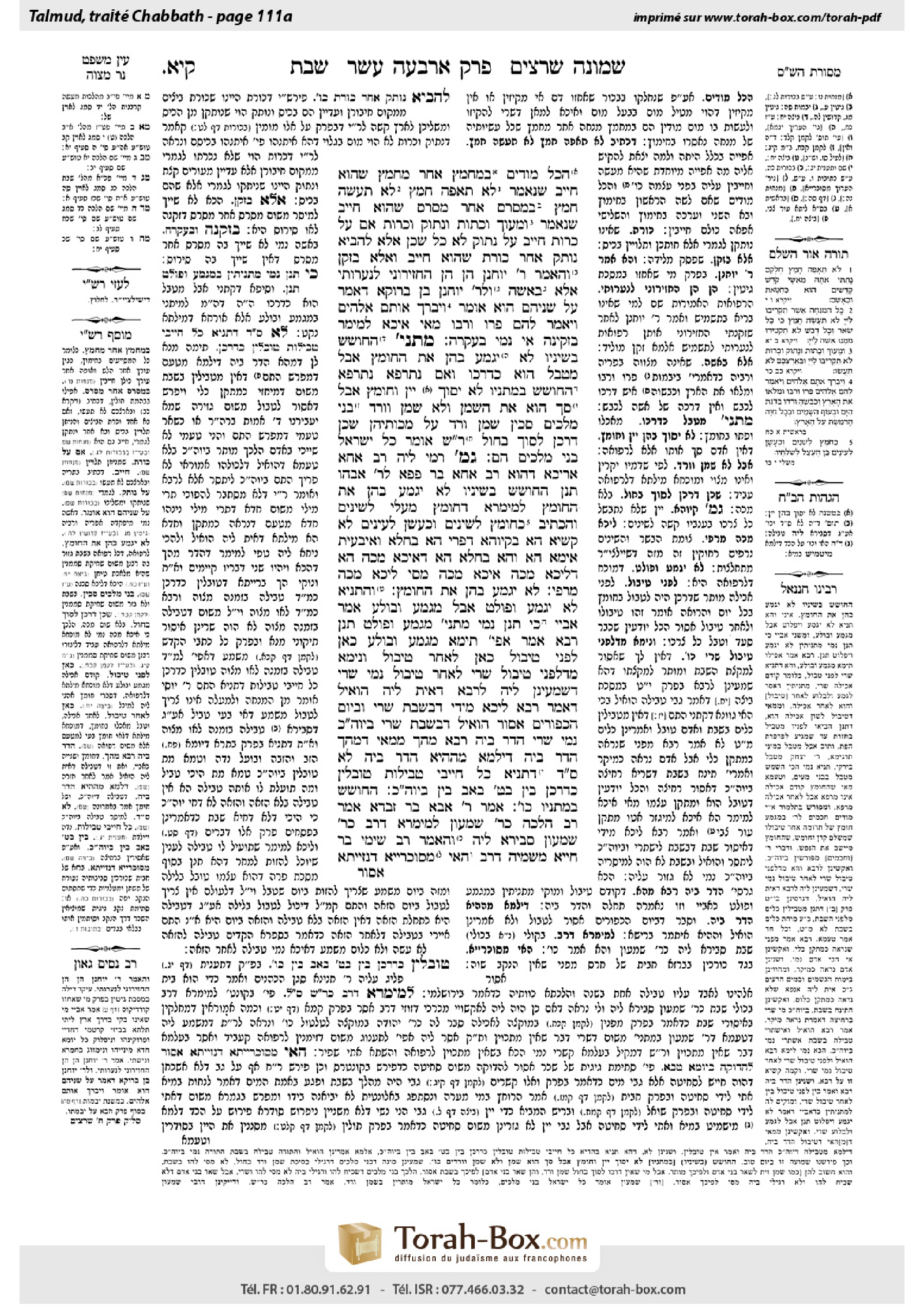
Shabbat 111a: Talmud study for Daf Yomi
Daf Yomi is the daily study of one Talmud folio. Explore 37 tractates with scans, Hebrew text, Sefaria English and AI-generated French translations where annotated.
Passage selection and English or AI-generated French translation are available where the scan has annotations. Daf Study is independent of Torah-Box and Sefaria.
Browse Shabbat · שבת · All tractatesShabbat 111a text and translations
This page of Shabbat includes the Aramaic text, an English translation and an AI-generated French translation, alongside the scan above.
שבת קי״א א · Aramaic and Hebrew text
הַכֹּל מוֹדִים בִּמְחַמֵּץ אַחַר מְחַמֵּץ שֶׁהוּא חַיָּיב, שֶׁנֶּאֱמַר: ״לֹא תֵאָפֶה חָמֵץ״, ״לֹא תֵעָשֶׂה חָמֵץ״. בִּמְסָרֵס אַחֵר מְסָרֵס שֶׁהוּא חַיָּיב, שֶׁנֶּאֱמַר: ״וּמָעוּךְ וְכָתוּת וְנָתוּק וְכָרוּת״, אִם עַל כָּרוּת חַיָּיב, עַל נָתוּק לֹא כׇּל שֶׁכֵּן! אֶלָּא, לְהָבִיא נוֹתֵק אַחַר כּוֹרֵת שֶׁהוּא חַיָּיב. וְאֶלָּא בְּזָקֵן.
וְהָאָמַר רַבִּי יוֹחָנָן הֵן הֵן הֶחְזִירוּנִי לְנַעֲרוּתִי! אֶלָּא בְּאִשָּׁה. וּלְרַבִּי יוֹחָנָן בֶּן בְּרוֹקָא דְּאָמַר עַל שְׁנֵיהֶם הוּא אוֹמֵר: ״וַיְבָרֶךְ אוֹתָם אֱלֹהִים וַיֹּאמֶר לָהֶם פְּרוּ וּרְבוּ״ — מַאי אִיכָּא לְמֵימַר? בִּזְקֵינָהּ, אִי נָמֵי בַּעֲקָרָה.
מַתְנִי׳ הַחוֹשֵׁשׁ בְּשִׁינָּיו — לֹא יְגַמֵּעַ בָּהֶן אֶת הַחוֹמֶץ, אֲבָל מְטַבֵּל הוּא כְּדַרְכּוֹ, וְאִם נִתְרַפֵּא — נִתְרַפֵּא. הַחוֹשֵׁשׁ בְּמׇתְנָיו — לָא יָסוּךְ יַיִן וָחוֹמֶץ, אֲבָל סָךְ הוּא אֶת הַשֶּׁמֶן. וְלֹא שֶׁמֶן וֶורֶד. בְּנֵי מְלָכִים סָכִין שֶׁמֶן וֶרֶד עַל מַכּוֹתֵיהֶן, שֶׁכֵּן דַּרְכָּן לָסוּךְ בְּחוֹל. רַבִּי שִׁמְעוֹן אוֹמֵר: כׇּל יִשְׂרָאֵל בְּנֵי מְלָכִים הֵם.
גְּמָ׳ רָמֵי לֵיהּ רַב אַחָא אֲרִיכָא דְּהוּא רַב אַחָא בַּר פָּפָּא לְרַבִּי אֲבָהוּ: תְּנַן, הַחוֹשֵׁשׁ בְּשִׁינָּיו — לֹא יְגַמֵּעַ בָּהֶן אֶת הַחוֹמֶץ. לְמֵימְרָא דְּחוֹמֶץ מְעַלֵּי לְשִׁינַּיִם?! וְהָכְתִיב: ״כַּחֹמֶץ לַשִּׁינַּיִם וְכֶעָשָׁן לָעֵינָיִם״! לָא קַשְׁיָא: הָא בְּקִיּוּהָא דְפֵרֵי, הָא בְּחַלָּא. וְאִיבָּעֵית אֵימָא, הָא וְהָא בְּחַלָּא: הָא דְּאִיכָּא מַכָּה, הָא דְּלֵיכָּא מַכָּה. אִיכָּא מַכָּה — מַסֵּי, לֵיכָּא מַכָּה — מְרַפֵּי.
לֹא יְגַמֵּעַ בָּהֶן אֶת הַחוֹמֶץ. וְהָתַנְיָא: לֹא יְגַמֵּעַ וּפוֹלֵט, אֲבָל מְגַמֵּעַ וּבוֹלֵעַ! אֲמַר אַבָּיֵי: כִּי תְּנַן נָמֵי מַתְנִיתִין, מְגַמֵּעַ וּפוֹלֵט תְּנַן. רָבָא אָמַר: אֲפִילּוּ תֵּימָא מְגַמֵּעַ וּבוֹלֵעַ, כָּאן — לִפְנֵי טִיבּוּל, כָּאן — לְאַחַר טִיבּוּל.
וְנֵימָא: מִדְּלִפְנֵי טִיבּוּל שְׁרֵי — לְאַחַר טִיבּוּל נָמֵי שְׁרֵי. דְּשָׁמְעִינַן לֵיהּ לְרָבָא דְּאִית לֵיהּ ״הוֹאִיל״.
דְּאָמַר רָבָא: לֵיכָּא מִידֵּי דִּבְשַׁבָּת שְׁרֵי וּבְיוֹם הַכִּפּוּרִים אָסוּר, הוֹאִיל דִּבְשַׁבָּת שְׁרֵי — בְּיוֹם הַכִּפּוּרִים נָמֵי שְׁרֵי!
הֲדַר בֵּיהּ רָבָא מֵהָךְ. מִמַּאי דְּמֵהָךְ הֲדַר בֵּיהּ, דִילְמָא מֵהַהִיא הֲדַר בֵּיהּ? לָא סָלְקָא דַּעְתָּךְ, דְּתַנְיָא: כׇּל חַיָּיבֵי טְבִילוֹת טוֹבְלִין כְּדַרְכָּן, בֵּין בְּתִשְׁעָה בְּאָב בֵּין בְּיוֹם הַכִּפּוּרִים.
הַחוֹשֵׁשׁ בְּמׇתְנָיו כּוּ׳. אָמַר רַבִּי אַבָּא בַּר זַבְדָּא אָמַר רַב: הֲלָכָה כְּרַבִּי שִׁמְעוֹן. לְמֵימְרָא דְּרַב כְּרַבִּי שִׁמְעוֹן סְבִירָא לֵיהּ? וְהָאָמַר רַב שִׁימִי בַּר חִיָּיא מִשְּׁמֵיהּ דְּרַב: הַאי מְסוֹכַרְיָיא דְּנָזְיָיתָא
Shabbat 111a · English translation
Everyone agrees that one who leavens a meal-offering after one who already leavened it is liable for the additional leavening, as it is stated: “It shall not be baked leavened” (Leviticus 6:10), and it is also stated: “No offering that you sacrifice to God shall be made with leaven” (Leviticus 2:11). The Sages interpreted this to mean that one is liable for every act of leavening performed on a Temple offering. Similarly, everyone agrees that one who castrates after one who castrates is liable, as it is stated: “Those whose testicles are bruised, or crushed, or torn, or cut, shall not be offered to the Lord, and you shall not do this in your land” (Leviticus 22:24). Presumably, if one is liable when the seminal vesicles are cut, when the testicles are detached altogether all the more so one is liable. Rather, this comes to include that one who detaches after one who cuts is liable. Apparently, one is liable for sterilizing one who is already castrated. Rather, we must say that it is permitted to use a remedy that causes sterility in an old man who is no longer capable of procreating.
The Gemara asks: Didn’t Rabbi Yoḥanan say with regard to remedies that restore procreative ability: These have restored me to my youth? Apparently, even an elderly man can procreate with the proper remedy. Rather, the remedy for jaundice was discussed with regard to a woman, who is not commanded to reproduce. The Gemara asks: And according to Rabbi Yoḥanan ben Beroka, who said: The mitzva is incumbent on both of them, the man and the woman, as it states: “And God blessed them and God said to them: Be fruitful and multiply and fill the earth and conquer it” (Genesis 1:28), what is there to say? How could a woman use this remedy? In his opinion a woman is also commanded to procreate. The Gemara answers: In his opinion, this remedy may be used for an elderly woman or, alternatively, for a barren woman. He would agree that there is no prohibition to cause infertility in a woman who cannot conceive.
MISHNA: One who is concerned about pain in his teeth may not sip vinegar through them on Shabbat for medicinal purposes: however, he may dip his food in vinegar in his usual manner and eat it, and if he is healed by the vinegar, he is healed. One who is concerned about pain in his loins may not smear wine and vinegar on them on Shabbat because that is a medical treatment. However, one may smear oil on them. However, one may not use rose oil, which is very expensive and used exclusively as a cure. However, princes may smear with rose oil on their wounds on Shabbat because it is their usual manner to smear rose oil on themselves during the week for pleasure. Rabbi Shimon says: All of the Jewish people are princes, and it is permitted for them to smear rose oil on themselves on Shabbat.
GEMARA: Rav Aḥa Arikha, so named for his height as the word arikha literally means long in Aramaic, who is also known as Rav Aha bar Pappa, raised a contradiction before Rabbi Abbahu: We learned in the mishna that one who is concerned about pain in his teeth may not sip vinegar through them on Shabbat. Is that to say that vinegar is beneficial for teeth? Isn’t it written: “Like vinegar to the teeth, and like smoke to the eyes, so is the lazy one to those who send him” (Proverbs 10:26)? The Gemara answers: This is not difficult, as there is a distinction. This verse, which indicates that vinegar is harmful for teeth, is referring to fruit vinegar. The mishna, which indicates that vinegar is beneficial for teeth, is referring to wine vinegar. And if you wish, say instead that both this and that are referring to wine vinegar. In that case, the distinction is as follows: The mishna, which states that vinegar is beneficial for teeth, is referring to a situation in which there is a wound in the teeth. That verse, which indicates that it is harmful for teeth, is referring to a situation in which there is not a wound in the teeth. The Gemara explains: Where there is a wound, vinegar heals; where there is not a wound, it weakens the teeth.
We learned in the mishna: One may not sip vinegar through his teeth on Shabbat. The Gemara asks: Wasn’t it taught in a baraita that the prohibition to sip vinegar on Shabbat means that one may not sip and spit it out; however, one may sip and swallow it? Abaye said: When we learned this ruling in the mishna, we learned it with regard to the case of one who sips and spits it out. Rava said: Even if you say that the mishna prohibits sipping vinegar even in a case where one sips and swallows it, there is still a distinction. Here, the baraita permits sipping vinegar before dipping one’s food in it, as he appears to be doing so for pleasure. Here, the mishna prohibits sipping vinegar after dipping, when it is clear that one is doing so for medicinal purposes.
The Gemara asks: And let us say that since before dipping it, sipping it is permitted, after dipping it sipping it is also permitted. As we heard that Rava accepts the principle of since. The principle of since is illustrated in the following example: The Sages discussed whether one may immerse himself in a ritual bath on Shabbat, even though immersion is similar to repairing oneself through purification and is therefore prohibited. The conclusion of that discussion was that immersion is permitted because it appears as if the individual is bathing for pleasure. On the other hand, immersion is prohibited on Yom Kippur, as bathing for pleasure is prohibited then.
Rava said: There is nothing that is permitted on Shabbat and prohibited on Yom Kippur. The principle is: Since it is permitted on Shabbat, it is also permitted on Yom Kippur. Although the reason to permit bathing on Shabbat does not apply on Yom Kippur, Rava nonetheless permits it due to the principle of since. The decrees of the Sages should be applied equally to whatever degree possible, without making distinctions for particular cases. Here, too, in the case of sipping vinegar, since it is permitted to sip vinegar before dipping food, it should also be permitted to sip vinegar after dipping food.
The Gemara answers: Rava retracted that statement and prohibited sipping vinegar. The Gemara asks: From where can it be determined that he retracted that statement? Perhaps he retracted this statement with regard to immersion in a ritual bath on Yom Kippur. The Gemara answers: It does not enter your mind to say so, as it was taught in a baraita: All obligated in immersions immerse in their usual manner, both on the Ninth of Av and on Yom Kippur. Rava certainly does not dispute this baraita.
We learned in the mishna: One who is concerned about pain in his loins may not smear rose oil on them on Shabbat, and Rabbi Shimon permits doing so. Rabbi Abba bar Zavda said that Rav said: The halakha is in accordance with the opinion of Rabbi Shimon. The Gemara is surprised at this: Is that to say that Rav holds in accordance with the opinion of Rabbi Shimon? Didn’t Rav Shimi bar Ḥiyya say the following in the name of Rav? With regard to this cloth stopper inserted into the spout of a barrel,
Shabbat 111a · Traduction française (IA)
Tout le monde s’accorde à dire que celui qui fait fermenter une offrande végétale après qu’un autre l’a déjà fait fermenter est passible pour cette fermentation supplémentaire, comme il est dit : « Elle ne sera pas cuite avec du levain » (Lévitique 6:10), et aussi : « Aucune offrande que vous présentez à Dieu ne sera faite avec du levain » (Lévitique 2:11). Les Sages ont interprété ces versets comme signifiant qu’on est passible pour chaque acte de fermentation accompli sur une offrande destinée au Temple. De même, tout le monde s’accorde à dire que celui qui castre après qu’un autre a castré est passible, comme il est dit : « Ceux dont les testicules sont meurtris, écrasés, arrachés ou coupés ne seront pas présentés au Seigneur, et vous ne ferez pas cela dans votre pays » (Lévitique 22:24). On pourrait supposer que, si l’on est passible lorsque les vésicules séminales sont coupées, à plus forte raison l’est-on lorsque les testicules sont entièrement détachés. Mais ce verset vient plutôt inclure le cas de celui qui détache après qu’un autre a coupé : il est passible. Il semble donc qu’on soit passible pour avoir stérilisé quelqu’un qui est déjà châtré. Il faut plutôt dire qu’il est permis d’employer un remède qui provoque la stérilité chez un vieil homme qui n’est plus capable de procréer.
La Guemara demande : Rabbi Yoḥanan n’a-t-il pas dit au sujet des remèdes qui rétablissent la capacité de procréer : « Ils m’ont rendu ma jeunesse » ? Il semble donc que même un homme âgé puisse procréer grâce au remède approprié. Il faut plutôt dire que le remède contre la jaunisse a été évoqué à propos d’une femme, qui n’est pas tenue d’accomplir la mitsva de procréer. La Guemara demande : Et selon Rabbi Yoḥanan ben Beroka, qui dit que la mitsva incombe aux deux, à l’homme et à la femme, comme il est dit : « Dieu les bénit et Dieu leur dit : Soyez féconds, multipliez-vous, remplissez la terre et soumettez-la » (Genèse 1:28), que peut-on répondre ? Comment une femme pourrait-elle employer ce remède ? Selon lui, la femme est elle aussi tenue de procréer. La Guemara répond : À son avis, ce remède peut être employé par une femme âgée ou, sinon, par une femme stérile. Il reconnaîtrait qu’il n’est pas interdit de provoquer l’infertilité chez une femme qui ne peut concevoir.
MICHNA : Celui qui souffre des dents ne peut pas, le Chabbat, aspirer du vinaigre à travers ses dents à des fins thérapeutiques ; toutefois, il peut tremper son aliment dans du vinaigre comme à son habitude et le manger, et si le vinaigre le guérit, tant mieux. Celui qui souffre des reins ne peut pas, le Chabbat, s’enduire les reins de vin et de vinaigre, car il s’agit d’un traitement médical. Il peut cependant s’enduire d’huile. Il ne peut toutefois pas utiliser d’huile de rose, qui est très coûteuse et exclusivement employée comme remède. Les princes peuvent cependant s’enduire les plaies d’huile de rose le Chabbat, car ils ont l’habitude de s’en enduire pendant la semaine, pour leur plaisir. Rabbi Shimon dit : Tout le peuple juif est composé de princes, et il lui est permis de s’enduire d’huile de rose le Chabbat.
GUEMARA : Rav Aḥa Arikha — ainsi nommé en raison de sa grande taille, car le mot arikha signifie littéralement « long » en araméen —, également connu sous le nom de Rav Aha bar Pappa, souleva une contradiction devant Rabbi Abbahu : Nous avons appris dans la Michna que celui qui souffre des dents ne peut pas aspirer du vinaigre à travers ses dents le Chabbat. Cela signifie-t-il que le vinaigre est bénéfique pour les dents ? N’est-il pas écrit : « Comme le vinaigre pour les dents et la fumée pour les yeux, ainsi est le paresseux pour ceux qui l’envoient » (Proverbes 10:26) ? La Guemara répond : Il n’y a pas de difficulté, car il faut distinguer les cas. Ce verset, qui indique que le vinaigre est nocif pour les dents, parle de vinaigre de fruits. La Michna, qui indique que le vinaigre est bénéfique pour les dents, parle de vinaigre de vin. Et si tu le souhaites, dis plutôt que les deux parlent de vinaigre de vin. Dans ce cas, la distinction est la suivante : la Michna, qui affirme que le vinaigre est bénéfique pour les dents, parle d’une situation où il y a une plaie dans les dents. Le verset, qui indique qu’il leur est nocif, parle d’une situation où il n’y a pas de plaie dans les dents. La Guemara explique : lorsqu’il y a une plaie, le vinaigre guérit ; lorsqu’il n’y en a pas, il affaiblit les dents.
Nous avons appris dans la Michna : On ne peut pas aspirer du vinaigre à travers ses dents le Chabbat. La Guemara demande : N’a-t-on pas enseigné dans une baraïta que l’interdiction d’aspirer du vinaigre le Chabbat signifie qu’on ne peut pas l’aspirer puis le recracher, mais qu’on peut l’aspirer et l’avaler ? Abaye dit : Lorsque nous avons appris cette règle dans la Michna, nous l’avons apprise à propos du cas où l’on aspire le vinaigre puis on le recrache. Rava dit : Même si tu dis que la Michna interdit d’aspirer le vinaigre même lorsqu’on l’avale, il existe néanmoins une distinction. Ici, la baraïta autorise à aspirer du vinaigre avant d’y tremper son aliment, car on semble le faire pour son plaisir. Ici, la Michna interdit d’aspirer du vinaigre après y avoir trempé son aliment, moment où il est clair qu’on le fait à des fins thérapeutiques.
La Guemara demande : Pourquoi ne pas dire que, puisque l’aspirer est permis avant d’y tremper l’aliment, il est également permis de l’aspirer après ? Nous savons que Rava accepte le principe du « puisque ». Ce principe est illustré par l’exemple suivant : Les Sages ont discuté de la question de savoir si l’on peut s’immerger dans un mikvé le Chabbat, bien que l’immersion ressemble au fait de se rendre apte par la purification et soit donc interdite. La conclusion de cette discussion fut que l’immersion est permise, car on dirait que la personne se baigne pour son plaisir. En revanche, l’immersion est interdite à Yom Kippour, car les bains pris pour le plaisir y sont interdits.
Rava dit : Il n’y a rien qui soit permis le Chabbat et interdit à Yom Kippour. Le principe est le suivant : puisque c’est permis le Chabbat, c’est également permis à Yom Kippour. Bien que la raison qui permet de se baigner le Chabbat ne s’applique pas à Yom Kippour, Rava l’autorise néanmoins en vertu du principe du « puisque ». Les décrets des Sages doivent être appliqués de manière égale dans toute la mesure du possible, sans distinguer les cas particuliers. Ici aussi, dans le cas où l’on aspire du vinaigre, puisque cela est permis avant d’y tremper un aliment, cela devrait également être permis après y avoir trempé un aliment.
La Guemara répond : Rava s’est rétracté sur cette déclaration et a interdit d’aspirer du vinaigre. La Guemara demande : D’où peut-on déterminer qu’il s’est rétracté sur cette déclaration ? Peut-être s’est-il rétracté sur celle concernant l’immersion dans un mikvé à Yom Kippour. La Guemara répond : Il ne te viendrait pas à l’esprit de dire cela, car il a été enseigné dans une baraïta : Tous ceux qui sont tenus de s’immerger le font comme à leur habitude, aussi bien à Ticha bé-Av qu’à Yom Kippour. Rava ne conteste certainement pas cette baraïta.
Nous avons appris dans la Michna : Celui qui souffre des reins ne peut pas s’enduire les reins d’huile de rose le Chabbat, et Rabbi Shimon le permet. Rabbi Abba bar Zavda dit au nom de Rav : La halakha est conforme à l’opinion de Rabbi Shimon. La Guemara s’en étonne : Cela signifie-t-il que Rav est d’accord avec l’opinion de Rabbi Shimon ? Rav Shimi bar Ḥiyya n’a-t-il pas rapporté ce qui suit au nom de Rav ? À propos de cette mèche en tissu insérée dans le goulot d’un tonneau,
Traduction française générée par IA à partir de l’édition anglaise de Sefaria. Vérifie toujours un passage avec le texte source.
Text from Sefaria: William Davidson Edition - Vocalized Aramaic (CC BY NC); William Davidson Edition - English (CC BY NC).