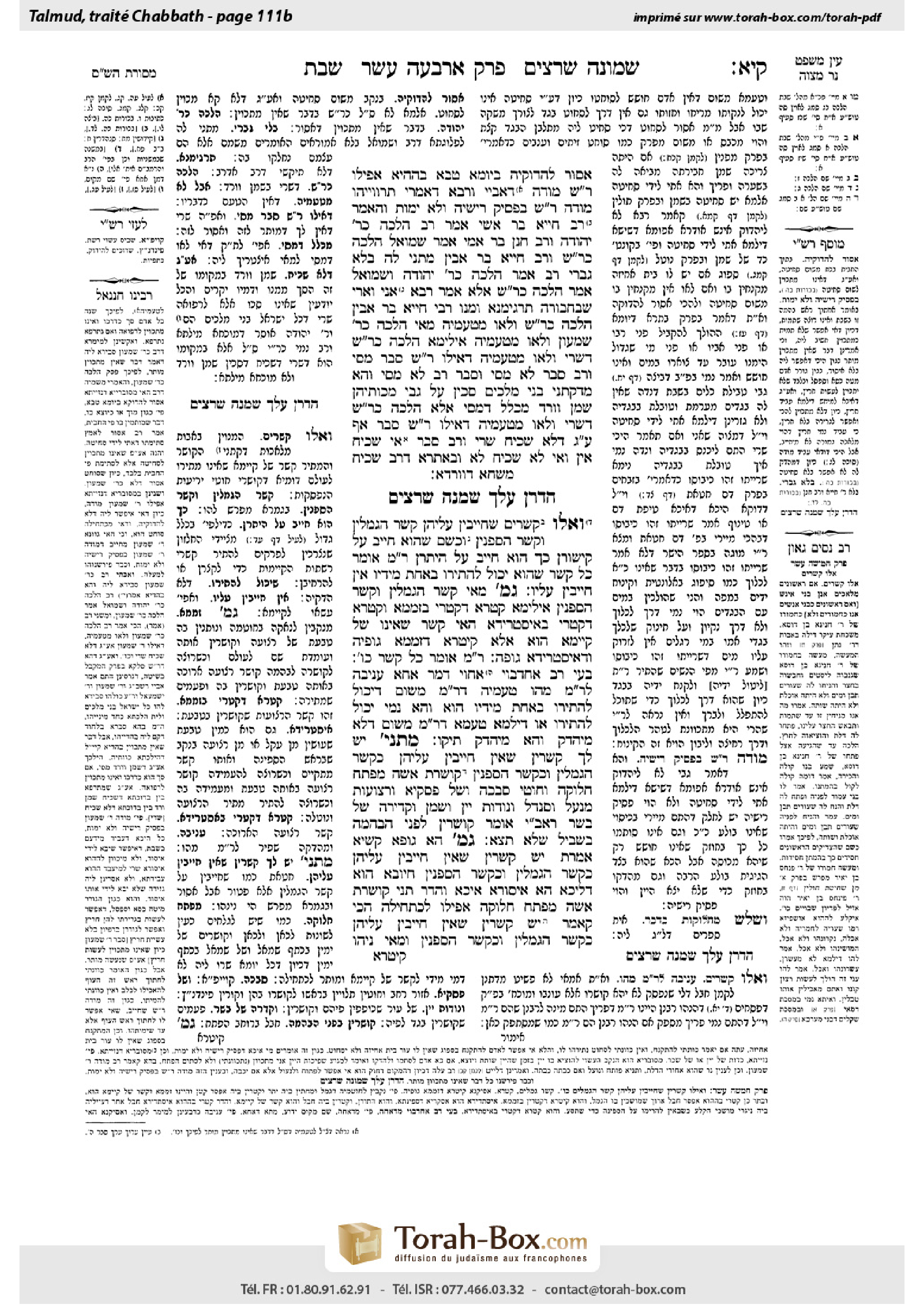
Shabbat 111b: Talmud study for Daf Yomi
Daf Yomi is the daily study of one Talmud folio. Explore 37 tractates with scans, Hebrew text, Sefaria English and AI-generated French translations where annotated.
Passage selection and English or AI-generated French translation are available where the scan has annotations. Daf Study is independent of Torah-Box and Sefaria.
Browse Shabbat · שבת · All tractatesShabbat 111b text and translations
This page of Shabbat includes the Aramaic text, an English translation and an AI-generated French translation, alongside the scan above.
שבת קי״א ב · Aramaic and Hebrew text
אֲסִיר לְהַדּוֹקֵיהּ בְּיוֹמָא טָבָא! בְּהָהִיא אֲפִילּוּ רַבִּי שִׁמְעוֹן מוֹדֶה. דְּאַבָּיֵי וְרָבָא דְּאָמְרִי תַּרְוַויְיהוּ: מוֹדֶה רַבִּי שִׁמְעוֹן בִּ״פְסִיק רֵישֵׁיהּ וְלָא יְמוּת״.
וְהָאָמַר רַב חִיָּיא בַּר אָשֵׁי אָמַר רַב: הֲלָכָה כְּרַבִּי יְהוּדָה, וְרַב חָנָן בַּר אַמֵּי אָמַר שְׁמוּאֵל: הֲלָכָה כְּרַבִּי שִׁמְעוֹן. וְרַב חִיָּיא בַּר אָבִין מַתְנֵי לַהּ בְּלָא גַבְרֵי, רַב אָמַר: הֲלָכָה כְּרַבִּי יְהוּדָה, וּשְׁמוּאֵל אָמַר: הֲלָכָה כְּרַבִּי שִׁמְעוֹן! אֶלָּא אָמַר רָבָא: אֲנִי וַאֲרִי שֶׁבַּחֲבוּרָה תַּרְגֵּימְנָא, וּמַנּוּ — רַבִּי חִיָּיא בַּר אָבִין: הֲלָכָה כְּרַבִּי שִׁמְעוֹן, וְלָאו מִטַּעְמֵיהּ.
מַאי ״הֲלָכָה כְּרַבִּי שִׁמְעוֹן וְלָאו מִטַּעְמֵיהּ״? אִילֵּימָא הֲלָכָה כְּרַבִּי שִׁמְעוֹן — דְּשָׁרֵי, וְלָאו מִטַּעְמֵיהּ — דְּאִילּוּ רַבִּי שִׁמְעוֹן סָבַר מַסֵּי, וְרַב סָבַר לָא מַסֵּי. וְסָבַר רַב לָא מַסֵּי? וְהָא מִדְּקָתָנֵי ״בְּנֵי מְלָכִים סָכִין עַל גַּבֵּי מַכּוֹתֵיהֶן שֶׁמֶן וֶורֶד״, מִכְּלָל דְּמַסֵּי. אֶלָּא: הֲלָכָה כְּרַבִּי שִׁמְעוֹן — דְּשָׁרֵי, וְלָאו מִטַּעְמֵיהּ — דְּאִילּוּ רַבִּי שִׁמְעוֹן סָבַר: אַף עַל גַּב דְּלָא שְׁכִיחַ, שְׁרֵי. וְרַב סָבַר: אִי שְׁכִיחַ — אִין, וְאִי לָא שְׁכִיחַ — לָא. וּבְאַתְרָא דְּרַב שְׁכִיחַ מִשְׁחָא דְוַורְדָּא.
הדרן עלך שמנה
שרצים
מַתְנִי׳ וְאֵלּוּ קְשָׁרִים שֶׁחַיָּיבִין עֲלֵיהֶן: קֶשֶׁר הַגַּמָּלִין וְקֶשֶׁר הַסַּפָּנִין, וּכְשֵׁם שֶׁהוּא חַיָּיב עַל קִישּׁוּרָן, כָּךְ הוּא חַיָּיב עַל הֶיתֵּרָן. רַבִּי מֵאִיר אוֹמֵר: כׇּל קֶשֶׁר שֶׁהוּא יָכוֹל לְהַתִּירוֹ בְּאַחַת מִיָּדָיו — אֵין חַיָּיבִין עָלָיו.
גְּמָ׳ מַאי קֶשֶׁר הַגַּמָּלִין וְקֶשֶׁר הַסַּפָּנִין? אִילֵּימָא קִטְרָא דְּקָטְרִי בִּזְמָמָא, וְקִטְרָא דְּקָטְרִי בְּאִיסְטָרִידָא — הַאי קֶשֶׁר שֶׁאֵינוֹ שֶׁל קַיָּימָא הוּא! אֶלָּא קִיטְרָא דִזְמָמָא גּוּפֵיהּ, וּדְאִיסְטָרִידָא גּוּפַהּ.
רַבִּי מֵאִיר אוֹמֵר כׇּל קֶשֶׁר כּוּ׳. בָּעֵי רַב אַחָדְבוּי אַחוּי דְּמָר אַחָא: עֲנִיבָה לְרַבִּי מֵאִיר מַהוּ? טַעְמֵיהּ דְּרַבִּי מֵאִיר מִשּׁוּם דְּיָכוֹל לְהַתִּירוֹ בְּאַחַת מִיָּדָיו הוּא — וְהָא נָמֵי יָכוֹל לְהַתִּירוֹ, אוֹ דִילְמָא טַעְמָא דְּרַבִּי מֵאִיר מִשּׁוּם דְּלָא מִיהַדַּק — וְהַאי [הָא] מִיהַדַּק. תֵּיקוּ.
מַתְנִי׳ יֵשׁ לְךָ קְשָׁרִין שֶׁאֵין חַיָּיבִין עֲלֵיהֶן כְּקֶשֶׁר הַגַּמָּלִין וּכְקֶשֶׁר הַסַּפָּנִין: קוֹשֶׁרֶת אִשָּׁה מִפְתַּח חֲלוּקָהּ, וְחוּטֵי סְבָכָה, וְשֶׁל פָּסִקְיָא, וּרְצוּעוֹת מִנְעָל וְסַנְדָּל, וְנוֹדוֹת יַיִן וָשֶׁמֶן, וּקְדֵירָה שֶׁל בָּשָׂר. רַבִּי אֱלִיעֶזֶר בֶּן יַעֲקֹב אוֹמֵר: קוֹשְׁרִין לִפְנֵי הַבְּהֵמָה בִּשְׁבִיל שֶׁלֹּא תֵּצֵא.
גְּמָ׳ הָא גּוּפַהּ קַשְׁיָא: אָמְרַתְּ יֵשׁ קְשָׁרִין שֶׁאֵין חַיָּיבִין עֲלֵיהֶן כְּקֶשֶׁר הַגַּמָּלִין וּכְקֶשֶׁר הַסַּפָּנִין: חִיּוּבָא הוּא דְּלֵיכָּא, הָא אִיסּוּרָא — אִיכָּא, וַהֲדַר תָּנֵי: קוֹשֶׁרֶת אִשָּׁה מִפְתַּח חֲלוּקָה: אֲפִילּוּ לְכַתְּחִילָּה! הָכִי קָאָמַר: יֵשׁ קְשָׁרִין שֶׁאֵין חַיָּיבִין עֲלֵיהֶן כְּקֶשֶׁר הַגַּמָּלִין וּכְקֶשֶׁר הַסַּפָּנִין. וּמַאי נִיהוּ —
Shabbat 111b · English translation
it is prohibited to insert it tightly on a Festival due to the prohibited labor of wringing. Doesn’t Rabbi Shimon permit performing an unintentional act from which a prohibited labor may ensue? The Gemara answers: In that case, even Rabbi Shimon concedes that it is prohibited, as it was Abaye and Rava who both said: Rabbi Shimon concedes in instances categorized as: Cut off its head and it shall not die. This category refers to situations where the ensuing prohibited labor is inevitable. In those kinds of cases, one is liable even according to Rabbi Shimon. Since stuffing a cloth into a barrel will inevitably lead to wringing wine from it, Rabbi Shimon concedes that doing so is forbidden.
The Gemara asks again: Didn’t Rav Ḥiyya bar Ashi say that Rav said explicitly: The halakha is in accordance with the opinion of Rabbi Yehuda, and Rav Ḥanan bar Ami said that Shmuel said: The halakha is in accordance with the opinion of Rabbi Shimon. And Rav Ḥiyya bar Avin taught the same tradition without mentioning the names of the men who cited the statements, but cited it directly: Rav said: The halakha is in accordance with the opinion of Rabbi Yehuda, and Shmuel said: The halakha is in accordance with the opinion of Rabbi Shimon. Rather, Rava said: I and the lion of the group explained this. And the Gemara asks: And who is the lion of the group? It is Rabbi Ḥiyya bar Avin. He and Rava explained: The halakha is indeed in accordance with the opinion of Rabbi Shimon, but not for his reason.
The Gemara explains: What exactly is the meaning of the statement: The halakha is in accordance with the opinion of Rabbi Shimon, but not for his reason? If we say the halakha is in accordance with the opinion of Rabbi Shimon, who permits smearing rose oil, but not for his reason, because Rabbi Shimon holds that rose oil heals, and Rav holds that it does not heal, which is why he permits smearing it on Shabbat, then does Rav hold that rose oil does not heal? From the fact that it is taught: Princes smear rose [vered] oil on their wounds; by inference, it heals. Rather, it means: The halakha is in accordance with the opinion of Rabbi Shimon, who permits rose oil, but not for his reason. As Rabbi Shimon holds that although rose oil is uncommon and expensive, and anyone who sees one smearing it realizes that it is for medicinal purposes, nevertheless, it is permitted. And Rav holds that if rose oil is common in a given place, yes, one may smear it on himself; however, if it is not common there, it is not permitted. And in Rav’s place, roses were common, and that is why he permitted smearing with rose oil on Shabbat. However, in a place where rose oil is uncommon, he concedes to the Rabbis, who prohibited doing so.
MISHNA: And these are knots for which one is liable to bring a sin-offering if one tied them on Shabbat: A camel driver’s knot and a sailor’s knot, both of which are meant to be permanent. And just as one is liable to bring a sin-offering for tying these knots, so too, he is liable to bring a sin-offering for untying them. Rabbi Meir says a principle: For tying any knot that one can untie with one of his hands, one is not liable to bring a sin-offering, because a loose knot of that sort is not considered permanent even if that was his intention.
GEMARA: The Gemara asks: What are a camel driver’s knot and a sailor’s knot? If you say that these are a knot that one uses to tie a strap to the camel’s nose ring in order to pull it and a knot that one uses to tie a rope to the ring [isterida] fixed to the bow of a ship when the ship is docked, then these knots are not meant to be permanent, as they are periodically untied. Rather, a camel driver’s knot is the knot that fixes the nose ring itself in the camel’s nose, and the sailor’s knot is the knot that fixes the ring itself to the ship. These knots are never untied and are permanent.
We learned in the mishna that Rabbi Meir says a principle: For tying any knot that one can untie with one of his hands, one is not liable for tying it. Rav Aḥadvoy, brother of Mar Aḥa, raised a dilemma: With regard to tying a bow, what is the ruling according to Rabbi Meir? Is it permitted to tie it tightly on Shabbat or not? The dilemma is: Is the reason for the opinion of Rabbi Meir merely that because one can untie the knot with one of his hands it is not considered a permanent knot, and this bow too, he can untie it with one of his hands and therefore he would not be liable for tying on Shabbat? Or perhaps the reason for the opinion of Rabbi Meir is because typically a knot that can be untied with one hand is not particularly tight, and this bow is tight and therefore it is prohibited to tie it on Shabbat. This dilemma is not resolved, and the Gemara concludes: Let it stand unresolved.
MISHNA: You have knots for which one is not liable to bring a sin-offering as one is liable for tying a camel driver’s knot and a sailor’s knot; however, it is nevertheless prohibited to tie them. A woman may tie closed the opening of her robe with straps, as well as the strings of her hairnet and the laces of her girdle, i.e., a wide belt tied with laces. One may also tie the straps of a shoe or a sandal, as well as the spouts of wine or oil jugs. One may also tie a garment over a pot of meat. Rabbi Eliezer ben Ya’akov says: One may tie a rope across an entrance before an animal so that it will not go out.
GEMARA: The Gemara asks: This matter itself is difficult, as there is an internal contradiction in the mishna. On the one hand, you said that there are knots for which one is not liable to bring a sin-offering as he is for tying a camel driver’s knot and a sailor’s knot, which would seem to indicate that although there is no Torah liability, there is a rabbinic prohibition. And then it was taught that a woman may tie the opening of her robe, indicating that doing so is permitted even ab initio. The Gemara answers that this is what the mishna is saying: There are knots for which one is not liable to bring a sin-offering for tying them on Shabbat as he is for tying a camel driver’s knot and a sailor’s knot. And which are these?
Shabbat 111b · Traduction française (IA)
Il est interdit de l’enfoncer étroitement un jour de fête, en raison du travail interdit d’essorage. Rabbi Shimon ne permet-il pas d’accomplir un acte involontaire dont peut résulter un travail interdit ? La Guemara répond : dans ce cas, même Rabbi Shimon reconnaît que c’est interdit, car Abayé et Rava ont tous deux dit que Rabbi Shimon reconnaît les cas qualifiés de « Coupe-lui la tête et qu’il ne meure pas ». Cette catégorie désigne les situations où le travail interdit qui en résulte est inévitable. Dans ces cas-là, on est passible même selon Rabbi Shimon. Puisqu’en bourrant un chiffon dans un tonneau, on finira inévitablement par en extraire le vin par essorage, Rabbi Shimon reconnaît que cela est interdit.
La Guemara demande encore : Rav Ḥiyya bar Ashi n’a-t-il pas dit que Rav a explicitement déclaré que la halakha est conforme à l’opinion de Rabbi Yehuda ? Et Rav Ḥanan bar Ami n’a-t-il pas dit que Shmuel a déclaré que la halakha est conforme à l’opinion de Rabbi Shimon ? Rav Ḥiyya bar Avin a transmis la même tradition sans mentionner les noms des personnes qui rapportaient ces propos, mais en les attribuant directement : Rav a dit que la halakha est conforme à l’opinion de Rabbi Yehuda, et Shmuel a dit que la halakha est conforme à l’opinion de Rabbi Shimon. Rava dit plutôt : « Le lion du groupe et moi avons expliqué cela. » La Guemara demande : « Et qui est le lion du groupe ? » Rabbi Ḥiyya bar Avin. Lui et Rava ont expliqué : la halakha est effectivement conforme à l’opinion de Rabbi Shimon, mais pas pour la raison qu’il avance.
La Guemara explique : Que signifie exactement cette affirmation : la halakha est conforme à l’opinion de Rabbi Shimon, mais pas pour la raison qu’il avance ? Si l’on veut dire que la halakha est conforme à l’opinion de Rabbi Shimon, qui permet de s’enduire d’huile de rose, mais pas pour sa raison, car Rabbi Shimon considère que l’huile de rose soigne, tandis que Rav estime qu’elle ne soigne pas, et que c’est pourquoi il permet de s’en enduire le Chabbat, alors Rav estime-t-il que l’huile de rose ne soigne pas ? Or, puisqu’il est enseigné que les princes s’enduisent d’huile de rose [vered] sur leurs blessures, il s’ensuit qu’elle soigne. Il faut plutôt comprendre que la halakha est conforme à l’opinion de Rabbi Shimon, qui permet l’usage de l’huile de rose, mais pas pour sa raison. En effet, Rabbi Shimon considère que, bien que l’huile de rose soit rare et coûteuse, et que quiconque voit quelqu’un s’en enduire comprenne que c’est à des fins médicales, cela reste néanmoins permis. Rav, lui, considère que si l’huile de rose est courante dans un endroit donné, on peut s’en enduire ; mais si elle n’y est pas courante, cela n’est pas permis. Dans la région de Rav, les roses étaient courantes, et c’est pourquoi il permettait de s’enduire d’huile de rose le Chabbat. Toutefois, dans un endroit où l’huile de rose est rare, il se rallie à l’opinion des rabbins, qui l’interdisent.
Michna : Voici les nœuds pour lesquels on est passible d’apporter un sacrifice expiatoire si on les noue le Chabbat : le nœud d’un chamelier et celui d’un marin, tous deux étant destinés à rester noués de façon permanente. Et de même qu’on est passible d’apporter un sacrifice expiatoire pour avoir noué ces nœuds, on l’est également pour les avoir dénoués. Rabbi Meir énonce un principe : pour tout nœud qu’on peut dénouer d’une seule main, on n’est pas passible d’apporter un sacrifice expiatoire, car un nœud lâche de ce genre n’est pas considéré comme permanent, même si telle était son intention.
Guemara : La Guemara demande : Que sont le nœud d’un chamelier et celui d’un marin ? Si l’on dit qu’il s’agit d’un nœud servant à attacher une courroie à l’anneau nasal du chameau afin de le tirer, et d’un nœud servant à attacher une corde à l’anneau [isterida] fixé à la proue d’un bateau lorsque celui-ci est à quai, alors ces nœuds ne sont pas destinés à rester noués de façon permanente, puisqu’on les défait périodiquement. Il faut plutôt dire que le nœud d’un chamelier est celui qui fixe l’anneau nasal lui-même dans le nez du chameau, et que le nœud d’un marin est celui qui fixe l’anneau lui-même au bateau. Ces nœuds ne sont jamais défaits et sont permanents.
Nous avons appris dans la Michna que Rabbi Meir énonce un principe : on n’est pas passible pour avoir noué un nœud qu’on peut dénouer d’une seule main. Rav Aḥadvoy, frère de Mar Aḥa, posa un dilemme : quel est le statut du fait de nouer un nœud de ruban, selon Rabbi Meir ? Est-il permis de le serrer fortement le Chabbat ou non ? Le dilemme est le suivant : la raison de l’opinion de Rabbi Meir est-elle simplement que, puisqu’on peut dénouer le nœud d’une seule main, celui-ci n’est pas considéré comme permanent, et que ce nœud de ruban aussi peut être dénoué d’une seule main, de sorte qu’on ne serait pas passible pour l’avoir noué le Chabbat ? Ou bien la raison de l’opinion de Rabbi Meir est-elle que, généralement, un nœud qu’on peut dénouer d’une seule main n’est pas particulièrement serré, tandis que ce nœud de ruban est serré, et qu’il est donc interdit de le nouer le Chabbat ? Ce dilemme n’est pas résolu, et la Guemara conclut : qu’il demeure sans solution.
Michna : Il existe des nœuds pour lesquels on n’est pas passible d’apporter un sacrifice expiatoire, contrairement au nœud d’un chamelier et à celui d’un marin ; il est toutefois interdit de les nouer. Une femme peut nouer les liens pour fermer l’ouverture de sa robe, ainsi que les cordons de son filet à cheveux et les lacets de sa ceinture, c’est-à-dire une large ceinture nouée à l’aide de lacets. On peut également nouer les lacets d’une chaussure ou d’une sandale, ainsi que les becs verseurs de cruches à vin ou à huile. On peut aussi nouer un vêtement au-dessus d’une marmite de viande. Rabbi Eliezer ben Ya’akov dit : on peut tendre une corde en travers d’une entrée devant un animal, afin qu’il ne sorte pas.
Guemara : La Guemara demande : Cet enseignement lui-même pose problème, car la Michna comporte une contradiction interne. D’une part, tu as dit qu’il existe des nœuds pour lesquels on n’est pas passible d’apporter un sacrifice expiatoire, contrairement au nœud d’un chamelier et à celui d’un marin, ce qui semble indiquer que, même si aucune peine n’est encourue au titre de la Torah, une interdiction rabbinique s’applique. Puis il a été enseigné qu’une femme peut nouer l’ouverture de sa robe, ce qui indique que cela est permis a priori. La Guemara répond que voici ce que la Michna veut dire : il existe des nœuds pour lesquels on n’est pas passible d’apporter un sacrifice expiatoire lorsqu’on les noue le Chabbat, contrairement au nœud d’un chamelier et à celui d’un marin. Et quels sont-ils ?
Traduction française générée par IA à partir de l’édition anglaise de Sefaria. Vérifie toujours un passage avec le texte source.
Text from Sefaria: William Davidson Edition - Vocalized Aramaic (CC BY NC); William Davidson Edition - English (CC BY NC).