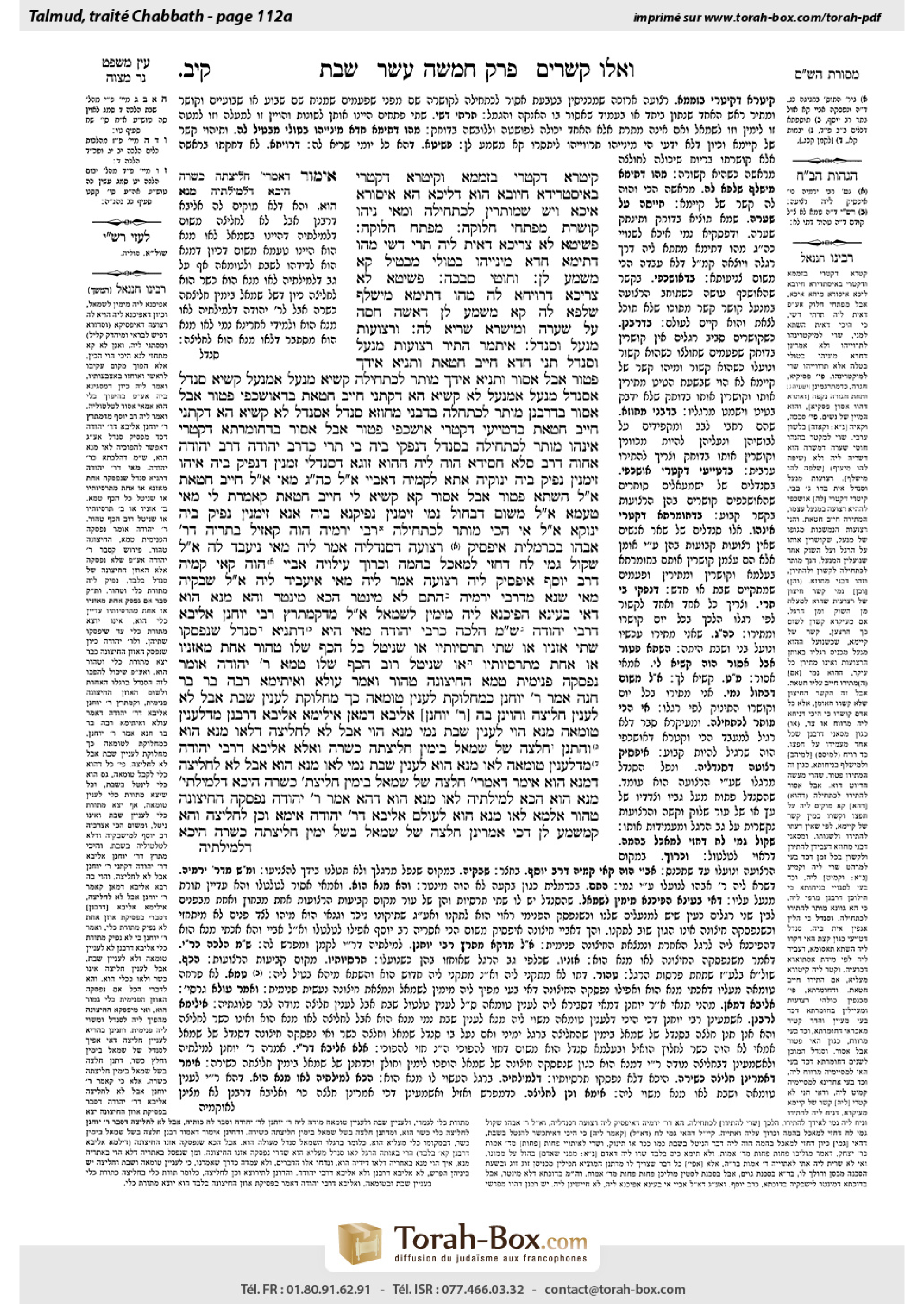
Shabbat 112a: Talmud study for Daf Yomi
Daf Yomi is the daily study of one Talmud folio. Explore 37 tractates with scans, Hebrew text, Sefaria English and AI-generated French translations where annotated.
Passage selection and English or AI-generated French translation are available where the scan has annotations. Daf Study is independent of Torah-Box and Sefaria.
Browse Shabbat · שבת · All tractatesShabbat 112a text and translations
This page of Shabbat includes the Aramaic text, an English translation and an AI-generated French translation, alongside the scan above.
שבת קי״ב א · Aramaic and Hebrew text
קִיטְרָא דְּקָטְרִי בִּזְמָמָא וְקִיטְרָא דְּקָטְרִי בְּאִיסְטָרִידָא, חִיּוּבָא הוּא דְּלֵיכָּא, הָא אִיסּוּרָא — אִיכָּא. וְיֵשׁ שֶׁמּוּתָּרִין לְכַתְּחִילָּה, וּמַאי נִיהוּ — קוֹשֶׁרֶת מִפְתְּחֵי חֲלוּקָהּ.
מִפְתַּח חֲלוּקָהּ. פְּשִׁיטָא! לָא צְרִיכָא, דְּאִית לֵיהּ תְּרֵי דַשֵּׁי. מַהוּ דְתֵימָא: חֲדָא מִינַּיְיהוּ בַּטּוֹלֵי מְבַטֵּיל [לַהּ], קָא מַשְׁמַע לַן.
וְחוּטֵי סְבָכָה. פְּשִׁיטָא! לָא צְרִיכָא, דִּרְוִיחָא לַהּ. מַהוּ דְתֵימָא: מִישְׁלָף שָׁלְפָא לַהּ, קָא מַשְׁמַע לַן דְּאִשָּׁה חָסָה עַל שְׂעָרָהּ וּמִישְׁרָא שָׁרְיָא לַהּ.
וּרְצוּעוֹת מִנְעָל וְסַנְדָּל. אִיתְּמַר: הִתִּיר רְצוּעוֹת מִנְעָל וְסַנְדָּל, תָּנֵי חֲדָא: חַיָּיב חַטָּאת, וְתַנְיָא אִידַּךְ: פָּטוּר אֲבָל אָסוּר, וְתַנְיָא אִידַּךְ: מוּתָּר לְכַתְּחִילָּה. קַשְׁיָא מִנְעָל אַמִּנְעָל, קַשְׁיָא סַנְדָּל אַסַּנְדָּל.
מִנְעָל אַמִּנְעָל לָא קַשְׁיָא: הָא דְּקָתָנֵי חַיָּיב חַטָּאת — בִּדְאוּשְׁכָּפֵי. פָּטוּר אֲבָל אָסוּר — בְּדַרְבָּנַן. מוּתָּר לְכַתְּחִלָּה — בְּדִבְנֵי מָחוֹזָא.
סַנְדָּל אַסַּנְדָּל לָא קַשְׁיָא: הָא דְּקָתָנֵי חַיָּיב חַטָּאת — בִּדְטַיָּיעֵי דְּקָטְרִי אוּשְׁכָּפֵי. פָּטוּר אֲבָל אָסוּר — בִּדְחוּמַרְתָּא דְּקָטְרִי אִינְהוּ. מוּתָּר לְכַתְּחִילָּה — בְּסַנְדָּל דְּנָפְקִי בֵּיהּ בֵּי תְרֵי, כִּדְרַב יְהוּדָה. דְּרַב יְהוּדָה אֲחוּהּ דְּרַב סַלָּא חֲסִידָא הֲוָה לֵיהּ הָהוּא זוּגָא דְּסַנְדָּלֵי, זִמְנִין דְּנָפֵיק בֵּיהּ אִיהוּ, זִימְנִין נָפֵיק בֵּיהּ יָנוֹקֵיהּ. אֲתָא לְקַמֵּיהּ דְּאַבָּיֵי, אֲמַר לֵיהּ: כְּהַאי גַּוְנָא מַאי? אֲמַר לֵיהּ: חַיָּיב חַטָּאת.
אֲמַר לֵיהּ: הַשְׁתָּא פָּטוּר אֲבָל אָסוּר קָא קַשְׁיָא לִי, ״חַיָּיב חַטָּאת״ קָאָמְרַתְּ לִי?! מַאי טַעְמָא? אֲמַר לֵיהּ: מִשּׁוּם דִּבְחוֹל נָמֵי זִימְנִין נָפֵיקְנָא בֵּיהּ אֲנָא, זִימְנִין נָפֵיק בֵּיהּ יָנוֹקָא. אֲמַר לֵיהּ: אִי הָכִי, מוּתָּר לְכַתְּחִילָּה.
רַבִּי יִרְמְיָה הֲוָה קָאָזֵיל בָּתְרֵיהּ דְּרַבִּי אֲבָהוּ בְּכַרְמְלִית. אִיפְּסִיק רְצוּעָה דְּסַנְדָּלֵיהּ. אֲמַר לֵיהּ: מַאי אֶעֱבֵיד לֵיהּ? אֲמַר לֵיהּ: שְׁקוֹל גֶּמִי לַח דַּחֲזֵי לְמַאֲכַל בְּהֵמָה, וּכְרוֹךְ עִילָּוֵיהּ. אַבָּיֵי הֲוָה קָאֵי קַמֵּיהּ דְּרַב יוֹסֵף. אִיפְּסִיק לֵיהּ רְצוּעָה. אֲמַר לֵיהּ: מַאי אֶיעֱבֵיד לֵיהּ? אֲמַר לֵיהּ: שִׁבְקֵיהּ. מַאי שְׁנָא מִדְּרַבִּי יִרְמְיָה? הָתָם לָא מִינְּטַר, הָכָא מִינְּטַר. וְהָא מָנָא הוּא, דְּאִי בָּעֵינָא הָפֵיכְנָא לֵיהּ מִיָּמִין לִשְׂמֹאל? אֲמַר לֵיהּ: מִדְּקָמְתָרֵץ רַבִּי יוֹחָנָן אַלִּיבָּא דְּרַבִּי יְהוּדָה, שְׁמַע מִינַּהּ הֲלָכָה כְּרַבִּי יְהוּדָה.
מַאי הִיא? דְּתַנְיָא: סַנְדָּל שֶׁנִּפְסְקוּ שְׁתֵּי אׇזְנָיו, אוֹ שְׁתֵּי תְרֵסִיּוֹתָיו, אוֹ שֶׁנִּיטַּל כׇּל הַכַּף שֶׁלּוֹ — טָהוֹר. אַחַת מֵאׇזְנָיו, אוֹ אַחַת מִתְּרֵסִיּוֹתָיו, אוֹ שֶׁנִּיטַּל רוֹב הַכַּף שֶׁלּוֹ — טָמֵא. רַבִּי יְהוּדָה אוֹמֵר: נִפְסְקָה פְּנִימִית — טָמֵא. הַחִיצוֹנָה — טָהוֹר. וְאָמַר עוּלָּא, וְאִיתֵּימָא רַבָּה בַּר בַּר חָנָה אָמַר רַבִּי יוֹחָנָן: כְּמַחֲלוֹקֶת לְעִנְיַן טוּמְאָה כָּךְ מַחֲלוֹקֶת לְעִנְיַן שַׁבָּת, אֲבָל לֹא לְעִנְיַן חֲלִיצָה.
וְהָוֵינַן בַּהּ: [רַבִּי יוֹחָנָן] אַלִּיבָּא דְּמַאן? אִילֵימָא אַלִּיבָּא דְּרַבָּנַן: מִדִּלְעִנְיַן טוּמְאָה מָנָא הָוֵי — לְעִנְיַן שַׁבָּת נָמֵי מָנָא הָוֵי, אֲבָל לֹא לַחֲלִיצָה — דְּלָאו מָנָא הוּא, וְהָתְנַן: חָלְצָה שֶׁל שְׂמֹאל בַּיָּמִין חֲלִיצָתָהּ כְּשֵׁרָה. וְאֶלָּא אַלִּיבָּא דְּרַבִּי יְהוּדָה: מִדִּלְעִנְיַן טוּמְאָה לָאו מָנָא הוּא — לְעִנְיַן שַׁבָּת נָמֵי לָאו מָנָא הוּא, אֲבָל לֹא לַחֲלִיצָה דְּמָנָא הוּא.
אֵימַר דְּאָמְרִינַן חָלְצָה שֶׁל שְׂמֹאל בַּיָּמִין חֲלִיצָתָהּ כְּשֵׁרָה — הִיכָא דִּלְמִילְּתֵיהּ מָנָא הוּא, הָכָא לְמִילְּתֵיהּ לָאו מָנָא הוּא, דְּהָא אָמַר רַבִּי יְהוּדָה: נִפְסְקָה הַחִיצוֹנָה טָהוֹר — אַלְמָא לָאו מָנָא הוּא! לְעוֹלָם אַלִּיבָּא דְּרַבִּי יְהוּדָה. אֵימָא: וְכֵן לַחֲלִיצָה. וְהָא קָמַשְׁמַע לַן: דְּכִי אָמְרִינַן חָלְצָה שֶׁל שְׂמֹאל בְּשֶׁל יָמִין חֲלִיצָתָהּ כְּשֵׁרָה — הֵיכָא
Shabbat 112a · English translation
A knot with which one ties a strap to the camel’s nose ring and a knot with which one ties a rope to the ring fixed to the bow of a ship, with regard to liability to bring a sin-offering, there is none; however, there is a rabbinic prohibition. And there are knots that are permitted to be tied on Shabbat ab initio. And which are these? The knot that a woman uses to tie the opening of her robe.
We learned in the mishna: A woman may tie the opening of her robe on Shabbat. The Gemara states: This is obvious, as the knot is meant to be untied and is therefore not permanent. The Gemara explains: It is only necessary to state this halakha in a case where the robe has two laces with which to tie the opening. Lest you say that one of them may become void because the woman can remove the garment even with one string, leaving the one not untied a permanent knot, it therefore teaches us that neither knot is considered permanent.
We learned in the mishna: And a woman may tie the strings of her hairnet on Shabbat. The Gemara states: This is obvious. The Gemara clarifies the matter: It was only necessary to state this halakha in a case where the hairnet is tied loosely on her head. Lest you say that she sometimes removes it without untying it and the knots remain, the mishna teaches us that a woman is protective of her hair and avoids pulling it out, and therefore she unties the hairnet to avoid damaging her hair.
We learned in the mishna: And it is permitted to tie the straps of a shoe or a sandal on Shabbat. It was stated with regard to one who untied the straps of a shoe or a sandal: One baraita taught that one who did so on Shabbat is liable to bring a sin-offering; and it was taught in another baraita that one is exempt by Torah law, and it is prohibited to untie those straps ab initio; and it was taught in another baraita that it is permitted to untie these knots ab initio. This is difficult, as there is a contradiction between one statement with regard to a shoe and another statement with regard to the straps of a shoe; and this is difficult, as there is a contradiction between one statement with regard to the straps of a sandal and another statement with regard to the straps of a sandal.
The Gemara explains: The apparent contradiction between one statement with regard to a shoe and the other statement with regard to a shoe is not difficult, as that baraita, which teaches that one is liable to bring a sin-offering, is referring to a shoemaker’s knot, which is permanent as it holds the shoe together. The baraita that states that he is exempt by Torah law and it is prohibited by rabbinic decree is referring to the shoe worn by Sages, as they often tie their shoes loosely so they can easily put on and remove their shoes. The baraita that teaches that it is permitted to tie shoes ab initio is referring to such knots used by the residents of the city of Meḥoza, who are meticulous in their dress and who tie and untie their shoes every day.
Similarly, the contradiction between one statement with regard to the straps of a sandal and the other statement with regard to the straps of a sandal is not difficult, as that baraita, which teaches that one is liable to bring a sin-offering, is referring to Arab sandals, for which shoemakers tie permanent knots. And the baraita that teaches that he is exempt by Torah law and it is prohibited by rabbinic decree is referring to straps that they, i.e., ordinary people, tie. The baraita that teaches that it is permitted to tie and untie the straps of a sandal ab initio is referring to a sandal shared by two people who alternate going out at different times. They untie and retie the straps each time to ensure that the sandals will fit properly, like the sandals of Rav Yehuda; as Rav Yehuda, brother of Rav Sala Ḥasida, had a pair of sandals, and sometimes he would go out wearing them and sometimes his child would go out wearing them. Rav Yehuda came before Abaye and said to him: What is the ruling in a case of this kind? May I tie the straps on Shabbat? Abaye said to him: Doing so renders you liable to bring a sin-offering.
Rav Yehuda said to him: Now, even if your ruling in that case had been that one is exempt by Torah law but it is still prohibited by rabbinic law, it would be difficult for me, and you say to me that the ruling is that one is liable to bring a sin-offering. Abaye asked him: What is the reason for that difficulty? Rav Yehuda said to him: Because on weekdays too I sometimes go out wearing them and sometimes my child goes out wearing them. Abaye said to him: If so, it is permitted to untie the straps ab initio.
Rabbi Yirmeya was walking after Rabbi Abbahu in a karmelit on Shabbat when the strap of his sandal tore. Rabbi Yirmeya said to Rabbi Abbahu: What should I do to it? Rabbi Abbahu said to him: Take a moist reed fit for animal consumption and wrap it around the sandal to fasten it. And the Gemara relates: Abaye was standing before Rav Yosef on Shabbat when the strap of his sandal tore. Abaye said to Rav Yosef: What should I do with it? He said to him: Leave it and do not move it. Abaye said to him: How is this case different from that of Rabbi Yirmeya? He answered him: There the sandal would not have been protected; here it will be protected. Abaye said to him: But it remains a utensil and may therefore be moved on Shabbat, as if I so desire, I can switch it from the right foot to the left foot and wear it. Rav Yosef said to him: From the fact that Rabbi Yoḥanan explains the matter in accordance with the opinion of Rabbi Yehuda, as will be explained, conclude from it that the halakha is in accordance with the opinion of Rabbi Yehuda. Therefore, a torn sandal is not considered to be a utensil even if it were switched, i.e., turned around.
The Gemara asks: What is that opinion of Rabbi Yehuda? As it was taught in a baraita: A sandal that was ritually impure, whose two ears that hold the straps or whose two straps (ge’onim) broke, or whose entire sole was removed, becomes ritually pure because it is no longer a utensil. However, if only one of its ears or one of its straps broke, or if only most but not all of its sole was removed, it remains impure. Rabbi Yehuda says: If the inner strap broke it remains impure, because the outer strap can still be used. If the outer strap broke it is rendered pure. And Ulla, and some say Rabba bar bar Ḥana, said that Rabbi Yoḥanan said: Like there is a dispute with regard to ritual impurity, so too, there is a dispute with regard to Shabbat, i.e., whether or not it is permitted to wear such a sandal on Shabbat. However, there is no dispute with regard to ḥalitza.
And we discussed this issue: In accordance with whose opinion is the statement of Rabbi Yoḥanan? If you say that it is in accordance with the opinion of the Rabbis, and the baraita is explained as follows: From the fact that it is a utensil with regard to ritual impurity, it is also a utensil with regard to Shabbat, but it is not considered a utensil with regard to ḥalitza. However, didn’t we learn in a mishna: If she removed the left shoe, which was on the right foot of her brother-in-law, her ḥalitza is valid? Apparently, a woman can perform ḥalitza even when the shoe is on the wrong foot, and it is not deemed unfit for ḥalitza. Rather, Rabbi Yoḥanan’s opinion must be in accordance with the opinion of Rabbi Yehuda, and is saying the following: From the fact that with regard to impurity it is not a utensil, with regard to Shabbat it is also not a utensil. However, that is not the case with regard to ḥalitza, for which it is a utensil.
The Gemara asks: Say that we said that if she removed the left shoe which was on the right foot, her ḥalitza is valid, that applies only in a case where it is fit as a utensil for its usual purpose, i.e., it can be used as footwear. However, here it is not fit as a utensil for its usual purpose, as Rabbi Yehuda said: If the outer strap of the sandal tore, the sandal is rendered ritually pure. Apparently, according to Rabbi Yehuda, it is not a utensil. Rabbi Yoḥanan’s statement is difficult according to both opinions. The Gemara answers: Actually, his opinion is in accordance with the opinion of Rabbi Yehuda; however, emend his statement and say that Rabbi Yoḥanan said: And this is the halakha with regard to ḥalitza as well. And this teaches us that when we say that if she removed the left shoe that was on the right foot her ḥalitza is valid, that is only in a case where
Shabbat 112a · Traduction française (IA)
Il n’y a pas d’obligation d’apporter un sacrifice expiatoire pour un nœud servant à attacher une lanière à l’anneau nasal d’un chameau, ni pour un nœud servant à attacher une corde à l’anneau fixé à la proue d’un navire ; toutefois, il est interdit de les nouer en vertu d’un décret rabbinique. Certains nœuds, en revanche, peuvent être noués a priori le Chabbat. Lesquels ? Le nœud qu’une femme utilise pour fermer l’ouverture de sa robe.
Nous avons appris dans la Michna : Une femme peut fermer l’ouverture de sa robe le Chabbat. La Guemara dit : Cela va de soi, puisque le nœud est destiné à être défait et n’est donc pas permanent. La Guemara explique : Cette halakha n’était nécessaire que dans le cas où la robe est munie de deux cordons servant à fermer l’ouverture. De crainte que tu ne dises que l’un d’eux devient superflu, puisque la femme peut retirer le vêtement même avec un seul cordon, de sorte que le cordon qui n’est pas défait forme un nœud permanent, la Michna nous enseigne qu’aucun des deux nœuds n’est considéré comme permanent.
Nous avons appris dans la Michna : Une femme peut également nouer les cordons de son filet à cheveux le Chabbat. La Guemara dit : Cela va de soi. La Guemara précise : Cette halakha n’était nécessaire que dans le cas où le filet est noué lâchement sur sa tête. De crainte que tu ne dises qu’elle l’enlève parfois sans le dénouer et que les nœuds restent en place, la Michna nous enseigne qu’une femme prend soin de ses cheveux et évite de les arracher ; elle dénoue donc le filet afin de ne pas les abîmer.
Nous avons appris dans la Michna : Il est permis de nouer les lacets d’une chaussure ou d’une sandale le Chabbat. Au sujet de celui qui a dénoué les lacets d’une chaussure ou d’une sandale, une baraïta enseigne que celui qui l’a fait le Chabbat est tenu d’apporter un sacrifice expiatoire ; une autre baraïta enseigne qu’il est exempt selon la Torah, mais qu’il lui est interdit de dénouer ces lacets a priori ; et une troisième baraïta enseigne qu’il est permis de défaire ces nœuds a priori. Il y a là une difficulté : une déclaration concernant une chaussure contredit une autre déclaration concernant les lacets d’une chaussure ; de même, une déclaration concernant les lacets d’une sandale contredit une autre déclaration concernant les lacets d’une sandale.
La Guemara explique : La contradiction apparente entre les deux déclarations concernant une chaussure ne pose pas de difficulté, car la baraïta qui enseigne que l’on est tenu d’apporter un sacrifice expiatoire parle du nœud d’un cordonnier, qui est permanent puisqu’il maintient la chaussure assemblée. La baraïta qui dit que l’on est exempt selon la Torah, mais que cela est interdit par décret rabbinique, parle de la chaussure portée par les Sages, car ils nouaient souvent leurs chaussures lâchement afin de pouvoir les enfiler et les retirer facilement. La baraïta qui enseigne qu’il est permis de nouer des chaussures a priori parle des nœuds de ce type utilisés par les habitants de la ville de Meḥoza, qui soignent leur tenue et nouent et dénouent leurs chaussures chaque jour.
De même, la contradiction entre les deux déclarations concernant les lacets d’une sandale ne pose pas de difficulté, car la baraïta qui enseigne que l’on est tenu d’apporter un sacrifice expiatoire parle des sandales arabes, dont les cordonniers nouent les lacets de façon permanente. La baraïta qui enseigne que l’on est exempt selon la Torah, mais que cela est interdit par décret rabbinique, parle des lacets noués par les gens ordinaires. La baraïta qui enseigne qu’il est permis de nouer et de dénouer les lacets d’une sandale a priori parle d’une sandale partagée par deux personnes qui sortent à des moments différents, à tour de rôle. Chaque fois, elles dénouent et renouent les lacets afin que les sandales leur aillent correctement, comme les sandales de Rav Yehuda. En effet, Rav Yehuda, frère de Rav Sala Ḥasida, possédait une paire de sandales : parfois, il sortait avec et parfois, son enfant les portait. Rav Yehuda se présenta devant Abaye et lui dit : Quelle est la halakha dans un tel cas ? Puis-je nouer les lacets le Chabbat ? Abaye lui dit : Si tu le fais, tu es tenu d’apporter un sacrifice expiatoire.
Rav Yehuda lui dit : À présent, même si ta décision avait été que, dans ce cas, on est exempt selon la Torah, mais que cela reste interdit par la loi rabbinique, cela m’aurait déjà posé problème ; et toi, tu me dis que l’on est tenu d’apporter un sacrifice expiatoire ! Abaye lui demanda : Quelle est la raison de cette difficulté ? Rav Yehuda lui dit : Parce que les jours de semaine aussi, il m’arrive de sortir avec ces sandales, et il arrive aussi que mon enfant les porte. Abaye lui dit : Dans ce cas, il est permis de dénouer les lacets a priori.
Rabbi Yirmeya marchait derrière Rabbi Abbahu dans un karmelit le Chabbat lorsque la lanière de sa sandale se déchira. Rabbi Yirmeya dit à Rabbi Abbahu : Que dois-je en faire ? Rabbi Abbahu lui dit : Prends un roseau humide propre à la consommation animale et enroule-le autour de la sandale pour la maintenir. La Guemara rapporte : Abaye se tenait devant Rav Yosef le Chabbat lorsque la lanière de sa sandale se déchira. Abaye dit à Rav Yosef : Que dois-je en faire ? Il lui dit : Laisse-la et ne la déplace pas. Abaye lui dit : En quoi ce cas diffère-t-il de celui de Rabbi Yirmeya ? Il lui répondit : Là, la sandale n’aurait pas été maintenue ; ici, elle le sera. Abaye lui dit : Mais elle reste un ustensile et peut donc être déplacée le Chabbat, car si je le souhaite, je peux la passer du pied droit au pied gauche et la porter. Rav Yosef lui dit : Puisque Rabbi Yoḥanan explique la question conformément à l’opinion de Rabbi Yehuda, comme cela sera expliqué, déduis-en que la halakha suit l’opinion de Rabbi Yehuda. Par conséquent, une sandale déchirée n’est pas considérée comme un ustensile, même si on la retournait, c’est-à-dire si on la changeait de pied.
La Guemara demande : Quelle est cette opinion de Rabbi Yehuda ? Car il a été enseigné dans une baraïta : Une sandale rituellement impure dont les deux attaches retenant les lanières, ou dont les deux lanières (ge’onim), se sont cassées, ou dont toute la semelle a été arrachée, devient rituellement pure, car elle n’est plus un ustensile. En revanche, si une seule de ses attaches ou une seule de ses lanières s’est cassée, ou si la majeure partie, mais pas la totalité, de sa semelle a été arrachée, elle reste impure. Rabbi Yehuda dit : Si la lanière intérieure s’est cassée, elle reste impure, car la lanière extérieure peut encore être utilisée. Si la lanière extérieure s’est cassée, elle devient pure. Ulla — et certains disent Rabba bar bar Ḥana — a dit au nom de Rabbi Yoḥanan : De même qu’il existe une controverse au sujet de l’impureté rituelle, il existe aussi une controverse concernant le Chabbat, c’est-à-dire pour savoir s’il est permis ou non de porter une telle sandale le Chabbat. En revanche, il n’y a pas de controverse au sujet de la ḥalitsa.
Nous avons examiné cette question : Selon l’opinion de qui la déclaration de Rabbi Yoḥanan a-t-elle été formulée ? Si tu dis qu’elle suit l’opinion des Rabbins et que la baraïta s’explique ainsi : puisqu’il s’agit d’un ustensile en matière d’impureté rituelle, il s’agit aussi d’un ustensile en matière de Chabbat, mais il n’est pas considéré comme un ustensile pour la ḥalitsa, n’avons-nous pas appris dans une Michna : Si elle a retiré la chaussure gauche qui se trouvait au pied droit de son beau-frère, sa ḥalitsa est valide ? Apparemment, une femme peut accomplir la ḥalitsa même lorsque la chaussure est au mauvais pied, et celle-ci n’est donc pas considérée comme impropre à la ḥalitsa. Il faut plutôt dire que l’opinion de Rabbi Yoḥanan suit celle de Rabbi Yehuda, et qu’il dit ceci : puisqu’en matière d’impureté, elle n’est pas un ustensile, elle n’est pas non plus un ustensile en matière de Chabbat. Toutefois, il n’en va pas de même pour la ḥalitsa, pour laquelle elle est un ustensile.
La Guemara demande : Lorsque nous avons dit que si elle a retiré la chaussure gauche qui se trouvait au pied droit, sa ḥalitsa est valide, cela ne s’applique-t-il qu’au cas où la chaussure peut servir à son usage habituel, c’est-à-dire être portée ? Or, ici, elle ne peut pas servir à son usage habituel, puisque Rabbi Yehuda a dit : Si la lanière extérieure de la sandale s’est déchirée, celle-ci devient rituellement pure. Apparemment, selon Rabbi Yehuda, ce n’est pas un ustensile. La déclaration de Rabbi Yoḥanan pose donc problème selon les deux opinions. La Guemara répond : En réalité, son opinion suit celle de Rabbi Yehuda ; toutefois, corrige sa déclaration et dis que Rabbi Yoḥanan a dit : Et telle est également la halakha concernant la ḥalitsa. Cela nous enseigne que lorsque nous disons que si elle a retiré la chaussure gauche qui se trouvait au pied droit, sa ḥalitsa est valide, cela ne vaut que dans un cas où
Traduction française générée par IA à partir de l’édition anglaise de Sefaria. Vérifie toujours un passage avec le texte source.
Text from Sefaria: William Davidson Edition - Vocalized Aramaic (CC BY NC); William Davidson Edition - English (CC BY NC).