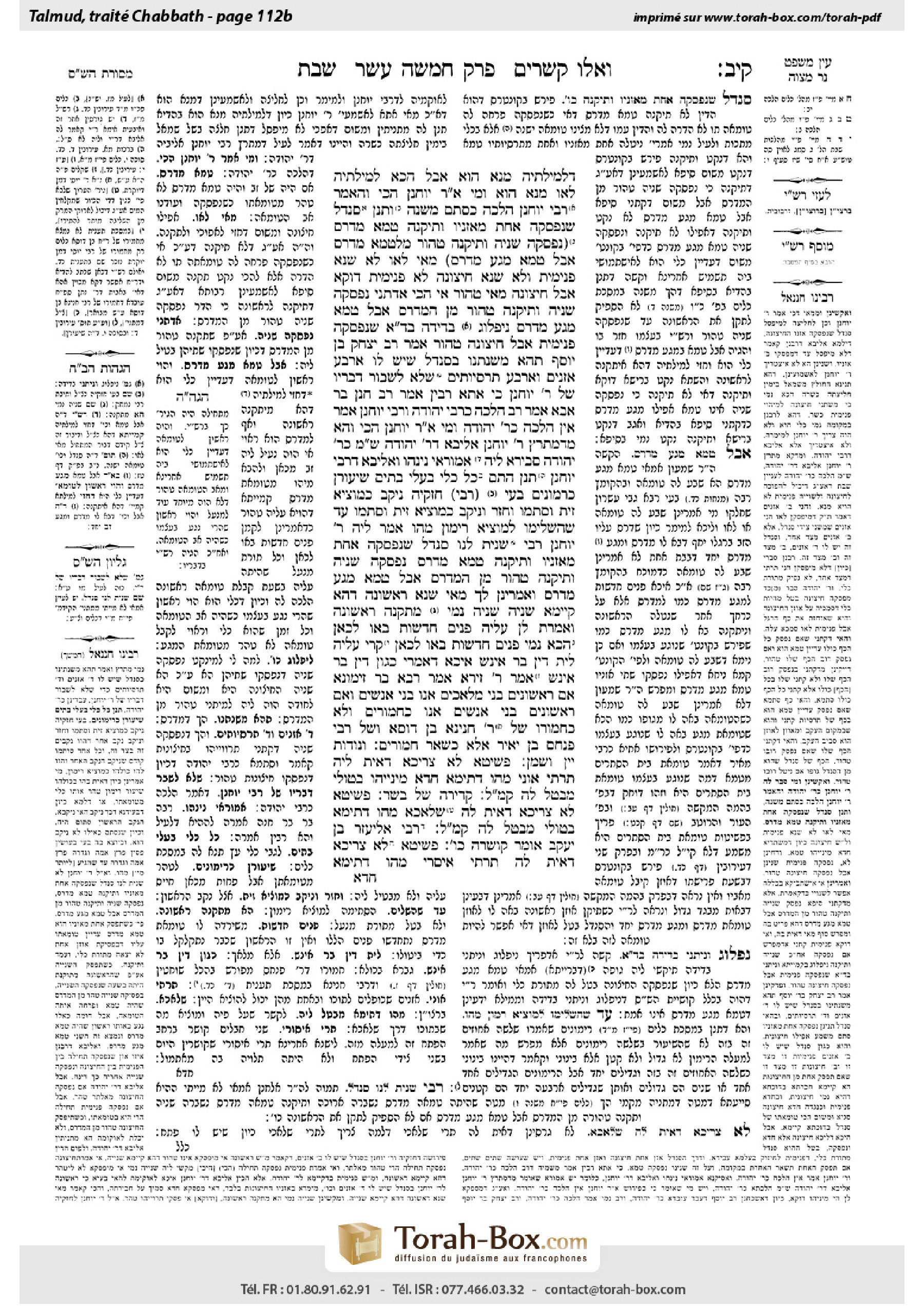
Shabbat 112b: Talmud study for Daf Yomi
Daf Yomi is the daily study of one Talmud folio. Explore 37 tractates with scans, Hebrew text, Sefaria English and AI-generated French translations where annotated.
Passage selection and English or AI-generated French translation are available where the scan has annotations. Daf Study is independent of Torah-Box and Sefaria.
Browse Shabbat · שבת · All tractatesShabbat 112b text and translations
This page of Shabbat includes the Aramaic text, an English translation and an AI-generated French translation, alongside the scan above.
שבת קי״ב ב · Aramaic and Hebrew text
דִּלְמִילְּתֵיהּ מָנָא הוּא, אֲבָל הָכָא — לְמִילְּתֵיהּ לָאו מָנָא הוּא.
וּמִי אָמַר רַבִּי יוֹחָנָן הָכִי? וְהָאָמַר רַבִּי יוֹחָנָן: הֲלָכָה כִּסְתַם מִשְׁנָה, וּתְנַן: סַנְדָּל שֶׁנִּפְסְקָה אַחַת מֵאׇזְנָיו וְתִיקְּנָהּ — טָמֵא מִדְרָס, נִפְסְקָה שְׁנִיָּה וְתִיקְּנָהּ — טָהוֹר מִלְּטַמֵּא מִדְרָס, אֲבָל טָמֵא מַגַּע מִדְרָס. מַאי לָאו לָא שְׁנָא פְּנִימִית וְלָא שְׁנָא חִיצוֹנָה!
לָא, פְּנִימִית דַּוְקָא. אֲבָל חִיצוֹנָה מַאי — טָהוֹר? אִי הָכִי, אַדְּתָנֵי: נִפְסְקָה שְׁנִיָּה וְתִיקְּנָהּ — טָהוֹר מִן הַמִּדְרָס אֲבָל טָמֵא מַגַּע מִדְרָס, נִיפְלוֹג בְּדִידַהּ: בַּמֶּה דְּבָרִים אֲמוּרִים — שֶׁנִּפְסְקָה פְּנִימִית, אֲבָל חִיצוֹנָה — טָהוֹר! אָמַר רַב יִצְחָק בֶּן יוֹסֵף: תְּהֵא מִשְׁנָתֵנוּ בְּסַנְדָּל שֶׁיֵּשׁ לוֹ אַרְבַּע אׇזְנַיִם וְאַרְבַּע תְּרֵסִיּוֹתַיִם, שֶׁלֹּא לִשְׁבּוֹר דְּבָרָיו שֶׁל רַבִּי יוֹחָנָן.
כִּי אֲתָא רָבִין אָמַר רַב חָנָן בַּר אַבָּא אָמַר רַב: הֲלָכָה כְּרַבִּי יְהוּדָה. וְרַבִּי יוֹחָנָן אָמַר: אֵין הֲלָכָה כְּרַבִּי יְהוּדָה. וּמִי אָמַר רַבִּי יוֹחָנָן הָכִי? וְהָא מִדִּמְתָרֵץ רַבִּי יוֹחָנָן אַלִּיבָּא דְּרַבִּי יְהוּדָה, שְׁמַע מִינַּהּ כְּרַבִּי יְהוּדָה סְבִירָא לֵיהּ! אָמוֹרָאֵי נִינְהוּ וְאַלִּיבָּא דְּרַבִּי יוֹחָנָן.
תְּנַן הָתָם: כׇּל כְּלֵי בַּעֲלֵי בָתִּים, שִׁיעוּרָן כְּרִמּוֹנִים. בָּעֵי רַבִּי חִזְקִיָּה: נִיקַּב כְּמוֹצִיא זַיִת וּסְתָמוֹ, וְחָזַר וְנִיקַּב כְּמוֹצִיא זַיִת וּסְתָמוֹ, עַד שֶׁהִשְׁלִימוֹ לְמוֹצִיא רִימּוֹן, מַהוּ?
אֲמַר לֵיהּ רַבִּי יוֹחָנָן: רַבִּי, שָׁנִיתָ לָנוּ סַנְדָּל שֶׁנִּפְסְקָה אַחַת מֵאׇזְנָיו וְתִיקְּנָהּ — טָמֵא מִדְרָס. נִפְסְקָה שְׁנִיָּה וְתִיקְּנָהּ — טָהוֹר מִן הַמִּדְרָס, אֲבָל טָמֵא מַגַּע מִדְרָס. וְאָמְרִינַן לָךְ: מַאי שְׁנָא רִאשׁוֹנָה — דְּהָא קָיְימָא שְׁנִיָּה? שְׁנִיָּה נָמֵי, [הָא] מִתַּקְּנָה רִאשׁוֹנָה!
וַאֲמַרְתְּ לַן עֲלֵיהּ: פָּנִים חֲדָשׁוֹת בָּאוּ לְכָאן. הָכָא נָמֵי פָּנִים חֲדָשׁוֹת בָּאוּ לְכָאן.
קָרֵי עֲלֵיהּ: לֵית דֵּין בַּר אִינָשׁ. אִיכָּא דְאָמְרִי: כְּגוֹן דֵּין בַּר אִינָשׁ. אָמַר רַבִּי זֵירָא אָמַר רָבָא בַּר זִימּוּנָא: אִם רִאשׁוֹנִים בְּנֵי מַלְאָכִים — אָנוּ בְּנֵי אֲנָשִׁים. וְאִם רִאשׁוֹנִים בְּנֵי אֲנָשִׁים — אָנוּ כַּחֲמוֹרִים. וְלֹא כַּחֲמוֹרוֹ שֶׁל רַבִּי חֲנִינָא בֶּן דּוֹסָא וְשֶׁל רַבִּי פִּנְחָס בֶּן יָאִיר, אֶלָּא כִּשְׁאָר חֲמוֹרִים.
וְנוֹדוֹת יַיִן וָשֶׁמֶן. פְּשִׁיטָא! לָא צְרִיכָא, דְּאִית לֵיהּ תַּרְתֵּי אוּנֵּי, מַהוּ דְתֵימָא: חֲדָא מִינַּיְיהוּ בַּטּוֹלֵי מְבַטֵּל לַהּ, קָא מַשְׁמַע לַן.
קְדֵירָה שֶׁל בָּשָׂר. פְּשִׁיטָא! לָא צְרִיכָא, דְּאִית לַהּ שְׁלָאכָא, מַהוּ דְּתֵימָא בַּטּוֹלֵי מְבַטֵּל לַהּ, קָא מַשְׁמַע לַן.
רַבִּי אֱלִיעֶזֶר בֶּן יַעֲקֹב אוֹמֵר קוֹשְׁרָהּ כּוּ׳. פְּשִׁיטָא? לָא צְרִיכָא, דְּאִית לַהּ תַּרְתֵּי אִיסָּרֵי, מַהוּ דְּתֵימָא
Shabbat 112b · English translation
it is fit as a utensil for its usual purpose, i.e., it can be used as footwear. However, here it is not fit as a utensil for its usual purpose.
The Gemara asks: Did Rabbi Yoḥanan in fact say that the halakha is in accordance with Rabbi Yehuda, who says that if the outer strap broke the sandal becomes pure? Didn’t Rabbi Yoḥanan say: The halakha is in accordance with an unattributed mishna? And we learned in a mishna: A sandal that became ritually impure with impurity imparted by the treading of a zav, and one of its ears broke and he repaired it, this sandal is still impure with ritual impurity imparted by treading, since a broken ear does not render the sandal useless and it remains a utensil. If the second ear broke and he repaired it, it is ritually pure in the sense that it no longer renders other objects ritually impure in the same way a vessel that became a primary source of ritual impurity by means of impurity imparted by treading does, since when both ears tear it is no longer a utensil. However, it is itself ritually impure with ritual impurity imparted by treading due to contact with a vessel that is impure, i.e., contact with itself. Since the sandal now has only one torn ear, it is still considered a utensil which is capable of contracting impurity, and it is as if it contracted impurity from itself in its previous state. Is this statement not an indication that there is no difference whether it was the inner strap or the outer strap that broke, as no single ear that breaks terminates the sandal’s use? This contradicts Rabbi Yoḥanan’s statement.
The Gemara rejects this: No, this mishna is referring specifically to the inner strap. When the inner strap breaks, even Rabbi Yehuda concedes that the sandal remains ritually impure. The Gemara asks: However, if the outer strap breaks, what is the halakha? Is it that the sandal is pure? If so, instead of teaching: If the second ear broke and he repaired it, it is ritually pure in the sense that it no longer renders other objects ritually impure as a vessel that became a primary source of ritual impurity by means of impurity imparted by treading; however, it is itself ritually impure due to contact with a vessel that is impure due to contact with an object that became ritually impure with impurity imparted by treading, let him make a distinction within the case itself: In what case was this statement said? In a case where the inner strap breaks. However, if the outer strap breaks, the sandal becomes ritually pure. Rav Yitzḥak ben Yosef said: Let our mishna be interpreted as referring to a sandal that has four ears and four straps, and it can be explained that when it says that the second one broke, it was referring to the second outer one. It is worthwhile to interpret it this way so as not to break, i.e., contradict, Rabbi Yoḥanan’s statement.
When Ravin came from Eretz Yisrael to Babylonia, he related that Rav Ḥanan bar Abba said that Rav said: The halakha is in accordance with the opinion of Rabbi Yehuda. And Rabbi Yoḥanan said: The halakha is not in accordance with the opinion of Rabbi Yehuda. The Gemara asks: And did Rabbi Yoḥanan actually say this? From the fact that Rabbi Yoḥanan provided an explanation in accordance with the opinion of Rabbi Yehuda, conclude from it that he holds that the halakha is in accordance with the opinion of Rabbi Yehuda. The Gemara answers: They are different amora’im who made their statements in accordance with the opinion of Rabbi Yoḥanan.
The Gemara cites another discussion related to the previous halakha. We learned there in a mishna in tractate Kelim: All ritually impure wooden utensils belonging to ordinary homeowners become pure through breaking the utensil if they have holes the size of pomegranates. Ḥizkiya asked: What is the halakha when a utensil was perforated with a hole large enough for an olive to emerge, and he sealed it, and then it was perforated again with a hole large enough for an olive to emerge, and he sealed it, and this went on until the total area of all the holes completed a space large enough for a pomegranate to emerge? In other words, do we say that because the sum of the areas of all the holes adds up to the size of a pomegranate, the utensil is pure, or do we say that since the previous hole was filled before the next hole was formed, the utensil remains ritually impure?
Rabbi Yoḥanan, his student, said to him: Master, you taught us that with regard to a sandal that became ritually impure by impurity imparted by the treading of a zav, and one of its ears broke and he repaired it, this sandal remains ritually impure with impurity imparted by treading. If the second ear broke and he repaired it, the sandal is ritually pure in the sense that it no longer renders other objects ritually impure in the same way a vessel that became a primary source of ritual impurity by means of impurity imparted by treading does. However, it is itself ritually impure with ritual impurity imparted by treading due to contact with a vessel that is impure, i.e., contact with itself. And we said to you: What is different when the first ear breaks that the sandal remains impure? It is because the second one is intact. So too, when the second ear breaks, the first one is repaired, and there is only one torn ear.
And you said to us in this regard that the reason the sandal is pure is because a new face has arrived here. The legal status of the sandal with the two repaired ears is not that of the original sandal; it is a new sandal. Here too, with regard to a utensil that was perforated several times and sealed each time, let us say with regard to the sandal as well that a new face has arrived here, and it is ritually pure because the repaired sandal is a new entity and not the original sandal.
Ḥizkiya was so impressed by Rabbi Yoḥanan’s comment that he exclaimed about him: This is not a human being, but an angel. Some say that he said: This is an ideal human being. On a similar note, Rabbi Zeira said that Rava bar Zimuna said: If the early generations are characterized as sons of angels, we are the sons of men. And if the early generations are characterized as the sons of men, we are akin to donkeys. And I do not mean that we are akin to either the donkey of Rabbi Ḥanina ben Dosa or the donkey of Rabbi Pinḥas ben Yair, who were both extraordinarily intelligent donkeys; rather, we are akin to other typical donkeys.
And we learned in the mishna: It is permitted to tie the spouts of wine or oil jugs. The Gemara says: This is obvious. The Gemara explains: It is only necessary to teach this halakha in a case where it, the jug, has two ears, i.e., two spouts. Lest you say: One of them, he voids it consequently defining the knot on that opening permanent and therefore prohibited, it teaches us that this is not the case.
We also learned in the mishna that it is even permitted to tie a garment to cover a pot of meat. The Gemara says: This is obvious. The Gemara explains: It is only necessary to teach this halakha a case where it has a string with which one could open a flap and empty the food. Lest you say that since a single opening usually suffices he voids the knot with which he ties the garment, it teaches us that this is not the case.
We also learned in the mishna that Rabbi Eliezer ben Ya’akov says: One may tie a rope across an entrance before an animal so that it will not go out. The Gemara says: This is obvious. The Gemara explains: It is only necessary to teach this halakha in a case where the entrance has two ropes. Lest you say
Shabbat 112b · Traduction française (IA)
il convient à son usage habituel en tant qu’objet, c’est-à-dire qu’il peut être porté comme chaussure. Mais ici, il ne convient pas à son usage habituel en tant qu’objet.
La Guemara demande : Rabbi Yoḥanan a-t-il vraiment dit que la halakha est conforme à l’opinion de Rabbi Yehuda, selon laquelle la sandale devient pure si la lanière extérieure se rompt ? Rabbi Yoḥanan n’a-t-il pas dit que la halakha est conforme à une Michna anonyme ? Or, nous avons appris dans une Michna : une sandale devenue rituellement impure par l’impureté transmise par le piétinement d’un zav, dont l’une des attaches s’est rompue et qu’on a réparée, reste rituellement impure par le piétinement, car la rupture d’une attache ne rend pas la sandale inutilisable et celle-ci demeure un ustensile. Si la seconde attache se rompt et qu’on la répare, la sandale est rituellement pure en ce sens qu’elle ne transmet plus l’impureté à d’autres objets comme le ferait un ustensile devenu une source primaire d’impureté rituelle par le piétinement ; toutefois, elle-même reste rituellement impure par le piétinement, du fait du contact avec un ustensile impur, c’est-à-dire par contact avec elle-même. Puisque la sandale n’a désormais qu’une seule attache déchirée, elle est encore considérée comme un ustensile susceptible de contracter l’impureté, et c’est comme si elle l’avait contractée d’elle-même dans son état antérieur. Cette déclaration n’indique-t-elle pas que peu importe que ce soit la lanière intérieure ou la lanière extérieure qui se soit rompue, puisque la rupture d’une seule attache ne met pas fin à l’usage de la sandale ? Cela contredit la déclaration de Rabbi Yoḥanan.
La Guemara rejette cette interprétation : non, cette Michna parle précisément de la lanière intérieure. Lorsque la lanière intérieure se rompt, même Rabbi Yehuda reconnaît que la sandale reste rituellement impure. La Guemara demande : Mais si la lanière extérieure se rompt, quelle est la halakha ? La sandale devient-elle pure ? Si oui, au lieu d’enseigner : « Si la seconde attache se rompt et qu’on la répare, la sandale est rituellement pure en ce sens qu’elle ne transmet plus l’impureté à d’autres objets comme un ustensile devenu une source primaire d’impureté rituelle par le piétinement ; toutefois, elle-même reste rituellement impure du fait du contact avec un ustensile impur par contact avec un objet devenu rituellement impur par le piétinement », qu’il distingue au sein même du cas : dans quel cas cette déclaration a-t-elle été formulée ? Lorsque la lanière intérieure se rompt. Mais si la lanière extérieure se rompt, la sandale devient rituellement pure. Rav Yitzḥak ben Yosef dit : Interprétons notre Michna comme parlant d’une sandale ayant quatre attaches et quatre lanières ; on peut alors expliquer que, lorsqu’elle dit que la seconde s’est rompue, il s’agit de la seconde attache extérieure. Il vaut mieux l’interpréter ainsi afin de ne pas contredire la déclaration de Rabbi Yoḥanan.
Lorsque Ravin vint d’Eretz Yisrael en Babylonie, il rapporta que Rav Ḥanan bar Abba avait dit au nom de Rav : la halakha est conforme à l’opinion de Rabbi Yehuda. Rabbi Yoḥanan, lui, dit : la halakha n’est pas conforme à l’opinion de Rabbi Yehuda. La Guemara demande : Rabbi Yoḥanan a-t-il vraiment dit cela ? Du fait que Rabbi Yoḥanan a donné une explication conforme à l’opinion de Rabbi Yehuda, faut-il en conclure qu’il estime que la halakha est conforme à son opinion ? La Guemara répond : il s’agit de différents amoraïm qui ont formulé leurs déclarations conformément à l’opinion de Rabbi Yoḥanan.
La Guemara cite une autre discussion liée à la halakha précédente. Nous avons appris là-bas, dans une Michna du traité Kelim : tous les ustensiles en bois rituellement impurs appartenant à des particuliers deviennent purs lorsqu’ils sont brisés au point d’avoir des trous assez grands pour laisser passer des grenades. Ḥizkiya demanda : quelle est la halakha dans le cas d’un ustensile percé d’un trou assez grand pour laisser passer une olive, puis bouché, ensuite percé de nouveau d’un trou assez grand pour laisser passer une olive, puis bouché, et ainsi de suite, jusqu’à ce que la superficie totale de tous les trous atteigne celle d’un trou assez grand pour laisser passer une grenade ? Autrement dit, disons-nous que, puisque la somme des superficies de tous les trous atteint la taille d’un trou permettant le passage d’une grenade, l’ustensile est pur, ou disons-nous que, puisque le trou précédent a été bouché avant que le suivant soit formé, l’ustensile reste rituellement impur ?
Rabbi Yoḥanan, son élève, lui dit : Maître, tu nous as enseigné qu’en ce qui concerne une sandale devenue rituellement impure par le piétinement d’un zav, si l’une de ses attaches se rompt et qu’on la répare, la sandale reste rituellement impure par le piétinement. Si la seconde attache se rompt et qu’on la répare, la sandale est rituellement pure en ce sens qu’elle ne transmet plus l’impureté à d’autres objets comme le ferait un ustensile devenu une source primaire d’impureté rituelle par le piétinement. Toutefois, elle-même reste rituellement impure par le piétinement, du fait du contact avec un ustensile impur, c’est-à-dire par contact avec elle-même. Et nous t’avons dit : en quoi la rupture de la première attache est-elle différente, de sorte que la sandale reste impure ? C’est parce que la seconde est intacte. De même, lorsque la seconde attache se rompt, la première est réparée et il ne reste qu’une seule attache déchirée.
Et tu nous as dit à ce propos que la sandale est pure parce qu’un nouvel aspect apparaît ici. Le statut de la sandale dont les deux attaches ont été réparées n’est pas celui de la sandale d’origine : c’est une nouvelle sandale. De même, dans le cas d’un ustensile percé plusieurs fois et bouché chaque fois, disons aussi qu’un nouvel aspect apparaît ici et que la sandale est rituellement pure, car la sandale réparée constitue une nouvelle entité et non la sandale d’origine.
Ḥizkiya fut si impressionné par la remarque de Rabbi Yoḥanan qu’il s’exclama à son sujet : « Celui-ci n’est pas un être humain, mais un ange. » Certains disent qu’il déclara : « Celui-ci est un être humain accompli. » Dans le même ordre d’idées, Rabbi Zeira dit au nom de Rava bar Zimuna : si les générations anciennes sont qualifiées de fils d’anges, nous sommes les fils des hommes. Et si les générations anciennes sont qualifiées de fils des hommes, nous sommes semblables à des ânes. Je ne veux pas dire que nous sommes semblables à l’âne de Rabbi Ḥanina ben Dosa ou à celui de Rabbi Pinḥas ben Yair, qui étaient tous deux extraordinairement intelligents ; nous sommes plutôt semblables à des ânes ordinaires.
Nous avons appris dans la Michna : il est permis de nouer les becs des cruches de vin ou d’huile. La Guemara dit : cela va de soi. La Guemara explique : cette halakha n’avait besoin d’être enseignée que dans le cas d’une cruche ayant deux becs. De peur que tu ne dises qu’il renonce à l’un d’eux et que, par conséquent, le nœud à cette ouverture devient permanent et est donc interdit, la Michna nous enseigne que ce n’est pas le cas.
Nous avons également appris dans la Michna qu’il est même permis de nouer un tissu pour couvrir une marmite de viande. La Guemara dit : cela va de soi. La Guemara explique : cette halakha n’avait besoin d’être enseignée que dans le cas où la marmite est munie d’un cordon permettant d’ouvrir un rabat et de vider la nourriture. De peur que tu ne dises que, puisqu’une seule ouverture suffit généralement, il renonce au nœud avec lequel il attache le tissu, la Michna nous enseigne que ce n’est pas le cas.
Nous avons également appris dans la Michna que Rabbi Eliezer ben Ya’akov dit : on peut tendre une corde en travers d’une entrée devant un animal afin qu’il ne sorte pas. La Guemara dit : cela va de soi. La Guemara explique : cette halakha n’avait besoin d’être enseignée que dans le cas où l’entrée comporte deux cordes. De peur que tu ne dises
Traduction française générée par IA à partir de l’édition anglaise de Sefaria. Vérifie toujours un passage avec le texte source.
Text from Sefaria: William Davidson Edition - Vocalized Aramaic (CC BY NC); William Davidson Edition - English (CC BY NC).