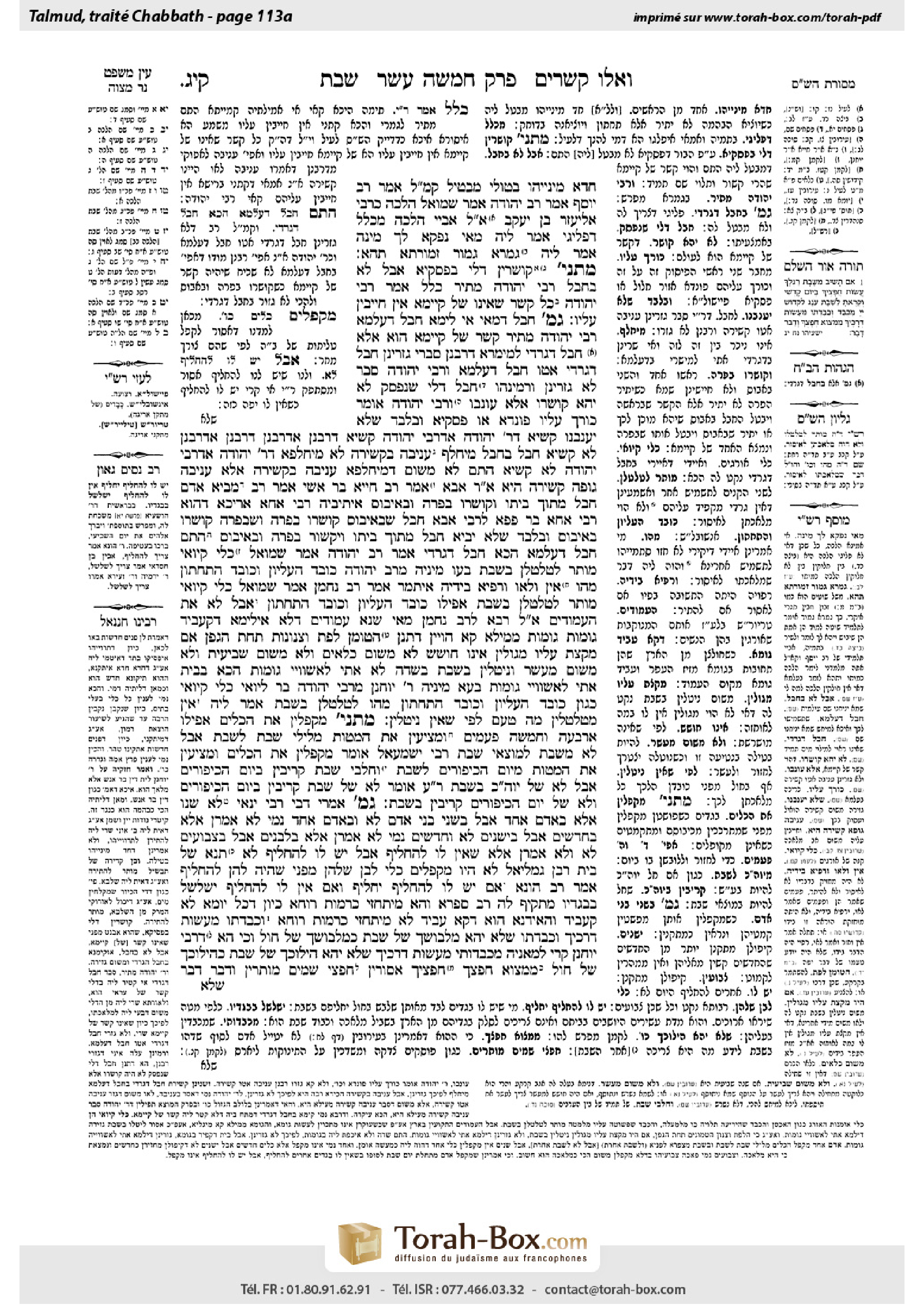
Shabbat 113a: Talmud study for Daf Yomi
Daf Yomi is the daily study of one Talmud folio. Explore 37 tractates with scans, Hebrew text, Sefaria English and AI-generated French translations where annotated.
Passage selection and English or AI-generated French translation are available where the scan has annotations. Daf Study is independent of Torah-Box and Sefaria.
Browse Shabbat · שבת · All tractatesShabbat 113a text and translations
This page of Shabbat includes the Aramaic text, an English translation and an AI-generated French translation, alongside the scan above.
שבת קי״ג א · Aramaic and Hebrew text
חֲדָא מִינַּיְיהוּ בַּטּוֹלֵי מְבַטֵּיל, קָא מַשְׁמַע לַן. אָמַר רַב יוֹסֵף אָמַר רַב יְהוּדָה אָמַר שְׁמוּאֵל: הֲלָכָה כְּרַבִּי אֱלִיעֶזֶר בֶּן יַעֲקֹב. אֲמַר לֵיהּ אַבָּיֵי: הֲלָכָה, מִכְּלָל דִּפְלִיגִי. אֲמַר לֵיהּ: מַאי נָפְקָא לָךְ מִינַּהּ? אֲמַר לֵיהּ: גְּמָרָא גְּמוֹר זְמוֹרְתָּא תְּהֵא?!
מַתְנִי׳ קוֹשְׁרִין דְּלִי בְּפָסִקְיָא, אֲבָל לֹא בְּחֶבֶל. רַבִּי יְהוּדָה מַתִּיר. כְּלָל אָמַר רַבִּי יְהוּדָה: כׇּל קֶשֶׁר שֶׁאֵינוֹ שֶׁל קַיָּימָא — אֵין חַיָּיבִין עָלָיו.
גְּמָ׳ חֶבֶל דְּמַאי? אִי לֵימָא חֶבֶל דְּעָלְמָא, רַבִּי יְהוּדָה מַתִּיר? קֶשֶׁר שֶׁל קַיָּימָא הוּא! אֶלָּא חֶבֶל דְּגַרְדִּי. לְמֵימְרָא דְּרַבָּנַן סָבְרִי גָּזְרִינַן חֶבֶל דְּגַרְדִּי אַטּוּ חֶבֶל דְּעָלְמָא, וְרַבִּי יְהוּדָה סָבַר לָא גָּזְרִינַן?
וּרְמִינְהוּ: חֶבֶל דְּלִי שֶׁנִּפְסַק לֹא יְהֵא קוֹשְׁרוֹ אֶלָּא עוֹנְבוֹ. וְרַבִּי יְהוּדָה אוֹמֵר: כּוֹרֵךְ עָלָיו פּוּנְדָּא אוֹ פָּסִקְיָא, וּבִלְבַד שֶׁלֹּא יַעַנְבֶנּוּ.
קַשְׁיָא דְּרַבִּי יְהוּדָה אַדְּרַבִּי יְהוּדָה, קַשְׁיָא דְּרַבָּנַן אַדְּרַבָּנַן.
דְּרַבָּנַן אַדְּרַבָּנַן לָא קַשְׁיָא: חֶבֶל בְּחֶבֶל — מִיחַלַּף. עֲנִיבָה בִּקְשִׁירָה — לָא מִיחַלְּפָא. דְּרַבִּי יְהוּדָה אַדְּרַבִּי יְהוּדָה לָא קַשְׁיָא: הָתָם — לָא מִשּׁוּם דְּמִיחַלְּפָא עֲנִיבָה בִּקְשִׁירָה, אֶלָּא עֲנִיבָה גּוּפָהּ קְשִׁירָה הִיא.
אָמַר רַבִּי אַבָּא אָמַר רַב חִיָּיא בַּר אָשֵׁי אָמַר רַב: מֵבִיא אָדָם חֶבֶל מִתּוֹךְ בֵּיתוֹ, וְקוֹשְׁרוֹ בַּפָּרָה וּבָאֵיבוּס אֵיתִיבֵיהּ רַבִּי אַחָא אֲרִיכָא דְּהוּא רַבִּי אַחָא בַּר פָּפָּא לְרַבִּי אַבָּא: חֶבֶל שֶׁבָּאֵיבוּס — קוֹשְׁרוֹ בַּפָּרָה, וְשֶׁבַּפָּרָה — קוֹשְׁרוֹ בָּאֵיבוּס, וּבִלְבַד שֶׁלֹּא יָבִיא חֶבֶל מִתּוֹךְ בֵּיתוֹ וְיִקְשׁוֹר בַּפָּרָה וּבָאֵיבוּס! הָתָם — חֶבֶל דְּעָלְמָא הָכָא חֶבֶל דְּגַרְדִּי.
אָמַר רַב יְהוּדָה אָמַר שְׁמוּאֵל: כְּלֵי קִיוָּאֵי מוּתָּר לְטַלְטְלָן בְּשַׁבָּת. בְּעוֹ מִינֵּיהּ מֵרַב יְהוּדָה: כּוֹבֶד הָעֶלְיוֹן וְכוֹבֶד הַתַּחְתּוֹן מַהוּ? אִין וְלָאו וְרַפְיָא בִּידֵיהּ. אִיתְּמַר אָמַר רַב נַחְמָן אָמַר שְׁמוּאֵל: כְּלֵי קִיוָּאֵי מוּתָּר לְטַלְטְלָן בְּשַׁבָּת, אֲפִילּוּ כּוֹבֶד הָעֶלְיוֹן וְכוֹבֶד הַתַּחְתּוֹן, אֲבָל לֹא אֶת הָעַמּוּדִים.
אֲמַר לֵיהּ רָבָא לְרַב נַחְמָן: מַאי שְׁנָא עַמּוּדִים דְּלָא? אִילֵּימָא דְּקָעָבֵיד גּוּמּוֹת, גּוּמּוֹת מִמֵּילָא קָא הָוְיָין, דִּתְנַן: הַטּוֹמֵן לֶפֶת וּצְנוֹנוֹת תַּחַת הַגֶּפֶן, אִם מִקְצָת עָלָיו מְגוּלִּין — אֵינוֹ חוֹשֵׁשׁ לֹא מִשּׁוּם כִּלְאַיִם, וְלֹא מִשּׁוּם שְׁבִיעִית, וְלֹא מִשּׁוּם מַעֲשֵׂר, וְנִיטָּלִין בְּשַׁבָּת.
בְּשָׂדֶה — לָא אָתֵי לְאַשְׁווֹיֵי גּוּמּוֹת, הָכָא בְּבַיִת — אָתֵי לְאַשְׁווֹיֵי גּוּמּוֹת. בְּעָא מִינֵּיהּ רַבִּי יוֹחָנָן מֵרַבִּי יְהוּדָה בַּר לֵיוַאי: כְּלֵי קִיוָּאֵי, כְּגוֹן כּוֹבֶד הָעֶלְיוֹן וְכוֹבֶד הַתַּחְתּוֹן, מַהוּ לְטַלְטְלָן בְּשַׁבָּת? אֲמַר לֵיהּ: אֵין מְטַלְטְלִין. מַה טַּעַם? לְפִי שֶׁאֵין נִיטָּלִין.
מַתְנִי׳ מְקַפְּלִין אֶת הַכֵּלִים אֲפִילּוּ אַרְבָּעָה וַחֲמִשָּׁה פְּעָמִים, וּמַצִּיעִין אֶת הַמִּטּוֹת מִלֵּילֵי שַׁבָּת לְשַׁבָּת, אֲבָל לֹא מִשַּׁבָּת לְמוֹצָאֵי שַׁבָּת. רַבִּי יִשְׁמָעֵאל אוֹמֵר: מְקַפְּלִין אֶת הַכֵּלִים, וּמַצִּיעִין אֶת הַמִּטּוֹת מִיּוֹם הַכִּיפּוּרִים לְשַׁבָּת. וְחֶלְבֵי שַׁבָּת קְרֵיבִין בְּיוֹם הַכִּיפּוּרִים, אֲבָל לֹא שֶׁל יוֹם הַכִּפּוּרִים בְּשַׁבָּת. רַבִּי עֲקִיבָא אוֹמֵר: לֹא שֶׁל שַׁבָּת קְרֵיבִין בְּיוֹם הַכִּיפּוּרִים, וְלֹא שֶׁל יוֹם הַכִּיפּוּרִים קְרֵיבִין בְּשַׁבָּת.
גְּמָ׳ אָמְרִי דְּבֵי רַבִּי יַנַּאי: לֹא שָׁנוּ אֶלָּא בְּאָדָם אֶחָד, אֲבָל בִּשְׁנֵי בְּנֵי אָדָם — לֹא. וּבְאָדָם אֶחָד נָמֵי לָא אֲמַרַן אֶלָּא בַּחֲדָשִׁים, אֲבָל בִּישָׁנִים — לָא. וָחֳדָשִׁים נָמֵי לָא אֲמַרַן אֶלָּא בִּלְבָנִים, אֲבָל בִּצְבוּעִים — לָא. וְלָא אֲמַרַן אֶלָּא שֶׁאֵין לוֹ לְהַחֲלִיף, אֲבָל יֵשׁ לוֹ לְהַחֲלִיף — לָא.
תָּנָא: שֶׁל בֵּית רַבָּן גַּמְלִיאֵל לֹא הָיוּ מְקַפְּלִים כְּלֵי לָבָן שֶׁלָּהֶן, מִפְּנֵי שֶׁהָיָה לָהֶן לְהַחֲלִיף. אָמַר רַב הוּנָא: אִם יֵשׁ לוֹ לְהַחֲלִיף — יַחֲלִיף, וְאִם אֵין לוֹ לְהַחֲלִיף — יְשַׁלְשֵׁל בִּבְגָדָיו. מַתְקִיף לַהּ רַב סָפְרָא: וְהָא מִיתְחֲזֵי כְּרָמוּת רוּחָא. כֵּיוָן דְּכׇל יוֹמָא לָא קָעָבֵיד, וְהָאִידָּנָא הוּא דְּקָא עָבֵיד — לָא מִיתְחֲזֵי כְּרָמוּת רוּחָא.
״וְכִבַּדְתּוֹ מֵעֲשׂוֹת דְּרָכֶיךָ״. ״וְכִבַּדְתּוֹ״ — שֶׁלֹּא יְהֵא מַלְבּוּשְׁךָ שֶׁל שַׁבָּת כְּמַלְבּוּשְׁךָ שֶׁל חוֹל, וְכִי הָא דְּרַבִּי יוֹחָנָן קָרֵי לְמָאנֵיהּ ״מְכַבְּדוֹתַי״. ״מֵעֲשׂוֹת דְּרָכֶיךָ״ — שֶׁלֹּא יְהֵא הִילּוּכְךָ שֶׁל שַׁבָּת כְּהִילּוּכְךָ שֶׁל חוֹל. ״מִמְּצוֹא חֶפְצְךָ״ — חֲפָצֶיךָ אֲסוּרִין, חֶפְצֵי שָׁמַיִם מוּתָּרִין. ״וְדַבֵּר דָּבָר״ —
Shabbat 113a · English translation
that one of the knots one voids, because he can enable the animal to go out, albeit with difficulty, after untying one knot, therefore, it teaches us that both are considered temporary knots, and it is permitted to tie them. Rav Yosef said that Rav Yehuda said that Shmuel said: The halakha is in accordance with the opinion of Rabbi Eliezer ben Ya’akov. Abaye said to Rav Yosef: If you rule the halakha in accordance with his opinion, does that mean, by inference, that the Rabbis disagree, or perhaps is there no dispute and everyone accepts the opinion of Rabbi Eliezer ben Ya’akov? Rav Yosef said to him: What difference is there to you whether or not the Rabbis disagree? In either case, the halakha is in accordance with the opinion of Rabbi Eliezer ben Ya’akov. Abaye answered Rav Yosef using a folk expression: Is it simply learn the lesson, let it be like a song? In other words, is it sufficient to simply parrot the halakhic ruling? Rather, it is necessary to examine the issue to understand it, even if it does not yield a practical halakhic difference.
MISHNA: One may tie a bucket with a belt on Shabbat, as he will certainly not leave it tied to the bucket, and therefore it is not a permanent knot. But one may not tie a bucket with a rope. Rabbi Yehuda permits doing so. Rabbi Yehuda stated a principle: With regard to any knot that is not permanent, one is not liable for tying it.
GEMARA: We learned in the mishna that according to the first tanna, it is prohibited to tie a rope to a bucket on Shabbat, and Rabbi Yehuda permits doing so. The Gemara asks: A rope of what kind? If you say it is referring to a standard rope, does Rabbi Yehuda permit doing so? It is a permanent knot. Rather, it is referring to a weaver’s rope; since the weaver needs it for his work, he will untie it after Shabbat. The Gemara asks: Is that to say that the Rabbis hold that we issue a decree prohibiting a weaver’s rope due to a standard rope, and Rabbi Yehuda holds that we do not issue a decree?
The Gemara raises a contradiction from that which was taught in a baraita: With regard to the rope of a bucket that was severed on Shabbat, one may not tie it with a regular knot; rather, he may tie a bow. And Rabbi Yehuda says: One may wrap a hollow belt around it or a sash as long as he does not tie it into a bow.
This is difficult, as there is a contradiction between one statement of Rabbi Yehuda and another statement of Rabbi Yehuda, as in the baraita he issued a decree prohibiting tying a bow due to tying a knot, and in the mishna he issued no decree. And this is also difficult, as there is a contradiction between one statement of the Rabbis and another statement of the Rabbis, as in the baraita they do not issue a decree and in the mishna they do issue a decree.
The Gemara responds: The contradiction between one statement of the Rabbis and the other statement of the Rabbis is not difficult, as they are of the opinion that a rope may be confused with another rope. Therefore, the Rabbis issued a decree prohibiting a weaver’s rope, because if it were permitted one might mistakenly come to tie a standard rope. However, a bow is not confused with a knot, and therefore they did not issue a decree prohibiting a bow. The contradiction between one statement of Rabbi Yehuda and the other statement of Rabbi Yehuda is not difficult, as there, where he prohibited tying a bow, it is not because a bow may be confused with a knot, but because, in his opinion, a bow itself is a full-fledged knot and is not prohibited due to a decree.
Rabbi Abba said that Rav Ḥiyya bar Ashi said that Rav said: A person may bring a rope from inside his house on Shabbat and tie one end of it to a cow and the other end to a trough. That is not considered a permanent knot, because he will certainly untie the rope. Rabbi Aḥa Arikha, who was nicknamed Rabbi Aḥa the Long, due to his height, who is also called Rabbi Aḥa bar Pappa, raised an objection to Rabbi Abba from the baraita: With regard to a rope that is tied to the trough, one may tie it to a cow, and a rope that is tied to the cow one may tie it to a trough, provided that one does not bring a rope from inside his house and tie it to the cow and to the trough. The Gemara answers: There, where they permitted it, it is referring to a weaver’s rope, which will certainly be untied.
Rav Yehuda said that Shmuel said: A weaver’s tools may be moved on Shabbat. They raised a dilemma before Rav Yehuda: What is the ruling with regard to the upper beam and the lower beam of the weaver’s loom? Does this leniency apply to them? Rav Yehuda did not provide a clear answer. He said: Yes and no, and the matter was uncertain to him. It was stated: Rav Naḥman said that Shmuel said: A weaver’s tools may be moved on Shabbat, even the upper beam and the lower beam, but not the posts.
Rava said to Rav Naḥman: What is different about the posts that one may not carry them? If we say it is because one makes holes when removing the post from the ground, holes come into being on their own and that is not prohibited, as we learned in a mishna: With regard to one who stores a turnip or radish in the ground beneath a vine for safekeeping, if some of its leaves were exposed, making it possible to grab the turnip or the radish and pull it out of the ground, he need not be concerned, neither due to diverse kinds, i.e., that he violated the prohibition of planting food crops in a vineyard, as there was no intent to plant them, nor due to concern that he violated the prohibition against working the land during the Sabbatical Year, nor due to tithes, i.e., that it would be considered as if he picked it from the ground and would be obligated to tithe it, and they may be taken from the ground on Shabbat. Apparently, the Rabbis do not prohibit doing so due to concern that one will thereby create a hole.
Rav Naḥman answered him: The cases are not comparable. In a field one will not come to fill holes; however, here, where the holes are created in the house, the concern is that one may come to smooth out the holes. Therefore, the Rabbis prohibited it. Rabbi Yoḥanan raised a dilemma before Rabbi Yehuda bar Liva’ei: With regard to weaver’s tools, such as the upper beam and the lower beam of the loom, what is the ruling in terms of carrying them on Shabbat? Rabbi Yehuda said to him: One may not carry them. Rabbi Yoḥanan asked him: What is the reason for this? Rabbi Yehuda bar Liva’ei answered: Because they are not usually carried even during the week, as they are extremely heavy and are considered fixed in place. Therefore, the Sages prohibited carrying them on Shabbat.
MISHNA: One may fold the garments after removing them even four or five times, and one may make the beds from Shabbat evening in preparation for Shabbat day, but not from Shabbat in preparation for the conclusion of Shabbat, since one may not perform an action on Shabbat that is preparation for a weekday. Rabbi Yishmael says: One may fold the garments and make the beds from Yom Kippur in preparation for Shabbat if Yom Kippur occurs on Friday. And the fats of the offerings that were sacrificed on Shabbat are offered on Yom Kippur, but not those of Yom Kippur on Shabbat, because the sanctity of Shabbat is greater than the sanctity of Yom Kippur. Rabbi Akiva says: Neither are the fats of the offerings sacrificed on Shabbat offered on Yom Kippur, nor are those of Yom Kippur offered on Shabbat.
GEMARA: The Sages in the school of Rabbi Yanai said: They only taught that it is permitted when one person is folding the garments alone on Shabbat; however, when two people are folding the garments together, no, they may not do so, because when two people fold garments it is tantamount to repairing the garment. And with regard to when a single person is folding the garments, we only said it is permitted when he is folding a new garment, which is suitable to be worn even if it were not folded; however, with regard to old garments, no, he may not do so. And with regard to new garments, we only said that one may fold the garments when they are white; however, when they are colored, no, one may not do so. And with regard to white garments, we only said it is permitted to fold them on Shabbat when one does not have garments into which one could change; however, if one has other garments into which he could change, he may not fold them.
And it was taught in the Tosefta: The members of Rabban Gamliel’s household did not even fold their white garments because they had others into which they could change. Rav Huna said: If one has new garments into which he could change on Shabbat, he will change into those garments; and if one does not have garments into which he could change, he lets his garments hang down before Shabbat to beautify himself in deference to Shabbat as it used to be the custom of wealthy people to wear their clothes loosely. Rav Safra strongly objects to this: Doesn’t this appear as haughtiness? The Gemara answers: Since every day he does not do so, and now in honor of Shabbat he is doing so, it does not appear as haughtiness. Rather it is apparent that he is acting in deference to Shabbat.
On a related note, the Gemara cites what we learned with regard to the following passage: “If you keep your feet from breaking, from pursuing your affairs on My holy day, and you call Shabbat a delight, the Lord’s holy day honorable, and you honor it by not going your own way, from attending to your affairs and speaking idle words” (Isaiah 58:13). The Rabbis derived from the words “and you honor it” that your dress on Shabbat should not be like your dress during the week, as Rabbi Yoḥanan would refer to his clothing as my honor, indicating that appropriate clothing is a form of deference. The words “going your own way” mean that your walking on Shabbat should not be like your walking during the week. “From attending to your affairs” means it is prohibited to deal with your weekday affairs and to speak about them on Shabbat. However, affairs of Heaven, i.e., those pertaining to mitzvot, are permitted. “And speaking idle words”
Shabbat 113a · Traduction française (IA)
que l’on peut dénouer l’un des nœuds, puisqu’après en avoir dénoué un, on peut permettre à l’animal de sortir, certes avec difficulté. Cela nous enseigne donc que tous deux sont considérés comme des nœuds temporaires et qu’il est permis de les nouer. Rav Yossef a dit au nom de Rav Yehouda, qui l’a dit au nom de Chmouel : La halakha est conforme à l’opinion de Rabbi Eliezer ben Yaakov. Abayé dit à Rav Yossef : Si tu établis la halakha conformément à son opinion, cela implique-t-il que les Rabbins ne sont pas d’accord avec lui, ou bien n’y a-t-il peut-être aucun désaccord et tous acceptent-ils l’opinion de Rabbi Eliezer ben Yaakov ? Rav Yossef lui dit : Quelle importance cela a-t-il pour toi que les Rabbins soient ou non en désaccord ? Dans tous les cas, la halakha est conforme à l’opinion de Rabbi Eliezer ben Yaakov. Abayé répondit à Rav Yossef par une expression populaire : Suffit-il donc d’apprendre la leçon et de la réciter comme une chanson ? Autrement dit, suffit-il de répéter simplement la décision halakhique ? Il faut plutôt examiner la question pour la comprendre, même si cela ne débouche pas sur une différence pratique en matière de halakha.
MICHNA : On peut attacher un seau avec une ceinture pendant Chabbat, car on ne la laissera certainement pas attachée au seau ; il ne s’agit donc pas d’un nœud permanent. En revanche, on ne peut pas attacher un seau avec une corde. Rabbi Yehouda le permet. Rabbi Yehouda a énoncé un principe : pour tout nœud qui n’est pas permanent, celui qui le noue n’est pas passible.
GUEMARA : Nous avons appris dans la Michna que, selon le premier tanna, il est interdit d’attacher une corde à un seau pendant Chabbat, tandis que Rabbi Yehouda le permet. La Guemara demande : De quel type de corde s’agit-il ? Si tu dis qu’il s’agit d’une corde ordinaire, Rabbi Yehouda permettrait-il cela ? Ce serait un nœud permanent. Il s’agit plutôt d’une corde de tisserand ; puisque le tisserand en a besoin pour son travail, il la dénouera après Chabbat. La Guemara demande : Faut-il en déduire que les Rabbins considèrent qu’il faut décréter l’interdiction d’une corde de tisserand à cause d’une corde ordinaire, tandis que Rabbi Yehouda estime qu’il ne faut pas prendre un tel décret ?
La Guemara soulève une contradiction à partir de ce qui a été enseigné dans une baraïta : si la corde d’un seau s’est rompue pendant Chabbat, on ne peut pas la renouer avec un nœud ordinaire ; on peut plutôt y faire un nœud coulant. Rabbi Yehouda dit : On peut l’enrouler avec une ceinture creuse ou une écharpe, à condition de ne pas faire un nœud coulant.
La difficulté est la suivante : il y a une contradiction entre une déclaration de Rabbi Yehouda et une autre déclaration de Rabbi Yehouda, car dans la baraïta il a décrété qu’il fallait interdire de faire un nœud coulant par crainte qu’on ne noue un nœud, tandis que dans la Michna il n’a pas pris ce décret. Il y a également une difficulté : une déclaration des Rabbins contredit une autre déclaration des Rabbins, car dans la baraïta ils ne prennent pas de décret, tandis que dans la Michna ils en prennent un.
La Guemara répond : Il n’y a pas de difficulté entre les deux déclarations des Rabbins, car ils estiment qu’on peut confondre une corde avec une autre corde. Les Rabbins ont donc décrété qu’il était interdit d’utiliser une corde de tisserand, car si cela était permis, on pourrait par erreur en venir à attacher une corde ordinaire. En revanche, on ne confond pas un nœud coulant avec un nœud ordinaire ; ils n’ont donc pas décrété l’interdiction de faire un nœud coulant. Il n’y a pas non plus de difficulté entre les deux déclarations de Rabbi Yehouda : là où il a interdit de faire un nœud coulant, ce n’est pas parce qu’on pourrait le confondre avec un nœud ordinaire, mais parce qu’à son avis, un nœud coulant est lui-même un véritable nœud et son interdiction ne relève pas d’un décret.
Rabbi Abba a dit au nom de Rav Ḥiyya bar Aché, qui l’a dit au nom de Rav : Une personne peut apporter une corde de l’intérieur de sa maison pendant Chabbat et en attacher une extrémité à une vache et l’autre à une auge. Cela n’est pas considéré comme un nœud permanent, car elle dénouera certainement la corde. Rabbi Aḥa Arikha, surnommé Rabbi Aḥa le Long en raison de sa taille, également appelé Rabbi Aḥa bar Pappa, souleva une objection à Rabbi Abba à partir de la baraïta : si une corde est attachée à l’auge, on peut l’attacher à une vache ; et si une corde est attachée à une vache, on peut l’attacher à une auge, à condition de ne pas apporter une corde de l’intérieur de sa maison pour l’attacher à la vache et à l’auge. La Guemara répond : Là, où cela a été permis, il s’agit d’une corde de tisserand, qui sera certainement dénouée.
Rav Yehouda a dit au nom de Chmouel : On peut déplacer les outils du tisserand pendant Chabbat. On posa à Rav Yehouda la question suivante : Quelle est la halakha concernant la traverse supérieure et la traverse inférieure du métier à tisser ? Cette permission s’applique-t-elle également à ces éléments ? Rav Yehouda ne donna pas de réponse claire. Il dit : Oui et non, car il n’en était pas certain. Il a été dit : Rav Naḥman a dit au nom de Chmouel : On peut déplacer les outils du tisserand pendant Chabbat, même la traverse supérieure et la traverse inférieure, mais pas les montants.
Rava dit à Rav Naḥman : En quoi les montants diffèrent-ils, pour qu’on ne puisse pas les transporter ? Si l’on dit que c’est parce qu’on fait des trous en retirant le montant du sol, les trous se forment d’eux-mêmes et cela n’est pas interdit, comme nous l’avons appris dans une Michna : celui qui enfouit un navet ou un radis dans la terre, sous une vigne, pour le conserver, si certaines de ses feuilles restent visibles, de sorte qu’il est possible de saisir le navet ou le radis et de le tirer hors de terre, n’a pas à s’en inquiéter, ni au sujet des espèces mélangées — c’est-à-dire qu’il aurait enfreint l’interdiction de planter des cultures alimentaires dans une vigne, alors qu’il n’avait pas l’intention de les planter —, ni au sujet de l’interdiction de travailler la terre pendant l’année sabbatique, ni au sujet des dîmes — c’est-à-dire qu’on considérerait qu’il l’a arraché et qu’il serait tenu d’en prélever la dîme — ; on peut également le retirer de terre pendant Chabbat. Il ressort de là que les Rabbins n’interdisent pas cette action par crainte qu’elle ne crée un trou.
Rav Naḥman lui répondit : Les cas ne sont pas comparables. Dans un champ, on n’en viendra pas à reboucher les trous ; mais ici, où les trous sont créés dans la maison, on craint qu’on ne vienne les aplanir. Les Rabbins l’ont donc interdit. Rabbi Yoḥanan posa à Rabbi Yehouda bar Livaï la question suivante : Quelle est la halakha concernant le transport des outils du tisserand, tels que la traverse supérieure et la traverse inférieure du métier à tisser, pendant Chabbat ? Rabbi Yehouda lui répondit : On ne peut pas les transporter. Rabbi Yoḥanan lui demanda : Pour quelle raison ? Rabbi Yehouda bar Livaï répondit : Parce qu’on ne les transporte généralement pas, même en semaine, étant donné qu’ils sont extrêmement lourds et considérés comme fixés à leur place. Les Sages ont donc interdit de les transporter pendant Chabbat.
MICHNA : On peut plier ses vêtements après les avoir enlevés, même quatre ou cinq fois. On peut faire les lits le soir de Chabbat en vue du jour de Chabbat, mais pas pendant Chabbat en vue de la fin de Chabbat, car on ne peut pas accomplir pendant Chabbat une action destinée à préparer un jour de semaine. Rabbi Yichmaël dit : On peut plier les vêtements et faire les lits pendant Yom Kippour en vue de Chabbat, si Yom Kippour tombe un vendredi. Les graisses des sacrifices offerts pendant Chabbat sont offertes à Yom Kippour, mais celles des sacrifices de Yom Kippour ne sont pas offertes pendant Chabbat, car la sainteté de Chabbat est supérieure à celle de Yom Kippour. Rabbi Akiva dit : Ni les graisses des sacrifices offerts pendant Chabbat ne sont offertes à Yom Kippour, ni celles des sacrifices de Yom Kippour ne sont offertes pendant Chabbat.
GUEMARA : Les Sages de l’école de Rabbi Yanai ont dit : Ils n’ont enseigné que le cas où une seule personne plie les vêtements pendant Chabbat ; en revanche, deux personnes qui les plient ensemble ne peuvent pas le faire, car plier des vêtements à deux revient à les remettre en état. Et concernant le cas où une seule personne plie les vêtements, nous avons dit que c’était permis uniquement s’il s’agissait d’un vêtement neuf, qui peut être porté même sans avoir été plié ; mais s’il s’agit de vêtements usagés, ce n’est pas permis. Et concernant les vêtements neufs, nous avons dit qu’on peut les plier uniquement s’ils sont blancs ; mais s’ils sont de couleur, ce n’est pas permis. Et concernant les vêtements blancs, nous avons dit qu’on peut les plier pendant Chabbat uniquement lorsqu’on n’a pas d’autres vêtements pour se changer ; mais si l’on a d’autres vêtements pour se changer, on ne peut pas les plier.
Et il a été enseigné dans la Tossefta : les membres de la maison de Rabban Gamliel ne pliaient même pas leurs vêtements blancs, car ils en avaient d’autres pour se changer. Rav Houna a dit : Si l’on a des vêtements neufs pour se changer pendant Chabbat, on se changera et on les portera ; si l’on n’a pas de vêtements pour se changer, on laisse ses vêtements retomber avant Chabbat afin de se faire beau en l’honneur de Chabbat, comme les gens riches avaient coutume de porter leurs vêtements amples. Rav Safra s’y opposa vivement : Cela ne ressemble-t-il pas à de l’arrogance ? La Guemara répond : Puisqu’il ne le fait pas chaque jour et qu’il le fait maintenant en l’honneur de Chabbat, cela ne ressemble pas à de l’arrogance. Au contraire, il est manifeste qu’il agit par déférence envers Chabbat.
À ce propos, la Guemara cite ce que nous avons appris au sujet du passage suivant : « Si tu détournes tes pieds de profaner le Chabbat, de poursuivre tes affaires en Mon saint jour, si tu appelles Chabbat délice, le saint jour de l’Éternel honorable, et si tu l’honores en ne suivant pas tes voies, en ne t’occupant pas de tes affaires et en ne prononçant pas de paroles vaines » (Isaïe 58,13). Les Rabbins ont déduit des mots « et si tu l’honores » que ta tenue vestimentaire pendant Chabbat ne doit pas être comme celle de la semaine, car Rabbi Yoḥanan désignait ses vêtements comme « mon honneur », indiquant ainsi qu’une tenue appropriée constitue une marque de déférence. Les mots « en ne suivant pas tes voies » signifient que ta façon de marcher pendant Chabbat ne doit pas être comme celle de la semaine. « En ne t’occupant pas de tes affaires » signifie qu’il est interdit de s’occuper de ses affaires de la semaine et d’en parler pendant Chabbat. En revanche, les affaires du Ciel, c’est-à-dire celles qui concernent les mitsvot, sont permises. « Et en ne prononçant pas de paroles vaines »
Traduction française générée par IA à partir de l’édition anglaise de Sefaria. Vérifie toujours un passage avec le texte source.
Text from Sefaria: William Davidson Edition - Vocalized Aramaic (CC BY NC); William Davidson Edition - English (CC BY NC).