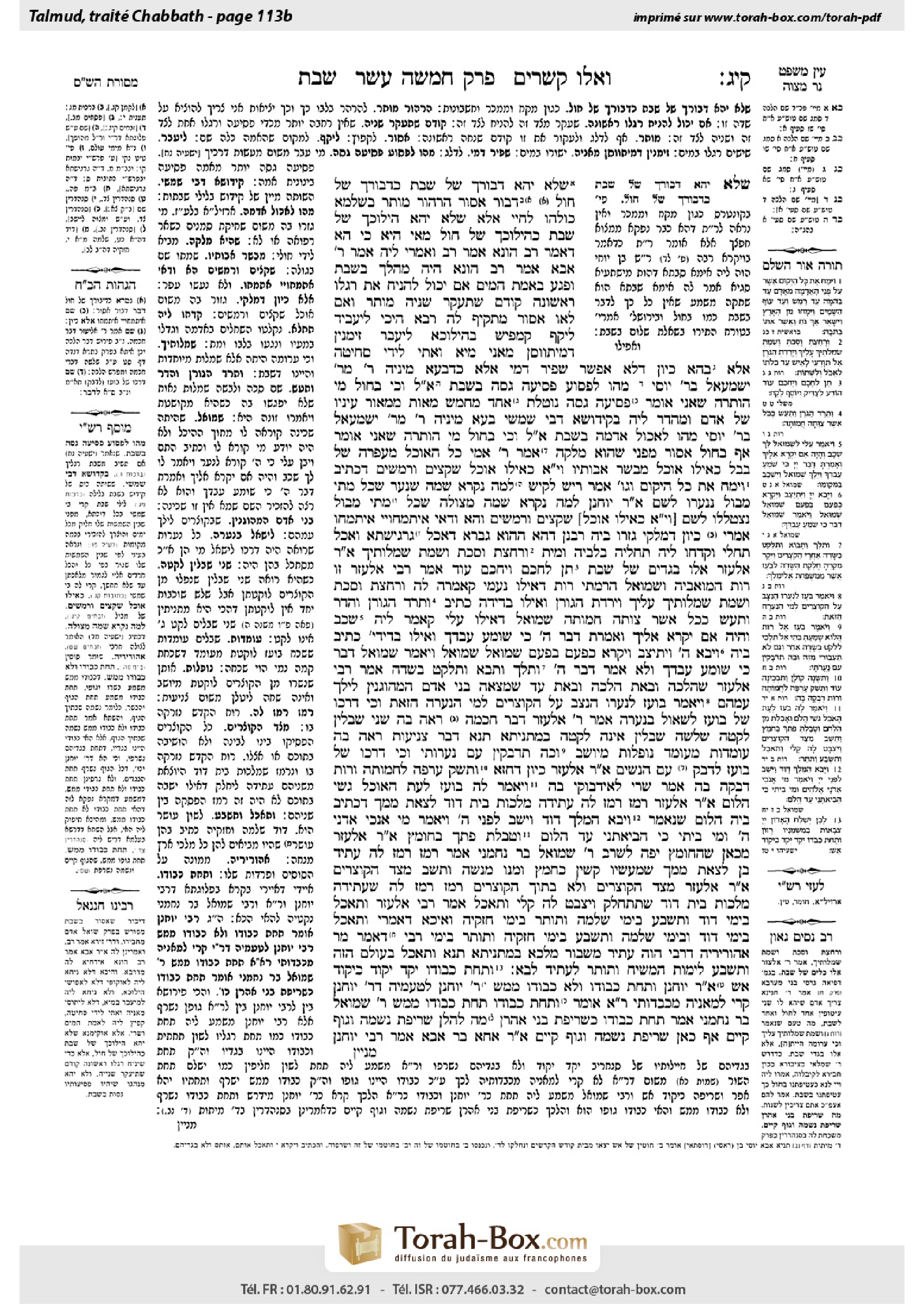
Shabbat 113b: Talmud study for Daf Yomi
Daf Yomi is the daily study of one Talmud folio. Explore 37 tractates with scans, Hebrew text, Sefaria English and AI-generated French translations where annotated.
Passage selection and English or AI-generated French translation are available where the scan has annotations. Daf Study is independent of Torah-Box and Sefaria.
Browse Shabbat · שבת · All tractatesShabbat 113b text and translations
This page of Shabbat includes the Aramaic text, an English translation and an AI-generated French translation, alongside the scan above.
שבת קי״ג ב · Aramaic and Hebrew text
שֶׁלֹּא יְהֵא דִּבּוּרְךָ שֶׁל שַׁבָּת כְּדִבּוּרְךָ שֶׁל חוֹל. דִּבּוּר אָסוּר, הִרְהוּר — מוּתָּר. בִּשְׁלָמָא כּוּלְּהוּ — לְחַיֵּי, אֶלָּא שֶׁלֹּא יְהֵא הִילּוּכְךָ שֶׁל שַׁבָּת כְּהִילּוּכְךָ שֶׁל חוֹל מַאי הִיא? כִּי הָא דְּאָמַר רַב הוּנָא אָמַר רַב, וְאָמְרִי לֵיהּ אָמַר רַבִּי אַבָּא אָמַר רַב הוּנָא: הָיָה מְהַלֵּךְ בְּשַׁבָּת וּפָגַע בְּאַמַּת הַמַּיִם, אִם יָכוֹל לְהַנִּיחַ אֶת רַגְלוֹ רִאשׁוֹנָה קוֹדֶם שֶׁתֵּעָקֵר שְׁנִיָּה — מוּתָּר, וְאִם לָאו — אָסוּר.
מַתְקִיף לַהּ רָבָא: הֵיכִי לֶיעְבֵּיד? לַיקֵּיף — קָמַפֵּישׁ בְּהִילּוּכָא. לִיעְבַּר — זִימְנִין דְּמִיתַּוְּוסָן מָאנֵיהּ מַיָּא, וְאָתֵי לִידֵי סְחִיטָה. אֶלָּא בְּהָא כֵּיוָן דְּלָא אֶפְשָׁר — שַׁפִּיר דָּמֵי. אֶלָּא כְּדִבְעָא מִינֵּיהּ רַבִּי מֵרַבִּי יִשְׁמָעֵאל בְּרַבִּי יוֹסֵי: מַהוּ לִפְסוֹעַ פְּסִיעָה גַּסָּה בְּשַׁבָּת? אֲמַר לֵיהּ: וְכִי בַּחוֹל מִי הוּתְּרָה? שֶׁאֲנִי אוֹמֵר: פְּסִיעָה גַּסָּה נוֹטֶלֶת אֶחָד מֵחֲמֵשׁ מֵאוֹת מִמְּאוֹר עֵינָיו שֶׁל אָדָם. וּמַהְדַּר לֵיהּ בְּקִידּוּשָׁא דְּבֵי שִׁמְשֵׁי.
בְּעָא מִינֵּיהּ רַבִּי מֵרַבִּי יִשְׁמָעֵאל בְּרַבִּי יוֹסֵי: מַהוּ לֶאֱכוֹל אֲדָמָה בְּשַׁבָּת? אֲמַר לֵיהּ: וְכִי בַּחוֹל מִי הוּתְּרָה? שֶׁאֲנִי אוֹמֵר: אַף בַּחוֹל אָסוּר, מִפְּנֵי שֶׁהוּא מַלְקֶה. אָמַר רַבִּי אַמֵּי: כָּל הָאוֹכֵל מֵעֲפָרָהּ שֶׁל בָּבֶל — כְּאִילּוּ אוֹכֵל מִבְּשַׂר אֲבוֹתָיו. וְיֵשׁ אוֹמְרִים: כְּאִילּוּ אוֹכֵל שְׁקָצִים וּרְמָשִׂים, דִּכְתִיב: ״וַיִּמַח אֶת כׇּל הַיְקוּם וְגוֹ׳״.
אָמַר רֵישׁ לָקִישׁ: לָמָּה נִקְרָא שְׁמָהּ ״שִׁנְעָר״ — שֶׁכׇּל מֵתֵי מַבּוּל נִנְעֲרוּ לְשָׁם. אָמַר רַבִּי יוֹחָנָן: לָמָּה נִקְרָא שְׁמָהּ ״מְצוּלָה״ — שֶׁכׇּל מֵתֵי מַבּוּל נִצְטַלְּלוּ לְשָׁם. [וְיֵשׁ אוֹמְרִים כְּאִילּוּ אוֹכֵל] שְׁקָצִים וּרְמָשִׂים, וְהָא וַדַּאי אִיתְמַחוֹיֵי אִיתְמַחוּ! אָמְרִי כֵּיוָן דְּמַלְקֵי גְּזַרוּ בֵּיהּ רַבָּנַן. דְּהָא הָהוּא גַּבְרָא דַּאֲכַל גַּרְגִּישְׁתָּא וַאֲכַל תַּחְלֵי, וּקְדַחוּ לֵיהּ תַּחְלֵי בְּלִבֵּיהּ, וּמִית.
״וְרָחַצְתְּ וָסַכְתְּ וְשַׂמְתְּ שִׂמְלֹתַיִךְ״ — אָמַר רַבִּי אֶלְעָזָר: אֵלּוּ בְּגָדִים שֶׁל שַׁבָּת. ״תֵּן לְחָכָם וְיֶחְכַּם עוֹד״ — אָמַר רַבִּי אֶלְעָזָר: זוֹ רוּת הַמּוֹאֲבִיָּה וּשְׁמוּאֵל הָרָמָתִי.
רוּת, דְּאִילּוּ נָעֳמִי קָאָמְרָה לַהּ ״וְרָחַצְתְּ וָסַכְתְּ וְשַׂמְתְּ שִׂמְלֹתַיִךְ עָלַיִךְ וְיָרַדְתְּ הַגֹּרֶן״, וְאִילּוּ בְּדִידַהּ כְּתִיב: ״וַתֵּרֶד הַגֹּרֶן״, וַהֲדַר ״וַתַּעַשׂ כְּכֹל אֲשֶׁר צִוַּתָּה חֲמוֹתָהּ״. שְׁמוּאֵל, דְּאִילּוּ עֵלִי קָאֲמַר לֵיהּ ״שְׁכָב וְהָיָה אִם יִקְרָא אֵלֶיךָ וְאָמַרְתָּ דַּבֵּר ה׳ כִּי שׁוֹמֵעַ עַבְדֶּךָ״, וְאִילּוּ בְּדִידֵיהּ כְּתִיב בֵּיהּ: ״וַיָּבֹא ה׳ וַיִּתְיַצַּב וַיִּקְרָא כְפַעַם בְּפַעַם שְׁמוּאֵל שְׁמוּאֵל וַיֹּאמֶר שְׁמוּאֵל דַּבֵּר כִּי שֹׁמֵעַ עַבְדֶּךָ״, וְלָא אֲמַר ״דַּבֵּר ה׳״.
״וַתֵּלֶךְ וַתָּבֹא וַתְּלַקֵּט בַּשָּׂדֶה״ — אָמַר רַבִּי אֶלְעָזָר: שֶׁהָלְכָה וּבָאת, הָלְכָה וּבָאת, עַד שֶׁמָּצְאָה בְּנֵי אָדָם הַמְהוּגָּנִין לְיֵלֵךְ עִמָּהֶם. ״וַיֹּאמֶר בּוֹעַז לְנַעֲרוֹ הַנִּצָּב עַל הַקּוֹצְרִים לְמִי הַנַּעֲרָה הַזֹּאת״ — וְכִי דַרְכּוֹ שֶׁל בּוֹעַז לִשְׁאוֹל בְּנַעֲרָה? אָמַר רַבִּי אֶלְעָזָר: דְּבַר חָכְמָה רָאָה בָּהּ. שְׁתֵּי שִׁבֳּלִין — לוֹקֶטֶת, שָׁלֹשׁ שִׁבֳּלִין — אֵינָהּ לוֹקֶטֶת.
בְּמַתְנִיתָא תָּנָא: דְּבַר צְנִיעוּת רָאָה בָּהּ, עוֹמְדוֹת — מְעוּמָּד, נוֹפְלוֹת — מְיוּשָּׁב. ״וְכֹה תִדְבָּקִין עִם נַעֲרוֹתָי״ — וְכִי דַּרְכּוֹ שֶׁל בּוֹעַז לִדָּבֵק עִם הַנָּשִׁים? אָמַר רַבִּי אֶלְעָזָר: כֵּיוָן דַּחֲזָא ״וַתִּשַּׁק עׇרְפָּה לַחֲמוֹתָהּ וְרוּת דָּבְקָה בָּהּ״, אֲמַר: שְׁרֵי לְאִידַּבּוֹקֵי בָּהּ.
״וַיֹּאמֶר לָה בֹעַז לְעֵת הָאֹכֶל גֹּשִׁי הֲלֹם״ — אָמַר רַבִּי אֶלְעָזָר, רֶמֶז רָמַז לָהּ: עֲתִידָה מַלְכוּת בֵּית דָּוִד לָצֵאת מִמֵּךְ, דִּכְתִיב בֵּיהּ ״הֲלֹם״, שֶׁנֶּאֱמַר: ״וַיָּבֹא הַמֶּלֶךְ דָּוִד וַיֵּשֶׁב לִפְנֵי ה׳ וַיֹּאמֶר מִי אָנֹכִי אֲדֹנָי ה׳ וּמִי בֵיתִי כִּי הֲבֵאתַנִי עַד הֲלֹם״. ״וְטָבַלְתְּ פִּתֵּךְ בַּחֹמֶץ״, אָמַר רַבִּי אֶלְעָזָר: מִכָּאן שֶׁהַחוֹמֶץ יָפֶה לַשָּׁרָב.
רַבִּי שְׁמוּאֵל בַּר נַחְמָנִי אָמַר: רֶמֶז רָמַז לָהּ עָתִיד בֵּן לָצֵאת מִמֵּךְ שֶׁמַּעֲשָׂיו קָשִׁין כַּחֹמֶץ, וּמַנּוּ — מְנַשֶּׁה. ״וַתֵּשֶׁב מִצַּד הַקּוֹצְרִים״ — אָמַר רַבִּי אֶלְעָזָר: מִצַּד הַקּוֹצְרִים וְלֹא בְּתוֹךְ הַקּוֹצְרִים, רֶמֶז רָמַז לָהּ שֶׁעֲתִידָה מַלְכוּת בֵּית דָּוִד שֶׁתִּתְחַלֵּק.
״וַיִּצְבׇּט לָהּ קָלִי וַתֹּאכַל״. אָמַר רַבִּי אֶלְעָזָר: ״וַתֹּאכַל״ — בִּימֵי דָוִד, ״וַתִּשְׂבַּע״ — בִּימֵי שְׁלֹמֹה, ״וַתֹּתַר״ — בִּימֵי חִזְקִיָּה. וְאִיכָּא דְאָמְרִי: ״וַתֹּאכַל״ — בִּימֵי דָּוִד וּבִימֵי שְׁלֹמֹה, ״וַתִּשְׂבַּע״ — בִּימֵי חִזְקִיָּה, ״וַתֹּתַר״ — בִּימֵי רַבִּי. דְּאָמַר מָר: אֲהוּרְיָרֵיהּ דְּרַבִּי הֲוָה עַתִּיר מִשַּׁבּוּר מַלְכָּא. בְּמַתְנִיתָא תָּנָא: ״וַתֹּאכַל״ — בָּעוֹלָם הַזֶּה, ״וַתִּשְׂבַּע״ — לִימוֹת הַמָּשִׁיחַ, ״וַתֹּתַר״ — לְעָתִיד לָבֹא.
״וְתַחַת כְּבוֹדוֹ יֵקַד יְקוֹד כִּיקוֹד אֵשׁ״. אָמַר רַבִּי יוֹחָנָן: ״וְתַחַת כְּבוֹדוֹ״, וְלֹא כְּבוֹדוֹ מַמָּשׁ. רַבִּי יוֹחָנָן לְטַעְמֵיהּ, דְּרַבִּי יוֹחָנָן קָרֵי לְמָאנֵיהּ ״מְכַבְּדוֹתַי״.
רַבִּי אֶלְעָזָר אוֹמֵר: ״וְתַחַת כְּבוֹדוֹ״ — תַּחַת כְּבוֹדוֹ מַמָּשׁ. רַבִּי שְׁמוּאֵל בַּר נַחְמָנִי אָמַר: ״תַּחַת כְּבוֹדוֹ״ — כִּשְׂרֵיפַת בְּנֵי אַהֲרֹן. מַה לְּהַלָּן שְׂרֵיפַת נְשָׁמָה וְגוּף קַיָּים, אַף כָּאן שְׂרֵיפַת נְשָׁמָה וְגוּף קַיָּים.
אָמַר רַבִּי אַחָא בַּר אַבָּא אָמַר רַבִּי יוֹחָנָן:
Shabbat 113b · English translation
means that your speech on Shabbat should not be like your speech during the week, i.e., one should not discuss his weekday affairs on Shabbat. However, it is only speech that they said is prohibited, whereas merely contemplating weekday affairs is permitted. The Gemara asks: Granted, all of these directives, fine, they are understood. However, what is the meaning of the following phrase: That your walking on Shabbat should not be like your walking during the week? The Gemara answers: It is in accordance with that which Rav Huna said that Rav said, and some say that Rabbi Abba said that Rav Huna said: If one were walking on Shabbat and came upon a stream of water and had to cross it, if the stream is narrow and one could place his first foot down on the other side before raising the second one, it is permitted to cross it; and if it is not possible and one must jump to cross it, it is prohibited. That is the type of walking that is not permitted on Shabbat.
Rava strongly objects to this: Since we have said that one’s walking on Shabbat should not be like his walking during the week, and jumping constitutes prohibited walking, if one encounters a stream on Shabbat, what should he do to cross to the other side? If he circumvents the stream, he is increasing the distance that he is walking and exerting extra effort on Shabbat. If he walks through the water, sometimes his clothes will absorb water and he will come to wring them out. What then should he do? Rather, in this case, since it is not possible to cross any other way, he may well cross it, i.e., it is permitted for him to jump over the stream. Therefore, rather say that walking that is defined as characteristic of weekday walking involves taking large steps. As Rabbi Yehuda HaNasi raised a dilemma before Rabbi Yishmael, son of Rabbi Yosei: What is the ruling with regard to taking large steps on Shabbat? That is what the Gemara meant when it used the phrase: Your walking during the week. Rabbi Yishmael said to him: And during the week are large steps permitted? As I say: A large step takes away one five-hundredth of a person’s eyesight. The Gemara comments: And his eyesight is restored to him during kiddush on Shabbat evening.
And Rabbi Yehuda HaNasi raised a dilemma before Rabbi Yishmael, son of Rabbi Yosei: What is the ruling with regard to eating earth for medicinal purposes on Shabbat? Rabbi Yishmael said to him: And during the week is it permitted to eat soil? As I say: Even during the week it is prohibited because it is harmful. Rabbi Ami said: Anyone who eats the dust of Babylonia, it is as if he is eating the flesh of his ancestors buried there. And some say: It is as if he eats abominations and creeping creatures, as it is written: “And He wiped out all that existed on the face of the earth, from humans to animals, to creeping creatures to the birds in the sky, and they were wiped off the land” (Genesis 7:23).
Apropos dead residue in the ground, Reish Lakish said: Why is Babylonia called Shinar? It is because all those who died in the Flood were deposited there [ninaru lesham]. Rabbi Yoḥanan said: Why is Babylonia called Metzula? It is because all those who died in the Flood sank there [nitztalelu lesham]. The Gemara asks: We said that some say that if one eats dirt from Babylonia, it is as if he eats abominations and creeping creatures. However, certainly their bodies have putrefied and decomposed, and therefore they are no longer prohibited. Rather, since soil is harmful, the Sages issued a decree not to eat it. The decree was not issued due to the prohibition of eating creeping creatures; rather, it was issued because a certain person ate soil for medicinal purposes and also ate cress. The cress took root in the soil that was inside him and began to grow. And the cress punctured his heart and he died.
The Gemara continues to discuss Shabbat. Naomi advised Ruth: “And you shall bathe, and anoint yourself, and put on your robes, and go down to the threshing floor. Do not make yourself known to the man until he has finished eating and drinking” (Ruth 3:3). Rabbi Elazar said: These robes are Shabbat garments that Naomi told her to wear in honor of the occasion. Apropos the book of Ruth, the Gemara cites additional statements of Rabbi Elazar with regard to Ruth: “Give to the wise one and he will become wiser; let the righteous one know and he will learn more” (Proverbs 9:9). Rabbi Elazar said: This refers to Ruth the Moabite and Samuel of Rama, who received advice and added to it with their wisdom.
The Gemara elaborates. Whereas Naomi said to Ruth: “And you shall bathe, and anoint yourself, and put on your robes, and go down to the threshing floor,” but with regard to Ruth herself it is written, “And she went down to the threshing floor” (Ruth 3:6), and only afterward does it say, “And she did according to all that her mother-in-law commanded her.” Ruth decided to anoint herself at the threshing floor and not on the road so that people would not meet her on the way there and suspect her of immorality. Whereas Eli said to Samuel: “Go and lie down and if He calls you, you say: Speak, Lord, for Your servant is listening” (I Samuel 3:9), but with regard to Samuel himself it is written: “And the Lord came and stood, and He called like He did the other times: Samuel, Samuel. And Samuel said: Speak, for Your servant is listening” (I Samuel 3:10), and he did not say: Speak, Lord, since he would not assume it was God speaking to him until he was sure of it.
And the verse in Ruth states: “And she went, and she came, and she collected in the field after the harvesters” (Ruth 2:3). Rabbi Elazar said: This verse teaches that she went and came, went and came, until she found suitable people with whom to walk. It also says: “And Boaz said to his youth who was standing over the harvesters: To whom does this young woman belong?” (Ruth 2:5). This is surprising: And was it Boaz’s habit to inquire about a young woman? Rabbi Elazar said: He saw in her a matter of wisdom and Torah, and that is why he asked about her. What he saw was that she collected two stalks, but she did not collect three stalks. She thereby acted in accordance with the halakha that three stalks lying together are not considered to be gleanings left for the poor; rather, they remain in the possession of the owner of the field.
It was taught in a baraita: He saw a matter of modesty in her when she was collecting stalks. She picked stalks that were upright while she was standing, and stalks that had fallen she picked while sitting; due to her modesty she did not bend over to take them. It also says: “And Boaz said to Ruth: Do you hear, my daughter? Do not go to glean in another field and do not leave from here, but cling to my maidens” (Ruth 2:8). This is also surprising. And was it Boaz’s habit to cling to women? Rabbi Elazar said: Since he saw “And Orpah kissed her mother-in-law and Ruth clung to her” (Ruth 1:14), he said: It is permitted to cling to a woman like this.
It also says: “And Boaz said to her at mealtime: Come here [halom] and eat from the bread and dip your bread in vinegar. And she sat beside the harvesters and he gave her roasted grain and she ate, and she was satiated, and she left some over” (Ruth 2:14). Rabbi Elazar interpreted this and said that he hinted to her prophetically: In the future the kingdom of David will come from you, as it is written with regard to it, i.e., the kingdom of David: “Here,” as it is stated: “And King David came and sat before God and said: Who am I, Lord, God, and who is my family that You have brought me to here [halom]?” (II Samuel 7:18). With regard to his saying: “And dip your bread in vinegar” (Ruth 2:14), Rabbi Elazar said: From here we see that vinegar is good to have in hot weather.
Rabbi Shmuel bar Naḥmani said that he hinted to her: A son will come from you in the future whose actions will be as sharp as vinegar, and who is he? King Manasseh. “And she sat beside the harvesters.” Rabbi Elazar said with regard to this: Beside the harvesters, and not among the harvesters. He hinted to her that the kingdom of David will be divided in the future and her children will not always be in the center of Israel.
It also says in the verse: “And he gave her roasted grain and she ate, and she was satiated, and she left some over.” The Gemara explains: “And he gave her roasted grain and she ate”; this is also interpreted as a prophetic message. Rabbi Elazar said: “And she ate” was fulfilled by her children’s children in the days of David; “And she was satiated” was fulfilled in the days of Solomon; “And she left some over” was fulfilled in the days of Hezekiah. And some say that there is a different interpretation: “And she ate,” was fulfilled in the days of David and Solomon; “And she was satiated,” was fulfilled in the days of Hezekiah; “And she left some over” was fulfilled in the days of Rabbi Yehuda HaNasi. As the Master said: Rabbi Yehuda HaNasi’s horsekeeper [ahuriyarei] was richer than the king of Persia. It was taught in a baraita: “And she ate,” in this world; “and she was satiated,” in the days of the Messiah; “and she left some over,” in the future, at the end of days.
It was mentioned earlier that Rabbi Yoḥanan called his clothing his honor. The Gemara cites the interpretation of the verse that speaks about the downfall of the king of Assyria: “Therefore, the Lord, the Lord of hosts, will send leanness to his fat ones and under his honor He will burn a burning like a burning fire” (Isaiah 10:16).
Rabbi Yoḥanan said: “And under his honor,” but not his actual honor. The Gemara explains: Rabbi Yoḥanan follows his own reasoning, for he called his clothing my honor, which means that the bodies of the king of Assyria’s soldiers were burned. However, their garments were miraculously not burned.
Rabbi Elazar said: “And under his honor” means in place of his actual honor. That is to say, their bodies were burned. Since, in Rabbi Elazar’s opinion, the word under means in the place of, the verse accordingly means that in the place of his honor, i.e., the body, there remain ashes.
Rabbi Shmuel bar Naḥmani said: Under his honor means beneath his flesh, similar to the burning of the sons of Aaron. Just as there, i.e., the burning of Aaron’s sons, the soul burned while the body remained intact, so too here, i.e., the burning of Assyrian soldiers, the soul burned while the body remained intact.
Rabbi Aḥa bar Abba said that Rabbi Yoḥanan said:
Shabbat 113b · Traduction française (IA)
Cela signifie que votre discours le Chabbat ne doit pas être comme votre discours en semaine, c’est-à-dire qu’on ne doit pas parler de ses affaires de semaine le Chabbat. Toutefois, seule la parole a été déclarée interdite, tandis qu’il est permis de simplement penser à ses affaires de semaine. La Guemara demande : D’accord, toutes ces directives sont compréhensibles. Mais que signifie la phrase suivante : « Que votre marche le Chabbat ne soit pas comme votre marche en semaine » ? La Guemara répond : Cela correspond à ce que Rav Houna a dit au nom de Rav — et certains disent que Rabbi Abba a dit au nom de Rav Houna : Si quelqu’un marche le Chabbat et rencontre un cours d’eau qu’il doit traverser, s’il est étroit et qu’il peut poser son premier pied de l’autre côté avant de soulever le second, il lui est permis de le traverser ; si cela n’est pas possible et qu’il doit sauter pour le franchir, cela lui est interdit. C’est ce type de marche qui n’est pas permis le Chabbat.
Rava s’y oppose vivement : Puisqu’on a dit que la marche le Chabbat ne doit pas être comme la marche en semaine, et que sauter constitue une marche interdite, que doit faire celui qui rencontre un cours d’eau le Chabbat pour passer de l’autre côté ? S’il contourne le cours d’eau, il allonge son trajet et fournit un effort supplémentaire le Chabbat. S’il marche dans l’eau, ses vêtements risquent parfois de s’imbiber et il pourrait en venir à les essorer. Que doit-il donc faire ? En réalité, dans ce cas, puisqu’il est impossible de traverser autrement, il peut bel et bien le franchir, c’est-à-dire qu’il lui est permis de sauter par-dessus le cours d’eau. Il faut donc plutôt dire que la marche caractéristique des jours de semaine consiste à faire de grands pas. En effet, Rabbi Yehouda HaNassi posa cette question à Rabbi Yichmaël, fils de Rabbi Yossi : Quel est le statut des grands pas le Chabbat ? C’est ce que la Guemara entendait par l’expression « votre marche en semaine ». Rabbi Yichmaël lui répondit : Et les grands pas sont-ils permis en semaine ? Car, comme je le dis, un grand pas fait perdre à une personne un cinq-centième de sa vue. La Guemara ajoute : Sa vue lui est rendue pendant le kiddouch du soir de Chabbat.
Rabbi Yehouda HaNassi posa également cette question à Rabbi Yichmaël, fils de Rabbi Yossi : Quel est le statut de la consommation de terre à des fins médicinales le Chabbat ? Rabbi Yichmaël lui répondit : Et en semaine, est-il permis de manger de la terre ? Car, comme je le dis, même en semaine, cela est interdit, puisque c’est nuisible. Rabbi Ami dit : Quiconque mange la poussière de Babylonie, c’est comme s’il mangeait la chair de ses ancêtres qui y sont ensevelis. Certains disent : C’est comme s’il mangeait des abominations et des bestioles rampantes, ainsi qu’il est écrit : « Il effaça tout ce qui existait à la surface de la terre, depuis les hommes jusqu’aux animaux, aux bestioles rampantes et aux oiseaux du ciel, et ils furent effacés de la terre » (Genèse 7, 23).
À propos des restes des morts dans le sol, Rech Lakich dit : Pourquoi la Babylonie est-elle appelée Chinar ? Parce que tous ceux qui moururent lors du Déluge y furent déposés [ninaru lesham]. Rabbi Yo’hanan dit : Pourquoi la Babylonie est-elle appelée Metsoula ? Parce que tous ceux qui moururent lors du Déluge y sombrèrent [nitztalelu lesham]. La Guemara demande : Nous avons dit, selon certains, que celui qui mange de la terre de Babylonie, c’est comme s’il mangeait des abominations et des bestioles rampantes. Pourtant, leurs corps se sont certainement putréfiés et décomposés, et ils ne sont donc plus interdits. En réalité, puisque la terre est nuisible, les Sages ont décrété qu’il ne fallait pas en manger. Ce décret n’a pas été pris en raison de l’interdiction de manger des bestioles rampantes ; il a plutôt été pris parce qu’un homme mangea de la terre à des fins médicinales et mangea aussi du cresson. Le cresson prit racine dans la terre qui se trouvait en lui et se mit à pousser. Il lui transperça le cœur, et l’homme mourut.
Naomi conseilla à Ruth : « Tu te laveras, tu te parfumeras, tu mettras tes vêtements, puis tu descendras à l’aire de battage. Ne te fais pas connaître de l’homme avant qu’il ait fini de manger et de boire » (Ruth 3, 3). Rabbi Elazar dit : Ces vêtements étaient des habits de Chabbat que Naomi lui dit de porter en l’honneur de l’occasion. À propos du livre de Ruth, la Guemara cite d’autres enseignements de Rabbi Elazar concernant Ruth : « Donne au sage, et il deviendra plus sage ; instruis le juste, et il apprendra davantage » (Proverbes 9, 9). Rabbi Elazar dit : Cela désigne Ruth la Moabite et Samuel de Rama, qui reçurent des conseils et les complétèrent grâce à leur sagesse.
La Guemara développe : Naomi dit à Ruth : « Tu te laveras, tu te parfumeras, tu mettras tes vêtements, puis tu descendras à l’aire de battage » ; mais, au sujet de Ruth elle-même, il est écrit : « Elle descendit à l’aire de battage » (Ruth 3, 6), et ce n’est qu’ensuite qu’il est dit : « Elle fit tout ce que sa belle-mère lui avait ordonné. » Ruth décida de se parfumer à l’aire de battage, et non sur le chemin, afin que les gens ne la rencontrent pas en route et ne la soupçonnent pas d’inconduite. Éli dit à Samuel : « Va te coucher, et s’il t’appelle, tu diras : Parle, Seigneur, car ton serviteur écoute » (I Samuel 3, 9) ; mais, au sujet de Samuel lui-même, il est écrit : « Le Seigneur vint, se tint là et appela comme les autres fois : Samuel, Samuel ! Et Samuel dit : Parle, car ton serviteur écoute » (I Samuel 3, 10). Il ne dit pas « Parle, Seigneur », car il ne voulait pas supposer que c’était Dieu qui lui parlait avant d’en être certain.
Et le verset de Ruth dit : « Elle partit, vint et glana dans le champ derrière les moissonneurs » (Ruth 2, 3). Rabbi Elazar dit : Ce verset enseigne qu’elle partait et revenait, repartait et revenait, jusqu’à ce qu’elle trouve des personnes convenables avec lesquelles marcher. Il est également dit : « Boaz dit à son serviteur qui se tenait auprès des moissonneurs : À qui appartient cette jeune femme ? » (Ruth 2, 5). Cela est étonnant : Boaz avait-il l’habitude de s’enquérir des jeunes femmes ? Rabbi Elazar dit : Il remarqua chez elle quelque chose qui témoignait de sagesse et de Torah, et c’est pourquoi il s’enquit à son sujet. Il avait remarqué qu’elle ramassait deux épis, mais pas trois. Elle se conformait ainsi à la halakha selon laquelle trois épis tombés ensemble ne sont pas considérés comme des glanures laissées aux pauvres ; ils restent la propriété du propriétaire du champ.
Il a été enseigné dans une baraïta : Il remarqua chez elle une attitude pudique lorsqu’elle ramassait les épis. Elle ramassait debout les épis qui se tenaient droits, et assise ceux qui étaient tombés ; par pudeur, elle ne se penchait pas pour les prendre. Il est également dit : « Boaz dit à Ruth : Entends-tu, ma fille ? Ne va pas glaner dans un autre champ et ne t’éloigne pas d’ici, mais reste auprès de mes servantes » (Ruth 2, 8). Cela aussi est étonnant : Boaz avait-il l’habitude de rester auprès des femmes ? Rabbi Elazar dit : Ayant vu que « Orpa embrassa sa belle-mère, tandis que Ruth s’attacha à elle » (Ruth 1, 14), il dit : Il est permis de s’attacher à une femme comme celle-ci.
Il est également dit : « Boaz lui dit au moment du repas : Approche-toi [halom], mange du pain et trempe ton morceau dans le vinaigre. Elle s’assit à côté des moissonneurs ; il lui donna du grain grillé, elle mangea, fut rassasiée et en laissa de reste » (Ruth 2, 14). Rabbi Elazar interpréta ce passage et dit que Boaz lui fit une allusion prophétique : le royaume de David viendrait un jour d’elle, car à son sujet, c’est-à-dire au sujet du royaume de David, il est écrit : « Ici », comme il est dit : « Le roi David vint s’asseoir devant Dieu et dit : Qui suis-je, Seigneur Dieu, et quelle est ma famille pour que Tu m’aies amené jusqu’ici [halom] ? » (II Samuel 7, 18). À propos de ses paroles « trempe ton morceau dans le vinaigre » (Ruth 2, 14), Rabbi Elazar dit : Nous voyons ici que le vinaigre est bon lorsqu’il fait chaud.
Rabbi Chmouel bar Na’hmani dit que Boaz lui fit cette allusion : Un fils naîtra un jour de toi, dont les actes seront aussi âpres que le vinaigre ; de qui s’agit-il ? Du roi Manassé. « Elle s’assit à côté des moissonneurs. » Rabbi Elazar dit à ce sujet : À côté des moissonneurs, et non parmi les moissonneurs. Il lui fit comprendre que le royaume de David serait un jour divisé et que ses descendants ne seraient pas toujours au centre d’Israël.
Le verset dit également : « Il lui donna du grain grillé, elle mangea, fut rassasiée et en laissa de reste. » La Guemara explique : « Il lui donna du grain grillé, elle mangea » s’interprète également comme un message prophétique. Rabbi Elazar dit : « Elle mangea » s’accomplit par les descendants de ses enfants à l’époque de David ; « elle fut rassasiée » s’accomplit à l’époque de Salomon ; « elle en laissa de reste » s’accomplit à l’époque d’Ézéchias. Certains donnent une autre interprétation : « Elle mangea » s’accomplit à l’époque de David et de Salomon ; « elle fut rassasiée » s’accomplit à l’époque d’Ézéchias ; « elle en laissa de reste » s’accomplit à l’époque de Rabbi Yehouda HaNassi. Car le Maître a dit : Le palefrenier de Rabbi Yehouda HaNassi [ahuriyarei] était plus riche que le roi de Perse. Il a été enseigné dans une baraïta : « Elle mangea », dans ce monde ; « elle fut rassasiée », à l’époque du Messie ; « elle en laissa de reste », dans l’avenir, à la fin des temps.
Il a été mentionné précédemment que Rabbi Yo’hanan appelait ses vêtements « mon honneur ». La Guemara cite l’interprétation du verset qui parle de la chute du roi d’Assyrie : « C’est pourquoi le Seigneur, le Seigneur des armées, enverra la maigreur à ses hommes vigoureux, et sous son honneur, il allumera un feu, comme un incendie » (Isaïe 10, 16). Rabbi Yo’hanan dit : « Sous son honneur », mais non son honneur véritable. La Guemara explique : Rabbi Yo’hanan suit ici son propre raisonnement, car il appelait ses vêtements « mon honneur ». Cela signifie que les corps des soldats du roi d’Assyrie furent brûlés, mais que leurs vêtements, par miracle, ne le furent pas.
Rabbi Elazar dit : « Sous son honneur » signifie à la place de son honneur véritable. Autrement dit, leurs corps furent brûlés. Selon Rabbi Elazar, puisque le mot « sous » signifie « à la place de », le verset signifie donc qu’à la place de son honneur, c’est-à-dire du corps, il ne reste que des cendres. Rabbi Chmouel bar Na’hmani dit : « Sous son honneur » signifie sous sa chair, comme lors de l’embrasement des fils d’Aaron. De même que là, c’est-à-dire lors de l’embrasement des fils d’Aaron, l’âme brûla tandis que le corps resta intact, ainsi ici, c’est-à-dire lors de l’embrasement des soldats assyriens, l’âme brûla tandis que le corps resta intact.
Rabbi A’ha bar Abba dit que Rabbi Yo’hanan dit :
Traduction française générée par IA à partir de l’édition anglaise de Sefaria. Vérifie toujours un passage avec le texte source.
Text from Sefaria: William Davidson Edition - Vocalized Aramaic (CC BY NC); William Davidson Edition - English (CC BY NC).