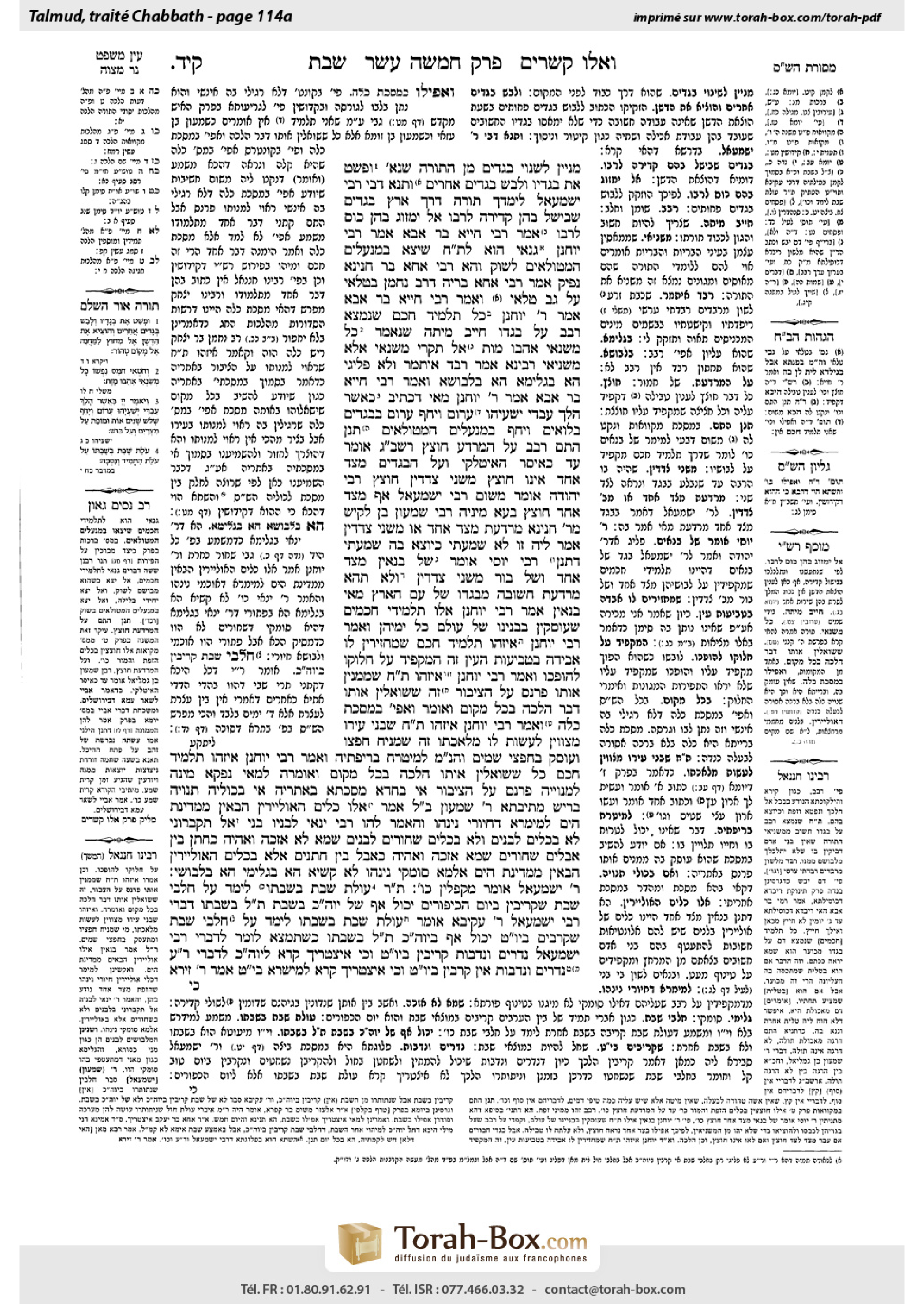
Shabbat 114a: Talmud study for Daf Yomi
Daf Yomi is the daily study of one Talmud folio. Explore 37 tractates with scans, Hebrew text, Sefaria English and AI-generated French translations where annotated.
Passage selection and English or AI-generated French translation are available where the scan has annotations. Daf Study is independent of Torah-Box and Sefaria.
Browse Shabbat · שבת · All tractatesShabbat 114a text and translations
This page of Shabbat includes the Aramaic text, an English translation and an AI-generated French translation, alongside the scan above.
שבת קי״ד א · Aramaic and Hebrew text
מִנַּיִין לְשִׁנּוּי בְּגָדִים מִן הַתּוֹרָה, שֶׁנֶּאֱמַר: ״וּפָשַׁט אֶת בְּגָדָיו וְלָבַשׁ בְּגָדִים אֲחֵרִים״, וְתָנָא דְּבֵי רַבִּי יִשְׁמָעֵאל, לִימְּדָה תּוֹרָה דֶּרֶךְ אֶרֶץ: בְּגָדִים שֶׁבִּישֵּׁל בָּהֶן קְדֵירָה לְרַבּוֹ — אַל יִמְזוֹג בָּהֶן כּוֹס לְרַבּוֹ.
אָמַר רַבִּי חִיָּיא בַּר אַבָּא אָמַר רַבִּי יוֹחָנָן: גְּנַאי הוּא לְתַלְמִיד חָכָם שֶׁיֵּצֵא בְּמִנְעָלִים הַמְטוּלָּאִים לַשּׁוּק. וְהָא רַבִּי אַחָא בַּר חֲנִינָא נָפֵיק! אָמַר רַבִּי אַחָא בְּרֵיהּ דְּרַב נַחְמָן: בִּטְלַאי עַל גַּב טְלַאי.
וְאָמַר רַבִּי חִיָּיא בַּר אַבָּא אָמַר רַבִּי יוֹחָנָן: כׇּל תַּלְמִיד חָכָם שֶׁנִּמְצָא רְבָב עַל בִּגְדּוֹ — חַיָּיב מִיתָה, שֶׁנֶּאֱמַר: ״כׇּל מְשַׂנְאַי אָהֲבוּ מָוֶת״ — אַל תִּקְרֵי ״מְשַׂנְאַי״, אֶלָּא ״מַשְׂנִיאַי״. רָבִינָא אָמַר: רְבָד אִיתְּמַר. וְלָא פְּלִיגִי: הָא בִּגְלִימָא, הָא בִּלְבוּשָׁא.
וְאָמַר רַבִּי חִיָּיא בַּר אַבָּא אָמַר רַבִּי יוֹחָנָן: מַאי דִּכְתִיב ״כַּאֲשֶׁר הָלַךְ עַבְדִּי יְשַׁעְיָהוּ עָרוֹם וְיָחֵף״. ״עָרוֹם״ — בִּבְגָדִים בְּלוּאִים, ״וְיָחֵף״ — בְּמִנְעָלִים הַמְטוּלָּאִים.
תְּנַן הָתָם: רְבָב עַל הַמַּרְדַּעַת חוֹצֵץ. רַבָּן שִׁמְעוֹן בֶּן גַּמְלִיאֵל אוֹמֵר: עַד כְּאִיסָּר הָאִיטַלְקִי. וְעַל הַבְּגָדִים, מִצַּד אֶחָד — אֵינוֹ חוֹצֵץ, מִשְּׁנֵי צְדָדִין — חוֹצֵץ. רַבִּי יְהוּדָה אוֹמֵר מִשּׁוּם רַבִּי יִשְׁמָעֵאל: אַף מִצַּד אֶחָד חוֹצֵץ.
בְּעָא מִינֵּיהּ רַבִּי שִׁמְעוֹן בֶּן לָקִישׁ מֵרַבִּי חֲנִינָא: מַרְדַּעַת, מִצַּד אֶחָד אוֹ מִשְּׁנֵי צְדָדִין? אֲמַר לֵיהּ: זוֹ לֹא שָׁמַעְתִּי, כַּיּוֹצֵא בָּהּ שָׁמַעְתִּי. דִּתְנַן רַבִּי יוֹסֵי אוֹמֵר: שֶׁל בַּנָּאִין — מִצַּד אֶחָד, וְשֶׁל בּוּר — מִשְּׁנֵי צְדָדִין. וְלֹא תְּהֵא מַרְדַּעַת חֲשׁוּבָה מִבִּגְדּוֹ שֶׁל עַם הָאָרֶץ.
מַאי ״בַּנָּאִין״? אָמַר רַבִּי יוֹחָנָן: אֵלּוּ תַּלְמִידֵי חֲכָמִים שֶׁעוֹסְקִין בְּבִנְיָנוֹ שֶׁל עוֹלָם כׇּל יְמֵיהֶן. וְאָמַר רַבִּי יוֹחָנָן: אֵיזֶהוּ תַּלְמִיד חָכָם שֶׁמַּחְזִירִין לוֹ אֲבֵידָה בִּטְבִיעוּת הָעַיִן — זֶה הַמַּקְפִּיד עַל חֲלוּקוֹ לְהוֹפְכוֹ. וְאָמַר רַבִּי יוֹחָנָן: אֵיזֶהוּ תַּלְמִיד חָכָם שֶׁמְּמַנִּין אוֹתוֹ פַּרְנָס עַל הַצִּיבּוּר — זֶה שֶׁשּׁוֹאֲלִין אוֹתוֹ דָּבָר הֲלָכָה בְּכׇל מָקוֹם וְאוֹמֵר, וַאֲפִילּוּ בְּמַסֶּכֶת כַּלָּה.
וְאָמַר רַבִּי יוֹחָנָן: אֵיזֶהוּ תַּלְמִיד חָכָם שֶׁבְּנֵי עִירוֹ מְצֻוִּוין לַעֲשׂוֹת לוֹ מְלַאכְתּוֹ — זֶה שֶׁמַּנִּיחַ חֶפְצוֹ וְעוֹסֵק בְּחֶפְצֵי שָׁמַיִם. וְהָנֵי מִילֵּי לְמִיטְרַח בְּרִיפְתֵּיהּ. וְאָמַר רַבִּי יוֹחָנָן: אֵיזֶהוּ תַּלְמִיד חָכָם — כׇּל שֶׁשּׁוֹאֲלִין אוֹתוֹ הֲלָכָה בְּכׇל מָקוֹם, וְאוֹמְרָהּ. לְמַאי נָפְקָא מִינַּהּ — לְמַנּוֹיֵיהּ פַּרְנָס עַל הַצִּיבּוּר. אִי בַּחֲדָא מַסֶּכְתָּא — בְּאַתְרֵיהּ, אִי בְּכוּלֵּיהּ תַּנּוֹיֵהּ — בְּרֵישׁ מְתִיבְתָּא.
רַבִּי שִׁמְעוֹן בֶּן לָקִישׁ אָמַר: אֵלּוּ כֵּלִים הָאוֹלְיָירִין הַבָּאִין מִמְּדִינַת הַיָּם. לְמֵימְרָא דְּחִיוָּרֵי נִינְהוּ? וְהָאֲמַר לְהוּ רַבִּי יַנַּאי לְבָנָיו: בָּנַי, אַל תִּקְבְּרוּנִי לֹא בְּכֵלִים לְבָנִים וְלֹא בְּכֵלִים שְׁחוֹרִים, לְבָנִים — שֶׁמָּא לֹא אֶזְכֶּה, וְאֶהְיֶה כְּחָתָן בֵּין אֲבֵלִים. שְׁחוֹרִים — שְׁמָא אֶזְכֶּה, וְאֶהְיֶה כְּאָבֵל בֵּין חֲתָנִים. אֶלָּא בְּכֵלִים הָאוֹלְיָירִין הַבָּאִין מִמְּדִינַת הַיָּם. אַלְמָא, סוּמָּקֵי נִינְהוּ! לָא קַשְׁיָא: הָא בִּגְלִימֵי, הָא בִּלְבוּשֵׁי.
רַבִּי יִשְׁמָעֵאל אוֹמֵר מְקַפְּלִין כּוּ׳. תָּנוּ רַבָּנַן: ״עוֹלַת שַׁבָּת בְּשַׁבַּתּוֹ״, לִימֵּד עַל חֶלְבֵי שַׁבָּת שֶׁקְּרֵיבִין בְּיוֹם הַכִּיפּוּרִים. יָכוֹל אַף שֶׁל יוֹם הַכִּפּוּרִים בְּשַׁבָּת — תַּלְמוּד לוֹמַר: ״בְּשַׁבַּתּוֹ״, דִּבְרֵי רַבִּי יִשְׁמָעֵאל.
רַבִּי עֲקִיבָא אוֹמֵר: ״עוֹלַת שַׁבָּת בְּשַׁבַּתּוֹ״, לִימֵּד עַל חֶלְבֵי שַׁבָּת שֶׁקְּרֵבִים בְּיוֹם טוֹב. יָכוֹל אַף בְּיוֹם הַכִּיפּוּרִים — תַּלְמוּד לוֹמַר: ״בְּשַׁבַּתּוֹ״.
כְּשֶׁתִּמְצָא לוֹמַר, לְדִבְרֵי רַבִּי יִשְׁמָעֵאל נְדָרִים וּנְדָבוֹת קְרֵיבִין בְּיוֹם טוֹב, וְכִי אִיצְטְרִיךְ קְרָא — לְיוֹם הַכִּיפּוּרִים. לְדִבְרֵי רַבִּי עֲקִיבָא נְדָרִים וּנְדָבוֹת אֵין קְרֵבִין בְּיוֹם טוֹב, וְכִי אִיצְטְרִיךְ קְרָא — לְמִישְׁרֵא בְּיוֹם טוֹב. אָמַר רַבִּי זֵירָא:
Shabbat 114a · English translation
From where is it derived that changing clothes is a display of honor? As it is stated: “And he will remove his garments and will don other garments, and he will bring the ashes outside of the camp to a pure location” (Leviticus 6:4). The school of Rabbi Yishmael taught: The Torah taught you etiquette. The clothes in which one prepared food for his master, one does not wear to pour his master wine. Since cooking makes one’s clothes dirty, he should wear fresh clothes when serving his master.
Rabbi Ḥiyya bar Abba said that Rabbi Yoḥanan said: It is disgraceful for a Torah scholar to go out to the marketplace in patched shoes. The Gemara asks: Didn’t Rabbi Aḥa bar Ḥanina go out in patched shoes? Rabbi Aḥa, son of Rav Naḥman, said: They only prohibited patched shoes if there is a patch upon a patch.
And Rabbi Ḥiyya bar Abba said that Rabbi Yoḥanan said: A Torah scholar on whose clothes a fat stain is found is liable to receive the death penalty, as it is stated: “All those who hate me love death” (Proverbs 8:36), and the Sages said: Do not read: Those who hate me [mesanai]. Rather, read: Those who cause me to be hated [masniai]. Those who cause people to hate the Torah by creating the impression that those who study Torah are unclean deserve the death penalty. Ravina said: A fat stain [revav] was not stated, but rather a bloodstain [revad] was stated (Rabbeinu Ḥananel), which is a greater disgrace. The Gemara adds: They did not disagree over the halakha. Rather, the dispute is whether that which we learned concerning stains on a Torah scholar’s clothes refers to an overgarment that people wear over the rest of their clothes, while that which we learned with regard to a bloodstain refers to an undergarment, where a bloodstain is disgraceful but other types of spots are not.
And similarly, Rabbi Ḥiyya bar Abba said that Rabbi Yoḥanan said: That which is written: “As My servant Isaiah went naked and barefoot for three years” (Isaiah 20:3), is not to be understood literally. Rather, naked means that he wore tattered clothing, and barefoot means that he walked with patched shoes.
We learned in a mishna there: A fat stain on a donkey’s saddle interposes, i.e., if the saddle becomes impure, its immersion in a ritual bath is invalid unless the stain is removed. Rabban Shimon ben Gamliel says: A stain interposes only when it is as large as an Italian issar but not smaller. And if there were a fat stain on clothing on one side, it does not interpose, but if the stain is on both sides it interposes. Rabbi Yehuda says in the name of Rabbi Yishmael: It interposes even on one side.
Rabbi Shimon ben Lakish raised a dilemma before Rabbi Ḥanina: Is a stain on a saddle an interposition even if it is on just one side, or only if it is on both sides? Rabbi Ḥanina said to him: That, I did not hear explicitly. However, I heard something similar to it. As we learned in that same mishna that Rabbi Yosei says: A garment belonging to builders [banna’in] is considered to have an interposition if it has a stain on one side, and that of an ignoramus, who is not meticulous, is considered to have an interposition when the stain is on both sides. And certainly a donkey’s saddle cannot be more important than the garment of an am ha’aretz.
The Gemara asks: Who are the builders mentioned here? Rabbi Yoḥanan said: These are Torah scholars, who are engaged in building the world all of their days. And with regard to this, Rabbi Yoḥanan said: Who is a Torah scholar of whom the Sages said that one must return a lost object to him based on visual identification, even if he does not provide an identifying sign for it? That is one who makes sure his upper undergarment is turned inward so that the uneven stitching is not visible. This means that he conducts himself like a Torah scholar in all his ways, even in matters of cleanliness and order (Maharsha). On a related note, the Gemara adds that which Rabbi Yoḥanan said: Who is a Torah scholar who may be appointed as a leader of the community? This is one who is asked about matters of halakha on any topic and he is able to answer, and even if he were asked about tractate Kalla, a tractate that few have mastered.
And Rabbi Yoḥanan said: Who is the Torah scholar for whom the inhabitants of his city are commanded to perform his labor for him? This is one who sets his own matters aside and engages in matters of Heaven. It is therefore fitting for the community to support him. And that applies only to exerting themselves to provide him with his bread, as it is appropriate that they sustain him. And Rabbi Yoḥanan said: Who is included in the category of a Torah scholar? Anyone who is asked about the halakha with regard to any topic and is able to state it. And they say: What are the practical consequences of this question? It is to appoint him a leader of the community. If he is an expert in a single tractate, they appoint him as a leader in his place; if he is an expert in all of his learning, they appoint him as the head of the yeshiva.
Rabbi Shimon ben Lakish said: These garments of the banna’in mentioned in the mishna are the clothes of the bath attendants [ulairin] that come from a country overseas, on which stains are apparent, and these men are meticulous about their cleanliness. The Gemara asks: Is that to say that these are white garments? Didn’t Rabbi Yannai say to his sons: My sons, do not bury me in white garments nor in black garments. Not in white, lest I not be acquitted in judgment, and I will be among the wicked like a groom among mourners. And not in black, lest I be acquitted in judgment, and I will be among the righteous like a mourner among grooms. Rather, bury me in the clothes of the bath attendants who come from a country overseas, which are neither black nor white. Apparently, these clothes of the bath attendants are red. The Gemara answers: This is not difficult, as a distinction can be made. When Rabbi Yannai indicates that they are red, that is referring to overgarments; the statement of Rabbi Shimon ben Lakish that indicated that they are white, that is referring to undergarments.
We learned in the mishna that Rabbi Yishmael says: One may fold clothes and make beds on Yom Kippur for Shabbat if Yom Kippur occurs on Friday, and the fats of the sacrifices that were brought on Shabbat were offered on Yom Kippur that occurs on Sunday. The verse “The burnt-offering of Shabbat on its Shabbat, besides the daily offering and its libation” (Numbers 28:10) taught, with regard to the fats of Shabbat, that they are offered on Yom Kippur, because Yom Kippur is also called Shabbat, and the verse indicates that the Shabbat offering is offered on another Shabbat. I might have thought even the fats from Yom Kippur offerings could be sacrificed on Shabbat; therefore, the verse states “on its Shabbat” to specify that it is not so; this is the statement of Rabbi Yishmael.
Rabbi Akiva says that when the verse says: “The burnt-offering of Shabbat on its Shabbat,” it teaches that the fats of Shabbat are offered on a Festival that occurs on the following day. I might have thought that they could even be offered on Yom Kippur that occurred on the day after Shabbat. Therefore, the verse states “on its Shabbat” and not on another one.
When you analyze the matter you will find that you can say that, in accordance with the statement of Rabbi Yishmael, vows and free-will offerings are offered on a Festival. If sacrifices that fulfill vows can be postponed to a weekday but are nevertheless brought on a Festival, certainly fats from Shabbat can be offered on a Festival that follows it. And the verse is needed to permit offering Shabbat fats on Yom Kippur that follows it. However, according to Rabbi Akiva vows and free-will offerings are not brought on a Festival, and therefore the verse is needed to permit sacrificing the fats from Shabbat on a Festival that follows it, but on Yom Kippur it is prohibited. Rabbi Zeira said:
Shabbat 114a · Traduction française (IA)
D’où déduit-on que se changer est une marque d’honneur ? Comme il est dit : « Il ôtera ses vêtements et en revêtira d’autres, puis il transportera les cendres hors du camp, dans un endroit pur » (Lévitique 6:4). L’école de Rabbi Yishmael enseignait : la Torah vous a appris les règles de bonne conduite. On ne porte pas, pour verser du vin à son maître, les vêtements que l’on portait pour lui préparer à manger. Puisque la cuisine salit les vêtements, il faut en porter de propres lorsqu’on sert son maître.
Rabbi Ḥiyya bar Abba a dit au nom de Rabbi Yoḥanan : il est indigne d’un érudit de la Torah de se rendre au marché avec des chaussures rapiécées. La Guemara demande : Rabbi Aḥa bar Ḥanina ne sortait-il pas avec des chaussures rapiécées ? Rabbi Aḥa, fils de Rav Naḥman, a dit : l’interdiction ne concerne que les chaussures portant une pièce sur une autre.
Et Rabbi Ḥiyya bar Abba a dit au nom de Rabbi Yoḥanan : un érudit de la Torah sur les vêtements duquel se trouve une tache de graisse est passible de la peine de mort, comme il est dit : « Tous ceux qui me haïssent aiment la mort » (Proverbes 8:36). Or, les Sages ont dit : ne lis pas « ceux qui me haïssent » [mesanai], mais « ceux qui me font haïr » [masniai]. Ceux qui font haïr la Torah en donnant l’impression que ceux qui l’étudient sont malpropres méritent la peine de mort. Ravina a dit : il n’est pas question d’une tache de graisse [revav], mais d’une tache de sang [revad] (Rabbeinu Ḥananel), qui est plus honteuse encore. La Guemara ajoute : ils ne sont pas en désaccord sur la halakha. Le débat porte plutôt sur la question de savoir si ce que nous avons appris concernant les taches sur les vêtements d’un érudit de la Torah concerne un vêtement extérieur, porté par-dessus les autres vêtements, tandis que ce que nous avons appris au sujet d’une tache de sang concerne un sous-vêtement, où seule une tache de sang est honteuse, et non les autres sortes de taches.
Et de même, Rabbi Ḥiyya bar Abba a dit au nom de Rabbi Yoḥanan : ce qui est écrit, « De même que mon serviteur Isaïe a marché nu et pieds nus pendant trois ans » (Isaïe 20:3), ne doit pas être compris au sens littéral. « Nu » signifie qu’il portait des vêtements en lambeaux, et « pieds nus » signifie qu’il marchait avec des chaussures rapiécées.
Nous avons appris dans une Michna, là-bas : une tache de graisse sur la selle d’un âne constitue une interposition, c’est-à-dire que si la selle devient impure, son immersion dans un bain rituel n’est pas valable tant que la tache n’a pas été enlevée. Rabban Shimon ben Gamliel dit : une tache ne constitue une interposition que si elle a la taille d’un issar italien, et non si elle est plus petite. Si un vêtement porte une tache de graisse sur une seule face, celle-ci ne constitue pas une interposition ; mais si la tache se trouve sur les deux faces, elle constitue une interposition. Rabbi Yehuda dit au nom de Rabbi Yishmael : elle constitue une interposition même sur une seule face.
Rabbi Shimon ben Lakish posa une question à Rabbi Ḥanina : une tache sur une selle constitue-t-elle une interposition même si elle ne se trouve que sur une seule face, ou seulement si elle se trouve sur les deux faces ? Rabbi Ḥanina lui répondit : cela, je ne l’ai pas entendu explicitement. Cependant, j’ai entendu quelque chose de semblable. En effet, nous avons appris dans cette même Michna que Rabbi Yosei dit : un vêtement de bâtisseur [banna’in] est considéré comme présentant une interposition si la tache se trouve sur une seule face, tandis qu’un vêtement d’ignorant, qui ne prend pas soin de sa tenue, est considéré comme présentant une interposition lorsque la tache se trouve sur les deux faces. À plus forte raison, une selle d’âne ne peut pas être plus importante que le vêtement d’un am ha’aretz.
La Guemara demande : qui sont les bâtisseurs mentionnés ici ? Rabbi Yoḥanan a dit : ce sont les érudits de la Torah, qui s’emploient à bâtir le monde tous les jours de leur vie. À ce propos, Rabbi Yoḥanan a dit : quel est l’érudit de la Torah à qui, selon les Sages, il faut restituer un objet perdu sur la base d’une reconnaissance visuelle, même s’il ne fournit aucun signe distinctif ? C’est celui qui veille à retourner son sous-vêtement supérieur de sorte que les coutures irrégulières ne soient pas visibles. Cela signifie qu’il se conduit en érudit de la Torah en toutes choses, même en matière de propreté et d’ordre (Maharsha). À ce propos, la Guemara ajoute les paroles de Rabbi Yoḥanan : quel est l’érudit de la Torah que l’on peut nommer dirigeant de la communauté ? C’est celui à qui l’on peut poser des questions de halakha sur n’importe quel sujet et qui est capable d’y répondre, même si on l’interroge sur le traité Kalla, que peu de gens maîtrisent.
Et Rabbi Yoḥanan a dit : quel est l’érudit de la Torah pour lequel les habitants de sa ville ont l’obligation d’accomplir le travail ? C’est celui qui met de côté ses propres affaires et se consacre aux affaires du Ciel. Il convient donc que la communauté le soutienne. Cela ne concerne que les efforts déployés pour lui fournir son pain, car il est approprié que la communauté le nourrisse. Et Rabbi Yoḥanan a dit : qui entre dans la catégorie des érudits de la Torah ? Quiconque est interrogé sur la halakha concernant n’importe quel sujet et est capable de l’énoncer. Et l’on dit : quelles sont les conséquences pratiques de cette question ? Il s’agit de le nommer dirigeant de la communauté. S’il est expert dans un seul traité, on le nomme dirigeant dans sa localité ; s’il maîtrise toute son étude, on le nomme chef de la yeshiva.
Rabbi Shimon ben Lakish a dit : les vêtements des banna’in mentionnés dans la Michna sont ceux des préposés aux bains [ulairin], qui viennent d’un pays d’outre-mer et sur lesquels les taches se voient ; ces hommes veillent soigneusement à leur propreté. La Guemara demande : faut-il en conclure que ces vêtements sont blancs ? Rabbi Yannai n’a-t-il pas dit à ses fils : « Mes fils, ne m’enterrez ni dans des vêtements blancs ni dans des vêtements noirs. Pas dans des vêtements blancs, de peur que je ne sois pas acquitté au jugement et que je me retrouve parmi les méchants, comme un marié parmi les endeuillés. Et pas dans des vêtements noirs, de peur que je ne sois acquitté au jugement et que je me retrouve parmi les justes, comme un endeuillé parmi les mariés. Enterrez-moi plutôt dans les vêtements des préposés aux bains qui viennent d’un pays d’outre-mer », lesquels ne sont ni noirs ni blancs. Il semble donc que les vêtements des préposés aux bains soient rouges. La Guemara répond : il n’y a pas de difficulté, car on peut distinguer les cas. Lorsque Rabbi Yannai indique qu’ils sont rouges, il s’agit de vêtements extérieurs ; la déclaration de Rabbi Shimon ben Lakish, selon laquelle ils sont blancs, concerne les sous-vêtements.
Nous avons appris dans la Michna que Rabbi Yishmael dit : on peut plier les vêtements et faire les lits à Yom Kippour pour Chabbat si Yom Kippour tombe un vendredi, et les graisses des sacrifices offerts le Chabbat sont offertes à Yom Kippour lorsqu’il tombe un dimanche. Le verset « L’holocauste du Chabbat, chaque Chabbat, outre l’offrande quotidienne et sa libation » (Nombres 28:10) enseigne, au sujet des graisses des sacrifices du Chabbat, qu’elles sont offertes à Yom Kippour, car Yom Kippour est également appelé Chabbat, et le verset indique que l’offrande du Chabbat est offerte un autre Chabbat. J’aurais pu penser que les graisses des sacrifices de Yom Kippour pouvaient elles aussi être offertes le Chabbat ; le verset précise donc « chaque Chabbat », pour enseigner qu’il n’en est pas ainsi. Telle est la déclaration de Rabbi Yishmael.
Rabbi Akiva dit que lorsque le verset dit : « L’holocauste du Chabbat, chaque Chabbat », il enseigne que les graisses des sacrifices du Chabbat sont offertes lors d’une fête qui tombe le lendemain. J’aurais pu penser qu’elles peuvent même être offertes à Yom Kippour lorsque celui-ci tombe le lendemain du Chabbat. Le verset précise donc « chaque Chabbat », et non un autre.
À l’examen, on peut dire que, conformément à la déclaration de Rabbi Yishmael, les sacrifices votifs et les offrandes volontaires sont offerts lors d’une fête. Si les sacrifices accomplissant des vœux peuvent être reportés à un jour de semaine, mais sont néanmoins apportés lors d’une fête, à plus forte raison les graisses des sacrifices du Chabbat peuvent-elles être offertes lors d’une fête qui suit le Chabbat. Le verset est toutefois nécessaire pour permettre d’offrir les graisses des sacrifices du Chabbat à Yom Kippour qui le suit. En revanche, selon Rabbi Akiva, les sacrifices votifs et les offrandes volontaires ne sont pas apportés lors d’une fête ; le verset est donc nécessaire pour permettre de sacrifier les graisses des sacrifices du Chabbat lors d’une fête qui suit, mais il est interdit de le faire à Yom Kippour. Rabbi Zeira a dit :
Traduction française générée par IA à partir de l’édition anglaise de Sefaria. Vérifie toujours un passage avec le texte source.
Text from Sefaria: William Davidson Edition - Vocalized Aramaic (CC BY NC); William Davidson Edition - English (CC BY NC).