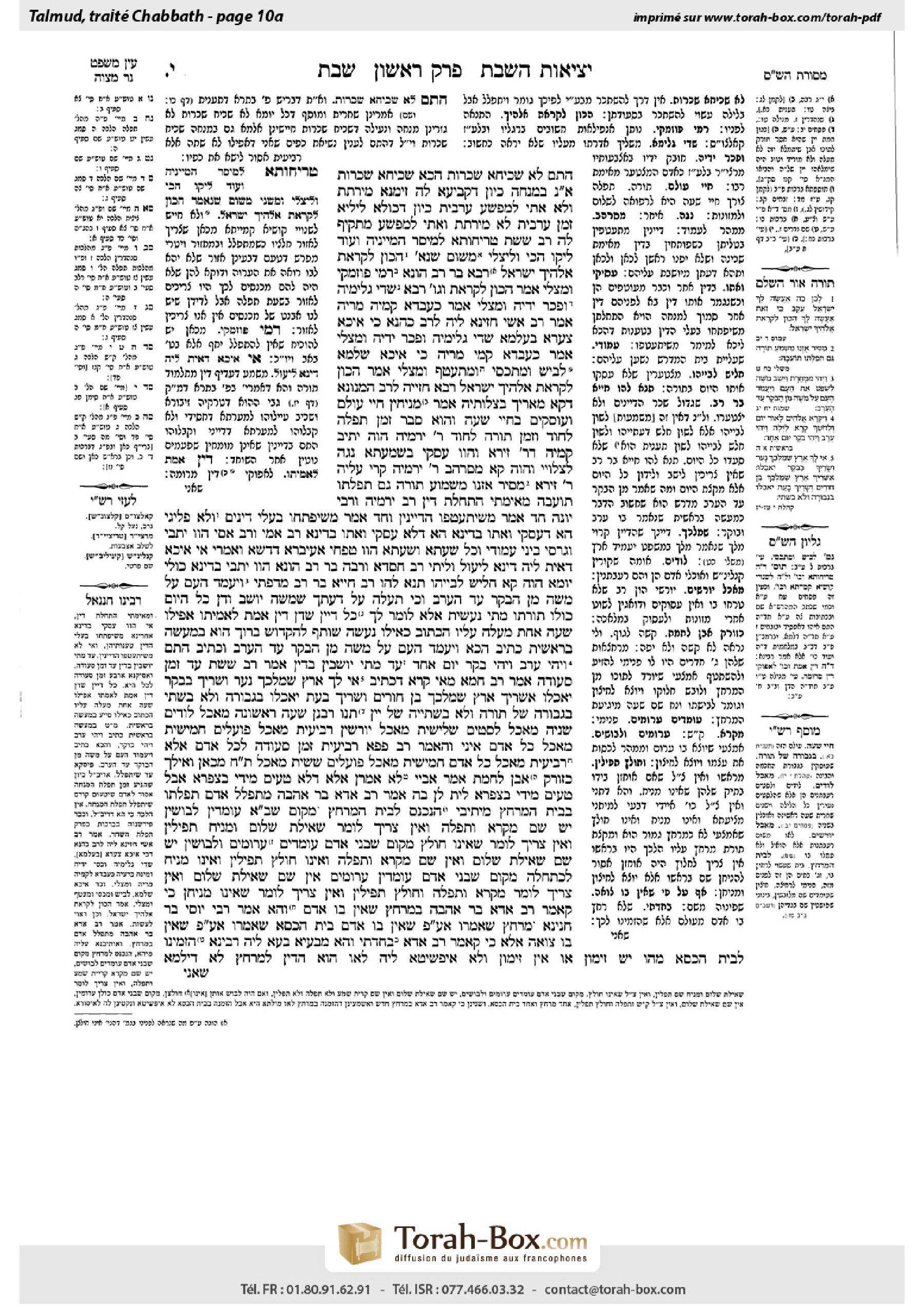
Shabbat 10a: Talmud study for Daf Yomi
Daf Yomi is the daily study of one Talmud folio. Explore 37 tractates with scans, Hebrew text, Sefaria English and AI-generated French translations where annotated.
Passage selection and English or AI-generated French translation are available where the scan has annotations. Daf Study is independent of Torah-Box and Sefaria.
Browse Shabbat · שבת · All tractatesShabbat 10a text and translations
This page of Shabbat includes the Aramaic text, an English translation and an AI-generated French translation, alongside the scan above.
שבת י׳ א · Aramaic and Hebrew text
הָתָם לָא שְׁכִיחָא שִׁכְרוּת, הָכָא שְׁכִיחָא שִׁכְרוּת. אִי נָמֵי, בְּמִנְחָה — כֵּיוָן דִּקְבִיעָא לַהּ זִימְנָא מִירְתַת וְלָא אָתֵי לְמִפְשַׁע. עַרְבִית — כֵּיוָן דְּכוּלֵּהּ לֵילְיָא זְמַן עַרְבִית, לָא מִירְתַת וְאָתֵי לְמִפְשַׁע. מַתְקִיף לַהּ רַב שֵׁשֶׁת: טְרִיחוּתָא לְמֵיסַר הֶמְיָינֵיהּ?! וְעוֹד, לֵיקוּ הָכִי וְלִיצַלֵּי! — מִשּׁוּם שֶׁנֶּאֱמַר: ״הִכּוֹן לִקְרַאת אֱלֹהֶיךָ יִשְׂרָאֵל״.
רָבָא בַּר רַב הוּנָא רָמֵי פּוּזְמָקֵי וּמְצַלֵּי, אָמַר: ״הִכּוֹן לִקְרַאת״ וְגוֹ׳. רָבָא שָׁדֵי גְּלִימֵיהּ וּפָכַר יְדֵיהּ וּמְצַלֵּי. אָמַר: ״כְּעַבְדָּא קַמֵּיהּ מָרֵיהּ״. אָמַר רַב אָשֵׁי: חֲזֵינָא לֵיהּ לְרַב כָּהֲנָא כִּי אִיכָּא צַעֲרָא בְּעָלְמָא, שָׁדֵי גְּלִימֵיהּ וּפָכַר יְדֵיהּ וּמְצַלֵּי. אָמַר: ״כְּעַבְדָּא קַמֵּי מָרֵיהּ״. כִּי אִיכָּא שְׁלָמָא לָבֵישׁ וּמִתְכַּסֵּי וּמִתְעַטֵּף וּמְצַלֵּי. אָמַר: ״הִכּוֹן לִקְרַאת אֱלֹהֶיךָ יִשְׂרָאֵל״.
רָבָא חַזְיֵיהּ לְרַב הַמְנוּנָא דְּקָא מַאֲרֵיךְ בִּצְלוֹתֵיהּ. אֲמַר: מַנִּיחִין חַיֵּי עוֹלָם, וְעוֹסְקִים בְּחַיֵּי שָׁעָה. וְהוּא סָבַר זְמַן תְּפִלָּה לְחוּד וּזְמַן תּוֹרָה לְחוּד. רַבִּי יִרְמְיָה הֲוָה יָתֵיב קַמֵּיהּ דְּרַבִּי זֵירָא וַהֲווֹ עָסְקִי בִּשְׁמַעְתָּא. נְגַהּ לְצַלּוֹיֵי וַהֲוָה קָא מְסַרְהֵב רַבִּי יִרְמְיָה. קָרֵי עֲלֵיהּ רַבִּי זֵירָא: ״מֵסִיר אׇזְנוֹ מִשְּׁמוֹעַ תּוֹרָה גַּם תְּפִלָּתוֹ תּוֹעֵבָה״.
מֵאֵימָתַי הַתְחָלַת דִּין? — רַבִּי יִרְמְיָה וְרַבִּי יוֹנָה. חַד אָמַר מִשֶּׁיִּתְעַטְּפוּ הַדַּיָּינִין. וְחַד אָמַר מִשֶּׁיִּפְתְּחוּ בַּעֲלֵי דִינִים. וְלָא פְּלִיגִי, הָא, דְּעָסְקִי וְאָתוּ בְּדִינָא. הָא, דְּלָא עָסְקִי וְאָתוּ בְּדִינָא.
רַב אַמֵּי וְרַב אַסִּי הֲווֹ יָתְבִי וְגָרְסִי בֵּינֵי עַמּוּדֵי. וְכֹל שַׁעְתָּא וְשַׁעְתָּא הֲווֹ טָפְחִי אַעֵיבְרָא דְּדַשָּׁא וְאָמְרִי: אִי אִיכָּא דְּאִית לֵיהּ דִּינָא, לֵיעוּל וְלֵיתֵי. רַב חִסְדָּא וְרַבָּה בַּר רַב הוּנָא הֲווֹ יָתְבִי בְּדִינָא כּוּלֵּי יוֹמָא, הֲוָה קָא חָלֵישׁ לִבַּיְיהוּ. תְּנָא לְהוּ רַב חִיָּיא בַּר רַב מִדִּפְתִּי: ״וַיַּעֲמֹד הָעָם עַל מֹשֶׁה מִן הַבֹּקֶר עַד הָעָרֶב״, וְכִי תַּעֲלֶה עַל דַּעְתְּךָ שֶׁמּשֶׁה יוֹשֵׁב וְדָן כׇּל הַיּוֹם כּוּלּוֹ? תּוֹרָתוֹ מָתַי נַעֲשֵׂית? אֶלָּא לוֹמַר לָךְ כׇּל דַּיָּין שֶׁדָּן דִּין אֱמֶת לַאֲמִיתּוֹ, אֲפִילּוּ שָׁעָה אַחַת, מַעֲלֶה עָלָיו הַכָּתוּב כְּאִילּוּ נַעֲשָׂה שׁוּתָּף לְהַקָּדוֹשׁ בָּרוּךְ הוּא בְּמַעֲשֵׂה בְרֵאשִׁית. כְּתִיב הָכָא: ״וַיַּעֲמֹד הָעָם עַל מֹשֶׁה מִן הַבֹּקֶר עַד הָעָרֶב״, וּכְתִיב הָתָם: ״וַיְהִי עֶרֶב וַיְהִי בֹקֶר יוֹם אֶחָד״.
עַד מָתַי יוֹשְׁבִין בַּדִּין? אָמַר רַב שֵׁשֶׁת: עַד זְמַן סְעוּדָה. אָמַר רַב חָמָא: מַאי קְרָא? — דִּכְתִיב: ״אִי לָךְ אֶרֶץ שֶׁמַּלְכֵּךְ נָעַר וְשָׂרַיִךְ בַּבֹּקֶר יֹאכֵלוּ. אַשְׁרֵיךְ אֶרֶץ שֶׁמַּלְכֵּךְ בֶּן חוֹרִים וְשָׂרַיִךְ בָּעֵת יֹאכֵלוּ בִּגְבוּרָה וְלֹא בַשְּׁתִי״. בִּגְבוּרָה שֶׁל תּוֹרָה, וְלֹא בִּשְׁתִיָּיה שֶׁל יַיִן.
תָּנוּ רַבָּנַן: שָׁעָה רִאשׁוֹנָה — מַאֲכַל לוּדִים. שְׁנִיָּה — מַאֲכַל לִסְטִים. שְׁלִישִׁית — מַאֲכַל יוֹרְשִׁין. רְבִיעִית — מַאֲכַל פּוֹעֲלִים. חֲמִישִׁית — מַאֲכַל כׇּל אָדָם.
אִינִי?! וְהָאָמַר רַב פָּפָּא רְבִיעִית זְמַן סְעוּדָה לְכׇל אָדָם! אֶלָּא רְבִיעִית מַאֲכַל כׇּל אָדָם. חֲמִישִׁית — מַאֲכַל פּוֹעֲלִים. שִׁשִּׁית — מַאֲכַל תַּלְמִידֵי חֲכָמִים. מִכָּאן וְאֵילָךְ — כְּזוֹרֵק אֶבֶן לַחֵמֶת. אָמַר אַבָּיֵי: לָא אֲמַרַן אֶלָּא דְּלָא טְעֵים מִידֵּי בְּצַפְרָא, אֲבָל טְעֵים מִידֵּי בְּצַפְרָא — לֵית לַן בַּהּ.
אָמַר רַב אַדָּא בַּר אַהֲבָה: מִתְפַּלֵּל אָדָם תְּפִלָּתוֹ בְּבֵית הַמֶּרְחָץ. מֵיתִיבִי: הַנִּכְנָס לְבֵית הַמֶּרְחָץ, מָקוֹם שֶׁבְּנֵי אָדָם עוֹמְדִין לְבוּשִׁין — יֵשׁ שָׁם מִקְרָא וּתְפִלָּה. וְאֵין צָרִיךְ לוֹמַר שְׁאֵילַת שָׁלוֹם. וּמַנִּיחַ תְּפִילִּין, וְאֵין צָרִיךְ לוֹמַר שֶׁאֵינוֹ חוֹלֵץ.
מָקוֹם שֶׁבְּנֵי אָדָם עוֹמְדִים עֲרוּמִּים וּלְבוּשִׁין — יֵשׁ שָׁם שְׁאֵילַת שָׁלוֹם, וְאֵין שָׁם מִקְרָא וּתְפִלָּה, וְאֵינוֹ חוֹלֵץ תְּפִילִּין, וְאֵינוֹ מַנִּיחַ לְכַתְּחִלָּה.
מָקוֹם שֶׁבְּנֵי אָדָם עוֹמְדִין עֲרוּמִּים — אֵין שָׁם שְׁאֵילַת שָׁלוֹם, וְאֵין צָרִיךְ לוֹמַר מִקְרָא וּתְפִלָּה, וְחוֹלֵץ תְּפִילִּין, וְאֵין צָרִיךְ לוֹמַר שֶׁאֵינוֹ מַנִּיחָן!
כִּי קָאָמַר רַב אַדָּא בַּר אַהֲבָה בְּמֶרְחָץ שֶׁאֵין בּוֹ אָדָם. וְהָא אָמַר רַבִּי יוֹסֵי בַּר חֲנִינָא: מֶרְחָץ שֶׁאָמְרוּ אַף עַל פִּי שֶׁאֵין בּוֹ אָדָם, בֵּית הַכִּסֵּא שֶׁאָמְרוּ אַף עַל פִּי שֶׁאֵין בּוֹ צוֹאָה!
אֶלָּא כִּי קָאָמַר רַב אַדָּא, בְּחַדְתֵי. וְהָא מִבְעָא בְּעָא לֵיהּ רָבִינָא: הִזְמִינוֹ לְבֵית הַכִּסֵּא מַהוּ, יֵשׁ זִימּוּן אוֹ אֵין זִימּוּן? וְלָא אִיפְּשִׁיטָא לֵיהּ. לָאו הוּא הַדִּין לְמֶרְחָץ? לָא, דִּילְמָא
Shabbat 10a · English translation
The Gemara responds that there is a difference between the cases. There, at the time of the afternoon prayer, drunkenness is uncommon, as it is unusual to drink excessively during the day. However, here, in the case of the evening prayer, drunkenness is common, and therefore there was room to issue a decree requiring one to interrupt his meal to recite the evening prayer. Alternatively, it is possible to explain that with regard to the afternoon prayer, since its time is fixed, he is anxious, and he won’t come to be negligent and forget to pray. However, with regard to the evening prayer, since all night is the time for the evening prayer, he is not anxious, and he will come to be negligent. Rav Sheshet strongly objects to this: Is it a burden to tie his belt? In addition, if it is a burden, let him stand that way, without a belt, and pray. The Gemara answers: It is necessary to wear a belt while praying, since it is stated: “Prepare to greet your God, Israel” (Amos 4:12). One must prepare and adorn himself when standing before God.
Since the verse: “Prepare to greet your God, Israel,” was cited with regard to the obligation to prepare and adorn oneself before prayer, the Gemara cites that indeed Rava bar Rav Huna would don expensive socks and pray and he said he would do this as it is written: “Prepare to greet your God, Israel.” On the other hand, Rava would not do so; rather, in his prayer he would remove his cloak and clasp his hands and pray. He said that he would do so as a slave before his master, who appears before him with extreme submission. Rav Ashi said: I saw that Rav Kahana, when there is suffering in the world, would remove his cloak and clasp his hands and pray. And he said that he did so as a slave before his master. When there is peace in the world, he would dress, and cover himself, and wrap himself in a significant garment, and pray, and he said that he did so in fulfillment of the verse: “Prepare to greet your God, Israel.”
Speaking of prayer, the Gemara relates that Rava saw Rav Hamnuna, who was prolonging his prayer. He said about him: They abandon eternal life, the study of Torah, and engage in temporal life, prayer, which includes requests for mundane needs. The Gemara explains: And Rav Hamnuna held that the time for prayer is distinct and the time for Torah is distinct. The time that one devotes to prayer is not at the expense of the time devoted to Torah study. Similarly, the Gemara relates that Rabbi Yirmeya was sitting before Rabbi Zeira and they were engaged in the study of halakha. The time for prayer was approaching and it was getting late and Rabbi Yirmeya was hurrying to conclude the subject that they were studying in order to pray. Rabbi Zeira read this verse as applying to Rabbi Yirmeya: “One who turns his ear from hearing Torah, his prayer is also an abomination” (Proverbs 28:9).
We learned that if one enters to sit in judgment adjacent to minḥa, he need not interrupt the trial and pray. The Gemara clarifies: From when is it considered the beginning of a trial? Rabbi Yirmeya and Rabbi Yona disagreed. One said that it begins from when the judges wrap themselves in their prayer shawls, as judges were accustomed to do before sitting in judgment. And one of them said that the beginning of judgment is from when the litigants begin articulating their claims. The Gemara comments: And they do not disagree. Rather, this amora, who says that it is from when the litigants begin, refers to a case where they were already engaged in a previous trial, and the judges were already wrapped in their prayer shawls. And that amora, who says that it is from when the judges wrap themselves in their prayer shawls, refers to a case where they were not engaged in a previous trial, and, as a result, the trial begins when they wrap themselves in the prayer shawls.
Speaking of judgment, the Gemara relates that Rav Ami and Rav Asi would sit and study between the pillars beneath the study hall. And each and every hour they would knock on the bolt of the door and say: If there is someone who has a case that requires judgment, let him enter and come before us. The Gemara also relates that Rav Ḥisda and Rabba bar Rav Huna would sit in judgment all day and their hearts would grow weak from hunger. Therefore, Rav Ḥiyya bar Rav from Difti taught them a baraita with regard to the verse: “And it was the next day and Moses sat to judge the people and the people stood over Moses from the morning until the evening” (Exodus 18:13). Does it enter your mind that Moses would sit and judge all day long? If so, when was his Torah study accomplished? Rather, surely the verse is coming to tell you: Any judge who judges a true judgment truthfully, even if he sits in judgment only one hour, the verse ascribes to him as if he became a partner to the Holy One, Blessed be He, in the act of Creation, as by means of a true judgment he upholds the world (Me’iri). This conclusion is derived by means of a verbal analogy [gezera shava]: It is written here: “And the people stood over Moses from the morning until the evening.” And it is written there, in the act of Creation: “And it was evening and it was morning, one day” (Genesis 1:5). The evening and part of the morning are considered a whole day. With regard to this issue as well, it is sufficient for the judges to sit in judgment for only part of the day and there is no need for them to starve themselves by sitting in judgment all day.
The Gemara questions further: Until when do they sit in judgment? What is the usual time that court adjourns? Rav Sheshet said: Until mealtime, noon. Rav Ḥama said: What is the verse that alludes to this? As it is written: “Woe to you, land that your king is a lad and your ministers eat in the morning. Happy are you, land that your king is free and your ministers eat on time in strength and not in drunkenness” (Ecclesiastes 10:16–17). He interprets the verse: The ministers in a proper country sit to eat only after they engaged in the strength of Torah and in judgment and not in the drunkenness of wine.
The Sages taught in a baraita: Eating in the first hour of the morning is the time of eating for Ludim, who are members of a nation of cannibals, and they are ravenous and hurry to eat. The second hour is the time of the eating of robbers. Since they spend the night stealing, they eat early in the morning. The third hour is the time of eating for heirs, i.e., people who inherited a lot of money and do not work for their sustenance. Their only preoccupation in the early hours of the morning is eating. The fourth hour is the time of eating for workers. The fifth hour is the time of eating for all people.
The Gemara asks: Is that so? Didn’t Rav Pappa say that the fourth hour is mealtime for all people? Rather, emend the statement and say: The fourth hour is the time of eating for all people. The fifth hour is the time of eating for workers who do not have time to eat beforehand. The sixth hour is the time of eating for Torah scholars as, until then, court is in session. The Gemara adds: One who eats from then on is as if he is throwing a stone into a barrel, meaning that by then it does not contribute to the body’s health. Abaye said: We only said that eating from the sixth hour on is not beneficial, when he did not taste anything in the morning; however, if he tasted something in the morning, we have no problem with it.
Rav Adda bar Ahava said: A person may, ab initio, recite his prayer in the bathhouse. The Gemara raises an objection from what was taught in the Tosefta: One who enters the bathhouse, in the first room, a place where all people stand dressed, it is like any other place and reading the Torah and prayer are permitted there, and, needless to say, in that room greeting [shalom] others is permitted. And he may don phylacteries there, and, needless to say, if he was already donning phylacteries that he need not remove them.
In the next room, a place where people dress and undress and they stand both naked and dressed, greeting others is permitted there. However, reading the Torah and prayer are not permitted there. And if one was already donning phylacteries there, he need not remove the phylacteries. However, he may not don phylacteries there ab initio.
In the innermost room, which is a place where people stand naked, greeting others is not permitted there, and, needless to say, reading the Torah and prayer are prohibited there. And if he is donning phylacteries there, he must remove the phylacteries, and, needless to say, he may not don them there ab initio. Apparently, the Tosefta contradicts the statement of Rav Adda bar Ahava as he was, no doubt, referring to the innermost room in the bathhouse, which alone is referred to simply as a bathhouse, and, according to him, one may pray there ab initio.
The Gemara answers: When Rav Adda bar Ahava said his halakha, he was referring to an empty bathhouse in which there are no people. The Gemara asks: Didn’t Rabbi Yosei bar Ḥanina say: With regard to the bathhouse in which they said that it is prohibited to pray, the prohibition exists even though there are no people in it? With regard to the bathroom in which they said that it is prohibited to pray, the prohibition exists even though there are no feces in it. Certainly, since the place serves a repugnant purpose, it is inappropriate to pray there at any time.
The Gemara answers: Rather, when Rav Adda made his statement, he was referring to a new bathhouse that had not yet been used for bathing. The Gemara asks: Didn’t Ravina raise a dilemma before Rav Adda with regard to this matter: A place that one designated as a bathroom, what is its legal status as far as praying there is concerned? Is there designation as a significant and determining factor in this case? Or, is designation not a halakhically significant matter? And the dilemma was not resolved for him. Is the same not true with regard to the bathhouse? Doesn’t the same dilemma exist there? The Gemara answers: No, perhaps
Shabbat 10a · Traduction française (IA)
La Guemara répond qu’il existe une différence entre les cas. Dans le premier cas, au moment de la prière de l’après-midi, l’ivresse est rare, car il est inhabituel de boire excessivement pendant la journée. Ici, en revanche, dans le cas de la prière du soir, l’ivresse est courante ; il y avait donc lieu de décréter qu’il fallait interrompre son repas pour réciter la prière du soir. On peut aussi expliquer que, pour la prière de l’après-midi, comme son horaire est fixe, on est inquiet et on risque moins de faire preuve de négligence et d’oublier de prier. Pour la prière du soir, en revanche, comme toute la nuit est consacrée à cette prière, on n’est pas inquiet et l’on risque de faire preuve de négligence. Rav Chéchet s’y oppose vivement : Est-ce si pénible d’attacher sa ceinture ? De plus, si c’est pénible, qu’il se tienne ainsi, sans ceinture, et qu’il prie. La Guemara répond : Il est nécessaire de porter une ceinture pendant la prière, car il est dit : « Prépare-toi à rencontrer ton Dieu, Israël » (Amos 4,12). Il faut se préparer et se parer lorsqu’on se tient devant Dieu.
Puisque le verset « Prépare-toi à rencontrer ton Dieu, Israël » a été cité à propos de l’obligation de se préparer et de se parer avant la prière, la Guemara rapporte qu’en effet, Rava bar Rav Houna mettait des chaussettes coûteuses pour prier et disait qu’il agissait ainsi conformément à ce qui est écrit : « Prépare-toi à rencontrer ton Dieu, Israël. » Rava, quant à lui, n’agissait pas ainsi ; pour prier, il retirait plutôt son manteau, joignait les mains et priait. Il disait qu’il agissait ainsi comme un serviteur devant son maître, qui se présente devant lui dans une attitude de soumission absolue. Rav Achi dit : J’ai vu que Rav Kahana, lorsqu’il y avait des souffrances dans le monde, retirait son manteau, joignait les mains et priait. Il disait qu’il agissait ainsi comme un serviteur devant son maître. Lorsque la paix régnait dans le monde, il s’habillait, se couvrait et se drapait d’un vêtement important pour prier ; il disait qu’il agissait ainsi en accomplissement du verset : « Prépare-toi à rencontrer ton Dieu, Israël. »
À propos de la prière, la Guemara rapporte que Rava vit Rav Hamnouna prolonger sa prière. Il dit à son sujet : « Ils abandonnent la vie éternelle, l’étude de la Torah, et s’occupent de la vie éphémère, la prière », qui comprend des demandes concernant les besoins matériels. La Guemara explique que Rav Hamnouna considérait que le temps de la prière et celui de l’étude de la Torah étaient distincts. Le temps consacré à la prière ne se prenait pas sur celui consacré à l’étude de la Torah. De même, la Guemara rapporte que Rabbi Yirmeya était assis devant Rabbi Zeira et qu’ils étudiaient la halakha. L’heure de la prière approchait et il se faisait tard ; Rabbi Yirmeya se dépêchait donc de conclure le sujet qu’ils étudiaient afin de prier. Rabbi Zeira lui appliqua ce verset : « Celui qui détourne son oreille pour ne pas entendre la Torah, sa prière aussi est une abomination » (Proverbes 28,9).
Nous avons appris que si quelqu’un entre pour siéger au tribunal à l’approche de minha, il n’a pas besoin d’interrompre le procès pour prier. La Guemara précise : À partir de quand considère-t-on qu’un procès a commencé ? Rabbi Yirmeya et Rabbi Yona sont en désaccord. Selon l’un, il commence lorsque les juges s’enveloppent dans leurs châles de prière, comme ils avaient coutume de le faire avant de siéger au tribunal. Selon l’autre, le procès commence lorsque les parties commencent à exposer leurs arguments. La Guemara commente : Ils ne sont pas en désaccord. L’amora qui dit que le procès commence lorsque les parties prennent la parole parle d’un cas où un procès antérieur était déjà en cours et où les juges étaient déjà enveloppés dans leurs châles de prière. L’amora qui dit qu’il commence lorsque les juges s’enveloppent dans leurs châles de prière parle d’un cas où aucun procès antérieur n’était en cours ; par conséquent, le procès commence lorsqu’ils s’enveloppent dans leurs châles de prière.
À propos du jugement, la Guemara rapporte que Rav Ami et Rav Assi s’asseyaient et étudiaient entre les piliers, sous la salle d’étude. Chaque heure, ils frappaient au verrou de la porte et disaient : « Si quelqu’un a une affaire à faire juger, qu’il entre et se présente devant nous. » La Guemara rapporte également que Rav Ḥisda et Rabba bar Rav Houna siégeaient au tribunal toute la journée et que la faim leur affaiblissait le cœur. Rav Ḥiyya bar Rav, de Difti, leur enseigna donc une baraïta au sujet du verset : « Le lendemain, Moïse siégea pour juger le peuple, et le peuple se tenait devant Moïse du matin jusqu’au soir » (Exode 18,13). Peut-on penser que Moïse siégeait pour juger toute la journée ? Dans ce cas, à quel moment aurait-il étudié la Torah ? Il est certain que le verset vient plutôt nous enseigner ceci : tout juge qui rend un jugement juste avec équité, même s’il ne siège au tribunal qu’une heure, le verset lui attribue le mérite d’être devenu l’associé du Saint, béni soit-Il, dans l’œuvre de la Création, car un jugement juste maintient le monde (Meïri). Cette conclusion est déduite au moyen d’une analogie verbale [gezera shava] : il est écrit ici : « Le peuple se tenait devant Moïse du matin jusqu’au soir », et il est écrit là, à propos de l’œuvre de la Création : « Il y eut un soir, il y eut un matin : premier jour » (Genèse 1,5). Le soir et une partie du matin sont considérés comme une journée entière. À cet égard également, il suffit que les juges siègent au tribunal une partie de la journée ; il n’est pas nécessaire qu’ils s’affament en y siégeant toute la journée.
La Guemara demande encore : Jusqu’à quand siègent-ils au tribunal ? À quelle heure le tribunal lève-t-il habituellement la séance ? Rav Chéchet dit : Jusqu’au moment du repas, à midi. Rav Ḥama dit : Quel verset y fait allusion ? Comme il est écrit : « Malheur à toi, pays dont le roi est un enfant et dont les princes mangent dès le matin. Heureux es-tu, pays dont le roi est un homme libre et dont les princes mangent à l’heure convenable, pour se fortifier et non pour s’enivrer » (Ecclésiaste 10,16-17). Il interprète le verset ainsi : dans un pays bien gouverné, les princes ne s’assoient pour manger qu’après s’être consacrés à la vigueur de la Torah et au jugement, et non à l’ivresse du vin.
Les Sages ont enseigné dans une baraïta : Le repas pris à la première heure du matin est celui des Ludim, membres d’un peuple de cannibales, qui sont voraces et se hâtent de manger. La deuxième heure est celle du repas des brigands. Comme ils passent la nuit à voler, ils mangent tôt le matin. La troisième heure est celle du repas des héritiers, c’est-à-dire des gens qui ont hérité d’une grande fortune et ne travaillent pas pour subvenir à leurs besoins. Leur seule occupation aux premières heures du matin est de manger. La quatrième heure est celle du repas des travailleurs. La cinquième heure est celle du repas de tout le monde.
La Guemara demande : Est-ce exact ? Rav Pappa n’a-t-il pas dit que la quatrième heure est l’heure du repas de tout le monde ? Il faut plutôt corriger l’énoncé et dire : La quatrième heure est celle du repas de tout le monde. La cinquième heure est celle du repas des travailleurs qui n’ont pas le temps de manger auparavant. La sixième heure est celle du repas des érudits en Torah, car le tribunal siège jusque-là. La Guemara ajoute : Celui qui mange à partir de ce moment-là, c’est comme s’il jetait une pierre dans un tonneau, c’est-à-dire qu’à ce stade, cela ne contribue pas à la santé du corps. Abaye dit : Nous avons seulement dit que manger à partir de la sixième heure n’est pas bénéfique lorsqu’on n’a rien goûté le matin ; mais si l’on a goûté quelque chose le matin, cela ne pose aucun problème.
Rav Adda bar Ahava dit : A priori, on peut réciter sa prière dans les bains. La Guemara soulève une objection à partir de ce qui a été enseigné dans la Tosefta : Celui qui entre dans les bains, dans la première salle, un endroit où tout le monde se tient habillé, se trouve dans un lieu comme les autres ; la lecture de la Torah et la prière y sont donc permises et, à plus forte raison, il est permis d’y saluer autrui [shalom]. On peut également y mettre les tefillin et, à plus forte raison, si l’on portait déjà les tefillin, on n’a pas besoin de les enlever.
Dans la salle suivante, un endroit où les gens s’habillent et se déshabillent, et où ils se tiennent aussi bien nus qu’habillés, il est permis de saluer autrui. Cependant, la lecture de la Torah et la prière n’y sont pas permises. Si quelqu’un portait déjà les tefillin à cet endroit, il n’a pas besoin de les enlever. En revanche, il ne peut pas y mettre les tefillin a priori.
Dans la salle la plus intérieure, où les gens se tiennent nus, il n’est pas permis de saluer autrui et, à plus forte raison, la lecture de la Torah et la prière y sont interdites. Si quelqu’un porte les tefillin à cet endroit, il doit les enlever et, à plus forte raison, il ne peut pas les y mettre a priori. Il apparaît que la Tosefta contredit l’affirmation de Rav Adda bar Ahava, car il faisait sans aucun doute référence à la salle la plus intérieure des bains, qui est la seule que l’on désigne simplement par le terme « bains » ; or, selon lui, on peut y prier a priori.
La Guemara répond : Lorsque Rav Adda bar Ahava a énoncé sa halakha, il parlait d’un bain public vide, où il n’y a personne. La Guemara demande : Rabbi Yosse bar Ḥanina n’a-t-il pas dit : Pour le bain public où il a été dit qu’il est interdit de prier, l’interdiction s’applique même s’il n’y a personne ; pour les toilettes où il a été dit qu’il est interdit de prier, l’interdiction s’applique même s’il n’y a pas d’excréments ? Il est certain que, puisqu’un tel lieu sert à un usage répugnant, il ne convient jamais d’y prier.
La Guemara répond : Rav Adda parlait plutôt d’un bain public neuf, qui n’avait pas encore servi à se baigner. La Guemara demande : Ravina n’a-t-il pas soumis à Rav Adda une question à ce sujet : Quel est le statut, du point de vue de la prière, d’un endroit qu’on a destiné à servir de toilettes ? Le fait de lui assigner cette destination est-il un facteur déterminant dans ce cas ? Ou bien cette destination n’a-t-elle pas de portée halakhique ? Et la question n’a pas été résolue pour lui. N’en va-t-il pas de même pour le bain public ? La même question ne s’y pose-t-elle pas ? La Guemara répond : Non, peut-être
Traduction française générée par IA à partir de l’édition anglaise de Sefaria. Vérifie toujours un passage avec le texte source.
Text from Sefaria: William Davidson Edition - Vocalized Aramaic (CC BY NC); William Davidson Edition - English (CC BY NC).