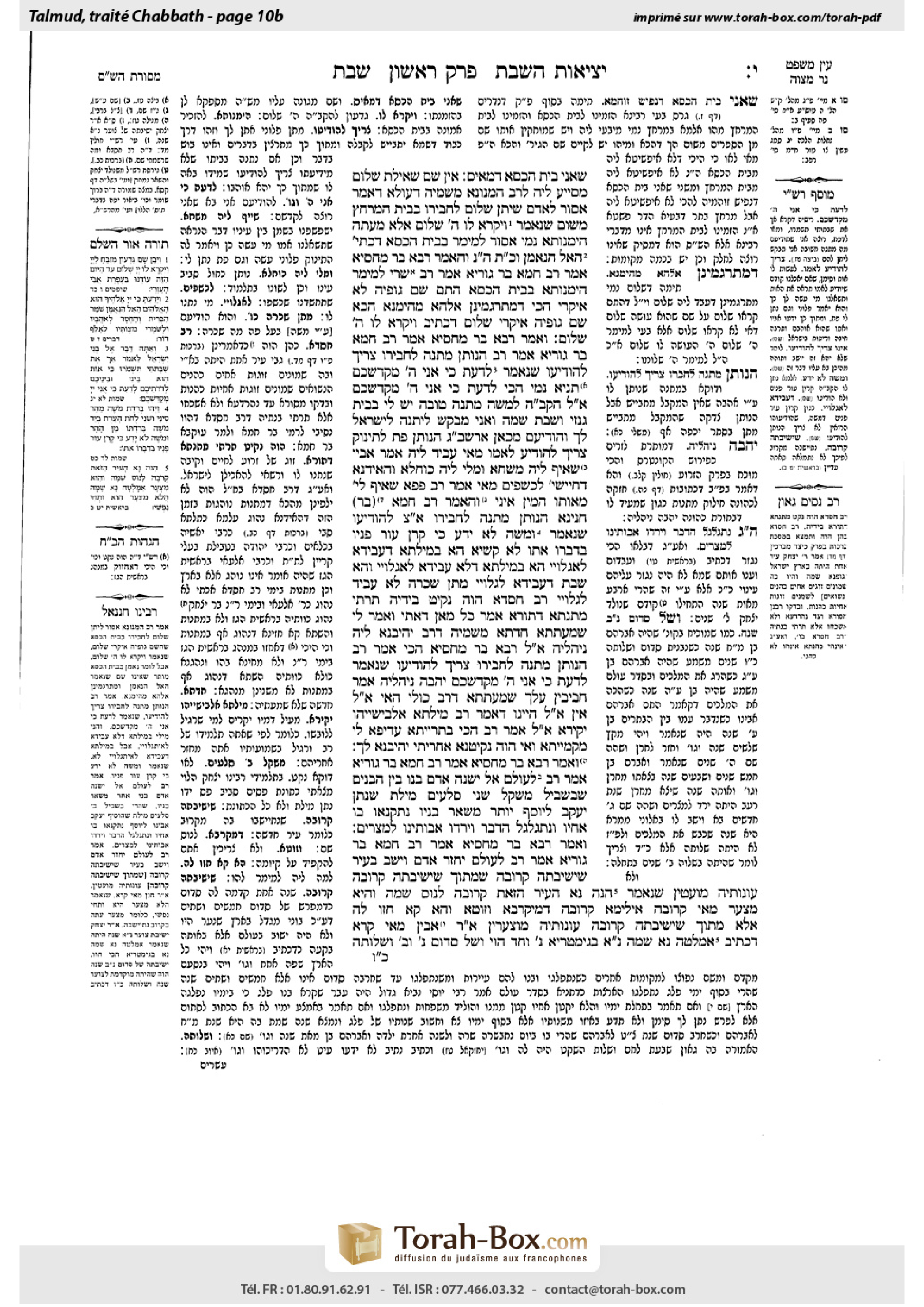
Shabbat 10b: Talmud study for Daf Yomi
Daf Yomi is the daily study of one Talmud folio. Explore 37 tractates with scans, Hebrew text, Sefaria English and AI-generated French translations where annotated.
Passage selection and English or AI-generated French translation are available where the scan has annotations. Daf Study is independent of Torah-Box and Sefaria.
Browse Shabbat · שבת · All tractatesShabbat 10b text and translations
This page of Shabbat includes the Aramaic text, an English translation and an AI-generated French translation, alongside the scan above.
שבת י׳ ב · Aramaic and Hebrew text
שָׁאנֵי בֵּית הַכִּסֵּא דִּמְאִיס.
אֵין שָׁם שְׁאֵילַת שָׁלוֹם. מְסַיַּיע לֵיהּ לְרַב הַמְנוּנָא מִשְּׁמֵיהּ דְּעוּלָּא דְּאָמַר: אָסוּר לְאָדָם שֶׁיִּתֵּן שָׁלוֹם לַחֲבֵירוֹ בְּבֵית הַמֶּרְחָץ, מִשּׁוּם שֶׁנֶּאֱמַר ״וַיִּקְרָא לוֹ ה׳ שָׁלוֹם״.
אֶלָּא מֵעַתָּה ״הֵימָנוּתָא״ נָמֵי אָסוּר לְמֵימַר בְּבֵית הַכִּסֵּא, דִּכְתִיב: ״הָאֵל הַנֶּאֱמָן״. וְכִי תֵּימָא הָכִי נָמֵי, וְהָאָמַר רָבָא בַּר מַחְסֵיָא, אָמַר רַב חָמָא בַּר גּוּרְיָא, אָמַר רַב: שָׁרֵי לְמֵימַר ״הֵימָנוּתָא״ בְּבֵית הַכִּסֵּא! הָתָם שֵׁם גּוּפֵיהּ לָא אִיקְּרִי הָכִי, דִּמְתַרְגְּמִינַן ״אֱלָהָא מְהֵימְנָא״, הָכָא שֵׁם גּוּפֵיהּ אִיקְּרִי ״שָׁלוֹם״ דִּכְתִיב ״וַיִּקְרָא לוֹ ה׳ שָׁלוֹם״.
וְאָמַר רָבָא בַּר מַחְסֵיָא אָמַר רַב חָמָא בַּר גּוּרְיָא אָמַר רַב: הַנּוֹתֵן מַתָּנָה לַחֲבֵירוֹ, צָרִיךְ לְהוֹדִיעוֹ. שֶׁנֶּאֱמַר: ״לָדַעַת כִּי אֲנִי ה׳ מְקַדִּשְׁכֶם״. תַּנְיָא נָמֵי הָכִי: ״לָדַעַת כִּי אֲנִי ה׳ מְקַדִּשְׁכֶם״, אָמַר לוֹ הַקָּדוֹשׁ בָּרוּךְ הוּא לְמֹשֶׁה: מַתָּנָה טוֹבָה יֵשׁ לִי בְּבֵית גְּנָזַי וְשַׁבָּת שְׁמָהּ, וַאֲנִי מְבַקֵּשׁ לִיתְּנָהּ לְיִשְׂרָאֵל, לֵךְ וְהוֹדִיעָם. מִכָּאן אָמַר רַבָּן שִׁמְעוֹן בֶּן גַּמְלִיאֵל: הַנּוֹתֵן פַּת לְתִינוֹק, צָרִיךְ לְהוֹדִיעַ לְאִמּוֹ. מַאי עָבֵיד לֵיהּ? אָמַר אַבָּיֵי: שָׁאֵיף לֵיהּ מִשְׁחָא, וּמָלֵי לֵיהּ כּוּחְלָא. וְהָאִידָּנָא דְּחָיְישִׁינַן לִכְשָׁפִים מַאי? אָמַר רַב פָּפָּא: שָׁאֵיף לֵיהּ מֵאוֹתוֹ הַמִּין.
אִינִי וְהָאָמַר רַב חָמָא (בַּר) [בְּרַבִּי] חֲנִינָא: הַנּוֹתֵן מַתָּנָה לַחֲבֵירוֹ אֵין צָרִיךְ לְהוֹדִיעוֹ, שֶׁנֶּאֱמַר: ״וּמֹשֶׁה לֹא יָדַע כִּי קָרַן עוֹר פָּנָיו בְּדַבְּרוֹ אִתּוֹ״! — לָא קַשְׁיָא: הָא בְּמִילְּתָא דַּעֲבִידָא לְאִגַּלּוֹיֵי, הָא בְּמִילְּתָא דְּלָא עֲבִידָא לְאִגַּלּוֹיֵי. וְהָא שַׁבָּת, דַּעֲבִידָא לִגַלּוֹיֵי? — מַתַּן שְׂכָרָהּ לָא עָבֵיד לִגַלּוֹיֵי.
רַב חִסְדָּא הֲוָה נָקֵיט בִּידֵיהּ תַּרְתֵּי מַתְּנָתָא דְתוֹרָא, אָמַר: כׇּל מַאן דְּאָתֵי וְאָמַר לִי שְׁמַעְתָּתָא חַדְתָּא מִשְּׁמֵיהּ דְּרַב יָהֵיבְנָא לֵיהּ נִיהֲלֵיהּ. אֲמַר לֵיהּ רָבָא בַּר מַחְסֵיָא, הָכִי אָמַר רַב: הַנּוֹתֵן מַתָּנָה לַחֲבֵירוֹ צָרִיךְ לְהוֹדִיעוֹ. שֶׁנֶּאֱמַר: ״לָדַעַת כִּי אֲנִי ה׳ מְקַדִּשְׁכֶם״. יַהֲבַהּ נִיהֲלֵיהּ. אֲמַר חֲבִיבִין עֲלָךְ שְׁמַעְתָּתָא דְּרַב כּוּלֵּי הַאי? אֲמַר לֵיהּ: אִין. אֲמַר לֵיהּ: הַיְינוּ דְּאָמַר רַב: מֵילָתָא אַלָּבֵישַׁיְיהוּ יַקִּירָא. אֲמַר לֵיהּ: אֲמַר רַב הָכִי?! בָּתְרָיְיתָא עֲדִיפָא לִי מִקַּמָּיְיתָא, וְאִי הֲוָה נָקֵיטְנָא אַחֲרִיתִי, יָהֵיבְנָא לָךְ.
וְאָמַר רָבָא בַּר מַחְסֵיָא אָמַר רַב חָמָא בַּר גּוּרְיָא אָמַר רַב: לְעוֹלָם אַל יְשַׁנֶּה אָדָם בְּנוֹ בֵּין הַבָּנִים, שֶׁבִּשְׁבִיל מִשְׁקַל שְׁנֵי סְלָעִים מֵילָת שֶׁנָּתַן יַעֲקֹב לְיוֹסֵף יוֹתֵר מִשְּׁאָר בָּנָיו, נִתְקַנְּאוּ בּוֹ אֶחָיו וְנִתְגַּלְגֵּל הַדָּבָר וְיָרְדוּ אֲבוֹתֵינוּ לְמִצְרַיִם.
וְאָמַר רָבָא בַּר מַחְסֵיָא אָמַר רַב חָמָא בַּר גּוּרְיָא אָמַר רַב: לְעוֹלָם יְחַזֵּר אָדָם וְיֵשֵׁב בְּעִיר שֶׁיְּשִׁיבָתָהּ קְרוֹבָה, שֶׁמִּתּוֹךְ שֶׁיְּשִׁיבָתָהּ קְרוֹבָה עֲוֹנוֹתֶיהָ מוּעָטִין. שֶׁנֶּאֱמַר: ״הִנֵּה נָא הָעִיר הַזֹּאת קְרוֹבָה לָנוּס שָׁמָּה וְהִיא מִצְעָר״. מַאי ״קְרוֹבָה״? אִילֵימָא קְרוֹבָה דְּמִיקָּרְבָא וְזוּטָא — וְהָא קָא חָזוּ לַהּ! אֶלָּא מִתּוֹךְ שֶׁיְּשִׁיבָתָהּ קְרוֹבָה, עֲוֹנוֹתֶיהָ מוּצְעָרִין. אָמַר רַבִּי אָבִין: מַאי קְרָא? — דִּכְתִיב: ״אִמָּלְטָה נָּא שָׁמָּה״. ״נָא״ בְּגִימַטְרִיָּא — חַמְשִׁין וְחַד הָוֵי, וְשֶׁל סְדוֹם חֲמִישִּׁים וּשְׁתַּיִם. וְשַׁלְוָתָהּ
Shabbat 10b · English translation
the bathroom is different, as it is disgusting. Once a place is called a bathroom it is disgusting and no longer fit for prayer. However, until he actually bathes in a bathhouse it remains fit for prayer.
It was taught in the Tosefta: There is no greeting [shalom] others permitted in the bathhouse. The Gemara comments that this statement supports the opinion of Rav Hamnuna in the name of Ulla, who said: It is forbidden for a person to greet [shalom] his friend in the bathhouse because Shalom is one of the names of God, as it is stated: “And Gideon built there an altar for God and he called Him Lord Shalom” (Judges 6:24). Therefore, it is prohibited to utter the word shalom in a dishonorable place.
The Gemara asks: But if so, words connoting faithfulness are also forbidden to say in the bathroom, as it is written “The faithful God who keeps the covenant and the kindness” (Deuteronomy 7:9). And if you say that it is indeed so, that it is forbidden to use the language of faithfulness in the bathroom, didn’t Rava bar Meḥasseya say that Rav Ḥama bar Gurya said that Rav said: It is permitted to say faithfulness in the bathroom? The Gemara answers: There is a difference between the terms: There, the name of God itself is not called in that way, as we translate it as “the faithful God.” However, here, the name of God Himself is called Shalom, as it is written: “And he called Him Lord Shalom.” It is not an adjective, but a holy name in and of itself.
Incidental to the halakhic statement in his name, the Gemara also cites another statement that Rava bar Meḥasseya said that Rav Ḥama bar Gurya said that Rav said: One who gives a gift to another must inform him that he is giving it to him. As it is stated: “Only keep My Shabbatot for it is a sign between Me and you for your generations to know that I am God Who sanctifies you” (Exodus 31:13). When the Holy One, Blessed be He, gave Shabbat to Israel, He told Moses to inform them about it. That was also taught in a baraita: The verse states: “For I am God Who sanctifies you,” meaning that the Holy One, Blessed be He, said to Moses: I have a good gift in My treasure house and Shabbat is its name, and I seek to give it to Israel. Go inform them about it. From here Rabban Shimon ben Gamliel said: One who gives a gift of bread to a child needs to inform his mother that he gave it to him. The Gemara asks: What does he do to the child, so that his mother will know that he gave him a gift? Abaye said: He should smear him with oil or place blue shadow around his eye in an obvious manner. When the mother of the child notices and asks him about it, he will tell her that so-and-so gave him a piece of bread. The Gemara asks: And now that we are concerned about witchcraft involving oil or eye shadow, what should one who gives a gift do? Rav Pappa said: He should smear him with food of the same type that he gave him to eat.
With regard to the halakha itself, the Gemara asks: Is that so? Didn’t Rav Ḥama bar Ḥanina say: One who gives a gift to his friend need not inform him, as God made Moses’ face glow, and nevertheless it is stated with regard to Moses: “And Moses did not know that the skin of his face shone when He spoke with him” (Exodus 34:29)? The Gemara answers: This is not difficult. When Rav Ḥama bar Ḥanina said that he need not inform him, he was referring to a matter that is likely to be revealed. When Rabban Shimon ben Gamliel said that he needs to inform him, he was referring to a matter that is not likely to be revealed. The Gemara asked: If so, isn’t Shabbat likely to be revealed, as it will be necessary to inform them of Shabbat together with the other mitzvot? Why was Moses asked to inform them about Shabbat separately? The Gemara answers: The giving of its reward is not likely to be revealed, and it was necessary to inform them about so extraordinary a gift.
The Gemara relates that Rav Ḥisda would take in his hand two gifts of the priesthood separated from an ox. He said: Anyone who comes and tells me a new halakha in the name of Rav, I will give these gifts to him. Rava bar Meḥasseya said to him, Rav said as follows: One who gives a gift to his friend needs to inform him, as it stated: “To know that I am God Who sanctifies you.” He gave the gift to Rava bar Meḥasseya. Rava bar Meḥasseya said to Rav Ḥisda: Are the halakhot of Rav so beloved to you? Rav Ḥisda said to him: Yes. Rava bar Meḥasseya said to him, this is what Rav said: Fine wool is precious to those who wear it (Rav Ya’akov Emden), meaning only a person who is used to delicate items can appreciate their quality. Rav Ḥisda said to him excitedly: Did Rav say that? The latter statement is preferable to me more than the first. And if I were holding another gift I would give it to you.
And Rava bar Meḥasseya said that Rav Ḥama bar Gurya said that Rav said: A person should never distinguish one of his sons from among the other sons by giving him preferential treatment. As, due to the weight of two sela of fine wool [meilat] that Jacob gave to Joseph, beyond what he gave the rest of his sons, in making him the striped coat, his brothers became jealous of him and the matter unfolded and our forefathers descended to Egypt.
And Rava bar Meḥasseya said that Rav Ḥama bar Gurya said Rav said: A person should always seek and dwell in a city whose settling took place in the recent past, meaning that it was recently established, as due to the fact that its settling is recent its sins are few, as its residents have not yet had the opportunity to commit many sins there. As it is stated that Lot said to the angel: “Behold, here is this city that is close to run away to and it is small” (Genesis 19:20). What is the meaning of the word close? If you say: That it is close in distance and truly small, why did he need to say that to the angel? Didn’t they see it? Rather, the meaning of the word close must be because its settling was close, that it had been recently settled, and therefore its sins were few. Rabbi Avin said: What is the verse that teaches us that Zoar was newer than the other cities? As it is written: “I will escape there please [na]” (Genesis 19:20); the numerological value of nun alef, the letters of the word na, is fifty-one, while Sodom was fifty-two years old. And Sodom’s tranquil period
Shabbat 10b · Traduction française (IA)
La salle de bains est différente, car elle est répugnante. Dès qu’un lieu est désigné comme salle de bains, il est répugnant et ne convient plus à la prière. Cependant, tant qu’on ne s’y est pas effectivement baigné, il reste propre à la prière.
Il a été enseigné dans la Tosefta : Il est interdit de saluer [shalom] autrui dans l’établissement de bains. La Guemara fait remarquer que cette déclaration confirme l’opinion de Rav Hamnouna au nom d’Oulla, qui a dit : Il est interdit de saluer [shalom] son ami dans l’établissement de bains, car Shalom est l’un des noms de Dieu, comme il est dit : « Gédéon bâtit là un autel pour Dieu et l’appela Seigneur Shalom » (Juges 6:24). Il est donc interdit de prononcer le mot shalom dans un lieu indigne.
La Guemara demande : Mais, dans ce cas, il devrait également être interdit de prononcer dans les toilettes des mots exprimant la fidélité, puisqu’il est écrit : « Dieu fidèle, qui garde l’alliance et la bonté » (Deutéronome 7:9). Et si tu dis qu’il en est effectivement ainsi, qu’il est interdit d’employer le terme de fidélité dans les toilettes, Rav bar Meḥasseya n’a-t-il pas dit que Rav Ḥama bar Gourya a dit au nom de Rav : Il est permis de prononcer le mot fidélité dans les toilettes ? La Guemara répond : Les termes sont différents. Dans ce cas-là, le nom de Dieu lui-même n’est pas appelé ainsi, car nous le traduisons par « Dieu fidèle ». En revanche, ici, Dieu lui-même est appelé Shalom, comme il est écrit : « Il l’appela Seigneur Shalom ». Ce n’est pas un adjectif, mais un nom sacré en soi.
À propos de la halakha transmise en son nom, la Guemara rapporte également une autre déclaration de Rava bar Meḥasseya, qui a dit que Rav Ḥama bar Gourya a dit au nom de Rav : Celui qui offre un cadeau à quelqu’un doit l’informer qu’il le lui donne. Comme il est dit : « Gardez seulement mes Chabbatot, car c’est un signe entre moi et vous, pour vos générations, afin que vous sachiez que je suis Dieu, qui vous sanctifie » (Exode 31:13). Lorsque le Saint, béni soit-Il, donna le Chabbat à Israël, Il dit à Moïse de les en informer. Cela a également été enseigné dans une baraïta : Le verset dit : « Car je suis Dieu, qui vous sanctifie », ce qui signifie que le Saint, béni soit-Il, dit à Moïse : J’ai un beau cadeau dans mon trésor, et son nom est Chabbat ; je souhaite le donner à Israël. Va les en informer. C’est de là que Rabban Shimon ben Gamliel a dit : Celui qui donne un morceau de pain à un enfant doit informer sa mère qu’il le lui a donné. La Guemara demande : Que doit-il faire à l’enfant pour que sa mère sache qu’il lui a fait un cadeau ? Abayé a dit : Il doit l’enduire d’huile ou lui appliquer ostensiblement du fard bleu autour de l’œil. Lorsque la mère de l’enfant le remarquera et l’interrogera à ce sujet, il lui dira qu’un tel lui a donné un morceau de pain. La Guemara demande : Et maintenant que nous craignons les pratiques de sorcellerie liées à l’huile ou au fard pour les yeux, que doit faire celui qui offre un cadeau ? Rav Pappa a dit : Il doit l’enduire d’un aliment du même type que celui qu’il lui a donné à manger.
À propos de la halakha elle-même, la Guemara demande : Est-ce vraiment ainsi ? Rav Ḥama bar Ḥanina n’a-t-il pas dit : Celui qui offre un cadeau à son ami n’est pas tenu de l’en informer, puisque Dieu fit resplendir le visage de Moïse, et pourtant il est dit à propos de Moïse : « Moïse ne savait pas que la peau de son visage rayonnait lorsqu’Il lui parlait » (Exode 34:29) ? La Guemara répond : Il n’y a pas de difficulté. Lorsque Rav Ḥama bar Ḥanina a dit qu’il n’était pas nécessaire de l’en informer, il parlait d’une chose susceptible d’être découverte. Lorsque Rabban Shimon ben Gamliel a dit qu’il fallait l’en informer, il parlait d’une chose qui n’était pas susceptible d’être découverte. La Guemara demande : Dans ce cas, le Chabbat n’était-il pas susceptible d’être découvert, puisqu’il aurait fallu leur parler du Chabbat en même temps que des autres mitsvot ? Pourquoi Moïse a-t-il été chargé de les informer séparément au sujet du Chabbat ? La Guemara répond : Le don de sa récompense n’était pas susceptible d’être découvert, et il était nécessaire de les informer de ce cadeau si extraordinaire.
La Guemara rapporte que Rav Ḥisda prit en main deux dons sacerdotaux prélevés sur un bœuf. Il dit : À quiconque viendra m’enseigner une nouvelle halakha au nom de Rav, je donnerai ces dons. Rava bar Meḥasseya lui dit : Rav a enseigné ceci : Celui qui offre un cadeau à son ami doit l’en informer, comme il est dit : « Afin que vous sachiez que je suis Dieu, qui vous sanctifie. » Rav Ḥisda lui donna les dons. Rava bar Meḥasseya lui demanda : Les halakhot de Rav te sont-elles si précieuses ? Rav Ḥisda lui répondit : Oui. Rava bar Meḥasseya lui dit : Voici ce que Rav a enseigné : La laine fine est précieuse à ceux qui la portent (Rav Ya’akov Emden), c’est-à-dire que seule une personne habituée aux objets délicats peut en apprécier la qualité. Rav Ḥisda lui demanda avec enthousiasme : Rav a-t-il enseigné cela ? Cette dernière déclaration m’est plus précieuse que la première. Et si j’avais eu un autre don en main, je te l’aurais donné.
Et Rava bar Meḥasseya a dit que Rav Ḥama bar Gourya a dit au nom de Rav : Une personne ne doit jamais favoriser l’un de ses fils par rapport aux autres en lui accordant un traitement de faveur. En effet, à cause des deux séla de laine fine [meilat] que Jacob donna à Joseph en plus de ce qu’il donna à ses autres fils, lorsqu’il lui confectionna la tunique rayée, ses frères furent jaloux de lui ; les événements s’enchaînèrent et nos ancêtres descendirent en Égypte.
Et Rava bar Meḥasseya a dit que Rav Ḥama bar Gourya a dit au nom de Rav : Une personne devrait toujours chercher à habiter dans une ville dont l’établissement est récent, c’est-à-dire qui a été fondée récemment, car, son établissement étant récent, ses péchés sont peu nombreux : ses habitants n’ont pas encore eu l’occasion d’y commettre beaucoup de péchés. Comme il est dit que Loth dit à l’ange : « Voici cette ville, assez proche pour m’y enfuir, et elle est petite » (Genèse 19:20). Que signifie le mot « proche » ? Si tu dis qu’elle est proche en distance et réellement petite, pourquoi avait-il besoin de le dire à l’ange ? Ne la voyaient-ils pas ? Il faut plutôt comprendre que « proche » signifie que son établissement était récent : elle avait été fondée récemment et ses péchés étaient donc peu nombreux. Rabbi Avin a dit : Quel verset nous enseigne que Tsoar était plus récente que les autres villes ? Comme il est écrit : « Que je m’enfuie là-bas, je te prie [na] » (Genèse 19:20). La valeur numérique des lettres noun et alef, qui composent le mot na, est cinquante et un, tandis que Sodome avait cinquante-deux ans. Et la période de tranquillité de Sodome
Traduction française générée par IA à partir de l’édition anglaise de Sefaria. Vérifie toujours un passage avec le texte source.
Text from Sefaria: William Davidson Edition - Vocalized Aramaic (CC BY NC); William Davidson Edition - English (CC BY NC).