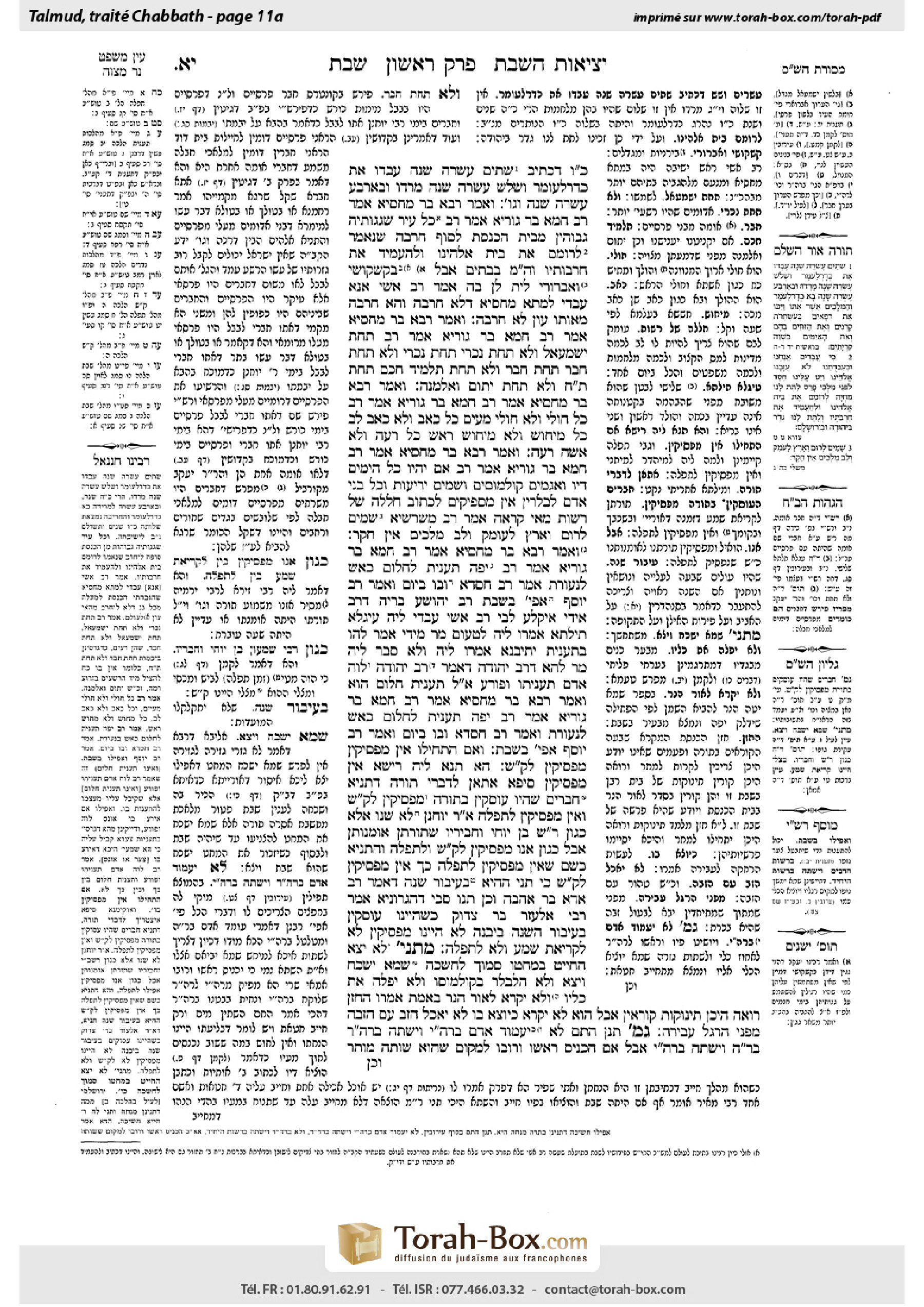
Shabbat 11a: Talmud study for Daf Yomi
Daf Yomi is the daily study of one Talmud folio. Explore 37 tractates with scans, Hebrew text, Sefaria English and AI-generated French translations where annotated.
Passage selection and English or AI-generated French translation are available where the scan has annotations. Daf Study is independent of Torah-Box and Sefaria.
Browse Shabbat · שבת · All tractatesShabbat 11a text and translations
This page of Shabbat includes the Aramaic text, an English translation and an AI-generated French translation, alongside the scan above.
שבת י״א א · Aramaic and Hebrew text
עֶשְׂרִים וָשֵׁשׁ, דִּכְתִיב: ״שְׁתֵּים עֶשְׂרֵה שָׁנָה עָבְדוּ אֶת כְּדׇרְלָעוֹמֶר וּשְׁלֹשׁ עֶשְׂרֵה שָׁנָה מָרָדוּ. וּבְאַרְבַּע עֶשְׂרֵה שָׁנָה וְגוֹ׳״
וְאָמַר רָבָא בַּר מַחְסֵיָא אָמַר רַב חָמָא בַּר גּוּרְיָא אָמַר רַב: כׇּל עִיר שֶׁגַּגּוֹתֶיהָ גְּבוֹהִין מִבֵּית הַכְּנֶסֶת לְסוֹף חֲרֵבָה. שֶׁנֶּאֱמַר: ״לְרוֹמֵם אֶת בֵּית אֱלֹהֵינוּ וּלְהַעֲמִיד אֶת חׇרְבוֹתָיו״. וְהָנֵי מִילֵּי בְּבָתִּים, אֲבָל בְּקִשְׁקוּשֵׁי וַאֲבַרְוָרֵי לֵית לַן בַּהּ. אָמַר רַב אָשֵׁי: אֲנָא עֲבַדִי לְמָתָא מַחְסֵיָא דְּלָא חֲרַבָה. וְהָא חֲרַבָה! מֵאוֹתוֹ עָוֹן לֹא חָרְבָה.
וְאָמַר רָבָא בַּר מַחְסֵיָא אָמַר רַב חָמָא בַּר גּוּרְיָא אָמַר רַב: תַּחַת יִשְׁמָעֵאל וְלֹא תַּחַת נׇכְרִי. תַּחַת נׇכְרִי וְלֹא תַּחַת חַבָּר. תַּחַת חַבָּר וְלֹא תַּחַת תַּלְמִיד חָכָם. תַּחַת תַּלְמִיד חָכָם וְלֹא תַּחַת יָתוֹם וְאַלְמָנָה.
וְאָמַר רָבָא בַּר מַחְסֵיָא אָמַר רַב חָמָא בַּר גּוּרְיָא אָמַר רַב: כׇּל חוֹלִי, וְלֹא חוֹלִי מֵעַיִם. כׇּל כְּאֵב, וְלֹא כְּאֵב לֵב. כׇּל מֵיחוֹשׁ, וְלֹא מֵיחוֹשׁ רֹאשׁ. כׇּל רָעָה, וְלֹא אִשָּׁה רָעָה.
וְאָמַר רָבָא בַּר מַחְסֵיָא אָמַר רַב חָמָא בַּר גּוּרְיָא אָמַר רַב: אִם יִהְיוּ כׇּל הַיָּמִים דְּיוֹ, וַאֲגַמִּים קוּלְמוֹסִים, וְשָׁמַיִם יְרִיעוֹת, וְכׇל בְּנֵי אָדָם לַבְלָרִין — אֵין מַסְפִּיקִים לִכְתּוֹב חֲלָלָהּ שֶׁל רְשׁוּת. מַאי קְרָאָה אָמַר רַב מְשַׁרְשְׁיָא: ״שָׁמַיִם לָרוּם וָאָרֶץ לָעוֹמֶק וְלֵב מְלָכִים אֵין חֵקֶר״.
וְאָמַר רָבָא בַּר מַחְסֵיָא אָמַר רַב חָמָא בַּר גּוּרְיָא אָמַר רַב: יָפָה תַּעֲנִית לַחֲלוֹם כְּאֵשׁ לִנְעוֹרֶת. אָמַר רַב חִסְדָּא: וּבוֹ בַּיּוֹם. וְאָמַר רַב יוֹסֵף: אֲפִילּוּ בְּשַׁבָּת.
רַב יְהוֹשֻׁעַ בְּרֵיהּ דְּרַב אִידֵּי אִיקְּלַע לְבֵי רַב אָשֵׁי. עָבְדִי לֵיהּ עִיגְלָא תִּילְתָּא. אֲמַרוּ לֵיהּ: לִטְעוֹם מָר מִידֵּי. אֲמַר לְהוּ: בְּתַעֲנִית יָתֵיבְנָא. אֲמַרוּ לֵיהּ: וְלָא סָבַר לֵיהּ מָר לְהָא דְּרַב יְהוּדָה? דְּאָמַר רַב יְהוּדָה: לֹוֶה אָדָם תַּעֲנִיתוֹ וּפוֹרֵעַ! אֲמַר לְהוּ: תַּעֲנִית חֲלוֹם הוּא. וְאָמַר רָבָא בַּר מַחְסֵיָא אָמַר רַב חָמָא בַּר גּוּרְיָא אָמַר רַב: יָפָה תַּעֲנִית לַחֲלוֹם כְּאֵשׁ לִנְעוֹרֶת. וְאָמַר רַב חִסְדָּא: וּבוֹ בַּיּוֹם. וְאָמַר רַב יוֹסֵף: אֲפִילּוּ בְּשַׁבָּת.
וְאִם הִתְחִילוּ אֵין מַפְסִיקִין, מַפְסִיקִין לִקְרִיאַת שְׁמַע. הָא תְּנָא לֵיהּ רֵישָׁא אֵין מַפְסִיקִין? סֵיפָא אֲתָאן לְדִבְרֵי תוֹרָה. דְּתַנְיָא: חֲבֵרִים שֶׁהָיוּ עוֹסְקִין בַּתּוֹרָה — מַפְסִיקִין לִקְרִיאַת שְׁמַע, וְאֵין מַפְסִיקִין לִתְפִלָּה. אָמַר רַבִּי יוֹחָנָן: לֹא שָׁנוּ אֶלָּא כְּגוֹן רַבִּי שִׁמְעוֹן בֶּן יוֹחַי וַחֲבֵירָיו שֶׁתּוֹרָתָן אוּמָּנוּתָן. אֲבָל כְּגוֹן אָנוּ, מַפְסִיקִין לִקְרִיאַת שְׁמַע וְלִתְפִלָּה.
וְהָתַנְיָא: כְּשֵׁם שֶׁאֵין מַפְסִיקִין לִתְפִלָּה, כָּךְ אֵין מַפְסִיקִין לִקְרִיאַת שְׁמַע! כִּי תָּנֵי הַהִיא — בְּעִיבּוּר שָׁנָה. דְּאָמַר רַב אַדָּא בַּר אַהֲבָה, וְכֵן תָּנוּ סָבֵי דְהַגְרוֹנְיָא אָמַר רַבִּי אֶלְעָזָר בַּר צָדוֹק: כְּשֶׁהָיִינוּ עוֹסְקִין בְּעִיבּוּר הַשָּׁנָה בְּיַבְנֶה לֹא הָיִינוּ מַפְסִיקִין לֹא לִקְרִיאַת שְׁמַע וְלֹא לִתְפִלָּה.
מַתְנִי׳ לֹא יֵצֵא הַחַיָּיט בְּמַחֲטוֹ סָמוּךְ לַחֲשֵׁכָה, שֶׁמָּא יִשְׁכַּח וְיֵצֵא. וְלֹא הַלַּבְלָר בְּקוּלְמוֹסוֹ. וְלֹא יְפַלֶּה אֶת כֵּלָיו, וְלֹא יִקְרָא לְאוֹר הַנֵּר. בֶּאֱמֶת אָמְרוּ, הַחַזָּן רוֹאֶה הֵיכָן תִּינוֹקוֹת קוֹרְאִין, אֲבָל הוּא לֹא יִקְרָא. כַּיּוֹצֵא בוֹ: לֹא יֹאכַל הַזָּב עִם הַזָּבָה, מִפְּנֵי הֶרְגֵּל עֲבֵירָה.
גְּמָ׳ תְּנַן הָתָם: לֹא יַעֲמוֹד אָדָם בִּרְשׁוּת הַיָּחִיד וְיִשְׁתֶּה בִּרְשׁוּת הָרַבִּים, בִּרְשׁוּת הָרַבִּים וְיִשְׁתֶּה בִּרְשׁוּת הַיָּחִיד. אֲבָל אִם הִכְנִיס רֹאשׁוֹ וְרוּבּוֹ לִמְקוֹם שֶׁהוּא שׁוֹתֶה — מוּתָּר.
Shabbat 11a · English translation
during which they committed their sins was altogether twenty-six years, as it is written: “Twelve years they served Chedorlaomer and thirteen years they rebelled, and in the fourteenth year Chedorlaomer came” (Genesis 14:4–5). The twelve years plus the fourteen years during which they were enslaved were not years of tranquility, leaving only twenty-six tranquil years when they were sinful.
And Rava bar Meḥasseya said that Rav Ḥama bar Gurya said that Rav said: Any city whose roofs are higher than the synagogue will ultimately be destroyed because of the contempt shown the synagogue. Allusion to this is from that which is stated: “To uplift the house of our God and restore its ruins” (Ezra 9:9). The house that is devoted to God needs to be elevated above the other houses of the city. The Gemara adds: And this applies only to the height of the houses themselves. However, if the poles [kashkushei] and the towers [abrurei] that extend from the house are higher than the synagogue, we have no problem with it. Rav Ashi said: I caused the city of Mata Meḥasseya to not be destroyed by building the synagogue higher than the other houses. The Gemara asks: Wasn’t Mata Meḥasseya ultimately destroyed? The Gemara answers: It was not destroyed because of that sin; other sins caused its destruction.
And Rava bar Meḥasseya said that Rav Ḥama bar Gurya said that Rav said: It is preferable to be under the yoke of Ishmael and not under the yoke of a stranger, the Romans; under a stranger and not under a Ḥabar, a Persian Zoroastrian fire priest; under a Ḥabar and not under a Torah scholar, as if one offends a Torah scholar who is greater than he, the scholar will be exacting with him and he will be punished at the hand of Heaven; under a Torah scholar and not under an orphan or a widow, as they are easily insulted and God promised to hear their cries and punish those who offend them.
And Rava bar Meḥasseya said that Rav Ḥama bar Gurya said that Rav said: It is preferable to suffer from any extended illness and not from an intestinal illness. Similarly, it is preferable to suffer any pain, even if it is sharp and excruciating, and not heart pain; any slight ache and not a headache; any evil and not an evil wife.
And Rava bar Meḥasseya said that Rav Ḥama bar Gurya said that Rav said: Even if all the seas would be ink, and the reeds that grow near swamps would be quills, and the heavens would be parchment upon which the words would be written, and all the people would be scribes; all of these are insufficient to write the unquantifiable space of governmental authority, i.e., all the considerations with which a government must concern itself and deal. Rav Mesharshiya said: What is the verse that alludes to this? “The Heavens on High and the land to the depth and the heart of kings are unsearchable” (Proverbs 25:3).
And Rava bar Meḥasseya said that Rav Ḥama bar Gurya said that Rav said: A fast is effective to neutralize a bad dream like fire burns chaff. Rav Ḥisda said: And a fast is effective specifically on that day that he dreamed. And Rav Yosef said: One suffering from a bad dream that he dreamed is permitted to fast even on Shabbat.
The Gemara relates: Rav Yehoshua, son of Rav Idi, happened to come to the house of Rav Ashi. They prepared a third-born calf, whose meat is high quality, for him. They said to him: Let the Master taste something. He said to them: I am sitting in the midst of a fast. They said to him: And does the Master not hold in accordance with this halakha of Rav Yehuda, as Rav Yehuda said: A person can borrow his fast and not fast on the day that he originally designated, and repay it by fasting on another day? You can postpone your fast to another day. He said to them: It is a fast for a dream. And Rava bar Meḥasseya said that Rav Ḥama bar Gurya said that Rav said: A fast is effective to neutralize a bad dream like fire burns chaff. And Rav Ḥisda said that the fast is effective specifically on that day that he dreamed. And Rav Yosef said that a person suffering due to a bad dream is permitted to fast even on Shabbat.
We learned in the mishna that if they already began any one of the activities mentioned in the mishna they need not stop to recite the Amida prayer; however, they stop to recite Shema. The Gemara asks: Didn’t the first clause of the mishna already teach that they need not stop? Why does the mishna repeat it? The Gemara answers: In the latter clause of the mishna, we came to discuss matters of Torah. With regard to those engaged in Torah study, they need not stop for prayer, but they are required to stop to recite Shema. As it was taught in a baraita: Torah scholars, who were engaged in the study of Torah, stop their Torah study for Shema, and they do not stop for prayer. Rabbi Yoḥanan said a caveat to this statement: They only taught that they need not stop for prayer with regard to the likes of Rabbi Shimon ben Yoḥai and his colleagues, whose Torah is their vocation and they never interrupt their Torah study. However, for the likes of us, who also engage in other activities, we stop both for Shema and for prayer.
With regard to the essence of the statement the Gemara asks: Didn’t we learn in a different baraita: Just as they do not stop for prayer, they do not stop for Shema? The Gemara answers: When that baraita was taught, it was taught with regard to those engaged in the intercalation of the year. Since their activity is crucial and all the Festivals of the year are determined through that activity, the Sages allowed them to continue and not stop to recite Shema. As Rav Adda bar Ahava said, and the Elders of the city of Hagronya also taught that Rabbi Elazar, son of Rabbi Tzadok, said: When we were engaged in the intercalation of the year in Yavne, we would stop neither for Shema nor for prayer.
MISHNA: This mishna deals with various decrees, especially with regard to the halakhot of Shabbat, which were issued in order to distance a person from transgressions that he is liable to commit through habit and routine. The mishna said: The tailor may not go out with his needle adjacent to nightfall on Shabbat eve, lest he forget that he is carrying the needle and go out with it to the public domain even after Shabbat begins. And, similarly, the scribe [lavlar] may not go out with his quill[kulmos] for the same reason. And one may not shake his clothes on Shabbat to rid them of lice; and one may not read a book by candlelight, so that he will not come to adjust the wick of the lamp. However, in truth they said an established halakha: The attendant sees where in the book the children under his supervision are reading in the Torah, even by candlelight on Shabbat. However, he himself may not read. Similarly, the Sages issued a similar decree with regard to other halakhot, as they said: The zav may not eat even with his wife the zava, despite the fact that they are both ritually impure, because, by eating together, they will come to excessive intimacy and become accustomed to sin.
GEMARA: Among the halakhot concerning decrees that were issued lest one come to commit a transgression, we learned in a mishna there: A person may not stand in the private domain and drink water located in the public domain, or vice versa, stand in the public domain and drink water located in the private domain, lest he transfer the vessel from which he is drinking the water to the place where he is standing and become liable to bring a sin-offering. However, if he introduced his head and most of his body into the place where the water that he is drinking is located, there is no longer room for concern, and it is permitted,
Shabbat 11a · Traduction française (IA)
La période durant laquelle ils commirent leurs péchés fut de vingt-six ans au total, comme il est écrit : « Ils servirent Kedorlaomer pendant douze ans, puis se révoltèrent pendant treize ans, et, la quatorzième année, Kedorlaomer vint » (Genèse 14, 4-5). Les douze années de servitude et les quatorze années durant lesquelles ils furent asservis ne furent pas des années de tranquillité ; il ne reste donc que vingt-six années paisibles durant lesquelles ils péchèrent.
Et Rava bar Meḥasseya dit que Rav Ḥama bar Gurya dit que Rav dit : Toute ville dont les toits sont plus hauts que la synagogue finira par être détruite, en raison du mépris manifesté envers la synagogue. On en trouve une allusion dans ce qui est dit : « Relever la maison de notre Dieu et en restaurer les ruines » (Esdras 9, 9). La maison consacrée à Dieu doit être élevée au-dessus des autres maisons de la ville. La Guemara ajoute : Cela ne s’applique qu’à la hauteur des maisons elles-mêmes. En revanche, si les perches [kashkushei] et les tours [abrurei] qui dépassent de la maison sont plus hautes que la synagogue, cela ne pose pas de problème. Rav Ashi dit : J’ai empêché la ville de Mata Meḥasseya d’être détruite en construisant la synagogue plus haut que les autres maisons. La Guemara demande : Mata Meḥasseya n’a-t-elle pas finalement été détruite ? La Guemara répond : Elle ne fut pas détruite à cause de cette faute ; d’autres fautes causèrent sa destruction.
Et Rava bar Meḥasseya dit que Rav Ḥama bar Gurya dit que Rav dit : Il vaut mieux être sous le joug d’Ismaël que sous celui d’un étranger, les Romains ; sous celui d’un étranger plutôt que sous celui d’un Ḥabar, prêtre du feu zoroastrien perse ; sous celui d’un Ḥabar plutôt que sous celui d’un sage de la Torah, car si l’on offense un sage de la Torah qui nous est supérieur, il se montrera exigeant envers nous et nous serons punis par le Ciel ; sous celui d’un sage de la Torah plutôt que sous celui d’un orphelin ou d’une veuve, car ils sont facilement offensés, et Dieu a promis d’entendre leurs cris et de punir ceux qui les offensent.
Et Rava bar Meḥasseya dit que Rav Ḥama bar Gurya dit que Rav dit : Il vaut mieux souffrir de n’importe quelle maladie prolongée que d’une maladie intestinale. De même, il vaut mieux souffrir de n’importe quelle douleur, même aiguë et atroce, que d’une douleur au cœur ; de n’importe quelle douleur légère plutôt que d’un mal de tête ; de n’importe quel mal plutôt que d’une mauvaise épouse.
Et Rava bar Meḥasseya dit que Rav Ḥama bar Gurya dit que Rav dit : Même si toutes les mers étaient de l’encre, les roseaux qui poussent près des marécages des plumes, le ciel un parchemin sur lequel les mots seraient écrits, et tous les hommes des scribes, tout cela ne suffirait pas à consigner l’étendue incommensurable des affaires du pouvoir politique, c’est-à-dire toutes les considérations dont un gouvernement doit se préoccuper et qu’il doit traiter. Rav Mesharshiya dit : Quel verset y fait allusion ? « Le ciel en haut, la terre dans ses profondeurs et le cœur des rois sont insondables » (Proverbes 25, 3).
Et Rava bar Meḥasseya dit que Rav Ḥama bar Gurya dit que Rav dit : Un jeûne permet de neutraliser un mauvais rêve, comme le feu consume le chaume. Rav Ḥisda dit : Un jeûne est efficace précisément le jour où l’on a rêvé. Et Rav Yosef dit : Celui qui souffre à cause d’un mauvais rêve qu’il a fait est autorisé à jeûner même le Chabbat.
La Guemara rapporte : Rav Yehoshua, fils de Rav Idi, se rendit par hasard chez Rav Ashi. On lui prépara un veau de troisième portée, dont la viande est de grande qualité. Ils lui dirent : « Que le maître goûte quelque chose. » Il leur répondit : « Je suis en plein jeûne. » Ils lui dirent : « Le maître ne suit-il pas cette halakha de Rav Yehuda ? Car Rav Yehuda a dit : On peut emprunter son jeûne, ne pas jeûner le jour qu’on avait initialement fixé, puis s’acquitter de ce jeûne en jeûnant un autre jour. Tu peux reporter ton jeûne à un autre jour. » Il leur répondit : « C’est un jeûne motivé par un rêve. » En effet, Rava bar Meḥasseya dit que Rav Ḥama bar Gurya dit que Rav dit : « Un jeûne est efficace pour neutraliser un mauvais rêve, comme le feu consume le chaume. » Et Rav Ḥisda dit que le jeûne est efficace précisément le jour où l’on a rêvé. Rav Yosef dit qu’une personne qui souffre à cause d’un mauvais rêve est autorisée à jeûner même le Chabbat.
Nous avons appris dans la Michna que, s’ils ont déjà commencé l’une des activités qui y sont mentionnées, ils n’ont pas besoin de s’interrompre pour réciter la prière de la Amida ; toutefois, ils s’interrompent pour réciter le Chéma. La Guemara demande : La première partie de la Michna n’enseignait-elle pas déjà qu’ils n’ont pas besoin de s’interrompre ? Pourquoi la Michna le répète-t-elle ? La Guemara répond : Dans la dernière partie de la Michna, il s’agit des affaires de Torah. Ceux qui étudient la Torah n’ont pas besoin de s’interrompre pour prier, mais ils doivent s’interrompre pour réciter le Chéma. En effet, il a été enseigné dans une baraïta : Les sages de la Torah qui étudient la Torah s’interrompent pour le Chéma, mais ne s’interrompent pas pour la prière. Rabbi Yoḥanan apporta une précision à cette déclaration : Ils n’ont enseigné qu’ils n’ont pas besoin de s’interrompre pour prier que pour des hommes comme Rabbi Shimon ben Yoḥai et ses collègues, dont l’étude de la Torah est le métier et qui ne l’interrompent jamais. En revanche, pour des hommes comme nous, qui nous consacrons aussi à d’autres activités, nous nous interrompons à la fois pour le Chéma et pour la prière.
À propos du fond de cette déclaration, la Guemara demande : N’avons-nous pas appris dans une autre baraïta : « De même qu’ils ne s’interrompent pas pour la prière, ils ne s’interrompent pas non plus pour le Chéma » ? La Guemara répond : Cette baraïta a été enseignée au sujet de ceux qui s’occupaient de l’intercalation de l’année. Comme leur activité est cruciale et que toutes les fêtes de l’année sont déterminées par elle, les Sages leur permirent de poursuivre sans s’interrompre pour réciter le Chéma. En effet, Rav Adda bar Ahava a dit, et les anciens de la ville de Hagronya ont également enseigné que Rabbi Elazar, fils de Rabbi Tzadok, a dit : « Lorsque nous nous occupions de l’intercalation de l’année à Yavné, nous ne nous interrompions ni pour le Chéma ni pour la prière. »
MICHNA : Cette Michna traite de divers décrets, notamment concernant les halakhot du Chabbat, qui furent édictés afin d’éloigner une personne des transgressions qu’elle risque de commettre par habitude et par routine. La Michna enseigne : Le tailleur ne doit pas sortir avec son aiguille à l’approche de la nuit, la veille du Chabbat, de peur d’oublier qu’il la porte et de sortir avec elle dans le domaine public après le début du Chabbat. De même, le scribe [lavlar] ne doit pas sortir avec son roseau à écrire [kulmos], pour la même raison. On ne doit pas non plus secouer ses vêtements le Chabbat pour en enlever les poux, ni lire un livre à la lumière d’une bougie, de peur d’en venir à régler la mèche de la lampe. Toutefois, ils ont en vérité énoncé une halakha établie : le surveillant peut regarder où en sont les enfants dont il a la charge dans leur lecture de la Torah, même à la lumière d’une bougie le Chabbat. Mais lui-même ne peut pas lire. De même, les Sages ont édicté un décret semblable concernant d’autres halakhot, en déclarant : Le zav ne doit pas manger avec son épouse, la zava, bien qu’ils soient tous deux rituellement impurs, car en mangeant ensemble, ils pourraient se rapprocher excessivement et prendre l’habitude de pécher.
GUEMARA : Parmi les halakhot relatives aux décrets édictés de peur que l’on en vienne à commettre une transgression, nous avons appris dans une Michna, là-bas : Une personne ne doit pas se tenir dans le domaine privé et boire de l’eau qui se trouve dans le domaine public, ni, inversement, se tenir dans le domaine public et boire de l’eau qui se trouve dans le domaine privé, de peur qu’elle ne transporte le récipient dont elle boit l’eau jusqu’à l’endroit où elle se tient et ne soit tenue d’apporter un sacrifice expiatoire. Toutefois, si elle a introduit sa tête et la majeure partie de son corps dans l’endroit où se trouve l’eau qu’elle boit, il n’y a plus lieu de s’inquiéter et cela est permis,
Traduction française générée par IA à partir de l’édition anglaise de Sefaria. Vérifie toujours un passage avec le texte source.
Text from Sefaria: William Davidson Edition - Vocalized Aramaic (CC BY NC); William Davidson Edition - English (CC BY NC).