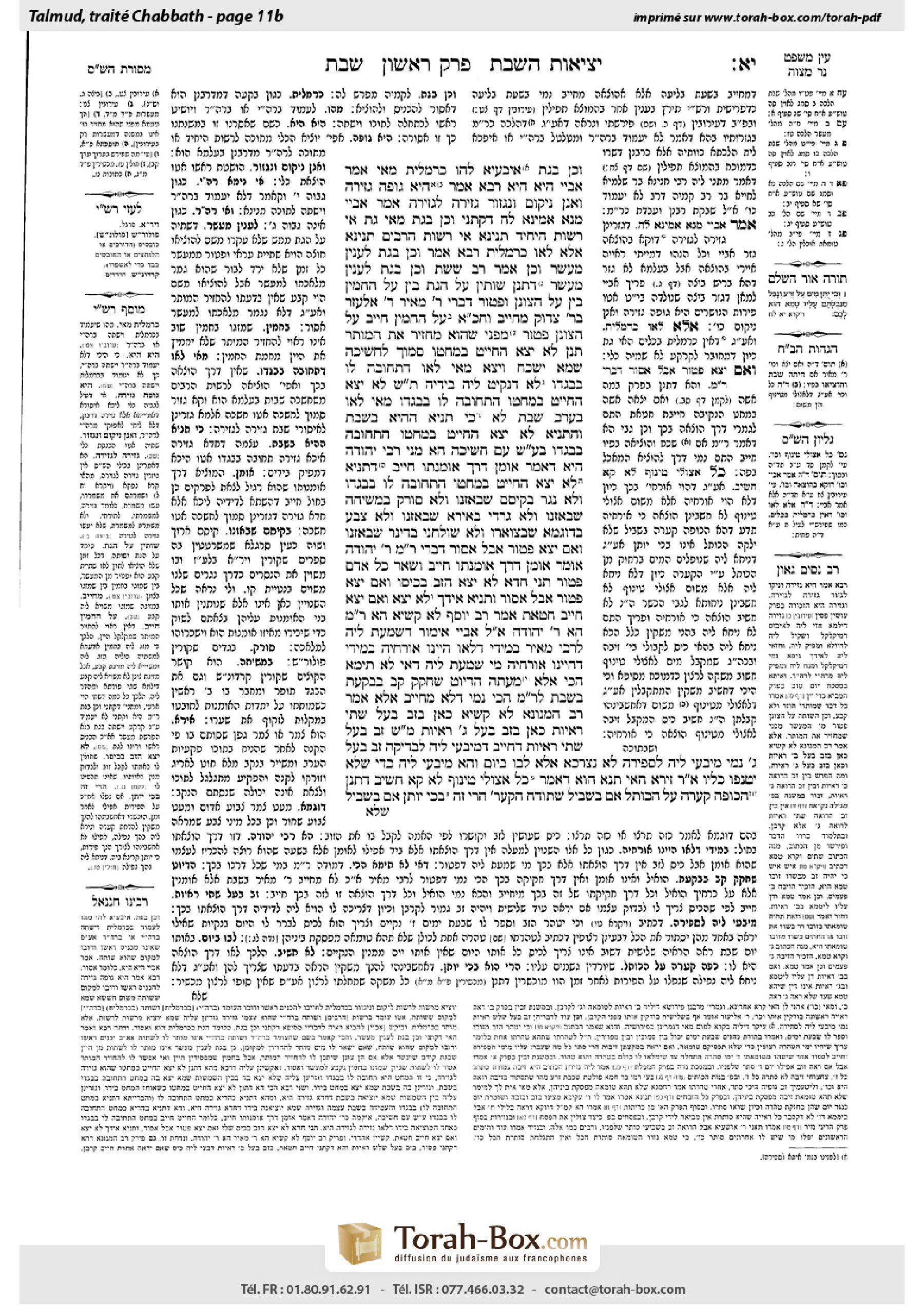
Shabbat 11b: Talmud study for Daf Yomi
Daf Yomi is the daily study of one Talmud folio. Explore 37 tractates with scans, Hebrew text, Sefaria English and AI-generated French translations where annotated.
Passage selection and English or AI-generated French translation are available where the scan has annotations. Daf Study is independent of Torah-Box and Sefaria.
Browse Shabbat · שבת · All tractatesShabbat 11b text and translations
This page of Shabbat includes the Aramaic text, an English translation and an AI-generated French translation, alongside the scan above.
שבת י״א ב · Aramaic and Hebrew text
וְכֵן בַּגַּת.
אִיבַּעְיָא לְהוּ: כַּרְמְלִית מַאי? אָמַר אַבָּיֵי: הִיא הִיא. רָבָא אָמַר: הִיא גוּפָהּ גְּזֵירָה, וַאֲנַן נֵיקוּם וְנִגְזוֹר גְּזֵירָה לִגְזֵירָה?
אָמַר אַבָּיֵי: מְנָא אָמֵינָא לַהּ — דְּקָתָנֵי: ״וְכֵן בַּגַּת״. מַאי גַּת? אִי רְשׁוּת הַיָּחִיד — תְּנֵינָא! אִי רְשׁוּת הָרַבִּים — תְּנֵינָא. אֶלָּא לָאו כַּרְמְלִית.
רָבָא אָמַר: ״וְכֵן בַּגַּת״, לְעִנְיַן מַעֲשֵׂר. וְכֵן אָמַר רַב שֵׁשֶׁת: ״וְכֵן בַּגַּת״ — לְעִנְיַן מַעֲשֵׂר. דִּתְנַן: שׁוֹתִין עַל הַגַּת, בֵּין עַל הַחַמִּין, בֵּין עַל הַצּוֹנֵן, וּפָטוּר. דִּבְרֵי רַבִּי מֵאִיר. רַבִּי אֶלְעָזָר בְּרַבִּי צָדוֹק מְחַיֵּיב. וַחֲכָמִים אוֹמְרִים: עַל הַחַמִּין, חַיָּיב. עַל הַצּוֹנֵן — פָּטוּר, מִפְּנֵי שֶׁהוּא מַחֲזִיר אֶת הַמּוֹתָר.
תְּנַן: לֹא יֵצֵא הַחַיָּיט בְּמַחֲטוֹ סָמוּךְ לַחֲשֵׁיכָה שֶׁמָּא יִשְׁכַּח וְיֵצֵא. מַאי לָאו דִּתְחוּבָה לוֹ בְּבִגְדוֹ? לָא, דְּנָקֵיט לֵיהּ בִּידֵיהּ.
תָּא שְׁמַע: לֹא יֵצֵא הַחַיָּיט בְּמַחֲטוֹ הַתְּחוּבָה לוֹ בְּבִגְדוֹ. מַאי לָאו בְּעֶרֶב שַׁבָּת? לָא, כִּי תַּנְיָא הַהִיא בְּשַׁבָּת. וְהָתַנְיָא: לֹא יֵצֵא הַחַיָּיט בְּמַחֲטוֹ הַתְּחוּבָה בְּבִגְדוֹ בְּעֶרֶב שַׁבָּת עִם חֲשֵׁיכָה. הָא מַנִּי? — רַבִּי יְהוּדָה הִיא, דְּאָמַר אוּמָּן דֶּרֶךְ אוּמָּנֻתוֹ, חַיָּיב.
דְּתַנְיָא: לֹא יֵצֵא הַחַיָּיט בְּמַחֲטוֹ הַתְּחוּבָה לוֹ בְּבִגְדוֹ, וְלֹא נַגָּר בְּקֵיסָם שֶׁבְּאׇזְנוֹ, וְלֹא סוֹרֵק בִּמְשִׁיחָה שֶׁבְּאׇזְנוֹ וְלֹא גַּרְדִּי בְּאִירָא שֶׁבְּאׇזְנוֹ, וְלֹא צַבָּע בְּדוּגְמָא שֶׁבְּצַוָּארוֹ, וְלֹא שׁוּלְחָנִי בְּדִינָר שֶׁבְּאׇזְנוֹ. וְאִם יָצָא — פָּטוּר אֲבָל אָסוּר, דִּבְרֵי רַבִּי מֵאִיר. רַבִּי יְהוּדָה אוֹמֵר: אוּמָּן דֶּרֶךְ אוּמָּנֻתוֹ — חַיָּיב, וּשְׁאָר כׇּל אָדָם — פָּטוּר.
תָּנֵי חֲדָא: לֹא יֵצֵא הַזָּב בְּכִיסוֹ, וְאִם יָצָא — פָּטוּר אֲבָל אָסוּר. וְתַנְיָא אִידַּךְ: לֹא יֵצֵא, וְאִם יָצָא — חַיָּיב חַטָּאת.
אָמַר רַב יוֹסֵף, לָא קַשְׁיָא: הָא רַבִּי מֵאִיר, הָא רַבִּי יְהוּדָה.
אֲמַר לֵיהּ אַבָּיֵי: אֵימוֹר דְּשָׁמְעַתְּ לֵיהּ לְרַבִּי מֵאִיר בְּמִידֵּי דְּלָאו הַיְינוּ אוֹרְחֵיהּ, בְּמִידֵּי דְּהַיְינוּ אוֹרְחֵיהּ מִי שָׁמְעַתְּ לֵיהּ? דְּאִי לָא תֵּימָא הָכִי, אֶלָּא מֵעַתָּה הֶדְיוֹט שֶׁחָקַק קַב בִּבְקַעַת בְּשַׁבָּת לְרַבִּי מֵאִיר הָכִי נָמֵי דְּלָא מְחַיַּיב?
אֶלָּא אָמַר רַב הַמְנוּנָא, לָא קַשְׁיָא: כָּאן בְּזָב בַּעַל שְׁתֵּי רְאִיּוֹת, כָּאן בְּזָב בַּעַל שָׁלֹשׁ רְאִיּוֹת.
מַאי שְׁנָא זָב בַּעַל שְׁתֵּי רְאִיּוֹת דְּחַיָּיב, דְּמִיבְּעֵי לֵיהּ לִבְדִיקָה, זָב בַּעַל שָׁלֹשׁ נָמֵי מִיבְּעֵי לֵיהּ לִסְפִירָה? לֹא נִצְרְכָא אֶלָּא לְבוֹ בַּיּוֹם.
וְהָא מִיבְּעֵי לֵיהּ כְּדֵי שֶׁלֹּא יִטַּנְּפוּ כֵּלָיו! אָמַר רַבִּי זֵירָא: הַאי תַּנָּא הוּא דְּאָמַר כׇּל אַצּוֹלֵי טִינּוּף לָא קָא חָשֵׁיב. דִּתְנַן: הַכּוֹפֶה קְעָרָה עַל הַכּוֹתֶל, אִם בִּשְׁבִיל שֶׁתּוּדַח הַקְּעָרָה, הֲרֵי זֶה בְּ״כִי יוּתַּן״. אִם בִּשְׁבִיל
Shabbat 11b · English translation
and the same is true in the wine press.
In light of the halakha that was taught in this mishna a dilemma was raised before the Sages: What is the legal status of a karmelit in this matter? Is it permissible to stand in one domain and drink from a karmelit or not? Abaye said: That case is equal to that case, i.e., the same way that the Sages prohibited drinking from the private domain to the public domain and vice versa, so too, they prohibited drinking from the karmelit to another domain. Rava said: It is not prohibited. It, the prohibition to carry between a karmelit and another domain, itself is merely a rabbinic decree. And will we arise and issue one decree to prevent violation of another decree? Although the Sages prohibited doing so in one of the domains by Torah law, i.e., the public and the private domains, a similar decree was not issued in a karmelit, which is a domain by rabbinic law.
Abaye said: From where do I say that halakha, i.e., that the decree applies to a karmelit? From that which we learned at the end of the mishna in tractate Eiruvin: And the same is true in the wine press. The question arises: What is the status of the wine press in terms of the domains of Shabbat? If you say that it is the private domain, we already learned that in the mishna. If it is the public domain, we already learned that as well. Rather, isn’t this press a karmelit? Apparently, a karmelit was also prohibited in the mishna.
Rava said: That which we learned in the mishna: And the same is true in the wine press, is not relevant to the halakhot of Shabbat. It refers to the matter of the halakhot of tithes. And Rav Sheshet also said: That which we learned in the mishna: And the same is true in the wine press, refers to the matter of tithes, as we learned in a mishna: One may ab initio drink grape juice directly on the press without tithing, whether the juice was diluted with hot water, even though he will then be unable to return the leftover wine to the press, as it would ruin all the wine in the press, or whether the juice was diluted with cold water, in which case he could return the leftover wine without ruining the rest, and he is exempt. Drinking that way is considered incidental drinking, and anything that is not a fixed meal is exempt from tithing. That is the statement of Rabbi Meir. Rabbi Elazar, son of Rabbi Tzadok, obligates one to separate the tithe in both cases. And the Rabbis say: There is a distinction between these two cases; when the wine was diluted with hot water, since he cannot return what is left of the wine to the press, he is obligated to tithe, as it is like fixed drinking for which one is obligated to tithe. However, when the wine was diluted with cold water, he is exempt, because he returns the leftover wine to the press, and it is incidental drinking, which is exempt from tithing. Our mishna, which says: And the same is true in the press, means that only if his head and most of his body was in the press is he permitted to drink without separating the tithe, and that halakha is not at all related to matters of Shabbat (Rabbeinu Ḥananel).
As proof for Abaye’s opinion, the Gemara states that which we learned in our mishna: The tailor may not go out with his needle adjacent to nightfall on Shabbat eve, lest he forget that he is carrying the needle and go out with it to the public domain even after Shabbat begins. Is it not speaking here in a case where the needle was stuck in his clothing? In that case, even if he was to go out into the public domain with the needle, he would not be liable by Torah law, since that is not the typical manner of carrying out; carrying out an object in that manner is prohibited only by rabbinic decree [shevut]. Nevertheless, not only did the Rabbis issue a decree to prohibit going out with the needle on Shabbat, they issued a decree to prevent violation of another decree and prohibited the tailor from going out with his needle adjacent to nightfall. Apparently, the Sages institute a decree to prevent violation of another decree with regard to the halakhot of carrying out on Shabbat (Tosafot). Consequently, with regard to the halakhot of karmelit, the Sages issued a decree as well, and this is proof for Abaye’s opinion. The Gemara rejects this: No, the mishna is referring to a case where he is holding the needle in his hand, which constitutes performance of the full-fledged prohibited labor of carrying out.
Come and hear another proof from that which was taught explicitly in the baraita: The tailor may not go out with his needle stuck in his clothing. Is it not speaking of a case where he goes out on Shabbat eve, and the Sages issued a decree to prevent violation of another decree, just as Abaye said? The Gemara rejects this: No, when that was taught in the baraita, it was only with regard to carrying out on Shabbat itself. The Gemara asks further: Wasn’t it taught explicitly in a baraita: The tailor may not go out with his needle stuck in his clothing on Shabbat eve at nightfall, and the Sages issued a decree to prevent violation of another decree, just as Abaye said? The Gemara rejects this: Whose opinion is cited in this baraita? It is the opinion of Rabbi Yehuda, who said: A craftsman who carries out an object in the manner common to his craft, even if others do not generally carry it out in that manner, the craftsman is liable, because he carried the object out in a manner standard for him.
As it was taught in a baraita: The tailor may not go out with his needle that is stuck in his clothing, and a carpenter may not go out with the wood chip that is behind his ear for use as a measuring stick, and a comber of wool may not go out with a cord with which he ties bundles of wool and which is usually placed that is on his ear, and a weaver [gardi] may not go out with a bit of wool [ira] that is on his ear which he uses for the purpose of his work, and the painter may not go out with the sample of dyed wool that is on his neck, and a money changer may not go out with the dinar that is in his ear. In all of these cases the halakha is that if he went out, he is exempt by Torah law, but it is prohibited for him to do so by rabbinic decree. This is the statement of Rabbi Meir. Rabbi Yehuda says: A craftsman who carries out an object in the manner common to his craft on Shabbat is liable by Torah law; any other person who carries it out in that manner is exempt, but it is prohibited for him to do so.
Since the dispute between Rabbi Meir and Rabbi Yehuda with regard to the legal status of one who carries out an object in an atypical manner was mentioned, the Gemara discusses a contradiction between two related baraitot. It was taught in one baraita: The zav may not go out on Shabbat with his pouch that he ties to his organ in order to absorb his emission. And if he went out, he is exempt by Torah law but it is prohibited for him to do so by rabbinic law. And it was taught in another baraita: The zav may not go out on Shabbat with his pouch. And if he went out unwittingly, he is liable to bring a sin-offering.
Rav Yosef said: This is not difficult. There is no contradiction between the baraitot, as this baraita, which deems him exempt, is in accordance with the opinion of Rabbi Meir; that, the other baraita, which deems him liable, is in accordance with the opinion of Rabbi Yehuda.
Abaye said to Rav Yosef: Say that you heard that Rabbi Meir deems him exempt with regard to an object that is not carried out in its typical manner. However, with regard to a matter that is carried out in its typical manner, did you hear that he deems him exempt? In general, one carries out a needle in his hand. Rabbi Meir exempts one who carries it out in his clothing, even if he is a craftsman. However, this pouch of a zav, even though it is not held in his hand, is always carried out in that manner, and, even according to Rabbi Meir, that constitutes a bona fide act of carrying out. As, if you do not say so, that the specifics of various prohibited labors can be performed in different manners, in the case of a layman [hedyot], who carved out a vessel the size of a kav in a piece of wood on Shabbat, would you say that Rabbi Meir also does not deem him liable for performing a prohibited labor on Shabbat because he is not a craftsman and he did not craft the vessel according to the standards of a craftsman? Certainly, the layman performed a full-fledged labor to the best of his ability and he is liable.
Rather, Rav Hamnuna said: This is not difficult, as the two baraitot are referring to two different cases. Here, in the baraita that deemed him liable by Torah law, it is referring to a zav who experienced two sightings of an emission. Liability to bring an offering as part of the purification process is only after he sees three emissions. Therefore, the zav requires the pouch in order to ascertain whether or not he experienced a third emission. However, there, in the baraita that deems him exempt, it is referring to a zav who already experienced three sightings. For him there is no significance whether or not he experiences an additional emission. Therefore, the pouch is insignificant and he has no interest in carrying it out.
The Gemara asks: What is different about a zav who had two sightings, who is liable, as he requires the pouch for the purpose of examination to ascertain whether or not he experienced a third sighting, and a zav who already experienced three sightings and requires the pouch for the purpose of counting clean days? In order to become ritually pure, he must count seven clean days without experiencing an emission. If so, even a zav who had three sightings requires the pouch, in order to ascertain whether or not he experienced another emission. The Gemara answers: That baraita was only needed for that day when he already saw his third emission. In any case, that day will not be a clean day.
The Gemara asks: Doesn’t even that zav need the pouch so that his clothes will not get soiled by the emission? Although he does not need the pouch for a halakhic determination, he needs it for practical considerations. Rabbi Zeira said: This tanna is the one who said that any usage intended to prevent filth is not considered a special purpose that will render a certain object an actual vessel. As we learned in a mishna: One who places a bowl on the wall while it is raining, if he did that so that the bowl would be rinsed with the rainwater, that is under the rubric of the verse: “If water be placed.” The water has the legal status of a liquid that he poured of his own volition on fruit and seeds. It renders them liable to become ritually impure, as it is written: “If water be placed upon seed and any of their carcass fell on it, it is impure to you” (Leviticus 11:38). However, if he placed the bowl so
Shabbat 11b · Traduction française (IA)
et il en va de même dans le pressoir.
À la lumière de la halakha enseignée dans cette Michna, les Sages soulevèrent la question suivante : quel est le statut juridique d’un karmelit dans ce cas ? Est-il permis de se tenir dans un domaine et de boire depuis un karmelit, ou non ? Abayé dit : ce cas est identique à l’autre ; de même que les Sages ont interdit de boire depuis le domaine privé vers le domaine public, et inversement, ils ont également interdit de boire depuis un karmelit vers un autre domaine. Rava dit : cela n’est pas interdit. L’interdiction de transporter entre un karmelit et un autre domaine est elle-même un simple décret rabbinique. Allons-nous donc instituer un décret pour prévenir la transgression d’un autre décret ? Bien que les Sages aient interdit de faire cela dans un domaine défini par la Torah, c’est-à-dire le domaine public ou le domaine privé, ils n’ont pas institué de décret similaire pour un karmelit, qui est un domaine défini par la loi rabbinique.
Abayé dit : d’où est-ce que je déduis cette halakha, à savoir que le décret s’applique à un karmelit ? De ce que nous avons appris à la fin de la Michna du traité Erouvin : « Et il en va de même dans le pressoir. » La question se pose : quel est le statut du pressoir au regard des domaines du Chabbat ? Si tu dis qu’il s’agit du domaine privé, nous l’avons déjà appris dans la Michna. S’il s’agit du domaine public, nous l’avons également appris. N’est-ce donc pas plutôt un karmelit ? Apparemment, l’interdiction de la Michna s’appliquait aussi à un karmelit.
Rava dit : ce que nous avons appris dans la Michna, « et il en va de même dans le pressoir », n’a aucun rapport avec les halakhot du Chabbat. Cela concerne les lois des dîmes. Rav Chéchet dit également : ce que nous avons appris dans la Michna, « et il en va de même dans le pressoir », concerne les lois des dîmes, comme nous l’avons appris dans une Michna : on peut, a priori, boire du jus de raisin directement au pressoir sans prélever les dîmes, que le jus ait été dilué avec de l’eau chaude — même si l’on ne peut alors pas remettre le vin restant dans le pressoir, car cela gâcherait tout le vin qui s’y trouve — ou avec de l’eau froide, auquel cas on peut remettre le vin restant sans gâter le reste ; dans les deux cas, on en est exempt. Boire de cette manière est considéré comme une consommation occasionnelle, et toute consommation qui ne constitue pas un repas fixe est exemptée de la dîme. Telle est l’opinion de Rabbi Méïr. Rabbi Elazar, fils de Rabbi Tsadok, oblige à prélever la dîme dans les deux cas. Les Sages disent : il faut distinguer ces deux cas. Lorsque le vin a été dilué avec de l’eau chaude, puisqu’on ne peut pas remettre le reste du vin dans le pressoir, on est tenu de prélever la dîme, car il s’agit d’une consommation fixe, soumise à la dîme. En revanche, lorsque le vin a été dilué avec de l’eau froide, on en est exempt, car on remet le vin restant dans le pressoir ; il s’agit donc d’une consommation occasionnelle, exemptée de la dîme. Notre Michna, qui dit : « et il en va de même dans le pressoir », signifie que ce n’est que si sa tête et la majeure partie de son corps se trouvent dans le pressoir qu’il lui est permis de boire sans prélever la dîme ; cette halakha n’a aucun rapport avec les questions du Chabbat (Rabbenou ‘Hananel).
À l’appui de l’opinion d’Abayé, la Guemara cite ce que nous avons appris dans notre Michna : le tailleur ne doit pas sortir avec son aiguille à l’approche de la nuit, à la veille du Chabbat, de peur qu’il oublie qu’il la porte et sorte avec elle dans le domaine public après le début du Chabbat. Ne s’agit-il pas d’un cas où l’aiguille est plantée dans son vêtement ? Dans ce cas, même s’il sortait avec l’aiguille dans le domaine public, il ne serait pas passible selon la Torah, car ce n’est pas la manière habituelle de transporter un objet ; transporter un objet de cette façon n’est interdit que par décret rabbinique [shevut]. Pourtant, les Sages n’ont pas seulement décrété qu’il était interdit de sortir avec l’aiguille pendant le Chabbat : ils ont institué un décret pour prévenir la transgression d’un autre décret et ont interdit au tailleur de sortir avec son aiguille à l’approche de la nuit. Apparemment, les Sages instituent un décret pour prévenir la transgression d’un autre décret concernant les lois du transport pendant le Chabbat (Tossefot). Par conséquent, concernant les lois du karmelit, les Sages ont également institué un décret, ce qui prouve que l’opinion d’Abayé est juste. La Guemara rejette cet argument : non, la Michna parle d’un cas où il tient l’aiguille à la main, ce qui constitue l’accomplissement à part entière du travail interdit de transporter.
Écoute une autre preuve, tirée de ce qui a été explicitement enseigné dans une baraïta : le tailleur ne doit pas sortir avec son aiguille plantée dans son vêtement. Ne s’agit-il pas d’un cas où il sort à la veille du Chabbat, et où les Sages ont institué un décret pour prévenir la transgression d’un autre décret, comme l’a dit Abayé ? La Guemara rejette cet argument : non, l’enseignement de la baraïta concerne uniquement le transport pendant le Chabbat lui-même. La Guemara demande encore : N’a-t-il pas été explicitement enseigné dans une baraïta que le tailleur ne doit pas sortir avec son aiguille plantée dans son vêtement à la veille du Chabbat, à la tombée de la nuit, et que les Sages ont institué un décret pour prévenir la transgression d’un autre décret, comme l’a dit Abayé ? La Guemara rejette cet argument : de qui cette baraïta rapporte-t-elle l’opinion ? De Rabbi Yehouda, qui a dit : un artisan qui transporte un objet de la manière habituelle dans son métier est passible, même si les autres ne le transportent généralement pas de cette façon, car il l’a transporté d’une manière habituelle pour lui.
Comme cela a été enseigné dans une baraïta : le tailleur ne doit pas sortir avec son aiguille plantée dans son vêtement ; le charpentier ne doit pas sortir avec le copeau de bois qu’il garde derrière son oreille pour s’en servir de mesure ; le cardeur de laine ne doit pas sortir avec le cordon servant à nouer les ballots de laine, qu’il porte habituellement sur son oreille ; le tisserand [gardi] ne doit pas sortir avec le petit morceau de laine [ira] qu’il porte sur son oreille et dont il se sert dans son travail ; le teinturier ne doit pas sortir avec l’échantillon de laine teinte qu’il porte autour du cou ; et le changeur ne doit pas sortir avec le dinar qu’il a dans l’oreille. Dans tous ces cas, s’il est sorti, il est exempt selon la Torah, mais cela lui est interdit par décret rabbinique. Telle est l’opinion de Rabbi Méïr. Rabbi Yehouda dit : un artisan qui transporte un objet le Chabbat de la manière habituelle dans son métier est passible selon la Torah ; toute autre personne qui le transporte de cette manière en est exemptée, mais cela lui est interdit.
Puisque le désaccord entre Rabbi Méïr et Rabbi Yehouda concernant le statut juridique de celui qui transporte un objet de manière inhabituelle a été mentionné, la Guemara examine une contradiction entre deux baraïtot liées. Une baraïta enseigne : le zav ne doit pas sortir le Chabbat avec la poche qu’il attache à son membre pour recueillir son écoulement. S’il est sorti, il est exempt selon la Torah, mais cela lui est interdit par la loi rabbinique. Une autre baraïta enseigne : le zav ne doit pas sortir le Chabbat avec sa poche. S’il est sorti par inadvertance, il est tenu d’apporter un sacrifice expiatoire.
Rav Yossef dit : il n’y a pas de difficulté. Les baraïtot ne se contredisent pas : cette baraïta, qui le déclare exempt, est conforme à l’opinion de Rabbi Méïr ; l’autre, qui le déclare passible, est conforme à l’opinion de Rabbi Yehouda.
Abayé dit à Rav Yossef : admettons que tu aies entendu Rabbi Méïr déclarer exempt celui qui transporte un objet d’une manière inhabituelle. Mais l’as-tu entendu le déclarer exempt lorsqu’il s’agit d’un objet transporté de la manière habituelle ? En général, on transporte une aiguille à la main. Rabbi Méïr déclare exempt celui qui la transporte dans son vêtement, même s’il est artisan. Cependant, cette poche du zav, bien qu’il ne la tienne pas à la main, est toujours transportée de cette manière ; même selon Rabbi Méïr, cela constitue bel et bien un acte de transport. Car, si tu ne dis pas cela — si tu prétends que les détails des différents travaux interdits peuvent être exécutés de diverses manières — alors, dans le cas d’un profane [hedyot] qui aurait creusé, le Chabbat, un récipient d’une contenance d’un kav dans un morceau de bois, dirais-tu que Rabbi Méïr ne le déclare pas non plus passible d’avoir accompli un travail interdit le Chabbat, au motif qu’il n’est pas artisan et n’a pas fabriqué le récipient selon les normes d’un artisan ? Certainement pas : le profane a accompli un véritable travail du mieux qu’il le pouvait, et il est passible.
Rav Hamnouna dit plutôt : il n’y a pas de difficulté, car les deux baraïtot parlent de deux cas différents. Ici, dans la baraïta qui le déclare passible selon la Torah, il s’agit d’un zav qui a eu deux écoulements. Il n’est tenu d’apporter une offrande dans le cadre de son processus de purification qu’après avoir eu trois écoulements. Le zav a donc besoin de la poche pour vérifier s’il a eu ou non un troisième écoulement. Là, en revanche, dans la baraïta qui le déclare exempt, il s’agit d’un zav qui a déjà eu trois écoulements. Pour lui, savoir s’il en a un de plus ou non n’a aucune importance. La poche est donc insignifiante et il ne tient pas à la transporter.
La Guemara demande : en quoi le zav qui a eu deux écoulements, et qui est passible parce qu’il a besoin de la poche pour vérifier s’il a eu ou non un troisième écoulement, diffère-t-il du zav qui a déjà eu trois écoulements et qui a besoin de la poche pour compter les jours de pureté ? Pour devenir rituellement pur, il doit compter sept jours de pureté sans avoir d’écoulement. Ainsi, même le zav qui a eu trois écoulements a besoin de la poche pour vérifier s’il a ou non un nouvel écoulement. La Guemara répond : cette baraïta ne concernait que le jour où il a déjà eu son troisième écoulement. Quoi qu’il en soit, ce jour ne sera pas un jour de pureté.
La Guemara demande : ce zav n’a-t-il pas lui aussi besoin de la poche pour que ses vêtements ne soient pas souillés par l’écoulement ? Même s’il n’en a pas besoin pour établir une halakha, il en a besoin pour des raisons pratiques. Rabbi Zeïra dit : ce tanna est celui qui a affirmé que tout usage destiné à éviter les salissures n’est pas considéré comme un usage particulier susceptible de conférer à un objet le statut de véritable récipient. Car nous avons appris dans une Michna : celui qui pose un bol sur un mur lorsqu’il pleut, s’il l’a fait afin que le bol soit rincé par l’eau de pluie, cela relève du verset : « Si de l’eau est mise. » L’eau a le statut d’un liquide qu’il a versé de son plein gré sur des fruits et des graines. Elle les rend susceptibles de devenir rituellement impurs, comme il est écrit : « Si de l’eau est mise sur une graine et qu’une partie de l’un de leurs cadavres tombe dessus, elle sera impure pour vous » (Lévitique 11, 38). Cependant, s’il a posé le bol de sorte que
Traduction française générée par IA à partir de l’édition anglaise de Sefaria. Vérifie toujours un passage avec le texte source.
Text from Sefaria: William Davidson Edition - Vocalized Aramaic (CC BY NC); William Davidson Edition - English (CC BY NC).