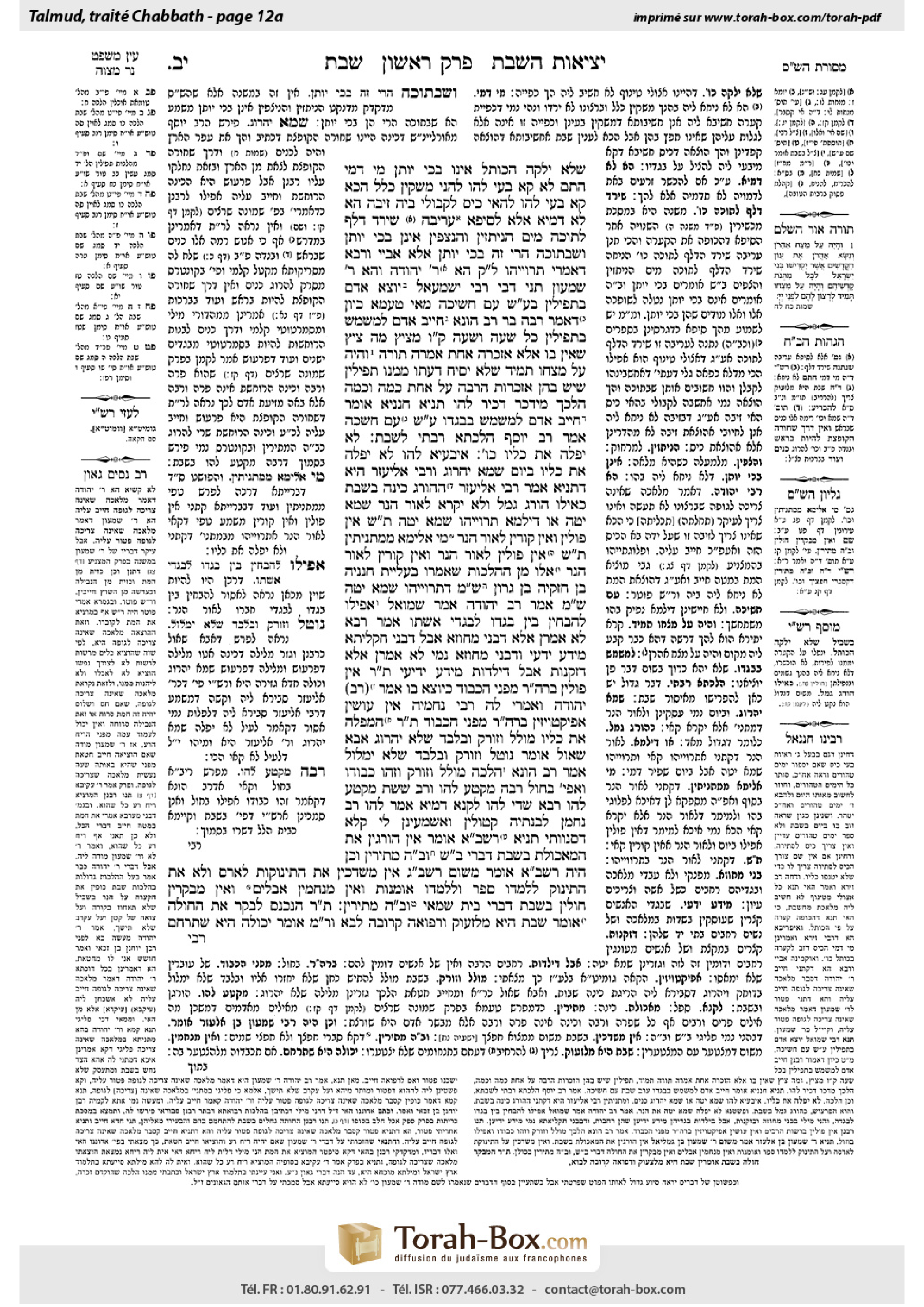
Shabbat 12a: Talmud study for Daf Yomi
Daf Yomi is the daily study of one Talmud folio. Explore 37 tractates with scans, Hebrew text, Sefaria English and AI-generated French translations where annotated.
Passage selection and English or AI-generated French translation are available where the scan has annotations. Daf Study is independent of Torah-Box and Sefaria.
Browse Shabbat · שבת · All tractatesShabbat 12a text and translations
This page of Shabbat includes the Aramaic text, an English translation and an AI-generated French translation, alongside the scan above.
שבת י״ב א · Aramaic and Hebrew text
שֶׁלֹּא יִלְקֶה הַכּוֹתֶל — אֵינוֹ בְּ״כִי יוּתַּן״! מִי דָּמֵי? הָתָם לָא קָא בָּעֵי לְהוּ לְהָנֵי מַשְׁקִין כְּלָל, הָכָא קָא בָעֵי לֵיהּ לְהַאי כִּיס לְקַבּוֹלֵי בֵּיהּ זִיבָה.
הָא לָא דָּמְיָא אֶלָּא לְסֵיפָא: עֲרֵיבָה שֶׁיָּרַד דֶּלֶף לְתוֹכָהּ, מַיִם הַנִּיתָּזִין וְהַנִּצָּפִין אֵינָן בְּ״כִי יוּתַּן״, וְשֶׁבְּתוֹכָהּ הֲרֵי זֶה בְּ״כִי יוּתַּן״.
אֶלָּא אַבָּיֵי וְרָבָא דְּאָמְרִי תַּרְוַיְיהוּ, לָא קַשְׁיָא: הָא רַבִּי יְהוּדָה, וְהָא רַבִּי שִׁמְעוֹן.
תָּנֵי דְּבֵי רַבִּי יִשְׁמָעֵאל: יוֹצֵא אָדָם בִּתְפִילִּין בְּעֶרֶב שַׁבָּת עִם חֲשֵׁיכָה. מַאי טַעְמָא? — כֵּיוָן דְּאָמַר רַבָּה בַּר רַב הוּנָא חַיָּיב אָדָם לְמַשְׁמֵשׁ בַּתְּפִילִּין כׇּל שָׁעָה וְשָׁעָה. קַל וָחֹמֶר מִצִּיץ: מָה צִיץ שֶׁאֵין בּוֹ אֶלָּא אַזְכָּרָה אַחַת אָמְרָה תּוֹרָה ״וְהָיָה עַל מִצְחוֹ תָּמִיד״ — שֶׁלֹּא יַסִּיחַ דַּעְתּוֹ מִמֶּנּוּ, תְּפִילִּין שֶׁיֵּשׁ בָּהֶן אַזְכָּרוֹת הַרְבֵּה — עַל אַחַת כַּמָּה וְכַמָּה. הִלְכָּךְ מִידְכָּר דָּכֵיר לְהוּ. תַּנְיָא, חֲנַנְיָא אוֹמֵר: חַיָּיב אָדָם לְמַשְׁמֵשׁ בְּבִגְדוֹ עֶרֶב שַׁבָּת עִם חֲשֵׁכָה. אָמַר רַב יוֹסֵף: הִלְכְתָא רַבָּתִי לְשַׁבָּת.
לֹא יְפַלֶּה אֶת כֵּלָיו כּוּ׳. אִיבַּעְיָא לְהוּ: לֹא יְפַלֶּה אֶת כֵּלָיו בַּיּוֹם שֶׁמָּא יַהֲרוֹג, וְרַבִּי אֱלִיעֶזֶר הִיא. דְּתַנְיָא, אָמַר רַבִּי אֱלִיעֶזֶר: הַהוֹרֵג כִּינָּה בְּשַׁבָּת — כְּאִילּוּ הוֹרֵג גָּמָל. וְלֹא יִקְרָא לְאוֹר הַנֵּר שֶׁמָּא יַטֶּה. אוֹ דִילְמָא תַּרְוַיְיהוּ שֶׁמָּא יַטֶּה?!
תָּא שְׁמַע: אֵין פּוֹלִין וְאֵין קוֹרִין לְאוֹר הַנֵּר. מִי אַלִּימָא מִמַּתְנִיתִין?!
תָּא שְׁמַע: אֵין פּוֹלִין לְאוֹר הַנֵּר וְאֵין קוֹרִין לְאוֹר הַנֵּר, אֵלּוּ מִן הַהֲלָכוֹת שֶׁאָמְרוּ בַּעֲלִיַּית חֲנַנְיָה בֶּן חִזְקִיָּה בֶּן גָּרוֹן. שְׁמַע מִינַּהּ דְּתַרְוַיְיהוּ שֶׁמָּא יַטֶּה, שְׁמַע מִינַּהּ.
אָמַר רַב יְהוּדָה אָמַר שְׁמוּאֵל: אֲפִילּוּ לְהַבְחִין בֵּין בִּגְדּוֹ לְבִגְדֵי אִשְׁתּוֹ. אָמַר רָבָא: לָא אֲמַרַן אֶלָּא דִּבְנֵי מָחוֹזָא, אֲבָל דִּבְנֵי חַקְלָיָתָא מִידָּע יָדְעִי. וְדִבְנֵי מָחוֹזָא נָמֵי לָא אֲמַרַן אֶלָּא דִּזְקֵנוֹת, אֲבָל דִּילָדוֹת מִידָּע יָדְעִי.
תָּנוּ רַבָּנַן: אֵין פּוֹלִין בִּרְשׁוּת הָרַבִּים מִפְּנֵי הַכָּבוֹד. כַּיּוֹצֵא בוֹ אָמַר רַב יְהוּדָה, וְאָמְרִי לַהּ רַבִּי נְחֶמְיָה: אֵין עוֹשִׂין אַפִּיקְטְוִיזִין בִּרְשׁוּת הָרַבִּים מִפְּנֵי הַכָּבוֹד. תָּנוּ רַבָּנַן: הַמְפַלֶּה אֶת כֵּלָיו, מוֹלֵל וְזוֹרֵק, וּבִלְבַד שֶׁלֹּא יַהֲרוֹג. אַבָּא שָׁאוּל אוֹמֵר: נוֹטֵל וְזוֹרֵק, וּבִלְבַד שֶׁלֹּא יִמְלוֹל. אָמַר רַב הוּנָא: הֲלָכָה מוֹלֵל וְזוֹרֵק וְזֶהוּ כְּבוֹדוֹ, וַאֲפִילּוּ בַּחוֹל. רַבָּה מְקַטַּע לְהוּ. וְרַב שֵׁשֶׁת מְקַטַּע לְהוּ. רָבָא שָׁדֵי לְהוּ לְלָקָנָא דְמַיָּא. אֲמַר לְהוּ רַב נַחְמָן לִבְנָתֵיהּ: קִטְלָן וְאַשְׁמְעִינַן לִי קָלָא דְסָנְווֹתִי.
תַּנְיָא, רַבִּי שִׁמְעוֹן בֶּן אֶלְעָזָר אוֹמֵר: אֵין הוֹרְגִין אֶת הַמַּאֲכוֹלֶת בְּשַׁבָּת, דִּבְרֵי בֵּית שַׁמַּאי. וּבֵית הִלֵּל מַתִּירִין.
וְכֵן הָיָה רַבִּי שִׁמְעוֹן בֶּן אֶלְעָזָר אוֹמֵר מִשּׁוּם רַבָּן שִׁמְעוֹן בֶּן גַּמְלִיאֵל: אֵין מְשַׁדְּכִין אֶת הַתִּינוֹקוֹת לֵאָרֵס, וְלֹא אֶת הַתִּינוֹק לְלַמְּדוֹ סֵפֶר וּלְלַמְּדוֹ אוּמָּנוּת, וְאֵין מְנַחֲמִין אֲבֵלִים, וְאֵין מְבַקְּרִין חוֹלִין בְּשַׁבָּת, דִּבְרֵי בֵּית שַׁמַּאי. וּבֵית הִלֵּל מַתִּירִין.
תָּנוּ רַבָּנַן, הַנִּכְנָס לְבַקֵּר אֶת הַחוֹלֶה אוֹמֵר: ״שַׁבָּת הִיא מִלִּזְעוֹק, וּרְפוּאָה קְרוֹבָה לָבֹא״. וְרַבִּי מֵאִיר אוֹמֵר: ״יְכוֹלָה הִיא שֶׁתְּרַחֵם״.
Shabbat 12a · English translation
that the wall will not be damaged, it is not under the rubric of the verse: “If water be placed.” The water does not have the legal status of water poured for that purpose. This tanna does not consider protecting the wall from dirt as a significant usage. Similarly, protecting the zav from being soiled by the emission would not be considered a significant usage and the pouch used for that purpose would not be considered a significant vessel. The Gemara rejects this: Are these cases comparable? There, he does not need those liquids at all, and therefore the vessel is not considered to have been placed to receive them. However, here he needs this pouch to absorb the emission, to ascertain whether or not he experienced an emission. Although on that particular day he does not require the pouch, the zav typically requires his pouch for the purpose of ascertaining whether or not there is another emission.
Rather, this halakha with regard to the zav is comparable only to the latter clause of the mishna dealing with rainwater, in which we learned: A bowl that the drip of rain from the roof dropped into it, the water that splashes or overflows from the bowl does not have the legal status of water collected for a purpose, and is not under the rubric of the verse: “If water be placed.” And the water that is in the bowl has the legal status of water collected for a purpose and is under the rubric of the verse: “If water be placed.” Although, fundamentally, one has no interest in the drip of water, once the water already dripped, he wants it to remain in the bowl and not dirty the house. That desire is sufficient to accord the water in the bowl the legal status of water placed there willfully. The same is true with regard to the pouch of the zav. In the current situation of the zav, he is interested in keeping the emission in its place, and therefore the original difficulty posed by the contradiction between the two baraitot remains intact.
Rather, it is Abaye and Rava, who both said that this is not difficult. There is no contradiction between the baraitot. This baraita, which deems a zav liable by Torah law for going out with his pouch, is in accordance with the opinion of Rabbi Yehuda. His opinion is that one who performs a prohibited labor that is not needed for its own sake, but rather for a different consequence of that prohibited labor, is liable. And that baraita, which deems him exempt, is in accordance with the opinion of Rabbi Shimon. He holds that one who performs a prohibited labor that is not needed for its own sake is exempt. Since the zav is not at all interested in the flow and the pouch, he is exempt by Torah law for carrying the pouch.
The Sage of the school of Rabbi Yishmael taught in a baraita: A person may go out ab initio donning phylacteries on Shabbat eve at nightfall. Although one does not don phylacteries on Shabbat and going out donning them involves an element of carrying, there is no concern lest he forget and remove them on Shabbat. What is the reason for this? Because Rabba bar Rav Huna said: A person is obligated to touch his phylacteries at all times that he is donning them. This is derived from an a fortiori inference [kal vaḥomer] from the frontplate [tzitz] of the High Priest. Just as with regard to the frontplate, which has only one mention of God’s name, the Torah said: “And it should be always upon his forehead” (Exodus 28:38), which means that the High Priest must always be aware that the tzitz is placed on his head and that he should not be distracted from it; phylacteries that have numerous mentions of God’s name, all the more so one should always be aware of them. Therefore, he remembers that the phylacteries are on his head and is not likely to come to carry them on Shabbat. On a related note, the Gemara mentions that it was taught in a baraita that Ḥananya says: A person is required to feel his clothing on Shabbat eve at nightfall to ascertain whether he forgot an object in his pockets that he might come to carry on Shabbat. And Rav Yosef commented and said: That is a significant halakha for Shabbat, and it is fitting to do so in order to refrain from violating a prohibition.
We learned in the mishna: One may not shake his clothes on Shabbat to rid them of lice; and one may not read a book by candlelight, so that he will not come to adjust the wick of the lamp. A dilemma was raised before the Sages: Does this mean that one may not shake his clothes even during the day due to the concern lest he kill the louse that he finds in his clothing, and our mishna is in accordance with the opinion of Rabbi Eliezer? As it was taught in a baraita that Rabbi Eliezer said: One who kills a louse on Shabbat, even though it is a very small creature, it is as if he killed a camel, and there is no difference in the severity of the prohibition. And what was said in the mishna: And he may not read by candlelight, is due to concern lest he adjust the wick, a totally independent matter. Or, perhaps both of these halakhot are due to the concern lest he adjust the wick, and both halakhot apply exclusively at night. During the day he is permitted to shake his clothes, and there is no concern lest he kill a louse.
Come and hear a resolution to this dilemma from that which was taught in a baraita: One may not shake clothing and one may not read a book by candlelight on Shabbat. The style of the baraita indicates that both actions are prohibited for the same reason. The Gemara rejects this: Is this proof from the baraita a stronger proof than our mishna? In our mishna, both halakhot are also cited together, and that was insufficient proof that they share a common rationale.
Come and hear a resolution to this dilemma from that which was taught in another baraita: One may not shake clothing by the light of the lamp and one may not read by the light of the lamp. These two decrees are among the halakhot that the Sages said in the upper story of Ḥananya ben Ḥizkiya ben Garon. Learn from this that both of the decrees are due to the concern lest he adjust the wick. In both decrees, the prohibition of doing so by the light of the lamp, lest he come to adjust the wick, was mentioned. Indeed, learn from this.
Rav Yehuda said that Shmuel said: It is prohibited to use candlelight even to distinguish between his garments and the garments of his wife. Because that requires a certain degree of scrutiny, there is concern lest he adjust the wick in order to see better. To qualify this statement, Rava said: We only said this with regard to the garments of the people of the city of Meḥoza, as there the men’s garments are wide and ornamented similar to the women’s garments; however, with regard to farmers and village residents, they know the difference between men’s and women’s garments. There is no concern lest they adjust the wick to distinguish between the garments, as the differences between men’s garments and women’s garments are obvious. Even with regard to the clothing of the people of Meḥoza, we only said that it is prohibited to distinguish between men’s and women’s garments with regard to the garments of old women; however, with regard to the garments of young women, they know the difference and there is no concern lest one adjust the wick to distinguish between them.
The Sages taught: One may not shake clothing to rid them of lice in the public domain in deference to human dignity, as passersby would be offended by this. Similarly, Rabbi Yehuda said, and some say that Rabbi Neḥemya said it: One may not make an appiktoizin, a drug to induce vomiting, in the public domain in deference to human dignity. With regard to the matter of shaking clothing to rid them of lice on Shabbat, the Gemara cites that which the Sages taught in the Tosefta: One who shakes his clothing may squeeze the louse and throw it, as long as he does not kill it. Abba Shaul says: He may take the louse and throw it, as long as he does not squeeze it. In his opinion, killing a louse is prohibited by Torah law. Therefore, even squeezing it is prohibited, lest he come to kill it. Rav Huna said: The halakha is that he may squeeze and throw the louse, and that is the dignified way to get rid of a louse, and even during the days of the week, when it is not Shabbat and there is no concern lest he violate the prohibition of killing a louse. Even then, it is preferable not to kill it because it is disgusting and it is sufficient to simply throw it (Me’iri). The Gemara relates that Rabba would kill the lice. And Rav Sheshet would also kill them. Rava would throw them into a cup [lekna] of water and he would not kill them directly with his hands. The Gemara relates that Rav Naḥman would say to his daughters: Kill them, and let me hear the sound of the combs, meaning, you may kill the lice in the usual manner on the comb.
As far as the basic halakha is concerned, it was taught in a baraita that Rabbi Shimon ben Elazar says that Beit Shammai and Beit Hillel disagreed with regard to killing a louse on Shabbat: One may not kill a louse on Shabbat, this is the statement of Beit Shammai; and Beit Hillel permit doing so. In their opinion, a louse is unlike the other creatures for which one is liable for killing them on Shabbat.
And Rabbi Shimon ben Elazar would also say in the name of Rabban Shimon ben Gamliel: One may not make matches [meshaddekhin] for the children, to betroth them on Shabbat, and one may not enter into an agreement to take the child and teach him to read a sacred book or to teach him a trade, and one may not comfort mourners on Shabbat, and one may not visit the sick on Shabbat, this is the statement of Beit Shammai, as in their opinion, those are weekday activities and not appropriate on Shabbat. And Beit Hillel permit performing all of these activities on Shabbat, as they each include an aspect of mitzva.
The Sages taught in a baraita: One who enters to visit a sick person on Shabbat does not address him in the manner customary during the week; rather, he says: It is on Shabbat that it is prohibited to cry out and ask for compassion, and healing is soon to come. And Rabbi Meir says that it is appropriate to add: The merit of Shabbat is capable of engendering compassion.
Shabbat 12a · Traduction française (IA)
Pour que le mur ne soit pas endommagé, cela ne relève pas du verset : « Si de l’eau est mise ». Cette eau n’a pas le statut d’eau versée dans ce but. Ce tanna ne considère pas que protéger le mur de la saleté constitue un usage significatif. De même, protéger le zav afin qu’il ne soit pas souillé par l’écoulement ne constituerait pas un usage significatif, et la poche utilisée à cette fin ne serait pas considérée comme un récipient significatif. La Guemara rejette cette réponse : ces cas sont-ils comparables ? Dans le premier cas, il n’a nul besoin de ces liquides et, par conséquent, le récipient n’est pas considéré comme ayant été placé pour les recueillir. Ici, en revanche, il a besoin de cette poche pour absorber l’écoulement, afin de déterminer s’il a eu un écoulement ou non. Même si, ce jour-là précisément, il n’a pas besoin de la poche, le zav en a généralement besoin pour vérifier s’il y a un nouvel écoulement.
Cette halakha concernant le zav n’est comparable qu’à la dernière partie de la Michna, qui traite de l’eau de pluie, où nous avons appris : lorsqu’une goutte tombée du toit s’écoule dans un bol, l’eau qui éclabousse ou déborde du bol n’a pas le statut d’eau recueillie dans un but précis et ne relève pas du verset : « Si de l’eau est mise ». Mais l’eau qui se trouve dans le bol a le statut d’eau recueillie dans un but précis et relève du verset : « Si de l’eau est mise ». Bien qu’au départ on ne souhaite pas recueillir cette goutte d’eau, une fois qu’elle est tombée, on veut qu’elle reste dans le bol et ne salisse pas la maison. Ce souhait suffit à conférer à l’eau dans le bol le statut d’eau qui y a été placée volontairement. Il en va de même pour la poche du zav. Dans la situation présente, il souhaite que l’écoulement reste à sa place ; la difficulté initiale, tirée de la contradiction entre les deux baraïtot, demeure donc entière.
Il faut plutôt dire qu’Abayé et Rava ont tous deux déclaré qu’il n’y a pas de difficulté : les deux baraïtot ne se contredisent pas. La baraïta qui considère le zav passible, selon la Torah, pour être sorti avec sa poche suit l’opinion de Rabbi Yehouda. Selon lui, celui qui accomplit un travail interdit qui n’est pas nécessaire en soi, mais qui vise une autre conséquence de ce travail interdit, est passible. Quant à la baraïta qui le considère quitte, elle suit l’opinion de Rabbi Shimon. Selon lui, celui qui accomplit un travail interdit qui n’est pas nécessaire en soi est quitte. Puisque le zav ne souhaite nullement l’écoulement ni la poche, il est quitte selon la Torah pour avoir transporté la poche.
Le Sage de l’école de Rabbi Yishmaël enseigna dans une baraïta : on peut sortir a priori en portant les téfilines à la tombée de la nuit, la veille de Chabbat. Bien qu’on ne porte pas les téfilines pendant Chabbat et que sortir en les portant comporte un élément de transport, il n’y a pas lieu de craindre qu’on oublie et qu’on les retire pendant Chabbat. Pour quelle raison ? Parce que Rabba bar Rav Houna a dit : une personne est tenue de toucher ses téfilines chaque fois qu’elle les porte. On le déduit par raisonnement a fortiori [kal vaḥomer] de la plaque frontale [tzitz] du grand prêtre. De même que, concernant la plaque frontale, qui ne porte qu’une seule mention du nom de Dieu, la Torah a dit : « Elle sera toujours sur son front » (Exode 28, 38), ce qui signifie que le grand prêtre doit toujours être conscient que le tzitz est posé sur sa tête et ne doit pas s’en distraire ; à plus forte raison, pour les téfilines, qui portent de nombreuses mentions du nom de Dieu, doit-on toujours en être conscient. Il se souvient donc que les téfilines sont sur sa tête et ne risque pas de les transporter pendant Chabbat. À ce propos, la Guemara mentionne qu’il a été enseigné dans une baraïta que Ḥananya dit : à la tombée de la nuit, la veille de Chabbat, une personne doit palper ses vêtements afin de vérifier qu’elle n’a pas oublié un objet dans ses poches qu’elle risquerait de transporter pendant Chabbat. Rav Yossef fit ce commentaire : c’est une halakha importante concernant Chabbat, et il convient d’agir ainsi afin de ne pas transgresser une interdiction.
Nous avons appris dans la Michna : on ne doit pas secouer ses vêtements pendant Chabbat pour en éliminer les poux ; et on ne doit pas lire à la lumière d’une lampe, de peur de venir ajuster la mèche. Une question fut soumise aux Sages : cela signifie-t-il qu’on ne doit pas secouer ses vêtements même pendant la journée, par crainte de tuer le pou qu’on trouverait dans ses vêtements, et que notre Michna suit l’opinion de Rabbi Éliézer ? En effet, il a été enseigné dans une baraïta que Rabbi Éliézer a dit : celui qui tue un pou pendant Chabbat, bien qu’il s’agisse d’une créature minuscule, c’est comme s’il avait tué un chameau, et l’interdiction n’est pas moins grave. Et la règle énoncée dans la Michna, selon laquelle on ne doit pas lire à la lumière d’une lampe, est due à la crainte qu’on ajuste la mèche, une question tout à fait distincte. Ou peut-être ces deux halakhot sont-elles dues à la crainte qu’on ajuste la mèche, et s’appliquent-elles toutes deux exclusivement la nuit. Pendant la journée, il serait permis de secouer ses vêtements, sans craindre qu’on tue un pou.
Viens et entends une réponse à cette question, tirée de ce qui a été enseigné dans une baraïta : on ne doit pas secouer ses vêtements et on ne doit pas lire à la lumière d’une lampe pendant Chabbat. La formulation de la baraïta indique que ces deux actions sont interdites pour la même raison. La Guemara rejette cette preuve : cette baraïta apporte-t-elle une preuve plus forte que notre Michna ? Dans notre Michna aussi, les deux halakhot sont citées ensemble, sans que cela suffise à prouver qu’elles reposent sur une raison commune.
Viens et entends une réponse à cette question, tirée de ce qui a été enseigné dans une autre baraïta : on ne doit pas secouer ses vêtements à la lumière d’une lampe et on ne doit pas lire à la lumière d’une lampe. Ces deux décrets font partie des halakhot que les Sages ont énoncées dans l’étage supérieur de Ḥananya ben Ḥizkiya ben Garon. Déduis-en que les deux décrets sont dus à la crainte qu’on ajuste la mèche. Dans les deux cas, il est mentionné qu’il est interdit d’agir à la lumière d’une lampe, de peur qu’on vienne ajuster la mèche. En effet, déduis-en cela.
Rav Yehouda a dit au nom de Shmouel : il est interdit d’utiliser la lumière d’une lampe même pour distinguer ses vêtements de ceux de sa femme. Comme cela exige un certain examen attentif, on craint qu’il ajuste la mèche afin d’y voir mieux. Pour préciser cette déclaration, Rava a dit : nous n’avons dit cela qu’à propos des vêtements des habitants de la ville de Meḥoza, car les vêtements des hommes y sont amples et ornés, à l’instar de ceux des femmes. En revanche, les paysans et les habitants des villages connaissent la différence entre les vêtements des hommes et ceux des femmes. On ne craint pas qu’ils ajustent la mèche pour les distinguer, car les différences entre ces vêtements sont évidentes. Même pour les vêtements des habitants de Meḥoza, nous n’avons dit qu’il est interdit de distinguer les vêtements des hommes de ceux des femmes qu’à propos des vêtements des femmes âgées ; en revanche, pour les vêtements des jeunes femmes, ils connaissent la différence, et on ne craint pas qu’on ajuste la mèche pour les distinguer.
Les Sages ont enseigné : on ne doit pas secouer ses vêtements pour en éliminer les poux dans le domaine public, par égard pour la dignité humaine, car les passants en seraient offensés. De même, Rabbi Yehouda a dit — et certains disent que c’est Rabbi Neḥemya qui l’a dit : on ne doit pas préparer un appiktoizin, un remède destiné à provoquer des vomissements, dans le domaine public, par égard pour la dignité humaine. Concernant le fait de secouer les vêtements pour en éliminer les poux pendant Chabbat, la Guemara cite ce que les Sages ont enseigné dans la Tossefta : celui qui secoue ses vêtements peut écraser le pou et le jeter, à condition de ne pas le tuer. Abba Shaoul dit : il peut prendre le pou et le jeter, à condition de ne pas l’écraser. Selon lui, tuer un pou est interdit par la Torah. Par conséquent, il est également interdit de l’écraser, de peur qu’on ne le tue. Rav Houna a dit : la halakha est qu’on peut écraser le pou et le jeter ; c’est une manière digne de se débarrasser d’un pou, même pendant les jours de la semaine, lorsqu’on n’est pas à Chabbat et qu’on ne risque donc pas de transgresser l’interdiction de tuer un pou. Même alors, il est préférable de ne pas le tuer, car c’est répugnant, et il suffit de le jeter (Meïri). La Guemara rapporte que Rabba tuait les poux. Rav Sheshet aussi les tuait. Rava les jetait dans une coupe [lekna] d’eau et ne les tuait pas directement avec ses mains. La Guemara rapporte que Rav Naḥman disait à ses filles : « Tuez-les et laissez-moi entendre le bruit des peignes », c’est-à-dire qu’elles pouvaient tuer les poux de la manière habituelle, sur le peigne.
Quant à la halakha fondamentale, il a été enseigné dans une baraïta que Rabbi Shimon ben Elazar dit que Beit Shammaï et Beit Hillel étaient en désaccord sur le fait de tuer un pou pendant Chabbat : on ne doit pas tuer un pou pendant Chabbat, telle est la déclaration de Beit Shammaï ; Beit Hillel le permettent. Selon eux, le pou n’est pas comparable aux autres créatures dont on devient passible pour avoir tué pendant Chabbat.
Rabbi Shimon ben Elazar disait aussi au nom de Rabban Shimon ben Gamliel : on ne doit pas arranger des mariages [meshaddekhin] pour les enfants, afin de les fiancer pendant Chabbat ; on ne doit pas non plus conclure d’accord pour prendre un enfant et lui apprendre à lire un livre sacré ou lui enseigner un métier ; et on ne doit ni réconforter les endeuillés pendant Chabbat, ni rendre visite aux malades pendant Chabbat. Telle est la déclaration de Beit Shammaï, car, selon eux, ce sont des activités de la semaine, qui ne conviennent pas à Chabbat. Beit Hillel permettent toutes ces activités pendant Chabbat, car chacune comporte un aspect de mitsva.
Les Sages ont enseigné dans une baraïta : celui qui vient rendre visite à un malade pendant Chabbat ne s’adresse pas à lui selon la formule habituelle de la semaine ; il dit plutôt : « C’est pendant Chabbat qu’il est interdit de crier et d’implorer la compassion, et la guérison ne tardera pas à venir. » Rabbi Meïr dit qu’il convient d’ajouter : « Le mérite de Chabbat est capable d’attirer la compassion. »
Traduction française générée par IA à partir de l’édition anglaise de Sefaria. Vérifie toujours un passage avec le texte source.
Text from Sefaria: William Davidson Edition - Vocalized Aramaic (CC BY NC); William Davidson Edition - English (CC BY NC).