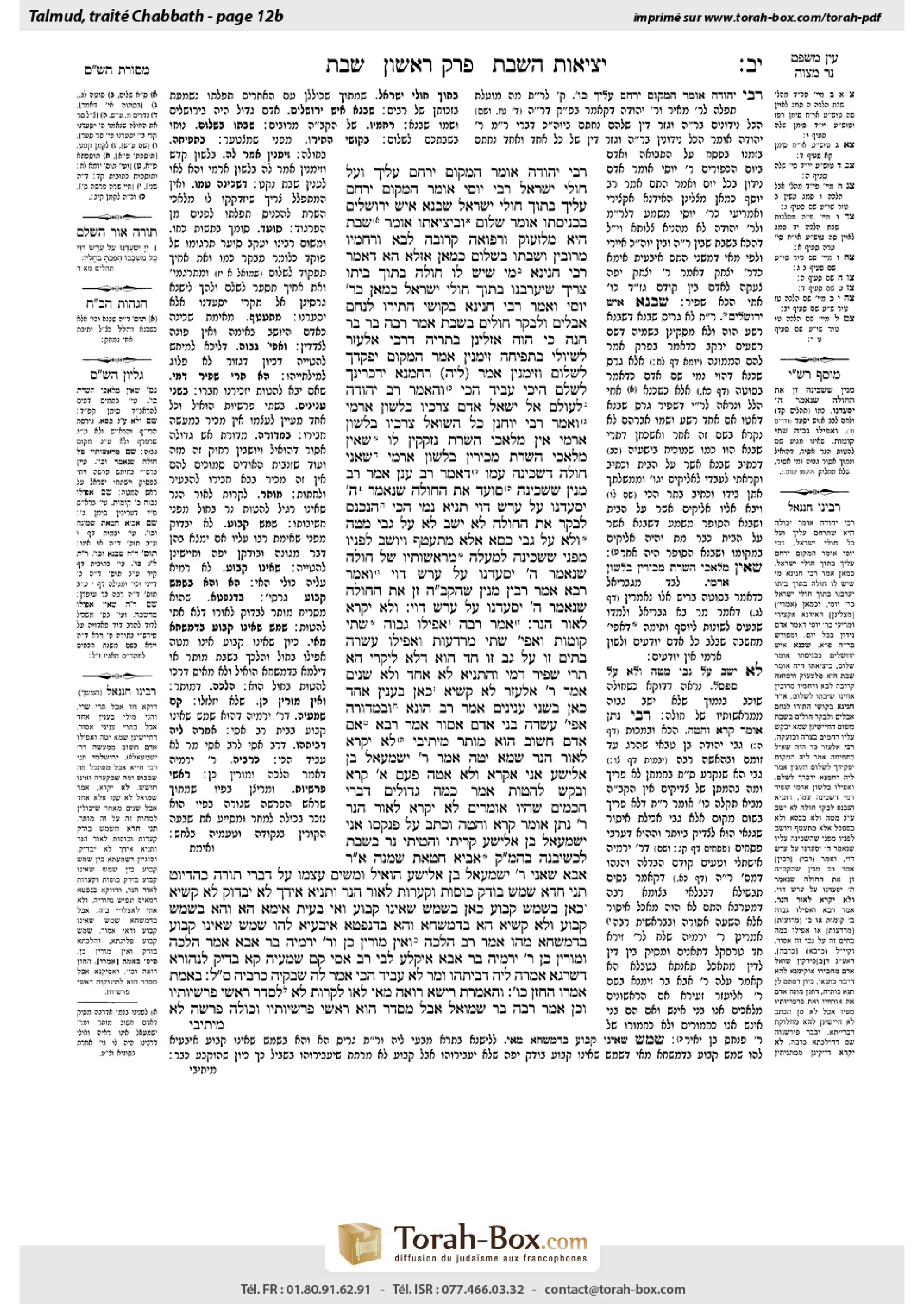
Shabbat 12b: Talmud study for Daf Yomi
Daf Yomi is the daily study of one Talmud folio. Explore 37 tractates with scans, Hebrew text, Sefaria English and AI-generated French translations where annotated.
Passage selection and English or AI-generated French translation are available where the scan has annotations. Daf Study is independent of Torah-Box and Sefaria.
Browse Shabbat · שבת · All tractatesShabbat 12b text and translations
This page of Shabbat includes the Aramaic text, an English translation and an AI-generated French translation, alongside the scan above.
שבת י״ב ב · Aramaic and Hebrew text
רַבִּי יְהוּדָה אוֹמֵר: ״הַמָּקוֹם יְרַחֵם עָלֶיךָ וְעַל חוֹלֵי יִשְׂרָאֵל״. רַבִּי יוֹסֵי אוֹמֵר: ״הַמָּקוֹם יְרַחֵם עָלֶיךָ בְּתוֹךְ חוֹלֵי יִשְׂרָאֵל״. שֶׁבְנָא אִישׁ יְרוּשָׁלַיִם, בִּכְנִיסָתוֹ אוֹמֵר: ״שָׁלוֹם״, וּבִיצִיאָתוֹ אוֹמֵר: ״שַׁבָּת הִיא מִלִּזְעוֹק וּרְפוּאָה קְרוֹבָה לָבֹא, וְרַחֲמָיו מְרוּבִּין, וְשִׁבְתוּ בְּשָׁלוֹם״. כְּמַאן אָזְלָא הָא דְּאָמַר רַבִּי חֲנִינָא: מִי שֶׁיֵּשׁ לוֹ חוֹלֶה בְּתוֹךְ בֵּיתוֹ צָרִיךְ שֶׁיְּעָרְבֶנּוּ בְּתוֹךְ חוֹלֵי יִשְׂרָאֵל? כְּמַאן — כְּרַבִּי יוֹסֵי.
וְאָמַר רַבִּי חֲנִינָא: בְּקוֹשִׁי הִתִּירוּ לְנַחֵם אֲבֵלִים וּלְבַקֵּר חוֹלִים בְּשַׁבָּת. אָמַר רַבָּה בַּר בַּר חָנָה: כִּי הֲוָה אָזְלִינַן בָּתְרֵיהּ דְּרַבִּי אֶלְעָזָר לְשַׁיּוֹלֵי בִּתְפִיחָה, זִימְנִין אָמַר: ״הַמָּקוֹם יִפְקׇדְךָ לְשָׁלוֹם״. וְזִימְנִין אָמַר לֵיהּ: ״רַחֲמָנָא יִדְכְּרִינָךְ לִשְׁלָם״. הֵיכִי עָבֵיד הָכִי? וְהָאָמַר רַב יְהוּדָה: לְעוֹלָם אַל יִשְׁאַל אָדָם צְרָכָיו בִּלְשׁוֹן אֲרַמִּי. וְאָמַר רַבִּי יוֹחָנָן: כׇּל הַשּׁוֹאֵל צְרָכָיו בִּלְשׁוֹן אֲרַמִּי — אֵין מַלְאֲכֵי הַשָּׁרֵת נִזְקָקִין לוֹ, שֶׁאֵין מַלְאֲכֵי הַשָּׁרֵת מַכִּירִין בִּלְשׁוֹן אֲרַמִּי! שָׁאנֵי חוֹלֶה דִּשְׁכִינָה עִמּוֹ.
דְּאָמַר רַב עָנָן אָמַר רַב: מִנַּיִן שֶׁהַקָּדוֹשׁ בָּרוּךְ הוּא סוֹעֵד אֶת הַחוֹלֶה? — שֶׁנֶּאֱמַר: ״ה׳ יִסְעָדֶנּוּ עַל עֶרֶשׂ דְּוָי״. תַּנְיָא נָמֵי הָכִי: הַנִּכְנָס לְבַקֵּר אֶת הַחוֹלֶה לֹא יֵשֵׁב לֹא עַל גַּבֵּי מִטָּה וְלֹא עַל גַּבֵּי כִּסֵּא, אֶלָּא מִתְעַטֵּף וְיוֹשֵׁב לְפָנָיו, מִפְּנֵי שֶׁשְּׁכִינָה לְמַעְלָה מִמְּרַאֲשׁוֹתָיו שֶׁל חוֹלֶה, שֶׁנֶּאֱמַר: ״ה׳ יִסְעָדֶנּוּ עַל עֶרֶשׂ דְּוָי״. וְאָמַר רָבָא אָמַר רָבִין: מִנַּיִן שֶׁהַקָּדוֹשׁ בָּרוּךְ הוּא זָן אֶת הַחוֹלֶה? — שֶׁנֶּאֱמַר: ״ה׳ יִסְעָדֶנּוּ עַל עֶרֶשׂ דְּוָי״.
וְלֹא יִקְרָא לְאוֹר הַנֵּר. אָמַר רַבָּה: אֲפִילּוּ גָּבוֹהַּ שְׁתֵּי קוֹמוֹת, וַאֲפִילּוּ שְׁתֵּי מַרְדָּעוֹת, וַאֲפִילּוּ עֲשָׂרָה בָּתִּים זֶה עַל גַּב זֶה. חַד הוּא דְּלָא לִיקְרֵי, הָא תְּרֵי — שַׁפִּיר דָּמֵי. וְהָתַנְיָא לֹא אֶחָד וְלֹא שְׁנַיִם! אָמַר רַבִּי אֶלְעָזָר, לָא קַשְׁיָא: כָּאן בְּעִנְיָן אֶחָד, כָּאן בִּשְׁנֵי עִנְיָנִים. אָמַר רַב הוּנָא: וּבִמְדוּרָה, אֲפִילּוּ עֲשָׂרָה בְּנֵי אָדָם אָסוּר.
אָמַר רָבָא: אִם אָדָם חָשׁוּב הוּא — מוּתָּר. מֵיתִיבִי: לֹא יִקְרָא לְאוֹר הַנֵּר, שֶׁמָּא יַטֶּה. אָמַר רַבִּי יִשְׁמָעֵאל בֶּן אֱלִישָׁע: אֲנִי אֶקְרָא וְלֹא אַטֶּה. פַּעַם אַחַת קָרָא וּבִקֵּשׁ לְהַטּוֹת. אָמַר: כַּמָּה גְּדוֹלִים דִּבְרֵי חֲכָמִים שֶׁהָיוּ אוֹמְרִים לֹא יִקְרָא לְאוֹר הַנֵּר. רַבִּי נָתָן אוֹמֵר, קָרָא וְהִטָּה וְכָתַב עַל פִּנְקָסוֹ: אֲנִי יִשְׁמָעֵאל בֶּן אֱלִישָׁע, קָרִיתִי וְהִטֵּיתִי נֵר בְּשַׁבָּת, לִכְשֶׁיִּבָּנֶה בֵּית הַמִּקְדָּשׁ אָבִיא חַטָּאת שְׁמֵנָה! אָמַר רַבִּי אַבָּא: שָׁאנֵי רַבִּי יִשְׁמָעֵאל בֶּן אֱלִישָׁע, הוֹאִיל וּמֵשִׂים עַצְמוֹ עַל דִּבְרֵי תוֹרָה כְּהֶדְיוֹט.
תָּנֵי חֲדָא: שַׁמָּשׁ בּוֹדֵק כּוֹסוֹת וּקְעָרוֹת לְאוֹר הַנֵּר. וְתַנְיָא אִידַּךְ: לֹא יִבְדּוֹק! לָא קַשְׁיָא: כָּאן בְּשַׁמָּשׁ קָבוּעַ, כָּאן בְּשַׁמָּשׁ שֶׁאֵינוֹ קָבוּעַ. וְאִי בָּעֵית אֵימָא: הָא וְהָא בְּשַׁמָּשׁ קָבוּעַ, וְלָא קַשְׁיָא: הָא בִּדְמִשְׁחָא, וְהָא בִּדְנַפְטָא.
אִיבַּעְיָא לְהוּ: שַׁמָּשׁ שֶׁאֵינוֹ קָבוּעַ בִּדְמִשְׁחָא מַהוּ? אָמַר רַב: הֲלָכָה וְאֵין מוֹרִין כֵּן. וְרַבִּי יִרְמְיָה בַּר אַבָּא אָמַר: הֲלָכָה וּמוֹרִין כֵּן. רַבִּי יִרְמְיָה בַּר אַבָּא אִיקְּלַע לְבֵי רַב אַסִּי. קָם שַׁמָּעֵיהּ קָא בָּדֵיק לִנְהוֹרָא דִשְׁרָגָא. אֲמַרָה לֵיהּ דְּבֵיתְהוּ: וּמָר לָא עָבֵיד הָכִי? אֲמַר לַהּ: שִׁבְקֵיהּ, כְּרַבֵּיהּ סְבִירָא לֵיהּ.
בֶּאֱמֶת אָמְרוּ הַחַזָּן כּוּ׳. וְהָאָמְרַתְּ רֵישָׁא ״רוֹאֶה״. מַאי לָאו, לִקְרוֹת?! לָא, לְסַדֵּר רָאשֵׁי פָּרָשִׁיּוֹתָיו. וְכֵן אָמַר רַבָּה בַּר שְׁמוּאֵל: אֲבָל מְסַדֵּר הוּא רָאשֵׁי פָּרָשִׁיּוֹתָיו, וְכוּלַּהּ פָּרָשָׁה לָא.
Shabbat 12b · English translation
Rabbi Yehuda says that it is appropriate to say: May the Omnipresent have compassion upon you and upon all the sick people of Israel. Rabbi Yosei says that it is appropriate to say: May the Omnipresent have compassion upon you among the sick people of Israel, thereby including this sick person within the community of Israel. When Shevna of Jerusalem would visit a sick person on Shabbat, upon entering, he would say shalom. And when he exited he would say: It is Shabbat when one is prohibited to cry out, and healing is soon to come, and His compassion is abundant, and rest on Shabbat in peace. The Gemara asks: In accordance with whose opinion is the halakha that Rabbi Ḥanina said: One who has a sick person in his house must include him among the sick people of Israel in his prayer? In accordance with whose opinion? In accordance with the opinion of Rabbi Yosei.
And Rabbi Ḥanina said: It was only with great difficulty that the Sages permitted to comfort the mourners and visit the sick on Shabbat, as both the visitor and the comforter experience suffering on Shabbat. They permitted it only due to the mitzva involved in these activities. Rabba bar bar Ḥana said: When we would follow Rabbi Elazar to inquire about the health of a sick person; sometimes he would say in Hebrew: May the Omnipresent remember you for peace, and sometimes he would say to him in Aramaic: May the all-Merciful remember you for peace. He would say it in Aramaic when the sick person did not understand Hebrew (Rav Elazar Moshe Horovitz). The Gemara asks: How did he do this, pray in Aramaic? Didn’t Rav Yehuda say: A person should never request that his needs be met in the Aramaic language? And, similarly, Rabbi Yoḥanan said: Anyone who requests that his needs be met in the Aramaic language, the ministering angels do not attend to him to bring his prayer before God, as the ministering angels are not familiar with the Aramaic language, but only with the sacred tongue, Hebrew, exclusively. The Gemara responds: A sick person is different. He does not need the angels to bring his prayer before God because the Divine Presence is with him.
As Rav Anan said that Rav said: From where is it derived that the Divine Presence cares for and aids the sick person? As it is stated: “God will support him on the bed of illness” (Psalms 41:4). The Gemara comments: That was also taught in a baraita: One who enters to visit the sick person should sit neither on the bed nor on a chair; rather, he should wrap himself in his prayer shawl with trepidation and awe, and sit before the sick person below him, as the Divine Presence is above the head of the sick person, as it is stated: “God will support him on the bed of illness,” and he must treat the Divine Presence with deference. On a similar note, Rava said that Ravin said: From where is it derived that the Holy One, Blessed be He, feeds the sick person during his illness? As it is stated: “God will support him on the bed of illness.”
We learned in the mishna that one may not read a book by candlelight on Shabbat. Rabba said: Since a decree was issued, there is no distinction whether or not the lamp was near enough to him to enable him to adjust the wick. The prohibition applies even if the lamp was two statures of a person high, and even as high as two plow handles, and even if it was as high as ten houses one atop the other. We learned in the mishna that one may not read, and the Gemara infers: One may not read, but for two, apparently, he may well do so. They will not violate any prohibition, as two people together will certainly not forget the Shabbat prohibition. The Gemara asks: Wasn’t it taught in a baraita that neither one nor two are permitted to read by the light of the lamp? Rabbi Elazar said: This is not difficult, as there is room to distinguish between them and say that here, where two were permitted to read by candlelight, it is referring to a case where they are both engaged in one matter and will remind each other to refrain from adjusting the wick. There, where two were prohibited to read by candlelight it is referring to a case where they are engaged in two different matters. Since each is preoccupied with a different text, they will not pay attention and remind each other. Rav Huna said: And with regard to a bonfire, where everyone is sitting around it and not adjacent to it, even if they were ten people, it is prohibited to read by its light. When sitting around a bonfire, everyone sits at a distance from the others, and therefore they do not notice each other, and each is liable to adjust the firebrands to provide himself with more light.
Rava said: Even though they prohibited reading by candlelight due to a decree lest they adjust the wick, if he is an important person, it is permitted, as even on weekdays he is not accustomed to adjust a lamp that is dirty with oil. The Gemara raises an objection from that which was taught in a Tosefta: One may not read a book on Shabbat by the light of the lamp, lest he adjust it. The Tosefta relates that Rabbi Yishmael ben Elisha said: I will read and will not adjust, as I will certainly not forget that it is Shabbat. However, once he read a book by candlelight and he sought to adjust the wick. He said: How great are the words of the Sages, who would say that one may not read by candlelight, as even a person like me sought to adjust the wick. Rabbi Natan says: That was not the way it happened. Rather, he read and actually adjusted the wick, and he wrote afterward in his notebook [pinkas]: I, Yishmael ben Elisha, read and adjusted a lamp on Shabbat. When the Temple will be rebuilt I will bring a fat sin-offering as atonement for this sin. This proves that even an important person like Rabbi Yishmael ben Elisha is liable to adjust the wick. Rabbi Abba said: Rabbi Yishmael ben Elisha is different, since with regard to the study of Torah, he comports himself like a simple man with no air of importance, but generally, an important person would not dirty his hands and adjust the wick.
On this subject, the Gemara cites two apparently contradictory baraitot. It was taught in one baraita that a servant may examine cups and bowls by candlelight to check if they are clean. And it was taught in another baraita that he may not examine them. The Gemara explains: This is not difficult. Rather, here, the baraita that prohibited examining the cups, is referring to a regularly employed servant who fears his master and examines the dishes meticulously. Therefore, there is concern lest he come to adjust the wick. While there, the baraita that permitted examining the cups, is referring to a servant who is not regularly employed, does not fear his master, and therefore will not check meticulously. There is no concern lest he come to adjust the wick. And if you wish, say instead that this baraita and that baraita are both referring to a regularly employed servant. And this is not difficult, as they are not referring to the same kind of lamp. This baraita, which prohibited examining the dishes, is referring to an oil lamp, where there is room for concern lest he adjust it. And that baraita, which permitted examining the dishes, is referring to a naphtha [nafta] lamp. Since the naphtha lamp is dirty, the servant certainly will not touch it while checking the cups and dishes.
A dilemma was raised before the Sages: What is the ruling with regard to a servant who is not regularly employed in terms of examining cups and dishes by the light of an oil lamp? Is he permitted to examine the cups by candlelight, or not? From the perspective of his being a servant not regularly employed, it should be permitted. On the other hand, because it is an oil lamp it should be prohibited. Rav said: The halakha is that it is permitted, and, however, ab initio a public ruling is not issued to that effect so that they will not come to sin. However, one who knows the halakha that it is permitted may practice accordingly. Rabbi Yirmeya bar Abba said: That halakha is that it is permitted and a public ruling is issued to that effect. The Gemara relates that Rabbi Yirmeya bar Abba happened to come to the house of Rav Asi on Shabbat. Rabbi Yirmeya’s servant stood and examined the cups by the light of a lamp [sheraga], as he was not a regularly employed servant in the house of Rav Asi. Rav Asi’s wife said to Rav Asi: But the Master, you, does not do so. You prohibit doing so. Why is the servant of Rabbi Yirmeya examining the cups? He said to her: Leave him, he holds in accordance with the opinion of his master.
We learned in the mishna that in truth they said that the attendant sees where in the book the children under his supervision are reading, but he himself should not read. The Gemara asked: Didn’t you say in the first clause of the mishna that the attendant sees? Doesn’t that mean that he sees in order to read? How can that part of the mishna conclude by saying that he may not read? The Gemara answers: No, it does not mean that the attendant is permitted to actually read; rather, he is only permitted to look and arrange the beginning of his sections of the Torah that he must read the next day. And so too, Rabba bar Shmuel said: However, he may arrange the beginning of his sections that he must read the next day. The Gemara asks: And may he not read the entire section?
Shabbat 12b · Traduction française (IA)
Rabbi Yehuda dit qu’il convient de dire : « Que le Maître du monde ait compassion de toi et de tous les malades d’Israël. » Rabbi Yosei dit qu’il convient de dire : « Que le Maître du monde ait compassion de toi parmi les malades d’Israël », incluant ainsi ce malade dans la communauté d’Israël. Lorsque Shevna de Jérusalem rendait visite à un malade le Chabbat, il disait en entrant : « Shalom. » En sortant, il disait : « C’est Chabbat, jour où il est interdit de crier ; la guérison viendra bientôt, Sa compassion est abondante, et que le repos du Chabbat soit dans la paix. » La Guemara demande : De l’opinion de qui relève la halakha énoncée par Rabbi Ḥanina : celui qui a un malade chez lui doit l’inclure parmi les malades d’Israël dans sa prière ? De l’opinion de qui ? De celle de Rabbi Yosei.
Et Rabbi Ḥanina dit : C’est seulement avec beaucoup de difficulté que les Sages ont permis de réconforter les endeuillés et de rendre visite aux malades le Chabbat, car le visiteur comme celui qui réconforte éprouvent de la souffrance le Chabbat. Ils ne l’ont permis qu’en raison de la mitsva que ces actes impliquent. Rabba bar bar Ḥana dit : Lorsque nous accompagnions Rabbi Elazar pour nous enquérir de la santé d’un malade, il lui disait parfois en hébreu : « Que le Maître du monde se souvienne de toi pour la paix », et parfois en araméen : « Que le Miséricordieux se souvienne de toi pour la paix. » Il le disait en araméen lorsque le malade ne comprenait pas l’hébreu (Rav Elazar Moshe Horovitz). La Guemara demande : Comment pouvait-il faire cela, prier en araméen ? Rav Yehuda n’a-t-il pas dit : « Une personne ne doit jamais demander que ses besoins soient satisfaits en araméen » ? De même, Rabbi Yoḥanan a dit : « Quiconque demande que ses besoins soient satisfaits en araméen, les anges du service ne s’occupent pas de lui pour porter sa prière devant Dieu », car les anges du service ne connaissent pas l’araméen, mais uniquement la langue sainte, l’hébreu. La Guemara répond : Le cas d’un malade est différent. Il n’a pas besoin que les anges portent sa prière devant Dieu, car la Présence divine est avec lui.
Car Rav Anan a dit au nom de Rav : D’où déduit-on que la Présence divine prend soin du malade et lui vient en aide ? Comme il est dit : « Dieu le soutiendra sur le lit de maladie » (Psaumes 41, 4). La Guemara commente : Cela a également été enseigné dans une baraïta : Celui qui entre rendre visite à un malade ne doit s’asseoir ni sur le lit ni sur une chaise ; il doit plutôt s’envelopper dans son châle de prière avec crainte et révérence, et s’asseoir devant le malade, plus bas que lui, car la Présence divine se tient au-dessus de la tête du malade, comme il est dit : « Dieu le soutiendra sur le lit de maladie » ; il doit donc témoigner de la déférence à la Présence divine. Dans le même ordre d’idées, Rava a dit au nom de Ravin : D’où déduit-on que le Saint, béni soit-Il, nourrit le malade pendant sa maladie ? Comme il est dit : « Dieu le soutiendra sur le lit de maladie. »
Nous avons appris dans la Michna qu’il est interdit de lire un livre à la lumière d’une lampe le Chabbat. Rabba dit : Dès lors qu’un décret a été pris, il n’y a aucune distinction selon que la lampe soit ou non assez proche pour que l’on puisse en ajuster la mèche. L’interdiction s’applique même si la lampe se trouve à deux fois la hauteur d’un homme, même à la hauteur de deux manches de charrue, et même à la hauteur de dix maisons empilées les unes sur les autres. Nous avons appris dans la Michna qu’il est interdit de lire, et la Guemara en déduit : il est interdit à une personne de lire, mais deux personnes, apparemment, peuvent le faire. Elles ne transgresseront aucune interdiction, car deux personnes ensemble n’oublieront certainement pas l’interdiction relative au Chabbat. La Guemara demande : N’a-t-il pas été enseigné dans une baraïta qu’une personne seule comme deux personnes ne sont pas autorisées à lire à la lumière d’une lampe ? Rabbi Elazar dit : Il n’y a pas de difficulté ; on peut distinguer les cas et dire qu’ici, où deux personnes sont autorisées à lire à la lumière d’une lampe, elles étudient toutes deux le même sujet et se rappelleront mutuellement de ne pas ajuster la mèche. Là, où deux personnes ne sont pas autorisées à lire à la lumière d’une lampe, elles étudient deux sujets différents. Chacune étant absorbée par un texte différent, elles ne prêteront pas attention l’une à l’autre et ne se rappelleront pas mutuellement de s’en abstenir. Rav Huna dit : Quant à un feu de joie, autour duquel tout le monde est assis sans être à proximité les uns des autres, il est interdit de lire à sa lumière, même s’ils sont dix. Autour d’un feu de joie, chacun s’assoit à distance des autres ; ils ne se remarquent donc pas, et chacun risque d’arranger les tisons afin d’avoir davantage de lumière.
Rava dit : Bien que les Sages aient interdit de lire à la lumière d’une lampe par décret, de peur que l’on n’ajuste la mèche, si la personne est importante, cela est permis, car même en semaine elle n’a pas l’habitude d’ajuster une lampe salie par l’huile. La Guemara soulève une objection à partir de ce qui a été enseigné dans une Tosefta : Il est interdit de lire un livre le Chabbat à la lumière d’une lampe, de peur que l’on n’ajuste la mèche. Rabbi Yishmael ben Elisha dit : « Je lirai et je ne l’ajusterai pas, car je n’oublierai certainement pas que c’est Chabbat. » Pourtant, un jour, il lut un livre à la lumière d’une lampe et voulut en ajuster la mèche. Il dit : « Que les paroles des Sages sont grandes, eux qui disaient qu’il est interdit de lire à la lumière d’une lampe, car même une personne comme moi a voulu ajuster la mèche. » Rabbi Natan dit : « Ce n’est pas ainsi que les faits se sont déroulés. » Il lut et ajusta effectivement la mèche, puis écrivit dans son carnet [pinkas] : « Moi, Yishmael ben Elisha, j’ai lu et ajusté une lampe le Chabbat. Lorsque le Temple sera reconstruit, j’apporterai un sacrifice expiatoire gras pour expier cette faute. » Cela prouve que même une personne importante comme Rabbi Yishmael ben Elisha risque d’ajuster la mèche. Rabbi Abba dit : Rabbi Yishmael ben Elisha est un cas différent, car, lorsqu’il s’agit d’étude de la Torah, il se comporte comme un homme ordinaire, sans se donner d’importance ; en général, une personne importante ne se salirait pas les mains pour ajuster la mèche.
À ce sujet, la Guemara cite deux baraïtot qui semblent se contredire. Il a été enseigné dans une baraïta qu’un serviteur peut examiner des coupes et des bols à la lumière d’une lampe pour vérifier s’ils sont propres. Une autre baraïta enseigne qu’il ne peut pas les examiner. La Guemara explique : Il n’y a pas de difficulté. La baraïta qui interdit d’examiner les coupes concerne un serviteur employé régulièrement, qui craint son maître et examine la vaisselle avec minutie. On craint donc qu’il en vienne à ajuster la mèche. En revanche, la baraïta qui permet d’examiner les coupes concerne un serviteur qui n’est pas employé régulièrement, ne craint pas son maître et ne vérifiera donc pas avec minutie. On ne craint pas qu’il en vienne à ajuster la mèche. Si tu le souhaites, on peut plutôt dire que les deux baraïtot concernent un serviteur employé régulièrement. Il n’y a pas de difficulté, car elles ne parlent pas du même type de lampe. La baraïta qui interdit d’examiner la vaisselle concerne une lampe à huile, pour laquelle il y a lieu de craindre qu’il en ajuste la mèche. L’autre baraïta, qui permet d’examiner la vaisselle, concerne une lampe au naphte [nafta]. Comme cette lampe est sale, le serviteur ne la touchera certainement pas en vérifiant les coupes et la vaisselle.
Une question fut posée aux Sages : Quel est le statut d’un serviteur qui n’est pas employé régulièrement, lorsqu’il s’agit d’examiner des coupes et de la vaisselle à la lumière d’une lampe à huile ? Lui est-il permis d’examiner les coupes à la lumière de la lampe, ou non ? Puisqu’il n’est pas employé régulièrement, cela devrait être permis. D’un autre côté, puisqu’il s’agit d’une lampe à huile, cela devrait être interdit. Rav dit : La halakha est que cela est permis ; toutefois, on ne rend pas d’emblée de décision publique en ce sens, afin que les gens n’en viennent pas à fauter. En revanche, celui qui connaît la halakha selon laquelle cela est permis peut agir en conséquence. Rabbi Yirmeya bar Abba dit : La halakha est que cela est permis, et une décision publique est rendue en ce sens. La Guemara rapporte que Rabbi Yirmeya bar Abba se rendit par hasard chez Rav Asi le Chabbat. Le serviteur de Rabbi Yirmeya se leva et examina les coupes à la lumière d’une lampe [sheraga], car il n’était pas employé régulièrement dans la maison de Rav Asi. La femme de Rav Asi dit à Rav Asi : « Mais toi, Maître, tu ne fais pas ainsi. Tu l’interdis. Pourquoi le serviteur de Rabbi Yirmeya examine-t-il les coupes ? » Il lui dit : « Laisse-le, il suit l’opinion de son maître. »
Nous avons appris dans la Michna qu’en vérité, ils ont dit que le préposé voit à quel endroit du livre les enfants placés sous sa surveillance lisent, mais que lui-même ne doit pas lire. La Guemara demande : N’as-tu pas dit dans la première partie de la Michna que le préposé voit ? Cela ne signifie-t-il pas qu’il regarde afin de lire ? Comment cette partie de la Michna peut-elle conclure qu’il ne doit pas lire ? La Guemara répond : Non, cela ne signifie pas que le préposé est autorisé à lire effectivement ; il lui est seulement permis de regarder et de repérer le début des passages de Torah qu’il devra lire le lendemain. De même, Rabba bar Shmuel dit : Toutefois, il peut repérer le début des passages qu’il devra lire le lendemain. La Guemara demande : Et ne peut-il pas lire le passage en entier ?
Traduction française générée par IA à partir de l’édition anglaise de Sefaria. Vérifie toujours un passage avec le texte source.
Text from Sefaria: William Davidson Edition - Vocalized Aramaic (CC BY NC); William Davidson Edition - English (CC BY NC).