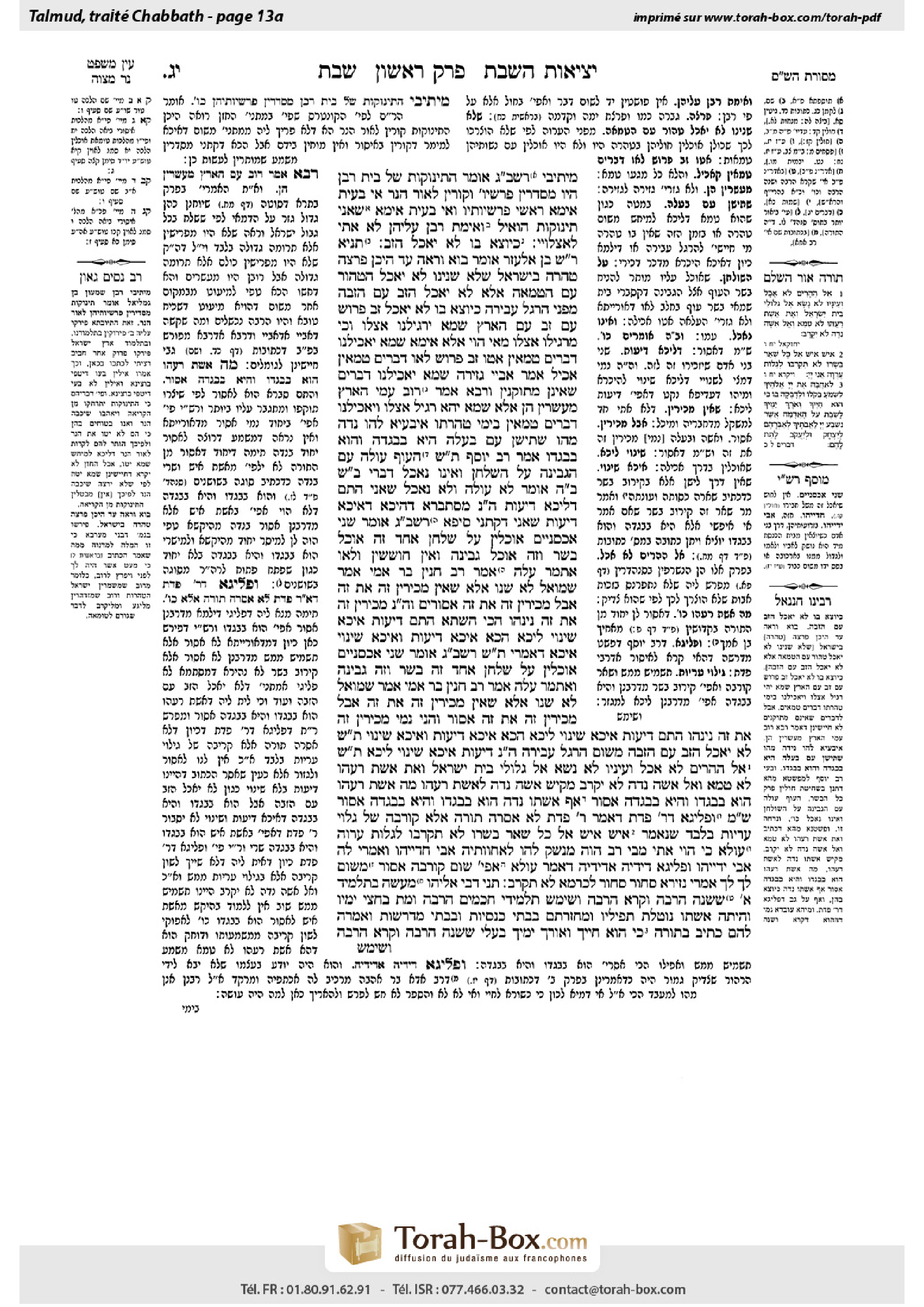
Shabbat 13a: Talmud study for Daf Yomi
Daf Yomi is the daily study of one Talmud folio. Explore 37 tractates with scans, Hebrew text, Sefaria English and AI-generated French translations where annotated.
Passage selection and English or AI-generated French translation are available where the scan has annotations. Daf Study is independent of Torah-Box and Sefaria.
Browse Shabbat · שבת · All tractatesShabbat 13a text and translations
This page of Shabbat includes the Aramaic text, an English translation and an AI-generated French translation, alongside the scan above.
שבת י״ג א · Aramaic and Hebrew text
מֵיתִיבִי: רַבָּן שִׁמְעוֹן בֶּן גַּמְלִיאֵל אוֹמֵר, הַתִּינוֹקוֹת שֶׁל בֵּית רַבָּן הָיוּ מְסַדְּרִין פָּרָשִׁיּוֹת וְקוֹרִין לְאוֹר הַנֵּר. אִי בָּעֵית אֵימָא — רָאשֵׁי פָּרָשִׁיּוֹתָיו, וְאִי בָּעֵית אֵימָא — שָׁאנֵי תִּינוֹקוֹת, הוֹאִיל וְאֵימַת רַבָּן עֲלֵיהֶן לָא אָתֵי לְאַצְלוֹיֵי.
כַּיּוֹצֵא בוֹ לֹא יֹאכַל הַזָּב. תַּנְיָא: רַבִּי שִׁמְעוֹן בֶּן אֶלְעָזָר אוֹמֵר: בּוֹא וּרְאֵה עַד הֵיכָן פָּרְצָה טׇהֳרָה בְּיִשְׂרָאֵל, שֶׁלֹּא שָׁנִינוּ ״לֹא יֹאכַל הַטָּהוֹר עִם הַטְּמֵאָה״, אֶלָּא לֹא יֹאכַל הַזָּב עִם הַזָּבָה מִפְּנֵי הֶרְגֵּל עֲבֵירָה. כַּיּוֹצֵא בוֹ: לֹא יֹאכַל זָב פָּרוּשׁ עִם זָב עַם הָאָרֶץ, שֶׁמָּא יַרְגִּילֶנּוּ אֶצְלוֹ.
וְכִי מַרְגִּילוֹ אֶצְלוֹ מַאי הָוֵי? אֶלָּא אֵימָא: שֶׁמָּא יַאֲכִילֶנּוּ דְּבָרִים טְמֵאִין. אַטּוּ זָב פָּרוּשׁ לָאו דְּבָרִים טְמֵאִין אָכֵיל? אָמַר אַבָּיֵי: גְּזֵירָה שֶׁמָּא יַאֲכִילֶנּוּ דְּבָרִים שֶׁאֵינָן מְתוּקָּנִין. וְרָבָא אָמַר: רוֹב עַמֵּי הָאָרֶץ מְעַשְּׂרִין הֵן, אֶלָּא שֶׁמָּא יְהֵא רָגִיל אֶצְלוֹ וְיַאֲכִילֶנּוּ דְּבָרִים טְמֵאִין בִּימֵי טׇהֳרָתוֹ.
אִיבַּעְיָא לְהוּ: נִדָּה מַהוּ שֶׁתִּישַׁן עִם בַּעֲלָהּ הִיא בְּבִגְדָהּ וְהוּא בְּבִגְדוֹ? אָמַר רַב יוֹסֵף, תָּא שְׁמַע: הָעוֹף עוֹלֶה עִם הַגְּבִינָה עַל הַשֻּׁלְחָן וְאֵינוֹ נֶאֱכָל, דִּבְרֵי בֵּית שַׁמַּאי. בֵּית הִלֵּל אוֹמְרִים: לֹא עוֹלֶה וְלֹא נֶאֱכָל. שָׁאנֵי הָתָם דְּלֵיכָּא דֵּיעוֹת.
הָכִי נָמֵי מִסְתַּבְּרָא דְּהֵיכָא דְּאִיכָּא דֵּיעוֹת שָׁאנֵי. דְּקָתָנֵי סֵיפָא: רַבָּן שִׁמְעוֹן בֶּן גַּמְלִיאֵל אוֹמֵר: שְׁנֵי אַכְסְנָיִים אוֹכְלִין עַל שֻׁלְחָן אֶחָד, זֶה אוֹכֵל בָּשָׂר וְזֶה אוֹכֵל גְּבִינָה, וְאֵין חוֹשְׁשִׁין. וְלָאו אִתְּמַר עֲלַהּ אָמַר רַב חָנִין בַּר אַמֵּי אָמַר שְׁמוּאֵל: לֹא שָׁנוּ אֶלָּא שֶׁאֵין מַכִּירִין זֶה אֶת זֶה, אֲבָל מַכִּירִין זֶה אֶת זֶה — אֲסוּרִים. וְהָנֵי נָמֵי, מַכִּירִין זֶה אֶת זֶה נִינְהוּ. הָכִי הַשְׁתָּא?! הָתָם דֵּיעוֹת אִיכָּא, שִׁינּוּי לֵיכָּא. הָכָא אִיכָּא דֵּיעוֹת וְאִיכָּא שִׁינּוּי.
אִיכָּא דְּאָמְרִי: תָּא שְׁמַע, רַבָּן שִׁמְעוֹן בֶּן גַּמְלִיאֵל אוֹמֵר: שְׁנֵי אַכְסְנָיִים אוֹכְלִין עַל שֻׁלְחָן אֶחָד, זֶה בָּשָׂר וְזֶה גְּבִינָה. וְאִתְּמַר עֲלַהּ, אָמַר רַב חָנִין בַּר אַמֵּי אָמַר שְׁמוּאֵל: לֹא שָׁנוּ אֶלָּא שֶׁאֵין מַכִּירִין זֶה אֶת זֶה, אֲבָל מַכִּירִין זֶה אֶת זֶה — אָסוּר. וְהָנֵי נָמֵי, מַכִּירִין זֶה אֶת זֶה נִינְהוּ! הָתָם, דֵּיעוֹת אִיכָּא שִׁינּוּי לֵיכָּא. הָכָא, אִיכָּא דֵּיעוֹת וְאִיכָּא שִׁינּוּי.
תָּא שְׁמַע: לֹא יֹאכַל הַזָּב עִם הַזָּבָה מִשּׁוּם הֶרְגֵּל עֲבֵירָה. הָכָא נָמֵי, דֵּיעוֹת אִיכָּא שִׁינּוּי לֵיכָּא.
תָּא שְׁמַע: ״אֶל הֶהָרִים לֹא אָכָל וְעֵינָיו לֹא נָשָׂא אֶל גִּלּוּלֵי בֵּית יִשְׂרָאֵל וְאֶת אֵשֶׁת רֵעֵהוּ לֹא טִמֵּא וְאֶל אִשָּׁה נִדָּה לֹא יִקְרָב״. מַקִּישׁ אִשָּׁה נִדָּה לְאֵשֶׁת רֵעֵהוּ: מָה אֵשֶׁת רֵעֵהוּ הוּא בְּבִגְדוֹ וְהִיא בְּבִגְדָהּ — אָסוּר, אַף אִשְׁתּוֹ נִדָּה הוּא בְּבִגְדוֹ וְהִיא בְּבִגְדָהּ — אָסוּר. שְׁמַע מִינַּהּ.
וּפְלִיגָא דְּרַבִּי פְּדָת: דְּאָמַר רַבִּי פְּדָת לֹא אָסְרָה תּוֹרָה אֶלָּא קוּרְבָה שֶׁל גִּלּוּי עֲרָיוֹת בִּלְבַד, שֶׁנֶּאֱמַר: ״אִישׁ אִישׁ אֶל כׇּל שְׁאֵר בְּשָׂרוֹ לֹא תִקְרְבוּ לְגַלּוֹת עֶרְוָה״.
עוּלָּא כִּי הָוֵי אָתֵי מִבֵּי רַב הֲוָה מְנַשֵּׁק לְהוּ לְאַחְווֹתֵיהּ אַבֵּי חָדַיְיהוּ, וְאָמְרִי לַהּ אַבֵּי יְדַיְיהוּ. וּפְלִיגָא דִידֵיהּ אַדִּידֵיהּ, דְּאָמַר עוּלָּא: אֲפִילּוּ שׁוּם קוּרְבָה אָסוּר, מִשּׁוּם ״לָךְ לָךְ אָמְרִי נְזִירָא סְחוֹר סְחוֹר, לְכַרְמָא לָא תִּקְרַב״.
תָּנֵי דְּבֵי אֵלִיָּהוּ: מַעֲשֶׂה בְּתַלְמִיד אֶחָד שֶׁשָּׁנָה הַרְבֵּה, וְקָרָא הַרְבֵּה, וְשִׁימֵּשׁ תַּלְמִידֵי חֲכָמִים הַרְבֵּה, וּמֵת בַּחֲצִי יָמָיו. וְהָיְתָה אִשְׁתּוֹ נוֹטֶלֶת תְּפִילָּיו וּמְחַזַּרְתָּם בְּבָתֵּי כְנֵסִיּוֹת וּבְבָתֵּי מִדְרָשׁוֹת, וְאָמְרָה לָהֶם: כָּתוּב בַּתּוֹרָה ״כִּי הוּא חַיֶּיךָ וְאוֹרֶךְ יָמֶיךָ״, בַּעֲלִי שֶׁשָּׁנָה הַרְבֵּה וְקָרָא הַרְבֵּה
Shabbat 13a · English translation
The Gemara raises an objection from that which was taught in a Tosefta: Rabban Shimon ben Gamliel says: The schoolchildren would organize the sections and read the book by candlelight. Apparently, it is permitted to read by candlelight on Shabbat. The Gemara answers: If you wish, say that the Tosefta is only referring to the beginning of the sections. And if you wish, say instead that children are different in this regard. Since the fear of their teacher is upon them, they will not come to adjust the wick. Even on a weekday, fear of their teacher will prevent them from tending to the lamp during their study.
We learned in the mishna: Similar to this decree of Shabbat, the Sages issued a decree that the zav may not eat with his wife, the zava, even though they are both ritually impure, because by eating together they will come to excessive intimacy and become accustomed to sin. It was taught in a Tosefta that Rabbi Shimon ben Elazar says: Come and see to what extent ritual purity was widespread in Israel, as we did not learn: The ritually pure may not eat with the ritually impure woman; but rather, the zav may not eat with the zava, although they are both ritually impure, lest he become accustomed to sin. Needless to say, a pure and an impure person certainly would not eat together, as everyone was careful with regard to ritual purity. On a similar note, the Sages said: A zav who generally distances himself from ritual impurity, eats ritually pure food, and is careful about separating tithes, may not eat with a zav who is an am ha’aretz, who does not distance himself from ritual impurity and is not careful about separating tithes, due to the concern lest the am ha’aretz accustom him to frequently spend time with him, by means of a shared meal.
The Gemara wonders: And if he accustoms him to be with him, what of it, what is the problem? Rather, say: Lest he feed him impure items. The Gemara asks: Is that to say that the zav who generally distances himself from ritual impurity does not eat impure things? In his impure state, everything he touches automatically becomes impure, so why would he be concerned with regard to impure items? Abaye said: This prohibition is due to a decree issued by the Sages lest the am ha’aretz feed him food items that are not tithed. Rava said: He needn’t worry about items that are not tithed. Even if his friend was an am ha’aretz, there is a general principle in effect that most amei ha’aretz tithe their fruits. Rather, the Sages were concerned lest he become accustomed to spending time with the am ha’aretz even after the period of his impurity and he feed him impure items even during the days of his purity.
An additional dilemma was raised before the Sages with regard to the requirement to distance oneself from prohibition and impurity: What is the halakha with regard to a menstruating woman? May she sleep with her husband in one bed while she is in her clothes and he is in his clothes? Rav Yosef said: Come and hear a resolution to this dilemma from what we learned in a mishna: The fowl is permitted to be placed together with the cheese on the table, although it may not be eaten with cheese. This is the statement of Beit Shammai. Beit Hillel say: The fowl is neither permitted to be placed together with the cheese on the table, nor may it be eaten with it. According to the opinion of Beit Hillel, which is the halakha, not only must one distance himself from the sin itself, but one must also make certain that items that are prohibited together are not placed together. The Gemara rejects this: There it is different as there are not several consciousnesses. When the fowl and the cheese are on one person’s table, he is liable to err and eat them both, as there is only one consciousness there, his. That is not the case when there are two people in one bed. In that case, there are two consciousnesses and there is no concern that they will both forget the prohibition.
The Gemara adds: So too, it is reasonable to say that where there are two or more consciousnesses it is different, as it was taught in the latter clause of that mishna, Rabban Shimon ben Gamliel says: Two guests in one house may eat on one table this one eating meat and this one eating cheese, and they need not be concerned. The Gemara rejects this: That is not a proof. Was it not said with regard to this halakha that Rabbi Ḥanin bar Ami said that Shmuel said: They only taught that the two of them may eat on one table when they are not familiar with each other; however, if they are familiar with each other it is prohibited for them to eat on one table, as there is room for concern that due to their familiarity they will share their food and come to sin. And, if so, these too, the husband and his wife, are familiar with each other. There is room for concern that they will not keep appropriate distance, and therefore they may not sleep together in one bed even if he is wearing his clothes and she is wearing her clothes. The Gemara rejects this: How can you compare these two cases? There, in the case of meat and milk, there are two consciousnesses; however, there is no noticeable change from the norm, as the meat and the cheese are on the table without any obvious indication to remind them not to mix the food items. While, here, in the case of the menstruating woman, there are two consciousnesses and there is also a noticeable change from the norm, as it is unusual for people to sleep in their clothes. The fact that they are both dressed constitutes a change.
Others cite the previous passage as proof for Rav Yosef’s opinion and then reject it and say: Come and hear, Rabban Shimon ben Gamliel says: Two guests may eat on one table, this one eating meat and this one eating cheese. And it was stated with regard to this halakha that Rabbi Ḥanin bar Ami said that Shmuel said: They only taught that the two of them may eat on one table when they are not familiar with each other; however, if they are familiar with each other it is prohibited for them to eat on one table, as there is room for concern that due to their familiarity they will share their food and come to sin. And, if so, these too, the husband and his wife are familiar with each other. There is room for concern that they will not act with the appropriate separation, and therefore they cannot sleep together in one bed, even if he is wearing his clothes and she is wearing her clothes. The Gemara distinguishes between the cases: There, in the case of meat and cheese, although there are two consciousnesses, there is no noticeable change. The meat and the cheese are on the table with no obvious indication to remind them not to mix the food items. While here, in the case of the menstruating woman, there are two consciousnesses and there is also a noticeable change.
Come and hear a resolution to the dilemma from what we learned in our mishna: The zav may not eat with the zava due to concern that excessive intimacy will lead them to become accustomed to sin. Even eating together is prohibited. The Gemara answers: Here, too, although there are two consciousnesses, there is no noticeable change.
Come and hear a different resolution from that which was taught in a baraita: It is stated: “And he has not eaten upon the mountains, neither has he lifted up his eyes to the idols of the house of Israel, neither has he defiled his neighbor’s wife, neither has he come near to a woman in her impurity” (Ezekiel 18:6). This verse juxtaposes a menstruating woman to his neighbor’s wife. Just as lying together with his neighbor’s wife, even when he is in his clothes and she is in her clothes, is prohibited, so too, lying with his wife when she is menstruating, even when he is in his clothes and she is in her clothes, is prohibited.
The Gemara comments: And this conclusion disagrees with the opinion of Rabbi Pedat, as Rabbi Pedat said: The Torah only prohibited intimacy that involves engaging in prohibited sexual relations, as it is stated: “None of you shall approach to any that is near of kin to him, to uncover their nakedness” (Leviticus 18:6). The prohibition of intimacy in the Torah applies exclusively to relations, and all other kinds of intimacy that do not include actual relations are not included in the prohibition. When there is separation, they did not issue a decree.
The Gemara relates that Ulla, when he would come from the house of his teacher, would kiss his sisters on their chests. And some say: On their hands. Ulla was not concerned about violating the prohibition of displaying affection toward a relative forbidden to him, as his intention was not to have relations with them. The Gemara adds that his action was in contradiction to a saying of his, as Ulla said: Even any intimacy is prohibited with a woman with whom he is forbidden to engage in sexual relations due to the reason formulated as an adage: Go around, go around, and do not approach the vineyard, they say to the nazirite. They advise the nazirite, who is forbidden to consume any product of a vine, that he should not even approach the vineyard. The same is true with regard to the prohibition of forbidden relations. According to Ulla, one must distance himself from them to whatever degree possible.
The Sage in the school of Eliyahu taught a baraita that deals with this halakha: There was an incident involving one student who studied much Mishna and read much Bible, and served Torah scholars extensively, studying Torah from them, and, nevertheless, died at half his days, half his life expectancy. His wife in her bitterness would take his phylacteries and go around with them to synagogues and study halls, and she said to the Sages: It is written in the Torah: “For it is your life and the length of your days” (Deuteronomy 30:20). If so, my husband who studied much Mishna, and read much Bible,
Shabbat 13a · Traduction française (IA)
La Guemara soulève une objection à partir de ce qui a été enseigné dans une baraïta : Rabban Shimon ben Gamliel dit : « Les écoliers organisaient les sections et lisaient le livre à la lumière d’une bougie. » Apparemment, il est permis de lire à la lumière d’une bougie pendant Chabbat. La Guemara répond : Si tu veux, dis que la baraïta ne parle que du début des sections. Et si tu veux, dis plutôt que les enfants sont différents sur ce point. Comme ils craignent leur maître, ils ne risquent pas de régler la mèche. Même en semaine, la crainte de leur maître les empêche de s’occuper de la lampe pendant leur étude.
Nous avons appris dans la Michna : À l’image de ce décret concernant Chabbat, les Sages ont décrété que le zav ne peut pas manger avec sa femme, la zava, bien qu’ils soient tous deux rituellement impurs, car en mangeant ensemble, ils pourraient avoir une intimité excessive et s’habituer à la faute. Il a été enseigné dans une baraïta que Rabbi Shimon ben Elazar dit : « Viens et vois à quel point la pureté rituelle était répandue en Israël : nous n’avons pas appris que celui qui est rituellement pur ne peut pas manger avec une femme rituellement impure, mais plutôt que le zav ne peut pas manger avec la zava, bien qu’ils soient tous deux rituellement impurs, de peur qu’il ne s’habitue à la faute. » À plus forte raison, une personne pure et une personne impure ne mangeraient certainement pas ensemble, car tous veillaient à la pureté rituelle. Dans le même ordre d’idées, les Sages ont dit : Un zav qui, en général, se tient à l’écart de l’impureté rituelle, mange des aliments rituellement purs et veille à prélever les dîmes, ne peut pas manger avec un zav qui est un am ha’aretz, qui ne se tient pas à l’écart de l’impureté rituelle et ne veille pas à prélever les dîmes, de peur que l’am ha’aretz ne l’habitue à passer souvent du temps avec lui en partageant un repas.
La Guemara s’interroge : Et s’il l’habitue à être avec lui, quel est le problème ? Il faut plutôt dire : De peur qu’il ne lui donne des aliments impurs. La Guemara demande : Cela signifie-t-il que le zav qui, en général, se tient à l’écart de l’impureté rituelle ne mange pas d’aliments impurs ? Dans son état d’impureté, tout ce qu’il touche devient automatiquement impur ; pourquoi donc se soucierait-il des aliments impurs ? Abaye dit : Cette interdiction découle d’un décret des Sages, de peur que l’am ha’aretz ne lui donne des aliments dont les dîmes n’ont pas été prélevées. Rava dit : Il n’a pas à s’inquiéter des aliments dont les dîmes n’ont pas été prélevées. Même si son compagnon est un am ha’aretz, le principe général veut que la plupart des amei ha’aretz prélèvent la dîme sur leurs fruits. Les Sages craignaient plutôt qu’il ne s’habitue à passer du temps avec l’am ha’aretz même après la période de son impureté et que celui-ci ne lui donne des aliments impurs, même pendant ses jours de pureté.
Une autre question fut soulevée devant les Sages au sujet de l’obligation de se tenir à l’écart de l’interdit et de l’impureté : quelle est la halakha concernant une femme menstruée ? Peut-elle dormir avec son mari dans le même lit, alors qu’elle est habillée et lui aussi ? Rav Yossef dit : Viens et écoute la réponse à cette question à partir de ce que nous avons appris dans une Michna : La volaille peut être placée avec le fromage sur la table, bien qu’elle ne puisse pas être mangée avec du fromage. Telle est la position de Beit Shammaï. Beit Hillel disent : La volaille ne peut être ni placée avec le fromage sur la table, ni mangée avec lui. Selon l’avis de Beit Hillel, qui est la halakha, il ne faut pas seulement se tenir à l’écart de la faute elle-même ; il faut aussi veiller à ne pas placer ensemble des aliments qu’il est interdit de consommer ensemble. La Guemara rejette cette preuve : Là, le cas est différent, car il n’y a pas plusieurs consciences. Lorsque la volaille et le fromage se trouvent sur la table d’une même personne, celle-ci risque de se tromper et de manger les deux, puisqu’il n’y a là qu’une seule conscience : la sienne. Ce n’est pas le cas lorsque deux personnes se trouvent dans un même lit. Dans ce cas, il y a deux consciences et l’on ne craint pas qu’elles oublient toutes deux l’interdiction.
La Guemara ajoute : De même, il est raisonnable de dire que le cas où il y a deux consciences ou plus est différent, car il a été enseigné dans la dernière partie de cette Michna que Rabban Shimon ben Gamliel dit : « Deux convives dans une même maison peuvent manger à une même table, l’un mangeant de la viande et l’autre du fromage, sans avoir à s’en inquiéter. » La Guemara rejette cette preuve : N’a-t-on pas dit à propos de cette halakha que Rabbi Ḥanin bar Ami a dit au nom de Shmuel : « Ils ont enseigné que les deux peuvent manger à une même table uniquement lorsqu’ils ne se connaissent pas ; mais s’ils se connaissent, il leur est interdit de manger à une même table, car on peut craindre qu’en raison de leur familiarité, ils ne partagent leurs aliments et ne commettent une faute. » Dans ce cas, ces deux personnes aussi, le mari et sa femme, se connaissent. On peut craindre qu’ils ne maintiennent pas une séparation convenable ; ils ne peuvent donc pas dormir ensemble dans un même lit, même si chacun est habillé. La Guemara rejette cette comparaison : Comment comparer ces deux cas ? Là, dans le cas de la viande et du lait, il y a deux consciences ; cependant, rien ne diffère visiblement de l’usage habituel, car la viande et le fromage sont sur la table sans aucun signe évident pour leur rappeler de ne pas mélanger les aliments. Ici, en revanche, dans le cas de la femme menstruée, il y a deux consciences et aussi un changement visible par rapport à l’usage habituel, car il est inhabituel de dormir habillé. Le fait qu’ils soient tous deux habillés constitue un changement.
D’autres citent le passage précédent comme preuve de l’opinion de Rav Yossef, puis la rejettent et disent : Viens et écoute : Rabban Shimon ben Gamliel dit que deux convives peuvent manger à une même table, l’un mangeant de la viande et l’autre du fromage. Or, il a été dit à propos de cette halakha que Rabbi Ḥanin bar Ami a dit au nom de Shmuel : « Ils ont enseigné que les deux peuvent manger à une même table uniquement lorsqu’ils ne se connaissent pas ; mais s’ils se connaissent, il leur est interdit de manger à une même table, car on peut craindre qu’en raison de leur familiarité, ils ne partagent leurs aliments et ne commettent une faute. » Dans ce cas, ces deux personnes aussi, le mari et sa femme, se connaissent. On peut craindre qu’ils ne respectent pas la séparation convenable ; ils ne peuvent donc pas dormir ensemble dans un même lit, même si chacun est habillé. La Guemara distingue les cas : Là, dans le cas de la viande et du fromage, bien qu’il y ait deux consciences, il n’y a pas de changement visible. La viande et le fromage sont sur la table sans signe évident pour leur rappeler de ne pas mélanger les aliments. Ici, en revanche, dans le cas de la femme menstruée, il y a deux consciences et aussi un changement visible.
Viens et écoute une réponse à cette question à partir de ce que nous avons appris dans notre Michna : Le zav ne peut pas manger avec la zava, de crainte qu’une intimité excessive ne les conduise à s’habituer à la faute. Même manger ensemble est interdit. La Guemara répond : Ici aussi, bien qu’il y ait deux consciences, il n’y a pas de changement visible.
Viens et écoute une autre réponse à partir de ce qui a été enseigné dans une baraïta : Il est écrit : « Il n’a pas mangé sur les montagnes, n’a pas levé les yeux vers les idoles de la maison d’Israël, n’a pas souillé la femme de son prochain, ne s’est pas approché d’une femme pendant son impureté » (Ézéchiel 18:6). Ce verset rapproche la femme menstruée de la femme de son prochain. De même qu’il est interdit de coucher avec la femme de son prochain, même lorsqu’il est habillé et qu’elle l’est aussi, de même il est interdit de coucher avec sa femme lorsqu’elle est menstruée, même lorsque chacun est habillé.
La Guemara fait remarquer que cette conclusion est contraire à l’opinion de Rabbi Pedat, car Rabbi Pedat a dit : « La Torah n’a interdit que l’intimité impliquant des relations sexuelles prohibées, comme il est écrit : “Nul d’entre vous ne s’approchera de sa proche parente pour découvrir sa nudité” » (Lévitique 18:6). Dans la Torah, l’interdiction d’intimité ne s’applique qu’aux relations sexuelles ; toutes les autres formes d’intimité qui ne comportent pas de relations sexuelles effectives ne sont pas visées par cette interdiction. Lorsqu’il y a séparation, les Sages n’ont pas décrété d’interdiction.
La Guemara rapporte que, lorsqu’Oulla revenait de chez son maître, il embrassait ses sœurs sur la poitrine. Certains disent : sur les mains. Oulla ne craignait pas de transgresser l’interdiction de manifester de l’affection à une proche avec laquelle les relations lui sont interdites, car son intention n’était pas d’avoir des relations avec elles. La Guemara ajoute que son geste contredisait une de ses propres paroles, car Oulla disait : « Toute forme d’intimité est interdite avec une femme avec laquelle les relations sexuelles lui sont interdites », conformément à l’adage : « Fais le tour, fais le tour, et ne t’approche pas de la vigne », dit-on au nazir. On conseille au nazir, à qui il est interdit de consommer tout produit de la vigne, de ne même pas s’approcher de la vigne. Il en va de même pour l’interdiction des relations prohibées. Selon Oulla, il faut s’en éloigner autant que possible.
Le Sage de l’école d’Eliyahou enseigna une baraïta portant sur cette halakha : Il arriva qu’un élève, qui avait beaucoup étudié la Michna, beaucoup lu la Bible et abondamment servi les sages de la Torah en étudiant la Torah auprès d’eux, mourut néanmoins à la moitié de ses jours, c’est-à-dire à la moitié de son espérance de vie. Sa femme, dans son amertume, prenait ses téfilines et allait de synagogue en maison d’étude, et disait aux Sages : « Il est écrit dans la Torah : “Car c’est ta vie et la longueur de tes jours” » (Deutéronome 30:20). Si tel est le cas, mon mari, qui a beaucoup étudié la Michna et beaucoup lu la Bible,
Traduction française générée par IA à partir de l’édition anglaise de Sefaria. Vérifie toujours un passage avec le texte source.
Text from Sefaria: William Davidson Edition - Vocalized Aramaic (CC BY NC); William Davidson Edition - English (CC BY NC).