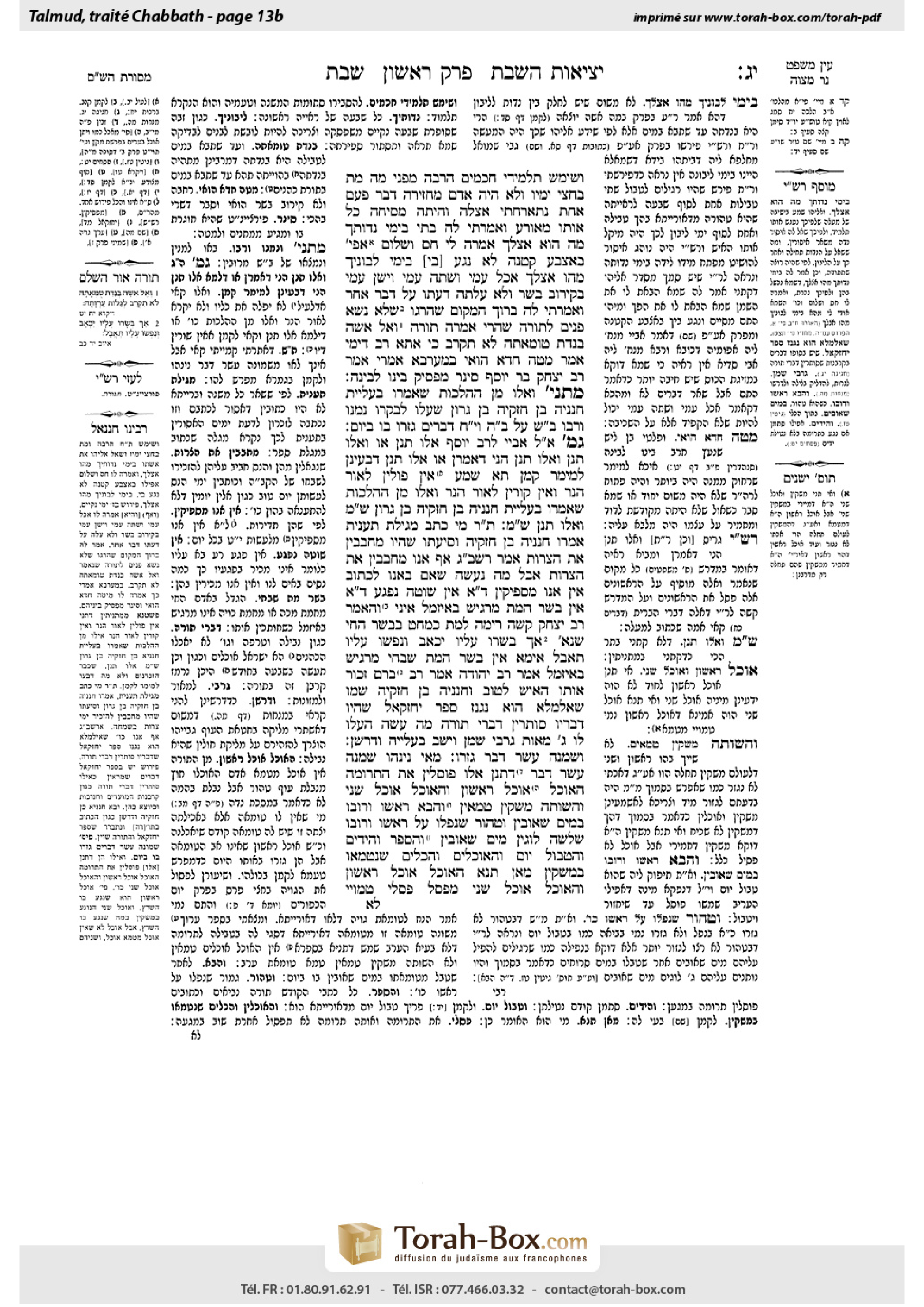
Shabbat 13b: Talmud study for Daf Yomi
Daf Yomi is the daily study of one Talmud folio. Explore 37 tractates with scans, Hebrew text, Sefaria English and AI-generated French translations where annotated.
Passage selection and English or AI-generated French translation are available where the scan has annotations. Daf Study is independent of Torah-Box and Sefaria.
Browse Shabbat · שבת · All tractatesShabbat 13b text and translations
This page of Shabbat includes the Aramaic text, an English translation and an AI-generated French translation, alongside the scan above.
שבת י״ג ב · Aramaic and Hebrew text
וְשִׁימֵּשׁ תַּלְמִידֵי חֲכָמִים הַרְבֵּה, מִפְּנֵי מָה מֵת בַּחֲצִי יָמָיו? וְלֹא הָיָה אָדָם מַחְזִירָהּ דָּבָר. פַּעַם אַחַת נִתְאָרַחְתִּי אֶצְלָהּ וְהָיְתָה מְסִיחָה כׇּל אוֹתוֹ מְאוֹרָע. וְאָמַרְתִּי לָהּ: בִּתִּי, בִּימֵי נִדּוּתֵךְ מַה הוּא אֶצְלֵךְ? אָמְרָה לִי: חַס וְשָׁלוֹם, אֲפִילּוּ בְּאֶצְבַּע קְטַנָּה לֹא נָגַע [בִּי]. בִּימֵי לִבּוּנִיךָ מַהוּ אֶצְלֵךְ? אָכַל עִמִּי וְשָׁתָה עִמִּי וְיָשַׁן עִמִּי בְּקֵירוּב בָּשָׂר, וְלֹא עָלְתָה דַּעְתּוֹ עַל דָּבָר אַחֵר. וְאָמַרְתִּי לָהּ: בָּרוּךְ הַמָּקוֹם שֶׁהֲרָגוֹ, שֶׁלֹּא נָשָׂא פָּנִים לַתּוֹרָה. שֶׁהֲרֵי אָמְרָה תּוֹרָה: ״וְאֶל אִשָּׁה בְּנִדַּת טוּמְאָתָהּ לֹא תִקְרַב״. כִּי אֲתָא רַב דִּימִי, אָמַר: מִטָּה חֲדָא הֲוַאי. בְּמַעְרְבָא אָמְרִי: אָמַר רַב יִצְחָק בַּר יוֹסֵף, סִינָר מַפְסִיק בֵּינוֹ לְבֵינָהּ.
מַתְנִי׳ וְאֵלּוּ מִן הַהֲלָכוֹת שֶׁאָמְרוּ בַּעֲלִיַּית חֲנַנְיָה בֶּן חִזְקִיָּה בֶּן גָּרוֹן. שֶׁעָלוּ לְבַקְּרוֹ, נִמְנוּ, וְרַבּוּ בֵּית שַׁמַּאי עַל בֵּית הִלֵּל. וּשְׁמוֹנָה עָשָׂר דְּבָרִים גָּזְרוּ בּוֹ בַּיּוֹם.
גְּמָ׳ אֲמַר לֵיהּ אַבָּיֵי לְרַב יוֹסֵף: ״אֵלּוּ״ תְּנַן, אוֹ ״וְאֵלּוּ״ תְּנַן? ״וְאֵלּוּ״ תְּנַן, הָנֵי דַּאֲמַרַן. אוֹ ״אֵלּוּ״ תְּנַן, דְּבָעֵינַן לְמֵימַר קַמַּן? תָּא שְׁמַע: אֵין פּוֹלִין לְאוֹר הַנֵּר וְאֵין קוֹרִין לְאוֹר הַנֵּר, וְאֵלּוּ מִן הַהֲלָכוֹת שֶׁאָמְרוּ בַּעֲלִיַּית חֲנַנְיָה בֶּן חִזְקִיָּה בֶּן גָּרוֹן. שְׁמַע מִינַּהּ: ״וְאֵלּוּ״ תְּנַן, שְׁמַע מִינַּהּ.
תָּנוּ רַבָּנַן: מִי כָּתַב מְגִילַּת תַּעֲנִית? — אָמְרוּ, חֲנַנְיָה בֶּן חִזְקִיָּה וְסִיעָתוֹ שֶׁהָיוּ מְחַבְּבִין אֶת הַצָּרוֹת.
אָמַר רַבָּן שִׁמְעוֹן בֶּן גַּמְלִיאֵל: אַף אָנוּ מְחַבְּבִין אֶת הַצָּרוֹת, אֲבָל מַה נַּעֲשֶׂה שֶׁאִם בָּאנוּ לִכְתּוֹב אֵין אָנוּ מַסְפִּיקִין.
דָּבָר אַחֵר: אֵין שׁוֹטֶה נִפְגָּע.
דָּבָר אַחֵר: אֵין בְּשַׂר הַמֵּת מַרְגִּישׁ בָּאִיזְמֵל. אִינִי?! וְהָאָמַר רַב יִצְחָק: קָשָׁה רִימָּה לַמֵּת כְּמַחַט בַּבָּשָׂר הַחַי, שֶׁנֶּאֱמַר: ״אַךְ בְּשָׂרוֹ עָלָיו יִכְאָב וְנַפְשׁוֹ עָלָיו תֶּאֱבָל״! אֵימָא: אֵין בָּשָׂר הַמֵּת שֶׁבַּחַי מַרְגִּישׁ בָּאִיזְמֵל.
אָמַר רַב יְהוּדָה אָמַר רַב: בְּרַם זָכוּר אוֹתוֹ הָאִישׁ לַטּוֹב וַחֲנַנְיָה בֶּן חִזְקִיָּה שְׁמוֹ, שֶׁאִלְמָלֵא הוּא נִגְנַז סֵפֶר יְחֶזְקֵאל, שֶׁהָיוּ דְּבָרָיו סוֹתְרִין דִּבְרֵי תוֹרָה. מֶה עָשָׂה? — הֶעֱלוּ לוֹ שְׁלֹשׁ מֵאוֹת גַּרְבֵי שֶׁמֶן, וְיָשַׁב בַּעֲלִיָּיה וּדְרָשָׁן.
וּשְׁמֹנָה עָשָׂר דָּבָר גָּזְרוּ. מַאי נִינְהוּ שְׁמֹנָה עָשָׂר דָּבָר? דִּתְנַן, אֵלּוּ פּוֹסְלִין אֶת הַתְּרוּמָה: הָאוֹכֵל אוֹכֶל רִאשׁוֹן, וְהָאוֹכֵל אוֹכֶל שֵׁנִי, וְהַשּׁוֹתֶה מַשְׁקִין טְמֵאִין, וְהַבָּא רֹאשׁוֹ וְרוּבּוֹ בְּמַיִם שְׁאוּבִין, וְטָהוֹר שֶׁנָּפְלוּ עַל רֹאשׁוֹ וְרוּבּוֹ שְׁלֹשָׁה לוּגִּין מַיִם שְׁאוּבִין, וְהַסֵּפֶר, וְהַיָּדַיִם, וְהַטְּבוּל יוֹם, וְהָאוֹכָלִים וְהַכֵּלִים שֶׁנִּטְמְאוּ בְּמַשְׁקִין.
מַאן תְּנָא הָאוֹכֵל אוֹכֶל רִאשׁוֹן וְהָאוֹכֵל אוֹכֶל שֵׁנִי — מִפְסָל פָּסְלִי, טַמּוֹיֵי
Shabbat 13b · English translation
and served Torah scholars extensively, why did he die at half his days? Where is the length of days promised him in the verse? No one would respond to her astonishment at all. Eliyahu said: One time I was a guest in her house, and she was relating that entire event with regard to the death of her husband. And I said to her: My daughter, during the period of your menstruation, how did he act toward you? She said to me: Heaven forbid, he did not touch me even with his little finger. And I asked her: In the days of your white garments, after the menstrual flow ended, and you were just counting clean days, how did he act toward you then? She said to me: He ate with me, and drank with me, and slept with me with bodily contact and, however, it did not enter his mind about something else, i.e., conjugal relations. And I said to her: Blessed is the Omnipresent who killed him for this sin, as your husband did not show respect to the Torah. The Torah said: “And to a woman in the separation of her impurity you should not approach” (Leviticus 18:19), even mere affectionate contact is prohibited. The Gemara relates that when Rav Dimi came from Eretz Yisrael to Babylonia, he said: That student did not actually sleep with her with bodily contact; rather, it was in one bed that they slept without contact. In the West, in Eretz Yisrael, they say that Rav Yitzḥak bar Yosef said: When they would sleep together in one bed, she wore a belt [sinar] from the waist down that would separate between him and her. Nevertheless, since the matter is prohibited, that student was punished.
MISHNA: And these are among the halakhot that the Sages, who went up to visit him, said in the upper story of Ḥananya ben Ḥizkiya ben Garon. The precise nature of these halakhot will be explained in the Gemara. These halakhot are considered one unit because they share a distinctive element. Since many Sages were there, among them most of the generation’s Torah scholars in Eretz Yisrael, they engaged in discussion of various halakhot of the Torah. It turned out that when the people expressing opinions were counted, the students of Beit Shammai outnumbered the students of Beit Hillel, and they issued decrees with regard to eighteen matters on that day in accordance with the opinion of Beit Shammai.
GEMARA: With regard to the language that introduces our mishna, Abaye said to Rav Yosef: Did we learn in our mishna: These are among the halakhot, or did we learn in our mishna: And these are among the halakhot? The difference is significant. Did we learn: And these, and if so, the reference would be to those that we said earlier, i.e., that those halakhot are included in the decrees? Or did we learn: These, and if so the reference would be to those that we seek to mention below? Come and hear a solution to this dilemma from the fact that these matters were taught together in a baraita: One may not shake garments to rid them of lice by the light of the lamp and one may not read by the light of the lamp; and these are among the halakhot that the Sages said in the attic of Ḥananya ben Ḥizkiya ben Garon. Conclude from this that we learned: And these in the mishna, and the reference is to the decrees mentioned earlier.
The Sages taught in a baraita with regard to Megillat Ta’anit, which is a list of days of redemption that were established as celebrations for generations: Who wrote Megillat Ta’anit? This scroll was written by Ḥananya ben Ḥizkiya ben Garon and his faction, who held dear the memory of the troubles that befell Israel and their salvation from them.
Rabban Shimon ben Gamliel said: We also hold dear the memory of the troubles from which Israel was saved, but what can we do? If we came to write all the days of that kind, we would not manage to do so, as the troubles that Israel experienced in every generation and era are numerous, and on each day there is an event worthy of commemoration.
Alternatively: Why do we not record the days of salvation from troubles? Just as a crazy person is not hurt, as he is not aware of the troubles that befall him, so too, we cannot appreciate the magnitude of the calamities that befall us.
Alternatively: The flesh of a dead person does not feel the scalpel [izemel] cutting into him, and we, too, are in such a difficult situation that we no longer feel the pains and troubles. With regard to the last analogy, the Gemara asks: Is that so? Didn’t Rav Yitzḥak say: The gnawing of maggots is as excruciating to the dead as the stab of a needle is to the flesh of the living, as it is stated with regard to the dead: “But his flesh shall hurt him, and his soul mourns over him” (Job 14:22)? Rather, say and explain the matter: The dead flesh in parts of the body of the living person that are insensitive to pain does not feel the scalpel that cuts him.
Rav Yehuda said that Rav said: Truly, that man is remembered for the good, and his name is Ḥananya ben Ḥizkiya, as if not for him, the book of Ezekiel would have been suppressed because its contents, in many details, contradict matters of Torah. The Sages sought to suppress the book and exclude it from the canon. What did he, Ḥananya ben Ḥizkiya, do? They brought him three hundred jugs of oil, for light and food, up to his upper story, and he sat isolated in the upper story and did not move from there until he homiletically interpreted all of those verses in the book of Ezekiel that seemed contradictory, and resolved the contradictions.
We learned in the mishna that when the Sages went up to the upper story of the house of Ḥananya ben Ḥizkiya ben Garon, they were counted and issued eighteen decrees in accordance with the opinion of Beit Shammai. The Gemara asks: What are those eighteen matters? The Gemara answers: As we learned in a mishna, a list of the decrees that the Sages issued with regard to items whose level of impurity is such that if they come into contact with teruma they disqualify it. By means of that contact, the teruma itself becomes impure, but it does not transmit impurity to other items. These disqualify teruma: One who eats food with first degree ritual impurity status acquired as a result of contact with a primary source of ritual impurity, e.g., a creeping animal; and one who eats food with second degree ritual impurity status acquired as a result of contact with an item with first degree ritual impurity status; and one who drinks impure liquids of any degree of impurity; and one whose head and most of his body come into drawn water after he immersed himself in a ritual bath to purify himself; and a ritually pure person that three log of drawn water fell on his head and most of his body; and a Torah scroll; and the hands of any person who did not purify himself for the purpose of handling teruma; and one who immersed himself during the day, i.e., one who was impure and immersed himself, and until evening he is not considered completely pure; and foods and vessels that became impure by coming into contact with impure liquids. Contact with any of these disqualifies the teruma. The Gemara seeks to clarify these matters.
The Gemara asks first: Who is the tanna who holds that one who eats food with first degree ritual impurity status, and one who eats food with second degree ritual impurity status, disqualify the teruma, but
Shabbat 13b · Traduction française (IA)
et qu’il s’était dévoué au service des sages de la Torah, pourquoi mourut-il au milieu de ses jours ? Où donc le verset lui promet-il une longue vie ? Personne ne répondit à son étonnement. Éliyahou dit : « Un jour, j’étais l’hôte chez elle, et elle me raconta tout cet épisode concernant la mort de son mari. Je lui demandai : “Ma fille, pendant tes règles, comment se comportait-il envers toi ?” Elle me répondit : “À Dieu ne plaise, il ne me touchait même pas du petit doigt.” Je lui demandai : “Et pendant les jours de tes vêtements blancs, après la fin du flux menstruel, alors que tu comptais seulement les jours de pureté, comment se comportait-il envers toi ?” Elle me répondit : “Il mangeait avec moi, buvait avec moi et dormait avec moi en ayant un contact corporel ; pourtant, il ne lui venait pas à l’esprit d’avoir des relations conjugales.” Je lui dis : “Béni soit l’Omniprésent, qui l’a fait mourir pour cette faute, car ton mari n’a pas respecté la Torah. La Torah dit : ‘Tu ne t’approcheras pas d’une femme pendant sa période de séparation due à son impureté’ (Lévitique 18,19) ; même un simple contact affectueux est interdit.” » La Guemara rapporte que, lorsque Rav Dimi vint d’Erets Israël en Babylonie, il dit : « Cet étudiant n’avait pas réellement dormi avec elle en ayant un contact corporel ; ils avaient plutôt dormi dans le même lit, sans contact. » En Occident, c’est-à-dire en Erets Israël, on rapporte que Rav Yitzḥak bar Yosef disait : « Lorsqu’ils dormaient ensemble dans le même lit, elle portait une ceinture [sinar] à partir de la taille, qui les séparait. » Néanmoins, puisque cela est interdit, cet étudiant fut puni.
MICHNA : Voici certaines des halakhot que les Sages, qui étaient montés lui rendre visite, énoncèrent dans l’étage supérieur de Ḥananya ben Ḥizkiya ben Garon. La nature exacte de ces halakhot sera expliquée dans la Guemara. Elles sont considérées comme un ensemble, car elles ont un trait distinctif en commun. Comme de nombreux Sages étaient présents, parmi lesquels se trouvaient la plupart des sages de la Torah de la génération en Erets Israël, ils discutèrent de diverses halakhot de la Torah. Lorsqu’on dénombra ceux qui exprimaient leur opinion, il apparut que les élèves de Beit Shammaï étaient plus nombreux que ceux de Beit Hillel ; ce jour-là, ils décrétèrent dix-huit mesures conformément à l’opinion de Beit Shammaï.
GUEMARA : À propos de la formulation qui introduit notre Michna, Abayé demanda à Rav Yossef : « Avons-nous appris dans notre Michna : “Voici certaines des halakhot”, ou bien : “Et voici certaines des halakhot” ? » La différence est importante. Avons-nous appris : « Et voici », auquel cas cela renverrait aux halakhot évoquées précédemment, c’est-à-dire qu’elles font partie des décrets ? Ou avons-nous appris : « Voici », auquel cas cela renverrait à celles que nous cherchons à mentionner plus loin ? Écoute la solution à cette difficulté : ces sujets ont été enseignés ensemble dans une baraïta : « On ne doit pas secouer des vêtements à la lumière d’une lampe pour en faire tomber les poux, et on ne doit pas lire à la lumière d’une lampe ; et voici certaines des halakhot que les Sages énoncèrent dans l’étage supérieur de Ḥananya ben Ḥizkiya ben Garon. » Déduis-en que nous avons appris dans la Michna : « Et voici », et que cela renvoie aux décrets mentionnés précédemment.
Les Sages enseignèrent dans une baraïta au sujet de Megillat Ta’anit, qui est une liste de jours de délivrance institués comme jours de fête pour les générations : Qui a rédigé Megillat Ta’anit ? Ce rouleau fut écrit par Ḥananya ben Ḥizkiya ben Garon et son groupe, qui tenaient en haute estime le souvenir des malheurs qui frappèrent Israël et de la délivrance dont il bénéficia.
Rabban Shimon ben Gamliel dit : « Nous aussi, nous tenons en haute estime le souvenir des malheurs dont Israël fut délivré, mais que pouvons-nous faire ? Si nous entreprenions d’écrire tous les jours de ce genre, nous n’y parviendrions pas, car les malheurs qu’Israël a connus à chaque génération et à chaque époque sont nombreux, et chaque jour survient un événement digne d’être commémoré. »
Autre explication : Pourquoi ne consignons-nous pas les jours où nous avons été délivrés des malheurs ? De même qu’un fou ne souffre pas, car il n’a pas conscience des malheurs qui le frappent, de même nous ne sommes pas capables d’apprécier l’ampleur des calamités qui nous accablent.
Autre explication : La chair d’un mort ne ressent pas le scalpel [izemel] qui la coupe ; de même, nous nous trouvons dans une situation si difficile que nous ne ressentons plus les souffrances et les malheurs. À propos de cette dernière comparaison, la Guemara demande : Est-ce vraiment ainsi ? Rav Yitzḥak n’a-t-il pas dit : « Les vers qui rongent un mort lui font aussi mal que la piqûre d’une aiguille dans la chair d’un vivant », ainsi qu’il est dit au sujet du mort : « Sa chair souffre pour lui, et son âme est en deuil à cause de lui » (Job 14,22) ? Dis plutôt et explique la chose ainsi : la chair morte, dans les parties du corps d’un vivant insensibles à la douleur, ne ressent pas le scalpel qui la coupe.
Rav Yehouda dit au nom de Rav : « En vérité, cet homme mérite qu’on se souvienne de lui en bien, et son nom est Ḥananya ben Ḥizkiya ; car, sans lui, le livre d’Ézéchiel aurait été écarté, puisque nombre de ses passages contredisent des éléments de la Torah. » Les Sages voulaient écarter ce livre et l’exclure du canon. Que fit Ḥananya ben Ḥizkiya ? On lui apporta trois cents cruches d’huile, pour l’éclairage et la nourriture, dans son étage supérieur ; il s’y isola et n’en bougea pas jusqu’à ce qu’il ait interprété par exégèse tous les versets du livre d’Ézéchiel qui semblaient contradictoires et résolu ces contradictions.
Nous avons appris dans la Michna que, lorsque les Sages montèrent à l’étage supérieur de la maison de Ḥananya ben Ḥizkiya ben Garon, ils furent dénombrés et décrétèrent dix-huit mesures conformément à l’opinion de Beit Shammaï. La Guemara demande : Quelles sont ces dix-huit mesures ? La Guemara répond : Il s’agit de la liste que nous avons apprise dans une Michna, celle des décrets que les Sages édictèrent concernant des éléments dont le degré d’impureté est tel que, s’ils entrent en contact avec de la terouma, ils la disqualifient. Par ce contact, la terouma elle-même devient impure, mais elle ne transmet pas l’impureté à d’autres éléments. Voici ce qui disqualifie la terouma : celui qui mange un aliment du premier degré d’impureté rituelle, acquis au contact d’une source primaire d’impureté rituelle, par exemple un animal rampant ; celui qui mange un aliment du deuxième degré d’impureté rituelle, acquis au contact d’un élément du premier degré d’impureté rituelle ; celui qui boit des liquides impurs, quel que soit leur degré d’impureté ; celui dont la tête et la majeure partie du corps entrent dans de l’eau puisée après qu’il s’est immergé dans un bain rituel pour se purifier ; une personne rituellement pure sur la tête et la majeure partie du corps de laquelle sont tombés trois log d’eau puisée ; un rouleau de la Torah ; les mains de toute personne qui ne s’est pas purifiée en vue de manipuler de la terouma ; celui qui s’est immergé pendant la journée, c’est-à-dire celui qui était impur et s’est immergé, mais qui n’est pas considéré comme entièrement pur avant le soir ; et les aliments et les ustensiles devenus impurs au contact de liquides impurs. Le contact avec chacun de ces éléments disqualifie la terouma. La Guemara cherche à préciser ces éléments.
La Guemara demande d’abord : Quel est le tanna qui estime que celui qui mange un aliment du premier degré d’impureté rituelle et celui qui mange un aliment du deuxième degré d’impureté rituelle disqualifient la terouma, mais
Traduction française générée par IA à partir de l’édition anglaise de Sefaria. Vérifie toujours un passage avec le texte source.
Text from Sefaria: William Davidson Edition - Vocalized Aramaic (CC BY NC); William Davidson Edition - English (CC BY NC).