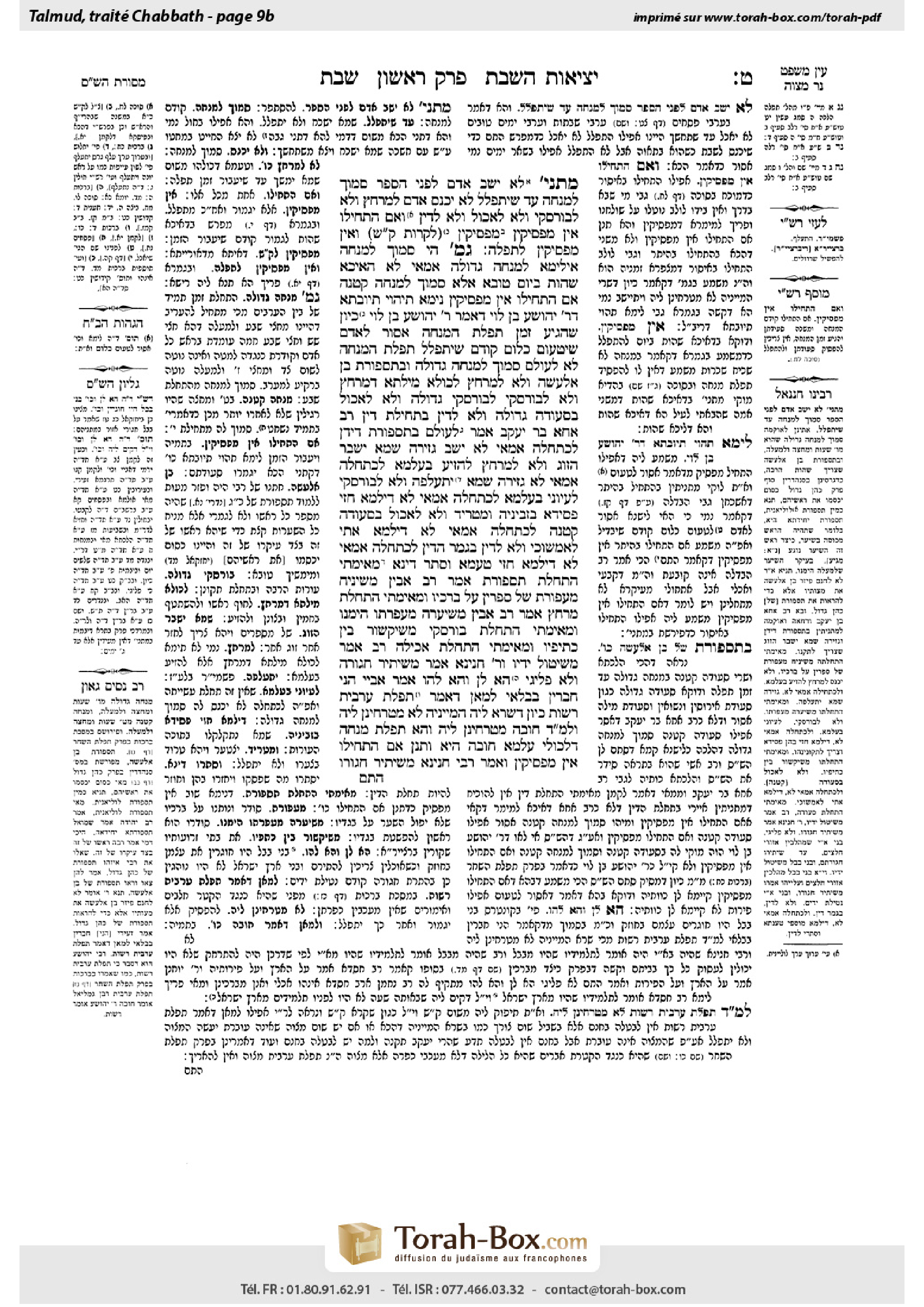
Shabbat 9b: Talmud study for Daf Yomi
Daf Yomi is the daily study of one Talmud folio. Explore 37 tractates with scans, Hebrew text, Sefaria English and AI-generated French translations where annotated.
Passage selection and English or AI-generated French translation are available where the scan has annotations. Daf Study is independent of Torah-Box and Sefaria.
Browse Shabbat · שבת · All tractatesShabbat 9b text and translations
This page of Shabbat includes the Aramaic text, an English translation and an AI-generated French translation, alongside the scan above.
שבת ט׳ ב · Aramaic and Hebrew text
מַתְנִי׳ לֹא יֵשֵׁב אָדָם לִפְנֵי הַסַּפָּר סָמוּךְ לַמִּנְחָה עַד שֶׁיִּתְפַּלֵּל. לֹא יִכָּנֵס אָדָם לַמֶּרְחָץ, וְלֹא לַבּוּרְסְקִי, וְלֹא לֶאֱכוֹל, וְלֹא לָדִין, וְאִם הִתְחִילוּ — אֵין מַפְסִיקִין. מַפְסִיקִין לִקְרוֹת קְרִיאַת שְׁמַע וְאֵין מַפְסִיקִין לִתְפִלָּה.
גְּמָ׳ הֵי ״סָמוּךְ לַמִּנְחָה״? אִילֵּימָא לְמִנְחָה גְּדוֹלָה — אַמַּאי לָא? הָאִיכָּא שְׁהוּת בַּיּוֹם טוּבָא! אֶלָּא סָמוּךְ לְמִנְחָה קְטַנָּה.
אִם הִתְחִילוּ אֵין מַפְסִיקִין. נֵימָא תֶּיהְוֵי תְּיוּבְתָּא דְּרַבִּי יְהוֹשֻׁעַ בֶּן לֵוִי, דְּאָמַר רַבִּי יְהוֹשֻׁעַ בֶּן לֵוִי: כֵּיוָן שֶׁהִגִּיעַ זְמַן תְּפִלַּת הַמִּנְחָה, אָסוּר לְאָדָם שֶׁיִּטְעוֹם כְּלוּם קוֹדֶם שֶׁיִּתְפַּלֵּל תְּפִלַּת הַמִּנְחָה.
לָא: לְעוֹלָם סָמוּךְ לְמִנְחָה גְּדוֹלָה — וּבְתִסְפּוֹרֶת בֶּן אֶלְעָשָׂה. וְלֹא לַמֶּרְחָץ — לְכוּלַּהּ מִילְּתָא דְּמֶרְחָץ. וְלֹא לְבוּרְסְקִי — לְבוּרְסְקִי גְּדוֹלָה. וְלֹא לֶאֱכוֹל — בִּסְעוּדָה גְּדוֹלָה. וְלֹא לָדִין — בִּתְחִלַּת דִּין.
רַב אַחָא בַּר יַעֲקֹב אָמַר: לְעוֹלָם בְּתִסְפּוֹרֶת דִּידַן, לְכַתְּחִילָּה אַמַּאי לֹא יֵשֵׁב — גְּזֵירָה שֶׁמָּא יִשָּׁבֵר הַזּוּג. וְלֹא לַמֶּרְחָץ — לְהַזִּיעַ בְּעָלְמָא. לְכַתְּחִלָּה אַמַּאי לָא — גְּזֵירָה שֶׁמָּא יִתְעַלְּפֶה. וְלֹא לַבּוּרְסְקִי — לְעַיּוֹנֵי בְּעָלְמָא. לְכַתְּחִלָּה אַמַּאי לָא — דִּילְמָא חָזֵי פְּסֵידָא בִּזְבִינֵיהּ וּמִטְּרִיד. וְלֹא לֶאֱכוֹל — בִּסְעוּדָה קְטַנָּה. לְכַתְּחִלָּה אַמַּאי לָא — דִילְמָא אָתֵי לְאִמְּשׁוֹכֵי. וְלֹא לָדִין — בִּגְמַר הַדִּין. לְכַתְּחִלָּה אַמַּאי לָא — דִילְמָא חָזֵי טַעְמָא וְסָתַר דִּינָא.
מֵאֵימָתַי הַתְחָלַת תִּסְפּוֹרֶת? אָמַר רַב אָבִין: מִשֶּׁיַּנִּיחַ מַעְפּוֹרֶת שֶׁל סַפָּרִין עַל בִּרְכָּיו. וּמֵאֵימָתַי הַתְחָלַת מֶרְחָץ? אָמַר רַב אָבִין: מִשֶּׁיַּעֲרֶה מַעְפׇּרְתּוֹ הֵימֶנּוּ. וּמֵאֵימָתַי הַתְחָלַת בּוּרְסְקִי? — מִשֶּׁיִּקְשׁוֹר בֵּין כְּתֵיפָיו. וּמֵאֵימָתַי הַתְחָלַת אֲכִילָה? — רַב אָמַר: מִשֶּׁיִּטּוֹל יָדָיו. וְרַבִּי חֲנִינָא אָמַר: מִשֶּׁיַּתִּיר חֲגוֹרוֹ.
וְלָא פְּלִיגִי: הָא לַן, וְהָא לְהוּ.
אָמַר אַבָּיֵי: הָנֵי חַבְרִין בַּבְלָאֵי, לְמַאן דְּאָמַר תְּפִלַּת עַרְבִית רְשׁוּת, כֵּיוָן דִּשְׁרָא לֵיהּ הֶמְיָינֵיהּ לָא מַטְרְחִינַן לֵיהּ, וּלְמַאן דְּאָמַר חוֹבָה מַטְרְחִינַן לֵיהּ?! וְהָא תְּפִלַּת מִנְחָה דִּלְכוּלֵּי עָלְמָא חוֹבָה הִיא, וּתְנַן אִם הִתְחִילוּ — אֵין מַפְסִיקִין. וְאָמַר רַבִּי חֲנִינָא מִשֶּׁיַּתִּיר חֲגוֹרוֹ!
Shabbat 9b · English translation
MISHNA: After having dealt with the limited and defined topic of the halakhot of carrying out on Shabbat, the mishna begins to deal with the halakhot of Shabbat chronologically, beginning with activities that one may not perform prior to the onset of Shabbat. With regard to one’s daily conduct, the mishna says: A person may not sit before the barber adjacent to the time of minḥa until he recites the afternoon prayer. And a person may not enter the bathhouse and may not enter to work in a tannery [burseki]. And he may neither begin to eat a meal nor to sit in judgment until he prays. And however, if they already began engaging in those activities, they need not stop and recite the Amida prayer. The tanna articulated a principle: One stops engaging in all of these activities to recite Shema and one does not stop to recite the Amida prayer.
GEMARA: First, the Gemara seeks to clarify: Which “adjacent to minḥa,” in other words, adjacent to which minḥa is the mishna referring? There is a difference between the time of greater minḥa [minḥa gedola], which begins approximately a half hour after noon, and the time of lesser minḥa [minḥa ketana], which begins approximately two and a half hours before sunset. The Gemara elaborates: If you say that it is prohibited to perform all of these activities adjacent to minḥa gedola, why not? Isn’t there still much time remaining in the day? Rather, the mishna means adjacent to minḥa ketana.
The Gemara asks: In that case, if they started, they need not stop. Let us say that this will be a conclusive refutation of the opinion of Rabbi Yehoshua ben Levi, as Rabbi Yehoshua ben Levi said: Once the time of the afternoon prayer has arrived, it is prohibited for a person to taste anything before he recites the afternoon prayer. The implication is that even if one began to eat he must stop.
Rather, that explanation is rejected and the Gemara says: Actually the mishna is referring to adjacent to minḥa gedola, and the statement of Rabbi Yehoshua ben Levi is dealing with adjacent to minḥa ketana. In response to the question: If the mishna means adjacent to minḥa gedola isn’t there significant time remaining in the day? The Gemara explains that each of the activities enumerated in the mishna is performed in an especially time-consuming manner. When the mishna said: A person may not sit before the barber, it was referring to a haircut of ben Elasa, whose haircut was very complicated and required several hours to complete. When the mishna said: A person may not go into the bathhouse adjacent to minḥa, it was referring to all matters involved in a visit to the bathhouse; not only washing, but also washing one’s hair, rinsing, and sweating. And he may not enter the tannery adjacent to minḥa, the reference is to a large tannery where there are many hides that require tanning and he must initiate the tanning process from the beginning. And he may not enter to eat, the reference is to a big meal, which lasts a long time. And he may not enter to sit in judgment, refers to a judge who enters at the beginning of the trial, and, generally, it will take a long time until a verdict is reached.
Rav Aḥa bar Ya’akov said: Indeed the mishna can be explained as referring to minḥa gedola and actually, even our ordinary haircut is prohibited. Ab initio, why may he not sit before the barber adjacent to the time of minḥa? Due to a decree lest the scissors break, and considerable time pass until they repair the scissors or obtain others. When the mishna said: A person may not enter the bathhouse adjacent to minḥa, it is prohibited even if he is entering just to sweat. Ab initio, why may he not enter? Due to a decree issued by the Sages lest he faint in the bathhouse and considerable time elapse until he recovers. And he may not enter the tannery adjacent to minḥa, even if he intends just to examine the skins. Ab initio, why may he not enter? Due to the concern that perhaps he will notice damage to his merchandise and become anxious and come to restore what was ruined. And he may not enter to eat a meal adjacent to the time of minḥa is referring even to a small meal. Ab initio, why may he not enter? There is concern that perhaps he will come to extend his meal for a long time. And he may not enter to sit in judgment adjacent to the time of minḥa, the mishna is referring even at the conclusion of the trial. Ab initio, why may he not enter? Due to concern that perhaps he will find a reason, contrary to what he originally thought, and will overturn the verdict completely, necessitating the restart of the trial from the beginning.
We learned in the mishna that if he began one of the aforementioned activities, haircut, bath, tannery, meal, and judgment, he is not required to stop. The Gemara asked: From when is it considered the beginning of the haircut? Rav Avin said: From when he places the barber’s wrap over his knees. And from when is it considered the beginning of the bath? Rav Avin said: From when the one entering the bathhouse to bathe removes his outer wrap, his cloak. And from when is it considered the beginning of his visit to the tannery? From when he ties the leather apron between his shoulders (Me’iri). And from when is it considered the beginning of eating? Rav said: From when he ritually washes his hands for the meal. And Rabbi Ḥanina said: From when he loosens his belt.
The Gemara comments: And they do not disagree. Rather this, the statement of Rabbi Ḥanina, who said that the beginning of the meal is considered from when he loosens his belt, is for us, for the people of Babylonia, who are accustomed to close their belts tightly, and therefore the beginning of the meal is when one loosens his belt. And that, the statement of Rav, who said that the beginning of the meal is considered from when he ritually washes his hands, is for them, the people of Eretz Yisrael who did not close their belts tightly, and therefore only when one washes his hands does the meal begin.
Similarly, Abaye said: Those Babylonian Torah scholars, according to the opinion of the one who said: The evening prayer is voluntary, once one of them loosens his belt, we do not impose upon him to stop his meal and pray. And the Gemara wonders: And according to the opinion of the one who said that the evening prayer is obligatory, we do impose upon him? Doesn’t everyone agree that the afternoon prayer is obligatory? And we learned in our mishna that if they started eating, they need not stop. And with regard to that halakha, Rabbi Ḥanina said: The beginning of the meal is from when he loosens his belt.
Shabbat 9b · Traduction française (IA)
MICHNA : Après avoir traité le sujet circonscrit et bien défini des halakhot relatives au transport pendant Chabbat, la Michna aborde les halakhot de Chabbat dans l’ordre chronologique, en commençant par les activités qu’il est interdit d’accomplir avant l’entrée de Chabbat. À propos de la conduite quotidienne, la Michna enseigne : On ne doit pas s’asseoir devant le coiffeur à l’approche de l’heure de min’ha avant d’avoir récité la prière de l’après-midi. On ne doit pas entrer aux bains ni dans une tannerie pour y travailler [burseki]. On ne doit pas non plus commencer un repas ni siéger en jugement avant d’avoir prié. Toutefois, si l’on a déjà commencé ces activités, il n’est pas nécessaire de les interrompre pour réciter la prière de la Amida. Le tanna énonce un principe : On interrompt toutes ces activités pour réciter le Chéma, mais on ne les interrompt pas pour réciter la prière de la Amida.
GUEMARA : Tout d’abord, la Guemara cherche à préciser : De quelle « approche de min’ha » parle la Michna, autrement dit, de quelle min’ha s’agit-il ? Il y a une différence entre l’heure de la grande min’ha [min’ha gedola], qui commence environ une demi-heure après midi, et celle de la petite min’ha [min’ha ketana], qui commence environ deux heures et demie avant le coucher du soleil. La Guemara développe : Si tu dis qu’il est interdit d’accomplir toutes ces activités à l’approche de la grande min’ha, pourquoi donc ? Ne reste-t-il pas encore beaucoup de temps dans la journée ? La Michna parle donc de l’approche de la petite min’ha.
La Guemara demande : Dans ce cas, s’ils ont commencé, ils ne sont pas tenus de s’arrêter. Ne faut-il pas en conclure une réfutation décisive de l’opinion de Rabbi Yehoshua ben Levi ? Car Rabbi Yehoshua ben Levi a dit : Dès que l’heure de la prière de l’après-midi est arrivée, il est interdit de goûter quoi que ce soit avant d’avoir récité cette prière. Cela implique que même si l’on a commencé à manger, on doit s’arrêter.
Cette explication est donc rejetée, et la Guemara dit : En réalité, la Michna parle de l’approche de la grande min’ha, tandis que la déclaration de Rabbi Yehoshua ben Levi concerne l’approche de la petite min’ha. À la question : Si la Michna parle de l’approche de la grande min’ha, ne reste-t-il pas beaucoup de temps dans la journée ? La Guemara explique que chacune des activités énumérées dans la Michna prend beaucoup de temps lorsqu’elle est pratiquée dans des circonstances particulières. Quand la Michna dit : « On ne doit pas s’asseoir devant le coiffeur », elle parle d’une coupe de cheveux à la manière de ben Elasa, très compliquée et qui nécessitait plusieurs heures. Quand la Michna dit : « On ne doit pas entrer aux bains à l’approche de la min’ha », elle vise toutes les étapes d’une visite aux bains : non seulement se laver, mais aussi se laver les cheveux, se rincer et transpirer. Et quand elle dit qu’on ne doit pas entrer dans une tannerie à l’approche de la min’ha, il s’agit d’une grande tannerie, où se trouvent de nombreuses peaux à tanner et où il faut commencer le tannage depuis le début. Quand elle dit qu’on ne doit pas entrer pour manger, il s’agit d’un grand repas, qui dure longtemps. Enfin, quand elle dit qu’on ne doit pas entrer pour siéger en jugement, elle parle d’un juge qui se présente au début du procès, lequel prend généralement beaucoup de temps avant qu’un verdict soit rendu.
Rav Aḥa bar Ya’akov a dit : En effet, on peut expliquer que la Michna parle de la grande min’ha et que même une coupe de cheveux ordinaire est interdite. Pourquoi ne doit-on pas s’asseoir devant le coiffeur à l’approche de l’heure de min’ha ? Par crainte que les ciseaux ne se cassent et qu’un temps considérable ne s’écoule avant qu’ils soient réparés ou remplacés. Quand la Michna dit : « On ne doit pas entrer aux bains à l’approche de la min’ha », cela est interdit même si l’on y entre uniquement pour transpirer. Pourquoi ne doit-on pas y entrer ? Par crainte que l’on ne s’évanouisse aux bains et qu’un temps considérable ne s’écoule avant que l’on reprenne ses esprits. Quand elle dit qu’on ne doit pas entrer dans une tannerie à l’approche de la min’ha, cela s’applique même si l’on a seulement l’intention d’examiner les peaux. Pourquoi ne doit-on pas y entrer ? De crainte que l’on ne remarque que sa marchandise a été endommagée, que l’on ne s’inquiète et que l’on ne cherche à réparer ce qui a été abîmé. Quand la Michna dit qu’on ne doit pas entrer pour prendre un repas à l’approche de l’heure de min’ha, cela vise même un petit repas. Pourquoi ne doit-on pas y entrer ? On craint que l’on ne prolonge le repas. Quand elle dit qu’on ne doit pas entrer pour siéger en jugement à l’approche de l’heure de min’ha, la Michna parle même de la fin du procès. Pourquoi ne doit-on pas y entrer ? De crainte que l’on ne trouve une raison contraire à ce que l’on pensait au départ, que l’on ne revienne entièrement sur le verdict et qu’il faille reprendre le procès depuis le début.
Nous avons appris dans la Michna que si l’on a commencé l’une des activités mentionnées — coupe de cheveux, bains, tannerie, repas ou jugement —, on n’est pas tenu de s’arrêter. La Guemara demande : À partir de quel moment considère-t-on que la coupe de cheveux a commencé ? Rav Avin a dit : À partir du moment où il pose la cape du coiffeur sur ses genoux. Et à partir de quel moment considère-t-on que la visite aux bains a commencé ? Rav Avin a dit : À partir du moment où celui qui entre aux bains pour se baigner retire son vêtement extérieur, son manteau. Et à partir de quel moment considère-t-on que la visite à la tannerie a commencé ? À partir du moment où il noue le tablier de cuir entre ses épaules (Me’iri). Et à partir de quel moment considère-t-on que le repas a commencé ? Rav a dit : À partir du moment où il se lave rituellement les mains pour le repas. Rabbi Ḥanina a dit : À partir du moment où il desserre sa ceinture.
La Guemara fait remarquer qu’ils ne sont pas en désaccord. La déclaration de Rabbi Ḥanina, selon laquelle le repas est considéré comme commencé dès que l’on desserre sa ceinture, s’applique à nous, les habitants de Babylonie, qui avons l’habitude de serrer étroitement nos ceintures ; le repas commence donc lorsqu’on desserre sa ceinture. La déclaration de Rav, selon laquelle le repas est considéré comme commencé dès que l’on se lave rituellement les mains, s’applique à eux, les habitants d’Eretz Yisrael, qui ne serraient pas étroitement leurs ceintures ; pour eux, le repas ne commence donc qu’au moment où l’on se lave les mains.
De même, Abaye a dit : Pour ces érudits de la Torah babyloniens, selon l’opinion de celui qui dit que la prière du soir est facultative, dès que l’un d’eux desserre sa ceinture, on ne lui impose pas d’interrompre son repas pour prier. La Guemara s’étonne : Et selon l’opinion de celui qui dit que la prière du soir est obligatoire, le lui impose-t-on ? Tout le monde ne convient-il pas que la prière de l’après-midi est obligatoire ? Or, nous avons appris dans notre Michna que si l’on a commencé à manger, on n’a pas besoin de s’arrêter. Et au sujet de cette halakha, Rabbi Ḥanina a dit que le repas commence dès que l’on desserre sa ceinture.
Traduction française générée par IA à partir de l’édition anglaise de Sefaria. Vérifie toujours un passage avec le texte source.
Text from Sefaria: William Davidson Edition - Vocalized Aramaic (CC BY NC); William Davidson Edition - English (CC BY NC).