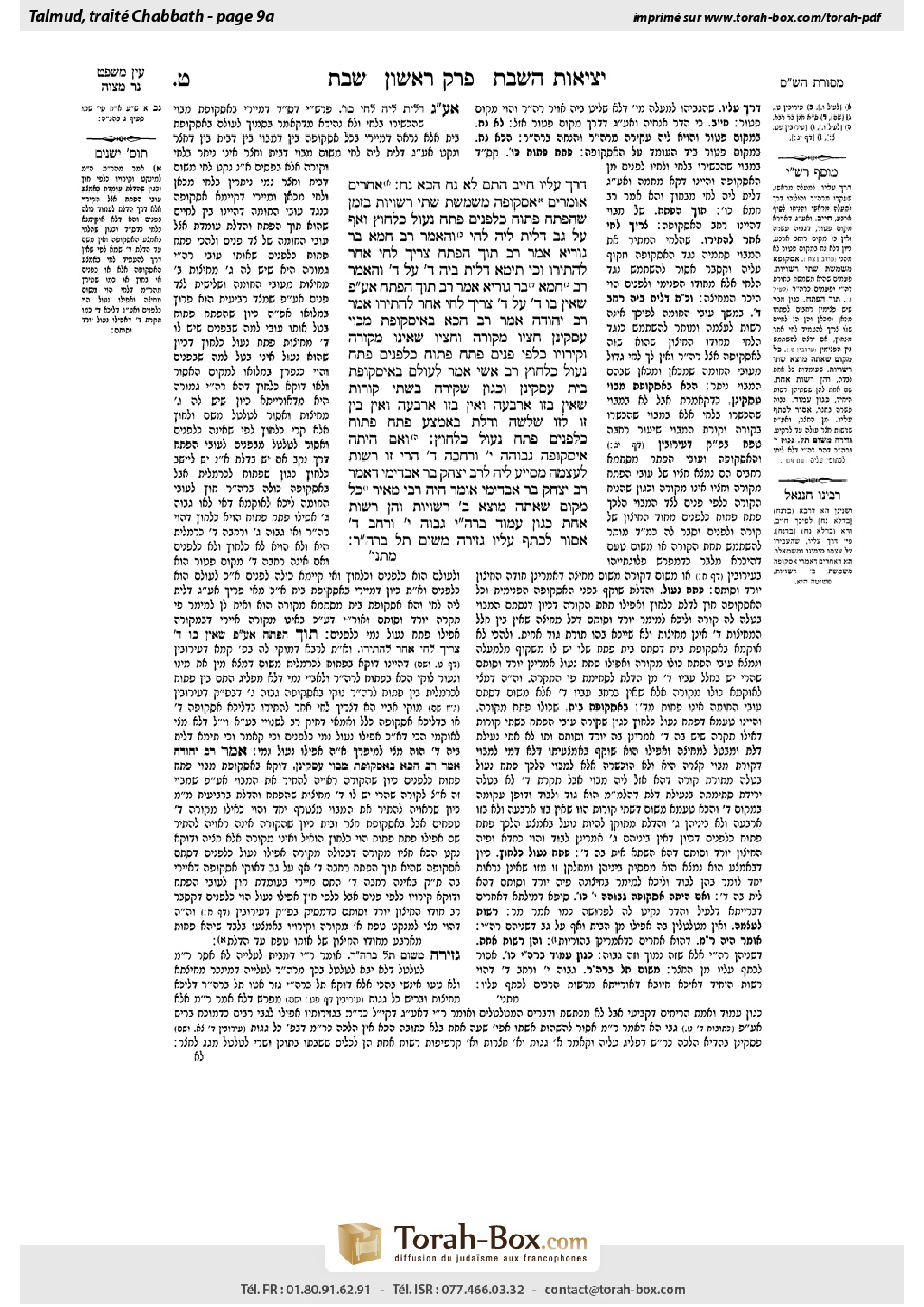
Shabbat 9a: Talmud study for Daf Yomi
Daf Yomi is the daily study of one Talmud folio. Explore 37 tractates with scans, Hebrew text, Sefaria English and AI-generated French translations where annotated.
Passage selection and English or AI-generated French translation are available where the scan has annotations. Daf Study is independent of Torah-Box and Sefaria.
Browse Shabbat · שבת · All tractatesShabbat 9a text and translations
This page of Shabbat includes the Aramaic text, an English translation and an AI-generated French translation, alongside the scan above.
שבת ט׳ א · Aramaic and Hebrew text
דֶּרֶךְ עָלָיו, חַיָּיב! הָתָם לָא נָח, הָכָא נָח.
אֲחֵרִים אוֹמְרִים: אִסְקוּפָּה מְשַׁמֶּשֶׁת שְׁתֵּי רְשׁוּיוֹת: בִּזְמַן שֶׁהַפֶּתַח פָּתוּחַ — כְּלִפְנִים. פֶּתַח נָעוּל — כְּלַחוּץ.
וְאַף עַל גַּב דְּלֵית לֵיהּ לֶחִי?! וְהָאָמַר רַב חָמָא בַּר גּוּרְיָא אָמַר רַב: תּוֹךְ הַפֶּתַח צָרִיךְ לֶחִי אַחֵר לְהַתִּירוֹ!
וְכִי תֵימָא דְּלֵית בֵּיהּ אַרְבָּעָה עַל אַרְבָּעָה — וְהָאָמַר רַב חָמָא בַּר גּוּרְיָא אָמַר רַב: תּוֹךְ הַפֶּתַח, אַף עַל פִּי שֶׁאֵין בּוֹ אַרְבָּעָה עַל אַרְבָּעָה, צָרִיךְ לֶחִי אַחֵר לְהַתִּירוֹ!
אָמַר רַב יְהוּדָה אָמַר רַב: הָכָא בְּאִיסְקוּפַּת מָבוֹי עָסְקִינַן, חֶצְיוֹ מְקוֹרֶה וְחֶצְיוֹ שֶׁאֵינוֹ מְקוֹרֶה, וְקֵירוּיוֹ כְּלַפֵּי פְנִים. פֶּתַח פָּתוּחַ, כְּלִפְנִים. פֶּתַח נָעוּל, כְּלַחוּץ.
רַב אָשֵׁי אָמַר: לְעוֹלָם בְּאִיסְקוּפַּת בַּיִת עָסְקִינַן, וּכְגוֹן שֶׁקֵּירָהּ בִּשְׁתֵּי קוֹרוֹת שֶׁאֵין בָּזוֹ אַרְבָּעָה וְאֵין בָּזוֹ אַרְבָּעָה, וְאֵין בֵּין זוֹ לָזוֹ שְׁלֹשָׁה, וְדֶלֶת בָּאֶמְצַע. פֶּתַח פָּתוּחַ, כְּלִפְנִים. פֶּתַח נָעוּל, כְּלַחוּץ.
וְאִם הָיְתָה אִיסְקוּפָּה גְּבוֹהָה עֲשָׂרָה וּרְחָבָה אַרְבָּעָה, הֲרֵי זוֹ רְשׁוּת לְעַצְמָהּ. מְסַיַּיע לֵיהּ לְרַב יִצְחָק בַּר אַבְדִּימִי. דְּאָמַר רַב יִצְחָק בַּר אַבְדִּימִי אוֹמֵר הָיָה רַבִּי מֵאִיר: כׇּל מָקוֹם שֶׁאַתָּה מוֹצֵא שְׁתֵּי רְשׁוּיוֹת וְהֵן רְשׁוּת אַחַת, כְּגוֹן עַמּוּד בִּרְשׁוּת הַיָּחִיד גָּבוֹהַּ עֲשָׂרָה וְרָחָב אַרְבָּעָה — אָסוּר לְכַתֵּף עָלָיו. גְּזֵירָה מִשּׁוּם תֵּל בִּרְשׁוּת הָרַבִּים.
Shabbat 9a · English translation
via the airspace above it, i.e., he raised the object more than ten handbreadths above the ground of the public domain, which is an exempt domain, still he is liable for carrying in the public domain. On the other hand, in the Tosefta it says that if the object passed through an exempt domain, he is exempt by Torah law from punishment for passing it from domain to domain. The Gemara rejects that refutation as there is room to distinguish between the cases: There, in the halakha stated by Rava, the object did not come to rest in an exempt domain; it merely passed through its airspace. However, here, when transferred via the threshold, the object came to rest in an exempt domain, and as a result, the act of carrying out was divided into two separate actions, neither of which involves a Torah prohibition.
Later in the Tosefta, Aḥerim say: Depending on the circumstances, a threshold serves two domains: When the entrance is open, the threshold is subsumed within the house and it is considered to be a private domain like the inside of the house. And when the entrance is locked, the threshold is not subsumed within the house, and it is considered to be a public domain like the outside.
The Gemara wonders: When the entrance is open the threshold is considered to be like a private domain, and is this so even though it does not have a post on its side? Didn’t Rav Ḥama bar Gurya say that Rav said: The opening in the wall, i.e., the doorway, requires another post in order to permit carrying there? A symbolic partition must be established at the side of the opening for that doorway to be considered closed and render carrying within it permissible like a full-fledged private domain. In the Tosefta, no mention was made of the need for a post of that kind.
And if you say that the Tosefta is referring to a threshold that does not have an area of four by four handbreadths, which is not considered an independent area and therefore does not require a post, didn’t Rav Ḥama bar Gurya say that Rav said explicitly: The opening, even though it does not have an area of four by four handbreadths, requires another post in order to permit carrying there?
Rav Yehuda said that Rav said: Here we are dealing with the threshold of an alleyway open to the public domain on only one side. Although, by Torah law, it is considered a private domain, the Sages required him to establish a fourth symbolic partition on the side open to the public domain. This alleyway was covered, and this covering extended to part of the threshold in a manner that half of it is covered and half of it is not covered, and the covering is over the part of the threshold toward the inside. In that case, if the entrance is open, its legal status is like that of the inside, as it is considered as if there were a partition extending from the edge of the roofing above to below, based on the halakhic principle: Lower the partition. The opening of the alleyway is thereby sealed, rendering it a private domain. However, when the entrance is locked, it is no longer possible to consider the covering as a partition, and therefore the part of the threshold that is beyond the locked door of the alleyway is considered like the outside, i.e., like a public domain.
Rav Ashi said: Actually, we can say that we are dealing with the threshold of a house, and in a special circumstance, a case where he covered the threshold with two beams. Furthermore, neither this beam is four handbreadths wide, nor is that beam four handbreadths wide, and there is not a gap of three handbreadths between this one and that one, and there is a door between the two beams. In this case, when the entrance is open, since there is a space of less than three handbreadths between the beams and, based on the principle of lavud, any space less than three handbreadths is considered non-existent, the two beams are considered to be one wide beam. It is considered as if there were a partition extending from the edge of the roofing above to below, based on the halakhic principle: Lower the partition. The threshold is thereby sealed and considered a full-fledged private domain like the inside. However, when the entrance is locked, the two beams do not join together to become one anymore. Since the door creates a separation between them and the outer beam is less than four handbreadths wide, it is not considered a roof from which a partition extends to the ground, and the area under this beam is considered to be a public domain like the outside.
The Sage also said in the Tosefta that if the threshold was ten handbreadths high and four by four handbreadths wide, it is an independent domain, even if it was inside a private domain. The Gemara comments: This supports the opinion of Rav Yitzḥak bar Avdimi, as Rav Yitzḥak bar Avdimi said that Rabbi Meir used to say: Any place that you find two domains, i.e., two places, each of which is sufficiently distinct to be an independent domain, and even though they are halakhically one domain, i.e., in a case where a pillar that is ten handbreadths high and four by four wide is standing in the private domain, even though the pillar is a private domain based on its measurements, it is prohibited by rabbinic law to adjust a burden on one’s shoulders upon it and to lift an object from the ground of the private domain and place it atop the pillar, as the pillar is deemed by its measurements to be an independent domain. It is prohibited by a decree issued by the Sages due to a similar situation, the case of a mound of that size in the public domain. In the public domain, lifting an object from the ground and placing it on the mound constitutes a violation of the Torah prohibition of carrying out from the public domain to the private domain. Therefore, the Sages prohibited placing an object on a pillar even in the private domain.
Shabbat 9a · Traduction française (IA)
par l’espace aérien situé au-dessus, c’est-à-dire qu’il a élevé l’objet à plus de dix palmes au-dessus du sol du domaine public, dans un domaine exempté ; il reste néanmoins passible pour avoir transporté l’objet dans le domaine public. En revanche, la Tossefta dit que si l’objet a traversé un domaine exempté, il est exempté, selon la Torah, de toute sanction pour l’avoir fait passer d’un domaine à un autre. La Guemara écarte cette réfutation, car on peut distinguer les cas : là, dans la halakha énoncée par Rava, l’objet ne s’est pas immobilisé dans un domaine exempté ; il n’a fait que traverser son espace aérien. Mais ici, lorsqu’il a été transféré par le seuil, l’objet s’est immobilisé dans un domaine exempté ; par conséquent, l’acte de transport a été divisé en deux actions distinctes, dont aucune n’implique une interdiction de la Torah.
Plus loin dans la Tossefta, les Aḥerim disent : selon les circonstances, un seuil relève de deux domaines. Lorsque l’entrée est ouverte, le seuil est assimilé à la maison et est considéré comme un domaine privé, au même titre que l’intérieur de la maison. En revanche, lorsque l’entrée est verrouillée, le seuil n’est pas assimilé à la maison et est considéré comme un domaine public, au même titre que l’extérieur.
La Guemara s’interroge : lorsque l’entrée est ouverte, le seuil est considéré comme un domaine privé, même s’il n’a pas de poteau sur le côté ? Rav Ḥama bar Gurya n’a-t-il pas dit au nom de Rav : l’ouverture dans le mur, c’est-à-dire l’embrasure de la porte, nécessite un poteau supplémentaire pour autoriser le transport à cet endroit ? Il faut établir une séparation symbolique sur le côté de l’ouverture pour que celle-ci soit considérée comme fermée et que le transport à l’intérieur soit permis, comme dans un véritable domaine privé. Or, dans la Tossefta, il n’est pas fait mention de la nécessité d’un tel poteau.
Et si tu dis que la Tossefta parle d’un seuil dont la superficie est inférieure à quatre palmes sur quatre, qui n’est donc pas considéré comme un espace indépendant et ne nécessite pas de poteau, Rav Ḥama bar Gurya n’a-t-il pas dit explicitement au nom de Rav : l’ouverture, même si sa superficie est inférieure à quatre palmes sur quatre, nécessite un poteau supplémentaire pour autoriser le transport à cet endroit ?
Rav Yehuda dit au nom de Rav : il s’agit ici du seuil d’une ruelle ouverte au domaine public d’un seul côté. Bien que, selon la Torah, cette ruelle soit considérée comme un domaine privé, les Sages ont exigé qu’on établisse une quatrième séparation symbolique du côté ouvert au domaine public. Cette ruelle était couverte, et cette couverture s’étendait sur une partie du seuil, de sorte que la moitié de celui-ci était couverte et l’autre moitié ne l’était pas ; la partie du seuil située vers l’intérieur était sous la couverture. Dans ce cas, si l’entrée est ouverte, le seuil a le statut de l’intérieur, car c’est comme si une séparation descendait du bord de la toiture jusqu’en bas, conformément au principe halakhique : « Abaisse la séparation. » L’ouverture de la ruelle est ainsi obturée, ce qui en fait un domaine privé. En revanche, lorsque l’entrée est verrouillée, on ne peut plus considérer la couverture comme une séparation ; la partie du seuil située au-delà de la porte verrouillée de la ruelle est donc considérée comme l’extérieur, c’est-à-dire comme un domaine public.
Rav Ashi dit : en réalité, on peut dire qu’il s’agit du seuil d’une maison, dans un cas particulier où le seuil a été couvert par deux poutres. De plus, aucune des deux poutres ne fait quatre palmes de large, l’espace entre elles est inférieur à trois palmes, et une porte se trouve entre elles. Dans ce cas, lorsque l’entrée est ouverte, puisqu’il y a moins de trois palmes entre les poutres et que, selon le principe de lavoud, tout espace inférieur à trois palmes est considéré comme inexistant, les deux poutres sont considérées comme une seule poutre large. C’est comme si une séparation descendait du bord de la toiture jusqu’en bas, conformément au principe halakhique : « Abaisse la séparation. » Le seuil est ainsi obturé et considéré comme un véritable domaine privé, à l’instar de l’intérieur. En revanche, lorsque l’entrée est verrouillée, les deux poutres ne s’unissent plus pour n’en former qu’une. Puisque la porte les sépare et que la poutre extérieure fait moins de quatre palmes de large, elle n’est pas considérée comme une toiture dont une séparation descend jusqu’au sol ; l’espace sous cette poutre est donc considéré comme un domaine public, à l’instar de l’extérieur.
Le Sage dit également dans la Tossefta que si le seuil avait dix palmes de hauteur et quatre palmes sur quatre de superficie, il constituait un domaine indépendant, même s’il se trouvait à l’intérieur d’un domaine privé. La Guemara commente : cela confirme l’opinion de Rav Yitsḥak bar Avdimi, car Rav Yitsḥak bar Avdimi disait que Rabbi Meïr avait coutume de dire : partout où l’on trouve deux domaines, c’est-à-dire deux lieux, chacun suffisamment distinct pour constituer un domaine indépendant, même s’ils forment, selon la halakha, un seul domaine — par exemple, lorsqu’un pilier de dix palmes de hauteur et de quatre palmes sur quatre se trouve dans un domaine privé —, il est interdit, par décret rabbinique, d’y réajuster une charge sur ses épaules et de prendre un objet posé sur le sol du domaine privé pour le placer au sommet du pilier. En effet, bien que le pilier se trouve dans un domaine privé, ses dimensions en font un domaine indépendant. Cette interdiction résulte d’un décret des Sages, pris en raison d’un cas analogue : celui d’un monticule de mêmes dimensions dans le domaine public. Dans le domaine public, prendre un objet posé sur le sol et le placer sur le monticule constitue une transgression de l’interdiction de la Torah de transporter un objet du domaine public vers le domaine privé. C’est pourquoi les Sages ont interdit de déposer un objet sur un pilier, même dans le domaine privé.
Traduction française générée par IA à partir de l’édition anglaise de Sefaria. Vérifie toujours un passage avec le texte source.
Text from Sefaria: William Davidson Edition - Vocalized Aramaic (CC BY NC); William Davidson Edition - English (CC BY NC).