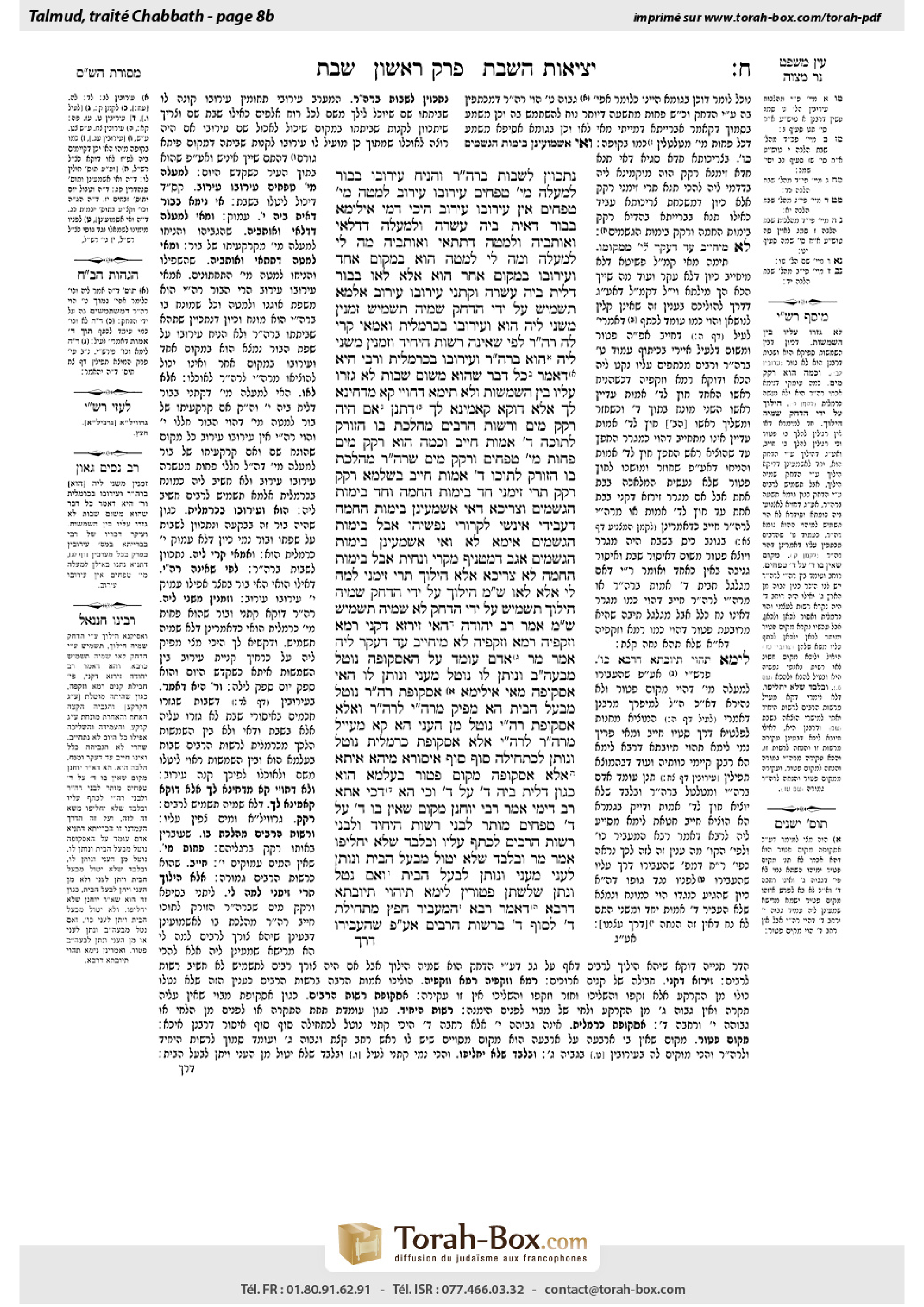
Shabbat 8b: Talmud study for Daf Yomi
Daf Yomi is the daily study of one Talmud folio. Explore 37 tractates with scans, Hebrew text, Sefaria English and AI-generated French translations where annotated.
Passage selection and English or AI-generated French translation are available where the scan has annotations. Daf Study is independent of Torah-Box and Sefaria.
Browse Shabbat · שבת · All tractatesShabbat 8b text and translations
This page of Shabbat includes the Aramaic text, an English translation and an AI-generated French translation, alongside the scan above.
שבת ח׳ ב · Aramaic and Hebrew text
נִתְכַּוֵּון לִשְׁבּוֹת בִּרְשׁוּת הָרַבִּים, וְהִנִּיחַ עֵירוּבוֹ בְּבוֹר לְמַעְלָה מֵעֲשָׂרָה טְפָחִים — עֵירוּבוֹ עֵירוּב. לְמַטָּה מֵעֲשָׂרָה טְפָחִים — אֵין עֵירוּבוֹ עֵירוּב.
הֵיכִי דָּמֵי? אִילֵּימָא בְּבוֹר דְּאִית בֵּיהּ עֲשָׂרָה, וּ״לְמַעְלָה״ — דְּדַלִּאי וְאוֹתְבֵיהּ, וּ״לְמַטָּה״ דְּתַתִּאי וְאוֹתְבֵיהּ, מָה לִי לְמַעְלָה וּמָה לִי לְמַטָּה. הוּא בְּמָקוֹם אֶחָד, וְעֵירוּבוֹ בְּמָקוֹם אַחֵר הוּא.
אֶלָּא לָאו בְּבוֹר דְּלֵית בֵּיהּ עֲשָׂרָה, וְקָתָנֵי עֵירוּבוֹ עֵירוּב. אַלְמָא תַּשְׁמִישׁ עַל יְדֵי הַדְּחָק שְׁמֵיהּ תַּשְׁמִישׁ.
זִמְנִין מְשַׁנֵּי לֵיהּ הוּא וְעֵירוּבוֹ בְּכַרְמְלִית, וְאַמַּאי קָרֵי לַהּ ״רְשׁוּת הָרַבִּים״ — לְפִי שֶׁאֵינָהּ רְשׁוּת הַיָּחִיד.
וְזִמְנִין מְשַׁנֵּי לֵיהּ, הוּא בִּרְשׁוּת הָרַבִּים וְעֵירוּבוֹ בְּכַרְמְלִית. וְרַבִּי הִיא, דְּאָמַר כׇּל דָּבָר שֶׁהוּא מִשּׁוּם שְׁבוּת, לֹא גָּזְרוּ עָלָיו בֵּין הַשְּׁמָשׁוֹת.
וְלָא תֵּימָא דַּחוֹיֵי קָא מְדַחֵינָא לָךְ, אֶלָּא דַּוְקָא קָאָמֵינָא לָךְ. דִּתְנַן: אִם הָיָה רְקָק מַיִם וּרְשׁוּת הָרַבִּים מְהַלֶּכֶת בּוֹ, הַזּוֹרֵק לְתוֹכָהּ אַרְבַּע אַמּוֹת — חַיָּיב. וְכַמָּה הוּא רְקָק מַיִם — פָּחוֹת מֵעֲשָׂרָה טְפָחִים. וּרְקָק מַיִם שֶׁרְשׁוּת הָרַבִּים מְהַלֶּכֶת בּוֹ, הַזּוֹרֵק לְתוֹכוֹ אַרְבַּע אַמּוֹת — חַיָּיב.
בִּשְׁלָמָא ״רְקָק״ ״רְקָק״ תְּרֵי זִימְנֵי, חַד בְּימוֹת הַחַמָּה וְחַד בִּימוֹת הַגְּשָׁמִים. וּצְרִיכָא, דְּאִי אַשְׁמְעִינַן בְּימוֹת הַחַמָּה, דַּעֲבִידִי אִינָשֵׁי לְקָרוֹרֵי נַפְשַׁיְהוּ, אֲבָל בִּימוֹת הַגְּשָׁמִים — אֵימָא לָא. וְאִי אַשְׁמְעִינַן בִּימוֹת הַגְּשָׁמִים, אַגַּב דְּמִטְּנִיף מִקְּרֵי וְנָחֵית, אֲבָל בִּימוֹת הַחַמָּה — לָא. צְרִיכָא.
אֶלָּא הִילּוּךְ תְּרֵי זִימְנֵי לְמָה לִי? אֶלָּא לָאו שְׁמַע מִינַּהּ הִילּוּךְ עַל יְדֵי הַדְּחָק — שְׁמֵיהּ הִילּוּךְ, תַּשְׁמִישׁ עַל יְדֵי הַדְּחָק — לָא שְׁמֵיהּ תַּשְׁמִישׁ. שְׁמַע מִינַּהּ.
אָמַר רַב יְהוּדָה: הַאי זִירְזָא דְּקָנֵי, רְמָא וְזַקְפֵיהּ רְמָא וְזַקְפֵיהּ — לָא מִיחַיַּיב עַד דְּעָקַר לֵיהּ.
אָמַר מָר: אָדָם עוֹמֵד עַל הָאִסְקוּפָּה, נוֹטֵל מִבַּעַל הַבַּיִת וְנוֹתֵן לוֹ, נוֹטֵל מֵעָנִי וְנוֹתֵן לוֹ. הַאי אִסְקוּפָּה מַאי?
אִילֵּימָא אִסְקוּפַּת רְשׁוּת הָרַבִּים — נוֹטֵל מִבַּעַל הַבַּיִת? הָא מַפֵּיק מֵרְשׁוּת הַיָּחִיד לִרְשׁוּת הָרַבִּים!
וְאֶלָּא אִסְקוּפַּת רְשׁוּת הַיָּחִיד — נוֹטֵל מִן הֶעָנִי? הָא קָא מְעַיֵּיל מֵרְשׁוּת הָרַבִּים לִרְשׁוּת הַיָּחִיד!
אֶלָּא אִסְקוּפַּת כַּרְמְלִית — נוֹטֵל וְנוֹתֵן לְכַתְּחִלָּה, סוֹף סוֹף אִיסּוּרָא מִיהָא אִיתָא!
אֶלָּא אִסְקוּפָּה מְקוֹם פָּטוּר בְּעָלְמָא הוּא — כְּגוֹן דְּלֵית בֵּיהּ אַרְבָּעָה עַל אַרְבָּעָה. וְכִי הָא דְּכִי אֲתָא רַב דִּימִי אָמַר רַבִּי יוֹחָנָן: מָקוֹם שֶׁאֵין בּוֹ אַרְבָּעָה עַל אַרְבָּעָה טְפָחִים — מוּתָּר לִבְנֵי רְשׁוּת הַיָּחִיד וְלִבְנֵי רְשׁוּת הָרַבִּים לְכַתֵּף עָלָיו, וּבִלְבַד שֶׁלֹּא יַחֲלִיפוּ.
אָמַר מָר, וּבִלְבַד שֶׁלֹּא יִטּוֹל מִבַּעַל הַבַּיִת וְנוֹתֵן לְעָנִי, מֵעָנִי וְנוֹתֵן לְבַעַל הַבַּיִת. וְאִם נָטַל וְנָתַן — שְׁלָשְׁתָּן פְּטוּרִין. לֵימָא תֶּיהְוֵי תְּיוּבְתָּא דְרָבָא. דְּאָמַר רָבָא: הַמַּעֲבִיר חֵפֶץ מִתְּחִילַּת אַרְבַּע לְסוֹף אַרְבַּע בִּרְשׁוּת הָרַבִּים — אַף עַל פִּי שֶׁהֶעֱבִירוֹ
Shabbat 8b · English translation
One who intended to establish his Shabbat abode in the public domain at a specific site must place food sufficient for two meals for that site to be considered his legal residence. And if he placed the food used for his eiruv in a pit above ten handbreadths, i.e., less than ten handbreadths below ground level, his eiruv is an eiruv. If he placed the eiruv below ten handbreadths from ground level, his eiruv is not an eiruv. Because the pit is a private domain and he may not carry the eiruv from that private domain to a public domain, where he has established his residence, the eiruv is invalid.
The Gemara seeks to clarify the details of this case. What are the exact circumstances? If you say that the baraita is referring to a pit that has ten handbreadths in depth and the phrase: And he placed it above ten handbreadths, means that he raised the eiruv and placed it within ten handbreadths of ground level, and the phrase: Below ten handbreadths, means that he lowered the eiruv and placed it ten handbreadths or more below ground level, what difference does it make to me if the eiruv is above ten handbreadths and what difference does it make to me if it is below ten handbreadths? In any case, the pit is a private domain, and the principle states that the private domain extends from its lowest point to the sky. There is no difference whether the eiruv was placed higher or lower. In any case, he is in one place, in the public domain, and his eiruv is in another place, in the private domain. Since he cannot take the eiruv out of the pit, his eiruv is not an eiruv.
Rather, is the baraita not referring to a pit that does not have in it a depth of ten handbreadths? And the baraita should be understood as follows: If he placed his eiruv below ten handbreadths, refers to a pit whose lowest point is ten handbreadths or more below ground level. If he placed his eiruv above ten handbreadths, refers to a pit that is less than ten handbreadths deep and is not a private domain. And, with regard to that case, it was taught that his eiruv is an eiruv. Consequently, usage under duress in a pit that is less than ten handbreadths deep is considered usage, and a pit of that kind is a full-fledged part of the public domain.
Rava suggested various responses to this objection. At times he would answer him that it is referring to a case where both he and his eiruv are in a karmelit, i.e., that he intended to establish residence in a karmelit and placed his eiruv there. The pit is less than ten handbreadths deep, and consequently, both he and his eiruv are in the same domain. And why does the baraita call his place of residence the public domain? Because it is not the private domain.
And at times he would answer him that it is referring to a case where he was, indeed, in the public domain and his eiruv was in a karmelit, as a pit that is not ten handbreadths deep is not part of the public domain, rather it is a karmelit. With regard to the question, how can this be considered a legitimate eiruv as it is forbidden to carry from a karmelit to a public domain as well, this baraita is in accordance with the opinion of Rabbi Yehuda HaNasi, who said: Anything that is prohibited on Shabbat and its prohibition is not by Torah law, rather it is due to a rabbinic decree [shevut], the Sages did not issue the decree to apply during twilight, which is neither definitive day nor definitive night. Consequently, at the time that the eiruv was placed in the karmelit it was permissible for him to carry it to the public domain. Since an eiruv takes effect even if it is fit for use just one moment during twilight on Shabbat eve, his eiruv is effective.
And Rava said to Rav Adda bar Mattana: Do not say that I am just putting you off with these answers. Rather, what I am saying to you is accurate. The opinion that usage under duress is not considered usage is a bona fide opinion and the suggested answers are appropriate explanations of that baraita. As we learned in a mishna: If there was a swamp and the public domain passes through it, one who throws an object into it at a distance of four cubits is liable just like anyone who carried four cubits in the public domain. And how deep is this swamp? It is less than ten handbreadths. The mishna adds: And with regard to a swamp that the public domain passes through it, one who throws four cubits into the swamp is liable.
The difficulty concerning the repetition of the same topic with virtually identical words is clear, and therefore: Granted, it is possible to explain, that swamp swamp was repeated twice; one case is referring to the summer, and one case is referring to the rainy season. And it is necessary to emphasize that this ruling is in effect both in the summer and in the winter. As, had the mishna told us this halakha only in the summer, we would have said that since people commonly pass through the swamp to cool themselves, it is considered part of the public domain. However, in the rainy season I would have said it is not part of the public domain. And conversely, had the mishna told us this halakha only in the rainy season, I would have said that since he is filthy anyway, it happens that he is not cautious and enters into the swamp. However, in the summer, when he is not dirty with mud, I would have said that it is not part of the public domain. Therefore, it was necessary for the mishna to repeat swamp twice, to teach us that this halakha applies at all times.
However, why do I need the mishna to state twice that the public domain passes through that swamp? Rather, shouldn’t one conclude from this that passage, even when it is under duress, and not free and easy, is considered passage, but usage under duress is not considered usage? It was necessary to emphasize that the public domain actually passes through it. If the multitudes do not pass through it and it was only used under duress, it would not have been considered a public domain. The Gemara concludes: Indeed conclude from this.
Somewhat related to the case of the barrel discussed earlier which was a case of moving an object without liability, the Gemara cites that Rav Yehuda said: That bundle of reeds that he stood upright and threw down, stood upright and threw down repeatedly, he is not liable for carrying it four cubits in the public domain until he lifts it off the ground. As long as he did not lift it from the ground, even though he moved it a long way, he did not perform the acts of lifting and placing which are prohibited by Torah law, as at least one part of the bundle always remained on the ground.
The Master said: A person standing on the threshold may take an object from the homeowner standing in the private domain and may give an object to him. Similarly, while standing there, he may take an object from a poor person standing in the public domain and may give an object to him because there is no element of prohibition or liability in carrying in and carrying out in an exempt domain on Shabbat. The Gemara asks: This threshold, what is it; to what type of threshold is it referring? Different thresholds have different halakhic status.
If you say that it is referring to a threshold that is the public domain, i.e., the threshold of an alleyway that is fewer than three handbreadths off the ground and is not covered, and the post that demarcates the parameters of the alleyway is situated between the public domain and the alleyway, how can the Tosefta say that he may take an object from the homeowner? Isn’t he carrying out from the private domain to the public domain?
Rather, say that the Tosefta is referring to a threshold that is the private domain, in a case where it is covered, or it is situated between the post that demarcates the parameters of the alleyway and the private domain, or it is ten handbreadths high and its area is at least four by four handbreadths. How then can the Tosefta say that he may take an object from a poor person? Isn’t he carrying in from the public domain to the private domain?
Rather, say that the Tosefta is referring to a threshold that is a karmelit, i.e., it is not ten handbreadths high and it is four by four handbreadths; how can the Tosefta say that he may take and give even ab initio? Ultimately, in this case, there is nevertheless a prohibition. Even though a karmelit does not engender liability by Torah law, carrying from it is prohibited by rabbinic law and is certainly not permitted ab initio.
Rather, say that the Tosefta is referring to a threshold that is merely an exempt domain, and therefore there is no prohibition at all. In what circumstances is it an exempt domain? In a case where it does not have an area of four by four handbreadths, and it is therefore not considered a domain with regard to liability on Shabbat. And that halakha is similar to that statement made when Rav Dimi came from Eretz Yisrael to Babylonia and he said that Rabbi Yoḥanan said: A place that does not have an area of four by four handbreadths and is set apart, it is permissible for both the people of the private domain and for the people of the public domain to adjust the burden on their shoulders upon it on Shabbat, as long as they do not exchange objects between them from one domain to the other domain.
The Master also said in the Tosefta: A person standing on the threshold may take an object from the homeowner and give an object to him, and he may take an object from the poor person or give an object to him, as long as he does not take the object from the homeowner and give it to a poor person or from a poor person and give it to the homeowner. And, however, if he took an object from one and gave it to the other, certainly no labor prohibited by Torah law was performed in that case, and all three of them are exempt. The Gemara asks: Say that this will be a conclusive refutation of Rava’s opinion, as Rava said: One who transfers an object from the beginning of four cubits to the end of four cubits in the public domain, even though he transferred it above the upper boundary of the public domain
Shabbat 8b · Traduction française (IA)
Celui qui avait l’intention d’établir son lieu de résidence pour Chabbat dans le domaine public, à un endroit précis, doit y déposer de la nourriture suffisante pour deux repas afin que cet endroit soit considéré comme sa résidence légale. S’il a placé la nourriture servant à son érouv dans une fosse, à plus de dix palmes de profondeur, c’est-à-dire à moins de dix palmes sous le niveau du sol, son érouv est valable. S’il a placé l’érouv à plus de dix palmes sous le niveau du sol, son érouv n’est pas valable. En effet, la fosse est un domaine privé et il ne peut pas transporter l’érouv de ce domaine privé vers le domaine public où il a établi sa résidence ; l’érouv est donc invalide.
La Guemara cherche à préciser les circonstances de ce cas. De quoi s’agit-il exactement ? Si tu dis que la baraïta parle d’une fosse profonde de dix palmes et que l’expression « il l’a placé au-dessus de dix palmes » signifie qu’il a remonté l’érouv et l’a placé à moins de dix palmes sous le niveau du sol, tandis que l’expression « au-dessous de dix palmes » signifie qu’il l’a abaissé et placé à dix palmes ou davantage sous le niveau du sol, quelle différence cela fait-il que l’érouv soit au-dessus ou au-dessous de dix palmes ? Dans les deux cas, la fosse est un domaine privé, et le principe veut que le domaine privé s’étende depuis son point le plus bas jusqu’au ciel. Peu importe donc que l’érouv ait été placé plus haut ou plus bas : dans tous les cas, lui se trouve à un endroit, dans le domaine public, tandis que son érouv se trouve à un autre endroit, dans le domaine privé. Puisqu’il ne peut pas sortir l’érouv de la fosse, son érouv n’est pas valable.
Ne faut-il pas plutôt dire que la baraïta parle d’une fosse qui n’a pas une profondeur de dix palmes ? Il faut comprendre la baraïta ainsi : « S’il a placé son érouv au-dessous de dix palmes » désigne une fosse dont le point le plus bas se trouve à dix palmes ou davantage sous le niveau du sol. « S’il a placé son érouv au-dessus de dix palmes » désigne une fosse de moins de dix palmes de profondeur, qui n’est pas un domaine privé. C’est à propos de ce cas qu’il a été enseigné que son érouv est valable. Par conséquent, un usage effectué sous la contrainte dans une fosse de moins de dix palmes de profondeur est considéré comme un usage, et une fosse de ce type fait pleinement partie du domaine public.
Rava proposait différentes réponses à cette objection. Parfois, il lui répondait que la baraïta parle d’un cas où l’homme et son érouv se trouvent tous deux dans une karmélite : il avait l’intention d’établir sa résidence dans une karmélite et y avait placé son érouv. La fosse a moins de dix palmes de profondeur et, par conséquent, lui et son érouv se trouvent dans le même domaine. Pourquoi la baraïta désigne-t-elle son lieu de résidence comme le domaine public ? Parce qu’il ne s’agit pas du domaine privé.
D’autres fois, il lui répondait que la baraïta parle d’un cas où l’homme se trouvait effectivement dans le domaine public, tandis que son érouv se trouvait dans une karmélite, car une fosse qui n’a pas dix palmes de profondeur ne fait pas partie du domaine public : c’est une karmélite. À la question de savoir comment cela peut être considéré comme un érouv valable, puisqu’il est également interdit de transporter d’une karmélite vers le domaine public, la réponse est que cette baraïta suit l’opinion de Rabbi Yehouda HaNassi, qui a dit : tout ce qui est interdit pendant Chabbat sans que l’interdiction relève de la Torah, mais seulement d’un décret rabbinique [shevut], n’a pas été soumis à ce décret par les Sages pendant le crépuscule, qui n’est ni véritablement le jour ni véritablement la nuit. Par conséquent, au moment où l’érouv a été placé dans la karmélite, il pouvait le transporter vers le domaine public. Comme un érouv prend effet dès lors qu’il est utilisable ne serait-ce qu’un seul instant pendant le crépuscule de la veille de Chabbat, son érouv est valable.
Rava dit à Rav Adda bar Mattana : « Ne dis pas que je cherche seulement à éluder tes questions par ces réponses. Ce que je te dis est exact. L’opinion selon laquelle un usage effectué sous la contrainte n’est pas considéré comme un usage est une opinion authentique, et les réponses proposées sont des explications appropriées de cette baraïta. » En effet, nous avons appris dans une Michna : s’il y avait un marécage que traversait le domaine public, celui qui y jette un objet à une distance de quatre coudées est passible, comme toute personne qui transporte un objet sur quatre coudées dans le domaine public. Quelle est la profondeur de ce marécage ? Elle est inférieure à dix palmes. La Michna ajoute : dans le cas d’un marécage que traverse le domaine public, celui qui y jette un objet sur une distance de quatre coudées est passible.
La difficulté que pose la répétition, presque dans les mêmes termes, du même sujet est évidente. Certes, on peut expliquer que le mot « marécage » a été répété deux fois : un cas concerne l’été et l’autre la saison des pluies. Il était nécessaire de souligner que cette halakha s’applique aussi bien en été qu’en hiver. Car si la Michna nous avait enseigné cette halakha uniquement pour l’été, nous aurions dit que, puisque les gens traversent couramment le marécage pour se rafraîchir, celui-ci est considéré comme faisant partie du domaine public. Mais, pour la saison des pluies, j’aurais dit qu’il n’en fait pas partie. À l’inverse, si la Michna nous avait enseigné cette halakha uniquement pour la saison des pluies, j’aurais dit que, comme il est déjà couvert de boue, il lui arrive de ne pas faire attention et d’entrer dans le marécage. Mais, en été, lorsqu’il n’est pas couvert de boue, j’aurais dit que le marécage ne fait pas partie du domaine public. Il fallait donc que la Michna répète deux fois le mot « marécage », afin de nous enseigner que cette halakha s’applique en toute saison.
Cependant, pourquoi la Michna doit-elle préciser deux fois que le domaine public traverse ce marécage ? Ne faut-il pas plutôt en conclure que le passage, même lorsqu’il se fait sous la contrainte et n’est ni libre ni facile, est considéré comme un passage, tandis qu’un usage effectué sous la contrainte n’est pas considéré comme un usage ? Il était nécessaire de souligner que le domaine public le traverse effectivement. Si la foule ne le traversait pas et qu’on ne l’empruntait que sous la contrainte, il n’aurait pas été considéré comme un domaine public. La Guemara conclut : conclus effectivement de là.
En rapport avec le cas du tonneau évoqué précédemment, où il s’agissait de déplacer un objet sans encourir de responsabilité, la Guemara rapporte que Rav Yehouda a dit : si quelqu’un a redressé cette botte de roseaux puis l’a jetée à terre, et l’a redressée puis jetée à terre à plusieurs reprises, il n’est pas passible pour l’avoir transportée sur quatre coudées dans le domaine public tant qu’il ne l’a pas soulevée du sol. Tant qu’il ne l’a pas soulevée du sol, même s’il l’a déplacée sur une longue distance, il n’a pas accompli les actes de soulèvement et de dépôt interdits par la Torah, puisqu’une partie de la botte est toujours restée au sol.
Le maître a dit : une personne qui se tient sur le seuil peut prendre un objet au propriétaire de la maison, qui se tient dans le domaine privé, et peut lui en donner un. De même, tout en restant là, elle peut prendre un objet à un pauvre qui se tient dans le domaine public et peut lui en donner un, car transporter un objet dans un domaine exempt de responsabilité pendant Chabbat ne comporte ni interdiction ni responsabilité. La Guemara demande : de quel type de seuil s’agit-il ? Les différents seuils ont des statuts halakhiques différents.
Si tu dis qu’il s’agit d’un seuil qui relève du domaine public, c’est-à-dire le seuil d’une ruelle situé à moins de trois palmes du sol et non couvert, tandis que le poteau qui délimite la ruelle se trouve entre le domaine public et la ruelle, comment la Tossefta peut-elle dire qu’il peut prendre un objet au propriétaire de la maison ? Ne le transporte-t-il pas du domaine privé vers le domaine public ?
Dis plutôt que la Tossefta parle d’un seuil qui relève du domaine privé, dans un cas où il est couvert, ou bien où il se trouve entre le poteau qui délimite la ruelle et le domaine privé, ou encore où il a dix palmes de hauteur et une surface d’au moins quatre palmes sur quatre. Comment la Tossefta peut-elle alors dire qu’il peut prendre un objet à un pauvre ? Ne le transporte-t-il pas du domaine public vers le domaine privé ?
Dis plutôt que la Tossefta parle d’un seuil qui est une karmélite, c’est-à-dire qui n’a pas dix palmes de hauteur et mesure quatre palmes sur quatre. Comment la Tossefta peut-elle dire qu’il peut y prendre et y déposer des objets, même a priori ? Dans ce cas, il y a tout de même une interdiction. Même si une karmélite n’entraîne pas de responsabilité au regard de la Torah, transporter depuis celle-ci est interdit par décret rabbinique et n’est certainement pas permis a priori.
Dis plutôt que la Tossefta parle d’un seuil qui constitue simplement un domaine exempt de responsabilité ; il n’y a donc aucune interdiction. Dans quelles circonstances s’agit-il d’un domaine exempt de responsabilité ? Lorsque sa surface est inférieure à quatre palmes sur quatre ; il n’est alors pas considéré comme un domaine pour ce qui concerne la responsabilité pendant Chabbat. Cette halakha est semblable à celle énoncée par Rav Dimi lorsqu’il vint d’Eretz Israël en Babylonie : il rapporta que Rabbi Yoḥanan avait dit qu’un endroit dont la surface est inférieure à quatre palmes sur quatre et qui est isolé peut être utilisé pendant Chabbat par les personnes du domaine privé comme par celles du domaine public pour rajuster leur charge sur leurs épaules, à condition qu’elles n’échangent pas d’objets entre elles d’un domaine à l’autre.
Le maître a également dit dans la Tossefta : une personne qui se tient sur le seuil peut prendre un objet au propriétaire de la maison et lui en donner un ; elle peut aussi prendre un objet au pauvre ou lui en donner un, à condition de ne pas prendre un objet au propriétaire de la maison pour le donner à un pauvre, ni de prendre un objet à un pauvre pour le donner au propriétaire de la maison. Cependant, si elle a pris un objet à l’un et l’a donné à l’autre, aucune activité interdite par la Torah n’a assurément été accomplie dans ce cas, et les trois personnes sont exemptes. La Guemara demande : faut-il en conclure une réfutation décisive de l’opinion de Rava ? Car Rava a dit : celui qui transporte un objet du début à la fin d’une distance de quatre coudées dans le domaine public, même s’il l’a transporté au-dessus de la limite supérieure du domaine public
Traduction française générée par IA à partir de l’édition anglaise de Sefaria. Vérifie toujours un passage avec le texte source.
Text from Sefaria: William Davidson Edition - Vocalized Aramaic (CC BY NC); William Davidson Edition - English (CC BY NC).