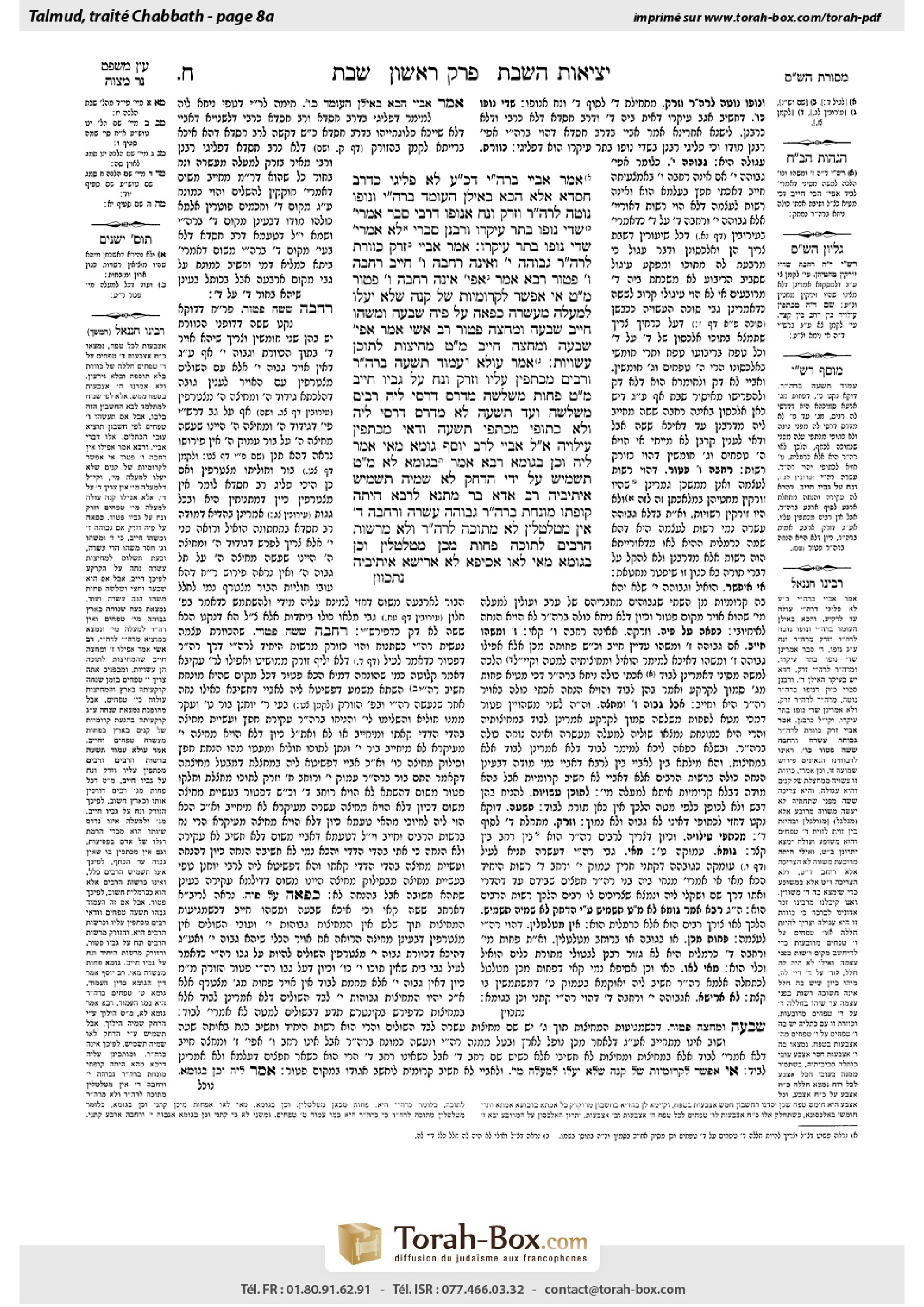
Shabbat 8a: Talmud study for Daf Yomi
Daf Yomi is the daily study of one Talmud folio. Explore 37 tractates with scans, Hebrew text, Sefaria English and AI-generated French translations where annotated.
Passage selection and English or AI-generated French translation are available where the scan has annotations. Daf Study is independent of Torah-Box and Sefaria.
Browse Shabbat · שבת · All tractatesShabbat 8a text and translations
This page of Shabbat includes the Aramaic text, an English translation and an AI-generated French translation, alongside the scan above.
שבת ח׳ א · Aramaic and Hebrew text
אָמַר אַבָּיֵי: בִּרְשׁוּת הַיָּחִיד דְּכוּלֵּי עָלְמָא לָא פְּלִיגִי כִּדְרַב חִסְדָּא, אֶלָּא הָכָא — בְּאִילָן הָעוֹמֵד בִּרְשׁוּת הַיָּחִיד וְנוֹפוֹ נוֹטֶה לִרְשׁוּת הָרַבִּים, וְזָרַק וְנָח אַנּוֹפוֹ, דְּרַבִּי סָבַר אָמְרִינַן ״שְׁדִי נוֹפוֹ בָּתַר עִיקָּרוֹ״. וְרַבָּנַן סָבְרִי לָא אָמְרִינַן ״שְׁדִי נוֹפוֹ בָּתַר עִיקָּרוֹ״.
אָמַר אַבָּיֵי: זָרַק כַּוֶּורֶת לִרְשׁוּת הָרַבִּים, גְּבוֹהָה עֲשָׂרָה וְאֵינָהּ רְחָבָה שִׁשָּׁה — חַיָּיב. רְחָבָה שִׁשָּׁה — פָּטוּר.
רָבָא אָמַר: אֲפִילּוּ אֵינָהּ רְחָבָה שִׁשָּׁה — פָּטוּר. מַאי טַעְמָא? — אִי אֶפְשָׁר לִקְרוּמִיּוֹת שֶׁל קָנֶה שֶׁלֹּא יַעֲלוּ לְמַעְלָה מֵעֲשָׂרָה.
כְּפָאָהּ עַל פִּיהָ, שִׁבְעָה וּמַשֶּׁהוּ — חַיָּיב. שִׁבְעָה וּמֶחֱצָה — פָּטוּר.
רַב אָשֵׁי אָמַר: אֲפִילּוּ שִׁבְעָה וּמֶחֱצָה — חַיָּיב. מַאי טַעְמָא? — מְחִיצּוֹת לְתוֹכָן עֲשׂוּיוֹת.
אָמַר עוּלָּא: עַמּוּד תִּשְׁעָה בִּרְשׁוּת הָרַבִּים וְרַבִּים מְכַתְּפִין עָלָיו, וְזָרַק וְנָח עַל גַּבָּיו — חַיָּיב. מַאי טַעְמָא? — פָּחוֹת מִשְּׁלֹשָׁה מִדְרָס דָּרְסִי לֵיהּ רַבִּים. מִשְּׁלֹשָׁה וְעַד תִּשְׁעָה — לָא מִדְרָס דָּרְסִי לֵיהּ וְלָא כַּתּוֹפֵי מְכַתְּפִי. תִּשְׁעָה וַדַּאי מְכַתְּפִין עִילָּוֵיהּ.
אֲמַר לֵיהּ אַבָּיֵי לְרַב יוֹסֵף: גּוּמָּא מַאי? אֲמַר לֵיהּ: וְכֵן בְּגוּמָּא. רָבָא אָמַר: בְּגוּמָּא לָא. מַאי טַעְמָא? — תַּשְׁמִישׁ עַל יְדֵי הַדְּחָק לָא שְׁמֵיהּ תַּשְׁמִישׁ.
אֵיתִיבֵיהּ רַב אַדָּא בַּר מַתְנָא לְרָבָא: הָיְתָה קוּפָּתוֹ מוּנַּחַת בִּרְשׁוּת הָרַבִּים גְּבוֹהָה עֲשָׂרָה וּרְחָבָה אַרְבָּעָה — אֵין מְטַלְטְלִין לֹא מִתּוֹכָהּ לִרְשׁוּת הָרַבִּים וְלֹא מֵרְשׁוּת הָרַבִּים לְתוֹכָהּ. פָּחוֹת מִכֵּן — מְטַלְטְלִין. וְכֵן בְּגוּמָּא. מַאי לָאו אַסֵּיפָא: לָא, אַרֵישָׁא.
אֵיתִיבֵיהּ:
Shabbat 8a · English translation
Regarding this assertion, Abaye said: In the private domain, everyone agrees that the halakha is in accordance with the opinion of Rav Ḥisda, i.e., that the private domain is considered one entity filled from the ground to the sky. However, here this baraita is referring to a special case involving a tree standing in the private domain and its boughs lean into the public domain, and one threw an object from the public domain and it rested upon the boughs of the tree. Rabbi Yehuda HaNasi holds that we say: Cast its boughs after its trunk. The tree’s branches are considered an extension of its trunk, therefore the entire tree is considered a private domain, and one who throws onto it is liable. And the Rabbis hold that we do not say: Cast its boughs after its trunk, and therefore the boughs themselves are not considered to be a private domain, but rather an exempt domain, and one who throws atop them from the public domain is not liable.
Abaye said: One who threw a round reed barrel into the public domain, and the barrel is ten handbreadths high and its diameter is not six handbreadths wide, is liable. Since its diameter is less than six handbreadths, its area can fit the area of four handbreadths squared. Therefore, this barrel is considered an object, and if he threw it from the private domain to the public domain he is liable. However, if the diameter of the barrel was six handbreadths wide, he is exempt. Since the area of the barrel is greater than the area of four handbreadths squared, it is considered an independent private domain, and he did not perform an act of throwing an object from one domain to another domain.
Rava said: Even if it was not six handbreadths wide he is exempt. What is the reason for this? He is exempt because it is impossible that the ends of the reeds protruding from the weave of the barrel will not extend above ten handbreadths. Consequently, the entire barrel never entered the public domain, as part of it remains in a non-liable place, i.e., ten handbreadths off the ground of the public domain.
If he turned the barrel that is less than six handbreadths wide over on its mouth, i.e., if he threw it with its mouth facing down, even if the barrel was only seven handbreadths and a bit high, he is still liable, as the legal status of this barrel is equivalent to that of any other object that lands there. However, if the height of this barrel was seven and a half handbreadths, he is exempt. Within three handbreadths of the ground, the principle of lavud takes effect: An object within three handbreadths of the ground has the legal status of being connected to the ground. The sides of the barrel extend to the ground and then it is considered as if the barrel already touched the ground of the public domain, even though it is actually still three handbreadths away, while its upper part remains an exempt domain. It is as if this was a barrel higher than ten handbreadths.
Rav Ashi said: Even if the height of the barrel was seven and a half handbreadths, he is liable, as the sides of the barrel are not considered to be higher than they are in reality. What is the reason for this? The reason is because partitions are made exclusively for the inside of the barrel. The sides of the barrel play no role beyond the barrel itself, and therefore there is no room to extend the sides by means of the principle of lavud. Therefore, if the barrel itself is not higher than ten handbreadths, it is merely an object.
Ulla said: A pillar that is nine handbreadths high, standing in the public domain, and many people adjust the burden on their shoulders upon it, and one threw an object from the private domain and it rested atop the pillar, he is liable. What is the reason for this? It is based on this principle: Anything protruding from the public domain: If it is less than three handbreadths off the ground, and the multitudes step on it, it is considered to be part of the ground. If it is from three to nine handbreadths, they, the multitudes, neither step on it nor adjust the burden on their shoulders on it, and it is not considered part of the public domain. However, a protrusion nine handbreadths high, certainly the multitudes adjust the burden on their shoulders on it. Since the multitudes utilize it, it is considered a public domain, despite its height.
Based on Ulla’s statement, Abaye said to Rav Yosef: A hole in the ground of the public domain, which is several handbreadths deep, what is its legal status? Is it also considered, in accordance with Ulla’s principle, part of the public domain? In general, with regard to the halakhot of Shabbat, there is no distinction between an area elevated above its surroundings and an area depressed below its surroundings. Rav Yosef said to him: And the same is true in a hole; these halakhot apply. Rava said: In a hole, these halakhot do not apply. What is the reason for this? Since use under duress is not considered use, and the use of a pit even if it is nine handbreadths deep is inconvenient, and it is not comparable to a pillar of the same height.
Rav Adda bar Mattana raised an objection to Rava’s opinion from that which was taught in a baraita: One whose basket was placed in the public domain and it was ten handbreadths high and four wide, one may neither move an object from it to the public domain nor from the public domain to it, since its legal status is that of a private domain. If it were less than that height, one may carry from it to the public domain and vice versa. The baraita adds: And the same is true for a hole. Is this statement not referring to the latter clause of the baraita: One may carry from a pit which is less than ten handbreadths deep to the public domain? This supports the opinion of Rav Yosef, that a hole is subsumed within the public domain. Rava rejected this: This statement is not referring to the latter clause of the baraita, but rather to the first clause of the baraita: It is like a basket in that one may not carry from a hole ten handbreadths deep to the public domain because it is a full-fledged private domain. However, no conclusion may be drawn with regard to a hole less than ten handbreadths deep.
Rav Adda bar Mattana raised another objection to Rava’s opinion from what was taught in a different baraita, which deals with the laws of joining of borders:
Shabbat 8a · Traduction française (IA)
À propos de cette affirmation, Abayé dit : Dans le domaine privé, tous conviennent que la halakha suit l’opinion de Rav Ḥisda, c’est-à-dire que le domaine privé est considéré comme un seul espace s’étendant du sol jusqu’au ciel. Toutefois, ici, cette baraïta traite d’un cas particulier : un arbre se dresse dans le domaine privé et ses branches s’inclinent dans le domaine public ; quelqu’un a lancé un objet depuis le domaine public, et celui-ci s’est posé sur les branches de l’arbre. Rabbi Yehouda HaNassi estime qu’on applique le principe suivant : « Considère les branches comme le tronc. » Les branches de l’arbre sont considérées comme un prolongement de son tronc ; l’arbre entier est donc considéré comme faisant partie du domaine privé, et celui qui lance un objet dessus est passible. Les Rabbins, eux, estiment qu’on n’applique pas le principe « Considère les branches comme le tronc » ; les branches elles-mêmes ne sont donc pas considérées comme faisant partie du domaine privé, mais comme un domaine exempt, et celui qui lance un objet dessus depuis le domaine public n’est pas passible.
Abayé dit : Celui qui lance un tonneau rond en roseaux dans le domaine public est passible si le tonneau mesure dix téfaḥim de hauteur et si son diamètre est inférieur à six téfaḥim. Comme son diamètre est inférieur à six téfaḥim, sa surface peut tenir dans un carré de quatre téfaḥim de côté. Le tonneau est donc considéré comme un objet, et celui qui le lance du domaine privé au domaine public est passible. En revanche, si le diamètre du tonneau est de six téfaḥim, il est exempt. Comme sa surface dépasse celle d’un carré de quatre téfaḥim de côté, il est considéré comme un domaine privé indépendant, et il n’a pas accompli un acte consistant à lancer un objet d’un domaine à un autre.
Rava dit : Même si son diamètre est inférieur à six téfaḥim, il est exempt. Pour quelle raison ? Parce qu’il est impossible que les extrémités des roseaux qui dépassent de la trame du tonneau ne s’élèvent pas au-dessus de dix téfaḥim. Par conséquent, le tonneau entier n’est jamais entré dans le domaine public, puisqu’une partie en demeure dans un lieu où l’on n’est pas passible, c’est-à-dire à dix téfaḥim au-dessus du sol du domaine public.
S’il a retourné le tonneau dont le diamètre est inférieur à six téfaḥim, de sorte qu’il repose sur son ouverture, c’est-à-dire s’il l’a lancé ouverture vers le bas, il est passible même si le tonneau ne mesurait que sept téfaḥim et un peu plus de hauteur, car son statut halakhique équivaut à celui de tout autre objet qui se pose à cet endroit. Toutefois, si le tonneau mesurait sept téfaḥim et demi de hauteur, il est exempt. À moins de trois téfaḥim du sol, le principe de lavoud s’applique : un objet situé à moins de trois téfaḥim du sol est considéré, du point de vue halakhique, comme y étant relié. Les parois du tonneau se prolongent jusqu’au sol ; on considère alors que le tonneau a déjà touché le sol du domaine public, bien qu’il se trouve en réalité à trois téfaḥim au-dessus de celui-ci, tandis que sa partie supérieure demeure dans un domaine exempt. C’est comme s’il s’agissait d’un tonneau de plus de dix téfaḥim de haut.
Rav Achi dit : Même si le tonneau mesurait sept téfaḥim et demi de hauteur, il est passible, car les parois du tonneau ne sont pas considérées comme dépassant leur hauteur réelle. Pour quelle raison ? Parce que les parois ne sont faites que pour l’intérieur du tonneau. Elles n’ont aucun rôle au-delà du tonneau lui-même ; il n’y a donc pas lieu de les prolonger en appliquant le principe de lavoud. Par conséquent, si le tonneau lui-même ne dépasse pas dix téfaḥim de hauteur, il n’est qu’un objet.
Oulla dit : Un pilier de neuf téfaḥim de hauteur se dresse dans le domaine public, et de nombreuses personnes y ajustent la charge qu’elles portent sur leurs épaules. Si quelqu’un lance un objet du domaine privé et que celui-ci se pose au sommet du pilier, il est passible. Pour quelle raison ? Cela repose sur le principe suivant : tout élément qui fait saillie dans le domaine public, s’il se trouve à moins de trois téfaḥim du sol et que la foule marche dessus, est considéré comme faisant partie du sol. S’il se trouve entre trois et neuf téfaḥim, la foule ne marche pas dessus et n’y ajuste pas la charge portée sur ses épaules ; il n’est donc pas considéré comme faisant partie du domaine public. En revanche, sur une saillie située à neuf téfaḥim de hauteur, la foule ajuste certainement la charge qu’elle porte sur ses épaules. Puisque la foule s’en sert, cet élément est considéré comme appartenant au domaine public, malgré sa hauteur.
À partir de la déclaration d’Oulla, Abayé dit à Rav Yossef : Quel est le statut halakhique d’un trou dans le sol du domaine public, profond de plusieurs téfaḥim ? Est-il lui aussi considéré, conformément au principe d’Oulla, comme faisant partie du domaine public ? En général, concernant les halakhot de Chabbat, il n’y a pas de différence entre un espace surélevé par rapport à son environnement et un espace situé en contrebas. Rav Yossef lui répondit : Il en va de même pour un trou ; ces halakhot s’y appliquent. Rava dit : Ces halakhot ne s’appliquent pas à un trou. Pour quelle raison ? Parce qu’un usage effectué sous la contrainte n’est pas considéré comme un usage, et qu’il est peu commode d’utiliser une fosse, même profonde de neuf téfaḥim ; elle n’est donc pas comparable à un pilier de même hauteur.
Rav Adda bar Mattana objecta à l’opinion de Rava à partir de ce qui a été enseigné dans une baraïta : Si le panier de quelqu’un est posé dans le domaine public, qu’il mesure dix téfaḥim de hauteur et quatre téfaḥim de largeur, il est interdit d’en déplacer un objet vers le domaine public ou du domaine public vers le panier, car son statut halakhique est celui d’un domaine privé. S’il mesure moins de dix téfaḥim de hauteur, il est permis de transporter du panier vers le domaine public et réciproquement. La baraïta ajoute : « Il en va de même pour un trou. » Cette affirmation ne se rapporte-t-elle pas à la dernière partie de la baraïta, qui dit qu’il est permis de transporter vers le domaine public depuis une fosse de moins de dix téfaḥim de profondeur ? Cela étaye l’opinion de Rav Yossef, selon laquelle un trou est inclus dans le domaine public. Rava rejeta cette interprétation : Cette affirmation ne se rapporte pas à la dernière partie de la baraïta, mais à sa première partie : le trou est comparable à un panier, en ce qu’il est interdit de transporter vers le domaine public depuis un trou profond de dix téfaḥim, car il constitue un domaine privé à part entière. Toutefois, on ne peut tirer aucune conclusion concernant un trou de moins de dix téfaḥim de profondeur.
Rav Adda bar Mattana objecta encore à l’opinion de Rava à partir de ce qui a été enseigné dans une autre baraïta, qui traite des lois de l’association des limites :
Traduction française générée par IA à partir de l’édition anglaise de Sefaria. Vérifie toujours un passage avec le texte source.
Text from Sefaria: William Davidson Edition - Vocalized Aramaic (CC BY NC); William Davidson Edition - English (CC BY NC).