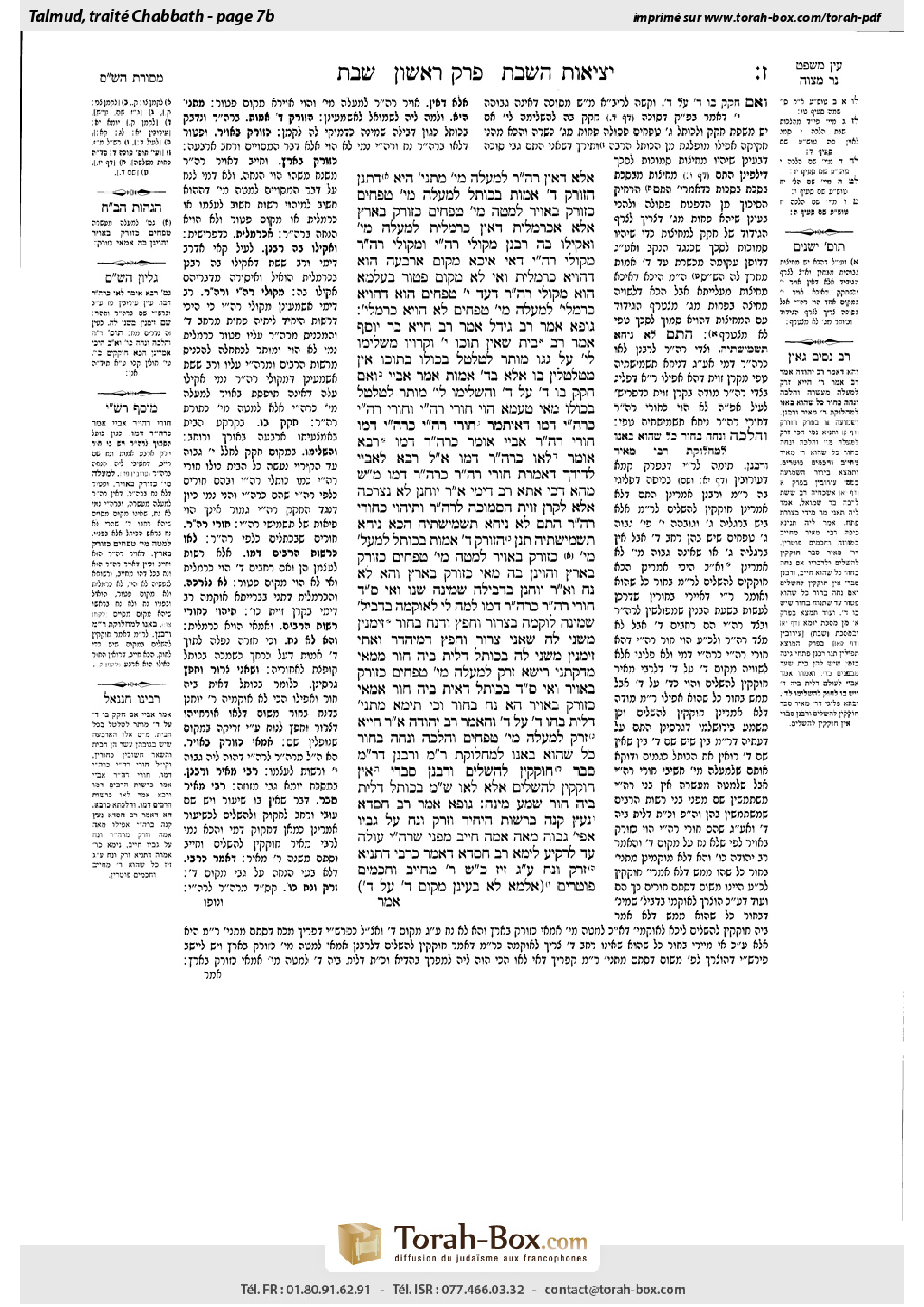
Shabbat 7b: Talmud study for Daf Yomi
Daf Yomi is the daily study of one Talmud folio. Explore 37 tractates with scans, Hebrew text, Sefaria English and AI-generated French translations where annotated.
Passage selection and English or AI-generated French translation are available where the scan has annotations. Daf Study is independent of Torah-Box and Sefaria.
Browse Shabbat · שבת · All tractatesShabbat 7b text and translations
This page of Shabbat includes the Aramaic text, an English translation and an AI-generated French translation, alongside the scan above.
שבת ז׳ ב · Aramaic and Hebrew text
אֶלָּא דְּאֵין רְשׁוּת הָרַבִּים לְמַעְלָה מֵעֲשָׂרָה — מַתְנִיתִין הִיא! דִּתְנַן: הַזּוֹרֵק אַרְבַּע אַמּוֹת בַּכּוֹתֶל, לְמַעְלָה מֵעֲשָׂרָה טְפָחִים — כְּזוֹרֵק בָּאֲוִיר. לְמַטָּה מֵעֲשָׂרָה טְפָחִים — כְּזוֹרֵק בָּאָרֶץ.
אֶלָּא כַּרְמְלִית, דְּאֵין כַּרְמְלִית לְמַעְלָה מֵעֲשָׂרָה. וְאַקִּילוּ בַּהּ רַבָּנַן מִקּוּלֵּי רְשׁוּת הַיָּחִיד וּמִקּוּלֵּי רְשׁוּת הָרַבִּים. מִקּוּלֵּי רְשׁוּת הַיָּחִיד — דְּאִי אִיכָּא מָקוֹם אַרְבָּעָה הוּא דְּהָוְיָא כַּרְמְלִית, וְאִי לָא — מְקוֹם פָּטוּר בְּעָלְמָא הוּא. מִקּוּלֵּי רְשׁוּת הָרַבִּים — דְּעַד עֲשָׂרָה טְפָחִים הוּא דְּהָוְיָא כַּרְמְלִית, לְמַעְלָה מֵעֲשָׂרָה טְפָחִים לָא הָוְיָא כַּרְמְלִית.
גּוּפָא, אָמַר רַב גִּידֵּל אָמַר רַב חִיָּיא בַּר יוֹסֵף אָמַר רַב: בַּיִת שֶׁאֵין תּוֹכוֹ עֲשָׂרָה וְקֵרוּיוֹ מַשְׁלִימוֹ לַעֲשָׂרָה, עַל גַּגּוֹ — מוּתָּר לְטַלְטֵל בְּכוּלּוֹ, בְּתוֹכוֹ — אֵין מְטַלְטְלִין בּוֹ אֶלָּא בְּאַרְבַּע אַמּוֹת.
אָמַר אַבָּיֵי: וְאִם חָקַק בּוֹ אַרְבָּעָה עַל אַרְבָּעָה וְהִשְׁלִימוֹ לַעֲשָׂרָה, — מוּתָּר לְטַלְטֵל בְּכוּלּוֹ. מַאי טַעְמָא? — הָוֵי חוֹרֵי רְשׁוּת הַיָּחִיד, וְחוֹרֵי רְשׁוּת הַיָּחִיד כִּרְשׁוּת הַיָּחִיד דָּמוּ. דְּאִיתְּמַר: חוֹרֵי רְשׁוּת הַיָּחִיד כִּרְשׁוּת הַיָּחִיד דָּמוּ, חוֹרֵי רְשׁוּת הָרַבִּים, אַבָּיֵי אוֹמֵר כִּרְשׁוּת הָרַבִּים דָּמוּ. רָבָא אוֹמֵר: לָאו כִּרְשׁוּת הָרַבִּים דָּמוּ.
אֲמַר לֵיהּ רָבָא לְאַבָּיֵי: לְדִידָךְ דְּאָמְרַתְּ חוֹרֵי רְשׁוּת הָרַבִּים כִּרְשׁוּת הָרַבִּים דָּמוּ, מַאי שְׁנָא מֵהָא דְּכִי אֲתָא רַב דִּימִי אֲמַר רַבִּי יוֹחָנָן: לֹא נִצְרְכָה אֶלָּא לְקֶרֶן זָוִית הַסְּמוּכָה לִרְשׁוּת הָרַבִּים, וְתִיהְוֵי כְּחוֹרֵי רְשׁוּת הָרַבִּים?! הָתָם לָא נִיחָא תַּשְׁמִישְׁתֵּיהּ, הָכָא נִיחָא תַּשְׁמִישְׁתֵּיהּ.
תְּנַן: הַזּוֹרֵק אַרְבַּע אַמּוֹת בַּכּוֹתֶל, לְמַעְלָה מֵעֲשָׂרָה — כְּזוֹרֵק בָּאֲוִיר. לְמַטָּה מֵעֲשָׂרָה טְפָחִים — כְּזוֹרֵק בָּאָרֶץ. וְהָוֵינַן בַּהּ: מַאי כְּזוֹרֵק בָּאָרֶץ? וְהָא לָא נָח!
וְאָמַר רַבִּי יוֹחָנָן, בִּדְבֵילָה שְׁמֵינָה שָׁנוּ. וְאִי סָלְקָא דַּעְתָּךְ חוֹרֵי רְשׁוּת הָרַבִּים כִּרְשׁוּת הָרַבִּים דָּמוּ, לְמָה לִי לְאוֹקֻמַהּ בִּדְבֵילָה שְׁמֵינָה? לוֹקְמַהּ בִּצְרוֹר וְחֵפֶץ, וּדְנָח בְּחוֹר!
זִימְנִין מְשַׁנֵּי לַהּ, שָׁאנֵי צְרוֹר וְחֵפֶץ דְּמִיהֲדַר וְאָתֵי. זִימְנִין מְשַׁנֵּי לַהּ, בְּכוֹתֶל דְּלֵית בֵּיהּ חוֹר. מִמַּאי? — מִדְּקָתָנֵי רֵישָׁא: זָרַק לְמַעְלָה מֵעֲשָׂרָה טְפָחִים — כְּזוֹרֵק בָּאֲוִיר. וְאִי סָלְקָא דַּעְתָּךְ בְּכוֹתֶל דְּאִית בֵּיהּ חוֹר, אַמַּאי כְּזוֹרֵק בָּאֲוִיר? הָא נָח בְּחוֹר!
וְכִי תֵּימָא מַתְנִיתִין דְּלֵית בְּהוּ אַרְבָּעָה עַל אַרְבָּעָה, וְהָאָמַר רַב יְהוּדָה אָמַר רַבִּי חִיָּיא: זָרַק לְמַעְלָה מֵעֲשָׂרָה טְפָחִים וְהָלְכָה וְנָחָה בְּחוֹר כׇּל שֶׁהוּא — בָּאנוּ לְמַחְלוֹקֶת רַבִּי מֵאִיר וְרַבָּנַן. דְּרַבִּי מֵאִיר סָבַר חוֹקְקִין לְהַשְׁלִים. וְרַבָּנַן סָבְרִי אֵין חוֹקְקִין לְהַשְׁלִים. אֶלָּא לָאו שְׁמַע מִינַּהּ, בְּכוֹתֶל דְּלֵית בֵּיהּ חוֹר. שְׁמַע מִינַּהּ.
גּוּפָא. אָמַר רַב חִסְדָּא: נָעַץ קָנֶה בִּרְשׁוּת הַיָּחִיד, וְזָרַק וְנָח עַל גַּבָּיו, אֲפִילּוּ גָּבוֹהַּ מֵאָה אַמָּה — חַיָּיב, מִפְּנֵי שֶׁרְשׁוּת הַיָּחִיד עוֹלָה עַד לָרָקִיעַ. לֵימָא רַב חִסְדָּא דְּאָמַר כְּרַבִּי? דְּתַנְיָא: זָרַק וְנָח עַל גַּבֵּי זִיז כׇּל שֶׁהוּא — רַבִּי מְחַיֵּיב וַחֲכָמִים פּוֹטְרִים. אַלְמָא לָא בָּעֵינַן מָקוֹם אַרְבָּעָה עַל אַרְבָּעָה.
Shabbat 7b · English translation
Rather, suggest that Shmuel meant that there is no public domain above ten handbreadths. It is a mishna, and why would he repeat an explicit mishna? As we learned in a mishna: With regard to one who throws an object four cubits in the public domain, and the object came to rest on a wall standing in the public domain above ten handbreadths from the ground, it is as if he were throwing an object in the air and it never landed. If it came to rest below ten handbreadths off the ground, it is as if he were throwing an object to the ground. That is an explicit mishna stating that the area of the public domain does not go beyond ten handbreadths off the ground.
Rather, it must be that Shmuel’s statement was referring to a karmelit; there is no karmelit above ten handbreadths. And, if so, the Sages were lenient with regard to a karmelit and applied some leniencies of the private domain and some leniencies of the public domain. The Gemara elaborates: Some leniencies of the private domain: That if there is an area of four handbreadths, then it is a karmelit, and if there is not an area of four handbreadths, it is merely an exempt domain. Some leniencies of the public domain: That until a height of ten handbreadths, it is a karmelit, above ten handbreadths is not a karmelit.
To the matter itself: It was mentioned above that Rav Giddel said that Rav Ḥiyya bar Yosef said that Rav said: A house that does not have inside it walls that are ten handbreadths high, and with its roofing it reaches a height of ten handbreadths above the ground; on its roof, one may carry on all of it, as its roof is a private domain in every sense, and inside it, one may only carry four cubits, as inside the height is insufficient to render it a private domain and it retains karmelit status.
With regard to this halakha, Abaye said: And if he dug out an area of four by four handbreadths in the floor of the house and in the place where the digging took place, its height to the ceiling reaches ten handbreadths, the house becomes a private domain, and it is permitted to carry in the entire house. What is the reason for this? Since the dug out area is a private domain, the rest of the house is ancillary to it, and it assumes the legal status of the holes of the private domain, and the holes of the private domain, although they lack the measure of a private domain, are considered like the private domain itself. As it was stated: Everyone agrees that the holes of the private domain are considered like the private domain; since they are subsumed within the private domain, they are judged to be like it. However, they disagreed with regard to the holes of the public domain. Abaye says: They are considered to be like the public domain. And Rava says: They are not considered to be like the public domain; they are either a karmelit or an exempt domain.
Rava said to Abaye: According to you, who said that the holes of the public domain are considered like the public domain, in what way is it different from this halakha? As when Rav Dimi came from Eretz Yisrael to Babylonia, he said that Rabbi Yoḥanan said: This addition of karmelit to the Tosefta was only necessary to teach the case of a corner adjacent to the public domain. And, according to your opinion, let this corner be like the holes of the public domain, and its legal status should be that of a public domain itself and not that of a karmelit. Abaye answered: There is a distinction between the cases. There, the corner, its use is not convenient; here, the holes of the public domain, their use is convenient. Since it is convenient to utilize the holes of the public domain, and they are in fact utilized, they are a public domain in every sense.
The Gemara raised an additional difficulty for Abaye’s opinion: We learned in a mishna with regard to one who throws an object four cubits in the public domain, and the object came to rest on a wall standing in the public domain above ten handbreadths from the ground, it is as if he were throwing an object in the air and it never landed. If it came to rest below ten handbreadths off the ground, it is as if he were throwing an object to the ground, and he is liable. And we discussed this halakha: What is the reason that when the wall is not ten handbreadths high it is as if he threw it to the ground? The object did not come to rest on the wall, as presumably the object hit the wall and then fell to the ground. Since there was no act of placement, he did not perform the prohibited labor of carrying in the public domain.
And Rabbi Yoḥanan said that they learned this mishna as referring to a case when he threw a juicy cake of figs that sticks to the wall and remains there. And should it enter your mind to say that the holes of the public domain are considered like the public domain, why do I need to establish the mishna as referring to the case of a juicy cake of figs? Let us establish it simply as referring to the case of a run-of-the-mill stone or object, and that it came to rest in a hole.
Sometimes Abaye would answer the question by saying that a stone or object is different from a juicy fig in that they come back when they are thrown and do not come to rest in the hole. Therefore, it was simpler to establish the mishna in the case of a fig. And sometimes he would answer it by saying that the mishna is referring to a wall that has no hole. And from where does he find support for this explanation? From that which we learned in the first clause of the mishna: One who throws above ten handbreadths from the ground, it is as if he is throwing in the air and it never landed. And if it should enter your mind to say that we are speaking here about a wall that has a hole in it, why should it be as if he threw it in the air and it never landed? It rested in a hole, and that hole is a private domain, as it is above ten handbreadths, and in that way the prohibited labor of carrying in was performed.
And if you say that the mishna is referring to a case where holes do not have an area of at least four by four handbreadths, which is common for holes in the wall, and therefore the holes have exempt domain status, didn’t Rav Yehuda say that Rabbi Ḥiyya said: One who threw an object above ten handbreadths and the object went and came to rest in a hole of any size, we have arrived in this matter at the dispute between Rabbi Meir and the Rabbis? The decision whether or not there is a prohibition here depends on an analysis of that dispute. Rabbi Meir holds that in all cases where a certain minimum area is required for a specific halakha to take effect and the existing area is smaller, if, theoretically, circumstances would allow to carve out and create an area of the requisite size, one considers it as if he carves out the space to complete it, i.e., the space has the legal status as if it was actually enlarged. And the Rabbis hold that one does not carve out the space to complete it. Rather, the legal status of the area corresponds to its actual size. Consequently, according to Rabbi Meir, if an object landed in a small hole, one considers the area as if it were carved out to complete the hole to four by four handbreadths, and its legal status is like that of a private domain in every sense. Rather, can we not conclude from the mishna that maintains that one who throws an object onto a wall above ten handbreadths it is as if he threw it in the air, that it is referring to a wall that has no hole in it, and the possibility of carving out the space was never raised? The Gemara concludes: Indeed, conclude from it.
The Gemara again returns to the matter that was mentioned above in passing itself [gufa]. Rav Ḥisda said: One who stuck a stick in the ground of the private domain, and an object that he himself threw from the public domain rested atop it, even if that stick was a hundred cubits high, he is liable. The reason for this is because the private domain rises up to the sky. The Gemara suggests: Let us say that when Rav Ḥisda said his statement, it was in accordance with the opinion of Rabbi Yehuda HaNasi. The tanna’im disagreed with regard to a similar issue, as it was taught in a baraita: One who threw an object on Shabbat in the public domain, and the object rested on a projection of any size, Rabbi Yehuda HaNasi deems him liable and the Rabbis deem him exempt. Consequently, only according to Rabbi Yehuda HaNasi is there no need for the object to come to rest on an area of a specific size, and therefore the statement of Rav Ḥisda with regard to the stick can only be in accordance with Rabbi Yehuda HaNasi’s opinion.
Shabbat 7b · Traduction française (IA)
Il faut plutôt proposer que Chmouel voulait dire qu’il n’existe pas de domaine public au-dessus de dix palmes. Mais c’est une Michna : pourquoi répéterait-il une Michna explicite ? En effet, nous avons appris dans une Michna : Celui qui lance un objet sur quatre coudées dans le domaine public et que l’objet s’immobilise sur un mur situé dans le domaine public, à plus de dix palmes du sol, est considéré comme ayant lancé un objet dans les airs sans qu’il ait jamais atterri. Si l’objet s’immobilise à moins de dix palmes du sol, c’est comme s’il l’avait lancé au sol. Voilà une Michna explicite qui enseigne que le domaine public ne s’étend pas au-delà de dix palmes au-dessus du sol.
Il faut donc plutôt dire que la déclaration de Chmouel concernait un karmelit : il n’existe pas de karmelit au-dessus de dix palmes. Si tel est le cas, les Sages ont fait preuve de clémence à l’égard du karmelit, en lui appliquant certaines règles indulgentes du domaine privé et certaines règles indulgentes du domaine public. La Guemara précise : certaines règles indulgentes du domaine privé, en ce sens que si la surface mesure quatre palmes, il s’agit d’un karmelit, et si elle ne mesure pas quatre palmes, il s’agit simplement d’un domaine exempté. Certaines règles indulgentes du domaine public, en ce sens que jusqu’à une hauteur de dix palmes, c’est un karmelit, tandis qu’au-dessus de dix palmes, ce n’en est pas un.
Revenons au sujet lui-même : il a été dit plus haut que Rav Giddel a rapporté au nom de Rav Ḥiyya bar Yosef, qui l’a rapporté au nom de Rav : Une maison dont les murs intérieurs n’atteignent pas dix palmes de hauteur, mais dont le toit permet d’atteindre une hauteur de dix palmes au-dessus du sol : sur le toit, on peut transporter sur toute sa surface, car celui-ci est à tous égards un domaine privé ; à l’intérieur, on ne peut transporter que sur quatre coudées, car la hauteur intérieure est insuffisante pour en faire un domaine privé et il conserve le statut de karmelit.
À propos de cette halakha, Abayé a dit : Si l’on creuse dans le sol de la maison une surface de quatre palmes sur quatre et qu’à l’endroit creusé, la hauteur jusqu’au plafond atteint dix palmes, la maison devient un domaine privé et il est permis d’y transporter partout. Pour quelle raison ? Puisque la partie creusée est un domaine privé, le reste de la maison lui est subordonné et prend le statut juridique des cavités d’un domaine privé ; or les cavités d’un domaine privé, même si elles n’ont pas les dimensions requises pour constituer un domaine privé, sont considérées comme le domaine privé lui-même. Car il a été enseigné : tous reconnaissent que les cavités d’un domaine privé sont considérées comme le domaine privé ; puisqu’elles sont incluses dans le domaine privé, elles sont jugées comme celui-ci. Toutefois, ils sont en désaccord au sujet des cavités du domaine public. Abayé dit qu’elles sont considérées comme le domaine public. Rava dit qu’elles ne sont pas considérées comme le domaine public : elles sont soit un karmelit, soit un domaine exempté.
Rava dit à Abayé : Selon toi, qui affirmes que les cavités du domaine public sont considérées comme le domaine public, en quoi cette situation diffère-t-elle de la halakha suivante ? Lorsque Rav Dimi est venu d’Erets Israël en Babylonie, il a rapporté que Rabbi Yoḥanan avait dit : Cet ajout concernant le karmelit dans la Tosefta n’était nécessaire que pour enseigner le cas d’un renfoncement adjacent au domaine public. Or, selon toi, ce renfoncement devrait être comme les cavités du domaine public ; son statut juridique devrait donc être celui du domaine public lui-même, et non celui d’un karmelit. Abayé répondit : Il y a une différence entre les cas. Là-bas, l’usage du renfoncement n’est pas commode ; ici, l’usage des cavités du domaine public est commode. Puisqu’il est commode d’utiliser ces cavités et qu’on les utilise effectivement, elles sont à tous égards un domaine public.
La Guemara soulève une difficulté supplémentaire contre l’opinion d’Abayé : Nous avons appris dans une Michna que celui qui lance un objet sur quatre coudées dans le domaine public et que l’objet s’immobilise sur un mur situé dans le domaine public, à plus de dix palmes du sol, est considéré comme ayant lancé un objet dans les airs sans qu’il ait jamais atterri. Si l’objet s’immobilise à moins de dix palmes du sol, c’est comme s’il l’avait lancé au sol, et il est passible. Nous avons examiné cette halakha : pourquoi, lorsque le mur ne mesure pas dix palmes de haut, est-ce comme s’il avait lancé l’objet au sol ? L’objet ne s’est pas immobilisé sur le mur, car il l’a vraisemblablement heurté avant de tomber au sol. Puisqu’il n’y a pas eu d’acte de dépôt, il n’a pas accompli le travail interdit consistant à transporter dans le domaine public.
Et Rabbi Yoḥanan a dit qu’ils ont appris cette Michna dans le cas où il a lancé un gâteau de figues juteux, qui colle au mur et y reste. Or, si l’on devait penser que les cavités du domaine public sont considérées comme le domaine public, pourquoi faudrait-il interpréter la Michna comme traitant du cas d’un gâteau de figues juteux ? Interprétons-la simplement comme traitant du cas d’une pierre ordinaire ou d’un objet quelconque qui s’est immobilisé dans une cavité.
Parfois, Abayé répondait que la pierre ou l’objet diffère d’une figue juteuse en ce qu’il rebondit lorsqu’on le lance et ne s’immobilise pas dans la cavité. Il était donc plus simple d’interpréter la Michna comme traitant du cas d’une figue. Parfois, il répondait que la Michna traite d’un mur dépourvu de cavité. Sur quoi fonde-t-il cette explication ? Sur ce que nous avons appris dans la première partie de la Michna : Celui qui lance un objet au-dessus de dix palmes du sol, c’est comme s’il l’avait lancé dans les airs sans qu’il ait jamais atterri. Or, si l’on devait penser qu’il s’agit ici d’un mur comportant une cavité, pourquoi serait-ce comme s’il l’avait lancé dans les airs sans qu’il ait jamais atterri ? L’objet s’est immobilisé dans une cavité, laquelle est un domaine privé puisqu’elle se trouve au-dessus de dix palmes ; ainsi, le travail interdit consistant à transporter dans le domaine privé a été accompli.
Et si tu dis que la Michna traite d’un cas où les cavités n’ont pas une surface d’au moins quatre palmes sur quatre, ce qui est fréquent pour les cavités d’un mur, et qu’elles ont donc le statut de domaine exempté, Rav Yehouda n’a-t-il pas dit au nom de Rabbi Ḥiyya : Celui qui lance un objet au-dessus de dix palmes et que l’objet va se poser dans une cavité, quelle qu’en soit la taille, se trouve confronté, sur cette question, à la controverse entre Rabbi Meïr et les Rabbins ? La décision quant à l’existence ou non d’une interdiction dépend de l’analyse de cette controverse. Rabbi Meïr estime que, dans tous les cas où une surface minimale est requise pour qu’une halakha donnée s’applique et où la surface existante est inférieure à ce minimum, si, en théorie, les circonstances permettent de creuser l’espace afin de créer une surface de la taille requise, on considère que l’on complète l’espace en le creusant, c’est-à-dire que l’espace a le statut juridique de la surface qu’il aurait eue s’il avait effectivement été agrandi. Les Rabbins, eux, estiment qu’on ne complète pas l’espace en le creusant : le statut juridique de la surface correspond à ses dimensions réelles. Par conséquent, selon Rabbi Meïr, si un objet tombe dans une petite cavité, on considère que l’espace a été creusé de manière à compléter la cavité pour qu’elle mesure quatre palmes sur quatre, et son statut juridique est à tous égards celui d’un domaine privé. Ne pouvons-nous donc pas conclure de la Michna, qui enseigne que celui qui lance un objet sur un mur à plus de dix palmes est considéré comme l’ayant lancé dans les airs, qu’elle traite d’un mur sans cavité et que la possibilité de creuser l’espace n’a jamais été évoquée ? La Guemara conclut : En effet, conclus-le.
La Guemara revient à présent au sujet lui-même qui avait été mentionné incidemment plus haut [gufa]. Rav Ḥisda a dit : Celui qui plante un bâton dans le sol du domaine privé, et qu’un objet qu’il a lui-même lancé depuis le domaine public vient se poser au sommet de ce bâton, est passible, même si le bâton mesure cent coudées de haut. La raison en est que le domaine privé s’élève jusqu’au ciel. La Guemara suggère : Peut-on dire que Rav Ḥisda a formulé sa déclaration conformément à l’opinion de Rabbi Yehouda HaNassi ? Les tannaïm sont en désaccord sur une question semblable, comme cela a été enseigné dans une baraïta : Celui qui lance un objet pendant Chabbat dans le domaine public et que l’objet s’immobilise sur un rebord, quelle qu’en soit la taille, Rabbi Yehouda HaNassi le déclare passible, tandis que les Rabbins l’exemptent. Par conséquent, selon Rabbi Yehouda HaNassi seulement, il n’est pas nécessaire que l’objet s’immobilise sur une surface d’une taille déterminée ; la déclaration de Rav Ḥisda au sujet du bâton ne peut donc être conforme qu’à l’opinion de Rabbi Yehouda HaNassi.
Traduction française générée par IA à partir de l’édition anglaise de Sefaria. Vérifie toujours un passage avec le texte source.
Text from Sefaria: William Davidson Edition - Vocalized Aramaic (CC BY NC); William Davidson Edition - English (CC BY NC).