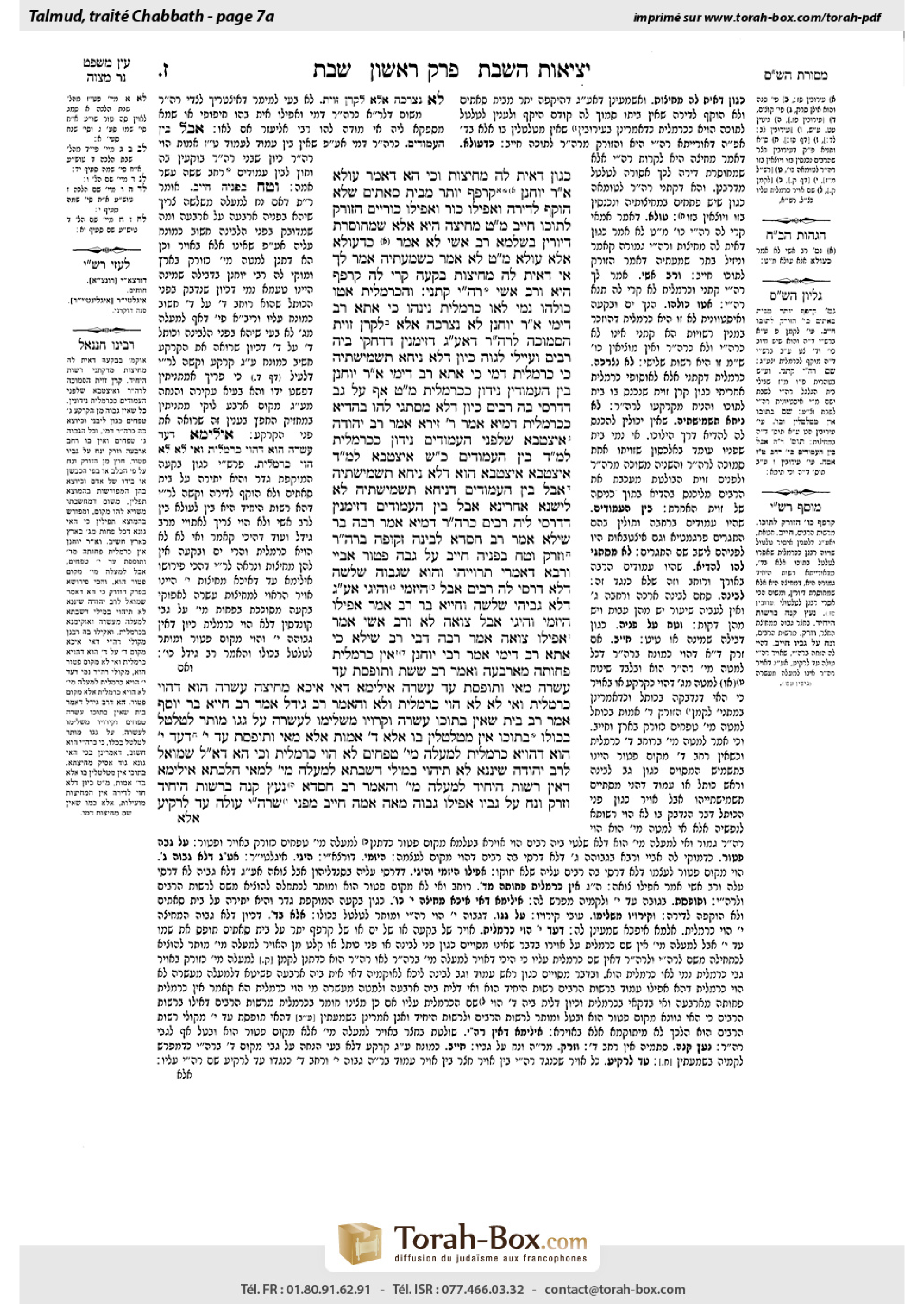
Shabbat 7a: Talmud study for Daf Yomi
Daf Yomi is the daily study of one Talmud folio. Explore 37 tractates with scans, Hebrew text, Sefaria English and AI-generated French translations where annotated.
Passage selection and English or AI-generated French translation are available where the scan has annotations. Daf Study is independent of Torah-Box and Sefaria.
Browse Shabbat · שבת · All tractatesShabbat 7a text and translations
This page of Shabbat includes the Aramaic text, an English translation and an AI-generated French translation, alongside the scan above.
שבת ז׳ א · Aramaic and Hebrew text
כְּגוֹן דְּאִית לַהּ מְחִיצּוֹת. וְכִי הָא דְּאָמַר עוּלָּא אָמַר רַבִּי יוֹחָנָן: קַרְפֵּף יוֹתֵר מִבֵּית סָאתַיִם שֶׁלֹּא הוּקַּף לְדִירָה, וַאֲפִילּוּ כּוֹר וַאֲפִילּוּ כּוֹרַיִים, הַזּוֹרֵק לְתוֹכוֹ חַיָּיב. מַאי טַעְמָא? — מְחִיצָה הִיא, אֶלָּא שֶׁמְחוּסֶּרֶת דָּיוֹרִין.
בִּשְׁלָמָא רַב אָשֵׁי לָא אָמַר כִּדְעוּלָּא, אֶלָּא עוּלָּא מַאי טַעְמָא לָא אָמַר כִּשְׁמַעְתֵּיהּ? אָמַר לָךְ: אִי דְּאִית לַהּ מְחִיצּוֹת ״בִּקְעָה״ קָרֵי לַהּ?! קַרְפֵּף הִיא! וְרַב אָשֵׁי ״רְשׁוּת הַיָּחִיד״ קָתָנֵי.
וְהַכַּרְמְלִית. אַטּוּ כּוּלְּהוּ נָמֵי לָאו כַּרְמְלִית נִינְהוּ? כִּי אֲתָא רַב דִּימִי אֲמַר רַבִּי יוֹחָנָן: לֹא נִצְרְכָה אֶלָּא לְקֶרֶן זָוִית הַסְּמוּכָה לִרְשׁוּת הָרַבִּים. דְּאַף עַל גַּב דְּזִימְנִין דְּדָחֲקִי בֵּיהּ רַבִּים וְעָיְילִי לְגַוַּהּ, כֵּיוָן דְּלָא נִיחָא תַּשְׁמִישְׁתֵּיהּ, כִּי כַרְמְלִית דָּמֵי.
כִּי אֲתָא רַב דִּימִי אָמַר רַבִּי יוֹחָנָן: בֵּין הָעַמּוּדִין נִידּוֹן כְּכַרְמְלִית. מַאי טַעְמָא? אַף עַל גַּב דְּדָרְסִי בַּהּ רַבִּים, כֵּיוָן דְּלָא מִסְתַּגִּי לְהוּ בְּהֶדְיָא — כְּכַרְמְלִית דָּמְיָא. אָמַר רַבִּי זֵירָא אָמַר רַב יְהוּדָה: אִיצְטְבָא שֶׁלִּפְנֵי הָעַמּוּדִים נִידּוֹן כְּכַרְמְלִית.
לְמַאן דְּאָמַר בֵּין הָעַמּוּדִים, כׇּל שֶׁכֵּן אִיצְטְבָא. לְמַאן דְּאָמַר אִיצְטְבָא — אִיצְטְבָא הוּא דְּלָא נִיחָא תַּשְׁמִישְׁתֵּיהּ, אֲבָל בֵּין הָעַמּוּדִים דְּנִיחָא תַּשְׁמִישְׁתֵּיהּ — לָא. לִישָּׁנָא אַחֲרִינָא: אֲבָל בֵּין הָעַמּוּדִין דְּזִימְנִין דְּדָרְסִי לֵיהּ רַבִּים, כִּרְשׁוּת הָרַבִּים דָּמְיָא.
אָמַר רַבָּה בַּר שֵׁילָא אָמַר רַב חִסְדָּא: לְבֵינָה זְקוּפָה בִּרְשׁוּת הָרַבִּים וְזָרַק וְטָח בְּפָנֶיהָ — חַיָּיב. עַל גַּבָּהּ — פָּטוּר.
אַבָּיֵי וְרָבָא דְּאָמְרִי תַּרְוַיְיהוּ: וְהוּא שֶׁגְּבוֹהָה שְׁלֹשָׁה, דְּלָא דָּרְסִי לַהּ רַבִּים. אֲבָל הִיזְמֵי וְהִיגֵי, אַף עַל גַּב דְּלָא גְּבִיהֵי שְׁלֹשָׁה. וְחִיָּיא בַּר רַב אָמַר: אֲפִילּוּ הִיזְמֵי וְהִיגֵי, אֲבָל צוֹאָה לָא. וְרַב אָשֵׁי אָמַר: אֲפִילּוּ צוֹאָה.
אָמַר רַבָּה דְּבֵי רַב שֵׁילָא: כִּי אֲתָא רַב דִּימִי אָמַר רַבִּי יוֹחָנָן: אֵין כַּרְמְלִית פְּחוּתָה מֵאַרְבָּעָה. וְאָמַר רַב שֵׁשֶׁת: וְתוֹפֶסֶת עַד עֲשָׂרָה. מַאי ״וְתוֹפֶסֶת עַד עֲשָׂרָה״? אִילֵּימָא דְּאִי אִיכָּא מְחִיצָה עֲשָׂרָה הוּא דְּהָוֵי כַּרְמְלִית, וְאִי לָא — לָא הָוֵי כַּרְמְלִית, וְלָא? וְהָאָמַר רַב גִּידֵּל אָמַר רַב חִיָּיא בַּר יוֹסֵף אָמַר רַב: בַּיִת שֶׁאֵין בְּתוֹכוֹ עֲשָׂרָה וְקֵרוּיוֹ מַשְׁלִימוֹ לַעֲשָׂרָה, עַל גַּגּוֹ — מוּתָּר לְטַלְטֵל בְּכוּלּוֹ, בְּתוֹכוֹ — אֵין מִטַּלְטְלִין בּוֹ אֶלָּא אַרְבַּע אַמּוֹת!
אֶלָּא מַאי ״וְתוֹפֶסֶת עַד עֲשָׂרָה״ — דְּעַד עֲשָׂרָה הוּא דְּהָוְיָא כַּרְמְלִית, לְמַעְלָה מֵעֲשָׂרָה טְפָחִים לָא הָוְיָא כַּרְמְלִית. וְכִי הָא דַּאֲמַר לֵיהּ שְׁמוּאֵל לְרַב יְהוּדָה: שִׁינָּנָא, לָא תְּיהַוֵּי בְּמִילֵּי דְשַׁבְּתָא לְמַעְלָה מֵעֲשָׂרָה. לְמַאי הִלְכְתָא? אִילֵּימָא דְּאֵין רְשׁוּת הַיָּחִיד לְמַעְלָה מֵעֲשָׂרָה? וְהָאָמַר רַב חִסְדָּא: נָעַץ קָנֶה בִּרְשׁוּת הַיָּחִיד וְזָרַק וְנָח עַל גַּבָּיו, אֲפִילּוּ גָּבוֹהַּ מֵאָה אַמָּה — חַיָּיב, מִפְּנֵי שֶׁרְשׁוּת הַיָּחִיד עוֹלָה עַד לָרָקִיעַ.
Shabbat 7a · English translation
The valley discussed in the mishna in Teharot is unusual, as it refers to a case where it has partitions that are ten handbreadths high surrounding it. And in accordance with that which Ulla said that Rav Yoḥanan said: An enclosure [karpef], a large courtyard that is not contiguous with the house and does not serve a direct purpose for the house, that is greater than a field that produces a crop of two se’a, that was not originally surrounded by a fence for the purpose of residence, but with a partition to protect his belongings, and even if it is as large as a field that produces a crop of one kor, thirty times the size of a se’a, and even two kor, it is still considered a private domain. And, consequently, one who throws an object into it from the public domain on Shabbat is liable. What is the reason for this? It is a partition that surrounds the enclosure and its legal status is like that of a partition in every sense, except that it is lacking residents. Even though the Rabbis were stringent with regard to this enclosure because of the lack of residents and prohibited carrying in it as if it were a karmelit, that does not negate its primary legal status; by Torah law it is a full-fledged private domain. The same is true with regard to the aforementioned valley. The valley is a large area surrounded by partitions erected for the purpose of protection and thereby assumes private domain status.
The Gemara asks: Granted, in explanation of the mishna, Rav Ashi did not say in accordance with the opinion of Ulla, as he provided a reason for it. However, what is the reason that Ulla did not say in accordance with his own halakha that he cited in the name of Rabbi Yoḥanan? The Gemara answers: Ulla could have said to you: If the mishna is referring to a case where it has partitions, would it call that place a valley? It is an enclosure. The implication of the word valley is that there are no partitions at all. And Rav Ashi defends his opinion by saying: The language taught in the mishna is: The private domain and not a karmelit. Therefore, his explanation more closely approximates the language of the mishna.
In the Tosefta, the list of places whose legal status is that of a karmelit also includes karmelit. The Gemara asks: Aren’t they, all the other places listed there, i.e., a sea, a valley, and a colonnade, a karmelit too? If so, what is this karmelit that is prominently mentioned here? The Gemara answers: When Rav Dimi came from Eretz Yisrael to Babylonia, he said that Rabbi Yoḥanan said: This addition of karmelit was only necessary in order to teach the case of a corner adjacent to the public domain, where, although at times the multitudes push their way in and enter it, since its use is inconvenient it is considered a karmelit.
Similarly, when Rav Dimi came from Eretz Yisrael to Babylonia, he said that Rabbi Yoḥanan said: Between the pillars alongside the public domain is judged like a karmelit. What is the reason for this? Although the multitudes stride there, since they cannot walk in it in a direct manner, uninterrupted, it is considered like a karmelit. Rabbi Zeira said that Rav Yehuda said: The same is true for the bench that is before the pillars upon which the merchants place their wares; it is judged to be like a karmelit.
The Gemara comments: According to the one who said that between the pillars is considered like a karmelit, all the more so a bench is considered a karmelit. However, according to the one who said that a bench is a karmelit, one could say that that is so specifically with regard to a bench because its use is inconvenient. However, the space between the pillars, whose use is convenient, would not be considered a karmelit. Another version of that statement: However, between the pillars where, at times, the multitudes stride there is considered like the public domain.
With regard to the question to what degree does the use of the multitudes determine whether a specific place is considered a public domain, the Gemara cites the halakha that Rabba bar Sheila said that Rav Ḥisda said: If an upright brick was placed in the public domain and one threw an object from a distance of four cubits and he stuck the object to its side, he is liable for throwing in the public domain. But if the object landed atop the brick, he is not liable. Because the multitudes do not step on the brick, it is not a full-fledged public domain.
It was Abaye and Rava, who both said: And that is specifically when that brick is at least three handbreadths high, as then the multitudes do not step on it, and, therefore, even though the brick is standing in the public domain, it is considered an independent domain. However, thorns and shrubs, even though they are not three handbreadths high, are not considered part of the public domain. Since people do not walk on thorns, those areas cannot be considered part of the public domain. And Ḥiyya bar Rav said: Even the place where there are thorns and shrubs in the public domain, if they were low, the place is considered part of the public domain. However, a place in the public domain where there are feces is not considered part of the public domain, as people do not walk there. And Rav Ashi said: Even a place in the public domain where there are feces is considered part of the public domain, since ultimately people who are rushing to work do not take care to avoid it and will step on it.
Rabba from the school of Rav Sheila said: When Rav Dimi came from Eretz Yisrael to Babylonia, he said that Rabbi Yoḥanan said: There is no karmelit less than four handbreadths. And Rav Sheshet added and said: And the karmelit extends up to ten handbreadths. With regard to the formulation of Rav Sheshet, the Gemara wondered: What is the meaning of the phrase: And extends up to ten? If you say that it means if there is a partition ten handbreadths high surrounding it then it is considered a karmelit, and if not, it is not considered a karmelit. And is it not a karmelit? Didn’t Rav Giddel say that Rav Ḥiyya bar Yosef said that Rav said: A house that does not have walls inside it that are ten handbreadths high, and with its roofing it reaches a height of ten handbreadths above the ground; on its roof, one may carry on all of it, as its roof is a private domain in every sense, and inside it, one may only carry four cubits, as inside, the height is insufficient to render it a private domain, and it retains karmelit status? Apparently, even an area less than ten handbreadths high has the legal status of a karmelit.
Rather, what is the meaning of Rav Sheshet’s formulation: And extends up to ten? Apparently, up to ten handbreadths is that which is within the parameters of a karmelit, and above ten handbreadths is not a karmelit. And as Shmuel said to Rav Yehuda: Keen scholar [shinnana], do not be involved with questions in the matters of Shabbat above ten handbreadths. The Gemara elaborates: With regard to what halakha and in the context of what issue did Shmuel make this statement? If you say his intention was that there is no private domain above ten handbreadths, didn’t Rav Ḥisda say: One who stuck a stick in the ground of the private domain and threw an object from the public domain and it landed atop it, even if the stick was a hundred cubits high, he is liable, since the private domain extends up to the sky? Apparently, there is a private domain even above ten handbreadths.
Shabbat 7a · Traduction française (IA)
La vallée évoquée dans la Michna de Taharot est un cas particulier, car il s’agit d’un endroit entouré de cloisons hautes de dix palmes. Cela correspond à ce qu’a dit Oula au nom de Rav Yoḥanan : un enclos [karpef], c’est-à-dire une grande cour qui n’est pas attenante à la maison et ne sert pas directement celle-ci, dont la superficie dépasse celle d’un champ produisant deux séa, et qui n’a pas été entouré à l’origine d’une clôture en vue de l’habitation, mais d’une cloison destinée à protéger les biens de son propriétaire, reste considéré comme un domaine privé, même s’il est aussi vaste qu’un champ produisant un kor, soit trente fois la superficie d’un séa, voire deux kor. Par conséquent, celui qui y jette un objet depuis le domaine public pendant Chabbat est passible. Pour quelle raison ? Une cloison entoure l’enclos et, à tous égards, son statut juridique est celui d’une cloison, à ceci près qu’il n’a pas d’habitants. Même si les rabbins ont été stricts au sujet de cet enclos en raison de l’absence d’habitants et ont interdit d’y transporter des objets comme s’il s’agissait d’un karmelit, cela n’annule pas son statut juridique fondamental : selon la Torah, il constitue un véritable domaine privé. Il en va de même pour la vallée mentionnée précédemment. C’est une vaste zone entourée de cloisons érigées à des fins de protection, ce qui lui confère le statut de domaine privé.
La Guemara demande : Certes, pour expliquer la Michna, Rav Ashi n’a pas suivi l’opinion d’Oula, puisqu’il en a donné une raison. Mais pourquoi Oula n’a-t-il pas expliqué la Michna conformément à la halakha qu’il a lui-même rapportée au nom de Rabbi Yoḥanan ? La Guemara répond : Oula aurait pu te dire : si la Michna parle d’un endroit doté de cloisons, l’appellerait-elle une vallée ? Ce serait un enclos. Le terme « vallée » implique qu’il n’y a aucune cloison. Rav Ashi défend son opinion en disant : La Michna emploie l’expression « le domaine privé et non un karmelit ». Son explication correspond donc davantage aux termes de la Michna.
Dans la Tosefta, la liste des endroits ayant le statut de karmelit comprend également un karmelit. La Guemara demande : Tous les autres endroits qui y sont énumérés — la mer, la vallée et la galerie à colonnade — ne sont-ils pas eux aussi des karmelit ? Dans ce cas, quel est ce karmelit mentionné ici de façon si particulière ? La Guemara répond : Lorsque Rav Dimi vint d’Eretz Israël en Babylonie, il dit que Rabbi Yoḥanan avait enseigné : Cette mention supplémentaire d’un karmelit n’était nécessaire que pour enseigner le cas d’un renfoncement jouxtant le domaine public. Bien que, parfois, la foule s’y fraye un passage et y pénètre, il est considéré comme un karmelit, car son usage est incommode.
De même, lorsque Rav Dimi vint d’Eretz Israël en Babylonie, il dit que Rabbi Yoḥanan avait enseigné : L’espace entre les piliers qui bordent le domaine public est considéré comme un karmelit. Pour quelle raison ? Bien que la foule y passe, cet espace est considéré comme un karmelit, car on ne peut pas y marcher de façon directe et ininterrompue. Rabbi Zeira dit au nom de Rav Yehuda : Il en va de même du banc situé devant les piliers, sur lequel les marchands déposent leurs marchandises : il est considéré comme un karmelit.
La Guemara fait remarquer : Selon celui qui affirme que l’espace entre les piliers est considéré comme un karmelit, à plus forte raison un banc est-il considéré comme un karmelit. En revanche, selon celui qui affirme qu’un banc est un karmelit, on pourrait dire que cela ne vaut que pour un banc, car son usage est incommode. Mais l’espace entre les piliers, dont l’usage est commode, ne serait pas considéré comme un karmelit. Selon une autre version de cette déclaration, en revanche, l’espace entre les piliers, où la foule passe parfois, est considéré comme le domaine public.
À propos de la question de savoir dans quelle mesure l’usage qu’en fait la foule détermine si un endroit donné est considéré comme un domaine public, la Guemara rapporte la halakha suivante : Rabba bar Sheila dit au nom de Rav Ḥisda : Si une brique est posée debout dans le domaine public et que quelqu’un jette un objet depuis une distance de quatre coudées et le fait adhérer à son côté, il est passible pour avoir jeté dans le domaine public. Mais si l’objet atterrit sur la brique, il n’est pas passible. Comme la foule ne marche pas sur la brique, celle-ci ne fait pas pleinement partie du domaine public.
Abayé et Rava ont tous deux dit : Cela ne vaut que lorsque la brique a au moins trois palmes de hauteur, car alors la foule ne marche pas dessus ; ainsi, bien que la brique se trouve dans le domaine public, elle constitue un domaine distinct. En revanche, les épines et les broussailles, même si elles n’atteignent pas trois palmes de hauteur, ne sont pas considérées comme faisant partie du domaine public. Puisque les gens ne marchent pas sur les épines, ces endroits ne peuvent pas être considérés comme faisant partie du domaine public. Ḥiyya bar Rav dit : Même un endroit du domaine public où poussent des épines et des broussailles est considéré comme faisant partie du domaine public si elles sont basses. En revanche, un endroit du domaine public où il y a des excréments n’est pas considéré comme faisant partie du domaine public, car les gens n’y marchent pas. Rav Ashi dit : Même un endroit du domaine public où il y a des excréments est considéré comme faisant partie du domaine public, puisque, en définitive, ceux qui se hâtent d’aller travailler ne prennent pas la peine de les éviter et marchent dessus.
Rabba de l’école de Rav Sheila dit : Lorsque Rav Dimi vint d’Eretz Israël en Babylonie, il dit que Rabbi Yoḥanan avait enseigné : Un karmelit ne peut pas avoir moins de quatre palmes. Rav Sheshet ajouta : Et le karmelit s’étend jusqu’à dix palmes. À propos de la formulation de Rav Sheshet, la Guemara s’interroge : Que signifie « s’étend jusqu’à dix » ? Si tu dis que cela signifie qu’un endroit entouré d’une cloison haute de dix palmes est considéré comme un karmelit, et que, sinon, il ne l’est pas, ne serait-ce pas alors un karmelit ? Rav Giddel n’a-t-il pas dit au nom de Rav Ḥiyya bar Yosef, lui-même au nom de Rav : Une maison qui n’a pas de murs intérieurs hauts de dix palmes, mais dont le toit atteint une hauteur de dix palmes au-dessus du sol, permet d’y transporter des objets sur toute sa surface, car son toit est à tous égards un domaine privé ; à l’intérieur, on ne peut transporter des objets que sur quatre coudées, car la hauteur intérieure est insuffisante pour lui conférer le statut de domaine privé et elle conserve celui de karmelit ? Il ressort donc de là qu’une zone de moins de dix palmes de hauteur a également le statut de karmelit.
Il faut plutôt comprendre ainsi la formulation de Rav Sheshet : « s’étend jusqu’à dix ». Apparemment, jusqu’à dix palmes, un endroit relève des limites du karmelit ; au-dessus de dix palmes, ce n’est pas un karmelit. Et Shmuel disait à Rav Yehuda : « Savant perspicace [shinnana], ne te préoccupe pas des questions relatives à Chabbat au-dessus de dix palmes. » La Guemara précise : À quelle halakha et à propos de quelle question Shmuel a-t-il fait cette déclaration ? Si tu dis qu’il voulait dire qu’il n’existe pas de domaine privé au-dessus de dix palmes, Rav Ḥisda n’a-t-il pas dit : Celui qui plante un bâton dans le sol du domaine privé, puis jette un objet depuis le domaine public et le fait atterrir à son sommet, est passible, même si le bâton mesure cent coudées de haut, car le domaine privé s’étend jusqu’au ciel ? Il ressort donc qu’un domaine privé existe même au-dessus de dix palmes.
Traduction française générée par IA à partir de l’édition anglaise de Sefaria. Vérifie toujours un passage avec le texte source.
Text from Sefaria: William Davidson Edition - Vocalized Aramaic (CC BY NC); William Davidson Edition - English (CC BY NC).