Shabbat 6b: Talmud study for Daf Yomi
Daf Yomi is the daily study of one Talmud folio. Explore 37 tractates with scans, Hebrew text, Sefaria English and AI-generated French translations where annotated.
Passage selection and English or AI-generated French translation are available where the scan has annotations. Daf Study is independent of Torah-Box and Sefaria.
Browse Shabbat · שבת · All tractatesShabbat 6b text and translations
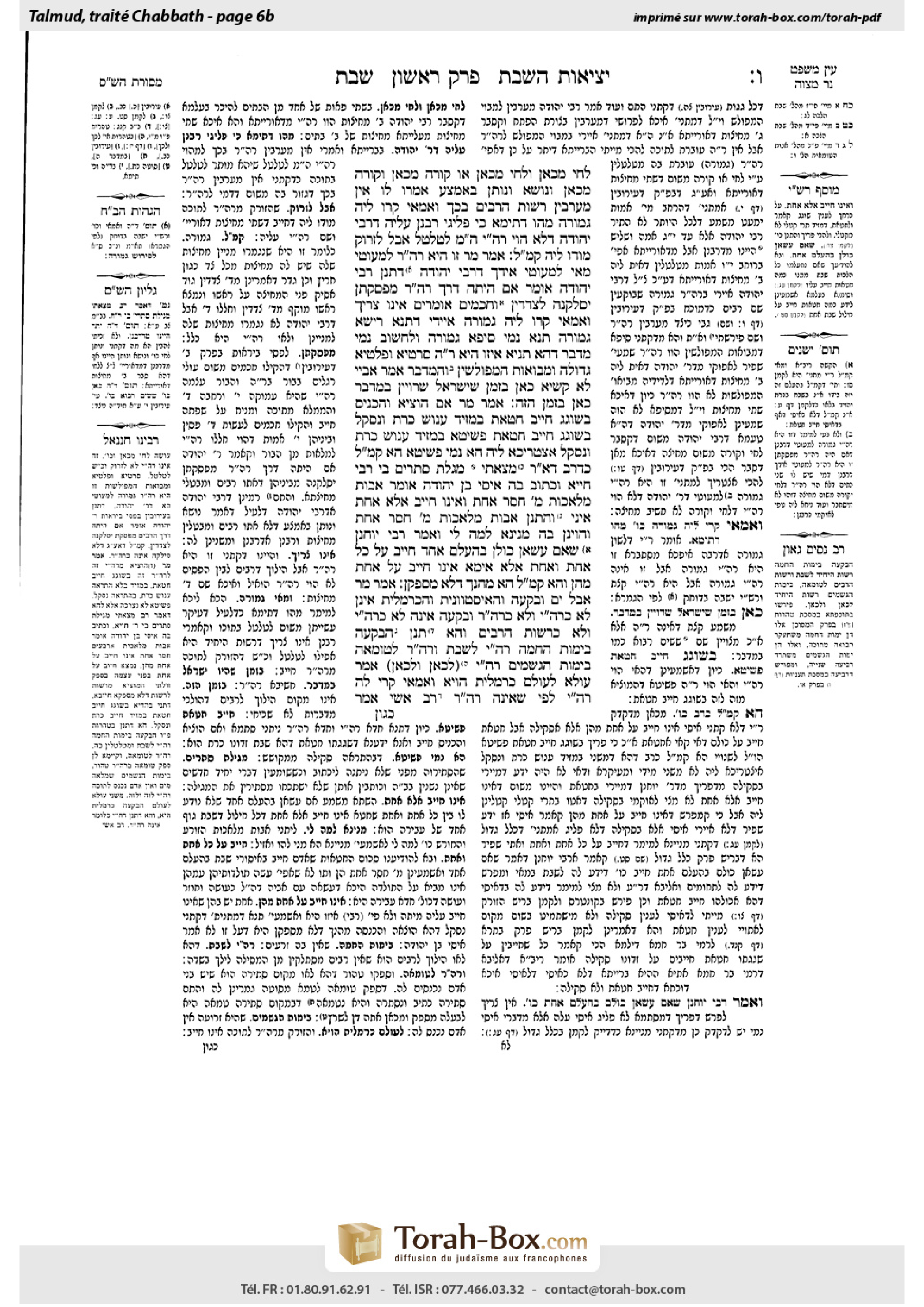
This page of Shabbat includes the Aramaic text, an English translation and an AI-generated French translation, alongside the scan above.
שבת ו׳ ב · Aramaic and Hebrew text
לֶחִי מִכָּאן, וְלֶחִי מִכָּאן, אוֹ קוֹרָה מִכָּאן וְקוֹרָה מִכָּאן, וְנוֹשֵׂא וְנוֹתֵן בָּאֶמְצַע. אָמְרוּ לוֹ: אֵין מְעָרְבִין רְשׁוּת הָרַבִּים בְּכָךְ!
וְאַמַּאי קָרוּ לֵיהּ ״גְּמוּרָה״? מַהוּ דְתֵימָא: כִּי פְּלִיגִי רַבָּנַן עֲלֵיהּ דְּרַבִּי יְהוּדָה דְּלָא הָוֵי רְשׁוּת הַיָּחִיד, הָנֵי מִילֵּי לְטַלְטֵל, אֲבָל לִזְרוֹק מוֹדוּ לֵיהּ — קָא מַשְׁמַע לַן.
אָמַר מָר: ״זוֹ הִיא רְשׁוּת הָרַבִּים״. לְמַעוֹטֵי מַאי? לְמַעוֹטֵי אִידַּךְ דְּרַבִּי יְהוּדָה. דִּתְנַן, רַבִּי יְהוּדָה אוֹמֵר: אִם הָיְתָה דֶּרֶךְ רְשׁוּת הָרַבִּים מַפְסַקְתָּן — יְסַלְּקֶנָּה לִצְדָדִין. וַחֲכָמִים אוֹמְרִים: אֵינוֹ צָרִיךְ.
וְאַמַּאי קָרוּ לֵיהּ ״גְּמוּרָה״? אַיְּידֵי דִּתְנָא רֵישָׁא ״גְּמוּרָה״, תְּנָא נָמֵי סֵיפָא ״גְּמוּרָה״.
וְלַחֲשׁוֹב נָמֵי מִדְבָּר, דְּהָא תַּנְיָא: אֵיזוֹ הִיא רְשׁוּת הָרַבִּים? — סְרַטְיָא וּפְלַטְיָא גְּדוֹלָה, וּמְבוֹאוֹת הַמְפוּלָּשִׁין, וְהַמִּדְבָּר! אָמַר אַבָּיֵי: לָא קַשְׁיָא, כָּאן בִּזְמַן שֶׁיִּשְׂרָאֵל שְׁרוּיִין בַּמִּדְבָּר. כָּאן בִּזְמַן הַזֶּה.
אָמַר מָר: אִם הוֹצִיא וְהִכְנִיס בְּשׁוֹגֵג — חַיָּיב חַטָּאת, בְּמֵזִיד — עָנוּשׁ כָּרֵת, וְנִסְקָל. בְּשׁוֹגֵג חַיָּיב חַטָּאת, פְּשִׁיטָא! בְּמֵזִיד עָנוּשׁ כָּרֵת וְנִסְקָל אִצְטְרִיכָא לֵיהּ.
הָא נָמֵי פְּשִׁיטָא! הָא קָא מַשְׁמַע לַן כִּדְרַב, דְּאָמַר רַב: מָצָאתִי מְגִלַּת סְתָרִים בֵּי רַבִּי חִיָּיא וְכָתוּב בָּהּ: אִיסִי בֶּן יְהוּדָה אוֹמֵר: אֲבוֹת מְלָאכוֹת אַרְבָּעִים חָסֵר אַחַת, וְאֵינוֹ חַיָּיב אֶלָּא אַחַת.
אִינִי?! וְהָתְנַן: אֲבוֹת מְלָאכוֹת אַרְבָּעִים חָסֵר אַחַת. וְהָוֵינַן בַּהּ: מִנְיָנָא לְמָה לִי? וְאָמַר רַבִּי יוֹחָנָן: שֶׁאִם עֲשָׂאָן כּוּלָּן בְּהֶעְלֵם אַחַת — חַיָּיב עַל כׇּל אַחַת וְאַחַת.
אֶלָּא אֵימָא: אֵינוֹ חַיָּיב עַל אַחַת מֵהֶן. וְהָא קָא מַשְׁמַע לַן: הָא מֵהָנָךְ דְּלָא מְסַפְּקָן.
אָמַר מָר: אֲבָל יָם וּבִקְעָה וְהָאִיסְטְווֹנִית וְהַכַּרְמְלִית אֵינָן לֹא כִּרְשׁוּת הַיָּחִיד וְלֹא כִּרְשׁוּת הָרַבִּים. וּבִקְעָה אֵינוֹ לֹא כִּרְשׁוּת הַיָּחִיד וְלֹא כִּרְשׁוּת הָרַבִּים? וְהָא תְּנַן הַבִּקְעָה בִּימוֹת הַחַמָּה, רְשׁוּת הַיָּחִיד לַשַּׁבָּת וּרְשׁוּת הָרַבִּים לַטּוּמְאָה. בִּימוֹת הַגְּשָׁמִים, רְשׁוּת הַיָּחִיד לְכָאן וּלְכָאן!
אָמַר עוּלָּא: לְעוֹלָם כַּרְמְלִית הָוְיָא, וְאַמַּאי קָרֵי לַהּ רְשׁוּת הַיָּחִיד — לְפִי שֶׁאֵינָהּ רְשׁוּת הָרַבִּים.
רַב אָשֵׁי אָמַר:
Shabbat 6b · English translation
a ten-handbreadth high post from here, perpendicular to the public domain. This creates a symbolic wall which, in the halakhot of alleyways, has the legal status of a wall. And, he may place an additional post from here, on the other side, and that has the same legal status as if he closed the public domain on all of its sides. Or, he can implement a different solution appropriate for alleyways by placing a beam extending from here, from one end of one house, to the end of the house opposite it. This creates a symbolic partition across the width of the street. And, he may place a beam extending from here, from the other side of the house. According to Rabbi Yehuda, in that way, one is permitted to carry objects and place them in the area between the symbolic partitions, as he would in a private domain. The Rabbis said to him: One may not place an eiruv in the public domain in that way. One who seeks to transform a public domain into a private domain must erect actual partitions.
The Gemara questions the language of the Tosefta: This is a full-fledged private domain. And why did they call it full-fledged? The Gemara answers: Lest you say: When do the Rabbis disagree with Rabbi Yehuda and say that it is not the private domain? This applies only with regard to the prohibition to carry there on Shabbat. By means of these partitions, it was not rendered a full-fledged private domain to the point that one is permitted to carry there. However, conceivably, with regard to the prohibition of throwing from the public domain to this place, the Rabbis agree with Rabbi Yehuda that the area between the partitions would be considered a private domain by Torah law and it would be prohibited. Therefore, the tanna taught us that according to the Rabbis it is not a private domain at all.
It was also taught in the Tosefta with regard to the definition of a public domain that the Master said, with added emphasis: This is the public domain. The Gemara asks: What was this emphasis added to exclude? The Gemara answers: Here, the Tosefta came to exclude another halakha of Rabbi Yehuda. As we learned in a mishna: The Sages permitted those ascending to Jerusalem on the Festival pilgrimage to place posts serving as symbolic boundaries around the wells, in order to render the wells and their surroundings a private domain. That way, the pilgrims could draw water from the wells even on Shabbat, as they became private domains. Rabbi Yehuda says: If the path of the public domain passes through the area of the wells and the posts and obstructs them, he must divert it to the sides, so that the passersby will not pass through there. In his opinion, many people passing through that area negates the private domain formed merely by means of symbolic boundaries. And the Rabbis say: He need not divert the path of the public domain. The emphasis in the Tosefta: This is the public domain, teaches that only the specific areas listed there fall into the category of a public domain; however, a well around which partitions were established is no longer in the realm of public domain, even if the multitudes continue to walk through that area.
The Gemara asks: And why do they call it full-fledged? The Gemara answers: This emphasis was unnecessary. But, since he taught the first clause of the Tosefta employing the term full-fledged, he also taught the latter section employing the term full-fledged in the interest of uniformity.
With regard to the places characterized as the public domain, the Gemara asks: And include the desert among the places considered a public domain? Wasn’t it taught in a different baraita: What is the public domain? A main street, and a large plaza, and open alleyways, and the desert? Abaye said: This is not difficult, as here, where it enumerated the desert among the public domains, it refers to the time when Israel was dwelling in the desert, and it was an area frequented by the multitudes. And here, where the desert was not enumerated among the public domains, refers to this time, when multitudes do not congregate there.
It was also taught in the Tosefta that the Master said: If he carried out an object on Shabbat from the private domain to the public domain or vice versa, if he carried in, if he did so unwittingly, he is liable to bring a sin-offering. If he did so intentionally and there were no witnesses to his act and he was not forewarned, he is punishable from the hand of Heaven with the punishment of karet. If he was forewarned and there were witnesses to his transgression, he is punished by the court and stoned. The Gemara asks: Unwittingly, he is liable to bring a sin-offering; it is obvious that one who violates the serious transgression of desecrating the Shabbat unwittingly is liable to bring a sin-offering. The Gemara answers: It was necessary for the tanna to teach that if he did so intentionally he is punishable with karet and stoned. Since he needed to cite those cases because they involve a novel element, he also cited the case where he performed the transgression unwittingly, in order to complete the picture.
The Gemara asks: That is also obvious, as the Torah states explicitly that one who desecrates Shabbat intentionally without witnesses and forewarning is punishable by karet, and that when there are witnesses and forewarning he is executed by stoning. The Gemara answers: This came to teach us in accordance with the statement of Rav, as Rav said: I found a hidden scroll in the house of Rabbi Ḥiyya in which matters of Oral Torah were briefly summarized, and in it was written: Isi ben Yehuda says: The primary categories of prohibited labor on Shabbat are forty-less-one, and he is liable only for one. This expression is unclear, and it would seem that it means that one who performs all of the prohibited labors is only liable to bring one sin-offering.
The Gemara asks: Is that so? Didn’t we learn in the mishna: The primary categories of prohibited labor are forty-less-one? The mishna proceeded to enumerate those labors. And we discussed it: Why do I need this tally of forty-less-one? It would have been sufficient for the mishna to merely list the prohibited labors. And Rabbi Yoḥanan said: The number is also significant, in order to teach us that if he performed all of the prohibited labors within one lapse of awareness, during which he remained unaware of the prohibition involved, he is liable to bring a sin-offering for each and every one of the prohibited labors separately. Consequently, the statement of Isi ben Yehuda cannot be understood as suggested above.
Rather, say as follows: There are forty prohibited labors less one, and he is not liable for one of them. Among those labors, there is one unspecified exception for which one is not liable to be executed by stoning and merely violates a negative prohibition. That which the Tosefta mentioned with regard to one carrying out on Shabbat being liable for karet and stoning, teaches us: This labor of carrying out from domain to domain, is among those prohibited labors with regard to which there is no uncertainty and it is clear that one is liable for karet and stoning for its violation.
It was also taught in the Tosefta that the Master said: However, a sea, and a valley, and the colonnade, and the karmelit all enter into the general category of karmelit, which is neither like the public domain nor like the private domain. The Gemara asks: And is a valley neither like the private domain nor like the public domain? Didn’t we learn in a mishna in tractate Teharot: The valley, in the days of summer, which is a time when the multitudes frequent it, nevertheless, it is considered the private domain with regard to the halakhot of Shabbat, as according to the parameters of domains of Shabbat it remains in the realm of a private domain. And, still, it is considered like the public domain with regard to the halakhot of ritual impurity, where there is a distinction between a place frequented by the multitudes and a place that the multitudes do not frequent. While in the rainy season, the winter, when multitudes do not frequent the fields, the valley is considered like the private domain for this, Shabbat, and for that, ritual purity. A valley is a private domain and not a karmelit.
Ulla said: Actually, the valley is a karmelit; and why does the mishna call it the private domain? In order to emphasize that it is not the public domain, as the mishna in tractate Teharot did not enter into the details of the halakhot of Shabbat. It merely underscored the distinction between the halakhot of Shabbat and the halakhot of ritual purity.
Rav Ashi said:
Shabbat 6b · Traduction française (IA)
un poteau de dix palmes de hauteur, placé ici, perpendiculairement au domaine public. Cela crée une cloison symbolique qui, dans les halakhot des ruelles, a le statut juridique d’un mur. Il peut aussi placer un poteau supplémentaire de l’autre côté, ce qui revient juridiquement à fermer le domaine public de tous côtés. Il peut également recourir à une autre solution adaptée aux ruelles, en plaçant une poutre qui s’étend d’ici, depuis l’extrémité d’une maison jusqu’à l’extrémité de la maison qui lui fait face. Cela crée une cloison symbolique sur toute la largeur de la rue. Il peut aussi placer une poutre depuis l’autre côté de la maison. Selon Rabbi Yehouda, de cette manière, il est permis de transporter des objets et de les déposer dans l’espace compris entre les cloisons symboliques, comme on le ferait dans un domaine privé. Les Sages lui dirent : « On ne peut pas placer un érouv dans le domaine public de cette manière. Celui qui cherche à transformer un domaine public en domaine privé doit ériger de véritables cloisons. »
La Guemara s’interroge sur la formulation de la Tossefta : « C’est un domaine privé à part entière. » Pourquoi l’a-t-on qualifié de domaine privé « à part entière » ? La Guemara répond : De peur que tu ne dises : les Sages ne sont en désaccord avec Rabbi Yehouda et n’affirment que ce n’est pas un domaine privé que concernant l’interdiction d’y transporter des objets pendant Chabbat. Ces cloisons n’en ont pas fait un domaine privé à part entière, où il serait permis de transporter des objets. On aurait toutefois pu penser que, concernant l’interdiction de jeter un objet du domaine public vers cet endroit, les Sages sont d’accord avec Rabbi Yehouda : l’espace compris entre les cloisons serait considéré comme un domaine privé selon la Torah et il serait interdit d’y jeter un objet. Le tanna nous enseigne donc que, selon les Sages, ce n’est pas du tout un domaine privé.
La Tossefta enseignait également, à propos de la définition du domaine public, que le Maître avait déclaré en insistant : « C’est le domaine public. » La Guemara demande : Qu’est-ce que cette insistance visait à exclure ? La Guemara répond : Ici, la Tossefta entendait exclure une autre halakha de Rabbi Yehouda. En effet, nous avons appris dans une Michna : Les Sages ont permis à ceux qui montaient à Jérusalem pour le pèlerinage de la fête de placer des poteaux servant de limites symboliques autour des puits, afin que les puits et leurs environs deviennent un domaine privé. Ainsi, les pèlerins pouvaient puiser de l’eau dans les puits même pendant Chabbat, puisqu’ils étaient devenus des domaines privés. Rabbi Yehouda dit : Si le chemin du domaine public traverse la zone des puits et des poteaux et les encombre, il faut le détourner sur les côtés, afin que les passants ne passent pas par là. Selon lui, le passage d’une foule dans cette zone annule le domaine privé créé au moyen de simples limites symboliques. Les Sages disent : Il n’est pas nécessaire de détourner le chemin du domaine public. L’insistance de la Tossefta — « C’est le domaine public » — enseigne que seules les zones précises qui y sont énumérées entrent dans la catégorie du domaine public ; toutefois, un puits autour duquel des cloisons ont été établies ne relève plus du domaine public, même si les foules continuent de traverser cette zone.
La Guemara demande : Pourquoi l’appelle-t-on « à part entière » ? La Guemara répond : Cette précision était superflue. Mais, comme la première partie de la Tossefta employait l’expression « à part entière », la dernière partie emploie aussi cette expression, par souci d’uniformité.
À propos des lieux caractérisés comme domaine public, la Guemara demande : Faut-il inclure le désert parmi les lieux considérés comme domaine public ? N’a-t-il pas été enseigné dans une autre baraïta : « Qu’est-ce que le domaine public ? Une grande voie, une vaste place, des ruelles ouvertes et le désert. » Abayé dit : Il n’y a pas de contradiction. Ici, lorsqu’elle énumère le désert parmi les domaines publics, cela se rapporte à l’époque où Israël séjournait dans le désert, qui était alors une zone fréquentée par les foules. Là, lorsque le désert n’est pas énuméré parmi les domaines publics, cela se rapporte à l’époque actuelle, où les foules ne s’y rassemblent pas.
La Tossefta enseignait également que le Maître avait déclaré : Si quelqu’un a sorti un objet pendant Chabbat du domaine privé vers le domaine public, ou inversement, s’il l’a fait sans le savoir, il est tenu d’apporter un sacrifice expiatoire. S’il l’a fait délibérément, sans témoin de son acte et sans avoir été averti, il encourt la peine de retranchement, infligée par le Ciel. S’il a été averti et que des témoins ont assisté à sa transgression, le tribunal le condamne à la lapidation. La Guemara demande : Qu’il soit tenu d’apporter un sacrifice expiatoire pour l’avoir fait sans le savoir, cela va de soi ; celui qui transgresse sans le savoir l’interdit grave de profaner Chabbat est évidemment tenu d’apporter un sacrifice expiatoire. La Guemara répond : Le tanna devait enseigner que s’il l’a fait délibérément, il encourt la peine de retranchement et la lapidation. Comme il lui fallait citer ces cas parce qu’ils comportent un élément nouveau, il a également cité le cas où il a commis la transgression sans le savoir, afin de présenter le tableau complet.
La Guemara demande : Cela aussi va de soi, puisque la Torah stipule explicitement que celui qui profane délibérément Chabbat sans témoins ni avertissement encourt la peine de retranchement, et que, s’il y a des témoins et un avertissement, il est exécuté par lapidation. La Guemara répond : Cela vient nous enseigner la déclaration de Rav, car Rav a dit : « J’ai trouvé un rouleau caché dans la maison de Rabbi Ḥiyya, où des sujets de Torah orale étaient résumés brièvement ; on y lisait : “Isi ben Yehouda dit : Les travaux principaux interdits pendant Chabbat sont au nombre de trente-neuf, et il n’est passible que pour l’un d’eux.” » Cette formule n’est pas claire ; elle semblerait signifier que celui qui accomplit tous les travaux interdits n’est tenu d’apporter qu’un seul sacrifice expiatoire.
La Guemara demande : Est-ce vraiment le cas ? N’avons-nous pas appris dans la Michna : « Les travaux principaux interdits sont au nombre de trente-neuf » ? La Michna a ensuite énuméré ces travaux. Et nous avons discuté de cette question : Pourquoi la Michna a-t-elle besoin de donner ce nombre de trente-neuf ? Il aurait suffi qu’elle énumère simplement les travaux interdits. Rabbi Yoḥanan a dit : Le nombre est également significatif ; il nous enseigne que si quelqu’un accomplit tous les travaux interdits au cours d’une seule période d’inadvertance, durant laquelle il n’a pas eu conscience de l’interdit en cause, il est tenu d’apporter un sacrifice expiatoire pour chacun de ces travaux interdits, séparément. Par conséquent, la déclaration d’Isi ben Yehouda ne peut pas être comprise comme on l’a suggéré plus haut.
Il faut plutôt comprendre ainsi : Il y a trente-neuf travaux interdits, et l’on n’est pas passible pour l’un d’eux. Parmi ces travaux, il y en a un, non précisé, pour lequel on ne peut pas être exécuté par lapidation et qui ne constitue qu’une transgression d’un interdit négatif. Ce que la Tossefta mentionne au sujet de celui qui sort un objet pendant Chabbat et encourt la peine de retranchement et la lapidation nous enseigne que le travail consistant à sortir un objet d’un domaine pour le faire entrer dans un autre fait partie des travaux interdits pour lesquels il n’y a aucune incertitude : il est clair que sa transgression rend passible de la peine de retranchement et de la lapidation.
La Tossefta enseignait également que le Maître avait déclaré : « Cependant, la mer, une vallée, une colonnade et le karmelit relèvent tous de la catégorie générale du karmelit, qui n’est semblable ni au domaine public ni au domaine privé. » La Guemara demande : Une vallée n’est-elle semblable ni au domaine privé ni au domaine public ? N’avons-nous pas appris dans une Michna du traité Teharot : « La vallée, en été, période où les foules la fréquentent, est néanmoins considérée comme un domaine privé au regard des halakhot de Chabbat, car, selon les critères des domaines de Chabbat, elle demeure un domaine privé. Pourtant, elle est considérée comme le domaine public au regard des halakhot de l’impureté rituelle, où l’on distingue les lieux fréquentés par les foules de ceux qu’elles ne fréquentent pas. En revanche, pendant la saison des pluies, en hiver, lorsque les foules ne fréquentent pas les champs, la vallée est considérée comme un domaine privé aussi bien pour ceci, Chabbat, que pour cela, la pureté rituelle. » Une vallée est un domaine privé et non un karmelit.
Oula dit : En réalité, la vallée est un karmelit. Pourquoi la Michna la qualifie-t-elle de domaine privé ? Pour souligner qu’elle n’est pas le domaine public, car la Michna du traité Teharot n’entrait pas dans les détails des halakhot de Chabbat. Elle mettait seulement en évidence la distinction entre les halakhot de Chabbat et celles de la pureté rituelle.
Rav Ashi dit :
Traduction française générée par IA à partir de l’édition anglaise de Sefaria. Vérifie toujours un passage avec le texte source.
Text from Sefaria: William Davidson Edition - Vocalized Aramaic (CC BY NC); William Davidson Edition - English (CC BY NC).