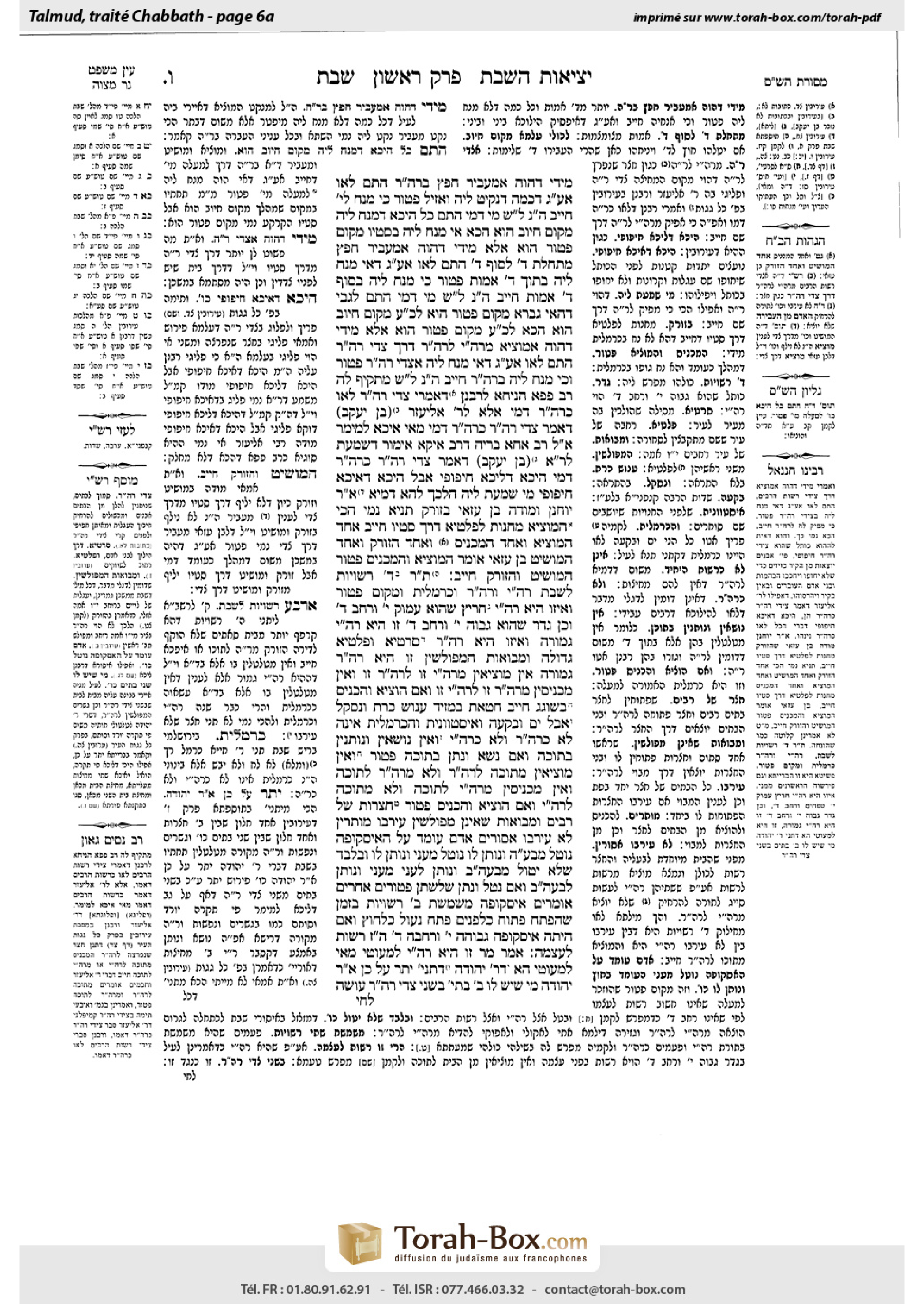
Shabbat 6a: Talmud study for Daf Yomi
Daf Yomi is the daily study of one Talmud folio. Explore 37 tractates with scans, Hebrew text, Sefaria English and AI-generated French translations where annotated.
Passage selection and English or AI-generated French translation are available where the scan has annotations. Daf Study is independent of Torah-Box and Sefaria.
Browse Shabbat · שבת · All tractatesShabbat 6a text and translations
This page of Shabbat includes the Aramaic text, an English translation and an AI-generated French translation, alongside the scan above.
שבת ו׳ א · Aramaic and Hebrew text
מִידֵּי דְּהָוֵה אַמַּעֲבִיר חֵפֶץ בִּרְשׁוּת הָרַבִּים. הָתָם, לָאו אַף עַל גַּב דְּכַמָּה דְּנָקֵיט לֵיהּ וְאָזֵיל פָּטוּר, כִּי מַנַּח לֵיהּ — חַיָּיב. הָכָא נָמֵי לָא שְׁנָא.
מִי דָּמֵי?! הָתָם כׇּל הֵיכָא דְּמַנַּח לֵיהּ מְקוֹם חִיּוּב הוּא. הָכָא, אִי מַנַּח לֵיהּ בִּסְטָיו מְקוֹם פְּטוּר הוּא.
אֶלָּא מִידֵּי דְּהָוֵה אַמַּעֲבִיר חֵפֶץ מִתְּחִלַּת אַרְבַּע לְסוֹף אַרְבַּע. הָתָם לָאו אַף עַל גַּב דְּאִי מַנַּח לֵיהּ בְּתוֹךְ אַרְבַּע אַמּוֹת פָּטוּר, כִּי מַנַּח לֵיהּ בְּסוֹף אַרְבַּע אַמּוֹת חַיָּיב, הָכָא נָמֵי לָא שְׁנָא.
מִי דָּמֵי?! הָתָם, לְגַבֵּי דְּהַאי גַּבְרָא מְקוֹם פְּטוּר הוּא, לְכוּלֵּי עָלְמָא מְקוֹם חִיּוּב הוּא. הָכָא לְכוּלֵּי עָלְמָא מְקוֹם פְּטוּר הוּא.
אֶלָּא מִידֵּי דְּהָוֵה אַמּוֹצִיא מֵרְשׁוּת הַיָּחִיד לִרְשׁוּת הָרַבִּים דֶּרֶךְ צִדֵּי רְשׁוּת הָרַבִּים. הָתָם, לָאו אַף עַל גַּב דְּאִי מַנַּח לֵיהּ אַצִּדֵּי רְשׁוּת הָרַבִּים — פָּטוּר, וְכִי מַנַּח לֵיהּ בִּרְשׁוּת הָרַבִּים — חַיָּיב, הָכָא נָמֵי לָא שְׁנָא.
מַתְקִיף לַהּ רַב פָּפָּא: הָנִיחָא לְרַבָּנַן דְּאָמְרִי צִדֵּי רְשׁוּת הָרַבִּים לָאו כִּרְשׁוּת הָרַבִּים דָּמֵי. אֶלָּא לְרַבִּי אֱלִיעֶזֶר בֶּן יַעֲקֹב דְּאָמַר צִדֵּי רְשׁוּת הָרַבִּים כִּרְשׁוּת הָרַבִּים דָּמֵי, מַאי אִיכָּא לְמֵימַר?
אָמַר לֵיהּ רַב אַחָא בְּרֵיהּ דְּרַב אִיקָא: אֵימוֹר דְּשָׁמְעַתְּ לְרַבִּי אֱלִיעֶזֶר בֶּן יַעֲקֹב דְּאָמַר צִדֵּי רְשׁוּת הָרַבִּים כִּרְשׁוּת הָרַבִּים דָּמֵי הֵיכָא דְּלֵיכָּא חִיפּוּפֵי. אֲבָל הֵיכָא דְּאִיכָּא חִיפּוּפֵי מִי שָׁמְעַתְּ לֵיהּ? הִלְכָּךְ לְהָא דָּמְיָא.
אָמַר רַבִּי יוֹחָנָן: וּמוֹדֶה בֶּן עַזַּאי בְּזוֹרֵק. תַּנְיָא נָמֵי הָכִי: הַמּוֹצִיא מֵחֲנוּת לִפְלַטְיָא דֶּרֶךְ סְטָיו — חַיָּיב. אֶחָד הַמּוֹצִיא, וְאֶחָד הַמַּכְנִיס, וְאֶחָד הַזּוֹרֵק, וְאֶחָד הַמּוֹשִׁיט. בֶּן עַזַּאי אוֹמֵר: הַמּוֹצִיא וְהַמַּכְנִיס פָּטוּר, הַמּוֹשִׁיט וְהַזּוֹרֵק — חַיָּיב.
תָּנוּ רַבָּנַן, אַרְבַּע רְשׁוּיוֹת לַשַּׁבָּת: רְשׁוּת הַיָּחִיד, וּרְשׁוּת הָרַבִּים, וְכַרְמְלִית, וּמְקוֹם פְּטוּר.
וְאֵיזוֹ הִיא רְשׁוּת הַיָּחִיד? — חָרִיץ שֶׁהוּא עָמוֹק עֲשָׂרָה וְרָחָב אַרְבָּעָה, וְכֵן גָּדֵר שֶׁהוּא גָּבוֹהַּ עֲשָׂרָה וְרָחָב אַרְבָּעָה — זוֹ הִיא רְשׁוּת הַיָּחִיד גְּמוּרָה.
וְאֵיזוֹ הִיא רְשׁוּת הָרַבִּים? סְרַטְיָא וּפְלַטְיָא גְּדוֹלָה, וּמְבוֹאוֹת הַמְפוּלָּשִׁין — זוֹ הִיא רְשׁוּת הָרַבִּים גְּמוּרָה. אֵין מוֹצִיאִין מֵרְשׁוּת הַיָּחִיד זוֹ לִרְשׁוּת הָרַבִּים זוֹ, וְאֵין מַכְנִיסִין מֵרְשׁוּת הָרַבִּים זוֹ לִרְשׁוּת הַיָּחִיד זוֹ, וְאִם הוֹצִיא וְהִכְנִיס בְּשׁוֹגֵג — חַיָּיב חַטָּאת, בְּמֵזִיד — עָנוּשׁ כָּרֵת, וְנִסְקָל.
אֲבָל יָם וּבִקְעָה וְאִיסְטְווֹנִית וְהַכַּרְמְלִית — אֵינָהּ לֹא כִּרְשׁוּת הָרַבִּים וְלֹא כִּרְשׁוּת הַיָּחִיד. וְאֵין נוֹשְׂאִין וְנוֹתְנִין בְּתוֹכָהּ. וְאִם נָשָׂא וְנָתַן בְּתוֹכָהּ — פָּטוּר. וְאֵין מוֹצִיאִין מִתּוֹכָהּ לִרְשׁוּת הָרַבִּים, וְלֹא מֵרְשׁוּת הָרַבִּים לְתוֹכָהּ. וְאֵין מַכְנִיסִין מֵרְשׁוּת הַיָּחִיד לְתוֹכָהּ, וְלֹא מִתּוֹכָהּ לִרְשׁוּת הַיָּחִיד. וְאִם הוֹצִיא וְהִכְנִיס פָּטוּר.
חֲצֵרוֹת שֶׁל רַבִּים וּמְבוֹאוֹת שֶׁאֵינָן מְפוּלָּשִׁין, עֵירְבוּ — מוּתָּרִין. לֹא עֵירְבוּ — אֲסוּרִים.
אָדָם עוֹמֵד עַל הָאִיסְקוּפָּה, נוֹטֵל מִבַּעַל הַבַּיִת וְנוֹתֵן לוֹ, נוֹטֵל מֵעָנִי וְנוֹתֵן לוֹ, וּבִלְבַד שֶׁלֹּא יִטּוֹל מִבַּעַל הַבַּיִת וְנוֹתֵן לְעָנִי, מֵעָנִי וְנוֹתֵן לְבַעַל הַבַּיִת. וְאִם נָטַל וְנָתַן — שְׁלָשְׁתָּן פְּטוּרִים.
אֲחֵרִים אוֹמְרִים: אִיסְקוּפָּה מְשַׁמֶּשֶׁת שְׁתֵּי רְשׁוּיוֹת. בִּזְמַן שֶׁהַפֶּתַח פָּתוּחַ — כְּלִפְנִים, פֶּתַח נָעוּל — כְּלַחוּץ. וְאִם הָיְתָה אִיסְקוּפָּה גְּבוֹהָה עֲשָׂרָה וּרְחָבָה אַרְבָּעָה — הֲרֵי זֶה רְשׁוּת לְעַצְמָהּ.
אָמַר מָר: ״זוֹ הִיא רְשׁוּת הַיָּחִיד״. לְמַעוֹטֵי מַאי? לְמַעוֹטֵי הָא דְּרַבִּי יְהוּדָה. דְּתַנְיָא, יֶתֶר עַל כֵּן אָמַר רַבִּי יְהוּדָה: מִי שֶׁיֵּשׁ לוֹ שְׁנֵי בָתִּים בִּשְׁנֵי צִדֵּי רְשׁוּת הָרַבִּים, עוֹשֶׂה
Shabbat 6a · English translation
as the halakha there is just as it is in the case of one who transfers an object in the public domain. There, even though as long as he takes it and walks and does not place the object he is exempt, is it not the case that when he places it he is liable? Obviously, between the place where he lifted the object and the place where he placed the object, where there is liability, there lies an undefined area where, as long as he continues walking, he is exempt. Here too, it is no different, as in both cases an identical situation exists: If he places the object at the end of his path he is liable, despite the fact that the area in the middle is an exempt place.
The Gemara rejects this comparison: Is this comparable? There, anywhere that he places the object is a place of potential liability. That cannot be described as two places of liability with an exempt domain between them, as the area between them is also a place of potential liability if he were to place the object there. On the other hand, here, if he places it in the colonnade, it is an absolute exempt domain.
Again the question arises: Where is there a precedent of liability for transferring an object through an exempt domain? The Gemara answers: Rather, it is possible to cite a different precedent: The halakha here is just as it is in the case of one who transfers an object in the public domain from the beginning of four cubits to the end of four cubits exactly. There, is it not the case that, even though were he to place it within four cubits of where he stands, he is not liable because within four cubits, the complete prohibited labor of carrying in the public domain was not performed; and nevertheless, when he places it at the end of four cubits he is liable? Here too, it is no different. It can be said that there is a strip of exempt domain between the lifting and the placement.
Again the Gemara rejects the analogy: Is that similar? There, in the public domain, for this man it is an exempt domain, as it is within four cubits of the place that he lifted the object. However, for the entire world, it is a place of potential liability, as the space itself is a public domain and it could be beyond four cubits for someone else who placed it there, and he would be liable. Here, on the other hand, the colonnade is an exempt domain for the entire world. There is no comparison between an absence of liability that stems from the fact that the prohibited labor was not completed and an unconditional exemption dependent solely on the nature of the domain in question.
Rather, it is possible to cite a different precedent: The halakha here is just as it is in the case of one who carries out an object from the private domain to the public domain through the sides of the public domain. The sides of a public domain are narrow strips located adjacent to the houses where the multitudes do not congregate. There, is it not the case that, even though if one were to place an object on the sides of the public domain, he is exempt and, nevertheless, when he places it in the public domain he is liable? If so, here too, it is no different.
Rav Pappa strongly objects to this explanation: Granted, according to the opinion of the Rabbis, who say that the sides of the public domain are a type of independent domain and not considered the public domain, that precedent is similar to our case. However, according to the opinion of Rabbi Eliezer ben Ya’akov, who said that the sides of the public domain are considered a full-fledged public domain, what is there to say?
Rav Aḥa, son of Rav Ika, said to him: Say that you heard that Rabbi Eliezer ben Ya’akov said that the sides of the public domain are considered a public domain in a place where there are no stakes [ḥipufei] separating the houses and the courtyards from the actual public domain to prevent the public from damaging the walls of the houses. However, in a place where there are stakes, did you hear him say that the legal status of the sides is that of the public domain itself? Therefore, it is similar to that case of the colonnade, and consequently it serves as a precedent for liability when carrying through an exempt domain.
Rabbi Yoḥanan said: Ben Azzai disagreed with regard to carrying out the object while walking through the colonnade. In his opinion one who carries it out is exempt. Yet, he agrees with the Rabbis that in a case where one throws an object from the private domain to the public domain through a colonnade he is liable, as it is tantamount to carrying out directly from domain to domain. That opinion was also taught in a baraita: One who carries out an object on Shabbat from a store to a plaza via a colonnade is liable. The halakha is identical with regard to all means of transferring an object from domain to domain via a colonnade. The same is true for one who carries out, and one who carries in, and one who throws, and one who extends his hand from domain to domain. Ben Azzai says: One who walks and carries out and one who walks and carries in are exempt, as he is considered to have come to rest in the colonnade. On the other hand, one who extends his hand with the object and one who throws the object, whose actions are uninterrupted, are liable.
In order to explain the essence of the laws of domains on Shabbat, the Gemara cites what the Sages taught in the Tosefta, that there are four domains for the halakhot of Shabbat: The private domain, and the public domain, and two additional domains: The karmelit, which is like neither the public domain nor the private domain, and an exempt domain, which does not fall into the category of domains.
The Gemara elaborates: And what is the private domain? A ditch which is ten handbreadths deep and four handbreadths wide, as well as a fence which is ten handbreadths high and four handbreadths wide; that is a full-fledged private domain. The criteria for a private domain are that it must be an area of four by four handbreadths, with a ten-handbreadth difference in elevation from the surrounding environment.
And what is the public domain? A main street [seratia] and a large plaza as well as alleyways [mevo’ot], which are open on both ends to the public domain, connecting between main streets; that is a full-fledged public domain. With regard to those domains: One may not carry out from the private domain of this kind to the public domain of this kind, and one may not carry in from the public domain of this kind to the private domain of this kind. If he did so unwittingly, he is liable to bring a sin-offering. If he did so intentionally, and there were no witnesses to his act, and he was not forewarned, he is liable to receive the punishment of excision [karet]. If he was forewarned and there were witnesses to his transgression, he is punished with the court-imposed capital punishment and stoned.
However, a sea and a valley and a colonnade and the karmelit all enter into the general category of karmelit, which is neither like the public domain, because the multitudes are not congregated there, nor like the private domain, as it has no partitions. Rather, the Sages instituted that cases like these should be considered an independent domain. One may not carry and place an object in it beyond four cubits, just as it is prohibited to do so in the public domain. And if he nevertheless carried and placed an object in it, he is exempt, as it involves no Torah prohibition. And one may neither carry from it into the public domain nor from the public domain into it, as it is not the public domain. And one may neither carry from the private domain into it nor from it into the private domain, as it is not the private domain. And if he carried out from the private domain or carried in from the public domain, he is exempt, as it involves is no Torah prohibition.
Similarly, there is a type of private domain which, by rabbinic law, has the legal status of a karmelit or a public domain. Courtyards shared by many and alleyways that are not open on both sides are private domains that are somewhat similar to the public domain because many people congregate there. For this reason, the Sages issued a decree prohibiting carrying within them. However, if they placed an eiruv, i.e., a joining of courtyards, to transform a common courtyard into a single domain, or a merging of alleyways to merge a common alleyway shared by several courtyards into a single domain, they are all permitted to carry objects from their houses into the courtyard or from the courtyard into the alleyway, respectively. However, if they did not place an eiruv, they are prohibited to do so.
An example of the fourth domain listed in the baraita, the exempt domain is: A person standing on the threshold may take an object from the homeowner standing in the private domain and may give an object to him. Similarly, while standing there, he may take an object from a poor person standing in the public domain and may give an object to him because there is no element of prohibition or liability in carrying and carrying out in an exempt domain on Shabbat. There is no prohibition as long as he does not take the object from the homeowner in the private domain and give it to a poor person in the public domain, or from a poor person and give to the homeowner, as by doing so he facilitated transfer from domain to domain. And, however, if he took an object from one and gave it to the other, certainly no labor prohibited by Torah law was performed, and all three of them are exempt.
Aḥerim say: Not every threshold is an exempt domain. Some are not sufficiently isolated from the surrounding domains. Sometimes, a threshold serves as two domains; at times the public domain and at times the private domain, as in different circumstances it is subsumed within the adjacent domain. Therefore, when the doorway is open, the threshold is an extension of the house and considered to be a private domain. If the doorway was locked, it is considered like the outside, like part of the public domain. This applies when the threshold is not an independent domain. And if the threshold was ten handbreadths high above the public domain and four handbreadths wide, it is a domain unto itself, i.e., a full-fledged private domain discrete from the house.
It was taught in the Tosefta with regard to the definition of a private domain that the Master said, with added emphasis: This is the private domain. The Gemara asks: What was this emphasis added to exclude? The Gemara answers: To exclude this halakha of Rabbi Yehuda, as it was taught in a baraita: Furthermore, Rabbi Yehuda said: One who has two houses opposite each other on two sides of the public domain, if he chooses, he may create a private domain for himself in the public domain. He may place
Shabbat 6a · Traduction française (IA)
car la halakha est ici identique à celle du cas où l’on transporte un objet dans le domaine public. Là, même si celui qui prend l’objet et marche sans le déposer est quitte, n’est-il pas vrai que, lorsqu’il le dépose, il est passible ? Il est évident qu’entre l’endroit où il a soulevé l’objet et celui où il l’a déposé, où il est passible, se trouve une zone indéterminée dans laquelle il est quitte tant qu’il continue à marcher. Ici aussi, il en va de même, car la situation est identique dans les deux cas : s’il dépose l’objet au terme de son trajet, il est passible, bien que la zone intermédiaire soit un endroit où il est quitte.
La Guemara rejette cette comparaison : est-ce comparable ? Là, partout où il dépose l’objet, il s’agit d’un endroit où il pourrait être passible. On ne peut pas décrire cela comme deux endroits où il est passible, séparés par un domaine exempt, puisque la zone intermédiaire est elle aussi un endroit où il pourrait être passible s’il y déposait l’objet. En revanche, ici, s’il le dépose dans la colonnade, il s’agit d’un domaine exempt à part entière.
La question se pose de nouveau : quel précédent établit qu’on est passible lorsqu’on transporte un objet à travers un domaine exempt ? La Guemara répond : On peut plutôt citer un autre précédent : la halakha est ici identique à celle du cas où l’on transporte un objet dans le domaine public sur exactement quatre coudées, du point de départ jusqu’au terme du trajet. Là, n’est-il pas vrai que, même s’il n’est pas passible lorsqu’il dépose l’objet à moins de quatre coudées de l’endroit où il se tient, car le travail interdit de transport dans le domaine public n’a pas été accompli dans son intégralité, il est néanmoins passible lorsqu’il le dépose au terme des quatre coudées ? Ici aussi, il en va de même. On peut dire qu’une bande de domaine exempt se trouve entre le point où il soulève l’objet et celui où il le dépose.
La Guemara rejette de nouveau l’analogie : est-ce comparable ? Là, dans le domaine public, cet endroit est un domaine exempt pour cet homme, puisqu’il se trouve à moins de quatre coudées du lieu où il a soulevé l’objet. Cependant, pour tout le monde, c’est un endroit où l’on peut être passible, car cet espace même est un domaine public et, pour quelqu’un d’autre qui y déposerait un objet, il pourrait se trouver à plus de quatre coudées du point de départ, auquel cas il serait passible. Ici, au contraire, la colonnade est un domaine exempt pour tout le monde. On ne peut comparer l’absence de responsabilité due au fait que le travail interdit n’a pas été accompli jusqu’au bout à une exemption inconditionnelle qui dépend uniquement de la nature du domaine concerné.
On peut plutôt citer un autre précédent : la halakha est ici identique à celle du cas où l’on transporte un objet du domaine privé au domaine public en passant par les abords du domaine public. Ceux-ci sont d’étroites bandes situées près des maisons, où la foule ne se rassemble pas. Là, n’est-il pas vrai que, même si l’on est quitte lorsqu’on dépose un objet sur ces abords, on est néanmoins passible lorsqu’on le dépose dans le domaine public ? Si oui, ici aussi, il en va de même.
Rav Pappa s’oppose vivement à cette explication : cela se comprend selon l’opinion des Rabbins, qui disent que les abords du domaine public constituent un domaine autonome et ne sont pas considérés comme faisant partie du domaine public. Mais, selon l’opinion de Rabbi Eliezer ben Ya’akov, qui dit que les abords du domaine public sont considérés comme un véritable domaine public, que peut-on répondre ?
Rav Aḥa, fils de Rav Ika, lui dit : Dis plutôt que tu as entendu Rabbi Eliezer ben Ya’akov dire que les abords du domaine public sont considérés comme un domaine public là où des pieux [ḥipufei] ne séparent pas les maisons et les cours du domaine public proprement dit afin d’empêcher la foule d’endommager les murs des maisons. Mais l’as-tu entendu dire que, là où il y a des pieux, les abords ont le statut du domaine public lui-même ? Ce cas est donc comparable à celui de la colonnade et constitue par conséquent un précédent établissant qu’on est passible lorsqu’on transporte un objet à travers un domaine exempt.
Rabbi Yoḥanan dit : Ben Azzai était en désaccord concernant le transport d’un objet en marchant à travers la colonnade. Selon lui, celui qui le transporte ainsi est quitte. Il est toutefois d’accord avec les Rabbins : lorsqu’on jette un objet du domaine privé au domaine public en passant par une colonnade, on est passible, car cela équivaut à le transporter directement d’un domaine à l’autre. Cette opinion est également enseignée dans une baraïta : celui qui transporte un objet pendant Chabbat d’un magasin à une place en passant par une colonnade est passible. La halakha est la même pour tous les moyens de transférer un objet d’un domaine à un autre en passant par une colonnade : celui qui transporte un objet vers l’extérieur, celui qui le transporte vers l’intérieur, celui qui le jette et celui qui tend la main d’un domaine à l’autre. Ben Azzai dit : celui qui marche en transportant un objet vers l’extérieur et celui qui marche en le transportant vers l’intérieur sont quittes, car on considère qu’ils se sont arrêtés dans la colonnade. En revanche, celui qui tend la main avec l’objet et celui qui le jette, dont les gestes ne comportent aucune interruption, sont passibles.
Pour exposer l’essentiel des lois des domaines pendant Chabbat, la Guemara cite ce que les Sages ont enseigné dans la Tosefta : il existe quatre domaines pour les halakhot de Chabbat : le domaine privé, le domaine public et deux autres domaines : le karmelit, qui n’est ni comme le domaine public ni comme le domaine privé, et le domaine exempt, qui ne relève pas de la catégorie des domaines.
La Guemara précise : qu’est-ce qu’un domaine privé ? Une fosse profonde de dix palmes et large de quatre palmes, ainsi qu’une clôture haute de dix palmes et large de quatre palmes : voilà un domaine privé à part entière. Les critères d’un domaine privé sont les suivants : il doit mesurer quatre palmes sur quatre et présenter une différence de niveau de dix palmes par rapport à l’environnement alentour.
Et qu’est-ce qu’un domaine public ? Une grande rue [seratia], une vaste place ainsi que des ruelles [mevo’ot] ouvertes à leurs deux extrémités sur le domaine public et reliant les grandes rues : voilà un domaine public à part entière. En ce qui concerne ces domaines, il est interdit de transporter un objet de ce type de domaine privé vers ce type de domaine public, ainsi que du domaine public de ce type vers le domaine privé de ce type. S’il l’a fait par inadvertance, il est tenu d’apporter un sacrifice expiatoire. S’il l’a fait intentionnellement, sans témoins de son acte et sans avoir été averti, il encourt la peine d’excision [karet]. S’il avait été averti et que des témoins avaient assisté à sa transgression, il est puni de la peine capitale prononcée par le tribunal et lapidé.
Cependant, la mer, une vallée, une colonnade et le karmelit relèvent tous de la catégorie générale du karmelit, qui n’est ni comme le domaine public, car la foule ne s’y rassemble pas, ni comme le domaine privé, car il n’a pas de cloisons. Les Sages ont plutôt institué que les endroits de ce genre soient considérés comme un domaine autonome. Il est interdit d’y transporter un objet et de le déposer à plus de quatre coudées, tout comme dans le domaine public. S’il l’a néanmoins transporté et déposé dans ce domaine, il est quitte, car cela n’implique aucune interdiction de la Torah. Il est interdit de transporter un objet de ce domaine vers le domaine public ou du domaine public vers celui-ci, puisqu’il ne s’agit pas du domaine public. Il est également interdit de transporter un objet du domaine privé vers celui-ci ou de celui-ci vers le domaine privé, puisqu’il ne s’agit pas du domaine privé. S’il a transporté un objet du domaine privé vers l’extérieur ou du domaine public vers l’intérieur, il est quitte, car cela n’implique aucune interdiction de la Torah.
De même, il existe un type de domaine privé qui, selon la loi rabbinique, a le statut d’un karmelit ou d’un domaine public. Les cours partagées par plusieurs personnes et les ruelles qui ne sont pas ouvertes des deux côtés sont des domaines privés quelque peu semblables au domaine public, car beaucoup de gens s’y rassemblent. Pour cette raison, les Sages ont décrété qu’il était interdit d’y transporter des objets. Toutefois, si l’on a établi un érouv, c’est-à-dire une union des cours, afin de transformer une cour commune en un domaine unique, ou un partage des ruelles afin de réunir en un domaine unique une ruelle commune partagée par plusieurs cours, il est permis de transporter des objets des maisons vers la cour ou de la cour vers la ruelle, respectivement. Mais, si l’on n’a pas établi d’érouv, cela est interdit.
Un exemple du quatrième domaine mentionné dans la baraïta, le domaine exempt, est le suivant : une personne qui se tient sur le seuil peut prendre un objet au propriétaire qui se tient dans le domaine privé et peut lui en donner un. De même, tout en se tenant là, elle peut prendre un objet à un pauvre qui se tient dans le domaine public et peut lui en donner un, car transporter un objet dans un domaine exempt, y compris le faire passer vers l’extérieur, n’entraîne ni interdiction ni responsabilité pendant Chabbat. Il n’y a pas d’interdiction tant qu’elle ne prend pas l’objet au propriétaire dans le domaine privé pour le donner à un pauvre dans le domaine public, ni qu’elle ne le prend à un pauvre pour le donner au propriétaire, car elle faciliterait ainsi le transfert d’un domaine à l’autre. Cependant, si elle a pris un objet à l’un et l’a donné à l’autre, aucun travail interdit par la Torah n’a été accompli, et tous les trois sont quittes.
Aḥerim disent : tout seuil n’est pas un domaine exempt. Certains ne sont pas suffisamment isolés des domaines qui les entourent. Parfois, un seuil relève de deux domaines : tantôt du domaine public, tantôt du domaine privé, car selon les circonstances, il est rattaché au domaine adjacent. Par conséquent, lorsque la porte est ouverte, le seuil est un prolongement de la maison et est considéré comme un domaine privé. Si la porte était fermée, le seuil est considéré comme l’extérieur, comme une partie du domaine public. Cela s’applique lorsque le seuil ne constitue pas un domaine autonome. Mais si le seuil se trouve à dix palmes au-dessus du domaine public et mesure quatre palmes de large, il constitue un domaine à part entière, c’est-à-dire un véritable domaine privé distinct de la maison.
La Tosefta enseigne au sujet de la définition d’un domaine privé que le Maître a dit, en insistant davantage : « Voilà le domaine privé. » La Guemara demande : qu’est-ce que cette insistance visait à exclure ? La Guemara répond : elle visait à exclure cette halakha de Rabbi Yehuda, comme il est enseigné dans une baraïta : en outre, Rabbi Yehuda a dit : celui qui possède deux maisons face à face, de part et d’autre du domaine public, peut, s’il le souhaite, créer pour lui-même un domaine privé dans le domaine public. Il peut placer
Traduction française générée par IA à partir de l’édition anglaise de Sefaria. Vérifie toujours un passage avec le texte source.
Text from Sefaria: William Davidson Edition - Vocalized Aramaic (CC BY NC); William Davidson Edition - English (CC BY NC).