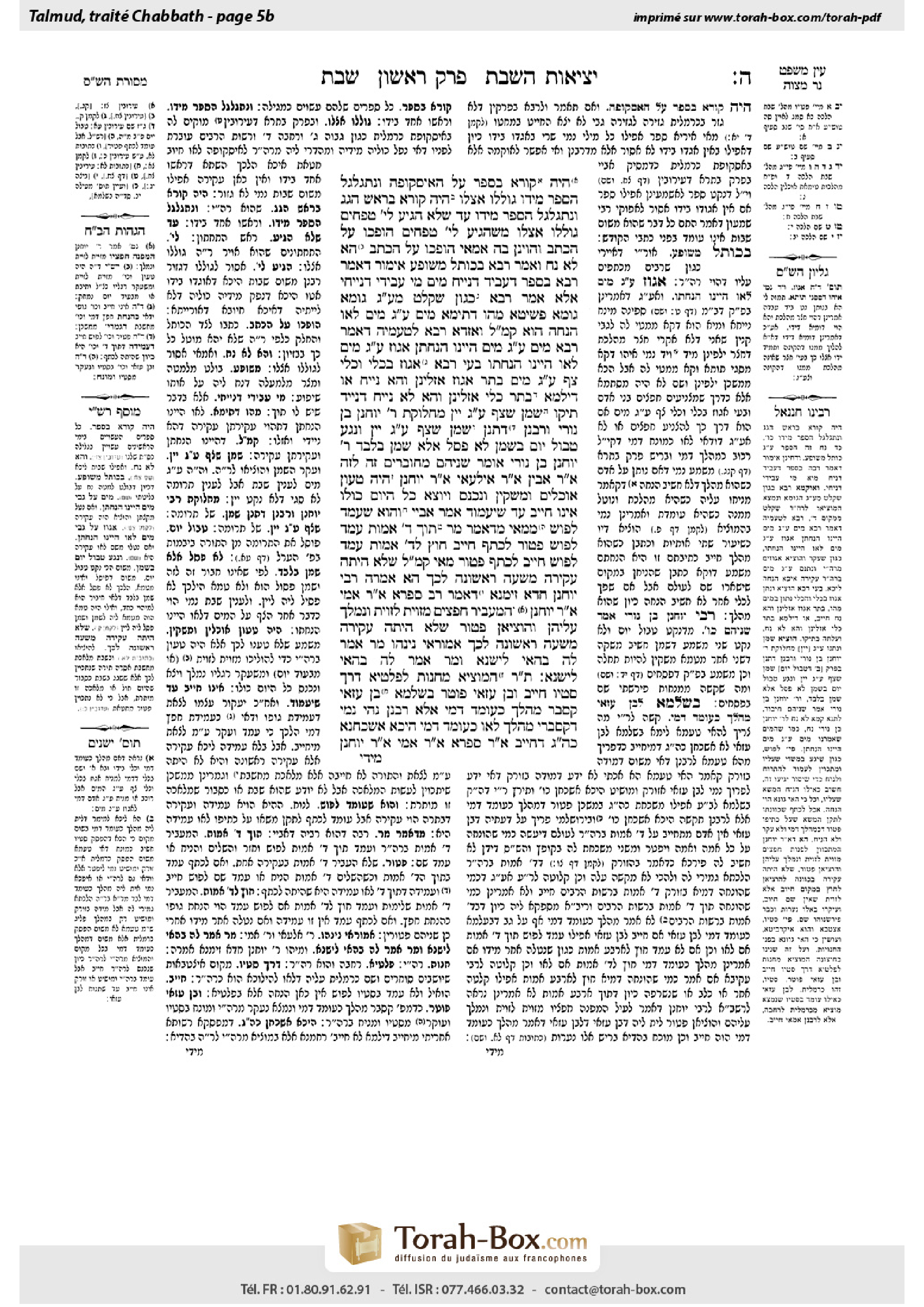
Shabbat 5b: Talmud study for Daf Yomi
Daf Yomi is the daily study of one Talmud folio. Explore 37 tractates with scans, Hebrew text, Sefaria English and AI-generated French translations where annotated.
Passage selection and English or AI-generated French translation are available where the scan has annotations. Daf Study is independent of Torah-Box and Sefaria.
Browse Shabbat · שבת · All tractatesShabbat 5b text and translations
This page of Shabbat includes the Aramaic text, an English translation and an AI-generated French translation, alongside the scan above.
שבת ה׳ ב · Aramaic and Hebrew text
הָיָה קוֹרֵא בַּסֵּפֶר עַל הָאִיסְקוּפָּה וְנִתְגַּלְגֵּל הַסֵּפֶר מִיָּדוֹ — גּוֹלְלוֹ אֶצְלוֹ. הָיָה קוֹרֵא בְּרֹאשׁ הַגָּג וְנִתְגַּלְגֵּל הַסֵּפֶר מִיָּדוֹ, עַד שֶׁלֹּא הִגִּיעַ לַעֲשָׂרָה טְפָחִים — גּוֹלְלוֹ אֶצְלוֹ. מִשֶּׁהִגִּיעַ לַעֲשָׂרָה טְפָחִים — הוֹפְכוֹ עַל הַכְּתָב. וְהָוֵינַן בַּהּ: אַמַּאי הוֹפְכוֹ עַל הַכְּתָב? הָא לָא נָח!
וְאָמַר רָבָא: בְּכוֹתֶל מְשׁוּפָּע. אֵימוֹר דְּאָמַר רָבָא בְּסֵפֶר, דַּעֲבִיד דְּנָיַיח, מַיִם מִי עֲבִידִי דְּנָיְיחִי?!
אֶלָּא אָמַר רָבָא: כְּגוֹן שֶׁקָּלַט מֵעַל גַּבֵּי גּוּמָּא. גּוּמָּא פְּשִׁיטָא! מַהוּ דְּתֵימָא מַיִם עַל גַּבֵּי מַיִם לָאו הַנָּחָה הוּא, קָא מַשְׁמַע לַן.
וְאָזְדָא רָבָא לְטַעְמֵיהּ, דְּאָמַר רָבָא: מַיִם עַל גַּבֵּי מַיִם — הַיְינוּ הַנָּחָתָן. אֱגוֹז עַל גַּבֵּי מַיִם — לָאו הַיְינוּ הַנָּחָתוֹ. בָּעֵי רָבָא: אֱגוֹז בִּכְלִי וּכְלִי צָף עַל גַּבֵּי מַיִם, בָּתַר אֱגוֹז אָזְלִינַן — וְהָא נָיַיח, אוֹ דִילְמָא בָּתַר כְּלִי אָזְלִינַן — וְהָא לָא נָיַיח, דְּנָיֵיד. תֵּיקוּ.
שֶׁמֶן שֶׁצָּף עַל גַּבֵּי יַיִן, מַחֲלוֹקֶת רַבִּי יוֹחָנָן בֶּן נוּרִי וְרַבָּנַן. דִּתְנַן: שֶׁמֶן שֶׁצָּף עַל גַּבֵּי יַיִן וְנָגַע טְבוּל יוֹם בַּשֶּׁמֶן — לֹא פָּסַל אֶלָּא שֶׁמֶן בִּלְבַד. רַבִּי יוֹחָנָן בֶּן נוּרִי אוֹמֵר: שְׁנֵיהֶם מְחוּבָּרִים זֶה לָזֶה.
אָמַר רַבִּי אָבִין אָמַר רַבִּי אִילְעַאי אָמַר רַבִּי יוֹחָנָן: הָיָה טָעוּן אוֹכְלִים וּמַשְׁקִין, וְנִכְנָס וְיוֹצֵא כׇּל הַיּוֹם כּוּלּוֹ — אֵינוֹ חַיָּיב עַד שֶׁיַּעֲמוֹד.
אָמַר אַבָּיֵי: וְהוּא שֶׁעָמַד לָפוּשׁ. מִמַּאי — מִדְּאָמַר מָר תּוֹךְ אַרְבַּע אַמּוֹת עָמַד לָפוּשׁ — פָּטוּר, לְכַתֵּף — חַיָּיב. חוּץ לְאַרְבַּע אַמּוֹת, עָמַד לָפוּשׁ — חַיָּיב. לְכַתֵּף — פָּטוּר.
מַאי קָא מַשְׁמַע לַן? — שֶׁלֹּא הָיְתָה עֲקִירָה מִשָּׁעָה רִאשׁוֹנָה לְכָךְ? הָא אַמְרַהּ רַבִּי יוֹחָנָן חֲדָא זִימְנָא! דְּאָמַר רַב סָפְרָא אָמַר רַבִּי אַמֵּי אָמַר רַבִּי יוֹחָנָן: הַמַּעֲבִיר חֲפָצִים מִזָּוִית לְזָוִית, וְנִמְלַךְ עֲלֵיהֶן וְהוֹצִיאָן — פָּטוּר, שֶׁלֹּא הָיְתָה עֲקִירָה מִשָּׁעָה רִאשׁוֹנָה לְכָךְ. אָמוֹרָאֵי נִינְהוּ, מָר אָמַר לַהּ בְּהַאי לִישָּׁנָא, וּמָר אָמַר לַהּ בְּהַאי לִישָּׁנָא.
תָּנוּ רַבָּנַן: הַמּוֹצִיא מֵחֲנוּת לִפְלַטְיָא דֶּרֶךְ סְטָיו — חַיָּיב. וּבֶן עַזַּאי פּוֹטֵר.
בִּשְׁלָמָא בֶּן עַזַּאי, קָסָבַר מְהַלֵּךְ כְּעוֹמֵד דָּמֵי. אֶלָּא רַבָּנַן, נְהִי נָמֵי דְּקָסָבְרִי מְהַלֵּךְ לָאו כְּעוֹמֵד דָּמֵי, הֵיכָא אַשְׁכַּחְנָא כְּהַאי גַּוְונָא דְּחַיָּיב?
אָמַר רַב סָפְרָא אָמַר רַבִּי אַמֵּי אָמַר רַבִּי יוֹחָנָן:
Shabbat 5b · English translation
One who was reading a sacred book in scroll form on Shabbat on an elevated, wide threshold and the book rolled from his hand outside and into the public domain, he may roll it back to himself, since one of its ends is still in his hand. However, if he was reading on top the roof, which is a full-fledged private domain, and the book rolled from his hand, as long as the edge of the book did not reach ten handbreadths above the public domain, the book is still in its own area, and he may roll it back to himself. However, once the book has reached within ten handbreadths above the public domain, he is prohibited to roll it back to himself. In that case, he may only turn it over onto the side with writing, so that the writing of the book should face down and should not be exposed and degraded. And we discussed this halakha: Why must he turn it over onto the side with writing, and he is prohibited to bring the book back to himself? Didn’t the book not yet come to rest upon a defined area in the public domain? Even if he brought it back it would not constitute lifting.
And Rava said: It is referring to the case of an inclined wall. Because it is inclined, the scroll is resting upon it to some degree. However, that answer is not effective in explaining the case of gathering water. Say that Rava said that the legal status of the slanted wall is different, specifically with regard to a book, as it is wont to come to rest upon an inclined wall. In contrast, is water wont to come to rest upon an inclined wall? It continues flowing. Consequently, the question with regard to water remains.
Rather, Rava said: Here, it is referring to a case where he gathered the rainwater from on top of a hole filled with water. The Gemara asks: If he gathered it from on top of a hole, it is obvious that it is considered like lifting from a significant place. The Gemara answers: Lest you say that since the water that comes down from the roof into the hole it is water on top of water and, perhaps, it is not considered placing. Therefore, he taught us that collecting water from on top of a hole filled with water is considered an act of lifting an object from its placement.
The Gemara comments: And Rava follows his standard line of reasoning, as Rava already said: It is obvious to me that water on top of water, that is its placement, and lifting the water from there is an act of lifting in every sense. It is also obvious that if a nut is floating on top of water, that is not considered its placement, and therefore lifting it from there is not considered an act of lifting. However, Rava raised a dilemma: In a case where a nut is in a vessel, and that vessel is floating on top of water, and one lifted the nut from the vessel, is that considered an act of lifting? The sides of the dilemma are: Do we go according to the nut and the halakha is decided exclusively based on its status, and it is at rest in the vessel? Or perhaps, we go according to the vessel and it is not at rest, as it is moving from place to place on the surface of the water. This dilemma remained unresolved, and therefore let it stand.
A similar dilemma was raised with regard to oil that was floating on top of wine. Oil does not mix with wine. Rather, it floats on top of it in a separate layer. Resolution of this dilemma is dependent on a dispute between Rabbi Yoḥanan ben Nuri and the Rabbis. Is oil considered a discrete entity placed on the wine? Or, perhaps it is considered to be connected to the wine? As we learned in a mishna: Oil that was floating on top of wine and one who immersed himself during the day touched the oil, he disqualified only the oil alone and not the wine, as he only touched the oil and the oil does not render the wine impure. And Rabbi Yoḥanan ben Nuri says: They both are considered connected to each other, and therefore they are both rendered impure through the same contact. The consideration of whether the oil and the wine are considered connected is the determining factor with regard to the laws of Shabbat as well.
Rabbi Avin said that Rabbi Elai said that Rabbi Yoḥanan said: One who was standing in the private domain or the public domain laden with food and drinks on Shabbat, and his intention was to carry them to another corner of the same domain, if once he began walking he changed his mind and exited that domain, and he enters and exits from domain to domain, even if he does so all day long, he is exempt by Torah law for carrying out on Shabbat until he stands still. Moving the object is not considered carrying out, since he did not intend from the outset to move himself in order to carry out. Therefore, only after he stands still can it be considered a bona fide placement, and only when he subsequently moves and walks would he incur liability.
Abaye added and said: And that is specifically if he stopped to rest; then it is considered placement. However, if he stopped to adjust his burden, it is not considered placement. The Gemara comments: From where did Abaye arrive at this conclusion? From that which the Master said with regard to the laws of carrying in the public domain: Although, by Torah law, one who transfers an object four cubits in the public domain is liable, if while transferring the object he stopped to rest within four cubits, he is exempt. By stopping to rest, he performed an act of placement in the middle of the transfer. As a result, he did not carry the object four complete cubits. However, if he stopped to adjust the burden on his shoulders, he is liable, as stopping in order to adjust his burden is not considered an act of placement. It is considered an action required to facilitate the continued carrying of that burden. On the other hand, after he walked beyond four cubits, if he stopped to rest, he thereby performed an act of placement and completed the prohibited labor, and he is liable; if he stopped to adjust the burden on his shoulders, he is exempt. From this halakha, Abaye learned that only when one stops to rest is it considered an act of placement in terms of the prohibited labor of carrying on Shabbat.
With regard to the essence of Rabbi Yoḥanan’s halakha about entering and exiting all day long, the Gemara asks: What principle is he teaching us with this halakha? Is it to teach that one is exempt from bringing a sin-offering for performing the prohibited labor of carrying out on Shabbat when the lifting of the object from its place from the first moment was not for that purpose of carrying out, but for another purpose? Didn’t Rabbi Yoḥanan already say it once? As Rav Safra said that Rabbi Ami said that Rabbi Yoḥanan said: One who transfers objects from corner to corner in a private domain, and, while carrying them, he changed his mind about them and took them out to the public domain, he is exempt because the lifting at the first moment was not for that purpose of carrying out to another domain. Why, then, was it necessary to repeat the same halakha? The Gemara answers: They are different amora’im who transmitted this matter. One Sage said it in this language and one Sage said it in that language. They chose different halakhot to relate the principle that Rabbi Yoḥanan stated a single time.
Since the issue of interruptions in the performance of the prohibited labor of carrying out was mentioned above, the Gemara proceeds to discuss a more complex related issue. The Sages taught in a baraita: One who carries an object out from a store, which is a private domain, to a plaza [pelatia], which is a public domain, by way of a colonnade [setav], which is situated between the store and the public domain and whose legal status is that of a karmelit, is liable, as he carried out from the private domain to the public domain. And ben Azzai deems him exempt.
The Gemara clarifies the opinions. Granted, the opinion of ben Azzai makes sense, as he holds that walking is considered like standing. In other words, with each step, he is considered as if he came to a complete stop. Therefore, as he walked through the colonnade, which is neither a public domain nor a private domain, he came to rest there. Consequently, he did not carry from a private domain to a public domain; he carried into and out of a karmelit. However, the Rabbis, although they hold that walking is not considered like standing, their opinion is difficult. Where do we find a comparable case where one is liable? There is no direct transfer from domain to domain. The transfer is via a domain where there is no Torah prohibition. Where do we find that the Torah deemed one who carried out in that manner liable?
Rav Safra said that Rabbi Ami said that Rabbi Yoḥanan said: That is not an exceptional case,
Shabbat 5b · Traduction française (IA)
Celui qui lisait un livre sacré en forme de rouleau pendant Chabbat, sur un seuil surélevé et large, et dont le livre a roulé de sa main vers l’extérieur, dans le domaine public, peut le ramener vers lui en le faisant rouler, puisque l’une de ses extrémités est encore dans sa main. Toutefois, s’il lisait sur le toit, qui constitue un véritable domaine privé, et que le livre a roulé de sa main, tant que le bord du livre ne se trouve pas à moins de dix palmes au-dessus du domaine public, le livre reste dans son propre espace et il peut le ramener vers lui en le faisant rouler. Mais dès que le livre est arrivé à moins de dix palmes au-dessus du domaine public, il lui est interdit de le ramener vers lui en le faisant rouler. Dans ce cas, il peut seulement le retourner du côté où se trouve l’écriture, afin que celle-ci soit tournée vers le bas et ne soit ni exposée ni dégradée. Nous avons discuté de cette halakha : pourquoi doit-il le retourner du côté où se trouve l’écriture, alors qu’il lui est interdit de ramener le livre vers lui ? Le livre n’était-il pas encore arrivé au repos dans un endroit déterminé du domaine public ? Même s’il le ramenait, cela ne constituerait pas un soulèvement.
Rava dit : il s’agit du cas d’un mur incliné. En raison de son inclinaison, le rouleau y repose dans une certaine mesure. Toutefois, cette réponse ne permet pas d’expliquer le cas du recueil d’eau. Disons que Rava a affirmé que le statut d’un mur incliné est particulier précisément en ce qui concerne un livre, car celui-ci est susceptible de s’arrêter sur un mur incliné. Mais l’eau est-elle susceptible de s’arrêter sur un mur incliné ? Elle continue de couler. Par conséquent, la question concernant l’eau reste entière.
Rava dit plutôt : il s’agit ici d’un cas où il a recueilli l’eau de pluie au-dessus d’un trou rempli d’eau. La Guemara demande : s’il l’a recueillie au-dessus d’un trou, il est évident que cela revient à soulever un objet depuis un emplacement important. La Guemara répond : de crainte que tu ne dises que, puisque l’eau descend du toit jusque dans le trou, il s’agit d’eau sur de l’eau et que, peut-être, cela n’est pas considéré comme une dépose, il nous enseigne que recueillir de l’eau au-dessus d’un trou rempli d’eau est considéré comme le soulèvement d’un objet depuis son emplacement.
La Guemara fait remarquer que Rava suit son raisonnement habituel, car Rava a déjà dit : il m’est évident que l’eau sur de l’eau constitue son emplacement et que soulever l’eau de là est, à tous égards, un acte de soulèvement. Il m’est également évident qu’une noix qui flotte sur l’eau ne se trouve pas à son emplacement ; par conséquent, la soulever de là n’est pas considérée comme un acte de soulèvement. Toutefois, Rava a soulevé une question : si une noix se trouve dans un récipient et que ce récipient flotte sur l’eau, soulever la noix du récipient est-il considéré comme un acte de soulèvement ? Les termes de la question sont les suivants : suivons-nous la noix, de sorte que la halakha soit déterminée exclusivement d’après son statut et qu’elle repose dans le récipient ? Ou bien suivons-nous le récipient, qui n’est pas au repos puisqu’il se déplace à la surface de l’eau ? Cette question est restée sans réponse ; qu’elle reste donc en suspens.
Une question semblable a été soulevée au sujet de l’huile qui flottait sur du vin. L’huile ne se mélange pas au vin ; elle flotte à sa surface en une couche distincte. La résolution de cette question dépend d’une controverse entre Rabbi Yoḥanan ben Nouri et les Rabbins : l’huile est-elle considérée comme une entité distincte, posée sur le vin ? Ou bien est-elle considérée comme liée au vin ? Car nous avons appris dans une Michna : de l’huile flottait sur du vin, et une personne qui s’était immergée durant la journée a touché l’huile ; elle a rendu impure l’huile seule, et non le vin, puisqu’elle n’a touché que l’huile et que celle-ci ne rend pas le vin impur. Rabbi Yoḥanan ben Nouri dit : les deux sont considérés comme liés l’un à l’autre ; par conséquent, le même contact les rend tous deux impurs. La question de savoir si l’huile et le vin sont considérés comme liés l’un à l’autre est également déterminante pour les lois de Chabbat.
Rabbi Avin a dit que Rabbi Elai a dit que Rabbi Yoḥanan a dit : celui qui se tenait dans le domaine privé ou dans le domaine public, chargé de nourriture et de boissons pendant Chabbat, avec l’intention de les transporter vers un autre coin du même domaine, mais qui, après avoir commencé à marcher, a changé d’avis et est sorti de ce domaine, entrant et sortant d’un domaine à l’autre, même s’il fait cela toute la journée, est exempt selon la Torah de la faute de transport pendant Chabbat jusqu’à ce qu’il s’arrête. Le déplacement de l’objet n’est pas considéré comme un transport vers l’extérieur, puisqu’il n’avait pas l’intention, dès le départ, de se déplacer afin de le transporter vers l’extérieur. Par conséquent, ce n’est qu’après s’être arrêté que l’on peut considérer qu’il y a eu une véritable dépose ; et ce n’est que lorsqu’il se remet ensuite en mouvement et marche qu’il encourt la responsabilité.
Abayé ajouta : cela ne s’applique que s’il s’est arrêté pour se reposer ; alors, cela est considéré comme une dépose. En revanche, s’il s’est arrêté pour ajuster sa charge, cela n’est pas considéré comme une dépose. La Guemara fait remarquer : d’où Abayé a-t-il tiré cette conclusion ? De ce que le maître a dit au sujet des lois du transport dans le domaine public : bien que, selon la Torah, celui qui transporte un objet sur quatre coudées dans le domaine public soit passible, s’il s’arrête pour se reposer avant d’avoir parcouru quatre coudées, il est exempt. En s’arrêtant pour se reposer, il a accompli une dépose au milieu du transport. Par conséquent, il n’a pas transporté l’objet sur quatre coudées complètes. Toutefois, s’il s’est arrêté pour ajuster la charge sur ses épaules, il est passible, car s’arrêter pour ajuster sa charge n’est pas considéré comme une dépose. C’est une action nécessaire pour pouvoir continuer à porter cette charge. En revanche, après avoir marché au-delà de quatre coudées, s’il s’arrête pour se reposer, il accomplit alors une dépose et achève le travail interdit ; il est donc passible. S’il s’arrête pour ajuster la charge sur ses épaules, il est exempt. Abayé a déduit de cette halakha que seul un arrêt destiné au repos est considéré comme une dépose dans le cadre du travail interdit de transport pendant Chabbat.
À propos de l’essentiel de la halakha de Rabbi Yoḥanan concernant le fait d’entrer et de sortir toute la journée, la Guemara demande : quel principe nous enseigne-t-il par cette halakha ? Est-ce pour enseigner qu’on est exempt d’apporter un sacrifice expiatoire pour avoir accompli le travail interdit de transport vers l’extérieur pendant Chabbat lorsque, dès le départ, le soulèvement de l’objet à son emplacement n’avait pas pour but de le transporter vers l’extérieur, mais répondait à un autre dessein ? Rabbi Yoḥanan ne l’a-t-il pas déjà dit ? Car Rav Safra a dit que Rabbi Ami a dit que Rabbi Yoḥanan a dit : celui qui transporte des objets d’un coin à l’autre dans un domaine privé, puis, alors qu’il les porte, change d’avis à leur sujet et les sort dans le domaine public, est exempt, car le soulèvement initial n’avait pas pour but de les transporter dans un autre domaine. Pourquoi était-il donc nécessaire de répéter la même halakha ? La Guemara répond : ce sont différents amoraïm qui ont transmis cet enseignement. Un Sage l’a formulé ainsi, et un autre Sage l’a formulé autrement. Ils ont choisi des halakhot différentes pour rapporter le principe énoncé une seule fois par Rabbi Yoḥanan.
Puisque la question des interruptions dans l’accomplissement du travail interdit de transport vers l’extérieur a été mentionnée plus haut, la Guemara aborde un problème connexe plus complexe. Les Sages ont enseigné dans une baraïta : celui qui transporte un objet d’un magasin, qui est un domaine privé, vers une place [pelatia], qui est un domaine public, en passant par une galerie à colonnes [setav], située entre le magasin et le domaine public et ayant le statut juridique de karmelit, est passible, car il a transporté l’objet du domaine privé au domaine public. Ben Azzai le déclare exempt.
La Guemara précise les opinions. Certes, l’opinion de Ben Azzai se comprend, puisqu’il considère que la marche équivaut à un arrêt. Autrement dit, à chaque pas, on considère qu’il s’est complètement arrêté. Par conséquent, en traversant la galerie à colonnes, qui n’est ni un domaine public ni un domaine privé, il s’y est arrêté. Il n’a donc pas transporté l’objet d’un domaine privé à un domaine public ; il l’a transporté vers une karmelit, puis l’en a fait sortir. Toutefois, l’opinion des Rabbins pose problème, bien qu’ils considèrent que la marche n’équivaut pas à un arrêt : où trouve-t-on un cas comparable où quelqu’un est passible ? Il n’y a pas eu de transfert direct d’un domaine à l’autre. Le transfert s’est fait par l’intermédiaire d’un domaine où aucune interdiction de la Torah ne s’applique. Où trouve-t-on que la Torah déclare passible celui qui transporte de cette manière ?
Rav Safra a dit que Rabbi Ami a dit que Rabbi Yoḥanan a dit : ce n’est pas un cas exceptionnel,
Traduction française générée par IA à partir de l’édition anglaise de Sefaria. Vérifie toujours un passage avec le texte source.
Text from Sefaria: William Davidson Edition - Vocalized Aramaic (CC BY NC); William Davidson Edition - English (CC BY NC).