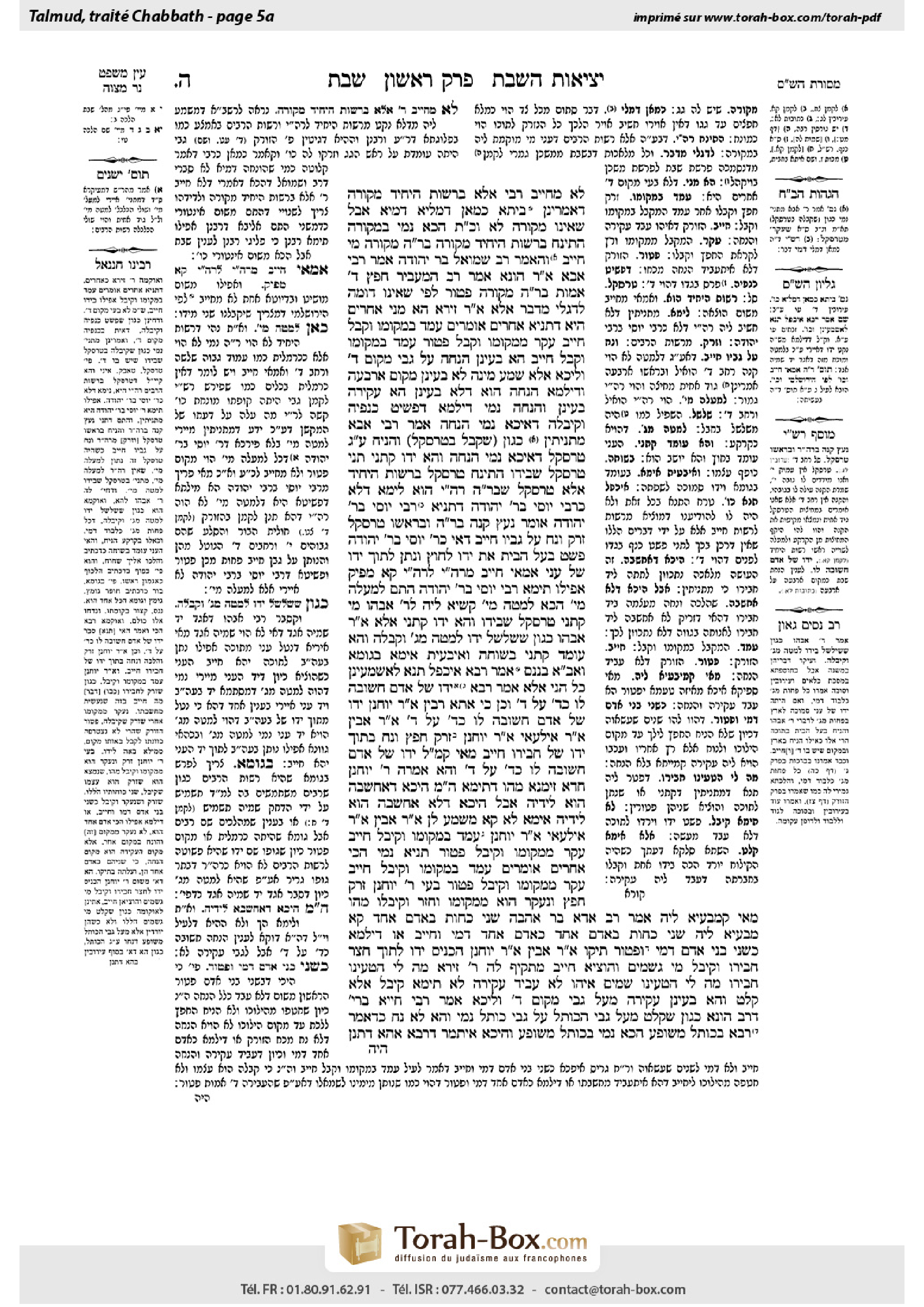
Shabbat 5a: Talmud study for Daf Yomi
Daf Yomi is the daily study of one Talmud folio. Explore 37 tractates with scans, Hebrew text, Sefaria English and AI-generated French translations where annotated.
Passage selection and English or AI-generated French translation are available where the scan has annotations. Daf Study is independent of Torah-Box and Sefaria.
Browse Shabbat · שבת · All tractatesShabbat 5a text and translations
This page of Shabbat includes the Aramaic text, an English translation and an AI-generated French translation, alongside the scan above.
שבת ה׳ א · Aramaic and Hebrew text
לָא מְחַיֵּיב רַבִּי אֶלָּא בִּרְשׁוּת הַיָּחִיד מְקוֹרֶה, דְּאָמְרִינַן: בֵּיתָא כְּמַאן דְּמַלְיָא דָּמְיָא. אֲבָל שֶׁאֵינוֹ מְקוֹרֶה — לָא.
וְכִי תֵּימָא הָכָא נָמֵי בִּמְקוֹרֶה — הָתִינַח בִּרְשׁוּת הַיָּחִיד מְקוֹרֶה, בִּרְשׁוּת הָרַבִּים מְקוֹרֶה מִי חַיָּיב? וְהָאָמַר רַב שְׁמוּאֵל בַּר יְהוּדָה אָמַר רַבִּי אַבָּא אָמַר רַב הוּנָא אָמַר רַב: הַמַּעֲבִיר חֵפֶץ אַרְבַּע אַמּוֹת בִּרְשׁוּת הָרַבִּים מְקוֹרֶה, פָּטוּר — לְפִי שֶׁאֵינוֹ דּוֹמֶה לְדִגְלֵי מִדְבָּר.
אֶלָּא אָמַר רַבִּי זֵירָא: הָא מַנִּי? — אֲחֵרִים הִיא. דְּתַנְיָא: אֲחֵרִים אוֹמְרִים: עָמַד בִּמְקוֹמוֹ וְקִבֵּל — חַיָּיב, עָקַר מִמְּקוֹמוֹ וְקִבֵּל — פָּטוּר. עָמַד בִּמְקוֹמוֹ וְקִבֵּל — חַיָּיב, הָא בָּעֵינַן הַנָּחָה עַל גַּבֵּי מְקוֹם אַרְבָּעָה וְלֵיכָּא! אֶלָּא שְׁמַע מִינַּהּ לָא בָּעֵינַן מְקוֹם אַרְבָּעָה.
וְדִילְמָא הַנָּחָה הוּא דְּלָא בָּעֵינַן, הָא עֲקִירָה בָּעֵינַן. וְהַנָּחָה נָמֵי, דִּילְמָא דִּפְשֵׁיט כַּנְפֵיהּ וְקַבְּלַהּ — דְּאִיכָּא נָמֵי הַנָּחָה.
אָמַר רַבִּי אַבָּא: מַתְנִיתִין, כְּגוֹן שֶׁקִּבֵּל בִּטְרַסְקָל וְהִנִּיחַ עַל גַּבֵּי טְרַסְקָל, דְּאִיכָּא נָמֵי הַנָּחָה. וְהָא ״יָדוֹ״ קָתָנֵי? — תְּנִי ״טְרַסְקָל שֶׁבְּיָדוֹ״.
הָתִינַח טְרַסְקָל בִּרְשׁוּת הַיָּחִיד, אֶלָּא טְרַסְקָל שֶׁבִּרְשׁוּת הָרַבִּים רְשׁוּת הַיָּחִיד הוּא.
לֵימָא דְּלָא כְּרַבִּי יוֹסֵי בְּרַבִּי יְהוּדָה. דְּתַנְיָא, רַבִּי יוֹסֵי בְּרַבִּי יְהוּדָה אוֹמֵר: נָעַץ קָנֶה בִּרְשׁוּת הָרַבִּים וּבְרֹאשׁוֹ טְרַסְקָל, זָרַק וְנָח עַל גַּבָּיו — חַיָּיב.
דְּאִי כְּרַבִּי יוֹסֵי בְּרַבִּי יְהוּדָה, פָּשַׁט בַּעַל הַבַּיִת אֶת יָדוֹ לַחוּץ וְנָתַן לְתוֹךְ יָדוֹ שֶׁל עָנִי אַמַּאי חַיָּיב? מֵרְשׁוּת הַיָּחִיד לִרְשׁוּת הַיָּחִיד קָא מַפֵּיק!
אֲפִילּוּ תֵּימָא רַבִּי יוֹסֵי בְּרַבִּי יְהוּדָה, הָתָם לְמַעְלָה מֵעֲשָׂרָה, הָכָא לְמַטָּה מֵעֲשָׂרָה.
קַשְׁיָא לֵיהּ לְרַבִּי אֲבָהוּ: מִי קָתָנֵי ״טְרַסְקָל שֶׁבְּיָדוֹ״, וְהָא ״יָדוֹ״ קָתָנֵי! אֶלָּא אָמַר רַבִּי אֲבָהוּ: כְּגוֹן שֶׁשִּׁלְשֵׁל יָדוֹ לְמַטָּה מִשְּׁלֹשָׁה וְקִבְּלָהּ.
וְהָא ״עוֹמֵד״ קָתָנֵי? — בְּשׁוֹחֶה. וְאִיבָּעֵית אֵימָא — בְּגוּמָּא. וְאִיבָּעֵית אֵימָא — בְּנַנָּס.
אָמַר רָבָא: אִיכְּפַל תַּנָּא לְאַשְׁמֹעִינַן כֹּל הָנֵי?! אֶלָּא אָמַר רָבָא: יָדוֹ שֶׁל אָדָם חֲשׁוּבָה לוֹ כְּאַרְבָּעָה עַל אַרְבָּעָה. וְכֵן כִּי אֲתָא רָבִין, אָמַר רַבִּי יוֹחָנָן: יָדוֹ שֶׁל אָדָם חֲשׁוּבָה לוֹ כְּאַרְבָּעָה עַל אַרְבָּעָה.
אָמַר רַבִּי אָבִין אָמַר רַבִּי אִילְעַאי אָמַר רַבִּי יוֹחָנָן: זָרַק חֵפֶץ וְנָח בְּתוֹךְ יָדוֹ שֶׁל חֲבֵירוֹ — חַיָּיב. מַאי קָא מַשְׁמַע לַן? — יָדוֹ שֶׁל אָדָם חֲשׁוּבָה לוֹ כְּאַרְבָּעָה עַל אַרְבָּעָה? וְהָא אַמְרַהּ רַבִּי יוֹחָנָן חֲדָא זִימְנָא? מַהוּ דְתֵימָא הָנֵי מִילֵּי, הֵיכָא דְּאַחְשְׁבַהּ הוּא לִידֵיהּ. אֲבָל הֵיכָא דְּלָא אַחְשְׁבַהּ הוּא לִידֵיהּ — אֵימָא לָא. קָא מַשְׁמַע לַן.
אָמַר רַבִּי אָבִין אָמַר רַבִּי אִילְעַאי אָמַר רַבִּי יוֹחָנָן: עָמַד בִּמְקוֹמוֹ וְקִיבֵּל — חַיָּיב. עָקַר מִמְּקוֹמוֹ וְקִיבֵּל — פָּטוּר. תַּנְיָא נָמֵי הָכִי, אֲחֵרִים אוֹמְרִים: עָמַד בִּמְקוֹמוֹ וְקִיבֵּל — חַיָּיב. עָקַר מִמְּקוֹמוֹ וְקִיבֵּל — פָּטוּר.
בָּעֵי רַבִּי יוֹחָנָן: זָרַק חֵפֶץ וְנֶעֱקַר הוּא מִמְּקוֹמוֹ וְחָזַר וְקִיבְּלוֹ — מַהוּ?
מַאי קָמִבַּעְיָא לֵיהּ? אָמַר רַב אַדָּא בַּר אַהֲבָה: ״שְׁנֵי כֹחוֹת בְּאָדָם אֶחָד״ קָא מִבַּעְיָא לֵיהּ. שְׁנֵי כֹחוֹת בְּאָדָם אֶחָד כְּאָדָם אֶחָד דָּמֵי, וְחַיָּיב, אוֹ דִילְמָא כִּשְׁנֵי בְנֵי אָדָם דָּמֵי, וּפָטוּר. תֵּיקוּ.
אָמַר רַבִּי אָבִין אָמַר רַבִּי יוֹחָנָן: הִכְנִיס יָדוֹ לְתוֹךְ חֲצַר חֲבֵירוֹ וְקִיבֵּל מֵי גְשָׁמִים וְהוֹצִיא — חַיָּיב. מַתְקִיף לַהּ רַבִּי זֵירָא: מָה לִי הִטְעִינוֹ חֲבֵירוֹ, מָה לִי הִטְעִינוֹ שָׁמַיִם, אִיהוּ לָא עָבֵיד עֲקִירָה?! לָא תֵּימָא ״קִיבֵּל״ אֶלָּא ״קָלַט״. וְהָא בָּעֵינַן עֲקִירָה מֵעַל גַּבֵּי מְקוֹם אַרְבָּעָה, וְלֵיכָּא!
אָמַר רַבִּי חִיָּיא בְּרֵיהּ דְּרַב הוּנָא: כְּגוֹן שֶׁקָּלַט מֵעַל גַּבֵּי הַכּוֹתֶל. עַל גַּבֵּי כּוֹתֶל נָמֵי, וְהָא לָא נָח! — כִּדְאָמַר רָבָא בְּכוֹתֶל מְשׁוּפָּע, הָכָא נָמֵי בְּכוֹתֶל מְשׁוּפָּע. וְהֵיכָא אִיתְּמַר דְּרָבָא — אַהָא דִּתְנַן:
Shabbat 5a · English translation
Rabbi Yehuda HaNasi only deemed him liable in the covered private domain, with a roof, as we say: The house is considered as one that is full? The entire house with all its space is considered one unit, and each part of it is considered as if it is filled with actual objects. Therefore, an object passing through the house is considered as if it landed on an actual surface of at least four by four handbreadths. However, in a private domain that is not covered, Rabbi Yehuda HaNasi does not deem him liable.
And if you say: Here too our mishna is speaking about a covered domain, and therefore the lifting from and the placing on the hand are considered as if they were performed in a place that is four handbreadths; granted, in a covered private domain lifting from and placing in a hand are considered as if it were lifted from and placed onto an area of four by four handbreadths, but in a covered public domain is he liable at all? Didn’t Rav Shmuel bar Yehuda say that Rabbi Abba said that Rav Huna said that Rav said: One who carries an object four cubits from place to place in a covered public domain, even though transferring an object four cubits in the public domain is like carrying out from one domain to another and prohibited by Torah law, in this case, he is not liable? The reason is that since the covered public domain is not similar to the banners in the desert, i.e., the area in which the banners of the tribes of Israel passed in the desert. The labors prohibited on Shabbat are derived from the labors that were performed in the building of the Tabernacle during the encampment of Israel in the desert, and the desert was most definitely not covered. Consequently, even according to Rabbi Yehuda HaNasi’s opinion, it is impossible to explain that our mishna is referring to the case of a covered public domain.
Rather, Rabbi Zeira said: There must be a different source for our mishna. Whose opinion is it in our mishna? It is the opinion of Aḥerim, as it was taught in a baraita: Aḥerim say: One who stood in his place on Shabbat and received an object thrown to him from another domain, the one who threw the object is liable for the prohibited labor of carrying out, as he both lifted and placed the object. However, if the one who received the object moved from his place, ran toward the object, and then received it in his hand, he, the one who threw it, is exempt. That is because, even though he performed an act of lifting, the placing of the object was facilitated by the action of the one who received it, and therefore the one who threw it did not perform the act of placing. In any case, according to the opinion of Aḥerim, if he stood in his place and received the object, the one who threw it is liable. Don’t we require placing upon an area of four by four handbreadths and there is none in this case? Rather, certainly conclude from this that according to Aḥerim we do not require an area of four by four.
The Gemara rejects this: This is not a proof, and one could say: Perhaps it is specifically for placing that we do not require an area of four by four; however, for lifting we require an area of four by four in order to consider it significant. And with regard to placing as well, one could say: Perhaps it was performed in a manner in which he extended the corners of his coat and received it, so in that case there is also placing upon an area of four by four. Therefore, there is no proof from here.
Rabbi Abba said: Our mishna is speaking about a special case where he received, i.e., lifted, the object that was in a basket [teraskal] and he placed it atop a basket. In that case, there is also placing performed upon an area of four by four handbreadths. The Gemara asks: Wasn’t it taught in the mishna: His hand? So how can you say that he received it in a basket? The Gemara answers: Emend the text of the mishna and teach: The basket in his hand.
The Gemara asks about this matter: Granted, when the basket was in the private domain, but if it was a basket that was placed in the public domain, doesn’t it immediately become the private domain? Presumably, the basket is ten handbreadths above the ground, and its surface is the requisite size for creating a private domain.
Since that is not the explanation given, let us say that this is a proof that our mishna is not in accordance with the opinion of Rabbi Yosei, son of Rabbi Yehuda. As it was taught in a baraita: Rabbi Yosei, son of Rabbi Yehuda, says: One who stuck a stick into the ground in the public domain, and hung a basket atop it, and threw an object from the public domain, and it landed upon it, he is liable, because he threw it from the public domain into the private domain. Since the surface of the basket is four by four handbreadths and it is ten handbreadths above the ground, it is considered a private domain. Even though the stick, which is serving as the base for this basket, is not four handbreadths wide, since the basket is that wide, we consider it as if the sides of the basket descend in a straight line. Consequently, a type of pillar of a private domain is formed in the public domain.
Our mishna is not in accordance with the opinion of Rabbi Yosei, son of Rabbi Yehuda, as if it were in accordance with the opinion of Rabbi Yosei, son of Rabbi Yehuda, in a case where the owner of the house extended his hand outside and placed an object in the basket in the hand of the poor person in the public domain, why is he liable? According to his opinion, the basket is considered a private domain and he, the owner of the house, is merely carrying out from private domain to private domain. This proves that the opinion of our mishna is not in accordance with the opinion of Rabbi Yosei, son of Rabbi Yehuda.
The Gemara answers: Even if you say that our mishna is in accordance with the opinion of Rabbi Yosei, son of Rabbi Yehuda, there, where we learned that a basket is considered like a private domain, was in a case in which the basket was above ten handbreadths off the ground. Here, in our mishna, the basket was below ten handbreadths off the ground. Even according to the opinion of Rabbi Yosei, son of Rabbi Yehuda, in a case where it is below ten handbreadths it is not considered a private domain, rather it is part of the public domain. Therefore, it is considered carrying out and he is liable.
The Gemara comments: Nevertheless, this explanation is difficult for Rabbi Abbahu: Was the language taught in the mishna: A basket in his hand? His hand, was taught. There is no reason to emend the mishna in that way. Rather, Rabbi Abbahu said: The mishna here is referring to a case where the poor person lowered his hand below three handbreadths off the ground and received that object in his hand. Below three handbreadths is considered, in all respects, to be appended to the ground and, therefore, a place of four by four handbreadths.
The Gemara asks: Didn’t the mishna teach: The poor person stands outside? If he is standing, how is it possible that his hand is within three handbreadths of the ground? Rabbi Abbahu answered: It is describing a case where he is bending down. In that case, his hand could be adjacent to the ground even though he is standing. And if you wish, say instead that it is possible in a case where the poor person is standing in a hole and his hand is adjacent to the ground. And if you wish, say instead a different depiction of the situation: The mishna is speaking about a case involving a midget [nanas], whose hands, even when standing, are within three handbreadths of the ground.
About all of these Rava said: Did the tanna go to all that trouble in an effort to teach us all of these cases? It is difficult to accept that the tanna could not find a more conventional manner to explain the halakha. Rather, Rava said: The problem must be resolved by establishing the principle: A person’s hand is considered like four by four handbreadths for him. It is true that lifting and placing upon a significant place are required. However, even though a significant place is normally no less than four handbreadths, the hand of a person is significant enough for it to be considered a significant place as far as the halakhot of Shabbat are concerned. And, so too, when Ravin came from Eretz Yisrael to Babylonia, he said that Rabbi Yoḥanan said: A person’s hand is considered four by four handbreadths for him.
Rabbi Avin said that Rabbi Elai said that Rabbi Yoḥanan said: One who threw an object and it landed in the hand of another who is in a different domain is liable. The Gemara asks: What is he teaching us? What halakhic principle is conveyed through this statement? Is it that a person’s hand is considered four by four for him? Didn’t Rabbi Yoḥanan already say that one time? Why was it necessary to repeat it, albeit in a different context? The Gemara answers: It was necessary to teach the halakha cited by Rabbi Elai as well, lest you say that this, the principle that a person’s hand is significant, applies only where he himself deemed his hand significant by lifting or receiving an object with his hand. However, where he did not deem his hand significant, rather the object fell into another’s hand without his intention, perhaps the hand is not considered a significant place and he would not be liable. Therefore, he teaches us that the hand’s significance is absolute and not dependent upon the intention of the one initiating the action.
Rabbi Avin said that Rabbi Elai said that Rabbi Yoḥanan said additionally: One who stood in his place and received an object that was thrown to him from another domain, the one who threw it is liable. However, if he moved from his place and then received the object, the one who threw it is exempt. That was also taught in a baraita. Aḥerim say: If he stood in his place and received in his hand the object that was thrown from another domain, the one who threw it is liable. And if he moved from his place and received it, he is exempt.
Rabbi Yoḥanan raised a related dilemma: One who threw an object from one domain and moved from his place and ran to another domain and then received the same object in his hand in the second domain, what is his legal status?
To clarify the matter, the Gemara asks: What is his dilemma? Didn’t one person perform a complete act of lifting and placing? Rav Adda bar Ahava said: His dilemma was with regard to two forces in one person. Rabbi Yoḥanan raised a dilemma with regard to one who performs two separate actions rather than one continuous action. Are two forces in one person considered like one person, and he is liable? Or, perhaps they are considered like two people, and he is exempt? This dilemma remains unresolved and therefore, let it stand.
Rabbi Avin said that Rabbi Yoḥanan said: If he brought his hand into the courtyard of another and received rainwater that fell at that time into his hand and carried it out to another domain, he is liable. Rabbi Zeira objects to this: What is the difference to me if his friend loaded him with an object, i.e., his friend placed an object in his hand, and what is the difference to me if Heaven loaded him with rainwater? In neither case did he perform an act of lifting. Why then should he be liable for carrying out from domain to domain? The Gemara answers: Do not say: He received rainwater, indicating that he passively received the rainwater in his hand. Rather, read: He actively gathered rainwater in his hand from the air, which is tantamount to lifting. The Gemara asks: In order to become liable, don’t we require lifting from atop an area of four handbreadths, and in this case there is none? How, therefore, would he be liable?
Rabbi Ḥiyya, son of Rav Huna, said: It is a case where he gathered the rainwater from atop and on the side of the wall, so he lifted it from a significant place. Therefore, it is considered an act of lifting, and he is liable. The Gemara questions: Atop a wall, too, the rain did not come to rest. Rather, it immediately and continuously flowed. If so, the lifting was not from the wall at all. The Gemara answers: As Rava said in another context that the case involves an inclined wall, here too the case involves an inclined wall. The Gemara asks: And where was this statement of Rava stated? It was stated with regard to that which we learned in a mishna:
Shabbat 5a · Traduction française (IA)
Rabbi Yehuda HaNasi ne l’a déclaré passible que dans un domaine privé couvert, doté d’un toit, car nous disons : « La maison est considérée comme remplie. » Toute la maison, avec tout son espace, est considérée comme une seule unité, et chacune de ses parties comme si elle était remplie d’objets réels. Ainsi, un objet qui traverse la maison est considéré comme s’il s’était posé sur une surface réelle d’au moins quatre téfaḥim sur quatre. Toutefois, dans un domaine privé qui n’est pas couvert, Rabbi Yehuda HaNasi ne le déclare pas passible.
Et si tu dis qu’ici aussi, notre Michna parle d’un domaine couvert, de sorte que le prélèvement et le dépôt sur la main sont considérés comme ayant eu lieu dans un endroit de quatre téfaḥim, cela convient pour un domaine privé couvert : le prélèvement et le dépôt dans une main sont considérés comme s’ils avaient eu lieu sur une surface de quatre téfaḥim sur quatre. Mais est-il seulement passible dans un domaine public couvert ? Rav Shmuel bar Yehuda n’a-t-il pas dit que Rabbi Abba a dit que Rav Huna a dit que Rav a dit : « Celui qui transporte un objet sur quatre coudées d’un endroit à un autre dans un domaine public couvert, bien que transporter un objet sur quatre coudées dans le domaine public soit comparable au transport d’un domaine à un autre et soit interdit par la Torah, n’est pas passible dans ce cas » ? La raison en est que le domaine public couvert ne ressemble pas au campement des tribus dans le désert, c’est-à-dire à l’espace où passaient les bannières des tribus d’Israël dans le désert. Les travaux interdits le Chabbat sont déduits des travaux accomplis lors de la construction du Tabernacle, pendant le campement d’Israël dans le désert, et le désert n’était certainement pas couvert. Par conséquent, même selon l’opinion de Rabbi Yehuda HaNasi, il est impossible d’expliquer que notre Michna traite du cas d’un domaine public couvert.
Rabbi Zeira a plutôt dit : Il faut trouver une autre source pour notre Michna. De l’opinion de qui relève notre Michna ? De celle d’Aḥerim, comme cela a été enseigné dans une baraïta : « Aḥerim disent : Celui qui est resté à sa place le Chabbat et a reçu un objet qu’on lui a lancé depuis un autre domaine rend celui qui a lancé l’objet passible du travail interdit de transport, car celui-ci a effectué à la fois le prélèvement et le dépôt de l’objet. Cependant, si le destinataire s’est déplacé, a couru vers l’objet, puis l’a reçu dans sa main, celui qui l’a lancé est exempt. » En effet, même s’il a accompli un acte de prélèvement, le dépôt de l’objet a été rendu possible par l’action du destinataire ; celui qui a lancé l’objet n’a donc pas accompli l’acte de dépôt. Quoi qu’il en soit, selon Aḥerim, si le destinataire est resté à sa place et a reçu l’objet, celui qui l’a lancé est passible. N’exige-t-on pas un dépôt sur une surface de quatre téfaḥim sur quatre, alors qu’il n’y en a pas dans ce cas ? Il faut donc conclure que, selon Aḥerim, une surface de quatre téfaḥim sur quatre n’est pas requise.
La Guemara rejette cette preuve : ce n’en est pas une, car on pourrait dire que seule une surface de quatre téfaḥim sur quatre n’est pas requise pour le dépôt ; en revanche, elle est requise pour le prélèvement, afin que celui-ci soit considéré comme significatif. Et pour le dépôt également, on pourrait dire qu’il a été effectué en étendant les pans de son vêtement pour recevoir l’objet ; dans ce cas, le dépôt s’est donc aussi fait sur une surface de quatre téfaḥim sur quatre. Il n’y a donc pas de preuve à tirer de là.
Rabbi Abba a dit : Notre Michna parle d’un cas particulier, où il a reçu — c’est-à-dire prélevé — l’objet qui se trouvait dans un panier [teraskal], puis l’a déposé sur un panier. Dans ce cas aussi, le dépôt a été effectué sur une surface de quatre téfaḥim sur quatre. La Guemara demande : La Michna n’a-t-elle pas enseigné : « Sa main » ? Comment peux-tu donc dire qu’il l’a reçu dans un panier ? La Guemara répond : Corrige le texte de la Michna et lis : « Le panier dans sa main ».
La Guemara interroge sur ce point : cela convient si le panier se trouvait dans le domaine privé ; mais s’il s’agissait d’un panier posé dans le domaine public, ne devient-il pas aussitôt un domaine privé ? Le panier se trouve vraisemblablement à dix téfaḥim au-dessus du sol, et sa surface a la taille requise pour constituer un domaine privé.
Puisque ce n’est pas l’explication donnée, disons que cela prouve que notre Michna n’est pas conforme à l’opinion de Rabbi Yosei, fils de Rabbi Yehuda. Car il a été enseigné dans une baraïta : « Rabbi Yosei, fils de Rabbi Yehuda, dit : Celui qui a planté un bâton dans le sol du domaine public, y a suspendu un panier, puis a lancé un objet depuis le domaine public et l’a fait tomber dessus est passible, car il l’a lancé du domaine public dans le domaine privé. » Puisque la surface du panier mesure quatre téfaḥim sur quatre et se trouve à dix téfaḥim au-dessus du sol, elle est considérée comme un domaine privé. Bien que le bâton, qui sert de support au panier, ne fasse pas quatre téfaḥim de large, puisque le panier a cette largeur, nous considérons que les parois du panier se prolongent verticalement vers le bas. Un type de pilier constituant un domaine privé est ainsi formé dans le domaine public.
Notre Michna n’est pas conforme à l’opinion de Rabbi Yosei, fils de Rabbi Yehuda. Car si elle était conforme à son opinion, dans le cas où le propriétaire de la maison tend la main à l’extérieur et dépose un objet dans le panier tenu par le pauvre, dans le domaine public, pourquoi est-il passible ? Selon son opinion, le panier est considéré comme un domaine privé et lui, le propriétaire de la maison, ne fait que transporter d’un domaine privé à un autre domaine privé. Cela prouve que l’opinion de notre Michna n’est pas celle de Rabbi Yosei, fils de Rabbi Yehuda.
La Guemara répond : Même si tu dis que notre Michna est conforme à l’opinion de Rabbi Yosei, fils de Rabbi Yehuda, le cas où nous avons appris qu’un panier est considéré comme un domaine privé concernait un panier situé à plus de dix téfaḥim du sol. Ici, dans notre Michna, le panier se trouvait à moins de dix téfaḥim du sol. Même selon l’opinion de Rabbi Yosei, fils de Rabbi Yehuda, s’il est à moins de dix téfaḥim, il n’est pas considéré comme un domaine privé, mais comme faisant partie du domaine public. Il s’agit donc d’un transport hors du domaine, et il est passible.
La Guemara fait remarquer : néanmoins, cette explication pose problème pour Rabbi Abbahu. La Michna enseignait-elle : « Un panier dans sa main » ? C’est « sa main » qui a été enseigné. Rien ne justifie de corriger la Michna de cette manière. Rabbi Abbahu a plutôt dit : Ici, la Michna parle d’un cas où le pauvre a abaissé sa main à moins de trois téfaḥim du sol et y a reçu l’objet. Tout ce qui se trouve à moins de trois téfaḥim du sol est, à tous égards, considéré comme rattaché au sol et constitue donc une surface de quatre téfaḥim sur quatre.
La Guemara demande : La Michna n’a-t-elle pas enseigné que le pauvre se tient à l’extérieur ? S’il est debout, comment sa main peut-elle se trouver à moins de trois téfaḥim du sol ? Rabbi Abbahu répondit : Cela décrit un cas où il se penche. Sa main peut alors être près du sol alors même qu’il est debout. Et si tu veux, dis plutôt qu’il est possible que le pauvre se tienne dans un trou et que sa main soit près du sol. Et si tu veux, donne une autre description de la situation : la Michna parle d’un cas impliquant un nain [nanas], dont les mains, même lorsqu’il est debout, se trouvent à moins de trois téfaḥim du sol.
Au sujet de toutes ces explications, Rava a dit : Le tanna s’est-il donné tant de peine pour nous enseigner tous ces cas ? Il est difficile d’admettre que le tanna n’ait pu trouver une manière plus habituelle d’expliquer la halakha. Rava a plutôt dit qu’il faut résoudre le problème en établissant le principe suivant : la main d’une personne est considérée pour elle comme une surface de quatre téfaḥim sur quatre. Il est vrai qu’un prélèvement et un dépôt sur un emplacement significatif sont requis. Cependant, même si un emplacement significatif mesure normalement au moins quatre téfaḥim, la main d’une personne est suffisamment significative pour être considérée comme un tel emplacement au regard des halakhot du Chabbat. De même, lorsque Ravin est venu d’Eretz Israël en Babylonie, il a dit que Rabbi Yoḥanan a dit : « La main d’une personne est considérée pour elle comme une surface de quatre téfaḥim sur quatre. »
Rabbi Avin a dit que Rabbi Elai a dit que Rabbi Yoḥanan a dit : Celui qui lance un objet et le fait tomber dans la main d’une autre personne se trouvant dans un autre domaine est passible. La Guemara demande : Que nous enseigne-t-il ? Quel principe halakhique cette déclaration transmet-elle ? Est-ce que la main d’une personne est considérée comme une surface de quatre téfaḥim sur quatre pour elle ? Rabbi Yoḥanan ne l’a-t-il pas déjà dit une fois ? Pourquoi était-il nécessaire de le répéter, même dans un contexte différent ? La Guemara répond : Il était également nécessaire d’enseigner la halakha rapportée par Rabbi Elai, de crainte que tu ne dises que le principe selon lequel la main d’une personne est significative ne s’applique que lorsqu’elle-même a conféré à sa main ce caractère significatif en y prélevant ou en y recevant un objet. En revanche, si elle ne lui a pas conféré ce caractère et que l’objet est tombé dans la main d’une autre personne sans que celle-ci l’ait voulu, peut-être la main n’est-elle pas considérée comme un emplacement significatif et le lanceur ne serait pas passible. Il nous enseigne donc que le caractère significatif de la main est absolu et ne dépend pas de l’intention de la personne à l’origine de l’action.
Rabbi Avin a dit que Rabbi Elai a dit que Rabbi Yoḥanan a dit en outre : Celui qui est resté à sa place et a reçu un objet qu’on lui a lancé depuis un autre domaine rend celui qui l’a lancé passible. Cependant, s’il s’est déplacé de sa place avant de recevoir l’objet, celui qui l’a lancé est exempt. Cela a également été enseigné dans une baraïta. Aḥerim disent : « S’il est resté à sa place et a reçu dans sa main l’objet lancé depuis un autre domaine, celui qui l’a lancé est passible. Mais s’il s’est déplacé de sa place et l’a reçu, celui qui l’a lancé est exempt. »
Rabbi Yoḥanan a soulevé une question connexe : Quel est le statut de celui qui lance un objet depuis un domaine, se déplace de sa place, court vers un autre domaine, puis reçoit ce même objet dans sa main, dans le second domaine ?
Pour clarifier la question, la Guemara demande : En quoi consiste son doute ? Une seule personne n’a-t-elle pas accompli un acte complet de prélèvement et de dépôt ? Rav Adda bar Ahava a dit : Son doute portait sur deux forces intervenant chez une seule personne. Rabbi Yoḥanan a soulevé une question concernant celui qui accomplit deux actions distinctes plutôt qu’une action continue. Deux forces intervenant chez une seule personne sont-elles considérées comme une seule personne, auquel cas elle est passible ? Ou bien sont-elles considérées comme deux personnes, auquel cas elle est exemptée ? Cette question reste sans réponse ; laissons-la donc en suspens.
Rabbi Avin a dit que Rabbi Yoḥanan a dit : Si quelqu’un a introduit sa main dans la cour d’autrui, y a reçu l’eau de pluie qui tombait alors dans sa main, puis l’a transportée dans un autre domaine, il est passible. Rabbi Zeira s’y oppose : Quelle différence cela me fait-il que son ami l’ait chargé d’un objet, c’est-à-dire que son ami ait placé un objet dans sa main, ou que le Ciel l’ait chargé d’eau de pluie ? Dans aucun des deux cas il n’a accompli un acte de prélèvement. Pourquoi serait-il alors passible d’avoir transporté d’un domaine à un autre ? La Guemara répond : Ne dis pas qu’il a « reçu » l’eau de pluie, ce qui indiquerait qu’il l’a reçue passivement dans sa main. Lis plutôt : il a activement recueilli dans sa main l’eau de pluie qui tombait dans l’air, ce qui équivaut à un prélèvement. La Guemara demande : Pour être passible, n’exige-t-on pas un prélèvement sur une surface de quatre téfaḥim, alors qu’il n’y en a pas dans ce cas ? Comment serait-il donc passible ?
Rabbi Ḥiyya, fils de Rav Huna, a dit : Il s’agit d’un cas où il a recueilli l’eau de pluie sur le dessus et le côté du mur, de sorte qu’il l’a prélevée depuis un emplacement significatif. Cela est donc considéré comme un acte de prélèvement, et il est passible. La Guemara objecte : Même sur le dessus d’un mur, l’eau de pluie ne s’est pas immobilisée ; elle s’est au contraire mise à couler aussitôt, sans interruption. Si tel est le cas, le prélèvement n’a pas été effectué depuis le mur. La Guemara répond : De même que Rava a dit, dans un autre contexte, que le cas concernait un mur incliné, ici aussi, il s’agit d’un mur incliné. La Guemara demande : Et où cette déclaration de Rava a-t-elle été énoncée ? Elle l’a été à propos de ce que nous avons appris dans une Michna :
Traduction française générée par IA à partir de l’édition anglaise de Sefaria. Vérifie toujours un passage avec le texte source.
Text from Sefaria: William Davidson Edition - Vocalized Aramaic (CC BY NC); William Davidson Edition - English (CC BY NC).