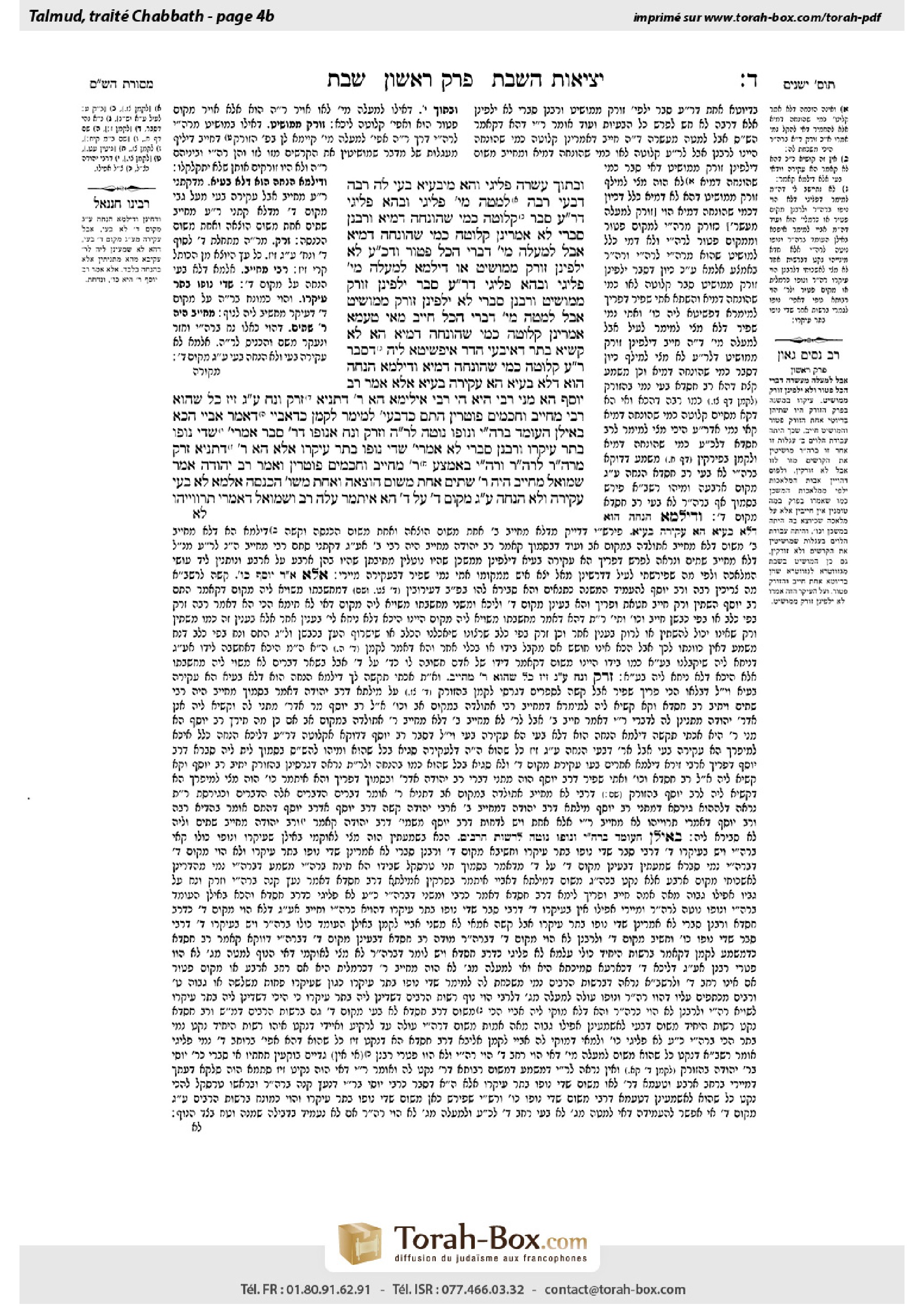
Shabbat 4b: Talmud study for Daf Yomi
Daf Yomi is the daily study of one Talmud folio. Explore 37 tractates with scans, Hebrew text, Sefaria English and AI-generated French translations where annotated.
Passage selection and English or AI-generated French translation are available where the scan has annotations. Daf Study is independent of Torah-Box and Sefaria.
Browse Shabbat · שבת · All tractatesShabbat 4b text and translations
This page of Shabbat includes the Aramaic text, an English translation and an AI-generated French translation, alongside the scan above.
שבת ד׳ ב · Aramaic and Hebrew text
וּבְתוֹךְ עֲשָׂרָה פְּלִיגִי? וְהָא מִיבַּעְיָא בָּעֵי לַהּ רַבָּה! דְּבָעֵי רַבָּה: לְמַטָּה מֵעֲשָׂרָה פְּלִיגִי — וּבְהָא פְּלִיגִי: דְּרַבִּי עֲקִיבָא סָבַר קְלוּטָה כְּמִי שֶׁהוּנְּחָה דָּמְיָא, וְרַבָּנַן סָבְרִי לָא אָמְרִינַן קְלוּטָה כְּמִי שֶׁהוּנְּחָה דָּמְיָא. אֲבָל לְמַעְלָה מֵעֲשָׂרָה דִּבְרֵי הַכֹּל פָּטוּר, וּדְכוּלֵּי עָלְמָא לָא יָלְפִינַן זוֹרֵק מִמּוֹשִׁיט.
אוֹ דִילְמָא לְמַעְלָה מֵעֲשָׂרָה פְּלִיגִי — וּבְהָא פְּלִיגִי: דְּרַבִּי עֲקִיבָא סָבַר יָלְפִינַן זוֹרֵק מִמּוֹשִׁיט, וְרַבָּנַן סָבְרִי לָא יָלְפִינַן זוֹרֵק מִמּוֹשִׁיט. אֲבָל לְמַטָּה מֵעֲשָׂרָה דִּבְרֵי הַכֹּל חַיָּיב. מַאי טַעְמָא, אָמְרִינַן קְלוּטָה כְּמִי שֶׁהוּנְּחָה דָּמְיָא.
הָא לָא קַשְׁיָא: בָּתַר דְּאִיבַּעְיָא הֲדַר אִיפְּשִׁיטָא לֵיהּ דְּסָבַר רַבִּי עֲקִיבָא קְלוּטָה כְּמִי שֶׁהוּנְּחָה דָּמְיָא.
וְדִילְמָא הַנָּחָה הוּא דְּלָא בָּעֲיָא, הָא עֲקִירָה בָּעֲיָא!
אֶלָּא אָמַר רַב יוֹסֵף: הָא מַנִּי? — רַבִּי הִיא.
הֵי רַבִּי? אִילֵּימָא הָא רַבִּי, דְּתַנְיָא: זָרַק וְנָח עַל גַּבֵּי זִיז כׇּל שֶׁהוּא — רַבִּי מְחַיֵּיב, וַחֲכָמִים פּוֹטְרִין.
הָתָם כִּדְבָעֵינַן לְמֵימַר לְקַמָּן כִּדְאַבָּיֵי, דְּאָמַר אַבָּיֵי: הָכָא בָּאִילָן הָעוֹמֵד בִּרְשׁוּת הַיָּחִיד וְנוֹפוֹ נוֹטֶה לִרְשׁוּת הָרַבִּים, וְזָרַק וְנָח אַנּוֹפוֹ.
דְּרַבִּי סָבַר: אָמְרִינַן ״שְׁדִי נוֹפוֹ בָּתַר עִיקָּרוֹ״. וְרַבָּנַן סָבְרִי: לָא אָמְרִינַן ״שְׁדִי נוֹפוֹ בָּתַר עִיקָּרוֹ״.
אֶלָּא הָא רַבִּי, דְּתַנְיָא: זָרַק מֵרְשׁוּת הָרַבִּים לִרְשׁוּת הָרַבִּים וּרְשׁוּת הַיָּחִיד בָּאֶמְצַע — רַבִּי מְחַיֵּיב, וַחֲכָמִים פּוֹטְרִין.
וְאָמַר רַב יְהוּדָה אָמַר שְׁמוּאֵל, מְחַיֵּיב הָיָה רַבִּי שְׁתַּיִם: אַחַת מִשּׁוּם הוֹצָאָה, וְאַחַת מִשּׁוּם הַכְנָסָה. אַלְמָא לָא בָּעֵי עֲקִירָה וְלָא הַנָּחָה עַל גַּבֵּי מְקוֹם אַרְבָּעָה עַל אַרְבָּעָה.
הָא אִיתְּמַר עֲלַהּ, רַב וּשְׁמוּאֵל דְּאָמְרִי תַּרְוַויְיהוּ:
Shabbat 4b · English translation
and it is in a case where the object passed within ten handbreadths of the ground that they disagree? And wasn’t it raised as a dilemma by Rabba, as it was unclear to him whether or not that is the correct explanation of the dispute between Rabbi Akiva and the Rabbis? As Rabba raised a dilemma: Do those who dispute the matter of one who throws from a private domain to a private domain with a public domain in the middle disagree with regard to a case where the object was thrown below ten handbreadths off the ground, and this is the point over which they disagree: Rabbi Akiva holds that an object in airspace is considered at rest, and the Rabbis hold that we do not say that an object in airspace is considered at rest? However, if the object passed more than ten handbreadths above the public domain, everyone agrees that he is exempt and everyone agrees that we do not derive the halakha of throwing from the halakha of passing. There is a special halakha with regard to passing objects: One standing in a private domain who passes an object through a public domain to another private domain, even though the object did not come to rest in the public domain, his action is considered to have carried out. However, the halakha with regard to throwing is different.
Or, perhaps they disagree with regard to a case where the object passed ten handbreadths above the ground, and this is the point over which they disagree: Rabbi Akiva holds that we derive the halakha of throwing from the halakha of passing and considers them details of one halakha. And the Rabbis hold that we do not derive throwing from passing, and, although one who passes the object in that case is liable, one who throws it is not. The halakha with regard to passing is a unique halakha, a Torah decree, and other cases cannot be derived from it. However, with regard to one who throws from one private domain to another via a public domain, if the object passed below ten handbreadths off the ground, everyone agrees that he is liable. What is the reason for this? Everyone agrees that an object in airspace is considered at rest. Since Rabba himself is uncertain as to the point of the dispute in that mishna with regard to one who throws an object, how can he determine Rabbi Akiva’s opinion in the matter of our mishna?
The Gemara answers: That is not difficult. It can be explained that, after he raised the dilemma, it was later resolved for him that the correct understanding is that Rabbi Akiva alone holds that an object in airspace is considered at rest.
However, there is room to question the parallel between Rabbi Akiva’s opinion and the case in our mishna. Perhaps placing alone does not require an area of four by four in order to be considered halakhic placing, but lifting does require a minimum of four by four handbreadths to be considered halakhic lifting. Perhaps placing, which is merely the conclusion of the prohibited labor, does not require the same conditions as lifting, which is the beginning and the essence of the labor of carrying out (Rashba). From Rabbi Akiva’s opinion, a conclusion may be drawn that an object in airspace is considered placed even without the surface area of four by four handbreadths. But, a conclusion may not be drawn that an object lifted from a surface lacking that area is considered lifted.
Rather, Rav Yosef said: Whose opinion is it in this mishna? It is the opinion of Rabbi Yehuda HaNasi.
The Gemara asks: To which of Rabbi Yehuda HaNasi’s halakhot is Rav Yosef referring? If you say that he is referring to this halakha, as it was taught in a baraita: One who threw an object on Shabbat in the public domain from the beginning to the end of four cubits, and it, the object, came to rest atop a projection of any size, Rabbi Yehuda HaNasi deems him liable, and the Rabbis deem him exempt. Apparently, this proves that, according to Rabbi Yehuda HaNasi, there is no minimum area required for lifting and placing. This is the halakha to which Rav Yosef referred.
The Gemara rejects this: There, the explanation is according to what we will need to say later in accordance with the statement of Abaye, as Abaye said: Here, the baraita is not dealing with just any situation. Rather, it is dealing with a special case where there is a tree standing in the private domain and its boughs lean into the public domain, and one threw an object from the public domain and it rested upon the boughs of the tree.
Rabbi Yehuda HaNasi holds that we say: Cast its boughs after its trunk. The tree’s branches are considered an extension of its trunk. Therefore, the entire tree is considered as a private domain, and one who throws onto it is liable. And the Rabbis hold that we do not say: Cast its boughs after its trunk. Therefore, the boughs themselves are not considered to be a private domain, and one who throws atop them from the public domain is not liable. Since Rabbi Yehuda HaNasi considers the boughs of the tree like part of the trunk, something thrown atop the tree is considered as if it were placed on the trunk, which is four by four handbreadths. If so, one cannot conclude from here that there is no need for a significant area according to Rabbi Yehuda HaNasi.
Rather, it is possible that Rav Yosef referred to this halakha of Rabbi Yehuda HaNasi, as it was taught in a baraita: One who threw an object on Shabbat from the public domain to the public domain and the private domain was in the middle, Rabbi Yehuda HaNasi deems him liable for carrying out from domain to domain, and the Rabbis deem him exempt.
And Rav Yehuda said that Shmuel said: In that case, Rabbi Yehuda HaNasi holds that the one who threw the object is liable to bring two sin-offerings, as he violated two prohibitions: One, due to carrying from the public domain into the private domain, when the object passed through the airspace of the private domain; and one, due to carrying from the private domain out to the public domain. Apparently, he requires neither lifting from nor placing upon an area of four by four handbreadths, as not only is he liable for carrying the object into a private domain and placing it by means of passing through its airspace, but he is also liable for lifting the object from that private domain and bringing it to the public domain. According to Rabbi Yehuda HaNasi, neither lifting nor placing requires a significant area.
The Gemara rejects this proof. Wasn’t it stated with regard to this dispute that Rav and Shmuel both said:
Shabbat 4b · Traduction française (IA)
Et s’agit-il d’un cas où l’objet est passé à moins de dix téfaḥim du sol, et est-ce sur ce point qu’ils sont en désaccord ? Pourtant, Rabba n’a-t-il pas soulevé une question, car il ne savait pas si telle était ou non la bonne explication du désaccord entre Rabbi Akiva et les Rabbins ? Rabba a en effet soulevé la question suivante : ceux qui sont en désaccord au sujet de celui qui lance un objet d’un domaine privé à un autre domaine privé, avec un domaine public entre les deux, sont-ils en désaccord dans le cas où l’objet a été lancé à moins de dix téfaḥim du sol, et leur désaccord porte-t-il sur ce point : Rabbi Akiva considère qu’un objet dans l’espace aérien est réputé au repos, tandis que les Rabbins ne considèrent pas qu’un objet dans l’espace aérien soit réputé au repos ? Cependant, si l’objet est passé à plus de dix téfaḥim au-dessus du domaine public, tous s’accordent à dire que celui qui l’a lancé est exempt et que nous ne déduisons pas la halakha du lancer de celle du passage. Il existe une halakha particulière concernant le passage d’objets : celui qui se tient dans un domaine privé et fait passer un objet à travers un domaine public vers un autre domaine privé est considéré comme l’ayant fait sortir, même si l’objet ne s’est pas arrêté dans le domaine public. Cependant, la halakha concernant le lancer est différente.
Ou bien sont-ils en désaccord dans le cas où l’objet est passé à plus de dix téfaḥim du sol, et leur désaccord porte-t-il sur ce point : Rabbi Akiva considère que nous déduisons la halakha du lancer de celle du passage et les traite comme des aspects d’une même halakha. Les Rabbins, eux, considèrent que nous ne déduisons pas la halakha du lancer de celle du passage ; ainsi, bien que celui qui fait passer l’objet dans ce cas soit passible, celui qui le lance ne l’est pas. La halakha concernant le passage est une halakha particulière, un décret de la Torah, et on ne peut en déduire d’autres cas. Cependant, dans le cas de celui qui lance un objet d’un domaine privé à un autre en passant par un domaine public, si l’objet est passé à moins de dix téfaḥim du sol, tous s’accordent à dire qu’il est passible. Pour quelle raison ? Tous s’accordent à dire qu’un objet dans l’espace aérien est réputé au repos. Puisque Rabba lui-même doute du point de désaccord dans cette Michna concernant celui qui lance un objet, comment peut-il déterminer l’opinion de Rabbi Akiva sur la question de notre Michna ?
La Guemara répond : il n’y a pas de difficulté. On peut expliquer qu’après avoir soulevé la question, il a ensuite résolu son doute : selon la bonne explication, Rabbi Akiva est le seul à considérer qu’un objet dans l’espace aérien est réputé au repos.
Cependant, il y a lieu de s’interroger sur le parallèle entre l’opinion de Rabbi Akiva et le cas de notre Michna. Peut-être que le dépôt, à lui seul, ne nécessite pas une superficie de quatre sur quatre pour être considéré comme un dépôt halakhique, tandis que le soulèvement exige une superficie minimale de quatre sur quatre téfaḥim pour être considéré comme un soulèvement halakhique. Peut-être que le dépôt, qui n’est que l’achèvement du travail interdit, n’est pas soumis aux mêmes conditions que le soulèvement, qui est le commencement et l’essence du travail de transport (Rashba). De l’opinion de Rabbi Akiva, on peut déduire qu’un objet dans l’espace aérien est réputé déposé même sans une superficie de quatre sur quatre téfaḥim. Mais on ne peut pas en déduire qu’un objet soulevé d’une surface dépourvue de cette superficie est considéré comme soulevé.
Rav Yossef a plutôt dit : De qui est l’opinion exprimée dans cette Michna ? C’est celle de Rabbi Yehouda HaNassi.
La Guemara demande : À quelle halakha de Rabbi Yehouda HaNassi Rav Yossef fait-il référence ? Si tu dis qu’il fait référence à cette halakha, enseignée dans une baraïta : celui qui, pendant Chabbat, lance un objet dans le domaine public sur une distance de quatre coudées, du début à la fin, et que l’objet s’arrête au sommet d’une saillie de n’importe quelle dimension, Rabbi Yehouda HaNassi le déclare passible, tandis que les Rabbins le déclarent exempt. Cela prouve apparemment que, selon Rabbi Yehouda HaNassi, aucune superficie minimale n’est requise pour soulever et déposer. C’est à cette halakha que Rav Yossef faisait référence.
La Guemara rejette cette explication : dans ce cas, l’explication repose sur ce que nous devrons dire plus tard, conformément à la déclaration d’Abayé. Car Abayé a dit : ici, la baraïta ne traite pas d’un cas quelconque. Elle traite plutôt d’un cas particulier où un arbre se dresse dans le domaine privé et où ses branches s’étendent dans le domaine public ; quelqu’un lance alors un objet depuis le domaine public, et celui-ci se pose sur les branches de l’arbre.
Rabbi Yehouda HaNassi considère que l’on dit : « Attribue ses branches à son tronc. » Les branches de l’arbre sont considérées comme un prolongement de son tronc. Par conséquent, l’arbre tout entier est considéré comme un domaine privé, et celui qui lance un objet dessus est passible. Les Rabbins, eux, considèrent que l’on ne dit pas : « Attribue ses branches à son tronc. » Par conséquent, les branches elles-mêmes ne sont pas considérées comme un domaine privé, et celui qui lance un objet du domaine public sur leur sommet n’est pas passible. Puisque Rabbi Yehouda HaNassi considère les branches de l’arbre comme une partie du tronc, un objet lancé au sommet de l’arbre est considéré comme s’il avait été déposé sur le tronc, qui mesure quatre sur quatre téfaḥim. On ne peut donc pas en conclure que, selon Rabbi Yehouda HaNassi, aucune superficie significative n’est nécessaire.
Il est plutôt possible que Rav Yossef ait fait référence à cette halakha de Rabbi Yehouda HaNassi, enseignée dans une baraïta : celui qui, pendant Chabbat, lance un objet d’un domaine public à un autre domaine public, avec un domaine privé au milieu, Rabbi Yehouda HaNassi le déclare passible d’avoir transporté l’objet d’un domaine à un autre, tandis que les Rabbins le déclarent exempt.
Et Rav Yehouda a dit au nom de Chmouel : dans ce cas, Rabbi Yehouda HaNassi considère que celui qui a lancé l’objet est passible d’apporter deux sacrifices expiatoires, car il a transgressé deux interdictions : l’une, pour avoir transporté l’objet du domaine public vers le domaine privé, lorsqu’il est passé à travers l’espace aérien du domaine privé ; l’autre, pour l’avoir transporté du domaine privé vers le domaine public. Cela montre apparemment qu’il n’exige ni que le soulèvement ait lieu sur une superficie de quatre sur quatre téfaḥim, ni que le dépôt ait lieu sur une telle superficie. En effet, non seulement est-il passible pour avoir transporté l’objet dans un domaine privé et l’y avoir déposé en le faisant passer à travers son espace aérien, mais il est aussi passible pour avoir soulevé l’objet de ce domaine privé et l’avoir amené dans le domaine public. Selon Rabbi Yehouda HaNassi, ni le soulèvement ni le dépôt n’exigent une superficie significative.
La Guemara rejette cette preuve. N’a-t-il pas été dit au sujet de ce désaccord que Rav et Chmouel ont tous deux déclaré :
Traduction française générée par IA à partir de l’édition anglaise de Sefaria. Vérifie toujours un passage avec le texte source.
Text from Sefaria: William Davidson Edition - Vocalized Aramaic (CC BY NC); William Davidson Edition - English (CC BY NC).