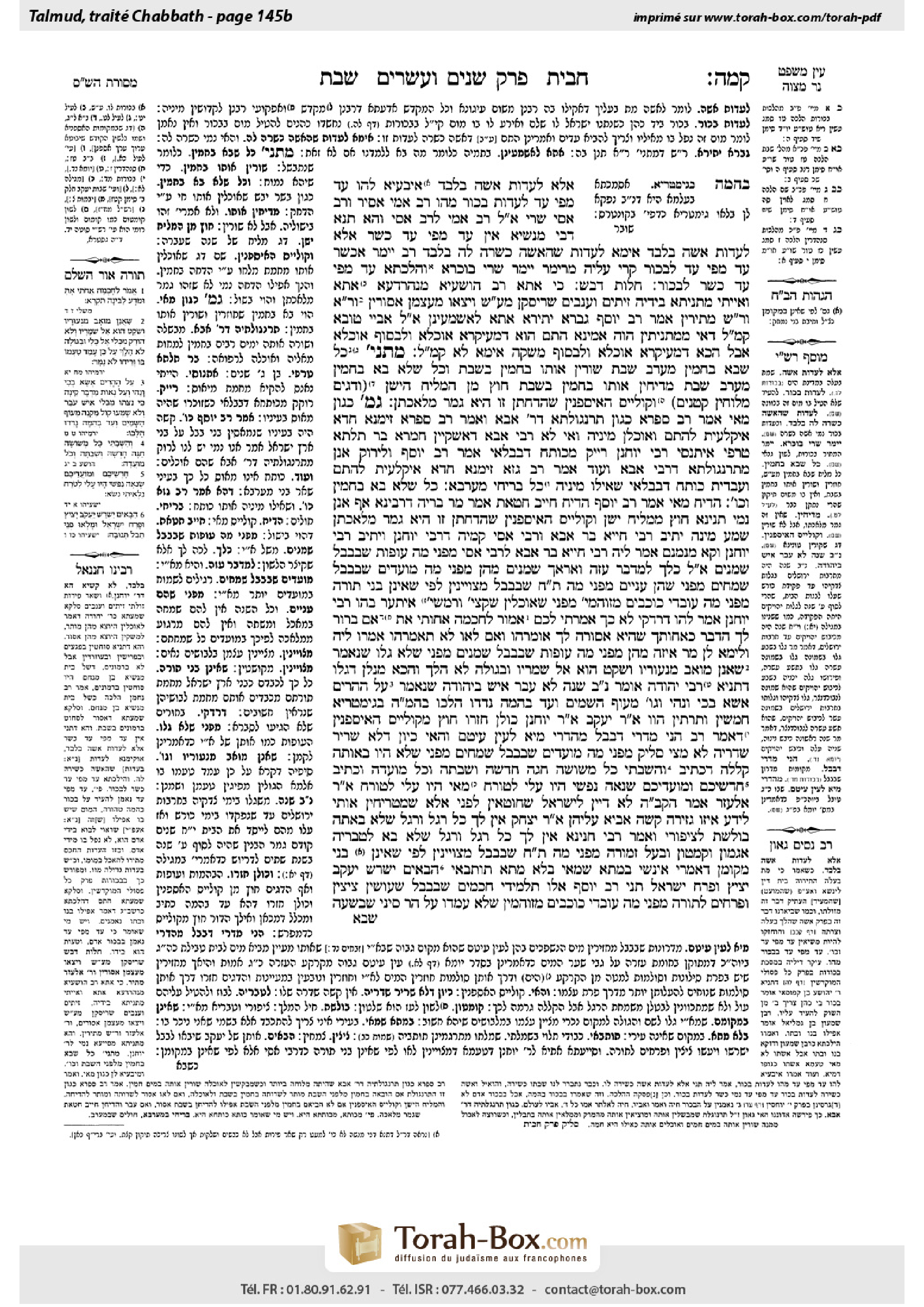
Shabbat 145b: Talmud study for Daf Yomi
Daf Yomi is the daily study of one Talmud folio. Explore 37 tractates with scans, Hebrew text, Sefaria English and AI-generated French translations where annotated.
Passage selection and English or AI-generated French translation are available where the scan has annotations. Daf Study is independent of Torah-Box and Sefaria.
Browse Shabbat · שבת · All tractatesShabbat 145b text and translations
This page of Shabbat includes the Aramaic text, an English translation and an AI-generated French translation, alongside the scan above.
שבת קמ״ה ב · Aramaic and Hebrew text
אֶלָּא לְעֵדוּת אִשָּׁה בִּלְבָד.
אִיבַּעְיָא לְהוּ: עֵד מִפִּי עֵד לְעֵדוּת בְּכוֹר, מַהוּ? רַב (אַמֵּי) [אִתַּי] אָסַר, וְרַב אַסִּי שָׁרֵי.
אֲמַר לֵיהּ רַב אַמֵּי לְרַב אַסִּי: וְהָא תָּנָא דְּבֵי מְנַשְּׁיָא: אֵין עֵד מִפִּי עֵד כָּשֵׁר אֶלָּא לְעֵדוּת אִשָּׁה בִּלְבָד! אֵימָא: לְעֵדוּת שֶׁהָאִשָּׁה כְּשֵׁרָה לָהּ בִּלְבָד. רַב יֵימַר אַכְשַׁר עֵד מִפִּי עֵד לִבְכוֹר. קָרֵי עֲלֵיהּ מָרִימָר: יֵימַר שָׁרֵי בּוּכְרָא. וְהִלְכְתָא עֵד מִפִּי עֵד כָּשֵׁר לִבְכוֹר.
חַלּוֹת דְּבַשׁ. כִּי אֲתָא רַב הוֹשַׁעְיָא מִנְּהַרְדְּעָא אֲתָא וְאַיְיתִי מַתְנִיתָא בִּידֵיהּ: זֵיתִים וַעֲנָבִים שֶׁרִיסְּקָן מֵעֶרֶב שַׁבָּת, וְיָצְאוּ מֵעַצְמָן — אֲסוּרִין. וְרַבִּי אֶלְעָזָר וְרַבִּי שִׁמְעוֹן מַתִּירִין.
אָמַר רַב יוֹסֵף: גַּבְרָא יַתִּירָא אֲתָא לְאַשְׁמוֹעִינַן. אֲמַר לֵיהּ אַבָּיֵי: טוּבָא קָא מַשְׁמַע לַן, דְּאִי מִמַּתְנִיתִין הֲוָה אָמֵינָא: הָתָם הוּא — דְּמֵעִיקָּרָא אוּכְלָא וּלְבַסּוֹף אוּכְלָא, אֲבָל הָכָא דְּמֵעִיקָּרָא אוּכְלָא וּלְבַסּוֹף מַשְׁקֶה — אֵימָא לָא, קָא מַשְׁמַע לַן.
מַתְנִי׳ כׇּל שֶׁבָּא בְּחַמִּין מֵעֶרֶב שַׁבָּת — שׁוֹרִין אוֹתוֹ בְּחַמִּין בְּשַׁבָּת. וְכׇל שֶׁלֹּא בָּא בְּחַמִּין מֵעֶרֶב שַׁבָּת — מְדִיחִין אוֹתוֹ בְּחַמִּין בַּשַּׁבָּת, חוּץ מִן הַמָּלִיחַ הַיָּשָׁן וְדָגִים מְלוּחִין קְטַנִּים וְקוֹלְיָיס הָאִיסְפְּנִין, שֶׁהַדָּחָתָן זוֹ הִיא גְּמַר מְלַאכְתָּן.
גְּמָ׳ כְּגוֹן מַאי? אָמַר רַב סָפְרָא: כְּגוֹן תַּרְנְגוֹלְתָּא דְּרַבִּי אַבָּא. וְאָמַר רַב סָפְרָא: זִימְנָא חֲדָא אִיקְּלַעִית לְהָתָם, וְאוֹכְלַן מִינֵּיהּ, וְאִי לָא רַבִּי אַבָּא דְּאַשְׁקְיַין חַמְרָא בַּר תְּלָתָא טַרְפֵי — אִיתְּנַסִי.
רַבִּי יוֹחָנָן רָיֵיק מִכּוּתָח דְּבַבְלָאֵי. אָמַר רַב יוֹסֵף: וְלִירוֹק אֲנַן מִתַּרְנְגוֹלְתָּא דְּרַבִּי אַבָּא. וְעוֹד, אָמַר רַב גַּזָּא: זִימְנָא חֲדָא אִיקְּלַעִית לְהָתָם, וַעֲבַדִית כּוּתָח דְּבַבְלָאֵי, שְׁאִילוּ מִינֵּיהּ כׇּל בְּרִיחֵי מַעְרְבָא.
כׇּל שֶׁלֹּא בָּא בְּחַמִּין וְכוּ׳. הֵדִיחַ מַאי? אָמַר רַב יוֹסֵף: הֵדִיחַ — חַיָּיב חַטָּאת. אָמַר מָר בְּרֵיהּ דְּרָבִינָא: אַף אֲנַן נָמֵי תְּנֵינָא: חוּץ מִמָּלִיחַ יָשָׁן וְקוֹלְיָיס הָאִיסְפְּנִין, שֶׁהֲדָחָתָן זוֹ הִיא גְּמַר מְלַאכְתָּן. שְׁמַע מִינַּהּ.
יָתֵיב רַבִּי חִיָּיא בַּר אַבָּא וְרַבִּי אַסִּי קַמֵּיהּ דְּרַבִּי יוֹחָנָן, וְיָתֵיב רַבִּי יוֹחָנָן וְקָא מְנַמְנֵם. אֲמַר לֵיהּ רַבִּי חִיָּיא בַּר אַבָּא לְרַבִּי אַסִּי: מִפְּנֵי מָה עוֹפוֹת שֶׁבְּבָבֶל שְׁמֵנִים? אֲמַר לֵיהּ: כְּלָךְ לְמִדְבַּר עַזָּה וְאַרְאֵךְ שְׁמֵנִים מֵהֶן. מִפְּנֵי מָה מוֹעֲדִים שֶׁבְּבָבֶל שְׂמֵחִים? מִפְּנֵי שֶׁהֵן עֲנִיִּים. מִפְּנֵי מָה תַּלְמִידֵי חֲכָמִים שֶׁבְּבָבֶל מְצוּיָּינִין? לְפִי שֶׁאֵינָן בְּנֵי תוֹרָה. מִפְּנֵי מָה גּוֹיִם מְזוֹהָמִים? מִפְּנֵי שֶׁאוֹכְלִין שְׁקָצִים וּרְמָשִׂים.
אִיתְּעַר בְּהוּ רַבִּי יוֹחָנָן, אֲמַר לְהוּ: דַּרְדְּקֵי! לֹא כָּךְ אָמַרְתִּי לָכֶם: ״אֱמוֹר לַחׇכְמָה אֲחוֹתִי אָתְּ״ — אִם בָּרוּר לְךָ הַדָּבָר כַּאֲחוֹתְךָ שֶׁהִיא אֲסוּרָה לְךָ — אוֹמְרֵהוּ, וְאִם לָאו — לֹא תֹּאמְרֵהוּ. אֲמַרוּ לֵיהּ: וְלֵימָא לַן מָר אֵיזֶה מֵהֶן? מִפְּנֵי מָה עוֹפוֹת שֶׁבְּבָבֶל שְׁמֵנִים — מִפְּנֵי שֶׁלֹּא גָּלוּ, שֶׁנֶּאֱמַר: ״שַׁאֲנַן מוֹאָב מִנְּעוּרָיו וְשֹׁקֵט הוּא אֶל שְׁמָרָיו וּבַגּוֹלָה לֹא הָלָךְ״.
וְהָכָא מְנָלַן דִּגְלוֹ? דְּתַנְיָא, רַבִּי יְהוּדָה אוֹמֵר: חֲמִשִּׁים וּשְׁתַּיִם שָׁנָה לֹא עָבַר אִישׁ בִּיהוּדָה, שֶׁנֶּאֱמַר: ״עַל הֶהָרִים אֶשָּׂא בְכִי וָנֶהִי וְגוֹ׳ מֵעוֹף הַשָּׁמַיִם וְעַד בְּהֵמָה נָדְדוּ הָלָכוּ״, ״בְּהֵמָה״ בְּגִימַטְרִיָּא חַמְשִׁין וְתַרְתֵּין הָווּ.
אָמַר רַבִּי יַעֲקֹב אָמַר רַבִּי יוֹחָנָן: כּוּלָּן חָזְרוּ, חוּץ מִקּוֹלְיָיס הָאִיסְפְּנִין, דַּאֲמַר רַב: הָנֵי מִדְרֵי דְבָבֶל מְהַדְּרִי מַיָּא לְעֵין עֵיטָם. וְהַאי, כֵּיוָן דְּלָא שָׁרִיר שִׁדְרֵיהּ לָא מָצֵי סָלֵיק.
מִפְּנֵי מָה מוֹעֲדִים שֶׁבְּבָבֶל שְׂמֵחִים? — מִפְּנֵי שֶׁלֹּא הָיוּ בְּאוֹתָהּ קְלָלָה, דִּכְתִיב: ״וְהִשְׁבַּתִּי כׇּל מְשׂוֹשָׂהּ חַגָּהּ חׇדְשָׁהּ וְשַׁבַּתָּהּ וְכֹל מוֹעֲדָהּ״. וּכְתִיב: ״חׇדְשֵׁיכֶם וּמוֹעֲדֵיכֶם שָׂנְאָה נַפְשִׁי הָיוּ עָלַי לָטוֹרַח״. מַאי ״הָיוּ עָלַי לָטוֹרַח״? אָמַר רַבִּי אֶלְעָזָר, אָמַר הַקָּדוֹשׁ בָּרוּךְ הוּא: לֹא דַּיָּין לְיִשְׂרָאֵל שֶׁחוֹטְאִין לְפָנַי, אֶלָּא שֶׁמַּטְרִיחִין אוֹתִי לֵידַע אֵיזוֹ גְּזֵירָה קָשָׁה אָבִיא עֲלֵיהֶן! אָמַר רַבִּי יִצְחָק: אֵין לְךָ כׇּל רֶגֶל וָרֶגֶל שֶׁלֹּא בָּאתָה בּוֹלֶשֶׁת לְצִיפּוֹרִי. וְאָמַר רַבִּי חֲנִינָא: אֵין לְךָ כׇּל רֶגֶל וָרֶגֶל שֶׁלֹּא בָּא לִטְבֶרְיָה אַגְמוֹן וְקֹמְטוֹן וּבַעַל זְמוֹרָה.
מִפְּנֵי מָה תַּלְמִידֵי חֲכָמִים שֶׁבְּבָבֶל מְצוּיָּינִין? — לְפִי שֶׁאֵינָן בְּנֵי מְקוֹמָן. דְאָמְרִי אִינָשֵׁי: בְּמָתָא שְׁמַאי, בְּלָא מָתָא — תּוֹתְבַאי. ״הַבָּאִים יַשְׁרֵשׁ יַעֲקֹב יָצִיץ וּפָרַח יִשְׂרָאֵל״. תָּנֵי רַב יוֹסֵף: אֵלּוּ תַּלְמִידֵי חֲכָמִים שֶׁבְּבָבֶל, שֶׁעוֹשִׂין צִיצִין וּפְרָחִים לַתּוֹרָה.
מִפְּנֵי מָה גּוֹיִם מְזוֹהָמִין? — שֶׁלֹּא עָמְדוּ עַל הַר סִינַי. שֶׁבְּשָׁעָה
Shabbat 145b · English translation
only for testimony that a woman’s husband died, enabling her to remarry. Only in that case can a ruling rely on hearsay testimony, and that is specifically so the woman will be allowed to remarry.
A dilemma was raised before the Sages about a related matter: With regard to hearsay testimony in testimony permitting a priest to eat a firstborn animal, what is the halakha? After the destruction of the Temple, the Sages decreed that if a priest has the firstborn offspring of a kosher animal and it becomes blemished, he must bring witnesses to testify that he did not cause the blemish. Priests were suspected of violating the prohibition against inflicting a wound on firstborn animals to enable them to eat the animals. The question here pertains to a case in which there is no one available who can testify that he saw firsthand how the animal was blemished, but there is someone who heard from an eyewitness how the blemish was caused. Rav Ami prohibited accepting hearsay testimony in this case, and Rav Asi permitted doing so.
Rav Ami said to Rav Asi: Didn’t the school of Menashya teach that hearsay testimony is only valid in testimony enabling a woman to remarry, indicating that it is not accepted in the case of a firstborn animal? Rav Asi answered: Emend the previously cited ruling and say: Hearsay testimony is only valid in testimony for which the testimony of a woman is valid. A woman’s testimony is accepted with regard to the death of a man, enabling his wife to remarry, and it is also accepted with regard to a firstborn animal. Rav Yeimar deemed hearsay testimony valid in permitting the slaughter of a firstborn animal that developed a blemish. Mareimar called him: Yeimar who permits the firstborn; Mareimar was of the opinion that testimony of that kind is invalid and cannot provide the basis to allow the animal to be slaughtered. The Gemara concludes: And the halakha is that hearsay testimony is valid with regard to a firstborn animal.
We learned in the mishna that according to Rabbi Eliezer, honey that flows on its own from honeycombs is permitted on Shabbat. When Rav Hoshaya came from Neharde’a, he came and brought a baraita with him: With regard to olives and grapes that one crushed before Shabbat and their juices seeped out on their own on Shabbat, the juices are prohibited for use on Shabbat; and Rabbi Elazar and Rabbi Shimon permit using them.
Rav Yosef said rhetorically: Did he merely come to teach us an additional person? This opinion already appears in the mishna in the name of Rabbi Elazar. Did Rav Hoshaya cite the baraita merely to add the name of Rabbi Shimon? Abaye said to him: He is teaching us a great deal, as if we learned this matter from the mishna alone, I would have said: It is there that it is permitted, because initially it was food and ultimately it remained food, since it is possible to assert that the honey that seeped is a food rather than a liquid. However, here, with regard to olives and grapes, which initially were food and ultimately became liquid, say that it is not permitted even according to Rabbi Elazar. Therefore, he is teaching us that Rabbi Elazar rules leniently even in the case of olives and grapes.
MISHNA: Any salted food item that was already placed in hot water, i.e., cooked, before Shabbat, one may soak it in hot water even on Shabbat. And anything that was not placed in hot water before Shabbat, one may rinse it in hot water on Shabbat but may not soak it, with the exception of old salted fish and small salted fish and the kolyas ha’ispanin fish, for which rinsing with hot water itself is completion of the prohibited labor of cooking.
GEMARA: We learned in the mishna that an item that was cooked before Shabbat may be soaked in hot water on Shabbat. The Gemara asks: In what case would soaking in hot water be required after the item was already cooked? Rav Safra said: In the case of the chicken of Rabbi Abba, which for medical reasons was cooked so thoroughly that it completely dissolved. And Rav Safra said: One time I happened to come there and he fed me chicken prepared that way, and if not for the fact that Rabbi Abba gave me three-leaf-, i.e., year, old wine to drink, I would have been forced to vomit.
The Gemara relates that Rabbi Yoḥanan would spit from the thought of Babylonian kutaḥ, because he found it so disgusting. Rav Yosef said: Then we should spit from the thought of Rabbi Abba’s chicken, which is even more disgusting to people from Babylonia. And furthermore, Rav Gaza said: On one occasion I happened to come there, to Eretz Yisrael, and I prepared Babylonian kutaḥ, and all of the sick people of the West, Eretz Yisrael, asked me for it. Apparently, not everyone in Eretz Yisrael found it disgusting.
We learned in the mishna: Anything that was not cooked in hot water before Shabbat, one may rinse it in hot water on Shabbat except for salted fish and kolyas ha’ispanin. The Gemara asks: If one unwittingly rinsed it, what is the halakha? Rav Yosef said: If one rinsed these foods, he is liable to bring a sin-offering for having performed the prohibited labor of cooking. Mar, son of Ravina, said: We, too, have also learned this ruling in the mishna, which states: Except for old salted fish and kolyas ha’ispanin, rinsing itself is completion of their prohibited labor of cooking. One who rinses these items is considered to have performed a prohibited labor. The Gemara concludes: Indeed, learn from this that this is the ruling.
Apropos relations between the Jews of Eretz Yisrael and Babylonia, the Gemara relates: Rabbi Ḥiyya bar Abba and Rabbi Asi were sitting before Rabbi Yoḥanan, and Rabbi Yoḥanan was sitting and dozing. In the meantime the two of them conversed. Rabbi Ḥiyya bar Abba said to Rabbi Asi: For what reason are the fowl in Babylonia fatter than those in Eretz Yisrael? He said to him: This is not at all the case; go to the desert of Gaza in Eretz Yisrael, and I will show you fowl that are fatter than them. Rabbi Ḥiyya bar Abba then asked: For what reason are Festivals in Babylonia more joyous than those in Eretz Yisrael? Rabbi Asi answered him: Because in Babylonia they are poor, and it is only on Festivals that they have a lot to eat, which causes them to rejoice. Rabbi Ḥiyya then asked: For what reason are Torah scholars in Babylonia distinguished by their special rabbinic garb? Rabbi Asi answered: Because they are not well-versed in Torah. If they would not distinguish themselves by dressing differently, they would not be respected for their Torah knowledge. He then asked: For what reason are gentiles ethically contaminated? He answered: Because they eat abominable creatures and crawling things, and that causes bad character traits.
Rabbi Yoḥanan woke up due to their discussion and said to them: You children, did I not tell you this, that the verse “Say to wisdom: You are my sister, and call understanding your kin” (Proverbs 7:4) means that if the matter is as clear to you as the fact that your sister is forbidden to you, say it, and if not, do not say it; and these explanations that you offered are unfounded. They said to him: Then will the Master tell us the answers to some of them? He said to them: Why are the fowl in Babylonia fatter than those in Eretz Yisrael? Because they were not exiled, as it says: “Moab has been at ease since his youth and he has settled on his lees, and he was not emptied from vessel to vessel and did not go into captivity; therefore his taste remained in him and his scent did not change” (Jeremiah 48:11). Apparently, one who is not exiled retains his strength.
And here in Eretz Yisrael, from where do we derive that even the animals and birds were exiled? As it was taught in a baraita: Rabbi Yehuda says that no person passed through the land of Judea for fifty-two years, as it is stated: “I will raise crying and wailing for the mountains and a lamentation for the pastures of the wilderness, for they have been burned, with no person passing through, and they do not hear the voice of the cattle, from the bird of the heavens to the beast [behema, spelled beit, heh, mem, heh], all have fled and gone” (Jeremiah 9:9). Behema has a numerical value of fifty-two, alluding to the fact that no one passed through for fifty-two years. From the verse cited in this baraita, it is clear that even the animals and birds were exiled, as it states: “All have fled and gone.”
Rabbi Ya’akov said that Rabbi Yoḥanan said: They all returned except for the kolyas ha’ispanin, as Rav said: Those inclines of Babylonia return the water through underground watercourses to the spring of Eitam in Eretz Yisrael, and the fish also returned through these watercourses. And this fish, the kolyas, because its spine is not strong, it could not ascend these watercourses and did not return to Eretz Yisrael.
Rabbi Yoḥanan continued to answer the questions of Rabbi Ḥiyya bar Abba and Rabbi Asi: For what reason are the Festivals in Babylonia more joyous than those in Eretz Yisrael? Because they were not included in that curse with which Eretz Yisrael was cursed, as it is written: “And I will cause all of her happiness to cease, her Festival, her New Moon, and her Shabbat and all her Festivals” (Hosea 2:13). And it is also written: “My soul hates your New Moons and your Festivals; they are a burden to Me; I am weary to bear them” (Isaiah 1:14). What is the meaning of the phrase: “They are a burden to me”? Rabbi Elazar said that the Holy One, Blessed be He, said: Is it not enough for the Jewish people that they sin before Me, that they also burden Me to know which harsh decree I will bring upon them? Rabbi Yitzḥak said: Because of this curse, there is not a single Festival on which troops did not come to Tzippori to conduct searches or to collect taxes. And Rabbi Ḥanina said: There is not a single Festival on which an egmon and a kamton and a branch bearer, Roman officials, did not come to Tiberias to collect taxes, thereby disrupting the festive celebrations.
For what reason are the Torah scholars in Babylonia distinguished by special garb? Because they are not native to that place and therefore require special dress to distinguish themselves, as people say in the folk expression: In my own city, I am honored for my name; in a place that is not my own city, I am honored for my clothing. The Gemara then praised the Sages of Babylonia by interpreting the verse “In days to come Jacob will take root, Israel will bud and blossom” (Isaiah 27:6). Rav Yosef taught: These are the Torah scholars in Babylonia, who add buds and blossoms to the Torah.
Rabbi Yoḥanan then explained to them: Why are gentiles ethically contaminated? It is because they did not stand on Mount Sinai. As when
Shabbat 145b · Traduction française (IA)
uniquement pour témoigner qu’une femme est devenue veuve, afin qu’elle puisse se remarier. Ce n’est que dans ce cas qu’une décision peut s’appuyer sur un témoignage indirect, et précisément pour permettre à la femme de se remarier.
Une question connexe fut soumise aux Sages : quelle est la halakha concernant un témoignage indirect permettant à un prêtre de consommer un animal premier-né ? Après la destruction du Temple, les Sages décrétèrent que si un prêtre possède le premier-né d’un animal casher et que celui-ci devient porteur d’un défaut, il doit faire venir des témoins pour attester qu’il n’a pas provoqué ce défaut. On soupçonnait les prêtres d’enfreindre l’interdiction de blesser les animaux premiers-nés afin de pouvoir les consommer. La question porte sur le cas où personne ne peut témoigner avoir vu de ses propres yeux comment l’animal a été atteint d’un défaut, mais où quelqu’un a entendu d’un témoin oculaire comment celui-ci a été causé. Rav Ami interdit d’accepter un témoignage indirect dans ce cas, tandis que Rav Asi l’autorisa.
Rav Ami dit à Rav Asi : L’école de Menashya n’a-t-elle pas enseigné qu’un témoignage indirect n’est valable que dans le cas d’un témoignage permettant à une femme de se remarier, ce qui indique qu’il n’est pas accepté dans le cas d’un animal premier-né ? Rav Asi répondit : Corrige la règle citée précédemment et dis : « Un témoignage indirect n’est valable que dans une affaire où le témoignage d’une femme est recevable. » Le témoignage d’une femme est accepté au sujet de la mort d’un homme, afin que son épouse puisse se remarier, et il l’est également au sujet d’un animal premier-né. Rav Yeimar estima qu’un témoignage indirect était recevable pour permettre l’abattage d’un animal premier-né qui avait développé un défaut. Mareimar l’interpella : « Yeimar, qui autorise l’abattage des premiers-nés ! » Mareimar estimait qu’un tel témoignage était invalide et ne pouvait justifier l’autorisation d’abattre l’animal. La Guemara conclut : la halakha est qu’un témoignage indirect est valable au sujet d’un animal premier-né.
Nous avons appris dans la Michna que, selon Rabbi Eliezer, le miel qui s’écoule spontanément des rayons est permis le Chabbat. Lorsque Rav Hoshaya arriva de Neharde’a, il apporta une baraïta : les jus des olives et des raisins qu’on avait pressés avant le Chabbat et qui s’étaient écoulés spontanément pendant le Chabbat sont interdits à l’usage le Chabbat ; Rabbi Elazar et Rabbi Shimon permettent de les utiliser.
Rav Yosef demanda avec ironie : Est-il venu simplement pour nous enseigner le nom d’un autre Sage ? Cette opinion figure déjà dans la Michna au nom de Rabbi Elazar. Rav Hoshaya a-t-il cité la baraïta uniquement pour ajouter le nom de Rabbi Shimon ? Abaye lui répondit : Il nous enseigne beaucoup, car, si nous n’avions appris cette règle que de la Michna, j’aurais dit que cela n’est permis que dans ce cas, parce qu’au départ il s’agissait d’un aliment et qu’à la fin il en restait un, puisqu’on peut soutenir que le miel qui s’est écoulé est un aliment plutôt qu’un liquide. En revanche, ici, dans le cas des olives et des raisins, qui étaient au départ des aliments et sont finalement devenus liquides, j’aurais dit que ce n’est pas permis, même selon Rabbi Elazar. Il nous enseigne donc que Rabbi Elazar adopte une position indulgente même dans le cas des olives et des raisins.
MICHNA : Tout aliment salé qui a déjà été placé dans de l’eau chaude, c’est-à-dire cuit, avant le Chabbat peut être trempé dans de l’eau chaude même le Chabbat. Tout ce qui n’a pas été placé dans de l’eau chaude avant le Chabbat peut être rincé à l’eau chaude le Chabbat, mais non trempé, à l’exception des vieux poissons salés, des petits poissons salés et du poisson kolyas ha’ispanin, pour lesquels le simple rinçage à l’eau chaude achève le travail interdit de cuisson.
GUEMARA : Nous avons appris dans la Michna qu’un aliment cuit avant le Chabbat peut être trempé dans de l’eau chaude le Chabbat. La Guemara demande : Dans quel cas faudrait-il tremper dans de l’eau chaude un aliment déjà cuit ? Rav Safra répondit : dans le cas du poulet de Rabbi Abba, qui, pour des raisons médicales, avait été cuit au point de se désagréger complètement. Rav Safra dit également : Un jour, il m’arriva de venir chez lui et il me servit du poulet préparé de cette façon ; si Rabbi Abba ne m’avait pas donné à boire du vin vieux de trois ans, j’aurais été contraint de vomir.
La Guemara rapporte que Rabbi Yoḥanan crachait à la seule pensée du kutaḥ babylonien, tant il le trouvait répugnant. Rav Yosef dit : Alors, nous devrions cracher à la seule pensée du poulet de Rabbi Abba, qui est encore plus répugnant aux yeux des Babyloniens. De plus, Rav Gaza dit : Un jour, il m’arriva de venir là-bas, en Eretz Israël, et je préparai du kutaḥ babylonien ; tous les malades de l’Ouest, c’est-à-dire d’Eretz Israël, m’en demandèrent. De toute évidence, tous les habitants d’Eretz Israël ne le trouvaient pas répugnant.
Nous avons appris dans la Michna : Tout ce qui n’a pas été cuit dans de l’eau chaude avant le Chabbat peut être rincé à l’eau chaude le Chabbat, à l’exception des poissons salés et du kolyas ha’ispanin. La Guemara demande : quelle est la halakha si quelqu’un les a rincés par inadvertance ? Rav Yosef dit : S’il a rincé ces aliments, il est tenu d’apporter un sacrifice expiatoire pour avoir accompli le travail interdit de cuisson. Mar, fils de Ravina, dit : Nous aussi, nous avons appris cette règle dans la Michna, qui précise : « À l’exception des vieux poissons salés et du kolyas ha’ispanin, pour lesquels le rinçage lui-même achève le travail interdit de cuisson. » Celui qui rince ces aliments est considéré comme ayant accompli un travail interdit. La Guemara conclut : En effet, déduis de là que telle est la règle.
À propos des relations entre les Juifs d’Eretz Israël et ceux de Babylonie, la Guemara rapporte : Rabbi Ḥiyya bar Abba et Rabbi Asi étaient assis devant Rabbi Yoḥanan, qui somnolait. Entre-temps, ils conversèrent. Rabbi Ḥiyya bar Abba demanda à Rabbi Asi : Pourquoi les volailles de Babylonie sont-elles plus grasses que celles d’Eretz Israël ? Il lui répondit : Ce n’est pas du tout le cas ; va dans le désert de Gaza, en Eretz Israël, et je te montrerai des volailles plus grasses que celles de Babylonie. Rabbi Ḥiyya bar Abba demanda ensuite : Pourquoi les fêtes sont-elles plus joyeuses en Babylonie qu’en Eretz Israël ? Rabbi Asi lui répondit : Parce qu’en Babylonie, les gens sont pauvres et que ce n’est que pendant les fêtes qu’ils ont beaucoup à manger, ce qui les réjouit. Rabbi Ḥiyya demanda ensuite : Pourquoi les érudits en Torah de Babylonie se distinguent-ils par leurs vêtements rabbiniques particuliers ? Rabbi Asi répondit : Parce qu’ils ne sont pas versés dans la Torah. S’ils ne se distinguaient pas en s’habillant différemment, on ne respecterait pas leur connaissance de la Torah. Rabbi Ḥiyya demanda alors : Pourquoi les non-Juifs sont-ils moralement corrompus ? Rabbi Asi répondit : Parce qu’ils mangent des créatures abominables et des choses rampantes, ce qui leur donne de mauvais traits de caractère.
Rabbi Yoḥanan se réveilla en entendant leur conversation et leur dit : Mes enfants, ne vous ai-je pas dit que le verset « Dis à la sagesse : Tu es ma sœur, et appelle l’intelligence ta parente » (Proverbes 7:4) signifie que si une chose vous apparaît aussi certaine que le fait que votre sœur vous est interdite, dites-la ; sinon, ne la dites pas ? Or les explications que vous avez proposées sont sans fondement. Ils lui dirent : Alors, Maître, pouvez-vous nous donner les réponses à certaines de ces questions ? Il leur répondit : Pourquoi les volailles de Babylonie sont-elles plus grasses que celles d’Eretz Israël ? Parce qu’elles n’ont pas été exilées, comme il est dit : « Moab a été tranquille depuis sa jeunesse, il s’est reposé sur sa lie et n’a pas été transvasé de récipient en récipient ni emmené en captivité ; c’est pourquoi il a gardé son goût et son parfum n’a pas changé » (Jérémie 48:11). Il apparaît ainsi que celui qui n’est pas exilé conserve ses forces.
Et ici, en Eretz Israël, d’où savons-nous que même les animaux et les oiseaux ont été exilés ? Car il a été enseigné dans une baraïta : Rabbi Yehuda dit que personne ne traversa le pays de Judée pendant cinquante-deux ans, comme il est dit : « Je ferai entendre des cris et des lamentations sur les montagnes, et une complainte sur les pâturages du désert, car ils ont été brûlés, personne n’y passant, et l’on n’y entend pas le mugissement du bétail ; des oiseaux du ciel jusqu’aux bêtes [behema, écrit avec les lettres beit, heh, mem, heh], tous ont fui et sont partis » (Jérémie 9:9). Behema a une valeur numérique de cinquante-deux, ce qui fait allusion au fait que personne ne passa par là pendant cinquante-deux ans. Le verset cité dans cette baraïta montre clairement que même les animaux et les oiseaux furent exilés, puisqu’il est dit : « Tous ont fui et sont partis. »
Rabbi Ya’akov dit au nom de Rabbi Yoḥanan : Ils revinrent tous, à l’exception du kolyas ha’ispanin. En effet, Rav dit : Ces pentes de Babylonie ramènent les eaux par des cours d’eau souterrains jusqu’à la source d’Eitam, en Eretz Israël, et les poissons revinrent également par ces cours d’eau. Mais ce poisson, le kolyas, dont l’arête dorsale n’est pas solide, ne put remonter ces cours d’eau et ne revint pas en Eretz Israël.
Rabbi Yoḥanan poursuivit ses réponses aux questions de Rabbi Ḥiyya bar Abba et de Rabbi Asi : Pourquoi les fêtes sont-elles plus joyeuses en Babylonie qu’en Eretz Israël ? Parce que les habitants de Babylonie n’ont pas été inclus dans la malédiction qui frappa Eretz Israël, comme il est écrit : « Je ferai cesser toute sa joie, sa fête, sa nouvelle lune, son Chabbat et toutes ses fêtes » (Osée 2:13). Et il est également écrit : « Mon âme déteste vos nouvelles lunes et vos fêtes ; elles sont un fardeau pour Moi, Je suis las de les supporter » (Isaïe 1:14). Que signifie l’expression « Elles sont un fardeau pour Moi » ? Rabbi Elazar dit que le Saint, béni soit-Il, a dit : Ne suffit-il pas que le peuple juif pèche devant Moi ? Faut-il encore qu’il M’impose de déterminer quel décret sévère Je vais faire peser sur lui ? Rabbi Yitzḥak dit : À cause de cette malédiction, il n’y eut pas une seule fête sans que des troupes viennent à Tzippori pour effectuer des perquisitions ou percevoir des impôts. Et Rabbi Ḥanina dit : Il n’y eut pas une seule fête sans qu’un egmon, un kamton et un porteur de branche, des fonctionnaires romains, viennent à Tibériade percevoir des impôts, perturbant ainsi les réjouissances.
Pourquoi les érudits en Torah de Babylonie se distinguent-ils par leurs vêtements particuliers ? Parce qu’ils ne sont pas originaires de cet endroit et qu’ils ont donc besoin de vêtements particuliers pour se distinguer, comme le dit le proverbe : « Dans ma propre ville, on m’honore pour mon nom ; dans une ville qui n’est pas la mienne, on m’honore pour mes vêtements. » La Guemara loua ensuite les Sages de Babylonie en interprétant le verset : « Dans les jours à venir, Jacob prendra racine, Israël bourgeonnera et fleurira » (Isaïe 27:6). Rav Yosef enseigna : Il s’agit des érudits en Torah de Babylonie, qui ajoutent des bourgeons et des fleurs à la Torah.
Rabbi Yoḥanan leur expliqua alors : Pourquoi les non-Juifs sont-ils moralement corrompus ? C’est parce qu’ils ne se sont pas tenus au mont Sinaï. Car lorsque
Traduction française générée par IA à partir de l’édition anglaise de Sefaria. Vérifie toujours un passage avec le texte source.
Text from Sefaria: William Davidson Edition - Vocalized Aramaic (CC BY NC); William Davidson Edition - English (CC BY NC).