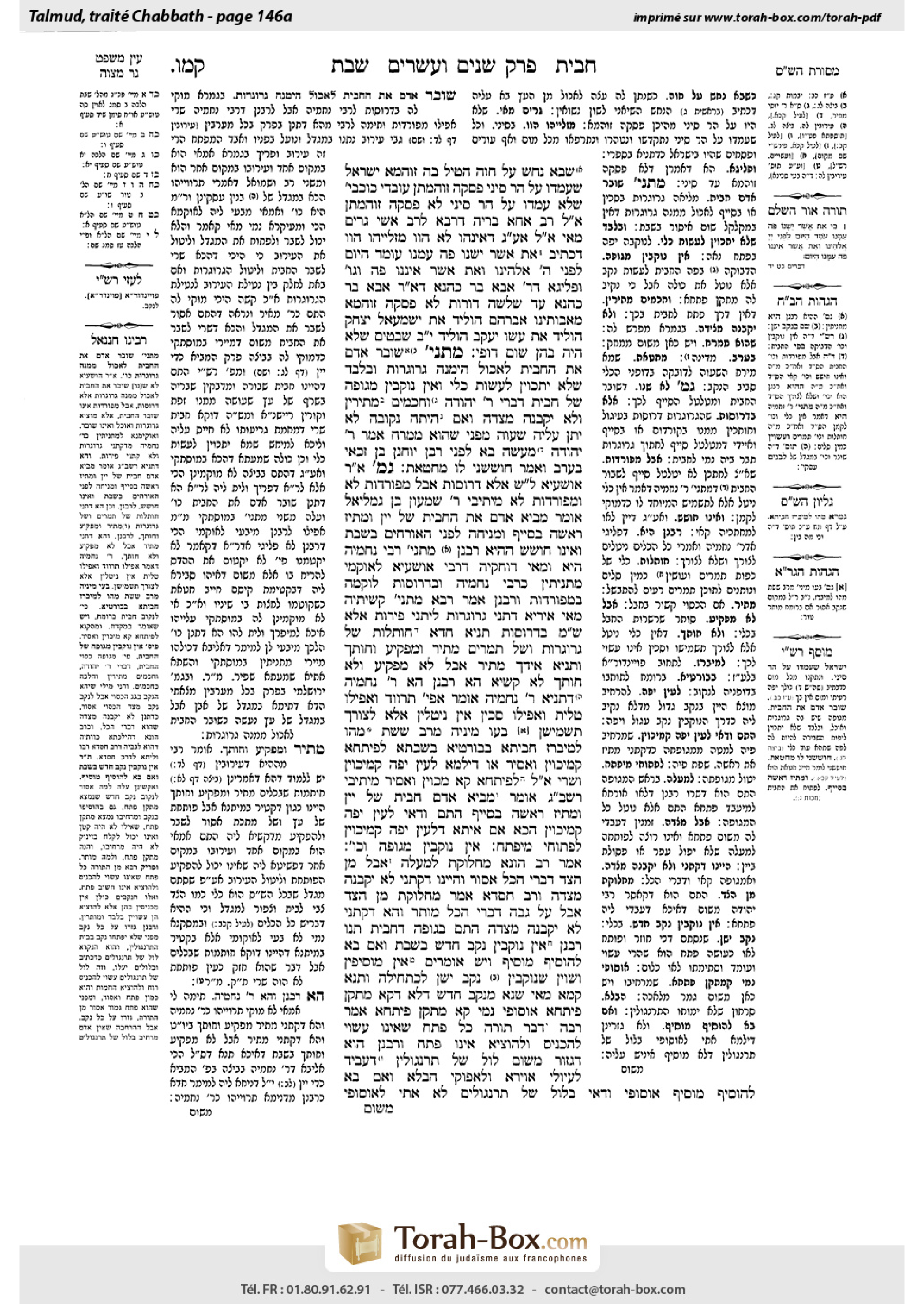
Shabbat 146a: Talmud study for Daf Yomi
Daf Yomi is the daily study of one Talmud folio. Explore 37 tractates with scans, Hebrew text, Sefaria English and AI-generated French translations where annotated.
Passage selection and English or AI-generated French translation are available where the scan has annotations. Daf Study is independent of Torah-Box and Sefaria.
Browse Shabbat · שבת · All tractatesShabbat 146a text and translations
This page of Shabbat includes the Aramaic text, an English translation and an AI-generated French translation, alongside the scan above.
שבת קמ״ו א · Aramaic and Hebrew text
שֶׁבָּא נָחָשׁ עַל חַוָּה הֵטִיל בָּהּ זוּהֲמָא, יִשְׂרָאֵל שֶׁעָמְדוּ עַל הַר סִינַי — פָּסְקָה זוּהֲמָתָן, גּוֹיִם שֶׁלֹּא עָמְדוּ עַל הַר סִינַי — לֹא פָּסְקָה זוּהֲמָתָן. אֲמַר לֵיהּ רַב אַחָא בְּרֵיהּ דְּרָבָא לְרַב אָשֵׁי: גֵּרִים מַאי? אֲמַר לֵיהּ: אַף עַל גַּב דְּאִינְהוּ לָא הֲווֹ, מַזָּלַיְיהוּ הֲווֹ. דִּכְתִיב: ״אֶת אֲשֶׁר יֶשְׁנוֹ פֹּה עִמָּנוּ עוֹמֵד הַיּוֹם לִפְנֵי ה׳ אֱלֹהֵינוּ וְאֵת אֲשֶׁר אֵינֶנּוּ פֹּה וְגוֹ׳״.
וּפְלִיגָא דְּרַבִּי אַבָּא בַּר כָּהֲנָא. דַּאֲמַר רַבִּי אַבָּא בַּר כָּהֲנָא: עַד שְׁלֹשָׁה דּוֹרוֹת לֹא פָּסְקָה זוּהֲמָא מֵאֲבוֹתֵינוּ: אַבְרָהָם הוֹלִיד אֶת יִשְׁמָעֵאל, יִצְחָק הוֹלִיד אֶת עֵשָׂו, יַעֲקֹב הוֹלִיד שְׁנֵים עָשָׂר שְׁבָטִים שֶׁלֹּא הָיָה בָּהֶן שׁוּם דּוֹפִי.
מַתְנִי׳ שׁוֹבֵר אָדָם אֶת הֶחָבִית לֶאֱכוֹל הֵימֶנָּה גְּרוֹגְרוֹת וּבִלְבַד שֶׁלֹּא יִתְכַּוֵּין לַעֲשׂוֹת כְּלִי. וְאֵין נוֹקְבִין מְגוּפָה שֶׁל חָבִית, דִּבְרֵי רַבִּי יְהוּדָה. וַחֲכָמִים מַתִּירִין, וְלֹא יִקְּבֶנָּה מִצִּדָּהּ. וְאִם הָיְתָה נְקוּבָה, לֹא יִתֵּן עָלֶיהָ שַׁעֲוָה, מִפְּנֵי שֶׁהוּא מְמָרֵחַ. אָמַר רַבִּי יְהוּדָה: מַעֲשֶׂה בָּא לִפְנֵי רַבָּן יוֹחָנָן בֶּן זַכַּאי בַּעֲרָב, וְאָמַר: חוֹשְׁשַׁנִי לוֹ מֵחַטָּאת.
גְּמָ׳ אָמַר רַבִּי אוֹשַׁעְיָא: לֹא שָׁנוּ אֶלָּא דְּרוּסוֹת, אֲבָל מְפוֹרָדוֹת — לֹא. וּמְפוֹרָדוֹת לֹא?
מֵיתִיבִי, רַבִּי שִׁמְעוֹן בֶּן גַּמְלִיאֵל אוֹמֵר: מֵבִיא אָדָם אֶת הֶחָבִית שֶׁל יַיִן וּמַתִּיז רֹאשָׁהּ בְּסַיִיף, וּמַנִּיחָהּ לִפְנֵי הָאוֹרְחִים בְּשַׁבָּת וְאֵינוֹ חוֹשֵׁשׁ! הַהִיא רַבָּנַן, מַתְנִיתִין רַבִּי נְחֶמְיָה הִיא.
וּמַאי דּוּחְקֵיהּ דְּרַבִּי אוֹשַׁעְיָא לְאוֹקוֹמֵי מַתְנִיתִין כְּרַבִּי נְחֶמְיָה וּבִדְרוּסוֹת, לוֹקְמַהּ בִּמְפוֹרָדוֹת וְרַבָּנַן! אָמַר רָבָא, מַתְנִיתִין קְשִׁיתֵיהּ: מַאי אִירְיָא דְּתָנֵי ״גְּרוֹגְרוֹת״? לִיתְנֵי ״פֵּירוֹת״! אֶלָּא שְׁמַע מִינַּהּ בִּדְרוּסוֹת.
תַּנְיָא חֲדָא: חוֹתָלוֹת שֶׁל גְּרוֹגְרוֹת וְשֶׁל תְּמָרִים — מַתִּיר וּמַפְקִיעַ וְחוֹתֵךְ. וְתַנְיָא אִידַּךְ: מַתִּיר אֲבָל לֹא מַפְקִיעַ וְלֹא חוֹתֵךְ! לָא קַשְׁיָא, הָא — רַבָּנַן, הָא — רַבִּי נְחֶמְיָה. דְּתַנְיָא, רַבִּי נְחֶמְיָה אוֹמֵר: אֲפִילּוּ תַּרְווֹד וַאֲפִילּוּ טַלִּית וַאֲפִילּוּ סַכִּין — אֵין נִיטָּלִין אֶלָּא לְצוֹרֶךְ תַּשְׁמִישָׁן.
בְּעוֹ מִינֵּיהּ מֵרַב שֵׁשֶׁת: מַהוּ לְמִיבְרַז חָבִיתָא בְּבוּרְטְיָא בְּשַׁבְּתָא? לְפִיתְחָא קָמִיכַּוֵּין, וַאֲסִיר, אוֹ דִילְמָא: לְעַיִן יָפָה קָמִיכַּוֵּין, וּשְׁרֵי? אֲמַר לֵיהּ: לְפִיתְחָא קָא מְכַוֵּין, וַאֲסִיר.
מֵיתִיבִי, רַבָּן שִׁמְעוֹן בֶּן גַּמְלִיאֵל אוֹמֵר: מֵבִיא אָדָם חָבִית שֶׁל יַיִן וּמַתִּיז רֹאשָׁהּ בְּסַיִיף? הָתָם — וַדַּאי לְעַיִן יָפָה קָמִיכַּוֵּין, הָכָא — אִם אִיתָא דִּלְעַיִן יָפָה קָמִיכַּוֵּין — לִפְתְּחֵיהּ מִיפְתָּח.
אֵין נוֹקְבִין מְגוּפָה וְכוּ׳. אָמַר רַב הוּנָא: מַחֲלוֹקֶת לְמַעְלָה, אֲבָל מִן הַצַּד — דִּבְרֵי הַכֹּל אָסוּר. וְהַיְינוּ דְּקָתָנֵי: ״לֹא יִקְּבֶנָּה מִצִּדָּהּ״. וְרַב חִסְדָּא אָמַר: מַחֲלוֹקֶת מִן הַצַּד, אֲבָל עַל גַּבָּהּ — דִּבְרֵי הַכֹּל מוּתָּר. וְהָא דְּקָתָנֵי ״לֹא יִקְּבֶנָּה מִצִּדָּהּ״ — הָתָם בְּגוּפָהּ דְּחָבִית.
תָּנוּ רַבָּנַן: אֵין נוֹקְבִין נֶקֶב חָדָשׁ בְּשַׁבָּת, וְאִם בָּא לְהוֹסִיף — מוֹסִיף. וְיֵשׁ אוֹמְרִים: אֵין מוֹסִיפִין. וְשָׁוִין, שֶׁנּוֹקְבִין נֶקֶב יָשָׁן לְכַתְּחִילָּה. וְתַנָּא קַמָּא: מַאי שְׁנָא מִנֶּקֶב חָדָשׁ דְּלָא — דְּקָא מְתַקֵּן פִּיתְחָא, אוֹסוֹפֵי נָמֵי — קָא מְתַקֵּן פִּיתְחָא!
אָמַר רַבָּה: דְּבַר תּוֹרָה — כׇּל פֶּתַח שֶׁאֵינוֹ עָשׂוּי לְהַכְנִיס וּלְהוֹצִיא — אֵינוֹ פֶּתַח, וְרַבָּנַן הוּא דִּגְזוּר מִשּׁוּם לוּל שֶׁל תַּרְנְגוֹלִין, דְּעָבֵיד לְעַיּוֹלֵי אַוֵּירָא וּלְאַפּוֹקֵי הַבְלָא. וְאִם בָּא לְהוֹסִיף — מוֹסִיף, אוֹסוֹפֵי וַדַּאי בְּלוּל שֶׁל תַּרְנְגוֹלִים — לָא אָתֵי לְאוֹסוֹפֵי
Shabbat 146a · English translation
the snake came upon Eve, i.e., when it seduced her to eat from the Tree of Knowledge, it infected her with moral contamination, and this contamination remained in all human beings. When the Jewish people stood at Mount Sinai, their contamination ceased, whereas gentiles did not stand at Mount Sinai, and their contamination never ceased. Rav Aḥa, the son of Rava, said to Rav Ashi: What about converts? How do you explain the cessation of their moral contamination? Rav Ashi said to him: Even though they themselves were not at Mount Sinai, their guardian angels were present, as it is written: “It is not with you alone that I make this covenant and this oath, but with he that stands here with us today before the Lord our God, and with he that is not here with us today” (Deuteronomy 29:13–14), and this includes converts.
The Gemara points out that this opinion disagrees with Rabbi Abba bar Kahana, as Rabbi Abba bar Kahana said: Until three generations passed, the moral contamination did not cease from our forefathers: Abraham fathered Ishmael, who was of lowly moral stature; Isaac fathered Esau; finally, Jacob fathered twelve tribes in whom there was no flaw. Rabbi Abba bar Kahana holds that the moral contamination ceased in the Patriarchs long before the Revelation at Sinai.
MISHNA: A person may break a barrel on Shabbat in order to eat dried figs from it, provided he does not intend to make a vessel. And one may not perforate the plug of a barrel to extract wine from it; rather, one must remove the plug entirely to avoid creating a new opening for the barrel. This is the statement of Rabbi Yehuda. And the Rabbis permit puncturing the plug, but they too restrict this leniency and say that one may not perforate the plug of the barrel on its side. And if it was already perforated, one may not apply wax to it to seal the hole, because in doing so he spreads the wax evenly on the barrel and thereby violates the prohibited labor of smoothing. Rabbi Yehuda said: An incident of that kind came before Rabban Yoḥanan ben Zakkai in the city of Arav, and he said: I am concerned for him, because he may be liable to bring a sin-offering as a result of this.
GEMARA: Rabbi Oshaya said: They only taught that it is permitted to break open a barrel when the figs were pressed together. This is because in that case it is permissible to use a utensil to separate the figs, that utensil may also be utilized to break open the barrel. However, if the figs were already separated, it is not permitted to handle a utensil for the sole purpose of breaking the barrel. The Gemara asks: And is it not permitted to break the barrel for separated figs?
The Gemara raises an objection based on a baraita: Rabban Shimon ben Gamliel says: A person may bring a barrel of wine and cut off the top of the barrel with a sword and place it before the guests on Shabbat without concern that it is prohibited to move the sword or that doing so constitutes the creation of a new vessel, which is prohibited. Apparently, it is permitted to move a sword in order to open a barrel on Shabbat even if it is not needed to cut the contents of the barrel. The Gemara answers for Rabbi Oshaya: That baraita, which cites the opinion of Rabban Shimon ben Gamliel, is in accordance with the opinion of the Rabbis, whereas our mishna is in accordance with the opinion of Rabbi Neḥemya, who said that it is prohibited to move any utensil on Shabbat for any purpose other than that for which the utensil is designated.
The Gemara asks: And what forced Rabbi Oshaya to establish the mishna in accordance with the minority opinion of Rabbi Neḥemya and to say that it is referring only to the case of a pressed dried figs? Let him establish that the mishna is referring even to separated figs and is in accordance with the opinion of the Rabbis. Rava said: The mishna posed a difficulty for him; why did the tanna teach particularly about dried figs? Let him teach a more general halakha with regard to fruit. Rather, learn from here that the mishna is referring specifically to pressed dried figs, and it is because one requires a utensil to separate them that he may use it to open the barrel as well.
It was taught in one baraita: If one has sealed, wicker baskets of dried figs or of dates, one may untie the basket’s knot on Shabbat, and unbraid the basket and cut it open. And it was taught in another baraita: One may untie the knot, but one may not unbraid or cut the basket. There is a contradiction between these two baraitot. The Gemara resolves this contradiction: This is not difficult. This baraita, which permits all of these actions, is in accordance with the opinion of the Rabbis. That baraita, which prohibits unbraiding and cutting, is in accordance with the opinion of Rabbi Neḥemya. As it was taught in a baraita that Rabbi Neḥemya says: Even a large spoon and even a cloak and even a knife may only be taken on Shabbat for their designated use, and it is therefore prohibited to take a knife to cut open baskets of fruit.
The students raised a dilemma before Rav Sheshet: What is the halakha with regard to whether or not it is permitted to perforate a barrel with a spear [burtiya] on Shabbat? Is the assumption that one intends to make an opening in the barrel and it is therefore prohibited, or perhaps is the assumption that one merely intends to display generosity and it is permitted? Rav Sheshet said to them: He intends to make an opening in the barrel and it is prohibited.
The Gemara raises an objection based on that which was taught in the baraita that Rabban Shimon ben Gamliel says: One may bring a barrel of wine on Shabbat and cut off its top with a sword. This contradicts Rav Sheshet’s opinion that opening a barrel with a spear is prohibited? He answered them: There, in the case of the sword, since one essentially destroys the barrel by cutting off its top, he certainly intends to display generosity by breaking the barrel open in his guests’ honor. However, here, in the case of spearing a hole in the barrel, if it were true that he intends to display generosity, let him open the top of the barrel by removing its plug. By perforating the barrel, he indicates that he specifically wants there to be a small hole.
We learned in the mishna: And one may not perforate the plug of a barrel; this is the statement of Rabbi Yehuda, and the Rabbis permit it. Rav Huna said: This dispute is only with regard to a case where one seeks to make a perforation on top of the plug; however, if he seeks to perforate it from the side, everyone agrees that it is prohibited, because people sometimes puncture a barrel beneath the plug in this way. And that is what the mishna is teaching: One may not perforate it on its side. Whereas Rav Ḥisda said: This dispute is with regard to a case where one seeks to perforate it from the side; however, if one seeks to perforate it on top, everyone agrees that it is permitted, and with regard to that which the mishna is teaching: One may not perforate it on its side, there it is referring to perforating the barrel itself, not the plug.
The Sages taught in a baraita: One may not create a new hole in a vessel on Shabbat. And if one seeks to add to and widen an already existing hole, one may add to it; and some say that one may not even add to an already existing hole. And all opinions, even those who generally prohibit creating new holes, agree that one may perforate the seal over an old hole, even ab initio. And with regard to the opinion of the first tanna, the Gemara asks: What is different about perforating the seal over an old hole that makes it permitted, whereas creating a new hole is not permitted? Is it because in creating the new hole he is creating an opening? If so, by adding to an already existing hole he is also creating an opening.
Rabba said: Actually, even creating a new hole is not prohibited, because by Torah law, any opening that is not made to both insert and to remove is not considered an opening, and a hole that one perforates in a barrel is intended exclusively to remove the contents of the barrel. And it was the Sages who issued a decree that one may not perforate a vessel because it is similar to perforating a chicken coop, which is designated for use in both directions, e.g., to let in air and to let out heat, and it is therefore prohibited by Torah law. And therefore we learned that if one seeks to add to an existing hole one may add to it. There is no reason to prohibit this due to concern that one may do so in a chicken coop, because one will certainly not come to add to an already existing hole in a chicken coop,
Shabbat 146a · Traduction française (IA)
Le serpent s’approcha d’Ève, c’est-à-dire qu’en la séduisant pour qu’elle mange de l’Arbre de la connaissance, il la contamina moralement, et cette contamination demeura chez tous les êtres humains. Lorsque le peuple juif se tint au mont Sinaï, sa contamination cessa, tandis que les non-Juifs ne s’y tinrent pas et que leur contamination ne cessa jamais. Rav Aḥa, fils de Rava, dit à Rav Ashi : Qu’en est-il des convertis ? Comment expliques-tu la cessation de leur contamination morale ? Rav Ashi lui dit : Bien qu’eux-mêmes ne se soient pas trouvés au mont Sinaï, leurs anges tutélaires étaient présents, comme il est écrit : « Ce n’est pas avec vous seuls que je conclus cette alliance et ce serment, mais avec celui qui se tient ici avec nous aujourd’hui devant le Seigneur notre Dieu, et avec celui qui n’est pas ici avec nous aujourd’hui » (Deutéronome 29, 13-14), ce qui inclut les convertis.
La Guemara relève que cette opinion est en désaccord avec celle de Rabbi Abba bar Kahana, car celui-ci a dit : Il fallut trois générations pour que la contamination morale cesse chez nos ancêtres : Abraham engendra Ismaël, qui avait une stature morale médiocre ; Isaac engendra Ésaü ; enfin, Jacob engendra douze tribus qui ne comportaient aucun défaut. Selon Rabbi Abba bar Kahana, la contamination morale cessa chez les Patriarches bien avant la Révélation au mont Sinaï.
MICHNA : On peut briser une jarre pendant Chabbat afin d’en manger les figues sèches, à condition de ne pas avoir l’intention de fabriquer un récipient. On ne peut pas percer le bouchon d’une jarre pour en tirer du vin ; il faut plutôt retirer entièrement le bouchon, afin de ne pas créer une nouvelle ouverture dans la jarre. Telle est la déclaration de Rabbi Yehuda. Les Sages, eux, permettent de percer le bouchon, mais limitent également cette permission et disent qu’on ne peut pas percer le bouchon sur le côté de la jarre. Si celui-ci était déjà percé, on ne peut pas y appliquer de cire pour boucher le trou, car on étale alors la cire uniformément sur la jarre et l’on enfreint ainsi le travail interdit de lisser. Rabbi Yehuda dit : Un incident de ce genre se produisit dans la ville d’Arav et fut porté devant Rabban Yoḥanan ben Zakkaï, qui déclara : Je m’inquiète pour lui, car il pourrait être tenu d’apporter un sacrifice expiatoire à la suite de cet acte.
GUEMARA : Rabbi Oshaya a dit : Ils n’ont enseigné qu’il est permis de briser une jarre que lorsque les figues étaient pressées ensemble. En effet, dans ce cas, il est permis d’utiliser un ustensile pour séparer les figues ; cet ustensile peut donc également servir à briser la jarre. En revanche, si les figues étaient déjà séparées, il n’est pas permis de manipuler un ustensile dans le seul but de briser la jarre. La Guemara demande : N’est-il donc pas permis de briser la jarre pour des figues séparées ?
La Guemara soulève une objection à partir d’une baraïta : Rabban Shimon ben Gamliel dit : On peut apporter une jarre de vin, en trancher le haut avec une épée et la présenter aux invités pendant Chabbat, sans craindre qu’il soit interdit de déplacer l’épée ni que cela constitue la fabrication d’un nouveau récipient, ce qui est interdit. Il semble donc permis de déplacer une épée pour ouvrir une jarre pendant Chabbat, même si elle n’est pas nécessaire pour couper le contenu de la jarre. La Guemara répond en faveur de Rabbi Oshaya : Cette baraïta, qui rapporte l’opinion de Rabban Shimon ben Gamliel, suit l’opinion des Sages, tandis que notre Michna suit celle de Rabbi Neḥemya, qui a dit qu’il est interdit de déplacer un ustensile pendant Chabbat pour un usage autre que celui auquel il est destiné.
La Guemara demande : Qu’est-ce qui a contraint Rabbi Oshaya à interpréter la Michna selon l’opinion minoritaire de Rabbi Neḥemya et à dire qu’elle ne concerne que le cas de figues sèches pressées ? Qu’il établisse que la Michna concerne également les figues séparées et qu’elle suit l’opinion des Sages. Rava dit : La Michna lui posait une difficulté : pourquoi le tanna a-t-il enseigné spécifiquement la règle au sujet des figues sèches ? Qu’il enseigne une halakha plus générale concernant les fruits. Il faut donc en déduire que la Michna concerne spécifiquement des figues sèches pressées et que, parce qu’on a besoin d’un ustensile pour les séparer, on peut également s’en servir pour ouvrir la jarre.
Il a été enseigné dans une baraïta : Si quelqu’un possède des paniers tressés et fermés contenant des figues sèches ou des dattes, il peut en défaire le nœud pendant Chabbat, puis détresser le panier et le découper pour l’ouvrir. Il a été enseigné dans une autre baraïta : On peut en défaire le nœud, mais on ne peut ni détresser ni découper le panier. Il y a une contradiction entre ces deux baraïtot. La Guemara résout cette contradiction : Il n’y a pas de difficulté. Cette baraïta, qui permet toutes ces actions, suit l’opinion des Sages. L’autre baraïta, qui interdit de détresser et de découper, suit l’opinion de Rabbi Neḥemya. En effet, il a été enseigné dans une baraïta que Rabbi Neḥemya dit : Même une grande cuillère, même un manteau et même un couteau ne peuvent être pris pendant Chabbat que pour l’usage auquel ils sont destinés ; il est donc interdit de prendre un couteau pour ouvrir des paniers de fruits.
Les élèves posèrent à Rav Sheshet la question suivante : Quelle est la halakha quant au fait de percer une jarre avec une lance [burtiya] pendant Chabbat ? Faut-il supposer qu’on a l’intention de faire une ouverture dans la jarre, ce qui est donc interdit, ou peut-être faut-il supposer qu’on veut seulement faire preuve de générosité, auquel cas cela est permis ? Rav Sheshet leur dit : Il a l’intention de faire une ouverture dans la jarre, et cela est interdit.
La Guemara soulève une objection à partir de ce qui a été enseigné dans la baraïta, où Rabban Shimon ben Gamliel dit : On peut apporter une jarre de vin pendant Chabbat et en trancher le haut avec une épée. Cela contredit l’opinion de Rav Sheshet, selon laquelle il est interdit d’ouvrir une jarre avec une lance. Rav Sheshet leur répondit : Dans le cas de l’épée, puisqu’on détruit en fait la jarre en lui tranchant le haut, on a certainement l’intention de faire preuve de générosité en l’ouvrant pour honorer ses invités. En revanche, ici, lorsqu’on perce un trou dans la jarre, si l’on avait vraiment l’intention de faire preuve de générosité, qu’on en ouvre donc le haut en retirant son bouchon. En perçant la jarre, on indique qu’on veut précisément qu’elle ait un petit trou.
Nous avons appris dans la Michna : On ne peut pas percer le bouchon d’une jarre ; telle est la déclaration de Rabbi Yehuda, tandis que les Sages le permettent. Rav Huna a dit : Ce désaccord ne concerne que le cas où l’on cherche à faire un trou sur le dessus du bouchon ; en revanche, si l’on cherche à le percer sur le côté, tous s’accordent à dire que c’est interdit, car il arrive que l’on perce ainsi une jarre au-dessous du bouchon. C’est ce qu’enseigne la Michna : On ne peut pas le percer sur le côté. Rav Ḥisda, lui, a dit : Ce désaccord concerne le cas où l’on cherche à le percer sur le côté ; en revanche, si l’on cherche à le percer sur le dessus, tous s’accordent à dire que c’est permis. Quant à l’enseignement de la Michna selon lequel on ne peut pas le percer sur le côté, il s’agit là de percer la jarre elle-même, et non le bouchon.
Les Sages ont enseigné dans une baraïta : On ne peut pas créer un nouveau trou dans un récipient pendant Chabbat. Si l’on cherche à agrandir un trou déjà existant, on peut l’agrandir ; certains disent qu’on ne peut même pas agrandir un trou déjà existant. Toutes les opinions, y compris celles qui interdisent généralement de créer de nouveaux trous, s’accordent à dire qu’on peut percer le sceau qui recouvre un ancien trou, même a priori. À propos de l’opinion du premier tanna, la Guemara demande : En quoi le fait de percer le sceau qui recouvre un ancien trou diffère-t-il, de sorte que cela soit permis alors que créer un nouveau trou ne l’est pas ? Est-ce parce qu’en créant le nouveau trou, on crée une ouverture ? Si tel est le cas, en agrandissant un trou déjà existant, on crée également une ouverture.
Rabba a dit : En réalité, même créer un nouveau trou n’est pas interdit, car, selon la Torah, une ouverture qui ne sert pas à la fois à faire entrer et à faire sortir n’est pas considérée comme une ouverture, et un trou que l’on perce dans une jarre sert uniquement à en faire sortir le contenu. Ce sont les Sages qui ont décrété qu’on ne peut pas percer un récipient, car cela ressemble au fait de percer un poulailler, lequel est destiné à permettre les deux mouvements, par exemple à faire entrer l’air et à laisser sortir la chaleur, ce qui est donc interdit par la Torah. C’est pourquoi nous avons appris que si l’on cherche à agrandir un trou déjà existant, on peut l’agrandir. Il n’y a aucune raison de l’interdire par crainte que l’on fasse de même dans un poulailler, car on n’en viendra certainement pas à agrandir un trou déjà existant dans un poulailler,
Traduction française générée par IA à partir de l’édition anglaise de Sefaria. Vérifie toujours un passage avec le texte source.
Text from Sefaria: William Davidson Edition - Vocalized Aramaic (CC BY NC); William Davidson Edition - English (CC BY NC).