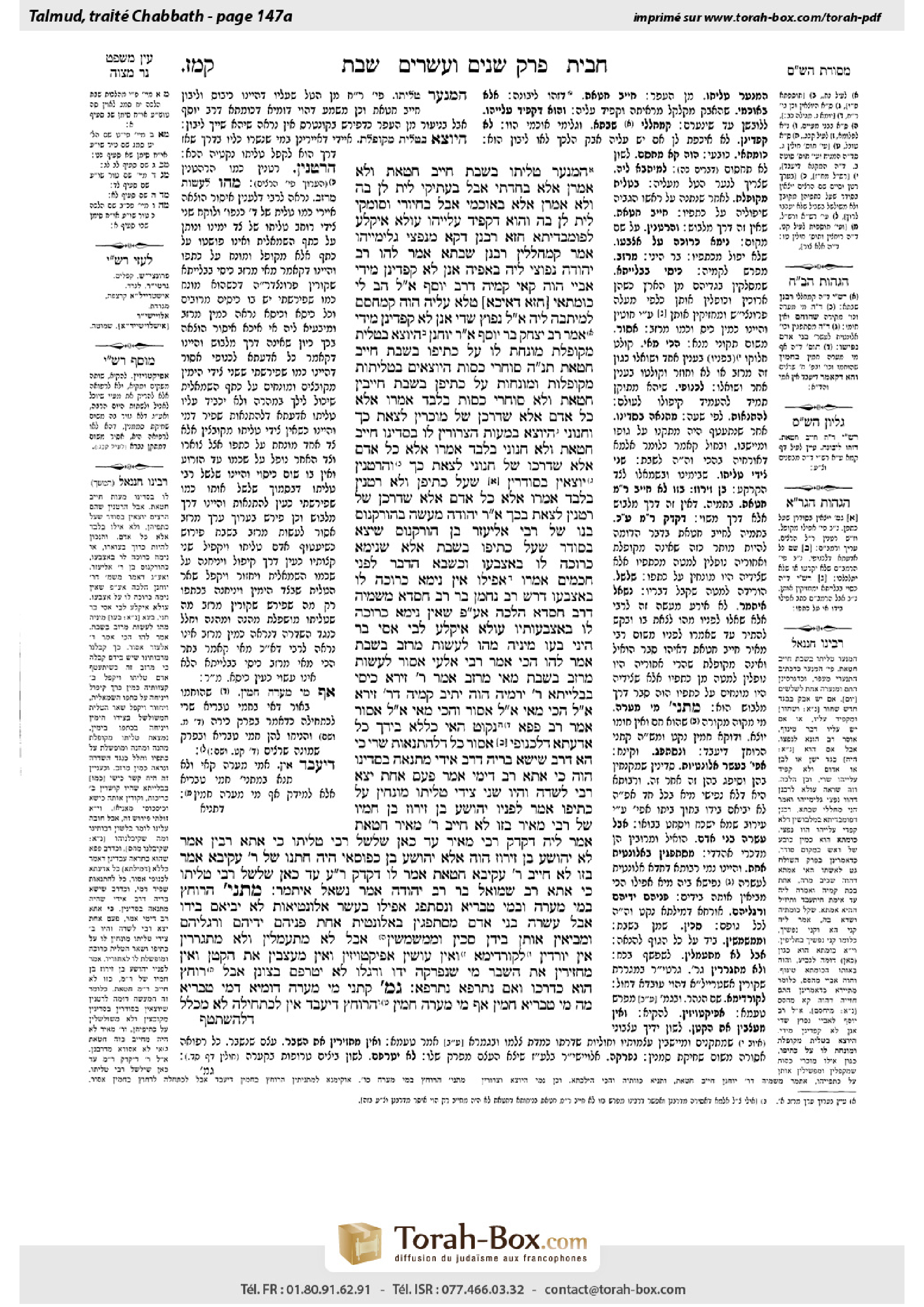
Shabbat 147a: Talmud study for Daf Yomi
Daf Yomi is the daily study of one Talmud folio. Explore 37 tractates with scans, Hebrew text, Sefaria English and AI-generated French translations where annotated.
Passage selection and English or AI-generated French translation are available where the scan has annotations. Daf Study is independent of Torah-Box and Sefaria.
Browse Shabbat · שבת · All tractatesShabbat 147a text and translations
This page of Shabbat includes the Aramaic text, an English translation and an AI-generated French translation, alongside the scan above.
שבת קמ״ז א · Aramaic and Hebrew text
הַמְנַעֵר טַלִּיתוֹ בְּשַׁבָּת — חַיָּיב חַטָּאת. וְלָא אֲמַרַן אֶלָּא בְּחַדְתֵי, אֲבָל בְּעַתִּיקֵי — לֵית לַן בַּהּ. וְלָא אֲמַרַן אֶלָּא בְּאוּכָּמֵי, אֲבָל בְּחִיוָּרֵי וְסוּמָּקֵי — לֵית לַן בַּהּ, וְהוּא דְּקָפֵיד עֲלַיְיהוּ.
עוּלָּא אִיקְּלַע לְפוּמְבְּדִיתָא, חֲזָא רַבָּנַן דְּקָא מְנַפְּצִי גְּלִימַיְיהוּ, אָמַר: קָמְחַלְּלִין רַבָּנַן שַׁבְּתָא. אֲמַר לְהוּ רַב יְהוּדָה: נְפוּצוּ לֵיהּ בְּאַפֵּיהּ, אֲנַן לָא קָפְדִינַן מִידֵּי.
אַבָּיֵי הֲוָה קָאֵי קַמֵּיהּ דְּרַב יוֹסֵף. אֲמַר לֵיהּ: הַב לִי כּוּמְתַּאי. [חֲזָא דְּאִיכָּא] טַלָּא עֲלֵיהּ, הֲוָה קָמְחַסֵּם לְמִיתְּבֵהּ לֵיהּ. אֲמַר לֵיהּ: נְפוֹץ שְׁדִי, אֲנַן לָא קָפְדִינַן מִידֵּי.
אָמַר רַב יִצְחָק בַּר יוֹסֵף אָמַר רַבִּי יוֹחָנָן: הַיּוֹצֵא בְּטַלִּית מְקוּפֶּלֶת מוּנַּחַת לוֹ עַל כְּתֵיפוֹ בְּשַׁבָּת — חַיָּיב חַטָּאת. תַּנְיָא נָמֵי הָכִי: סוֹחֲרֵי כְּסוּת הַיּוֹצְאִים בְּטַלִּיתוֹת מְקוּפָּלוֹת וּמוּנָּחוֹת עַל כְּתֵיפָן בַּשַּׁבָּת — חַיָּיבִין חַטָּאת. וְלֹא סוֹחֲרֵי כְּסוּת בִּלְבַד אָמְרוּ, אֶלָּא כָּל אָדָם. אֶלָּא שֶׁדַּרְכָּן שֶׁל מוֹכְרִין לָצֵאת כָּךְ.
וְחֶנְוָנִי הַיּוֹצֵא בְּמָעוֹת הַצְּרוּרִין לוֹ בִּסְדִינוֹ — חַיָּיב חַטָּאת. וְלֹא חֶנְוָנִי בִּלְבַד אָמְרוּ, אֶלָּא כָּל אָדָם. אֶלָּא שֶׁדַּרְכּוֹ שֶׁל חֶנְוָנִי לָצֵאת כָּךְ. וְהָרָטָנִין יוֹצְאִין בְּסוּדָרִין שֶׁעַל כְּתֵיפָן. וְלֹא רָטָנִין בִּלְבַד אָמְרוּ, אֶלָּא כָּל אָדָם. אֶלָּא שֶׁדַּרְכָּן שֶׁל רָטָנִין לָצֵאת בְּכָךְ.
אָמַר רַבִּי יְהוּדָה: מַעֲשֶׂה בְּהוּרְקָנוֹס בְּנוֹ שֶׁל רַבִּי אֱלִיעֶזֶר בֶּן הוּרְקָנוֹס שֶׁיָּצָא בְּסוּדָר שֶׁעַל כְּתֵיפוֹ בַּשַּׁבָּת, אֶלָּא שֶׁנִּימָא כְּרוּכָה לוֹ בְּאֶצְבָּעוֹ, וּכְשֶׁבָּא הַדָּבָר לִפְנֵי חֲכָמִים, אָמְרוּ: אֲפִילּוּ אֵין נִימָא כְּרוּכָה לוֹ בְּאֶצְבָּעוֹ. דָּרֵשׁ רַב נַחְמָן בַּר רַב חִסְדָּא מִשְּׁמֵיהּ דְּרַב חִסְדָּא: הֲלָכָה אַף עַל פִּי שֶׁאֵין נִימָא כְּרוּכָה לוֹ בְּאֶצְבְּעוֹתָיו.
עוּלָּא אִיקְּלַע לְבֵי אַסִּי בַּר הִינִי, בְּעוֹ מִינֵּיהּ: מַהוּ לַעֲשׂוֹת מַרְזֵב בְּשַׁבָּת? אֲמַר לְהוּ, הָכִי אָמַר רַבִּי אִלְעַי: אָסוּר לַעֲשׂוֹת מַרְזֵב בְּשַׁבָּת. מַאי מַרְזֵב? אָמַר רַבִּי זֵירָא: כִּיסֵי בָּבְלָיָיתָא.
רַבִּי יִרְמְיָה הֲוָה יָתֵיב קַמֵּיהּ דְּרַבִּי זֵירָא. אֲמַר לֵיהּ: הָכִי מַאי? אֲמַר לֵיהּ: אָסוּר. וְהָכִי מַאי? אֲמַר לֵיהּ: אָסוּר. אָמַר רַב פָּפָּא: נְקוֹט הַאי כְּלָלָא בִּידָךְ: כׇּל אַדַּעְתָּא לְכַנּוֹפֵי — אָסוּר, כֹּל דִּלְהִתְנָאוֹת — שְׁרֵי. כִּי הָא דְּרַב שִׁישָׁא בְּרֵיהּ דְּרַב אִידִי מִתְנָאֶה בִּסְדִינוֹ הֲוָה.
כִּי אֲתָא רַב דִּימִי, אָמַר: פַּעַם אַחַת יָצָא רַבִּי לַשָּׂדֶה וְהָיוּ שְׁנֵי צִידֵּי טַלִּיתוֹ מוּנָּחִין עַל כְּתֵיפוֹ. אָמַר לְפָנָיו יְהוֹשֻׁעַ בֶּן זֵירוּז בֶּן חָמִיו שֶׁל רַבִּי מֵאִיר: בָּזוֹ לֹא חִיֵּיב רַבִּי מֵאִיר חַטָּאת? אָמַר לוֹ: דִּקְדֵּק רַבִּי מֵאִיר עַד כָּאן? שִׁלְשֵׁל רַבִּי טַלִּיתוֹ.
כִּי אֲתָא רָבִין אָמַר: לֹא יְהוֹשֻׁעַ בֶּן זֵירוּז הֲוָה אֶלָּא יְהוֹשֻׁעַ בֶּן כְּפוֹסַאי הָיָה, חֲתָנוֹ שֶׁל רַבִּי עֲקִיבָא, אָמַר: בָּזוֹ לֹא חִיֵּיב רַבִּי עֲקִיבָא חַטָּאת? אָמַר לוֹ: דִּקְדֵּק רַבִּי עֲקִיבָא עַד כָּאן? שִׁלְשֵׁל רַבִּי טַלִּיתוֹ. כִּי אֲתָא רַב שְׁמוּאֵל בַּר רַב יְהוּדָה אָמַר: ״נִשְׁאַל״ אִיתְּמַר.
מַתְנִי׳ הָרוֹחֵץ בְּמֵי מְעָרָה וּבְמֵי טְבֶרְיָא וְנִסְתַּפֵּג אֲפִילּוּ בְּעֶשֶׂר אֲלוֹנְטִיאוֹת — לֹא יְבִיאֵם בְּיָדוֹ. אֲבָל עֲשָׂרָה בְּנֵי אָדָם מִסְתַּפְּגִין בַּאֲלוּנְטִית אַחַת, פְּנֵיהֶם יְדֵיהֶם וְרַגְלֵיהֶם, וּמְבִיאִין אוֹתָן בְּיָדָן.
סָכִין וּמְמַשְׁמְשִׁין, אֲבָל לֹא מִתְעַמְּלִין. וְלֹא מִתְגָּרְרִין. אֵין יוֹרְדִין לְקוֹרְדִימָא, וְאֵין עוֹשִׂין אַפִּיקְטְוִיזִין, וְאֵין מְעַצְּבִין אֶת הַקָּטָן, וְאֵין מַחֲזִירִין אֶת הַשֶּׁבֶר, מִי שֶׁנִּפְרְקָה יָדוֹ וְרַגְלוֹ לֹא יִטְרְפֵם בְּצוֹנֵן, אֲבָל רוֹחֵץ הוּא כְּדַרְכּוֹ, וְאִם נִתְרַפֵּא — נִתְרַפֵּא.
גְּמָ׳ קָתָנֵי מֵי מְעָרָה דּוּמְיָא דְּמֵי טְבֶרְיָא: מָה מֵי טְבֶרְיָא חַמִּין — אַף מֵי מְעָרָה חַמִּין. ״הָרוֹחֵץ״: דִּיעֲבַד — אִין, לְכַתְּחִילָּה — לָא. מִכְּלָל
Shabbat 147a · English translation
One who shakes his cloak on Shabbat to remove dust that collected on it is liable to bring a sin-offering for violating the prohibition of laundering. The Gemara qualifies this ruling: We only stated this halakha with regard to new garments, but with regard to old garments, we have no problem with this behavior. And we only stated this with regard to black garments, but with regard to white or red garments, we have no problem, as shaking off the dust would not be prohibited. And this prohibition applies only when one is particular about keeping them clean, but if one does not insist on wearing clean garments, we have no problem with it, i.e., it is not prohibited to shake off the dust.
The Gemara relates that Ulla happened to come to Pumbedita, and while there he saw rabbis shaking their cloaks to remove dust. He said: The Rabbis are desecrating Shabbat. Rav Yehuda said to the Rabbis whom Ulla criticized: You may continue to shake your cloaks in his presence. We are not at all particular about this, and it is therefore permitted for us to shake the dust from our cloaks.
The Gemara also relates that Abaye was standing before Rav Yosef. Rav Yosef said to him: Give me my hat. Abaye saw that there was dew on it, and he hesitated to give it to him, because he feared violating a prohibition by shaking off the dew. Rav Yosef said to him: Shake off the dew and throw me the hat; we are not at all particular about the cleanliness of the hat, and it is therefore permitted to shake off the dew.
Rav Yitzḥak bar Yosef said that Rabbi Yoḥanan said: One who goes out with a cloak folded and resting on his shoulder on Shabbat is liable to bring a sin-offering for carrying in the public domain. This ruling was also taught in a baraita: Clothing merchants who go outside with cloaks folded and resting on their shoulders on Shabbat are liable to bring a sin-offering. And they did not say this only with regard to clothing merchants; rather, any person is liable for this transgression, and they only stated the halakha in these terms because it is the usual manner for merchants to go out this way.
And likewise, a shopkeeper who goes out with coins bound in his cloak is liable to bring a sin-offering. And they did not say this only with regard to a shopkeeper; rather, any person is liable for this, and they only stated the halakha in these terms because it is the usual manner of a shopkeeper to go out this way. And runners, i.e., foot messengers, may go out on Shabbat with scarves on their shoulders, because this is how they typically wear them. And they did not say this only with regard to runners; rather, any person is permitted to do this, but it is simply the usual manner of runners to go out this way.
Rabbi Yehuda said: There was an incident involving Hyrcanus, son of Rabbi Eliezer ben Hyrcanus, who went outside with a scarf on his shoulder on Shabbat. However, a thread from the garment was tied around his finger so that the garment would not fall. When this matter came before the Sages, they said: It is permitted to go out in that manner even if a thread is not tied around one’s finger. And likewise, Rav Naḥman bar Rav Ḥisda taught in the name of Rav Ḥisda: The halakha is that one may go outside with a garment around one’s shoulders even if a thread from the garment is not tied around one’s finger.
Ulla happened to come to the house of Asi bar Hini. The members of the household asked him: What is the halakha: Is it permitted to make a spout of one’s garment on Shabbat? Ulla said to them that this is what Rabbi Elai said: It is prohibited to make a spout on Shabbat. The Gemara asks: What is the spout referred to here? Rabbi Zeira said: It is referring to Babylonian pockets, which were formed by lifting up the bottom of the cloaks and tying them to their shoulders to make pocket-like folds in their garments.
The Gemara relates that Rabbi Yirmeya was sitting before Rabbi Zeira and showed him a certain fold and said to him: What is the halakha with regard to this kind of fold on Shabbat? He said to him: It is prohibited to make it on Shabbat. He then showed him another fold and asked: And what is the halakha with regard to this? He said to him: It is prohibited. Rav Pappa said: Grasp this principle: Any fold made to gather one’s clothing from the ground is prohibited, and any fold that is merely to beautify oneself is permitted, as the precedent of Rav Sheisha, son of Rav Idi, who was beautifying himself with his garment by folding it on his shoulders.
When Rav Dimi came from Eretz Yisrael to Babylonia, he said: On one occasion, Rabbi Yehuda HaNasi went out into a field, and the two sides of his cloak were resting on his shoulders. Yehoshua ben Zeiruz, son of the father-in-law of Rabbi Meir, said before Rabbi Yehuda HaNasi: In a case like this, didn’t Rabbi Meir hold one liable to bring a sin-offering? Rabbi said to him: Was Rabbi Meir exacting to that extent, i.e., he considered wearing a garment in this fashion to be carrying on Shabbat? If so, it is preferable to avoid questionable practices; immediately Rabbi Yehuda HaNasi lowered his cloak from his shoulders.
When Ravin came from Eretz Yisrael to Babylonia he said: It was not Yehoshua ben Zeiruz; rather, it was Yehoshua ben Kefusai, Rabbi Akiva’s son-in-law, and he said: In a case like this, didn’t Rabbi Akiva hold one liable to bring a sin-offering? Rabbi Yehuda HaNasi said to him: Was Rabbi Akiva exacting to that extent? If so, it is preferable to avoid questionable practices. Immediately, Rabbi Yehuda HaNasi lowered his cloak from his shoulders. When Rav Shmuel bar Rav Yehuda came, he said: This is not what happened, as Rabbi Yehuda HaNasi himself did not wear his cloak folded up on his shoulders on Shabbat. Rather it was stated that Rabbi was asked, meaning that this question came before him, and he wanted to rule leniently, until he was informed that some of the greatest Sages of the generation ruled stringently.
MISHNA: One who bathes on Shabbat in a ritual bath formed by cave water or in the water of Tiberias and dried himself even with ten towels may not carry them in his hand, lest he forget that it is Shabbat and wring the water from them. However, ten people may use one towel to dry their faces, hands, and feet, and may carry them in their hands. Even though in this case the towel would be quite wet, it is permitted to handle the towel because there are several people present, and they will remind each other that it is prohibited to wring a towel on Shabbat.
Apropos the waters of Tiberias, the mishna discusses the halakhot of bathing and medicine on Shabbat. One may smear oil on his body and gently rub his body with his hand; however, one may not exert himself with vigorous massage or by means of exercise in order to benefit from the therapeutic effects of sweating; and one may not scrape the oil off with a scraper. Additionally, one may not go into a swampy river [kurdima], on Shabbat. And one may not make a drug to induce vomiting, nor may one align a young infant’s bones to straighten them, nor may one reset a break in a bone. One whose hand or foot was dislocated may not move them about vigorously in cold water, which is the standard method of treatment; however, one may wash the limb in the typical manner, and if one is cured through this washing, he is cured.
GEMARA: The tanna of the mishna teaches the case of cave water that is similar to the case of water of Tiberias; just as the water of Tiberias is hot, so too the cave water is hot. The Gemara also infers from the formulation of the mishna: With regard to one who bathes, after the fact, yes, one may dry himself; however, one may not bathe ab initio, as had the mishna intended to permit bathing ab initio it would have said: One may bathe in cave water. This proves by inference
Shabbat 147a · Traduction française (IA)
Celui qui secoue son manteau pendant Chabbat pour en enlever la poussière qui s’y est accumulée est passible d’un sacrifice expiatoire, car il enfreint l’interdit de laver. La Guemara précise cette règle : nous n’avons énoncé cette halakha que pour des vêtements neufs ; pour des vêtements anciens, ce comportement ne pose pas de problème. Et nous ne l’avons énoncée que pour des vêtements noirs ; pour des vêtements blancs ou rouges, cela ne pose pas de problème, car secouer la poussière n’est pas interdit. Cet interdit ne s’applique que lorsqu’on tient à garder ses vêtements propres ; si l’on ne tient pas à porter des vêtements propres, cela ne pose pas de problème, c’est-à-dire qu’il n’est pas interdit d’en secouer la poussière.
La Guemara rapporte qu’Oulla arriva par hasard à Poumbedita et y vit des rabbins secouer leurs manteaux pour en enlever la poussière. Il dit : « Les rabbins profanent Chabbat. » Rav Yehouda dit aux rabbins qu’Oulla avait critiqués : « Vous pouvez continuer à secouer vos manteaux en sa présence. Nous n’y tenons absolument pas ; il nous est donc permis d’en secouer la poussière. »
La Guemara rapporte également qu’Abayé se tenait devant Rav Yossef. Rav Yossef lui dit : « Donne-moi mon chapeau. » Abayé vit qu’il y avait de la rosée dessus et hésita à le lui donner, car il craignait d’enfreindre un interdit en secouant la rosée. Rav Yossef lui dit : « Secoue la rosée et passe-moi le chapeau ; nous ne tenons absolument pas à ce que le chapeau soit propre, et il est donc permis d’en secouer la rosée. »
Rav Yitsḥak bar Yossef rapporte au nom de Rabbi Yoḥanan : Celui qui sort pendant Chabbat avec un manteau replié et posé sur son épaule est passible d’un sacrifice expiatoire pour avoir transporté un objet dans le domaine public. Cette règle a aussi été enseignée dans une baraïta : les marchands de vêtements qui sortent pendant Chabbat avec des manteaux repliés et posés sur leurs épaules sont passibles d’un sacrifice expiatoire. Cela n’a pas été dit uniquement au sujet des marchands de vêtements ; toute personne est passible de cette transgression. La halakha a été formulée ainsi uniquement parce que les marchands ont l’habitude de sortir de cette manière.
De même, un boutiquier qui sort avec des pièces attachées dans son manteau est passible d’un sacrifice expiatoire. Cela n’a pas été dit uniquement au sujet d’un boutiquier ; toute personne est passible de cette transgression. La halakha a été formulée ainsi uniquement parce que les boutiquiers ont l’habitude de sortir de cette manière. Quant aux coureurs, c’est-à-dire aux messagers à pied, ils peuvent sortir pendant Chabbat avec des foulards sur les épaules, car c’est ainsi qu’ils les portent habituellement. Cela n’a pas été dit uniquement au sujet des coureurs ; toute personne est autorisée à le faire, mais les coureurs ont simplement l’habitude de sortir ainsi.
Rabbi Yehouda a dit : Un épisode eut lieu avec Hyrcanus, fils de Rabbi Eliezer ben Hyrcanus, qui sortit pendant Chabbat avec un foulard sur l’épaule. Toutefois, un fil du vêtement était noué autour de son doigt afin que le vêtement ne tombe pas. Lorsque cette question fut soumise aux Sages, ils dirent : « Il est permis de sortir de cette manière, même si aucun fil n’est noué autour du doigt. » De même, Rav Naḥman bar Rav Ḥisda enseigna au nom de Rav Ḥisda : La halakha est qu’on peut sortir avec un vêtement posé sur les épaules, même si aucun fil du vêtement n’est noué autour du doigt.
Oulla arriva par hasard chez Asi bar Hini. Les membres de la maisonnée lui demandèrent : « Quelle est la halakha ? Est-il permis de confectionner une poche avec son vêtement pendant Chabbat ? » Oulla leur répondit que Rabbi Ilaï avait enseigné ceci : « Il est interdit de confectionner une poche pendant Chabbat. » La Guemara demande : « À quelle sorte de poche fait-on ici référence ? » Rabbi Zeira dit : « Il s’agit des poches babyloniennes, que l’on formait en relevant le bas des manteaux et en l’attachant aux épaules, afin de créer dans les vêtements des plis semblables à des poches. »
La Guemara rapporte que Rabbi Yirmeya était assis devant Rabbi Zeira. Il lui montra un certain pli et lui demanda : « Quelle est la halakha concernant ce type de pli pendant Chabbat ? » Rabbi Zeira lui répondit : « Il est interdit de le faire pendant Chabbat. » Rabbi Yirmeya lui montra alors un autre pli et demanda : « Et quelle est la halakha dans ce cas ? » Rabbi Zeira lui répondit : « C’est interdit. » Rav Pappa dit : « Retenez ce principe : tout pli destiné à relever son vêtement du sol est interdit, tandis que tout pli qui sert uniquement à se parer est permis, comme le montre le cas de Rav Sheisha, fils de Rav Idi, qui se parait avec son vêtement en le repliant sur ses épaules. »
Lorsque Rav Dimi arriva d’Eretz Israël en Babylonie, il dit : « Un jour, Rabbi Yehouda HaNassi sortit dans un champ, les deux pans de son manteau reposant sur ses épaules. Yehoshua ben Zeiruz, fils du beau-père de Rabbi Meïr, dit devant Rabbi Yehouda HaNassi : “Dans un cas comme celui-ci, Rabbi Meïr ne considérait-il pas qu’on était passible d’un sacrifice expiatoire ?” Rabbi lui répondit : “Rabbi Meïr était-il à ce point rigoureux, au point de considérer que porter un vêtement de cette manière constituait un transport interdit pendant Chabbat ?” S’il en était ainsi, mieux valait éviter les pratiques douteuses. Aussitôt, Rabbi Yehouda HaNassi fit glisser son manteau de ses épaules. »
Lorsque Ravin arriva d’Eretz Israël en Babylonie, il dit : « Ce n’était pas Yehoshua ben Zeiruz, mais Yehoshua ben Kefousaï, le gendre de Rabbi Akiva, qui dit : “Dans un cas comme celui-ci, Rabbi Akiva ne considérait-il pas qu’on était passible d’un sacrifice expiatoire ?” Rabbi Yehouda HaNassi lui répondit : “Rabbi Akiva était-il à ce point rigoureux ?” S’il en était ainsi, mieux valait éviter les pratiques douteuses. Aussitôt, Rabbi Yehouda HaNassi fit glisser son manteau de ses épaules. » Lorsque Rav Shmuel bar Rav Yehouda arriva, il dit : « Ce n’est pas ainsi que les choses se sont passées, car Rabbi Yehouda HaNassi lui-même ne portait pas son manteau replié sur ses épaules pendant Chabbat. Il a plutôt été rapporté que Rabbi fut interrogé, c’est-à-dire que cette question lui fut soumise, et qu’il voulait rendre une décision indulgente, jusqu’à ce qu’on l’informe que certains des plus grands Sages de la génération avaient statué avec rigueur. »
Michna : Celui qui se baigne pendant Chabbat dans un mikvé alimenté par les eaux d’une grotte ou dans les eaux de Tibériade, puis se sèche même avec dix serviettes, ne peut pas les transporter à la main, de peur d’oublier que c’est Chabbat et d’en essorer l’eau. Cependant, dix personnes peuvent utiliser une même serviette pour se sécher le visage, les mains et les pieds, puis la transporter à la main. Même si, dans ce cas, la serviette est très mouillée, il est permis de la manipuler, car plusieurs personnes sont présentes et elles se rappelleront mutuellement qu’il est interdit d’essorer une serviette pendant Chabbat.
À propos des eaux de Tibériade, la Michna traite des halakhot du bain et des remèdes pendant Chabbat. On peut s’enduire le corps d’huile et le frotter doucement avec la main ; toutefois, il est interdit de se livrer à un massage énergique ou de faire des exercices afin de bénéficier des effets thérapeutiques de la transpiration. Il est également interdit de racler l’huile avec un grattoir. De plus, il est interdit d’entrer dans une rivière marécageuse [kurdima] pendant Chabbat. Il est aussi interdit de préparer un remède pour provoquer le vomissement, de remettre en place les os d’un jeune nourrisson afin de les redresser, ou de réduire une fracture. Celui dont la main ou le pied a été déboîté ne peut pas remuer vigoureusement le membre dans l’eau froide, qui est la méthode habituelle de traitement. Toutefois, il peut le laver de la manière habituelle et, si ce lavage le guérit, il est guéri.
Guemara : Le tanna de la Michna enseigne le cas des eaux d’une grotte en parallèle avec celui des eaux de Tibériade : de même que les eaux de Tibériade sont chaudes, celles de la grotte le sont aussi. La Guemara déduit également de la formulation de la Michna : concernant celui qui se baigne, après coup, oui, il peut se sécher ; cependant, il ne peut pas se baigner a priori, car si la Michna avait voulu autoriser le bain a priori, elle aurait dit : « On peut se baigner dans les eaux d’une grotte. » Cela prouve par déduction
Traduction française générée par IA à partir de l’édition anglaise de Sefaria. Vérifie toujours un passage avec le texte source.
Text from Sefaria: William Davidson Edition - Vocalized Aramaic (CC BY NC); William Davidson Edition - English (CC BY NC).