Shabbat 147b: Talmud study for Daf Yomi
Daf Yomi is the daily study of one Talmud folio. Explore 37 tractates with scans, Hebrew text, Sefaria English and AI-generated French translations where annotated.
Passage selection and English or AI-generated French translation are available where the scan has annotations. Daf Study is independent of Torah-Box and Sefaria.
Browse Shabbat · שבת · All tractatesShabbat 147b text and translations
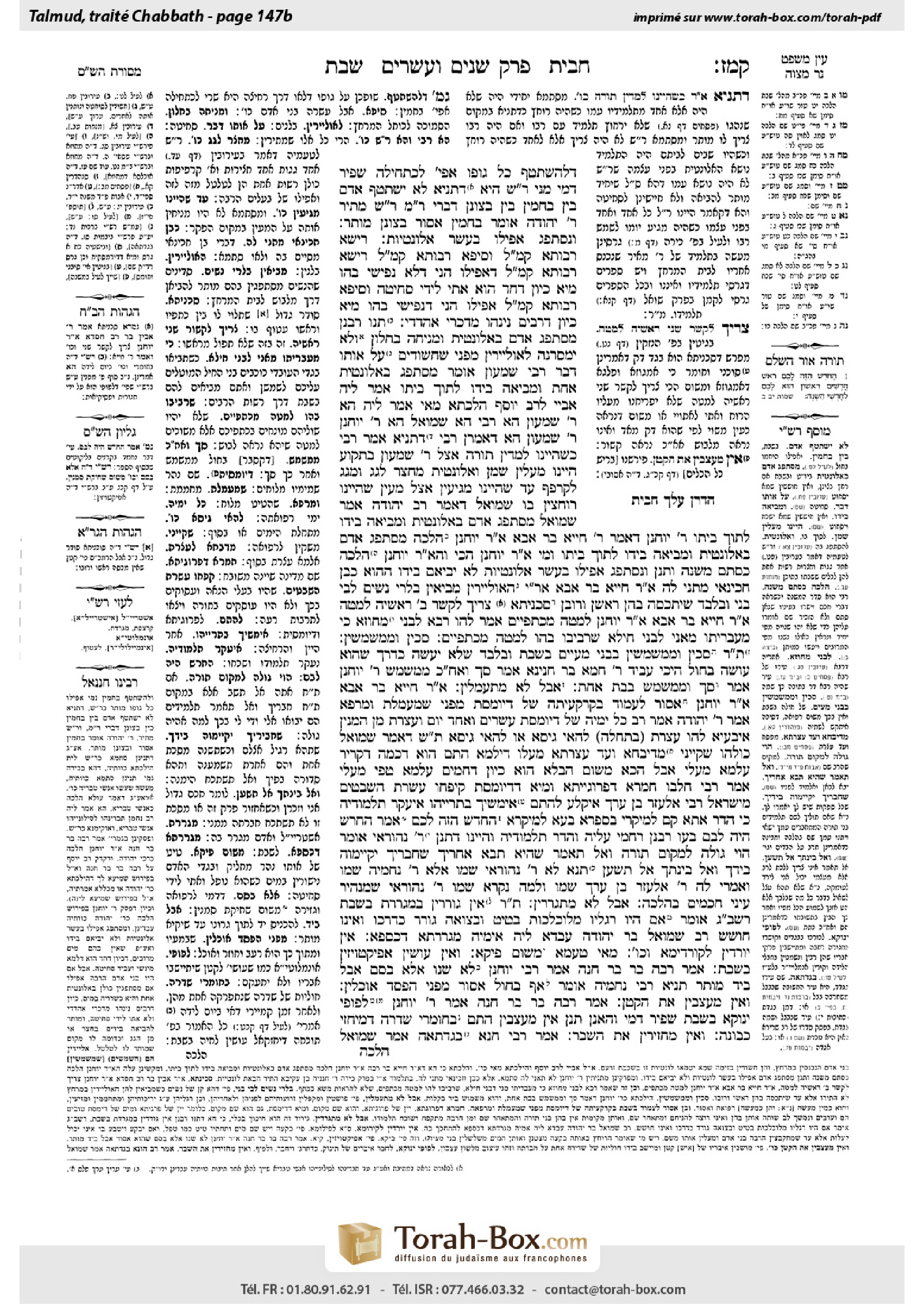
This page of Shabbat includes the Aramaic text, an English translation and an AI-generated French translation, alongside the scan above.
שבת קמ״ז ב · Aramaic and Hebrew text
דִּלְהִשְׁתַּטֵּף כׇּל גּוּפוֹ אֲפִילּוּ לְכַתְּחִילָּה שַׁפִּיר דָּמֵי. מַנִּי? רַבִּי שִׁמְעוֹן הִיא. דְּתַנְיָא: לֹא יִשְׁתַּטֵּף אָדָם בֵּין בְּחַמִּין בֵּין בְּצוֹנֵן, דִּבְרֵי רַבִּי מֵאִיר. רַבִּי שִׁמְעוֹן מַתִּיר. רַבִּי יְהוּדָה אוֹמֵר: בְּחַמִּין — אָסוּר, בְּצוֹנֵן — מוּתָּר.
וְנִסְתַּפֵּג אֲפִילּוּ בְּעֶשֶׂר אֲלוּנְטִיּוֹת. רֵישָׁא רְבוּתָא קָא מַשְׁמַע לַן וְסֵיפָא רְבוּתָא קָא מַשְׁמַע לַן. רֵישָׁא רְבוּתָא קָא מַשְׁמַע לַן, דַּאֲפִילּוּ הָנֵי דְּלָא נְפִישִׁי בְּהוּ מַיָּא, כֵּיוָן דְּחַד הוּא — אָתֵי לִידֵי סְחִיטָה, וְסֵיפָא רְבוּתָא קָא מַשְׁמַע לַן, אֲפִילּוּ הָנֵי דִּנְפִישִׁי בְּהוּ מַיָּא, כֵּיוָן דְּרַבִּים נִינְהוּ — מַדְכְּרִי אַהֲדָדֵי.
תָּנוּ רַבָּנַן: מִסְתַּפֵּג אָדָם בַּאֲלוּנְטִית וּמַנִּיחָהּ בַּחַלּוֹן. וְלֹא יִמְסְרֶנָּה לָאוֹלְיָירִין, מִפְּנֵי שֶׁחֲשׁוּדִים עַל אוֹתוֹ דָּבָר. רַבִּי שִׁמְעוֹן אוֹמֵר: מִסְתַּפֵּג בַּאֲלוּנְטִית אַחַת וּמְבִיאָהּ בְּיָדוֹ לְתוֹךְ בֵּיתוֹ.
אֲמַר לֵיהּ אַבָּיֵי לְרַב יוֹסֵף: הִלְכְתָא מַאי? אֲמַר לֵיהּ: הָא רַבִּי שִׁמְעוֹן, הָא רַבִּי, הָא שְׁמוּאֵל, הָא רַבִּי יוֹחָנָן.
רַבִּי שִׁמְעוֹן הָא דַּאֲמַרַן. רַבִּי — דְּתַנְיָא, אָמַר רַבִּי: כְּשֶׁהָיִינוּ לְמֵדִין תּוֹרָה אֵצֶל רַבִּי שִׁמְעוֹן בִּתְקוֹעַ, הָיִינוּ מַעֲלִין שֶׁמֶן וַאֲלוּנְטִית מֵחָצֵר לַגַּג וּמִגַּג לְקַרְפֵּף, עַד שֶׁהָיִינוּ מַגִּיעִין אֵצֶל מַעְיָן שֶׁהָיִינוּ רוֹחֲצִין בּוֹ. שְׁמוּאֵל — דְּאָמַר רַב יְהוּדָה אָמַר שְׁמוּאֵל: מִסְתַּפֵּג אָדָם בַּאֲלוּנְטִית וּמְבִיאָהּ בְּיָדוֹ לְתוֹךְ בֵּיתוֹ. רַבִּי יוֹחָנָן — דְּאָמַר רַבִּי חִיָּיא בַּר אַבָּא אָמַר רַבִּי יוֹחָנָן: הֲלָכָה מִסְתַּפֵּג אָדָם בַּאֲלוּנְטִית וּמְבִיאָהּ בְּיָדוֹ לְתוֹךְ בֵּיתוֹ.
וּמִי אָמַר רַבִּי יוֹחָנָן הָכִי? וְהָאָמַר רַבִּי יוֹחָנָן: הֲלָכָה כִּסְתַם מִשְׁנָה, וּתְנַן: וְנִסְתַּפֵּג אֲפִילּוּ בְּעֶשֶׂר אֲלוּנְטִיּוֹת לֹא יְבִיאֵם בְּיָדוֹ! הָהוּא — כְּבֶן חֲכִינַאי מַתְנֵי לַהּ.
אָמַר רַבִּי חִיָּיא בַּר אַבָּא אָמַר רַבִּי יוֹחָנָן: הָאוֹלְיָירִין מְבִיאִין בַּלָּרֵי נָשִׁים לְבֵי בָנֵי, וּבִלְבַד שֶׁיִּתְכַּסֶּה בָּהֶן רֹאשָׁן וְרוּבָּן. סִכְנִיתָא צָרִיךְ לְקַשֵּׁר שְׁנֵי רָאשֶׁיהָ לְמַטָּה. אָמַר רַבִּי חִיָּיא בַּר אַבָּא אָמַר רַבִּי יוֹחָנָן: לְמַטָּה מִכְּתֵפַיִים. אֲמַר לְהוּ רָבָא לִבְנֵי מָחוֹזָא: כִּי מְעַבְּרִיתוּ מָאנֵי לִבְנֵי חֵילָא, שַׁרְבִּיבוּ בְּהוּ לְמַטָּה מִכְּתֵפַיִם.
סָכִין וּמְמַשְׁמְשִׁין. תָּנוּ רַבָּנַן: סָכִין וּמְמַשְׁמְשִׁין בִּבְנֵי מֵעַיִים בְּשַׁבָּת, וּבִלְבַד שֶׁלֹּא יַעֲשֶׂה כְּדֶרֶךְ שֶׁהוּא עוֹשֶׂה בַּחוֹל. הֵיכִי עָבֵיד? רַבִּי חָמָא בַּר חֲנִינָא אָמַר: סָךְ וְאַחַר כָּךְ מְמַשְׁמֵשׁ. רַבִּי יוֹחָנָן אָמַר: סָךְ וּמְמַשְׁמֵשׁ בְּבַת אַחַת.
אֲבָל לֹא מִתְעַמְּלִין. אָמַר רַבִּי חִיָּיא בַּר אַבָּא אָמַר רַבִּי יוֹחָנָן: אָסוּר לַעֲמוֹד בְּקַרְקָעִיתָהּ שֶׁל דְּיוֹמְסֵת מִפְּנֵי שֶׁמְעַמֶּלֶת וּמְרַפָּא. אָמַר רַבִּי יְהוּדָה אָמַר רַב: כׇּל יָמֶיהָ שֶׁל דְּיוֹמְסֵת עֶשְׂרִים וְאֶחָד יוֹם וַעֲצֶרֶת מִן הַמִּנְיָן. אִיבַּעְיָא לְהוּ: עֲצֶרֶת בַּתְּחִלָּה לְהַאי גִּיסָא, אוֹ לְהַאי גִּיסָא? תָּא שְׁמַע דְּאָמַר שְׁמוּאֵל: כּוּלְּהוּ שַׁקְיָינֵי מִדִּיבְחָא וְעַד עֲצַרְתָּא מְעַלּוּ! דִּילְמָא הָתָם הוּא דְּכַמָּה דְּקָרִיר עָלְמָא מְעַלֵּי, אֲבָל הָכָא מִשּׁוּם הַבְלָא הוּא, כֵּיוָן דְּחַמִּים עָלְמָא טְפֵי מְעַלֵּי.
אָמַר רַבִּי חֶלְבּוֹ: חַמְרָא דִּפְרוֹגִיתָא וּמַיָּא דִדְיוֹמְסֵת קִיפְּחוּ עֲשֶׂרֶת הַשְּׁבָטִים מִיִּשְׂרָאֵל.
רַבִּי אֶלְעָזָר בֶּן עֲרָךְ אִיקְּלַע לְהָתָם, אִימְּשִׁיךְ בָּתְרַיְיהוּ אִיעַקַּר תַּלְמוּדֵיהּ. כִּי הֲדַר אֲתָא, קָם לְמִיקְרֵי בְּסִפְרָא, בְּעָא לְמִקְרֵי ״הַחֹדֶשׁ הַזֶּה לָכֶם״, אָמַר ״הַחֵרֵשׁ הָיָה לִבָּם״. בְּעוֹ רַבָּנַן רַחֲמֵי עֲלֵיהּ וַהֲדַר תַּלְמוּדֵיהּ.
וְהַיְינוּ דִּתְנַן, רַבִּי נְהוֹרַאי אוֹמֵר: הֱוֵי גּוֹלֶה לִמְקוֹם תּוֹרָה וְאַל תֹּאמַר שֶׁהִיא תָּבֹא אַחֲרֶיךָ, שֶׁחֲבֵרֶיךָ יְקַיְּימוּהָ בְּיָדְךָ, וְאֶל בִּינָתְךָ אַל תִּשָּׁעֵן. תָּנָא: לֹא רַבִּי נְהוֹרַאי שְׁמוֹ, אֶלָּא רַבִּי נְחֶמְיָה שְׁמוֹ. וְאָמְרִי לַהּ, רַבִּי אֶלְעָזָר בֶּן עֲרָךְ שְׁמוֹ. וְלָמָּה נִקְרָא שְׁמוֹ רַבִּי נְהוֹרַאי? — שֶׁמַּנְהִיר עֵינֵי חֲכָמִים בַּהֲלָכָה.
אֲבָל לֹא מִתְגָּרְרִין. תָּנוּ רַבָּנַן: אֵין גּוֹרְרִין בְּמִגְרֶרֶת בַּשַּׁבָּת. רַבָּן שִׁמְעוֹן בֶּן גַּמְלִיאֵל אוֹמֵר: אִם הָיוּ רַגְלָיו מְלוּכְלָכוֹת בְּטִיט וּבְצוֹאָה — גּוֹרֵר כְּדַרְכּוֹ וְאֵינוֹ חוֹשֵׁשׁ. רַב שְׁמוּאֵל בַּר יְהוּדָה עֲבַדָא לֵיהּ אִימֵּיהּ מַגְרַרְתָּא דְכַסְפָּא.
אֵין יוֹרְדִין לְקוֹרְדִימָא וְכוּ׳. מַאי טַעְמָא? — מִשּׁוּם פִּיקָא.
וְאֵין עוֹשִׂין אַפִּיקְטְוִיזִין בְּשַׁבָּת. אָמַר רַבָּה בַּר בַּר חָנָה אָמַר רַבִּי יוֹחָנָן: לֹא שָׁנוּ אֶלָּא בְּסַם, אֲבָל בַּיָּד — מוּתָּר. תַּנְיָא, רַבִּי נְחֶמְיָה אוֹמֵר: אַף בַּחוֹל אָסוּר מִפְּנֵי הֶפְסֵד אוֹכָלִין.
וְאֵין מְעַצְּבִין אֶת הַקָּטָן. אָמַר רַבָּה בַּר בַּר חָנָה אָמַר רַבִּי יוֹחָנָן: לַפּוֹפֵי יָנוֹקָא בְּשַׁבָּת שַׁפִּיר דָּמֵי. וְהָאֲנַן תְּנַן: אֵין מְעַצְּבִין! הָתָם בְּחוּמְרֵי שִׁדְרָה, דְּמֶיחְזֵי כְּבוֹנֶה.
וְאֵין מַחֲזִירִין אֶת הַשֶּׁבֶר. אָמַר רַבִּי חָנָא בַּגְדָּתָאָה אָמַר שְׁמוּאֵל:
Shabbat 147b · English translation
that rinsing one’s entire body by pouring water on it rather than bathing in the standard fashion may well be done even ab initio. The Gemara asks: According to whose opinion is our mishna? The Gemara answers: It is in accordance with the opinion of Rabbi Shimon, as it was taught in a baraita: One may not rinse himself on Shabbat, neither with hot water nor with cold water; this is the statement of Rabbi Meir. Rabbi Shimon permits rinsing one’s body even with hot water. Rabbi Yehuda says that there is a distinction: With hot water it is prohibited and with cold water it is permitted.
The mishna addressed the permissibility of drying oneself with a towel after bathing on Shabbat, and added the phrase: And dried himself off even with ten towels. The Gemara comments on the formulation of the mishna: The first clause teaches us a novel concept, and the latter clause teaches us a novel concept. The Gemara explains: The first clause: One who…dried himself even with ten towels may not carry them, teaches us a novel concept, that the prohibition applies even to these towels, which do not have much water absorbed in them. The reason for this is that since he is one person, he may come to squeeze them. And the latter clause teaches us a novel concept, that even these ten people may carry the towel that they have all used, despite the fact that they have absorbed much water and the towel is very wet. The reason for this is that since they are many people, they remind each other not to wring the towel.
The Sages taught in a baraita: One may dry himself with a towel on Shabbat and leave it in the window of the bathhouse; and one may not give it to the bath attendants, because they are suspect in this matter of wringing out towels. Rabbi Shimon says: One may dry himself with a single towel and carry it in his hand into his home, and there is no concern lest he wring out the water.
Abaye said to Rav Yosef: What is the halakha with regard to carrying a towel home after using it to dry himself? Rav Yosef said to him: There is Rabbi Shimon, there is Rabbi Yehuda HaNasi, there is Shmuel, and there is Rabbi Yoḥanan, all of whom permit it.
The Gemara elaborates: Rabbi Shimon rules leniently, as we have already stated that he permits bathing and drying oneself with a towel and then bringing it home. Rabbi Yehuda HaNasi agrees, as it was taught in a baraita that Rabbi Yehuda HaNasi said: When we would study Torah with Rabbi Shimon in Tekoa, we would carry oil and towels from the courtyard to the roof and from the roof into an enclosure similar to a courtyard until we reached the spring in which we would bathe, without passing through a public domain. In Rabbi Yehuda HaNasi’s opinion, it is permitted to carry a towel both before and after using it to dry oneself. Shmuel is also lenient, as Rav Yehuda said that Shmuel said explicitly: One may dry himself with a towel and carry it in his hand into his home. Rabbi Yoḥanan is also lenient, as Rabbi Ḥiyya bar Abba said that Rabbi Yoḥanan said: The halakha is that one may dry himself with a towel and carry it in his hand into his house.
The Gemara challenges this last point: And did Rabbi Yoḥanan really say that? Didn’t Rabbi Yoḥanan state a principle that the halakha is in accordance with an unattributed mishna, in which the name of the tanna who issued the rulings does not appear? And we learned explicitly in our mishna, which is unattributed, that if one bathed and dried himself even with ten towels, he may not carry them in his hand. The Gemara answers: Rabbi Yoḥanan’s version of the mishna does not teach this halakha unattributed; rather, it teaches it in accordance with the opinion of ben Ḥakhinai, which is the opinion of an individual Sage that is not the accepted halakha.
Rabbi Ḥiyya bar Abba said that Rabbi Yoḥanan said: Bath attendants may bring women’s bathing garments [balarei] to the bathhouse on Shabbat as long as they cover their heads and the majority of their bodies with them, so that they are being worn rather than carried. With regard to the large scarf that is worn draped over one’s shoulders, one must tie its two ends together below so that it will not fall. Rabbi Ḥiyya bar Abba said that Rabbi Yoḥanan said: This means that one must tie it below the shoulders. In a similar vein, Rava said to the inhabitants of his city, Meḥoza: When you transport clothing for the soldiers who are staying in the city, extend them beneath your shoulders so that you will wear them like a garment and not simply carry them.
We learned in the mishna: One may smear oil and rub a person’s body by hand on Shabbat. The Sages taught in a baraita: One may smear oil on and rub his intestinal area on Shabbat, and it is not a prohibited form of healing, provided he does not do so in the manner in which he does during the week. The Gemara asks: How then does one do this on Shabbat? Rabbi Ḥama bar Ḥanina said: One first smears oil and afterward rubs the body. And Rabbi Yoḥanan said: One smears oil and rubs simultaneously.
The mishna taught: However, one may not exert himself on Shabbat. Rabbi Ḥiyya bar Abba said that Rabbi Yoḥanan said: It is prohibited to stand on the floor of the therapeutic bathhouse of Deyomset on Shabbat, because it warms and heals even if one is not bathing or exerting himself. Rav Yehuda said that Rav said: The entire period that bathing in Deyomset is therapeutic is twenty-one days; and Shavuot is included. The Gemara raises a dilemma: Is Shavuot on this side, at the beginning, of the twenty-one-day period, or on this side, at the end, of the twenty-one days? Come and hear a resolution to this dilemma from that which Shmuel said: All medicinal drinks are effective from Passover to Shavuot; apparently, the waters of the Deyomset are therapeutic in the time period leading up to Shavuot. The Gemara rejects this proof: Perhaps there, with regard to medicinal drinks, it is so, because the cooler the world, the better these drinks heal; however, here, with regard to bathing, the therapeutic effect is due to the heat, and therefore the warmer the world, the better. The time period during which bathing is effective would only begin with Shavuot.
Apropos Deyomset, the Gemara cites that Rabbi Ḥelbo said: The wine of Phrygia [Perugaita] and the water of the Deyomset deprived Israel of the ten lost tribes. Because the members of these tribes were attracted to the pleasures of wine and bathing and did not occupy themselves with Torah, they were lost to the Jewish people.
The Gemara relates that once Rabbi Elazar ben Arakh happened to come there, to Phrygia and Deyomset, and he was drawn after them, and his Torah learning was forgotten. When he returned, he stood to read from a Torah scroll and was supposed to read the verse: “This month shall be for you [haḥodesh hazeh lakhem]” (Exodus 12:2), but he had forgotten so much that he could barely remember how to read the Hebrew letters, and instead he read: Have their hearts become deaf [haḥeresh haya libbam], interchanging the similar letters reish for dalet, yod for zayin, and beit for khaf. The Sages prayed and asked for God to have mercy on him, and his learning was restored.
And that is what we learned in a mishna that Rabbi Nehorai says: Exile yourself to a place of Torah and do not say that it will follow you, as if you are in a place of Torah, your colleagues will establish it in your hands, and do not rely on your understanding alone. It was taught: Rabbi Nehorai was not his name, but rather Rabbi Neḥemya was his name; and some say that Rabbi Elazar ben Arakh was his name and his statement was based on the personal experience of forgetting his Torah due to his failure to exile himself to a place of Torah. And why was he called Rabbi Nehorai? It was because he would illuminate [manhir] the eyes of the Sages in halakha.
The mishna taught: However, one may not scrape off the oil on Shabbat. The Sages taught in a baraita: One may not scrape his body with a scraper on Shabbat. Rabban Shimon ben Gamliel says: If one’s feet were dirty with mortar and excrement he may scrape them in the usual manner with a scraper and need not be concerned about violating a prohibition. Rav Shmuel bar Yehuda’s mother made him a silver scraper to use on Shabbat to distinguish it from a weekday.
The mishna also taught that one may not enter a swampy river full of mud on Shabbat. The Gemara explains: What is the reason for this? Due to the mud, as it is likely that one will slip and fall and come to violate the prohibitions of bathing and wringing out his clothes.
We also learned in the mishna that one may not make a drug to induce vomiting on Shabbat. Rabba bar bar Ḥana said that Rabbi Yoḥanan said: They only taught that this is prohibited with a drug, which is considered a medicine; however, inducing vomiting by hand is permitted. It was taught in a baraita that Rabbi Neḥemya says: Even during the week, if one need not vomit for medical reasons, it is prohibited to induce vomiting because it causes loss of food.
And we learned in the mishna that one may not align a young infant’s bones in order to straighten them on Shabbat. Rabba bar bar Ḥana said that Rabbi Yoḥanan said: With regard to swaddling an infant on Shabbat, one may well do so. The Gemara challenges this statement: Didn’t we learn in the mishna that one may not align an infant’s bones? The Gemara answers: There, the mishna is referring to the bones, vertebrae, of the spine, because straightening them appears like the prohibited labor of building.
We also learned in the mishna that one may not reset a break in a bone on Shabbat. Rav Ḥana of Baghdad said that Shmuel said:
Shabbat 147b · Traduction française (IA)
que se rincer tout le corps en y versant de l’eau, plutôt que de se baigner de la manière habituelle, peut parfaitement être permis même a priori. La Guemara demande : Selon l’avis de qui notre Michna est-elle formulée ? La Guemara répond : Elle est conforme à l’avis de Rabbi Shimon, comme cela a été enseigné dans une baraïta : Il est interdit de se rincer le Chabbat, ni à l’eau chaude ni à l’eau froide ; telle est la déclaration de Rabbi Meïr. Rabbi Shimon permet de se rincer le corps, même à l’eau chaude. Rabbi Yehouda dit qu’il y a une distinction : à l’eau chaude, c’est interdit, et à l’eau froide, c’est permis.
La Michna traite de la permission de se sécher avec une serviette après s’être baigné le Chabbat et ajoute : « Et il se sécha avec jusqu’à dix serviettes ». La Guemara commente la formulation de la Michna : la première partie nous enseigne une nouveauté, et la dernière partie nous en enseigne également une. La Guemara explique : la première partie, selon laquelle celui qui… s’est séché avec jusqu’à dix serviettes ne peut pas les transporter, nous enseigne une nouveauté : l’interdiction s’applique même à ces serviettes, qui n’ont pas absorbé beaucoup d’eau. En effet, puisqu’il est seul, il pourrait en venir à les essorer. La dernière partie nous enseigne une nouveauté : même ces dix personnes peuvent transporter la serviette dont elles se sont toutes servies, bien qu’elle ait absorbé beaucoup d’eau et soit très mouillée. En effet, puisqu’elles sont nombreuses, elles se rappellent mutuellement de ne pas essorer la serviette.
Les Sages ont enseigné dans une baraïta : On peut se sécher avec une serviette le Chabbat et la laisser à la fenêtre des bains publics ; mais on ne peut pas la confier aux préposés aux bains, car ils sont soupçonnés d’essorer les serviettes. Rabbi Shimon dit : On peut se sécher avec une seule serviette et la porter à la main jusque chez soi, sans craindre d’en essorer l’eau.
Abayé demanda à Rav Yossef : Quelle est la halakha concernant le fait de rapporter chez soi une serviette après s’être séché avec ? Rav Yossef lui répondit : Rabbi Shimon, Rabbi Yehouda HaNassi, Shmouel et Rabbi Yo’hanan le permettent tous.
La Guemara précise : Rabbi Shimon est indulgent, comme nous l’avons déjà dit : il permet de se baigner, de se sécher avec une serviette, puis de la rapporter chez soi. Rabbi Yehouda HaNassi est du même avis, comme cela a été enseigné dans une baraïta : Rabbi Yehouda HaNassi a dit : « Lorsque nous étudiions la Torah avec Rabbi Shimon à Teqoa, nous transportions de l’huile et des serviettes de la cour au toit, puis du toit dans un enclos semblable à une cour, jusqu’à la source où nous nous baignions, sans passer par un domaine public. » Selon Rabbi Yehouda HaNassi, il est permis de transporter une serviette aussi bien avant qu’après s’en être servi pour se sécher. Shmouel est lui aussi indulgent, car Rav Yehouda a rapporté explicitement au nom de Shmouel : On peut se sécher avec une serviette et la porter à la main jusque chez soi. Rabbi Yo’hanan est également indulgent, car Rabbi ‘Hiyya bar Abba a rapporté au nom de Rabbi Yo’hanan : La halakha est qu’on peut se sécher avec une serviette et la porter à la main jusque chez soi.
La Guemara conteste ce dernier point : Rabbi Yo’hanan a-t-il vraiment dit cela ? N’a-t-il pas posé le principe que la halakha est conforme à une Michna anonyme, dans laquelle le nom du tanna ayant énoncé les décisions n’apparaît pas ? Or, nous avons appris explicitement dans notre Michna, qui est anonyme, que si quelqu’un s’est baigné et s’est séché avec jusqu’à dix serviettes, il ne peut pas les porter à la main. La Guemara répond : Dans la version de la Michna de Rabbi Yo’hanan, cette halakha n’est pas anonyme ; elle est formulée conformément à l’avis de ben ‘Hakinaï, un Sage isolé dont l’avis ne constitue pas la halakha retenue.
Rabbi ‘Hiyya bar Abba a rapporté au nom de Rabbi Yo’hanan : Le Chabbat, les préposés aux bains peuvent apporter au bain public les vêtements de bain des femmes [balarei], à condition que celles-ci se couvrent la tête et la majeure partie du corps avec ces vêtements, de sorte qu’elles les portent plutôt qu’elles ne les transportent. Quant au grand châle que l’on porte drapé sur les épaules, il faut en nouer les deux extrémités en dessous, pour qu’il ne tombe pas. Rabbi ‘Hiyya bar Abba a rapporté au nom de Rabbi Yo’hanan : Cela signifie qu’il faut le nouer sous les épaules. Dans le même ordre d’idées, Rava dit aux habitants de sa ville, Me’hoza : Lorsque vous transportez des vêtements pour les soldats qui séjournent dans la ville, faites-les passer sous vos épaules, afin de les porter comme un vêtement et non de simplement les transporter.
Nous avons appris dans la Michna : Le Chabbat, on peut enduire le corps d’huile et le frictionner à la main. Les Sages ont enseigné dans une baraïta : Le Chabbat, on peut enduire d’huile et frictionner la région intestinale, sans que cela constitue une forme interdite de soin, à condition de ne pas le faire comme on le fait pendant la semaine. La Guemara demande : Comment faut-il donc procéder le Chabbat ? Rabbi ‘Hama bar ‘Hanina dit : On enduit d’abord d’huile, puis on frictionne le corps. Rabbi Yo’hanan dit : On enduit le corps d’huile et on le frictionne simultanément.
La Michna enseigne : Toutefois, on ne peut pas se livrer à un effort physique le Chabbat. Rabbi ‘Hiyya bar Abba a rapporté au nom de Rabbi Yo’hanan : Il est interdit de se tenir sur le sol de l’établissement thermal thérapeutique de Deyomset le Chabbat, car il réchauffe et soigne même si l’on ne se baigne pas et qu’on ne fait pas d’effort. Rav Yehouda a rapporté au nom de Rav : La période entière pendant laquelle les bains de Deyomset ont un effet thérapeutique dure vingt et un jours, et Chavouot est compris dans cette période. La Guemara soulève une question : Chavouot se situe-t-il au début de la période de vingt et un jours, ou à la fin de ces vingt et un jours ? Écoutons la réponse à cette question tirée de ce que Shmouel a dit : Toutes les boissons médicinales sont efficaces de Pessa’h à Chavouot. Il semble donc que les eaux de Deyomset aient un effet thérapeutique durant la période qui précède Chavouot. La Guemara rejette cette preuve : Peut-être en est-il ainsi pour les boissons médicinales, car plus le monde est frais, mieux elles soignent ; mais ici, pour les bains, l’effet thérapeutique est dû à la chaleur et, par conséquent, plus le monde est chaud, mieux ils agissent. La période pendant laquelle les bains sont efficaces ne commencerait donc qu’à Chavouot.
À propos de Deyomset, la Guemara rapporte que Rabbi ‘Helbo a dit : Le vin de Phrygie [Perugaita] et les eaux de Deyomset ont privé Israël des dix tribus perdues. Attirés par les plaisirs du vin et des bains, les membres de ces tribus ne se consacrèrent pas à la Torah et furent perdus pour le peuple juif.
La Guemara raconte qu’un jour, Rabbi Elazar ben Arakh se rendit là-bas, en Phrygie et à Deyomset, et se laissa entraîner par ces plaisirs ; il oublia alors son étude de la Torah. À son retour, il se leva pour lire dans un rouleau de la Torah et devait lire le verset : « Ce mois sera pour vous [haḥodesh hazeh lakhem] » (Exode 12, 2). Mais il avait tant oublié qu’il se souvenait à peine de la manière de lire les lettres hébraïques, et il lut à la place : « Leur cœur est-il devenu sourd [haḥeresh haya libbam] », confondant les lettres proches reish et dalet, yod et zayin, ainsi que beit et khaf. Les Sages prièrent et demandèrent à Dieu d’avoir pitié de lui, et son savoir lui revint.
C’est ce que nous avons appris dans une Michna, où Rabbi Nehoraï dit : « Exile-toi dans un lieu de Torah et ne dis pas qu’elle te suivra ; car si tu te trouves dans un lieu de Torah, tes collègues l’établiront dans tes mains. Ne te fie pas à ta seule compréhension. » Il a été enseigné : Rabbi Nehoraï n’était pas son nom ; son nom était plutôt Rabbi Ne’hemya. Certains disent que son nom était Rabbi Elazar ben Arakh et que sa déclaration reposait sur son expérience personnelle : il avait oublié sa Torah faute de s’être exilé dans un lieu de Torah. Pourquoi l’appelait-on Rabbi Nehoraï ? Parce qu’il éclairait [manhir] les yeux des Sages en matière de halakha.
La Michna enseigne : Toutefois, on ne peut pas gratter l’huile le Chabbat. Les Sages ont enseigné dans une baraïta : On ne peut pas se gratter le corps avec un grattoir le Chabbat. Rabban Shimon ben Gamliel dit : Si les pieds de quelqu’un sont salis par du mortier et des excréments, il peut les gratter avec un grattoir de la manière habituelle et n’a pas à craindre de transgresser une interdiction. La mère de Rav Shmouel bar Yehouda lui fabriqua un grattoir en argent pour le Chabbat, afin de le distinguer de celui des jours de semaine.
La Michna enseigne également qu’on ne peut pas entrer le Chabbat dans une rivière marécageuse pleine de boue. La Guemara explique : Pourquoi ? À cause de la boue, car on risque de glisser et de tomber, et d’en venir à transgresser les interdictions de se baigner et d’essorer ses vêtements.
Nous avons également appris dans la Michna qu’on ne peut pas préparer le Chabbat une potion pour provoquer des vomissements. Rabba bar bar ‘Hana a rapporté au nom de Rabbi Yo’hanan : Ils n’ont enseigné l’interdiction que pour une potion, considérée comme un médicament ; en revanche, il est permis de provoquer les vomissements avec la main. Il a été enseigné dans une baraïta que Rabbi Ne’hemya dit : Même pendant la semaine, si l’on n’a pas besoin de vomir pour des raisons médicales, il est interdit de provoquer des vomissements, car cela entraîne une perte de nourriture.
Nous avons appris dans la Michna qu’on ne peut pas remettre en place les os d’un jeune nourrisson afin de les redresser le Chabbat. Rabba bar bar ‘Hana a rapporté au nom de Rabbi Yo’hanan : Le Chabbat, on peut tout à fait emmailloter un nourrisson. La Guemara conteste cette déclaration : N’avons-nous pas appris dans la Michna qu’on ne peut pas remettre les os d’un nourrisson en place ? La Guemara répond : Là, la Michna parle des os, c’est-à-dire des vertèbres de la colonne vertébrale, car les redresser ressemble au travail interdit de construire.
Nous avons également appris dans la Michna qu’on ne peut pas remettre en place une fracture le Chabbat. Rav ‘Hana de Bagdad a rapporté au nom de Shmouel :
Traduction française générée par IA à partir de l’édition anglaise de Sefaria. Vérifie toujours un passage avec le texte source.
Text from Sefaria: William Davidson Edition - Vocalized Aramaic (CC BY NC); William Davidson Edition - English (CC BY NC).