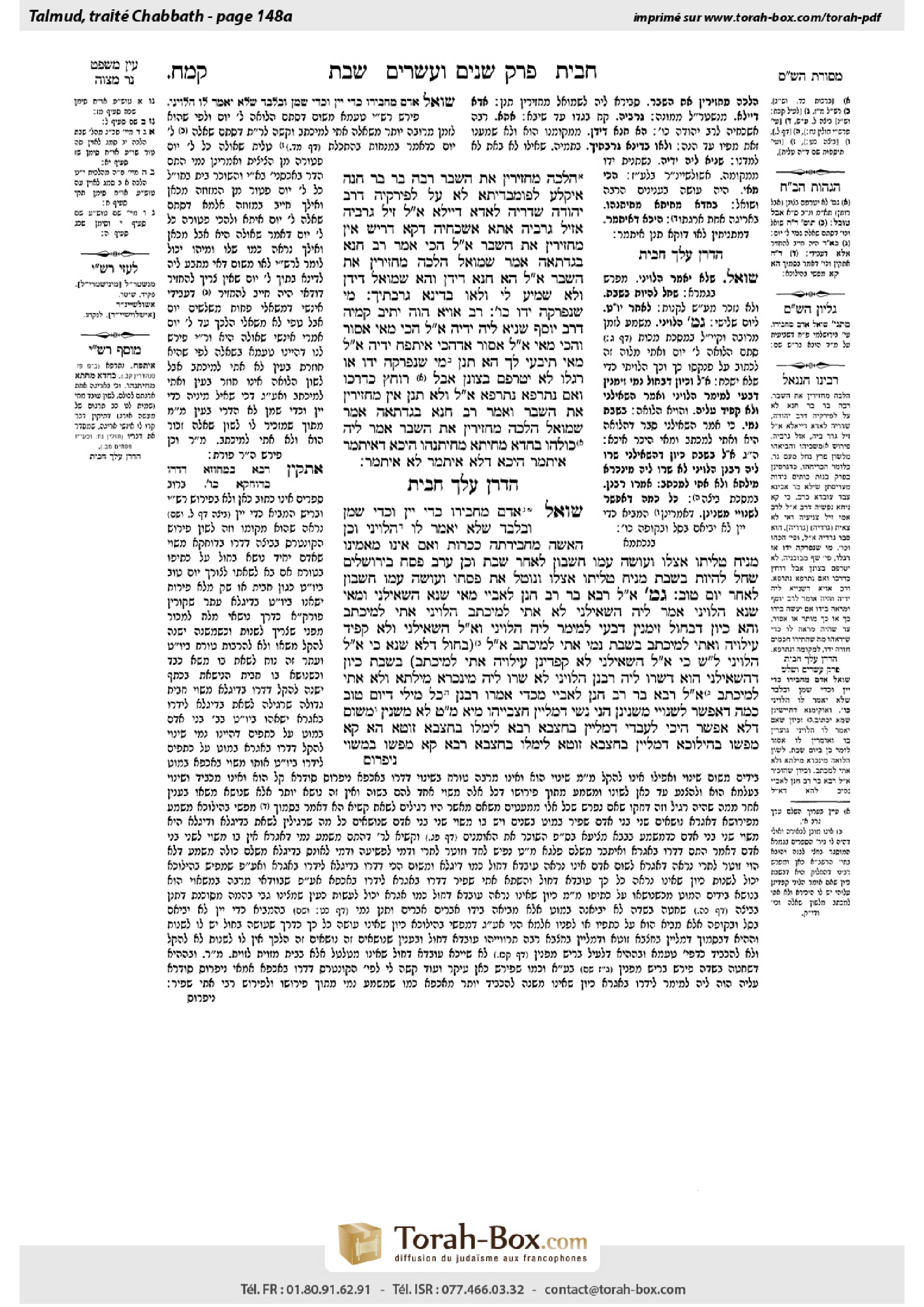
Shabbat 148a: Talmud study for Daf Yomi
Daf Yomi is the daily study of one Talmud folio. Explore 37 tractates with scans, Hebrew text, Sefaria English and AI-generated French translations where annotated.
Passage selection and English or AI-generated French translation are available where the scan has annotations. Daf Study is independent of Torah-Box and Sefaria.
Browse Shabbat · שבת · All tractatesShabbat 148a text and translations
This page of Shabbat includes the Aramaic text, an English translation and an AI-generated French translation, alongside the scan above.
שבת קמ״ח א · Aramaic and Hebrew text
הֲלָכָה: מַחֲזִירִין אֶת הַשֶּׁבֶר. רַבָּה בַּר בַּר חָנָה אִיקְּלַע לְפוּמְבְּדִיתָא, לָא עָל לְפִירְקֵיהּ דְּרַב יְהוּדָה. שַׁדְּרֵיהּ לַאֲדָא דַּיָּילָא, אֲמַר לֵיהּ: זִיל גַּרְבֵּיהּ. אֲזַל גַּרְבֵּיהּ. אֲתָא, אַשְׁכְּחֵיהּ דְּקָא דָרֵישׁ: אֵין מַחֲזִירִין אֶת הַשֶּׁבֶר. אֲמַר לֵיהּ: הָכִי אָמַר רַב חָנָא בַּגְדָּתָאָה אָמַר שְׁמוּאֵל: הֲלָכָה — מַחֲזִירִין אֶת הַשֶּׁבֶר. אֲמַר לֵיהּ: הָא חָנָא דִּידַן, וְהָא שְׁמוּאֵל דִּידַן, וְלָא שְׁמִיעַ לִי — וְלָאו בְּדִינָא גְּרַבְתָּיךְ?!
מִי שֶׁנִּפְרְקָה יָדוֹ כּוּ׳. רַב אַוְיָא הֲוָה יָתֵיב קַמֵּיהּ דְּרַב יוֹסֵף, שַׁנְיָא לֵיהּ יְדֵיהּ. אֲמַר לֵיהּ: הָכִי מַאי? אָסוּר. וְהָכִי מַאי? אֲמַר לֵיהּ: אָסוּר. אַדְּהָכִי אִיתְּפַח יְדֵיהּ.
אֲמַר לֵיהּ: מַאי תִּיבְּעֵי לָךְ, הָא תְּנַן: מִי שֶׁנִּפְרְקָה יָדוֹ אוֹ רַגְלוֹ — לֹא יִטְרְפֵם בְּצוֹנֵן, אֲבָל רוֹחֵץ כְּדַרְכּוֹ, וְאִם נִתְרַפֵּא — נִתְרַפֵּא. אֲמַר לֵיהּ: וְלָא תְּנַן: ״אֵין מַחֲזִירִין אֶת הַשֶּׁבֶר״, וְאָמַר רַב חָנָא בַּגְדָּתָאָהּ אָמַר שְׁמוּאֵל: הֲלָכָה — מַחֲזִירִין אֶת הַשֶּׁבֶר! אֲמַר לֵיהּ: כּוּלְּהוּ בַּחֲדָא מְחִיתָא מְחִיתִּנְהוּ?! הֵיכָא דְּאִיתְּמַר — אִיתְּמַר, הֵיכָא דְּלָא אִיתְּמַר — לָא אִיתְּמַר.
הדרן עלך חבית
מַתְנִי׳ שׁוֹאֵל אָדָם מֵחֲבֵירוֹ כַּדֵּי יַיִן וְכַדֵּי שֶׁמֶן, וּבִלְבַד שֶׁלֹּא יֹאמַר לוֹ ״הַלְוֵינִי״. וְכֵן הָאִשָּׁה מֵחֲבֶירְתָּהּ כִּכָּרוֹת. וְאִם אֵינוֹ מַאֲמִינוֹ — מַנִּיחַ טַלִּיתוֹ אֶצְלוֹ, וְעוֹשֶׂה עִמּוֹ חֶשְׁבּוֹן לְאַחַר שַׁבָּת. וְכֵן עֶרֶב פֶּסַח בִּירוּשָׁלַיִם שֶׁחָל לִהְיוֹת בְּשַׁבָּת, מַנִּיחַ טַלִּיתוֹ אֶצְלוֹ, וְנוֹטֵל אֶת פִּסְחוֹ, וְעוֹשֶׂה עִמּוֹ חֶשְׁבּוֹן לְאַחַר יוֹם טוֹב.
גְּמָ׳ אֲמַר לֵיהּ רָבָא בַּר רַב חָנָן לְאַבָּיֵי: מַאי שְׁנָא הַשְׁאִילֵנִי, וּמַאי שְׁנָא הַלְוֵינִי? אֲמַר לֵיהּ: הַשְׁאִילֵנִי — לָא אָתֵי לְמִיכְתַּב, הַלְוֵינִי — אָתֵי לְמִיכְתַּב.
וְהָא כֵּיוָן דִּבְחוֹל, זִימְנִין דְּבָעֵי לְמֵימַר לֵיהּ ״הַלְוֵינִי״ וַאֲמַר לֵיהּ ״הַשְׁאִילֵנִי״ וְלָא קָפֵיד עִילָּוֵיהּ — וְאָתֵי לְמִיכְתַּב, בְּשַׁבָּת נָמֵי אָתֵי לְמִיכְתַּב! אֲמַר לֵיהּ: (בְּחוֹל, דְּלָא שְׁנָא כִּי אֲמַר לֵיהּ ״הַלְוֵינִי״ לָא שְׁנָא כִּי אֲמַר לֵיהּ ״הַשְׁאִילֵנִי״, לָא קָפְדִינַן עִילָּוֵיהּ — אָתֵי לְמִיכְתַּב.) בְּשַׁבָּת כֵּיוָן דְּ״הַשְׁאִילֵנִי״ הוּא דְּשָׁרוּ לֵיהּ רַבָּנַן, ״הַלְוֵינִי״ לָא שָׁרוּ לֵיהּ — מִינַּכְרָא מִילְּתָא, וְלָא אָתֵי לְמִיכְתַּב.
אֲמַר לֵיהּ רָבָא בַּר רַב חָנָן לְאַבָּיֵי: מִכְּדֵי אֲמַרוּ רַבָּנַן: כׇּל מִילֵּי דְּיוֹם טוֹב כַּמָּה דְּאֶפְשָׁר לְשַׁנּוֹיֵי מְשַׁנִּינַן, הָנֵי נְשֵׁי דְּמָלְיָין חַצְבַיְיהוּ מַיָּא, מַאי טַעְמָא לָא מְשַׁנְּיָן? מִשּׁוּם דְּלָא אֶפְשָׁר: הֵיכִי לַעֲבֵיד? דְּמָלְיָין בְּחַצְבָּא רַבָּא, לִימְלוֹ בְּחַצְבָּא זוּטָא — הָא קָא מַפְּשׁוּ בְּהִילּוּכָא. דְּמָלְיָין בְּחַצְבָּא זוּטָא, לִימְלוֹ בְּחַצְבָּא רַבָּא — קָא מַפְּשׁוּ בְּמַשּׂוֹי.
Shabbat 148a · English translation
The halakha is that one may reset a break on Shabbat, which was the ruling in Shmuel’s version of the mishna. The Gemara relates that Rabba bar bar Ḥana happened to come to Pumbedita and he did not enter Rav Yehuda’s lecture. Rav Yehuda sent for Adda, his attendant, and said to him: Go drag him to the lecture. He went and dragged him forcibly to the lecture (Rabbeinu Ḥananel). Rabba bar bar Ḥana came and found Rav Yehuda teaching that one may not reset a break on Shabbat. He said to him: This is what Rav Ḥana of Baghdad said that Shmuel said: The halakha is that one may reset a break on Shabbat. Rav Yehuda said to him: Ḥana is ours, a Babylonian scholar, and Shmuel is ours, and nevertheless, I did not yet hear this halakha; did I not rightfully drag you to the lecture?
We learned in the mishna that one whose hand was dislocated may not treat it by vigorously moving it about in water. The Gemara relates that Rav Avya was once sitting before Rav Yosef and his hand became dislocated. Rav Avya then displayed a variety of hand positions and he said to him: What is the ruling with regard to this? Am I permitted to place my hand in this way, or is it a violation of the prohibition against healing on Shabbat? Rav Yosef said to him: It is prohibited. Rav Avya again asked: And what is the ruling if I position my hand in this way? Rav Yosef said to him: It is prohibited. In the meantime, his hand was restored to its proper location and was healed.
Rav Yosef said to him: What is your dilemma? We learned in our mishna that one whose hand or foot was dislocated on Shabbat may not vigorously move it about in cold water; however, he may rinse it in the usual manner, and if it is healed, it is healed. Rav Avya said to him: That is no proof, as didn’t we learn in our mishna that one may not reset a break, and Rav Ḥana of Baghdad said that Shmuel said that the halakha is that one may indeed reset a broken bone. Therefore, perhaps a dislocated limb may also be treated on Shabbat. Rav Yosef said to him: Were all these woven together in a single weave? Where it was stated that an alternative version of the mishna exists, it was stated; where it was not stated, it was not stated. Therefore, the ruling of the mishna with regard to a dislocated limb must be observed.
MISHNA: One may borrow jugs of wine and jugs of oil from another on Shabbat, as long as one does not say the following to him: Loan me. And similarly, a woman may borrow from another loaves of bread on Shabbat. And if the lender does not trust him that he will return them, the borrower may leave his cloak with him as collateral and make the proper calculation with him after Shabbat. And similarly, on the eve of Passover in Jerusalem, when it occurs on Shabbat, one who is procuring a Paschal lamb may leave his cloak with him, i.e., the person from whom he is purchasing it, and take the lamb to bring as his Paschal lamb, and then make the proper calculation with him after the Festival.
GEMARA: It was taught in the mishna that one is permitted to borrow jugs from another on Shabbat, but one may not use the phrase loan me. Rava bar Rav Ḥanan said to Abaye: What is different about the expression let me borrow, that makes it permitted? And what is different about the expression loan me that makes it prohibited? He said to him: If someone says let me borrow, the lender will not come to write down the loan because the expression indicates that the borrower intends to return the object in its current state within a short amount of time. On the other hand, the expression loan me indicates a more extended loan in which the object is not necessarily returned in exactly the same manner in which it was taken. Therefore, the lender will come to write down the terms of the loan.
Rava bar Rav Ḥanan challenged Abaye’s answer: But since on weekdays there are times one intends to say loan me and instead says let me borrow, and the lender is not particular about his imprecise terminology and he comes to write down the terms of the loan, on Shabbat he will also come to write. Abaye said to him: On a weekday, when there is no difference if one says loan me or let me borrow, lenders are not particular about his terminology, and the lender will therefore come to write down the terms of the loan. On Shabbat, since only the expression let me borrow was allowed by the Sages, while the expression loan me was not permitted, the matter is recognizable. Both of the parties must bear in mind which terminology is acceptable, and the lender will not come to write.
Rava bar Rav Ḥanan said to Abaye: Now, since the Sages said that with regard to all matters of a Festival, as much as we can change the way we do things from the manner in which we do them on weekdays, we change, these women who fill their pitchers with water, what is the reason they do not change the way they draw water from their normal weekday procedure? Abaye answers: Because it is not possible to change the procedure. How would they do it differently? If you say that those who normally fill a large pitcher should fill a small pitcher on a Festival, they would thereby add to their walking and expend extra effort. Conversely, if those who normally fill a small pitcher would fill a large pitcher on a Festival, they would thereby add to the weight of their load. Even though these methods are different from the norm, they would cause added exertion. Therefore, the Sages did not require that one draw water in an unusual fashion.
Shabbat 148a · Traduction française (IA)
La halakha est qu’on peut remettre en place une fracture le Chabbat ; telle était la décision dans la version de la Michna rapportée par Shmuel. La Guemara raconte que Rabba bar bar Ḥana arriva par hasard à Pumbedita et n’assista pas au cours de Rav Yehuda. Rav Yehuda envoya chercher Adda, son serviteur, et lui dit : « Va le traîner jusqu’au cours. » Adda alla le traîner de force jusqu’au cours (Rabbeinu Ḥananel). Rabba bar bar Ḥana arriva et trouva Rav Yehuda enseignant qu’on ne peut pas remettre en place une fracture le Chabbat. Il lui dit : « Voici ce que Rav Ḥana de Bagdad a dit au nom de Shmuel : la halakha est qu’on peut remettre en place une fracture le Chabbat. » Rav Yehuda lui dit : « Ḥana est des nôtres, c’est un sage babylonien, et Shmuel est des nôtres ; pourtant, je n’avais pas encore entendu cette halakha. N’avais-je donc pas raison de te traîner jusqu’au cours ? »
Nous avons appris dans la Michna que celui dont la main a été déboîtée ne peut pas la soigner en la remuant vigoureusement dans l’eau. La Guemara raconte que Rav Avya était un jour assis devant Rav Yosef lorsque sa main fut déboîtée. Rav Avya lui montra alors diverses positions de la main et lui demanda : « Quelle est la halakha à propos de ceci ? M’est-il permis de placer ma main ainsi, ou est-ce une transgression de l’interdiction de se soigner le Chabbat ? » Rav Yosef lui répondit : « C’est interdit. » Rav Avya demanda de nouveau : « Et quelle est la halakha si je place ma main ainsi ? » Rav Yosef lui répondit : « C’est interdit. » Entre-temps, sa main avait repris sa place normale et était guérie.
Rav Yosef lui dit : « Quel est ton doute ? Nous avons appris dans notre Michna que celui dont la main ou le pied a été déboîté le Chabbat ne peut pas le remuer vigoureusement dans l’eau froide ; toutefois, il peut le rincer de la manière habituelle, et s’il guérit, il guérit. » Rav Avya lui dit : « Cela ne prouve rien, car n’avons-nous pas appris dans notre Michna qu’on ne peut pas remettre en place une fracture, alors que Rav Ḥana de Bagdad a dit au nom de Shmuel que la halakha est qu’on peut effectivement remettre en place un os fracturé ? Il se peut donc qu’on puisse également soigner un membre déboîté le Chabbat. » Rav Yosef lui dit : « Est-ce que tout cela a été tissé d’un seul fil ? Là où il a été dit qu’il existe une autre version de la Michna, cela a été dit ; là où cela n’a pas été dit, cela n’a pas été dit. La décision de la Michna concernant un membre déboîté doit donc être respectée. »
MICHNA : On peut emprunter à quelqu’un des cruches de vin et des cruches d’huile le Chabbat, à condition de ne pas lui dire : « Prête-moi. » De même, une femme peut emprunter à une autre des pains le Chabbat. Si le prêteur ne lui fait pas confiance quant à leur restitution, l’emprunteur peut lui laisser son manteau en gage et régler leurs comptes comme il convient après le Chabbat. De même, la veille de Pessaḥ à Jérusalem, lorsque Pessaḥ tombe un Chabbat, celui qui se procure un agneau pascal peut laisser son manteau à celui qui le lui vend, prendre l’agneau pour l’offrir comme sacrifice pascal, puis régler leurs comptes comme il convient après la fête.
GUEMARA : La Michna enseigne qu’il est permis d’emprunter des cruches à quelqu’un le Chabbat, mais qu’on ne peut pas employer l’expression « prête-moi ». Rava bar Rav Ḥanan dit à Abaye : « En quoi l’expression “laisse-moi emprunter” diffère-t-elle pour être permise, et en quoi l’expression “prête-moi” diffère-t-elle pour être interdite ? » Abaye lui répondit : « Si quelqu’un dit “laisse-moi emprunter”, le prêteur ne viendra pas noter le prêt, car cette expression indique que l’emprunteur a l’intention de rendre l’objet tel quel dans un bref délai. En revanche, l’expression “prête-moi” indique un prêt de plus longue durée, dans lequel l’objet n’est pas nécessairement rendu exactement dans le même état que celui où il a été pris. Le prêteur viendra donc noter les conditions du prêt. »
Rava bar Rav Ḥanan objecta à la réponse d’Abaye : « Pourtant, en semaine, il arrive qu’on ait l’intention de dire “prête-moi” et qu’on dise plutôt “laisse-moi emprunter”, et le prêteur ne lui tient pas rigueur de cette imprécision de langage ; il vient néanmoins noter les conditions du prêt. Le Chabbat aussi, il viendra donc écrire. » Abaye lui dit : « En semaine, puisqu’il n’y a aucune différence entre dire “prête-moi” et dire “laisse-moi emprunter”, les prêteurs ne tiennent pas rigueur de son expression, et le prêteur vient donc noter les conditions du prêt. Le Chabbat, puisque les Sages n’ont autorisé que l’expression “laisse-moi emprunter” et n’ont pas permis l’expression “prête-moi”, la distinction est manifeste. Les deux parties doivent garder à l’esprit quelle expression est acceptable, et le prêteur ne viendra pas écrire. »
Rava bar Rav Ḥanan dit à Abaye : « Puisque les Sages ont enseigné que, pour toutes les affaires de la fête, nous modifions autant que possible nos façons de faire par rapport à celles des jours de semaine, pour quelle raison ces femmes qui remplissent leurs cruches d’eau ne modifient-elles pas leur façon habituelle de puiser l’eau ? » Abaye répond : « Parce qu’il n’est pas possible de modifier la façon de faire. Comment pourraient-elles procéder autrement ? Si tu dis que celles qui remplissent habituellement une grande cruche devraient remplir une petite cruche pendant la fête, elles devraient alors marcher davantage et fournir un effort supplémentaire. À l’inverse, si celles qui remplissent habituellement une petite cruche remplissaient une grande cruche pendant la fête, le poids de leur charge augmenterait. Bien que ces méthodes diffèrent de l’usage habituel, elles entraîneraient un effort supplémentaire. Les Sages n’ont donc pas exigé que l’on puise l’eau d’une manière inhabituelle. »
Traduction française générée par IA à partir de l’édition anglaise de Sefaria. Vérifie toujours un passage avec le texte source.
Text from Sefaria: William Davidson Edition - Vocalized Aramaic (CC BY NC); William Davidson Edition - English (CC BY NC).