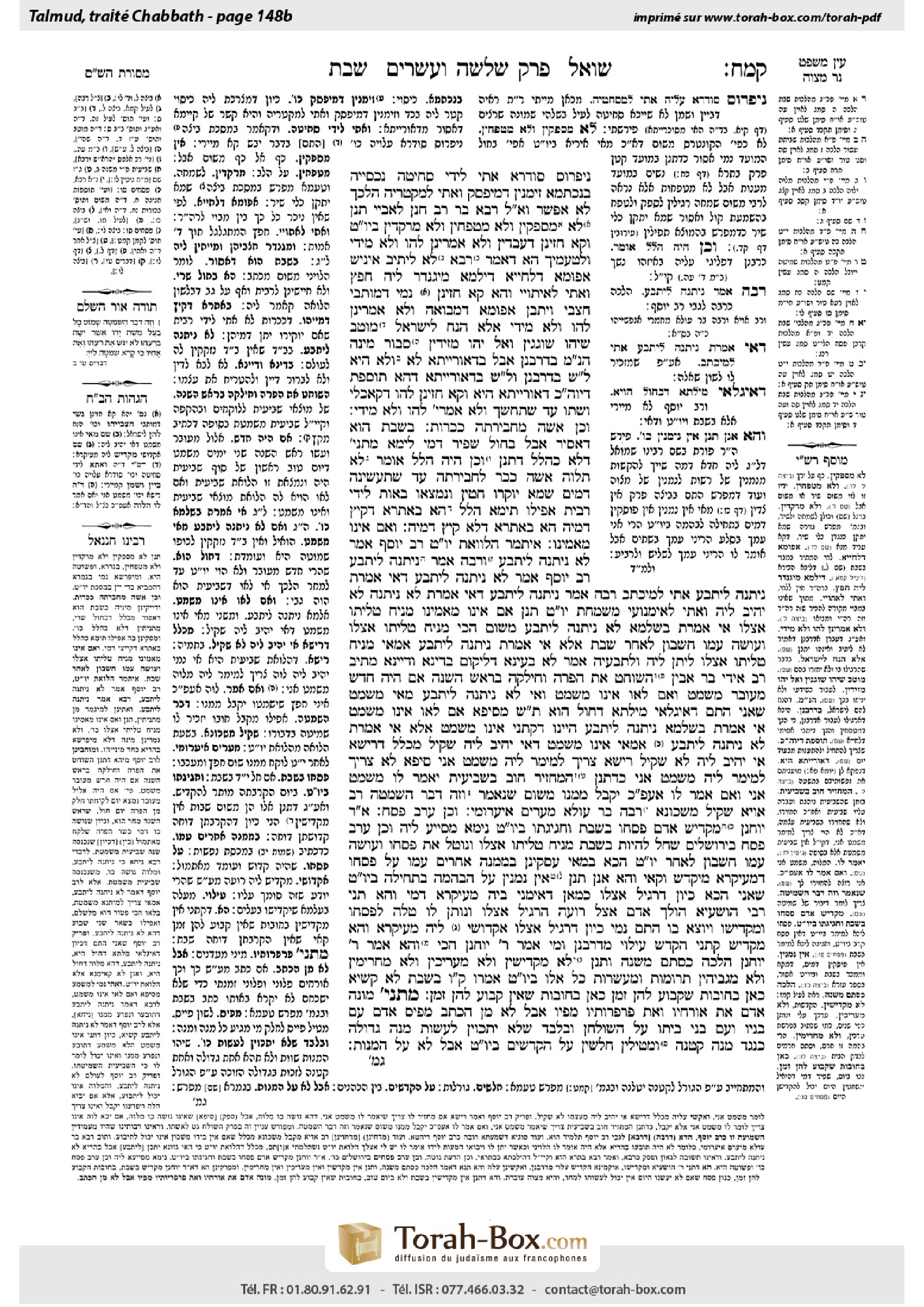
Shabbat 148b: Talmud study for Daf Yomi
Daf Yomi is the daily study of one Talmud folio. Explore 37 tractates with scans, Hebrew text, Sefaria English and AI-generated French translations where annotated.
Passage selection and English or AI-generated French translation are available where the scan has annotations. Daf Study is independent of Torah-Box and Sefaria.
Browse Shabbat · שבת · All tractatesShabbat 148b text and translations
This page of Shabbat includes the Aramaic text, an English translation and an AI-generated French translation, alongside the scan above.
שבת קמ״ח ב · Aramaic and Hebrew text
נִיפְרוֹס סוּדָרָא — אָתֵי לִידֵי סְחִיטָה. נְכַסְּיֵיהּ בְּנִכְתְּמָא — זִימְנִין דְּמִיפְּסַק, וְאָתֵי לְמִקְטְרֵיהּ. הִלְכָּךְ לָא אֶפְשָׁר.
וַאֲמַר לֵיהּ רַבָּא בַּר רַב חָנָן לְאַבָּיֵי: תְּנַן לֹא מְסַפְּקִין, וְלֹא מְטַפְּחִין, וְלֹא מְרַקְּדִין בְּיוֹם טוֹב. וְקָא חָזֵינַן דְּעָבְדִין, וְלָא אָמְרִינַן לְהוּ וְלָא מִידֵּי! וּלְטַעְמָיךְ, הָא דְּאָמַר רַבָּא: לָא לִיתִּיב אִינִישׁ אַפּוּמָּא דְלֶחְיָיא, דִילְמָא מִיגַּנְדַּר לֵיהּ חֵפֶץ וְאָתֵי לְאֵיתוֹיֵי, וְהָא קָא חָזֵינַן נְשֵׁי דְּמַיְתְיָין חַצְבֵי וְיָתְבָן אַפּוּמָּא דִמְבוֹאָה, וְלָא אָמְרִינַן לְהוּ וְלָא מִידֵּי! אֶלָּא: הַנַּח לְיִשְׂרָאֵל, מוּטָב שֶׁיְּהוּ שׁוֹגְגִין וְאַל יְהוּ מְזִידִין.
סְבוּר מִינָּה הָנֵי מִילֵּי בִּדְרַבָּנַן, אֲבָל בִּדְאוֹרָיְיתָא — לָא. וְלָא הִיא, לָא שְׁנָא בִּדְרַבָּנַן וְלָא שְׁנָא בִּדְאוֹרָיְיתָא. דְּהָא תּוֹסֶפֶת דְּיוֹם הַכִּפּוּרִים דְּאוֹרָיְיתָא הִיא, וְקָא חָזֵינַן לְהוּ דְּקָאָכְלִי וְשָׁתוּ עַד שֶׁתֶּחְשַׁךְ וְלָא אָמְרִינַן לְהוּ וְלָא מִידֵּי.
וְכֵן אִשָּׁה מֵחֲבֶירְתָּהּ כִּכָּרוֹת. בְּשַׁבָּת הוּא דַּאֲסִיר, אֲבָל בְּחוֹל — שַׁפִּיר דָּמֵי? לֵימָא מַתְנִיתִין דְּלָא כְּהִלֵּל, דִּתְנַן: וְכֵן הָיָה הִלֵּל אוֹמֵר: לֹא תַּלְוֶה אִשָּׁה כִּכָּר לַחֲבֶירְתָּהּ עַד שֶׁתַּעֲשֶׂנָּה דָּמִים, שֶׁמָּא יוּקְּרוּ חִטִּין וְנִמְצְאוּ בָּאוֹת לִידֵי רִבִּית!
אֲפִילּוּ תֵּימָא הִלֵּל, הָא — בְּאַתְרָא דְּקִיץ דְּמַיְהוּ, הָא — בְּאַתְרָא דְּלָא קִיץ דְּמַיְהוּ.
וְאִם אֵינוֹ מַאֲמִינוֹ. אִיתְּמַר הַלְווֹאַת יוֹם טוֹב, רַב יוֹסֵף אָמַר: לֹא נִיתְּנָה לִיתָּבַע, וְרַבָּה אָמַר: נִיתְּנָה לִיתָּבַע. רַב יוֹסֵף אָמַר לֹא נִיתְּנָה לִיתָּבַע: דְּאִי אָמַרְתָּ נִיתְּנָה לִיתָּבַע — אָתֵי לְמִיכְתַּב. רַבָּה אָמַר נִיתְּנָה לִיתָּבַע: דְּאִי אָמְרַתְּ לֹא נִיתְּנָה — לָא יָהֵיב לֵיהּ וְאָתֵי לְאִימְּנוֹעֵי מִשִּׂמְחַת יוֹם טוֹב.
תְּנַן אִם אֵינוֹ מַאֲמִינוֹ — מַנִּיחַ טַלִּיתוֹ אֶצְלוֹ: אִי אָמְרַתְּ בִּשְׁלָמָא לֹא נִיתְּנָה לִיתָּבַע — מִשּׁוּם הָכִי מַנִּיחַ טַלִּיתוֹ אֶצְלוֹ וְעוֹשֶׂה עִמּוֹ חֶשְׁבּוֹן לְאַחַר שַׁבָּת. אֶלָּא אִי אָמְרַתְּ נִיתְּנָה לִיתָּבַע, אַמַּאי מַנִּיחַ טַלִּיתוֹ אֶצְלוֹ? לִיתֵּן לֵיהּ וְלִתְבְּעֵיהּ! אָמַר: לָא בָּעֵינָא דְּלֵיקוּם בְּדִינָא וְדַיָּינָא.
מֵתִיב רַב אִידִי בַּר אָבִין: הַשּׁוֹחֵט אֶת הַפָּרָה וְחִילְּקָהּ בְּרֹאשׁ הַשָּׁנָה. אִם הָיָה חֹדֶשׁ מְעוּבָּר — מְשַׁמֵּט. וְאִם לָאו — אֵינוֹ מְשַׁמֵּט.
וְאִי לֹא נִיתְּנָה לִיתָּבַע — מַאי ״מְשַׁמֵּט״? שָׁאנֵי הָתָם דְּאִיגַּלַּאי מִילְּתָא דְּחוֹל הוּא.
תָּא שְׁמַע מִסֵּיפָא: אִם לָאו — אֵינוֹ מְשַׁמֵּט. אִי אָמְרַתְּ בִּשְׁלָמָא נִיתְּנָה לִיתָּבַע — הַיְינוּ דְּקָתָנֵי ״אֵינוֹ מְשַׁמֵּט״. אֶלָּא אִי אָמְרַתְּ לֹא נִיתְּנָה לִיתָּבַע, אַמַּאי אֵינוֹ מְשַׁמֵּט? דְּאִי יָהֵיב לֵיהּ — שָׁקֵיל.
מִכְּלָל דְּרֵישָׁא אִי יָהֵיב לֵיהּ — לָא שָׁקֵיל?! רֵישָׁא — צָרִיךְ לְמֵימַר לֵיהּ ״מְשַׁמֵּט אֲנִי״, סֵיפָא — לָא צָרִיךְ לְמֵימַר לֵיהּ ״מְשַׁמֵּט אֲנִי״. כְּדִתְנַן: הַמַּחֲזִיר חוֹב בַּשְּׁבִיעִית, יֹאמַר לוֹ: ״מְשַׁמֵּט אֲנִי״.
וְאִם אָמַר לוֹ ״אַף עַל פִּי כֵן״ — יְקַבֵּל מִמֶּנּוּ, מִשּׁוּם שֶׁנֶּאֱמַר: ״וְזֶה דְּבַר הַשְּׁמִטָּה״.
רַב אַוְיָא שָׁקֵיל מַשְׁכּוֹנָא. רַבָּה בַּר עוּלָּא מִיעָרַם אִיעָרוֹמֵי.
וְכֵן עֶרֶב פֶּסַח. אָמַר רַבִּי יוֹחָנָן: מַקְדִּישׁ אָדָם פִּסְחוֹ בְּשַׁבָּת, וַחֲגִיגָתוֹ בְּיוֹם טוֹב. נֵימָא מְסַיַּיע לֵיהּ: וְכֵן עֶרֶב פֶּסַח בִּירוּשָׁלַיִם שֶׁחָל לִהְיוֹת בְּשַׁבָּת מַנִּיחַ טַלִּיתוֹ אֶצְלוֹ, וְנוֹטֵל אֶת פִּסְחוֹ וְעוֹשֶׂה עִמּוֹ חֶשְׁבּוֹן לְאַחַר יוֹם טוֹב.
הָכָא בְּמַאי עָסְקִינַן — בְּמַמְנֶה אֲחֵרִים עִמּוֹ עַל פִּסְחוֹ, דְּמֵעִיקָּרָא מִיקַּדַּשׁ וְקָאֵי.
וְהָא אֲנַן תְּנַן: אֵין נִמְנִין עַל הַבְּהֵמָה בַּתְּחִילָּה בְּיוֹם טוֹב! שָׁאנֵי הָכָא, כֵּיוָן דְּרָגִיל אֶצְלוֹ — כְּמַאן דְּאִימְּנִי בֵּיהּ מֵעִיקָּרָא דָּמֵי.
וְהָא תָּנֵי רַבִּי הוֹשַׁעְיָא: הוֹלֵךְ אָדָם אֵצֶל רוֹעֶה הָרָגִיל אֶצְלוֹ וְנוֹתֵן לוֹ טָלֶה לְפִסְחוֹ וּמַקְדִּישׁוֹ וְיוֹצֵא בּוֹ! הָתָם נָמֵי, כֵּיוָן דְּרָגִיל אֶצְלוֹ — אַקְדּוֹשֵׁי [מַקְדֵּישׁ] לֵיהּ מֵעִיקָּרָא. וְהָא ״מַקְדִּישׁ״ קָתָנֵי? הֶקְדֵּשׁ עִילּוּי מִדְּרַבָּנַן.
וּמִי אָמַר רַבִּי יוֹחָנָן הָכִי? וְהָא אָמַר רַבִּי יוֹחָנָן: הֲלָכָה כִּסְתַם מִשְׁנָה, וּתְנַן: לֹא מַקְדִּישִׁין, וְלֹא מַעֲרִיכִין, וְלֹא מַחֲרִימִין, וְלֹא מַגְבִּיהִין תְּרוּמוֹת וּמַעַשְׂרוֹת, כׇּל אֵלּוּ — בְּיוֹם טוֹב אָמְרוּ, קַל וָחוֹמֶר בְּשַׁבָּת! לָא קַשְׁיָא: כָּאן בְּחוֹבוֹת שֶׁקָּבוּעַ לָהֶן זְמַן, כָּאן — בְּחוֹבוֹת שֶׁאֵין קָבוּעַ לָהֶן זְמַן.
מַתְנִי׳ מוֹנֶה אָדָם אֶת אוֹרְחָיו וְאֶת פַּרְפְּרוֹתָיו מִפִּיו, אֲבָל לֹא מִן הַכְּתָב. מֵפִיס אָדָם עִם בָּנָיו וְעִם בְּנֵי בֵיתוֹ עַל הַשּׁוּלְחָן, וּבִלְבַד שֶׁלֹּא יִתְכַּוֵּין לַעֲשׂוֹת מָנָה גְּדוֹלָה כְּנֶגֶד מָנָה קְטַנָּה. וּמְטִילִין חֲלָשִׁין עַל הַקֳּדָשִׁים בְּיוֹם טוֹב, אֲבָל לֹא עַל הַמָּנוֹת.
Shabbat 148b · English translation
If you say that, in order to draw water in an unusual manner, we should require a woman to spread a cloth over the vessel, she may come to violate the prohibition of squeezing water from the cloth. And if we would cover it with a lid, sometimes it is severed from the pitcher, and one will then come to tie it. Therefore, since it is impossible to require women to draw water any other way, women draw water on a Festival in the usual manner.
And Rava bar Rav Ḥanan said to Abaye: Did we not learn in a mishna that one may not clap hands, or clap one’s hand against one’s body, or dance on a Festival? And we see, however, that people do these things, and we do not say anything to stop them. Abaye responded: And according to your reasoning, what about this halakha that Rava said: One may not sit on Shabbat at the entrance of a private alleyway next to the post, which delineates its boundaries, lest an object roll away into the public domain and he come to bring it back? And yet we see that women put down their jugs and sit at the entrance of the alleyway, and we do not say anything to stop them. Rather, in these matters we rely on a different principle: Leave the Jewish people alone, and do not rebuke them. It is better that they be unwitting in their halakhic violations and that they not be intentional sinners, for if they are told about these prohibitions they may not listen anyway.
There were those who understood from this statement that this halakha applies only to rabbinic prohibitions but not to Torah prohibitions, with regard to which we must certainly reprimand transgressors. However, that is not so. There is no difference between rabbinic prohibitions and Torah prohibitions. In both cases one does not reprimand those who violate unwittingly and would not listen to the reprimand. For the requirement of adding to Yom Kippur by beginning the fast while it is still day is from the Torah, and we see women who eat and drink on the eve of Yom Kippur up until nightfall, and we do not say anything to them. Thus, this rule, which applies to rabbinic prohibitions, applies to Torah prohibitions as well.
We learned in the mishna: And similarly, a woman may borrow loaves of bread from another on Shabbat. However, as in the previous halakha, she may not ask for them using the word loan. The Gemara asks: Is it only on Shabbat that it is prohibited, but on a weekday it seems well. Is it permitted to borrow bread as a loan on a weekday? If so, let us say that the mishna is not in accordance with the opinion of Hillel, for we learned in a mishna: And thus Hillel would say: A woman may not loan a loaf of bread to another until she calculates its monetary value, lest wheat become more valuable and they come to violate the prohibition against lending with interest. If the price of wheat rises and the borrower returns the same sized loaf of bread, she will have returned something of greater value than what she borrowed, and therefore she will have paid interest on her loan. From here we see that even on weekdays it is prohibited to borrow a loaf of bread from another person.
The Gemara answers: Even if you say that the mishna is in accordance with the opinion of Hillel, we may distinguish between the cases such that there is no contradiction: This case, in which the mishna permits borrowing a loaf of bread as a loan, is applicable in a place where the price of the loaf is set, while this statement, which was said by Hillel, is applicable in a place where its price is not set.
The mishna taught further that if the lender does not trust the one who borrows from him on Shabbat or a Festival, the borrower may leave his cloak as collateral. On this topic, the Gemara cites that which was said in an amoraic dispute with regard to loans on a Festival: Rav Yosef said that such a loan cannot be claimed in court. Although the borrower is obligated to return the object or reimburse the lender, the lender cannot force him to do so by taking legal action. And Rabba said that such a loan is like any other type of loan and can be claimed in court. The Gemara explains these two positions: Rav Yosef said that a loan made on a Festival cannot be claimed in court, for if you say that it can be claimed, there is a concern that the lender may come to write the details of the loan on the Festival so that he can claim it later. Rabba said that it can be claimed, for if you say that it cannot be claimed, the lender will not give him anything to borrow, and the potential borrower will refrain from rejoicing on the Festival.
We learned in the mishna that if he does not trust him, he may leave his cloak with him as collateral. The Gemara attempts to show that this halakha supports Rav Yosef’s position: Granted, this halakha makes sense if you say that loans given on a Festival cannot be claimed, in accordance with Rav Yosef’s position. Due to this, he leaves his cloak with him and makes a calculation with him after Shabbat. However, if you say that loans given on a Festival can indeed be claimed in court, why then would he leave his cloak with him? Let him give him the item on loan and bring him to court if he does not return it. The Gemara rejects this argument because the lender can say: I do not want to stand in judgment before judges; he may prefer taking collateral so that he will not need to go to court at a later time.
Rav Idi bar Avin raised an objection to the view of Rav Yosef, based on a mishna pertaining to one who slaughters a cow and divides it among purchasers on Rosh HaShana of a year that follows the Sabbatical Year [shemitta]. Even during the times of the Temple, they were already celebrating two days of Rosh HaShana. The first day was possibly the last day of the month of Elul and possibly the first day of the month of Tishrei, which is the actual date of Rosh Hashana. The question therefore arises as to whether those who bought the meat of the cow initiated their debt on the final day of the Sabbatical Year, in which case the debts would be canceled, or whether the transactions took place on the first day of the following year, in which case the debts may still be collected. The mishna said that if it becomes clear that Elul of the previous year was a full thirty-day month, the Sabbatical Year cancels the debts because the very end of the Sabbatical Year cancels the ability to collect all previous debts. And if this was not the case, and the first day of Rosh HaShana was actually the first day of the new year, the Sabbatical Year does not cancel the loan.
Based on that mishna, Rav Idi bar Avin makes the following argument: If a loan given on a Festival cannot be claimed in court, what is the meaning of the word cancels? In any event, the lender could not have presented his claim against the borrower in court. The Gemara rejects this argument: It is different there, in an instance in which the month of Elul has thirty days, for it has become clear that the first day of Rosh HaShana was a regular weekday. The loan could therefore be claimed in court, if not for the fact that it was canceled by the Sabbatical Year.
The Gemara attempts to bring a different proof: Come and hear a proof for this from what we learned in the latter clause of that mishna: If the month of Elul did not turn out to be a full month, such that the first day of Rosh HaShana was actually the first day of the new year, the Sabbatical Year does not cancel the loan. Granted, if you say that a loan given on a Festival can be claimed, that which was taught that it does not cancel the loan is understandable. But if you say that it cannot be claimed, why does it teach that it does not cancel the loan? In any event, the lender cannot make a claim on it in court. The Gemara explains: A loan given on a Festival cannot be claimed in court, but since it has not been canceled, if the borrower gives him the money he may take it.
The Gemara is surprised at this statement: Does this prove by inference that, in the first clause of the mishna, if the borrower gives him the money, he may not take it? One does not have to refuse repayment of a loan that the Sabbatical Year has canceled. One is simply not allowed to demand repayment from the borrower. The Gemara explains the difference between the two clauses of the mishna: In the first clause of the mishna, in which the first day of Rosh HaShana turned out to be the last day of Elul, the lender must say to him: I relinquish my claim against you. However, in the latter clause of the mishna, in which the first day of Rosh HaShana is the first day of the new year, he does not need to say to him: I relinquish my claim. This is as we learned in a mishna: When one repays a debt during the Sabbatical Year, the lender should say to him: I relinquish my claim.
And if the borrower says to him: Nonetheless, I want to repay you, he may accept it due to that which is stated: “And this is the manner of the release [devar hashemitta], every creditor shall release that which he has lent to his neighbor; he shall not exact it of his neighbor or brother because the Lord’s Sabbatical Year has been proclaimed” (Deuteronomy 15:2). The manner of the release, devar hashemitta, can be rendered: The statement of release. The Sages derived that, although the creditor must verbally release the debtor from obligation, if the debtor persists in his desire to repay the debt, the creditor may accept payment. If, however, the loan was made after the Sabbatical Year, as is the case in the latter clause of the mishna, the creditor need not verbally release the debtor from obligation.
The Gemara relates that Rav Avya would take collateral for loans that he gave on a Festivals. Rabba bar Ulla would circumvent the issue by taking something from the borrower after the conclusion of the Festival and holding onto it until the repayment of the loan.
We learned in the mishna: And similarly, on the eve of Passover in Jerusalem, when it occurs on Shabbat, one who needs to obtain an animal for the Paschal lamb may leave his cloak with the owner of the lamb as collateral and then make the appropriate calculations with him after the Festival. Rabbi Yoḥanan said: A person may consecrate his Paschal lamb on Shabbat and his Festival peace-offering on the Festival. The Gemara suggests: Shall we say that the mishna supports him? It states: And similarly, on the eve of Passover in Jerusalem which occurred on Shabbat, one may leave one’s cloak with him and take his Paschal lamb and make the appropriate calculation with him after the Festival. Here, we see that the lamb itself is consecrated on Shabbat, which follows the opinion of Rabbi Yoḥanan.
The Gemara rejects this suggestion: This is not necessarily the case, for with what are we dealing here? With a case in which one registers others to participate with him in bringing his Paschal lamb. In other words, the case is not one in which a person consecrates a previously unconsecrated animal but rather a case in which one allows others to join with him in registering for an animal that was already consecrated from the outset.
The Gemara challenges this: But we learned in a mishna: One may not initially register for an animal on the Festival. Therefore, even if the animal has been consecrated in advance, it is prohibited to register for it on the Festival, and it should certainly be prohibited to do so on Shabbat. The Gemara answers: The case here is different. Since each person who joins regularly registers together with him, the legal status of that person is like that of one who registered for it from the outset.
The Gemara raises another proof to the view of Rabbi Yoḥanan: But Rabbi Hoshaya taught: One who wants to bring a Paschal lamb and does not have his own lamb may go to a shepherd to whom he normally goes, and the shepherd may give him a lamb to be used for his Paschal lamb, and he may consecrate it and fulfill his obligation with it. This indicates that one may consecrate an animal on Shabbat. The Gemara answers: There, too, it is referring to a special case. Since he normally goes to him every year, the shepherd has already consecrated it beforehand, prior to Shabbat. The Gemara challenges this explanation: But it taught that one may consecrate it, indicating that the animal is only now being consecrated. The Gemara answers: This is not an actual sanctification in the normal sense, but rather consecration by valuation. By consecrating their animals on their own, the owners add further sanctity to the offering. This process is merely rabbinic, and it may be performed on Shabbat according to all opinions.
The Gemara questions the very basis of this discussion: Did Rabbi Yoḥanan really say this? But Rabbi Yoḥanan stated as a general principle that the halakha is always in accordance with an unattributed mishna, i.e., a mishna that does not mention the name of the Sage whose ruling is quoted in the mishna. And we learned in an unattributed mishna: One may not consecrate, or take a valuation vow, or consecrate objects for use by the priests or the Temple, or separate terumot or tithes; they said all of these prohibitions with regard to a Festival, and it is an a fortiori inference that these activities are prohibited on Shabbat as well. How, then, would Rabbi Yoḥanan have permitted sanctifying an animal on Shabbat or on a Festival? The Gemara answers: This is not difficult. Here, in the case in which Rabbi Yoḥanan deems it permitted, it is referring to obligations that have a set time, such that if the person does not consecrate the animal right now he will no longer be able to fulfill the mitzva. There, in the mishna that prohibits these activities, the prohibition is referring to obligations that do not have a set time, and one can therefore consecrate the animal after Shabbat.
MISHNA: One may count his guests who are coming to his meal and his appetizers, as long as he does so from memory; but one may not read them from a written list, the reason for which will be explained in the Gemara. A person may draw lots with his children and family members at the table on Shabbat, in order to determine who will receive which portion, as long as he does not intend to set a large portion against a small portion in such a lottery. Rather, the portions must be of equal size. And one may cast lots among the priests for sanctified foods on a Festival, but not for the specific portions.
Shabbat 148b · Traduction française (IA)
Si tu dis que, pour puiser de l’eau d’une manière inhabituelle, il faudrait demander à une femme d’étendre un linge sur le récipient, elle risque de transgresser l’interdiction d’essorer le linge. Et si l’on recouvrait le récipient d’un couvercle, il arrive parfois que celui-ci se détache de la cruche, et l’on pourrait alors en venir à l’attacher. Par conséquent, puisqu’il est impossible d’exiger des femmes qu’elles puisent l’eau d’une autre manière, elles la puisent de la manière habituelle pendant un jour de fête.
Rava bar Rav Ḥanan dit à Abaye : « N’avons-nous pas appris dans une Michna qu’il est interdit de frapper des mains, de se frapper le corps avec la main ou de danser pendant un jour de fête ? Pourtant, nous voyons des gens faire ces choses et nous ne leur disons rien pour les en empêcher. » Abaye lui répondit : « Selon ton raisonnement, qu’en est-il de cette halakha enseignée par Rava : il est interdit de s’asseoir pendant Chabbat à l’entrée d’une ruelle privée, près du poteau qui en délimite les frontières, de crainte qu’un objet ne roule dans le domaine public et qu’on ne le rapporte ? Pourtant, nous voyons des femmes poser leurs cruches et s’asseoir à l’entrée de la ruelle, et nous ne leur disons rien pour les en empêcher. » Au contraire, dans ces domaines, nous nous appuyons sur un autre principe : laissons le peuple juif tranquille et ne le réprimandons pas. Mieux vaut qu’il commette ses transgressions halakhiques sans le savoir plutôt que de devenir des pécheurs délibérés, car si on leur parle de ces interdictions, ils risquent de ne pas écouter de toute façon.
Certains ont compris de cette déclaration que cette halakha ne s’applique qu’aux interdictions rabbiniques, mais pas aux interdictions de la Torah, au sujet desquelles il faudrait certainement réprimander les transgresseurs. Mais ce n’est pas le cas. Il n’y a pas de différence entre les interdictions rabbiniques et celles de la Torah. Dans les deux cas, on ne réprimande pas ceux qui transgressent sans le savoir et qui n’écouteraient pas la réprimande. En effet, l’obligation d’ajouter au jour de Yom Kippour en commençant le jeûne alors qu’il fait encore jour vient de la Torah ; pourtant, nous voyons des femmes manger et boire la veille de Yom Kippour jusqu’à la tombée de la nuit, et nous ne leur disons rien. Ainsi, cette règle, qui s’applique aux interdictions rabbiniques, s’applique également aux interdictions de la Torah.
Nous avons appris dans la Michna : de même, une femme peut emprunter des miches de pain à une autre pendant Chabbat. Cependant, comme dans le cas précédent, elle ne peut pas les lui demander en employant le mot « prêt ». La Guemara demande : Est-ce interdit uniquement pendant Chabbat, mais permis en semaine ? Est-il donc permis d’emprunter du pain à titre de prêt en semaine ? Si c’est le cas, disons que la Michna n’est pas conforme à l’opinion de Hillel, car nous avons appris dans une Michna : « Hillel disait ainsi : une femme ne peut pas prêter une miche de pain à une autre avant d’en avoir calculé la valeur monétaire, de crainte que le blé ne prenne de la valeur et qu’elles ne transgressent l’interdiction de prêter à intérêt. » Si le prix du blé augmente et que l’emprunteuse rend une miche de même taille, elle aura rendu quelque chose de plus grande valeur que ce qu’elle a emprunté ; elle aura donc payé un intérêt sur son prêt. Nous voyons donc que même en semaine, il est interdit d’emprunter une miche de pain à une autre personne.
La Guemara répond : même si tu dis que la Michna est conforme à l’opinion de Hillel, on peut distinguer les cas, de sorte qu’il n’y a pas de contradiction : le cas où la Michna permet d’emprunter une miche de pain à titre de prêt concerne un endroit où le prix de la miche est fixé ; la déclaration de Hillel concerne, elle, un endroit où son prix n’est pas fixé.
La Michna enseigne encore que, si le prêteur ne fait pas confiance à celui qui lui emprunte pendant Chabbat ou un jour de fête, l’emprunteur peut laisser son manteau en garantie. À ce sujet, la Guemara rapporte une controverse entre amoraïm au sujet des prêts consentis un jour de fête : Rav Yossef dit qu’un tel prêt ne peut pas être réclamé devant un tribunal. Bien que l’emprunteur soit tenu de rendre l’objet ou de rembourser le prêteur, celui-ci ne peut pas l’y contraindre par une action en justice. Rabba dit qu’un tel prêt est comme tout autre prêt et peut être réclamé devant un tribunal. La Guemara explique ces deux positions : Rav Yossef dit qu’un prêt consenti un jour de fête ne peut pas être réclamé devant un tribunal, car si tu dis qu’il peut l’être, le prêteur risque d’en venir à en écrire les détails pendant le jour de fête afin de pouvoir le réclamer par la suite. Rabba dit qu’il peut être réclamé, car si tu dis qu’il ne peut pas l’être, le prêteur ne lui prêtera rien, et l’emprunteur potentiel s’abstiendra de se réjouir pendant le jour de fête.
Nous avons appris dans la Michna que, s’il ne lui fait pas confiance, il peut lui laisser son manteau en garantie. La Guemara tente de montrer que cette halakha appuie la position de Rav Yossef : certes, cette halakha est logique si tu dis que les prêts consentis un jour de fête ne peuvent pas être réclamés devant un tribunal, conformément à la position de Rav Yossef. C’est pour cette raison qu’il laisse son manteau au prêteur et fait le compte avec lui après Chabbat. Mais si tu dis que les prêts consentis un jour de fête peuvent effectivement être réclamés devant un tribunal, pourquoi lui laisserait-il son manteau ? Qu’il lui prête l’objet et le traîne en justice s’il ne le rend pas. La Guemara rejette cet argument : le prêteur peut dire : « Je ne veux pas comparaître devant des juges » ; il peut préférer prendre une garantie afin de ne pas avoir à aller au tribunal plus tard.
Rav Idi bar Avin soulève une objection à l’opinion de Rav Yossef en s’appuyant sur une Michna concernant celui qui abat une vache et en partage la viande entre des acheteurs à Roch Hachana d’une année qui suit l’année de la Chemita [shemitta]. Même à l’époque du Temple, on célébrait déjà Roch Hachana pendant deux jours. Le premier jour pouvait être le dernier jour du mois d’Eloul ou le premier jour du mois de Tichri, qui est la date effective de Roch Hachana. La question se pose donc de savoir si les acheteurs de la viande de la vache se sont endettés le dernier jour de l’année de la Chemita, auquel cas les dettes seraient annulées, ou si les transactions ont eu lieu le premier jour de l’année suivante, auquel cas les dettes peuvent encore être recouvrées. La Michna dit que, s’il s’avère que le mois d’Eloul de l’année précédente comptait trente jours, l’année de la Chemita annule les dettes, car la toute fin de l’année de la Chemita annule le droit de recouvrer toutes les dettes antérieures. Si, en revanche, le mois d’Eloul n’a pas compté trente jours et que le premier jour de Roch Hachana était en réalité le premier jour de la nouvelle année, l’année de la Chemita n’annule pas le prêt.
À partir de cette Michna, Rav Idi bar Avin formule l’argument suivant : si un prêt consenti un jour de fête ne peut pas être réclamé devant un tribunal, que signifie le mot « annule » ? De toute façon, le prêteur n’aurait pas pu présenter sa demande contre l’emprunteur devant un tribunal. La Guemara rejette cet argument : le cas où le mois d’Eloul compte trente jours est différent, car il est alors apparu que le premier jour de Roch Hachana était un jour de semaine ordinaire. Le prêt aurait donc pu être réclamé devant un tribunal si l’année de la Chemita ne l’avait pas annulé.
La Guemara tente d’apporter une autre preuve : « Viens et entends » une preuve tirée de la dernière partie de cette Michna que nous avons apprise : si le mois d’Eloul ne s’est pas révélé être un mois complet, de sorte que le premier jour de Roch Hachana était en réalité le premier jour de la nouvelle année, l’année de la Chemita n’annule pas le prêt. Certes, si tu dis qu’un prêt consenti un jour de fête peut être réclamé, il est compréhensible qu’il soit enseigné que le prêt n’est pas annulé. Mais si tu dis qu’il ne peut pas être réclamé, pourquoi enseigner que le prêt n’est pas annulé ? De toute façon, le prêteur ne peut pas en réclamer le remboursement devant un tribunal. La Guemara explique : un prêt consenti un jour de fête ne peut pas être réclamé devant un tribunal, mais puisqu’il n’a pas été annulé, si l’emprunteur lui donne l’argent, il peut l’accepter.
La Guemara s’étonne de cette déclaration : cela prouve-t-il, par déduction, que, dans la première partie de la Michna, si l’emprunteur lui donne l’argent, il ne peut pas l’accepter ? Il n’est pas nécessaire de refuser le remboursement d’un prêt que l’année de la Chemita a annulé. On ne peut simplement pas en exiger le remboursement de l’emprunteur. La Guemara explique la différence entre les deux parties de la Michna : dans la première partie, où il s’est avéré que le premier jour de Roch Hachana était le dernier jour d’Eloul, le prêteur doit lui dire : « Je renonce à ma créance sur toi. » Mais dans la dernière partie de la Michna, où le premier jour de Roch Hachana est le premier jour de la nouvelle année, il n’a pas besoin de lui dire : « Je renonce à ma créance. » En effet, nous avons appris dans une Michna : lorsqu’on rembourse une dette pendant l’année de la Chemita, le prêteur doit lui dire : « Je renonce à ma créance. »
Et si l’emprunteur lui dit : « Malgré tout, je veux te rembourser », le prêteur peut accepter le paiement, en vertu de ce qui est écrit : « Voici de quelle manière s’opère la remise [devar hashemitta] : tout créancier remet la dette qu’il a faite à son prochain ; il ne la réclamera pas à son prochain ni à son frère, car on a proclamé l’année de remise du Seigneur » (Deutéronome 15:2). L’expression « de quelle manière s’opère la remise », devar hashemitta, peut être rendue par « la déclaration de remise ». Les Sages en ont déduit que, même si le créancier doit verbalement libérer le débiteur de son obligation, si celui-ci insiste pour rembourser la dette, le créancier peut accepter le paiement. En revanche, si le prêt a été consenti après l’année de la Chemita, comme dans la dernière partie de la Michna, le créancier n’a pas besoin de libérer verbalement le débiteur de son obligation.
La Guemara rapporte que Rav Avya prenait des garanties pour les prêts qu’il consentait les jours de fête. Rabba bar Oula contournait la difficulté en prenant quelque chose à l’emprunteur après la fin du jour de fête et en le gardant jusqu’au remboursement du prêt.
Nous avons appris dans la Michna : de même, la veille de Pessa’h à Jérusalem, lorsque cette veille tombe un Chabbat, celui qui a besoin d’obtenir un animal pour l’offrande pascale peut laisser son manteau en garantie au propriétaire de l’agneau, puis faire les comptes avec lui après le jour de fête. Rabbi Yoḥanan dit : une personne peut consacrer son agneau pascal pendant Chabbat et son sacrifice de paix de fête pendant un jour de fête. La Guemara suggère : « Dirons-nous que la Michna appuie son opinion ? » Elle enseigne : de même, la veille de Pessa’h à Jérusalem, lorsqu’elle tombe un Chabbat, on peut lui laisser son manteau, prendre son agneau pascal et faire les comptes avec lui après le jour de fête. Nous voyons ici que l’agneau lui-même est consacré pendant Chabbat, ce qui correspond à l’opinion de Rabbi Yoḥanan.
La Guemara rejette cette suggestion : ce n’est pas nécessairement le cas. De quel cas s’agit-il ici ? D’un cas où une personne inscrit d’autres personnes afin qu’elles participent avec elle à l’offrande de son agneau pascal. Autrement dit, il ne s’agit pas du cas où une personne consacre un animal qui ne l’était pas auparavant, mais d’un cas où elle permet à d’autres de se joindre à elle pour s’inscrire sur un animal qui était déjà consacré dès le départ.
La Guemara objecte : mais nous avons appris dans une Michna qu’il est interdit de s’inscrire pour la première fois sur un animal pendant un jour de fête. Par conséquent, même si l’animal a été consacré à l’avance, il est interdit de s’y inscrire pendant un jour de fête ; à plus forte raison, il devrait être interdit de le faire pendant Chabbat. La Guemara répond : le cas présent est différent. Puisque chaque personne qui se joint à lui s’inscrit habituellement avec lui, son statut juridique est celui de quelqu’un qui s’y était inscrit dès le départ.
La Guemara apporte une autre preuve à l’appui de l’opinion de Rabbi Yoḥanan : mais Rabbi Hoshaya a enseigné que celui qui veut offrir un agneau pascal et n’en possède pas peut se rendre chez un berger qu’il fréquente habituellement ; le berger peut lui donner un agneau destiné à son offrande pascale, et il peut le consacrer et s’acquitter de son obligation avec lui. Cela indique qu’on peut consacrer un animal pendant Chabbat. La Guemara répond : là aussi, il s’agit d’un cas particulier. Puisqu’il se rend chez ce berger chaque année, celui-ci l’a déjà consacré auparavant, avant Chabbat. La Guemara objecte : mais il est enseigné qu’il peut le consacrer, ce qui indique que l’animal n’est consacré qu’à présent. La Guemara répond : il ne s’agit pas d’une consécration véritable au sens habituel, mais d’une consécration par estimation. En consacrant eux-mêmes leurs animaux, les propriétaires ajoutent un degré supplémentaire de sainteté à l’offrande. Cette procédure n’est que rabbinique et peut être accomplie pendant Chabbat selon toutes les opinions.
La Guemara remet en question le fondement même de cette discussion : Rabbi Yoḥanan a-t-il vraiment dit cela ? Or Rabbi Yoḥanan a énoncé comme principe général que la halakha suit toujours une Michna anonyme, c’est-à-dire une Michna qui ne mentionne pas le nom du Sage dont l’avis y est rapporté. Et nous avons appris dans une Michna anonyme : il est interdit de consacrer, de prononcer un vœu d’estimation, de consacrer des objets à l’usage des prêtres ou du Temple, ou de prélever les teroumot ou les dîmes ; toutes ces interdictions ont été énoncées au sujet d’un jour de fête, et l’on peut en déduire a fortiori que ces activités sont également interdites pendant Chabbat. Comment Rabbi Yoḥanan aurait-il donc pu permettre de consacrer un animal pendant Chabbat ou un jour de fête ? La Guemara répond : il n’y a pas de difficulté. Ici, dans le cas où Rabbi Yoḥanan estime cela permis, il s’agit d’obligations dont l’échéance est fixe, si bien que si la personne ne consacre pas l’animal sur-le-champ, elle ne pourra plus accomplir la mitsva. Là, dans la Michna qui interdit ces activités, l’interdiction concerne des obligations sans échéance fixe ; on peut donc consacrer l’animal après Chabbat.
MICHNA : On peut compter de mémoire les invités qui viennent à son repas et les mets qui leur sont servis en entrée, mais on ne peut pas consulter une liste écrite ; la raison en sera expliquée dans la Guemara. Une personne peut tirer au sort avec ses enfants et les membres de sa famille à table pendant Chabbat, afin de déterminer qui recevra quelle portion, à condition de ne pas vouloir attribuer une grande portion à l’un et une petite à l’autre dans ce tirage au sort. Les portions doivent plutôt être de taille égale. On peut tirer au sort entre les prêtres pour les aliments consacrés pendant un jour de fête, mais pas pour déterminer les portions précises.
Traduction française générée par IA à partir de l’édition anglaise de Sefaria. Vérifie toujours un passage avec le texte source.
Text from Sefaria: William Davidson Edition - Vocalized Aramaic (CC BY NC); William Davidson Edition - English (CC BY NC).