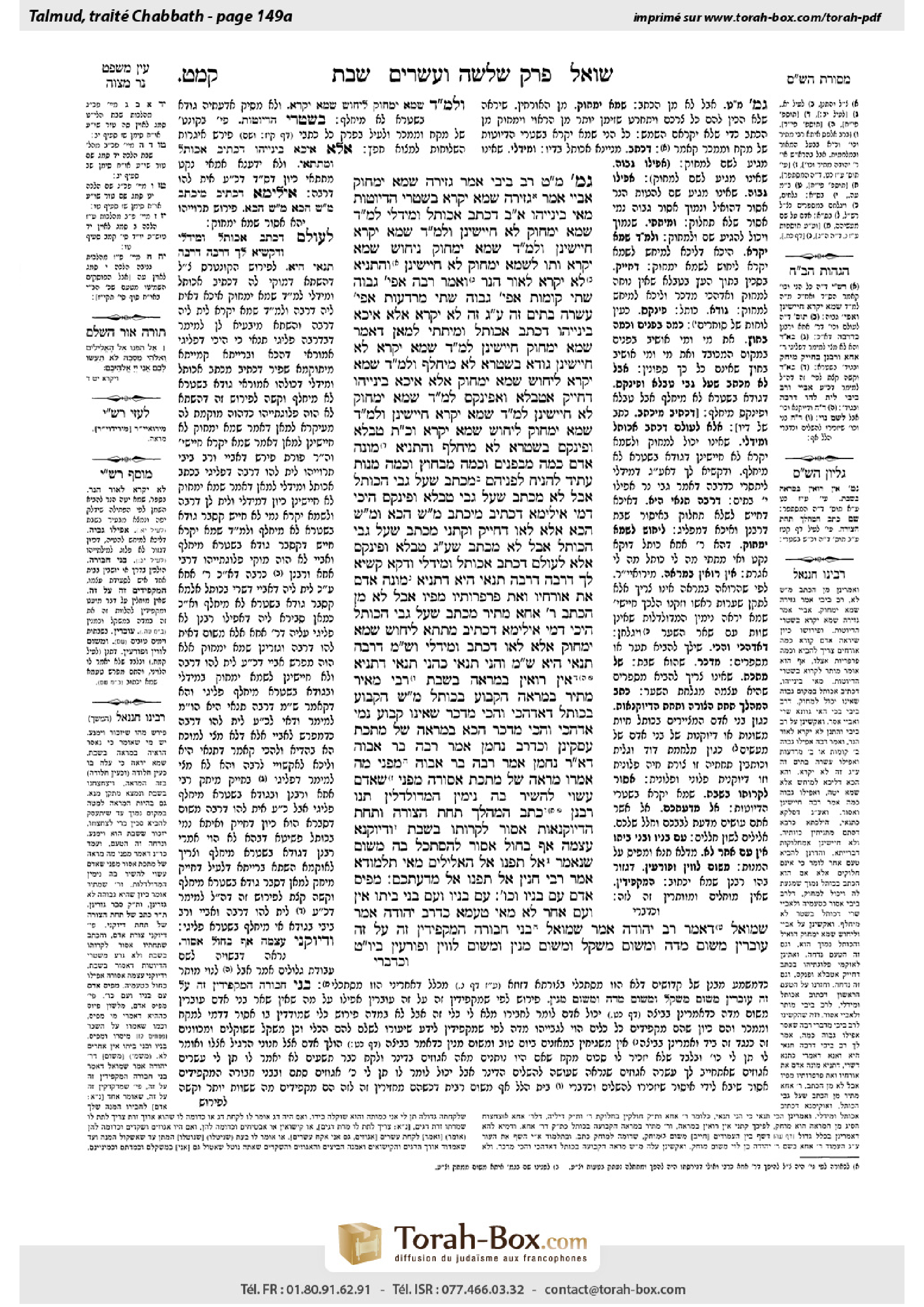
Shabbat 149a: Talmud study for Daf Yomi
Daf Yomi is the daily study of one Talmud folio. Explore 37 tractates with scans, Hebrew text, Sefaria English and AI-generated French translations where annotated.
Passage selection and English or AI-generated French translation are available where the scan has annotations. Daf Study is independent of Torah-Box and Sefaria.
Browse Shabbat · שבת · All tractatesShabbat 149a text and translations
This page of Shabbat includes the Aramaic text, an English translation and an AI-generated French translation, alongside the scan above.
שבת קמ״ט א · Aramaic and Hebrew text
גְּמָ׳ מַאי טַעְמָא? רַב בִּיבִי אָמַר: גְּזֵירָה שֶׁמָּא יִמְחוֹק. אַבָּיֵי אָמַר: גְּזֵירָה שֶׁמָּא יִקְרָא בְּשִׁטְרֵי הֶדְיוֹטוֹת.
מַאי בֵּינַיְיהוּ? אִיכָּא בֵּינַיְיהוּ דִּכְתִיב אַכּוֹתֶל וּמִידְּלֵי: לְמַאן דְּאָמַר שֶׁמָּא יִמְחוֹק — לָא חָיְישִׁינַן, וּלְמַאן דְּאָמַר שֶׁמָּא יִקְרָא — חָיְישִׁינַן.
וּלְמַאן דְּאָמַר שֶׁמָּא יִמְחוֹק, נֵיחוּשׁ שֶׁמָּא יִקְרָא! וְתוּ, לְשֶׁמָּא יִמְחוֹק לָא חָיְישִׁינַן? וְהָתַנְיָא: לֹא יִקְרָא לְאוֹר הַנֵּר. וְאָמַר רַבָּה: אֲפִילּוּ גָּבוֹהַּ שְׁתֵּי קוֹמוֹת, אֲפִילּוּ גָּבוֹהַּ שְׁתֵּי מַרְדְּעוֹת, אֲפִילּוּ עֲשָׂרָה בָּתִּים זֶה עַל גַּבֵּי — זֶה לֹא יִקְרָא.
אֶלָּא, אִיכָּא בֵּינַיְיהוּ דִּכְתִיב אַכּוֹתֶל וּמִיתַּתֵּי: לְמַאן דְּאָמַר שֶׁמָּא יִמְחוֹק — חָיְישִׁינַן, לְמַאן דְּאָמַר שֶׁמָּא יִקְרָא — לָא חָיְישִׁינַן, גּוּדָּא בִּשְׁטָרָא לָא מִיחַלַּף.
וּלְמַאן דְּאָמַר שֶׁמָּא יִקְרָא, לֵיחוּשׁ שֶׁמָּא יִמְחוֹק! אֶלָּא, אִיכָּא בֵּינַיְיהוּ דַּחֲיִיק אַטַּבְלָא וְאַפִּינְקָס: לְמַאן דְּאָמַר שֶׁמָּא יִמְחוֹק — לָא חָיְישִׁינַן, לְמַאן דְּאָמַר שֶׁמָּא יִקְרָא — חָיְישִׁינַן.
וּלְמַאן דְּאָמַר שֶׁמָּא יִמְחוֹק, לֵיחוּשׁ שֶׁמָּא יִקְרָא! וְכִי תֵּימָא: טַבְלָא וּפִינְקָס בִּשְׁטָרָא לָא מִיחַלַּף — וְהָתַנְיָא: מוֹנֶה אָדָם כַּמָּה מִבִּפְנִים וְכַמָּה מִבַּחוּץ וְכַמָּה מָנוֹת עָתִיד לְהַנִּיחַ לִפְנֵיהֶם מִכְּתָב שֶׁעַל גַּבֵּי הַכּוֹתֶל, אֲבָל לֹא מִכְּתָב שֶׁעַל גַּבֵּי טַבְלָא וּפִינְקָס!
הֵיכִי דָּמֵי? אִילֵּימָא דִּכְתִיב מִיכְתָּב — מַאי שְׁנָא הָכָא וּמַאי שְׁנָא הָכָא. אֶלָּא לָאו דַּחֲיִיק, וְקָתָנֵי: מִכְּתָב שֶׁעַל גַּבֵּי הַכּוֹתֶל אֲבָל לֹא מִכְּתָב שֶׁעַל גַּבֵּי טַבְלָא וּפִינְקָס!
אֶלָּא: לְעוֹלָם דִּכְתִיב אַכּוֹתֶל וּמִידְּלֵי, וּדְקָא קַשְׁיָא לָךְ דְּרַבָּה — דְּרַבָּה תַּנָּאֵי הִיא. דְּתַנְיָא: מוֹנֶה אָדָם אֶת אוֹרְחָיו וְאֶת פַּרְפְּרוֹתָיו מִפִּיו, אֲבָל לֹא מִן הַכְּתָב. רַבִּי אַחָא מַתִּיר מִכְּתָב שֶׁעַל גַּבֵּי הַכּוֹתֶל.
הֵיכִי דָמֵי? אִילֵּימָא דִּכְתִיב וּמִתַּתַּאי — לִיחוּשׁ שֶׁמָּא יִמְחוֹק! אֶלָּא לָאו דִּכְתִיב וּמִידְּלֵי, וּשְׁמַע מִינַּהּ דְּרַבָּה תַּנָּאֵי הִיא. שְׁמַע מִינַּהּ.
וְהָנֵי תַנָּאֵי כְּהָנֵי תַנָּאֵי. דְּתַנְיָא: אֵין רוֹאִין בְּמַרְאָה בְּשַׁבָּת. רַבִּי מֵאִיר מַתִּיר בְּמַרְאָה הַקְּבוּעָה בַּכּוֹתֶל.
מַאי שְׁנָא הַקְּבוּעָה בַּכּוֹתֶל — דְּאַדְּהָכִי וְהָכִי מִדְּכַר, שֶׁאֵינוֹ קָבוּעַ נָמֵי: אַדְּהָכִי וְהָכִי מִדְּכַר!
הָכָא בְּמַרְאָה שֶׁל מַתֶּכֶת עָסְקִינַן, וְכִדְרַב נַחְמָן אָמַר רַבָּה בַּר אֲבוּהּ. דְּאָמַר רַב נַחְמָן אָמַר רַבָּה בַּר אֲבוּהּ: מִפְּנֵי מָה אָמְרוּ מַרְאָה שֶׁל מַתֶּכֶת אֲסוּרָה — מִפְּנֵי שֶׁאָדָם עָשׂוּי לְהַשִּׁיר בָּהּ נִימִין הַמְדוּלְדָּלִין.
תָּנוּ רַבָּנַן: כְּתָב הַמְהַלֵּךְ תַּחַת הַצּוּרָה וְתַחַת הַדְּיוֹקְנָאוֹת — אָסוּר לִקְרוֹתוֹ בְּשַׁבָּת. וּדְיוֹקְנָא עַצְמָהּ — אַף בַּחוֹל אָסוּר לְהִסְתַּכֵּל בָּהּ, מִשּׁוּם שֶׁנֶּאֱמַר ״אַל תִּפְנוּ אֶל הָאֱלִילִים״. מַאי תַּלְמוּדָא? אָמַר רַבִּי חָנִין: אַל תְּפַנּוּ אֵל מִדַּעְתְּכֶם.
מֵפִיס אָדָם עִם בָּנָיו וְכוּ׳. עִם בָּנָיו וְעִם בְּנֵי בֵיתוֹ אִין, וְעִם אַחֵר — לָא. מַאי טַעְמָא? כִּדְרַב יְהוּדָה אָמַר שְׁמוּאֵל. דְּאָמַר רַב יְהוּדָה אָמַר שְׁמוּאֵל: בְּנֵי חֲבוּרָה הַמַּקְפִּידִין זֶה עַל זֶה — עוֹבְרִין מִשּׁוּם מִדָּה וּמִשּׁוּם מִשְׁקָל וּמִשּׁוּם מִנְיָן, וּמִשּׁוּם לוֹוִין וּפוֹרְעִין בְּיוֹם טוֹב,
Shabbat 149a · English translation
GEMARA: We learned in the mishna that one may not read the names of his guests or the appetizers served in his meal from a written list. The Gemara asks: What is the reason for this prohibition? Rav Beivai said: It is a decree lest one erase something that is written on the list if he regrets inviting a particular guest or changes his mind about a particular dish. Abaye said: It is a decree lest one read regular business documents.
The Gemara asks: What is the practical difference between them? The Gemara answers: There is a difference between them in a case in which the writing is on a wall and it is raised higher than a person can reach. According to the one who says that the decree was made lest one erase something from the list, in a case such as this we are not concerned about erasure because one cannot even reach the writing. But according to the one who says that the decree was made lest one read business documents, we are still concerned in this case.
The Gemara asks: And according to the one who says that the decree was made lest one erase, we should also be concerned lest one read business documents. And furthermore, are we really not concerned lest one erase when the writing is high up? But wasn’t it taught in a baraita that one may not read by the light of a lamp on Shabbat lest one adjust the lamp toward oneself; and Rabba said: Even if the lamp was two statures of a person high, and even as high as two plow handles, and even if it was as high as ten houses one atop the other, one may not read by its light. This clearly demonstrates that when we are concerned that one may violate halakha, we do not distinguish between situations in which such a violation is more or less likely.
Rather, there is a difference between them in a case in which the writing is on a wall and it is low down. According to the one who says that the reason for the decree is lest one erase, in a case such as this we are concerned because one can easily reach the writing and erase it. However, according to the one who says that the decree was made lest one read business documents, we are not concerned because a wall will not be confused with a document, and reading from the wall will not cause one to then read business documents.
The Gemara asks further: And according to the one who says that the concern is lest one read, we should also be concerned lest one erase. Rather, there is a practical difference between them in a case where the writing is engraved on a tablet or on a board. According to the one who says that the concern is lest one erase, in a case such as this we are not concerned. Since the writing is not in ink, there is no concern that he will erase it. According to the one who says that the concern is lest one read business documents, we are concerned. The style of writing is irrelevant in terms of the likelihood that one will end up reading business documents.
The Gemara asks further: According to the one who says that the concern is lest one erase, we should also be concerned lest one read business documents. And if you say: A tablet or a board will not be confused with a document, but wasn’t it taught explicitly in a baraita: One may count how many guests will sit inside, and how many guests will sit outside, and how many portions he will place before them from writing that is on the wall, but not from writing that is on a tablet or a board?
The Gemara attempts to clarify this: What are the circumstances of the case described in this statement? If you say that it was written in ink, what is the difference here, when the writing is on a wall, and what is the difference here, when the writing is on a tablet? Rather, is it not a case of a list that has been engraved, and nonetheless it teaches that one may read from writing that is on the wall but not from writing that is on a tablet or a board?
Rather, we should actually explain that the writing was on a wall and was raised. And with regard to what was difficult for you, based on Rabba’s statement that prohibited reading by candlelight on Shabbat regardless of the height of the candle, which presumably means that in our case, too, we should be stringent regardless of the height of the writing, that statement of Rabba is the subject of dispute between tanna’im, as it was taught in a baraita: One may count one’s guests and one’s appetizers from memory, but not from a written list. Rabbi Aḥa permits reading from a written list that is on a wall.
The Gemara attempts to clarify this: What are the circumstances in which Rabbi Aḥa permits this? If you say that it is written below, low down on the wall, we should be concerned that perhaps one will erase it. Rather, is it not referring to a case in which it is written and the location of the writing is raised such that it is high up on the wall, and conclude from this that the statement of Rabba is the subject of dispute among the tanna’im? The Gemara concludes: Indeed, conclude from this that it is so.
The Gemara comments that in this matter, these tanna’im are like those tanna’im, who also argued over the same principle, as it was taught in a baraita: One may not look in a mirror on Shabbat lest one see a hair hanging and pluck it. Rabbi Meir permits looking in a mirror that is fixed on a wall.
The Gemara questions Rabbi Meir’s leniency: What is different about a mirror that is fixed on a wall? In that situation we say that, in the meantime, while one goes to bring scissors or another appliance to cut one’s hair, one will remember that it is Shabbat and that it is prohibited to cut hair. If so, with regard to a mirror that is not fixed on a wall, we can also say that in the meantime one will remember.
Rather, here we are dealing with a metal mirror, and it is as Rav Naḥman said that Rabba bar Avuh said, for Rav Naḥman said that Rabba bar Avuh said: For what reason did the Sages say that a metal mirror is prohibited for use on Shabbat? Because a person may remove hanging hairs with it, meaning that one may use the sharp edge of the mirror itself to cut the hairs. If the mirror is permanently set on the wall, we are not concerned that one will do this. This is similar to the view that one may read writing that is high up on a wall because it is impractical to erase the writing.
The Sages taught in a baraita: With regard to writing that is under a picture or under graven images [deyokenaot], it is prohibited to read it on Shabbat lest one end up reading business documents. And with regard to an idolatrous image itself, even on a weekday it is prohibited to look at it, because it says: “Do not turn toward idols [al tifnu el ha’elilim] or make yourselves molten gods, I am the Lord your God” (Leviticus 19:4). The Gemara asks for clarification: What is the biblical derivation? How does this verse indicate that one may not look at an idolatrous image? Rabbi Ḥanin said: Do not push God [al tefannu El] out of your mind by looking at these images (Arukh).
We learned in the mishna that a person may draw lots with one’s children and family members at the table on Shabbat to see who will receive which meal portion. The Gemara infers: With one’s children and family members, yes, it is permitted, but with another person it is not. What is the reason for this? The Gemara explains that it is as Rav Yehuda said that Shmuel said, for Rav Yehuda said that Shmuel said: Members of a group who are eating together on Shabbat or on a Festival and who are particular with each other that no one receive a larger portion than anyone else are in violation of the prohibitions of measuring, and weighing, and counting merchandise on Shabbat or a Festival, and they are also in violation of the prohibition against lending and repaying on a Festival.
Shabbat 149a · Traduction française (IA)
GUEMARA : Nous avons appris dans la Michna qu’il est interdit de lire sur une liste écrite les noms de ses invités ou ceux des hors-d’œuvre servis au repas. La Guemara demande : Quelle est la raison de cette interdiction ? Rav Beivaï dit : C’est un décret, de crainte que l’on n’efface un élément inscrit sur la liste si l’on regrette d’avoir invité un convive en particulier ou si l’on change d’avis au sujet d’un plat en particulier. Abayé dit : C’est un décret, de crainte que l’on ne lise des documents commerciaux ordinaires.
La Guemara demande : Quelle est la différence pratique entre eux ? La Guemara répond : La différence se présente dans le cas où l’inscription se trouve sur un mur, à une hauteur qu’une personne ne peut atteindre. Selon celui qui dit que le décret a été institué de crainte que l’on n’efface un élément de la liste, dans un tel cas, nous ne craignons pas que l’on efface l’inscription, puisqu’on ne peut même pas l’atteindre. Mais selon celui qui dit que le décret a été institué de crainte que l’on ne lise des documents commerciaux, nous le craignons même dans ce cas.
La Guemara demande : Et selon celui qui dit que le décret a été institué de crainte que l’on n’efface, ne devrait-on pas également craindre que l’on ne lise des documents commerciaux ? Et, de plus, ne craigne-t-on vraiment pas que l’on efface lorsque l’inscription est placée en hauteur ? N’a-t-il pas été enseigné dans une baraïta qu’il est interdit de lire à la lumière d’une lampe pendant Chabbat, de crainte que l’on ne rapproche la lampe de soi pour l’ajuster ? Et Rabba a dit : Même si la lampe était placée à deux fois la hauteur d’un homme, voire à la hauteur de deux manches de charrue, et même à la hauteur de dix maisons empilées les unes sur les autres, il est interdit de lire à sa lumière. Cela montre clairement que, lorsqu’on craint qu’une personne ne transgresse la halakha, on ne distingue pas les situations où cette transgression est plus ou moins probable.
Il faut plutôt dire que la différence se présente dans le cas où l’inscription se trouve en bas d’un mur. Selon celui qui dit que le décret a été institué de crainte que l’on n’efface, dans un tel cas, nous le craignons, car on peut facilement atteindre l’inscription et l’effacer. En revanche, selon celui qui dit que le décret a été institué de crainte que l’on ne lise des documents commerciaux, nous ne le craignons pas, car un mur ne peut pas être confondu avec un document et le fait de lire sur le mur ne conduira pas ensuite à lire des documents commerciaux.
La Guemara demande encore : Et selon celui qui dit que l’on craint que l’on ne lise, ne devrait-on pas également craindre que l’on n’efface ? Il y a plutôt entre eux une différence pratique dans le cas où l’inscription est gravée sur une tablette ou une planche. Selon celui qui dit que l’on craint que l’on n’efface, dans un tel cas, nous ne le craignons pas. Puisque l’inscription n’est pas à l’encre, on ne craint pas qu’on l’efface. Selon celui qui dit que l’on craint que l’on ne lise des documents commerciaux, nous le craignons. Le style d’écriture n’a aucune incidence sur le risque que l’on finisse par lire des documents commerciaux.
La Guemara demande encore : Selon celui qui dit que l’on craint que l’on n’efface, ne devrait-on pas également craindre que l’on ne lise des documents commerciaux ? Et si tu dis qu’une tablette ou une planche ne peut pas être confondue avec un document, n’a-t-il pas été explicitement enseigné dans une baraïta : On peut compter combien d’invités s’assiéront à l’intérieur et combien s’assiéront à l’extérieur, ainsi que combien de portions on placera devant eux, à partir d’une inscription sur un mur, mais pas à partir d’une inscription sur une tablette ou une planche ?
La Guemara cherche à préciser : Dans quelles circonstances se présente le cas décrit ici ? Si tu dis que l’inscription a été écrite à l’encre, quelle différence y a-t-il entre le cas où elle se trouve sur un mur et celui où elle se trouve sur une tablette ? Il s’agit donc, n’est-ce pas, d’une liste gravée ; pourtant, l’enseignement dit qu’on peut lire une inscription sur un mur, mais pas une inscription sur une tablette ou une planche.
Il faut plutôt expliquer que l’inscription se trouve sur un mur et qu’elle est placée en hauteur. Quant à la difficulté que tu soulevais à partir de la déclaration de Rabba — qui interdit de lire à la lumière d’une lampe pendant Chabbat quelle que soit la hauteur de celle-ci —, supposant que, dans notre cas aussi, il faille être strict quelle que soit la hauteur de l’inscription, la déclaration de Rabba fait l’objet d’un désaccord entre des tannaïm. En effet, il a été enseigné dans une baraïta : On peut compter ses invités et ses hors-d’œuvre de mémoire, mais pas à partir d’une liste écrite. Rabbi Aḥa permet de lire une liste écrite qui se trouve sur un mur.
La Guemara cherche à préciser : Dans quelles circonstances Rabbi Aḥa le permet-il ? Si tu dis que l’inscription se trouve en bas, sur la partie inférieure du mur, ne devrait-on pas craindre que l’on ne l’efface ? Il s’agit donc, n’est-ce pas, d’un cas où l’inscription est placée en hauteur, tout en haut du mur. On peut donc en conclure que la déclaration de Rabba fait l’objet d’un désaccord entre les tannaïm. La Guemara conclut : En effet, on peut en conclure ainsi.
La Guemara fait remarquer que, sur ce point, ces tannaïm sont semblables à ces autres tannaïm, qui se sont également disputés sur le même principe. En effet, il a été enseigné dans une baraïta : Il est interdit de se regarder dans un miroir pendant Chabbat, de crainte d’apercevoir un poil qui dépasse et de l’arracher. Rabbi Meïr permet de se regarder dans un miroir fixé au mur.
La Guemara met en question la permission de Rabbi Meïr : Qu’est-ce qui distingue un miroir fixé au mur ? Dans ce cas, on dit qu’entre-temps, tandis que la personne va chercher des ciseaux ou un autre ustensile pour couper ses cheveux, elle se souviendra que c’est Chabbat et qu’il est interdit de se couper les cheveux. Si tel est le cas, concernant un miroir qui n’est pas fixé au mur, ne peut-on pas également dire qu’entre-temps elle s’en souviendra ?
Il s’agit plutôt ici d’un miroir en métal, et c’est comme l’a dit Rav Naḥman au nom de Rabba bar Avouha. Car Rav Naḥman a dit au nom de Rabba bar Avouha : Pour quelle raison les Sages ont-ils dit qu’il est interdit d’utiliser un miroir en métal pendant Chabbat ? Parce qu’une personne peut s’en servir pour enlever les poils qui dépassent, c’est-à-dire qu’elle peut utiliser le bord tranchant du miroir lui-même pour couper les poils. Si le miroir est fixé de façon permanente au mur, nous ne craignons pas qu’elle le fasse. Cela est semblable à l’opinion selon laquelle on peut lire une inscription placée en hauteur sur un mur, car il est impraticable de l’effacer.
Les Sages ont enseigné dans une baraïta : Il est interdit de lire pendant Chabbat une inscription qui se trouve sous une image ou sous des images gravées [deyokenaot], de crainte que l’on ne finisse par lire des documents commerciaux. Quant à une image idolâtre elle-même, il est interdit de la regarder même en semaine, car il est dit : « Ne vous tournez pas vers les idoles [al tifnu el ha’elilim] et ne vous faites pas de dieux en métal fondu ; Je suis l’Éternel votre Dieu » (Lévitique 19:4). La Guemara demande des précisions : Quelle est la déduction tirée du verset ? Comment ce verset indique-t-il qu’il est interdit de regarder une image idolâtre ? Rabbi Ḥanin dit : Ne repoussez pas Dieu [al tefannu El] de votre esprit en regardant ces images (Arukh).
Nous avons appris dans la Michna qu’une personne peut tirer au sort avec ses enfants et les membres de sa famille à table pendant Chabbat, afin de déterminer qui recevra quelle portion du repas. La Guemara en déduit : Avec ses enfants et les membres de sa famille, oui, c’est permis, mais pas avec une autre personne. Pour quelle raison ? La Guemara explique que c’est comme l’a dit Rav Yehouda au nom de Shmouel. Car Rav Yehouda a dit au nom de Shmouel : Les membres d’un groupe qui mangent ensemble pendant Chabbat ou un jour de fête et qui tiennent à ce que personne ne reçoive une portion plus grande qu’un autre transgressent les interdictions de mesurer, de peser et de compter des marchandises pendant Chabbat ou un jour de fête ; ils transgressent aussi l’interdiction de prêter et de rembourser un prêt un jour de fête.
Traduction française générée par IA à partir de l’édition anglaise de Sefaria. Vérifie toujours un passage avec le texte source.
Text from Sefaria: William Davidson Edition - Vocalized Aramaic (CC BY NC); William Davidson Edition - English (CC BY NC).