Shabbat 149b: Talmud study for Daf Yomi
Daf Yomi is the daily study of one Talmud folio. Explore 37 tractates with scans, Hebrew text, Sefaria English and AI-generated French translations where annotated.
Passage selection and English or AI-generated French translation are available where the scan has annotations. Daf Study is independent of Torah-Box and Sefaria.
Browse Shabbat · שבת · All tractatesShabbat 149b text and translations
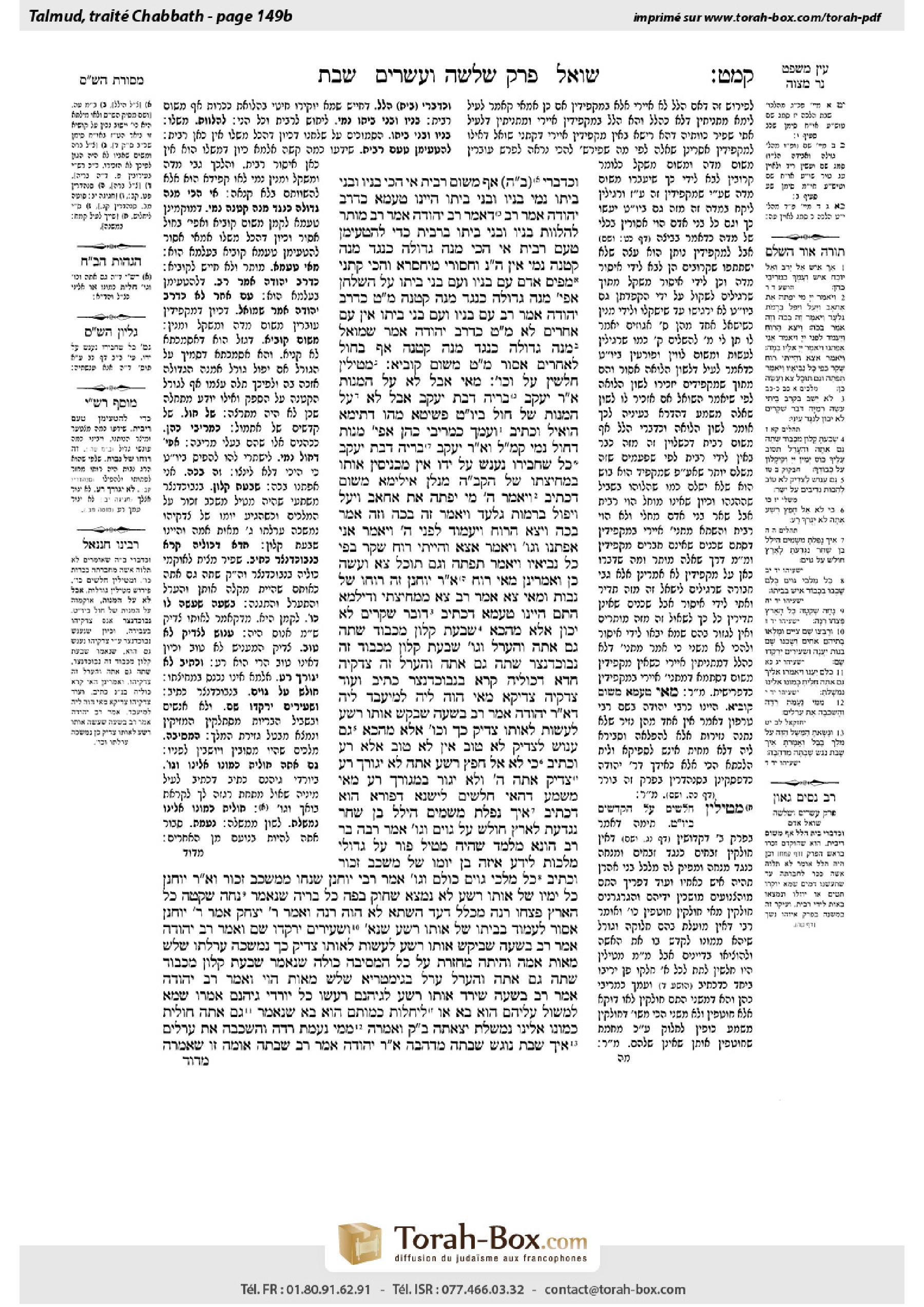
This page of Shabbat includes the Aramaic text, an English translation and an AI-generated French translation, alongside the scan above.
שבת קמ״ט ב · Aramaic and Hebrew text
וּכְדִבְרֵי בֵּית הִלֵּל אַף מִשּׁוּם רִבִּית.
אִי הָכִי בָּנָיו וּבְנֵי בֵּיתוֹ נָמֵי! בָּנָיו וּבְנֵי בֵּיתוֹ הַיְינוּ טַעְמָא — כִּדְרַב יְהוּדָה אָמַר רַב. דְּאָמַר רַב יְהוּדָה אָמַר רַב: מוּתָּר לְהַלְווֹת בָּנָיו וּבְנֵי בֵיתוֹ בְּרִבִּית כְּדֵי לְהַטְעִימָן טַעַם רִבִּית.
אִי הָכִי, מָנָה גְּדוֹלָה כְּנֶגֶד מָנָה קְטַנָּה נָמֵי!
אִין הָכִי נָמֵי, וְחַסּוֹרֵי מִיחַסְּרָא וְהָכִי קָתָנֵי: מֵפִיס אָדָם עִם בָּנָיו וְעִם בְּנֵי בֵיתוֹ עַל הַשֻּׁלְחָן אֲפִילּוּ מָנָה גְּדוֹלָה כְּנֶגֶד מָנָה קְטַנָּה. מַאי טַעְמָא? — כִּדְרַב יְהוּדָה אָמַר רַב. עִם בָּנָיו וְעִם בְּנֵי בֵּיתוֹ — אִין, עִם אֲחֵרִים — לָא. מַאי טַעְמָא? כִּדְרַב יְהוּדָה אָמַר שְׁמוּאֵל. מָנָה גְּדוֹלָה כְּנֶגֶד מָנָה קְטַנָּה — אַף בַּחוֹל לַאֲחֵרִים אָסוּר. מַאי טַעְמָא? — מִשּׁוּם קוּבְיָא.
מְטִילִין חֲלָשִׁין עַל וְכוּ׳. מַאי ״אֲבָל לֹא עַל הַמָּנוֹת״? אָמַר רַבִּי יַעֲקֹב בְּרֵיהּ דְּבַת יַעֲקֹב: אֲבָל לֹא עַל הַמָּנוֹת שֶׁל חוֹל בְּיוֹם טוֹב. פְּשִׁיטָא! מַהוּ דְתֵימָא: הוֹאִיל וּכְתִיב ״וְעַמְּךָ כִּמְרִיבֵי כֹּהֵן״, אֲפִילּוּ מָנוֹת דְּחוֹל נָמֵי. קָא מַשְׁמַע לַן.
וְאָמַר רַבִּי יַעֲקֹב בְּרֵיהּ דְּבַת יַעֲקֹב: כָּל שֶׁחֲבֵירוֹ נֶעֱנָשׁ עַל יָדוֹ — אֵין מַכְנִיסִין אוֹתוֹ בִּמְחִיצָתוֹ שֶׁל הַקָּדוֹשׁ בָּרוּךְ הוּא. מְנָלַן? אִילֵּימָא מִשּׁוּם דִּכְתִיב: ״וַיֹּאמֶר ה׳ מִי יְפַתֶּה אֶת אַחְאָב וְיַעַל וְיִפּוֹל בְּרָמוֹת גִּלְעָד וַיֹּאמֶר זֶה בְּכֹה וְזֶה אֹמֵר בְּכֹה. וַיֵּצֵא הָרוּחַ וַיַּעֲמוֹד לִפְנֵי ה׳ וַיֹּאמֶר אֲנִי אֲפַתֶּנּוּ וְגוֹ׳ וַיֹּאמֶר אֵצֵא וְהָיִיתִי רוּחַ שֶׁקֶר בְּפִי כׇּל נְבִיאָיו וַיֹּאמֶר תְּפַתֶּה וְגַם תּוּכָל צֵא וַעֲשֵׂה כֵן״,
וְאָמְרִינַן: מַאי ״רוּחַ״, אָמַר רַבִּי יוֹחָנָן: זֶה רוּחוֹ שֶׁל נָבוֹת. וּמַאי ״צֵא״ אָמַר רַב: צֵא מִמְּחִיצָתִי. וְדִילְמָא הָתָם הַיְינוּ טַעְמָא, דִּכְתִיב ״דּוֹבֵר שְׁקָרִים לֹא יִכּוֹן״?!
אֶלָּא מֵהָכָא: ״שָׂבַעְתָּ קָלוֹן מִכָּבוֹד שְׁתֵה גַם אַתָּה וְהֵעָרֵל וְגוֹ׳״. ״שָׂבַעְתָּ קָלוֹן מִכָּבוֹד״ — זֶה נְבוּכַדְנֶצַּר. ״שְׁתֵה גַם אַתָּה וְהֵעָרֵל״ — זֶה צִדְקִיָּה. חֲדָא, דְּכוּלֵּיהּ קְרָא בִּנְבוּכַדְנֶצַּר כְּתִיב. וְעוֹד: צִדְקִיָּה צַדִּיקָא מַאי הֲוָה לֵיהּ לְמִיעְבַּד לֵיהּ, דְּאָמַר רַבִּי יְהוּדָה אָמַר רַב: בְּשָׁעָה שֶׁבִּקֵּשׁ אוֹתוֹ רָשָׁע לַעֲשׂוֹת לְאוֹתוֹ צַדִּיק כָּךְ וְכוּ׳.
אֶלָּא מֵהָכָא: ״גַּם עֲנוֹשׁ לַצַּדִּיק לֹא טוֹב״, אֵין ״לֹא טוֹב״ אֶלָּא רָע, וּכְתִיב: ״כִּי לֹא אֵל חָפֵץ רֶשַׁע אָתָּה לֹא יְגוּרְךָ רָע״ — צַדִּיק אַתָּה ה׳ וְלֹא יָגוּר בִּמְגוּרְךָ רָע.
מַאי מַשְׁמַע דְּהַאי ״חֲלָשִׁים״ לִישָּׁנָא דְפוּרָא הוּא? — דִּכְתִיב: ״אֵיךְ נָפַלְתָּ מִשָּׁמַיִם הֵילֵל בֶּן שָׁחַר נִגְדַּעְתָּ לָאָרֶץ חוֹלֵשׁ עַל גּוֹיִם וְגוֹ׳״, אָמַר רַבָּה בַּר רַב הוּנָא: מְלַמֵּד שֶׁהָיָה מֵטִיל פּוּר עַל גְּדוֹלֵי מַלְכוּת לֵידַע אֵיזֶה בֶּן יוֹמוֹ שֶׁל מִשְׁכַּב זָכוּר. וּכְתִיב: ״כׇּל מַלְכֵי גוֹיִם כּוּלָּם וְגוֹ׳״, אָמַר רַבִּי יוֹחָנָן: שֶׁנָּחוּ מִמִּשְׁכַּב זָכוּר.
וְאָמַר רַבִּי יוֹחָנָן: כׇּל יָמָיו שֶׁל אוֹתוֹ רָשָׁע לֹא נִמְצָא שְׂחוֹק בְּפִי כׇּל בְּרִיָּה, שֶׁנֶּאֱמַר: ״נָחָה שָׁקְטָה כׇּל הָאָרֶץ פָּצְחוּ רִנָּה״, מִכְּלָל דְּעַד הַשְׁתָּא לָא הֲוָה רִנָּה.
וְאָמַר רַבִּי יִצְחָק אָמַר רַבִּי יוֹחָנָן: אָסוּר לַעֲמוֹד בְּבֵיתוֹ שֶׁל אוֹתוֹ רָשָׁע, שֶׁנֶּאֱמַר: ״וּשְׂעִירִים יְרַקְּדוּ שָׁם״.
וְאָמַר רַב יְהוּדָה אָמַר רַב: בְּשָׁעָה שֶׁבִּיקֵּשׁ אוֹתוֹ רָשָׁע, לַעֲשׂוֹת לְאוֹתוֹ צַדִּיק כָּךְ, נִמְשְׁכָה עׇרְלָתוֹ שְׁלֹשׁ מֵאוֹת אַמָּה, וְהָיְתָה מְחַזֶּרֶת עַל כׇּל הַמְּסִיבָּה כּוּלָּהּ. שֶׁנֶּאֱמַר: ״שָׂבַעְתָּ קָלוֹן מִכָּבוֹד שְׁתֵה גַם אַתָּה וְהֵעָרֵל״, עָרֵל בְּגִימַטְרִיָּא שְׁלֹשׁ מֵאוֹת הָוֵי.
וְאָמַר רַב יְהוּדָה אָמַר רַב: בְּשָׁעָה שֶׁיָּרַד אוֹתוֹ רָשָׁע לְגֵיהִנָּם רָעֲשׁוּ כׇּל יוֹרְדֵי גֵיהִנָּם, אָמְרוּ: שֶׁמָּא לִמְשׁוֹל עֲלֵיהֶם הוּא בָּא, אוֹ לֵיחָלוֹת כְּמוֹתָם הוּא בָּא? שֶׁנֶּאֱמַר: ״גַּם אַתָּה חוּלֵּיתָ כָמוֹנוּ אֵלֵינוּ נִמְשָׁלְתָּ״, יָצְתָה בַּת קוֹל וְאָמְרָה: ״מִמִּי נָעָמְתָּ רְדָה וְהׇשְׁכְּבָה אֶת עֲרֵלִים״.
״אֵיךְ שָׁבַת נוֹגֵשׂ שָׁבְתָה מַדְהֵבָה״, אָמַר רַבִּי יְהוּדָה אָמַר רַב: שָׁבְתָה אוּמָּה זוֹ שֶׁאָמְרָה
Shabbat 149b · English translation
And according to Beit Hillel, they even violate the prohibition of interest. In Beit Hillel’s view, it is prohibited to loan or return objects without determining their monetary value, lest the object rise in value and the borrower end up returning an item that is more expensive than the one he borrowed.
The Gemara asks: If this is so, and one violates so many prohibitions when drawing lots, it should be prohibited to do so with one’s children and family members also. The Gemara answers: With regard to one’s children and family members, this is the reason that it is permitted: It is like the ruling that Rav Yehuda said that Rav said, for Rav Yehuda said that Rav said: It is permitted to loan to one’s children and family members with interest, in order to let them experience a taste of how difficult it is to repay a loan taken with interest. Also, in the case of family members, all the money, including the money used to repay the loan, belongs to the same person. Therefore, there is no real prohibition of interest.
The Gemara asks: If this is so, and everything in this case actually belongs to the father, and he uses a lottery system in order to educate his family, it should be permitted to cast lots for a big portion against a small portion also.
The Gemara answers: Yes, it is indeed so, and the mishna is incomplete and it teaches the following: A person may draw lots with his children and his family members at the table, and he may even do so with a large portion against a small portion. What is the reason for this? It is in accordance with the ruling that Rav Yehuda said that Rav said. Although with one’s children and family members, yes, this is permitted, with others it is not. What is the reason for this? It is in accordance with the ruling that Rav Yehuda said that Shmuel said: Raffling a large portion against a small portion is prohibited to do for other people, even on a weekday. What is the reason? Due to the prohibition against gambling with dice, which is prohibited by rabbinic law as a form of theft.
The mishna taught that one may draw lots for the sacrifices but not for the specific portions. This statement is not entirely clear, and the Gemara asks: What is the meaning of the phrase: But not for the specific portions? Rabbi Ya’akov, son of the daughter of Ya’akov, said that it means: But one may not draw lots for the weekday [ḥol] portions on a Festival. The Gemara challenges: This is obvious. The Gemara answers: Lest you say that since the priests are naturally quarrelsome, which the Sages derive from that which is written: “Yet let no man strive, neither let any man reprove, for your people are like those that strive with the priest” (Hosea 4:4), and in order to maintain peace between them even lotteries for weekday portions were also permitted, therefore, the mishna teaches us that this is not the case.
Having quoted Rabbi Ya’akov, son of the daughter of Ya’akov, the Gemara brings another teaching of this amora. And Rabbi Ya’akov, son of the daughter of Ya’akov, said: Anyone who causes another to be punished on his account, they do not bring him within the partition of the Holy One, Blessed be He, even if he is right. The Gemara asks: From where do we know this? If you say it is because of what is written in the prophecy of Micaiah, that proof can be disputed. It is written: “And the Lord said: Who will entice Ahab to go up and fall at Ramot Gilad? And one said: In this manner, and another said: In that manner. And the spirit came out and stood before the Lord and said: I will entice him. And the Lord said to it: With what? And it said: I will go out and will be a lying spirit in the mouth of all of his prophets. And He said: You shall entice him and will prevail. Go out and do this” (I Kings 22:20–22).
And we said: What is this spirit? Rabbi Yoḥanan said: This is the spirit of Naboth the Jezreelite, who asked to avenge his death at the hands of Ahab. And what is the meaning of the words: Go out, which God commanded him? Rav said: It means that he was given permission to entice Ahab, but God said: Leave from within My partition. Therefore, it seems that the spirit of Naboth was told to leave God’s area because it caused Ahab to be punished. The Gemara rejects this proof: But perhaps there, the reason is as it is written: “One who speaks lies shall not dwell before My eyes” (Psalms 101:7), and this is the only reason that the spirit of Naboth was removed from within God’s partition.
Rather, it is derived from here: “You are filled with shame instead of honor. Drink, you, and be like one who is uncircumcised, the cup of the Lord’s right hand will turn to you and filthiness shall be upon your glory” (Habakkuk 2:16). The verse is expounded: “You are filled with shame instead of honor”; this is referring to Nebuchadnezzar. “Drink, you, and be like one who is uncircumcised”; this is referring to Zedekiah, who was also punished for being the cause of Nebuchadnezzar’s punishment, as will be explained. The Gemara rejects this proof: One objection to this is that the entire verse is written about Nebuchadnezzar. And furthermore, with regard to Zedekiah, the righteous one, what could he have done to him? For Rav Yehuda said that Rav said about this matter: When that wicked man wanted to do this to that righteous man, his foreskin was stretched, as will be explained.
Rather, the basis for this idea is from here: “Punishment is also not good for the righteous” (Proverbs 17:26), meaning that it is not good for a righteous person to issue punishment. There is no meaning of not good other than evil. And it says: “For You are not a God that desires wickedness, evil will not dwell with You” (Psalms 5:5), meaning that You, God, are righteous and evil shall not dwell with You in Your place of dwelling. Even a righteous person who punishes someone and is called evil and cannot dwell within God’s partition.
The Gemara asks: From where may it be inferred that this term used in the mishna, ḥalashim, is a word for lots? As it is written: “How have you fallen from heaven, O day-star, son of the morning! How have you been cut down to the ground, casting lots [ḥolesh] over the nations!” (Isaiah 14:12), and Rabba bar Rav Huna said: This verse teaches us that he, Nebuchadnezzar, would cast lots [ḥolesh] for the royal leaders of the nations he had captured, in order to know whose day it was to service him with homosexual relations. And it is written: “All the kings of the nations, all of them sleep in glory, every one in his own house” (Isaiah 14:18). And Rabbi Yoḥanan said: The meaning of this verse is that they rested from homosexual relations.
And Rabbi Yoḥanan said: All of the days of the life of that wicked man, laughter could not be found in the mouth of any creature, as it is stated: “The whole earth is at rest and is quiet; they break forth into singing” (Isaiah 14:7). This proves by inference that until now there was not any song.
And Rabbi Yitzḥak said that Rabbi Yoḥanan said: It is prohibited even nowadays to stand in the ruins of the house of that wicked man, Nebuchadnezzar, in Babylonia, for it is stated about that place: “And demons shall dance there” (Isaiah 13:21). There is concern that one may be injured by the harmful forces there (Maharsha).
And Rav Yehuda said that Rav said: At the time when that wicked man, Nebuchadnezzar, wanted to do to that righteous man, Zedekiah, this act of sodomy, his foreskin was stretched three hundred cubits, and it surrounded the entire company at Nebuchadnezzar’s feast, as it is stated: “Woe to one who gives his neighbor drink, who puts your venom in and also makes him drunk so that you may look upon their nakedness. You are filled with shame instead of honor. Drink, you, and be like one who is uncircumcised [vehe’arel]” (Habakkuk 2:15–16). The word arel, which refers here to one who is uncircumcised and also connotes the foreskin, has a numerical value of three hundred.
And Rav Yehuda also said that Rav said: When that wicked man descended into Gehenna, everyone who had already descended to Gehenna trembled, and they said, referring to themselves in third person: Perhaps he is coming to rule over them; or is he coming to be weakened like them? As it is stated: “They all answer and say to you: Have you also become weak like us? Have you become like us [eleinu nimshalta]?” (Isaiah 14:10). The Hebrew phrase: Eleinu nimshalta, can mean: Have you become like us, or alternatively: Have you come to rule over us. A Divine Voice emerged and said: “Whom do you pass in beauty? Go down and be laid with the uncircumcised” (Ezekiel 32:19). This confirmed that Nebuchadnezzar has the same status in Gehenna as everyone else.
On a related note, the verse states: “And you shall take up this parable against the king of Babylonia and you shall say: How has the oppressor ceased. The exactor of gold has ceased” (Isaiah 14:4). Rav Yehuda said that Rav said: The meaning of this verse is that this nation that said:
Shabbat 149b · Traduction française (IA)
Et, selon Beit Hillel, ils enfreignent même l’interdit de l’intérêt. Selon Beit Hillel, il est interdit de prêter ou de rendre des objets sans en avoir déterminé la valeur monétaire, de peur que l’objet ne prenne de la valeur et que l’emprunteur finisse par rendre un objet plus cher que celui qu’il a emprunté.
La Guemara demande : Si tel est le cas, et que l’on enfreint tant d’interdits en tirant au sort, il devrait également être interdit de le faire avec ses enfants et les membres de sa famille. La Guemara répond : S’agissant de ses enfants et des membres de sa famille, voici pourquoi cela est permis : c’est conforme à la halakha que Rav Yehouda a rapportée au nom de Rav. En effet, Rav Yehouda a rapporté au nom de Rav : Il est permis de prêter à ses enfants et aux membres de sa famille avec intérêt, afin de leur faire éprouver la difficulté de rembourser un prêt contracté avec intérêt. En outre, dans le cas des membres de la famille, tout l’argent, y compris celui qui sert à rembourser le prêt, appartient à une seule et même personne. Il n’y a donc pas de véritable interdit de l’intérêt.
La Guemara demande : Si tel est le cas, et que tout ce qui est en jeu appartient en réalité au père, qui recourt au tirage au sort pour éduquer sa famille, il devrait également être permis de tirer au sort entre une grande portion et une petite portion.
La Guemara répond : Oui, c’est bien le cas, et la Michna est incomplète. Elle enseigne ceci : On peut tirer au sort avec ses enfants et les membres de sa famille à table, et on peut même le faire entre une grande portion et une petite portion. Pour quelle raison ? C’est conforme à la halakha que Rav Yehouda a rapportée au nom de Rav. Avec ses enfants et les membres de sa famille, oui, cela est permis ; avec les autres, non. Pour quelle raison ? C’est conforme à la halakha que Rav Yehouda a rapportée au nom de Chmouel : Il est interdit de tirer au sort entre une grande portion et une petite portion pour d’autres personnes, même en semaine. Pour quelle raison ? En raison de l’interdit des jeux de dés, interdit par décret rabbinique en tant que forme de vol.
La Michna a enseigné qu’on peut tirer au sort pour les sacrifices, mais pas pour les portions précises. Cette formulation n’est pas tout à fait claire, et la Guemara demande : Que signifie l’expression « mais pas pour les portions précises » ? Rabbi Yaakov, fils de la fille de Yaakov, a dit qu’elle signifie : on ne peut pas tirer au sort pour les portions des jours de semaine [ḥol] un jour de fête. La Guemara objecte : C’est évident. La Guemara répond : De peur que tu ne dises que, puisque les prêtres sont naturellement querelleurs — ce que les Sages déduisent de ce qui est écrit : « Que personne ne conteste et que personne ne réprimande, car ton peuple est comme ceux qui contestent le prêtre » (Osée 4:4) —, et que, pour maintenir la paix entre eux, même les tirages au sort pour les portions des jours de semaine seraient permis, la Michna nous enseigne que ce n’est pas le cas.
Après avoir cité Rabbi Yaakov, fils de la fille de Yaakov, la Guemara rapporte un autre enseignement de cet amora. Rabbi Yaakov, fils de la fille de Yaakov, a dit : Quiconque fait punir autrui à cause de lui, on ne le fait pas entrer derrière la cloison du Saint, béni soit-Il, même s’il a raison. La Guemara demande : D’où le savons-nous ? Si tu dis que cela ressort de la prophétie de Mikhaïa, cette preuve peut être contestée. Il est écrit : « Et le Seigneur dit : Qui séduira Ahab pour qu’il monte et tombe à Ramot-Galaad ? L’un dit ainsi, l’autre dit ainsi. Alors l’esprit s’avança, se tint devant le Seigneur et dit : Je le séduirai. Le Seigneur lui dit : Comment ? Il répondit : J’irai et je serai un esprit mensonger dans la bouche de tous ses prophètes. Il dit : Tu le séduiras et tu réussiras. Va et fais ainsi » (I Rois 22:20–22).
Et nous avons dit : Quel est cet esprit ? Rabbi Yoḥanan a dit : C’est l’esprit de Naboth de Jezréel, qui a demandé à venger sa mort aux mains d’Ahab. Et que signifient les mots « Va », que Dieu lui a ordonné ? Rav a dit : Cela signifie qu’il a reçu l’autorisation de séduire Ahab, mais Dieu lui a dit : « Sors de derrière ma cloison. » Il semble donc que l’esprit de Naboth ait reçu l’ordre de quitter le domaine de Dieu parce qu’il avait fait punir Ahab. La Guemara rejette cette preuve : Mais peut-être que, dans ce cas, la raison est celle qui est écrite : « Celui qui profère des mensonges ne demeurera pas devant mes yeux » (Psaumes 101:7), et que c’est la seule raison pour laquelle l’esprit de Naboth a été chassé de derrière la cloison de Dieu.
On le déduit plutôt de ce verset : « Tu es rassasié de honte au lieu d’honneur. Bois, toi aussi, et sois comme un incirconcis ; la coupe de la droite du Seigneur se tournera vers toi, et l’ignominie couvrira ta gloire » (Habaquq 2:16). Le verset est interprété ainsi : « Tu es rassasié de honte au lieu d’honneur » fait référence à Nabuchodonosor. « Bois, toi aussi, et sois comme un incirconcis » fait référence à Sédécias, qui fut lui aussi puni pour avoir été la cause de la punition de Nabuchodonosor, comme cela sera expliqué. La Guemara rejette cette preuve : Première objection, tout le verset parle de Nabuchodonosor. En outre, concernant Sédécias, le juste, qu’aurait-il bien pu lui faire ? Rav Yehouda a rapporté au nom de Rav à ce sujet : Lorsque ce méchant voulut faire cela à ce juste, son prépuce s’allongea, comme cela sera expliqué.
La base de cette idée se trouve plutôt ici : « Même punir le juste n’est pas bien » (Proverbes 17:26), ce qui signifie qu’il n’est pas bon qu’un juste inflige une punition. « Pas bien » ne peut avoir d’autre sens que « mal ». Et il est dit : « Car tu n’es pas un Dieu qui désire la méchanceté ; le mal ne séjournera pas auprès de toi » (Psaumes 5:5), ce qui signifie que Toi, Dieu, es juste et que le mal ne séjournera pas auprès de toi, dans ta demeure. Même un juste qui punit quelqu’un est qualifié de mal et ne peut demeurer derrière la cloison de Dieu.
La Guemara demande : D’où peut-on déduire que le terme ḥalashim employé dans la Michna désigne un tirage au sort ? Car il est écrit : « Comme tu es tombé du ciel, astre brillant, fils de l’aurore ! Comme tu as été abattu à terre, toi qui tirais au sort [ḥolesh] parmi les nations ! » (Isaïe 14:12). Rabba bar Rav Houna a dit : Ce verset nous enseigne que Nabuchodonosor tirait au sort [ḥolesh] parmi les chefs des nations qu’il avait capturés, afin de savoir lequel devait le servir ce jour-là dans des relations homosexuelles. Et il est écrit : « Tous les rois des nations, tous, reposent dans la gloire, chacun dans sa maison » (Isaïe 14:18). Rabbi Yoḥanan a dit que ce verset signifie qu’ils se reposaient des relations homosexuelles.
Et Rabbi Yoḥanan a dit : Durant toute la vie de ce méchant, aucun rire ne se trouvait dans la bouche d’aucune créature, comme il est dit : « Toute la terre est en repos et tranquille ; tous éclatent en chants » (Isaïe 14:7). Il en ressort que, jusque-là, aucun chant n’avait retenti.
Et Rabbi Yitzḥak a rapporté au nom de Rabbi Yoḥanan : Même de nos jours, il est interdit de se tenir dans les ruines de la demeure de ce méchant, Nabuchodonosor, en Babylonie, car il est dit à propos de cet endroit : « Les démons y danseront » (Isaïe 13:21). On craint qu’une personne ne soit blessée par les forces nuisibles qui s’y trouvent (Maharsha).
Et Rav Yehouda a rapporté au nom de Rav : Lorsque ce méchant, Nabuchodonosor, voulut commettre cet acte de sodomie avec ce juste, Sédécias, son prépuce s’allongea de trois cents coudées et encercla toute l’assemblée réunie au festin de Nabuchodonosor, comme il est dit : « Malheur à celui qui fait boire son prochain, qui y ajoute son venin et l’enivre, afin de regarder leur nudité. Tu es rassasié de honte au lieu d’honneur. Bois, toi aussi, et sois comme un incirconcis [vehe’arel] » (Habaquq 2:15–16). Le mot arel, qui désigne ici un incirconcis et évoque aussi le prépuce, a une valeur numérique de trois cents.
Et Rav Yehouda a également rapporté au nom de Rav : Lorsque ce méchant descendit dans la Guéhenne, tous ceux qui y étaient déjà descendus tremblèrent et se dirent, en parlant d’eux-mêmes à la troisième personne : Peut-être vient-il régner sur eux ? Ou bien vient-il être affaibli comme eux ? Comme il est dit : « Tous répondent et te disent : Toi aussi, tu es devenu faible comme nous ? Es-tu devenu comme nous [eleinu nimshalta] ? » (Isaïe 14:10). L’expression hébraïque eleinu nimshalta peut signifier « Es-tu devenu comme nous ? » ou, alternativement, « Es-tu venu régner sur nous ? » Une Voix céleste se fit entendre et dit : « Qui surpasses-tu en beauté ? Descends et couche-toi avec les incirconcis » (Ézéchiel 32:19). Cela confirma que Nabuchodonosor avait dans la Guéhenne le même statut que tous les autres.
Dans le même ordre d’idées, le verset dit : « Tu prononceras cette parabole contre le roi de Babylone et tu diras : Comme l’oppresseur a cessé ! Celui qui exigeait l’or a cessé ! » (Isaïe 14:4). Rav Yehouda a rapporté au nom de Rav que ce verset signifie que cette nation qui disait :
Traduction française générée par IA à partir de l’édition anglaise de Sefaria. Vérifie toujours un passage avec le texte source.
Text from Sefaria: William Davidson Edition - Vocalized Aramaic (CC BY NC); William Davidson Edition - English (CC BY NC).