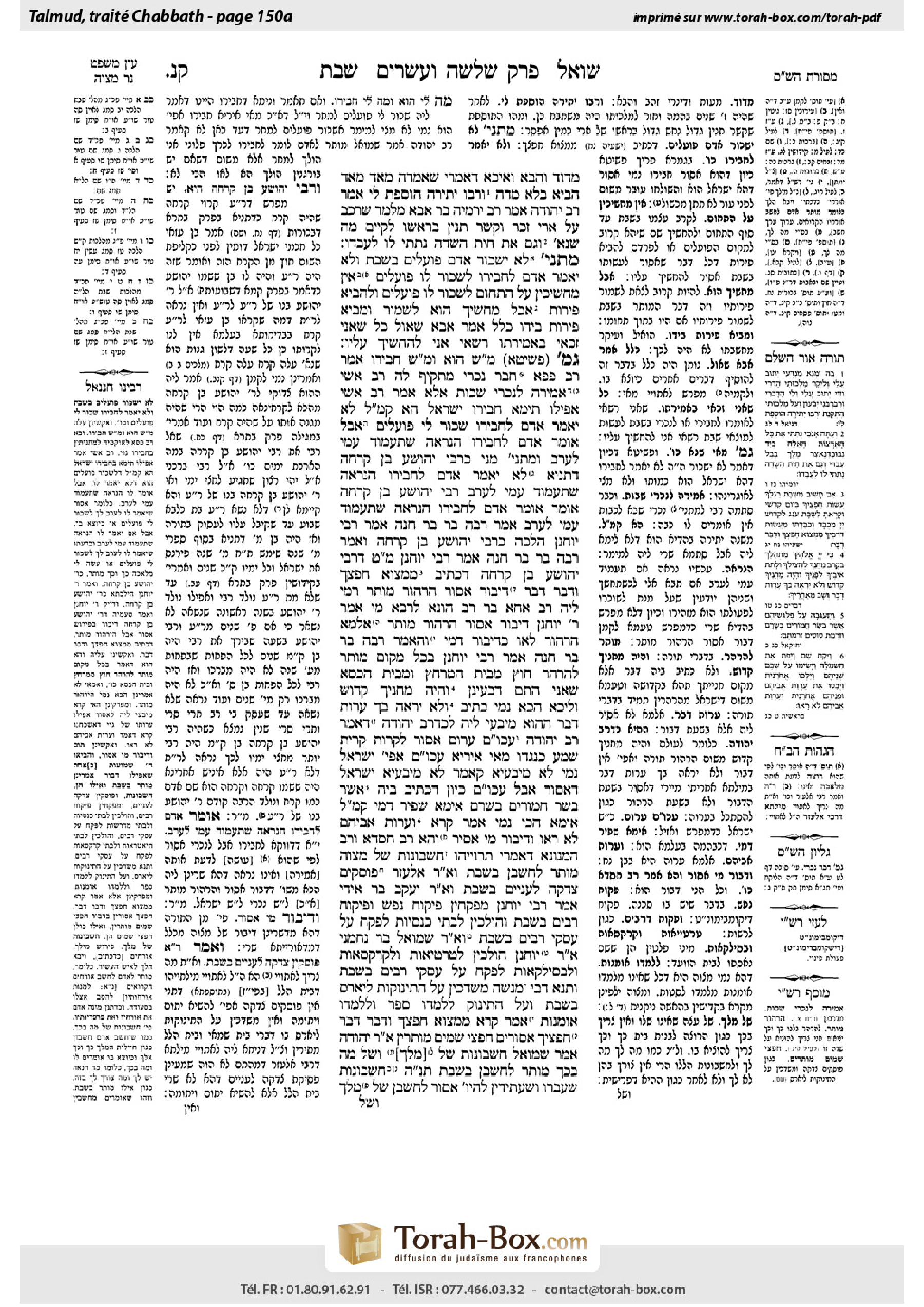
Shabbat 150a: Talmud study for Daf Yomi
Daf Yomi is the daily study of one Talmud folio. Explore 37 tractates with scans, Hebrew text, Sefaria English and AI-generated French translations where annotated.
Passage selection and English or AI-generated French translation are available where the scan has annotations. Daf Study is independent of Torah-Box and Sefaria.
Browse Shabbat · שבת · All tractatesShabbat 150a text and translations
This page of Shabbat includes the Aramaic text, an English translation and an AI-generated French translation, alongside the scan above.
שבת ק״נ א · Aramaic and Hebrew text
מְדוֹד וְהָבֵא. וְאִיכָּא דְאָמְרִי, שֶׁאָמְרָה ״מְאֹד מְאֹד הָבֵיא בְּלֹא מִדָּה״.
״וּרְבוּ יַתִּירָה הוּסְפַת לִי״, אָמַר רַב יְהוּדָה אָמַר רַב יִרְמְיָה בַּר אַבָּא: מְלַמֵּד שֶׁרָכַב עַל אֲרִי זָכָר, וְקָשַׁר תַּנִּין בְּרֹאשׁוֹ, לְקַיֵּים מַה שֶּׁנֶּאֱמַר: ״וְגַם אֶת חַיַּת הַשָּׂדֶה נָתַתִּי לוֹ לְעׇבְדוֹ״.
מַתְנִי׳ לֹא יִשְׂכּוֹר אָדָם פּוֹעֲלִים בְּשַׁבָּת. וְלֹא יֹאמַר אָדָם לַחֲבֵירוֹ לִשְׂכּוֹר לוֹ פּוֹעֲלִים. אֵין מַחְשִׁיכִין עַל הַתְּחוּם לִשְׂכּוֹר לוֹ פּוֹעֲלִים וּלְהָבִיא פֵּירוֹת, אֲבָל מַחְשִׁיךְ הוּא לִשְׁמוֹר, וּמֵבִיא פֵּירוֹת בְּיָדוֹ. כְּלָל אָמַר אַבָּא שָׁאוּל: כׇּל שֶׁאֲנִי זַכַּאי בַּאֲמִירָתוֹ — רַשַּׁאי אֲנִי לְהַחְשִׁיךְ עָלָיו.
גְּמָ׳ פְּשִׁיטָא מַאי שְׁנָא הוּא וּמַאי שְׁנָא חֲבֵירוֹ? אָמַר רַב פָּפָּא: חָבֵר גּוֹי. מַתְקֵיף לַהּ רַב אָשֵׁי: אֲמִירָה לְגוֹי שְׁבוּת!
אֶלָּא אָמַר רַב אָשֵׁי: אֲפִילּוּ תֵּימָא חֲבֵירוֹ יִשְׂרָאֵל, הָא קָא מַשְׁמַע לַן: לֹא יֹאמַר אָדָם לַחֲבֵירוֹ ״שְׂכוֹר לִי פּוֹעֲלִים״, אֲבָל אוֹמֵר אָדָם לַחֲבֵירוֹ ״הֲנִרְאֶה שֶׁתַּעֲמוֹד עִמִּי לָעֶרֶב?״ וּמַתְנִיתִין מַנִּי — כְּרַבִּי יְהוֹשֻׁעַ בֶּן קׇרְחָה. דְּתַנְיָא: לֹא יֹאמַר אָדָם לַחֲבֵירוֹ ״הֲנִרְאֶה שֶׁתַּעֲמוֹד עִמִּי לָעֶרֶב״. רַבִּי יְהוֹשֻׁעַ בֶּן קׇרְחָה אוֹמֵר: אוֹמֵר אָדָם לַחֲבֵירוֹ ״הֲנִרְאֶה שֶׁתַּעֲמוֹד עִמִּי לָעֶרֶב״.
אָמַר רַבָּה בַּר בַּר חָנָה אָמַר רַבִּי יוֹחָנָן: הֲלָכָה כְּרַבִּי יְהוֹשֻׁעַ בֶּן קׇרְחָה. וְאָמַר רַבָּה בַּר בַּר חָנָה אָמַר רַבִּי יוֹחָנָן: מַאי טַעְמָא דְּרַבִּי יְהוֹשֻׁעַ בֶּן קׇרְחָה — דִּכְתִיב: ״מִמְּצוֹא חֶפְצְךָ וְדַבֵּר דָּבָר״. דִּיבּוּר — אָסוּר, הִרְהוּר — מוּתָּר.
רָמֵי לֵיהּ רַב אַחָא בַּר רַב הוּנָא לְרָבָא: מִי אָמַר רַבִּי יוֹחָנָן דִּיבּוּר אָסוּר הִרְהוּר מוּתָּר — אַלְמָא הִרְהוּר לָאו כְּדִיבּוּר דָּמֵי? וְהָאָמַר רַבָּה בַּר בַּר חָנָה אָמַר רַבִּי יוֹחָנָן: בְּכׇל מָקוֹם מוּתָּר לְהַרְהֵר, חוּץ מִבֵּית הַמֶּרְחָץ וּמִבֵּית הַכִּסֵּא! שָׁאנֵי הָתָם, דְּבָעֵינַן ״וְהָיָה מַחֲנֶיךָ קָדוֹשׁ״, וְלֵיכָּא.
הָכָא נָמֵי, כְּתִיב: ״וְלֹא יִרְאֶה בְךָ עֶרְוַת דָּבָר״? הַהוּא, מִיבְּעֵי לֵיהּ לְכִדְרַב יְהוּדָה. דְּאָמַר רַב יְהוּדָה גּוֹי עָרוֹם — אָסוּר לִקְרוֹת קְרִיַּת שְׁמַע כְּנֶגְדּוֹ.
מַאי אִירְיָא גּוֹי, אֲפִילּוּ יִשְׂרָאֵל נָמֵי?! ״לָא מִיבַּעְיָא״ קָאָמַר: לָא מִיבַּעְיָא יִשְׂרָאֵל דְאָסוּר, אֲבָל גּוֹי, כֵּיוָן דִּכְתִיב בֵּיהּ: ״אֲשֶׁר בְּשַׂר חֲמוֹרִים בְּשָׂרָם״, אֵימָא שַׁפִּיר דָּמֵי, קָא מַשְׁמַע לַן.
אֵימָא הָכִי נָמֵי?! אָמַר קְרָא: ״וְעֶרְוַת אֲבִיהֶם לֹא רָאוּ״.
וְדִיבּוּר מִי אֲסִיר? וְהָא רַב חִסְדָּא וְרַב הַמְנוּנָא דְאָמְרִי תַּרְוַיְיהוּ: חֶשְׁבּוֹנוֹת שֶׁל מִצְוָה — מוּתָּר לְחַשְּׁבָן בְּשַׁבָּת. וְאָמַר רַבִּי אֶלְעָזָר: פּוֹסְקִים צְדָקָה לַעֲנִיִּים בְּשַׁבָּת. וְאָמַר רַבִּי יַעֲקֹב בַּר אִידֵּי אָמַר רַבִּי יוֹחָנָן: מְפַקְּחִין פִּיקּוּחַ נֶפֶשׁ וּפִיקּוּחַ רַבִּים בְּשַׁבָּת, וְהוֹלְכִין לְבָתֵּי כְנֵסִיּוֹת לְפַקֵּחַ עַל עִסְקֵי רַבִּים בְּשַׁבָּת.
וְאָמַר רַבִּי שְׁמוּאֵל בַּר נַחְמָנִי אָמַר רַבִּי יוֹחָנָן: הוֹלְכִין לְטֵרַטְיָאוֹת וּלְקִרְקְסָאוֹת וּלְבָסִילְקָאוֹת לְפַקֵּחַ עַל עִסְקֵי רַבִּים בְּשַׁבָּת. וְתָנָא דְבֵי מְנַשֶּׁה: מְשַׁדְּכִין עַל הַתִּינוֹקוֹת לֵיאָרֵס בְּשַׁבָּת, וְעַל הַתִּינוֹק לְלַמְּדוֹ סֵפֶר וּלְלַמְּדוֹ אוּמָּנוּת?! אָמַר קְרָא: ״מִמְּצוֹא חֶפְצְךָ וְדַבֵּר דָּבָר״ — חֲפָצֶיךָ אֲסוּרִים, חֶפְצֵי שָׁמַיִם מוּתָּרִין.
אָמַר רַב יְהוּדָה אָמַר שְׁמוּאֵל: חֶשְׁבּוֹנוֹת שֶׁל [מַלָּךְ] וְשֶׁל מַה בְּכָךְ — מוּתָּר לְחַשְּׁבָן בְּשַׁבָּת. תַּנְיָא נָמֵי הָכִי: חֶשְׁבּוֹנוֹת שֶׁעָבְרוּ וְשֶׁעֲתִידִין לִהְיוֹת — אָסוּר לְחַשְּׁבָן. שֶׁל מַלָּךְ
Shabbat 150a · English translation
Measure and bring a lot of money, has ceased. And some say that the meaning of the statement is that this nation said: Bring very, very much, without measure.
The Gemara cites another verse pertaining to Nebuchadnezzar: “And surpassing greatness was added unto me” (Daniel 4:33), about which Rav Yehuda said that Rav Yirmeya bar Abba said: This teaches that Nebuchadnezzar rode atop a male lion and tied a serpent to its head, fulfilling what was said of him: “And the beasts of the field I have also given him to serve him” (Jeremiah 27:6).
MISHNA: A person may not hire workers on Shabbat to work for him after Shabbat because even speaking about weekday matters is prohibited on Shabbat. Similarly, a person may not tell another on Shabbat to hire workers for him. One may not even wait for nightfall at the edge of the Shabbat boundary in order to leave the boundary immediately after Shabbat to hire workers for himself or to bring produce from his field. But he may wait for nightfall at the edge of the Shabbat boundary in order to guard his produce that is outside the Shabbat boundary, and he may then bring produce back in his hand, since he did not initially intend to wait at the edge of the boundary for this purpose. Abba Shaul stated a general principle: With regard to anything that I am permitted to discuss on Shabbat, I am permitted to wait for nightfall at the edge of the Shabbat boundary for its sake.
GEMARA: The beginning of the mishna taught that one may not hire workers on Shabbat, and one may not tell another to hire workers for him. The Gemara finds this puzzling and states: This is obvious. What is the difference between him and another? Just as he is prohibited from hiring workers on Shabbat, others are also prohibited from doing so. Rav Pappa said: Another is referring to a gentile. Rav Ashi strongly objects to this: This is itself a prohibition, for telling a gentile to do something that is prohibited for a Jew on Shabbat violates a rabbinic prohibition.
Rather, Rav Ashi said: Even if you say that it is referring to another Jew, it can be said that the novel element of this ruling is not the statement itself but what can be derived from it. This is what it is teaching us: One may not say to another explicitly on Shabbat: Hire workers for me, but one may say to another: Does it seem that you will join me this evening? This is permitted even though both of them understand that the questioner intends to hire the other person to work for him. And in accordance with whose opinion is the mishna? It is in accordance with the opinion of Rabbi Yehoshua ben Korḥa; as it was taught in a baraita: A person may not say to another on Shabbat: Does it seem that you will join me this evening? Rabbi Yehoshua ben Korḥa says: A person may say to another on Shabbat: Does it seem that you will join me this evening?
Rabba bar bar Ḥana said that Rabbi Yoḥanan said: The halakha is in accordance with the opinion of Rabbi Yehoshua ben Korḥa. And Rabba bar bar Ḥana said that Rabbi Yoḥanan said: What is the reason for Rabbi Yehoshua ben Korḥa’s ruling? As it is written in the verse from which we derive the prohibition to speak on Shabbat about activities that one may not perform on that day: “And you shall honor it by not doing your ways, nor pursuing your business, nor speaking of it” (Isaiah 58:13). We derive from this verse that speaking is prohibited, but merely contemplating these matters is permitted.
Rav Aḥa bar Rav Huna raised a contradiction to Rava: Did Rabbi Yoḥanan really state as a general principle that speaking is prohibited, but contemplating is permitted? Consequently, we can derive from here that contemplation is not tantamount to speech. But Rabba bar bar Ḥana said that Rabbi Yoḥanan said: It is permitted to think about Torah in any place except for a bathhouse and a bathroom. This statement indicates that contemplation is tantamount to speech, as even thought is prohibited in these locations. The Gemara answers: It is different there, for with regard to Torah we need to fulfill the verse: “For the Lord your God walks in the midst of your camp to deliver you and to give your enemies before you; therefore, your camp shall be sacred so that He see no unseemly thing in you and turn away from you” (Deuteronomy 23:15); and the requirement to be sacred is not fulfilled if one thinks about Torah while in the bathhouse or bathroom.
The Gemara challenges this: But here, too, with regard to a bathhouse and a bathroom, it is written: “So that He see no unseemly thing [davar] in you” (Deuteronomy 23:15). We can infer that this prohibits speech [dibbur] but not contemplation. The Gemara answers: That verse is not referring to speech. It is needed for the ruling of Rav Yehuda, for Rav Yehuda said: Opposite a naked gentile, it is prohibited to recite Shema, as this is included in the prohibition of unseemly things mentioned above.
The Gemara asks: Why did Rav Yehuda teach this prohibition particularly with regard to a gentile? Even in the presence of a naked Jew, reciting Shema is also prohibited. The Gemara answers: That ruling is stated employing the style of: There is no need. The Gemara explains: There is no need to state this halakha with regard to a Jew, as it is certainly prohibited to recite Shema in the presence of a naked Jew. However, with regard to a gentile, since it is written about him: “Whose flesh is as the flesh of donkeys” (Ezekiel 23:20), perhaps his flesh is not considered nakedness, and one may say that it seems well and permitted. Therefore, Rav Yehuda teaches us that it is also prohibited to recite Shema before a naked gentile.
The Gemara asks: Why not say that it is indeed so, that gentile flesh is not considered nakedness? The Gemara rejects this idea: The verse already said with regard to the sons of Noah: “And they walked backward and covered their father’s nakedness, and their faces were turned backward, and they did not see their father’s nakedness” (Genesis 9:23). The verse uses the term nakedness with regard to Noah, who was a gentile.
The Gemara addresses the basis of the halakha mentioned above: And is it speaking about proscribed activities prohibited on Shabbat? But Rav Ḥisda and Rav Hamnuna both said: It is permitted to make calculations pertaining to a mitzva on Shabbat, and Rabbi Elazar said that this means that one may apportion charity for the poor on Shabbat. And Rabbi Ya’akov bar Idi said that Rabbi Yoḥanan said: One may attend to activities necessary for saving a life or for communal needs on Shabbat, and one may go to a synagogue to attend to communal affairs on Shabbat.
And Rabbi Shmuel bar Naḥmani said that Rabbi Yoḥanan said: One may go to theaters [tarteiot], and circus performances [kirkesaot], and courthouses [basilkaot] to attend to communal affairs on Shabbat. And one of the Sages in the school of Menashe taught: One may make the necessary arrangements to pair off children so that they will be betrothed on Shabbat, and one may likewise make arrangements for a child by finding someone to teach him how to read books and to teach him a craft. If speaking about monetary matters is prohibited on Shabbat, how is it possible to participate in all these activities? The Gemara answers that although speaking about similar things is generally prohibited on Shabbat, it is permitted in these cases because the verse said: “Nor pursuing your business, nor speaking of it” (Isaiah 58:13), which indicates that your business matters are prohibited to speak of on Shabbat, but the business of Heaven, matters which have religious significance, is permitted to speak of.
Rav Yehuda said that Shmuel said: With regard to calculations of: What is it to you, [mallakh], calculations that are in no way relevant to the person making them, and of: What significance does it have [ma bekhakh], calculations that do not have any practical significance, it is permitted to make them on Shabbat. This was also taught in the Tosefta: Calculations with regard to matters that have passed or that will be in the future may not be calculated on Shabbat. However, with regard to calculations of: What is it to you,
Shabbat 150a · Traduction française (IA)
La mesure et l’apport d’une grande quantité d’argent ont cessé. Certains disent que le sens de cette déclaration est que cette nation disait : « Apportez-en énormément, sans mesure. »
La Guemara cite un autre verset concernant Nabuchodonosor : « Une grandeur extraordinaire me fut ajoutée » (Daniel 4:33). À ce sujet, Rav Yehouda dit que Rav Yirmeya bar Abba a dit : Cela enseigne que Nabuchodonosor chevauchait un lion mâle et avait attaché un serpent à sa tête, accomplissant ainsi ce qui avait été dit à son sujet : « Je lui ai aussi donné les bêtes des champs pour le servir » (Jérémie 27:6).
MICHNA : Il est interdit d’engager des ouvriers pendant Chabbat pour qu’ils travaillent après Chabbat, car même parler de questions profanes est interdit pendant Chabbat. De même, il est interdit de dire à quelqu’un d’autre, pendant Chabbat, d’engager des ouvriers pour soi. Il est même interdit d’attendre la tombée de la nuit à la limite du תחום שבת afin de sortir de ce périmètre immédiatement après Chabbat pour engager des ouvriers ou apporter des produits de son champ. En revanche, on peut attendre la tombée de la nuit à la limite du périmètre de Chabbat afin de garder les produits qui se trouvent au-delà de cette limite, puis les rapporter à la main, car on n’avait pas initialement l’intention d’attendre à la limite du périmètre dans ce but. Abba Shaul a formulé un principe général : pour toute chose dont il est permis de parler pendant Chabbat, il est permis d’attendre la tombée de la nuit à la limite du périmètre de Chabbat afin de s’en occuper.
GUEMARA : Le début de la Michna enseigne qu’il est interdit d’engager des ouvriers pendant Chabbat et de dire à quelqu’un d’autre de les engager pour soi. La Guemara trouve cela étonnant et dit : Cela va de soi. Quelle différence y a-t-il entre lui et quelqu’un d’autre ? De même qu’il lui est interdit d’engager des ouvriers pendant Chabbat, il est également interdit aux autres de le faire. Rav Pappa dit : « Quelqu’un d’autre » désigne un non-Juif. Rav Achi s’y oppose vivement : cela constitue en soi une interdiction, car demander à un non-Juif d’accomplir une action interdite à un Juif pendant Chabbat enfreint une interdiction rabbinique.
Rav Achi dit plutôt : Même si tu dis qu’il s’agit d’un autre Juif, on peut expliquer que la nouveauté de cette règle ne réside pas dans la déclaration elle-même, mais dans ce qu’on peut en déduire. Voici ce qu’elle nous enseigne : il est interdit de dire explicitement à quelqu’un, pendant Chabbat : « Engage des ouvriers pour moi », mais on peut lui dire : « Penses-tu te joindre à moi ce soir ? » Cela est permis, même si tous deux comprennent que celui qui pose la question a l’intention d’engager l’autre pour travailler pour lui. Selon l’opinion de qui la Michna est-elle formulée ? Selon celle de Rabbi Yehoshua ben Korḥa, comme cela a été enseigné dans une baraïta : Il est interdit de dire à quelqu’un, pendant Chabbat : « Penses-tu te joindre à moi ce soir ? » Rabbi Yehoshua ben Korḥa dit : Il est permis de dire à quelqu’un, pendant Chabbat : « Penses-tu te joindre à moi ce soir ? »
Rabba bar bar Ḥana dit au nom de Rabbi Yoḥanan : La halakha est conforme à l’opinion de Rabbi Yehoshua ben Korḥa. Et Rabba bar bar Ḥana dit au nom de Rabbi Yoḥanan : Quelle est la raison de la décision de Rabbi Yehoshua ben Korḥa ? Le verset dont nous déduisons l’interdiction de parler pendant Chabbat d’activités qu’on ne peut pas accomplir ce jour-là dit : « Tu l’honoreras en ne suivant pas tes voies, en ne poursuivant pas tes affaires et en n’en parlant pas » (Isaïe 58:13). Nous déduisons de ce verset que la parole est interdite, mais que le simple fait de penser à ces choses est permis.
Rav Aḥa bar Rav Huna souleva une contradiction devant Rava : Rabbi Yoḥanan a-t-il vraiment posé en principe général qu’il est interdit de parler, mais permis de penser ? On peut donc en déduire que la pensée n’équivaut pas à la parole. Pourtant, Rabba bar bar Ḥana dit au nom de Rabbi Yoḥanan : Il est permis de penser à la Torah en tout lieu, sauf dans un bain public et des toilettes. Cette déclaration indique que la pensée équivaut à la parole, puisque même penser est interdit dans ces endroits. La Guemara répond : Le cas est différent, car, concernant la Torah, il faut respecter le verset : « Car l’Éternel, ton Dieu, marche au milieu de ton camp pour te délivrer et livrer tes ennemis devant toi ; ton camp sera donc saint, afin qu’Il ne voie chez toi rien d’indécent et ne se détourne pas de toi » (Deutéronome 23:15). Or, l’exigence de sainteté n’est pas respectée si l’on pense à la Torah dans un bain public ou aux toilettes.
La Guemara objecte : Mais ici aussi, à propos du bain public et des toilettes, il est écrit : « Afin qu’Il ne voie chez toi rien d’indécent [davar] » (Deutéronome 23:15). On peut en déduire que cela interdit la parole [dibbur], mais pas la pensée. La Guemara répond : Ce verset ne porte pas sur la parole. Il est nécessaire pour établir la règle de Rav Yehouda, car Rav Yehouda a dit : En face d’un non-Juif nu, il est interdit de réciter le Chéma, car cela relève de l’interdiction des choses indécentes mentionnée ci-dessus.
La Guemara demande : Pourquoi Rav Yehouda a-t-il enseigné cette interdiction précisément à propos d’un non-Juif ? Même en présence d’un Juif nu, il est également interdit de réciter le Chéma. La Guemara répond que cette règle est formulée selon le principe : « Il n’est pas nécessaire de dire… » La Guemara explique : Il n’est pas nécessaire d’énoncer cette halakha à propos d’un Juif, car il est certainement interdit de réciter le Chéma en présence d’un Juif nu. En revanche, au sujet d’un non-Juif, puisqu’il est écrit à son propos : « dont la chair est comme la chair des ânes » (Ézéchiel 23:20), on pourrait croire que sa chair n’est pas considérée comme une nudité et que cela est donc permis. Rav Yehouda nous enseigne ainsi qu’il est également interdit de réciter le Chéma devant un non-Juif nu.
La Guemara demande : Pourquoi ne pas dire qu’il en est effectivement ainsi, et que la chair d’un non-Juif n’est pas considérée comme une nudité ? La Guemara rejette cette idée : le verset dit déjà au sujet des fils de Noé : « Ils marchèrent à reculons et couvrirent la nudité de leur père ; leurs visages étaient tournés en arrière et ils ne virent pas la nudité de leur père » (Genèse 9:23). Le verset emploie le terme « nudité » à propos de Noé, qui était un non-Juif.
La Guemara examine le fondement de la halakha mentionnée plus haut : Est-il question d’activités interdites pendant Chabbat ? Pourtant, Rav Ḥisda et Rav Hamnuna ont tous deux dit qu’il est permis d’effectuer pendant Chabbat des calculs relatifs à une mitsva, et Rabbi Elazar a dit que cela signifie qu’on peut répartir la tsédaka destinée aux pauvres pendant Chabbat. Rabbi Yaakov bar Idi dit au nom de Rabbi Yoḥanan : On peut s’occuper pendant Chabbat des activités nécessaires pour sauver une vie ou répondre aux besoins de la communauté, et se rendre à la synagogue pour s’occuper des affaires communautaires pendant Chabbat.
Rabbi Shmuel bar Naḥmani dit au nom de Rabbi Yoḥanan : On peut se rendre aux théâtres [tarteiot], aux spectacles de cirque [kirkesaot] et aux tribunaux [basilkaot] pour s’occuper des affaires communautaires pendant Chabbat. Un des Sages de l’école de Menashé enseigna : On peut prendre les dispositions nécessaires pour mettre des enfants en relation afin qu’ils se fiancent, et prendre des dispositions pour un enfant en trouvant quelqu’un qui lui apprendra à lire des livres et lui enseignera un métier. Si parler de questions d’argent est interdit pendant Chabbat, comment peut-on participer à toutes ces activités ? La Guemara répond que, bien qu’il soit généralement interdit de parler de choses semblables pendant Chabbat, cela est permis dans ces cas, car le verset dit : « Ne poursuivant pas tes affaires et n’en parlant pas » (Isaïe 58:13). Cela indique qu’il est interdit de parler pendant Chabbat de ses propres affaires, mais permis de parler des affaires du Ciel, c’est-à-dire de questions ayant une portée religieuse.
Rav Yehouda dit au nom de Shmouel : Il est permis d’effectuer pendant Chabbat des calculs de type « qu’est-ce que cela peut te faire ? » [mallakh], c’est-à-dire des calculs qui ne concernent en rien la personne qui les effectue, ainsi que des calculs de type « quelle importance cela a-t-il ? » [ma bekhakh], c’est-à-dire des calculs qui n’ont aucune portée pratique. Cela a également été enseigné dans la Tossefta : Il est interdit d’effectuer pendant Chabbat des calculs portant sur des affaires passées ou à venir. En revanche, pour les calculs de type « qu’est-ce que cela peut te faire ? »,
Traduction française générée par IA à partir de l’édition anglaise de Sefaria. Vérifie toujours un passage avec le texte source.
Text from Sefaria: William Davidson Edition - Vocalized Aramaic (CC BY NC); William Davidson Edition - English (CC BY NC).