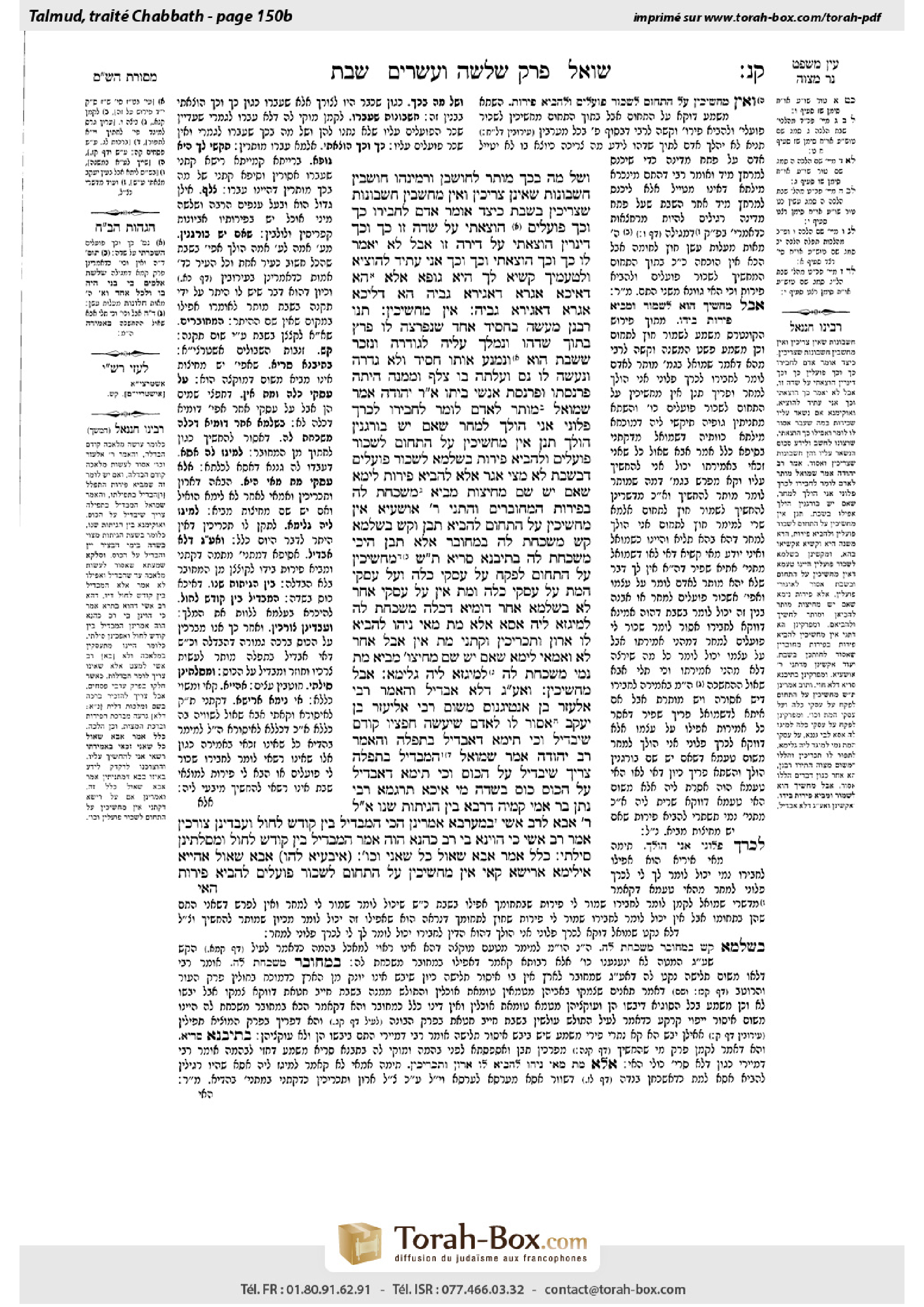
Shabbat 150b: Talmud study for Daf Yomi
Daf Yomi is the daily study of one Talmud folio. Explore 37 tractates with scans, Hebrew text, Sefaria English and AI-generated French translations where annotated.
Passage selection and English or AI-generated French translation are available where the scan has annotations. Daf Study is independent of Torah-Box and Sefaria.
Browse Shabbat · שבת · All tractatesShabbat 150b text and translations
This page of Shabbat includes the Aramaic text, an English translation and an AI-generated French translation, alongside the scan above.
שבת ק״נ ב · Aramaic and Hebrew text
וְשֶׁל מַה בְּכָךְ — מוּתָּר לְחַשְּׁבָן.
וּרְמִינְהוּ: חוֹשְׁבִין חֶשְׁבּוֹנוֹת שֶׁאֵינָן צְרִיכִין, וְאֵין מְחַשְּׁבִין חֶשְׁבּוֹנוֹת שֶׁצְּרִיכִין, בְּשַׁבָּת. כֵּיצַד? אוֹמֵר אָדָם לַחֲבֵירוֹ: ״כָּךְ וְכָךְ פּוֹעֲלִים הוֹצֵאתִי עַל שָׂדֶה זוֹ, כָּךְ וְכָךְ דִּינָרִין הוֹצֵאתִי עַל דִּירָה זוֹ״. אֲבָל לֹא יֹאמַר לוֹ: ״כָּךְ וְכָךְ הוֹצֵאתִי, וְכָךְ וְכָךְ אֲנִי עָתִיד לְהוֹצִיא״!
וּלְטַעְמָיךְ, קַשְׁיָא לָךְ הִיא גּוּפַהּ! אֶלָּא: הָא — דְּאִיכָּא אַגְרָא דַאֲגִירָא גַּבֵּיהּ. הָא — דְּלֵיכָּא אַגְרָא דַאֲגִירָא גַּבֵּיהּ.
אֵין מַחְשִׁיכִין. תָּנוּ רַבָּנַן: מַעֲשֶׂה בְּחָסִיד אֶחָד שֶׁנִּפְרְצָה לוֹ פִּרְצָה בְּתוֹךְ שָׂדֵהוּ וְנִמְלַךְ עָלֶיהָ לְגוֹדְרָהּ, וְנִזְכַּר שֶׁשַּׁבָּת הוּא, וְנִמְנַע אוֹתוֹ חָסִיד וְלֹא גְּדָרָהּ, וְנַעֲשָׂה לוֹ נֵס וְעָלְתָה בּוֹ צָלָף, וּמִמֶּנָּה הָיְתָה פַּרְנָסָתוֹ וּפַרְנָסַת אַנְשֵׁי בֵיתוֹ.
אָמַר רַב יְהוּדָה אָמַר שְׁמוּאֵל: מוּתָּר לָאָדָם לוֹמַר לַחֲבֵירוֹ ״לִכְרַךְ פְּלוֹנִי אֲנִי הוֹלֵךְ לְמָחָר״, שֶׁאִם יֵשׁ בּוּרְגָּנִין — הוֹלֵךְ.
תְּנַן: אֵין מַחְשִׁיכִין עַל הַתְּחוּם לִשְׂכּוֹר פּוֹעֲלִים וּלְהָבִיא פֵּירוֹת. בִּשְׁלָמָא לִשְׂכּוֹר פּוֹעֲלִים דִּבְשַׁבָּת לָא מָצֵי אָגַר, אֶלָּא לְהָבִיא פֵּירוֹת? לֵימָא: שֶׁאִם יֵשׁ שָׁם מְחִיצּוֹת — מֵבִיא! מַשְׁכַּחַתְּ לַהּ בְּפֵירוֹת הַמְחוּבָּרִים.
וְהָתָנֵי רַבִּי אוֹשַׁעְיָא: אֵין מַחְשִׁיכִין עַל הַתְּחוּם לְהָבִיא תֶּבֶן וָקַשׁ. בִּשְׁלָמָא קַשׁ מַשְׁכַּחַתְּ לַהּ בִּמְחוּבָּר. אֶלָּא תֶּבֶן, הֵיכִי מַשְׁכַּחַתְּ לַהּ? בְּתִיבְנָא סַרְיָא.
תָּא שְׁמַע: מַחְשִׁיכִין עַל הַתְּחוּם לְפַקֵּחַ עַל עִסְקֵי כַלָּה וְעַל עִסְקֵי הַמֵּת. עַל עִסְקֵי כַלָּה וָמֵת — אִין, עַל עִסְקֵי אַחֵר — לָא.
בִּשְׁלָמָא אַחֵר דּוּמְיָא דְכַלָּה מַשְׁכַּחַתְּ לַהּ לְמֵיגַז לֵיהּ אַסָּא. אֶלָּא מֵת מַאי נִיהוּ? — לְהָבִיא לוֹ אָרוֹן וְתַכְרִיכִין. וְקָתָנֵי מֵת — אִין, אֲבָל אַחֵר — לָא.
וְאַמַּאי? לֵימָא: שֶׁאִם יֵשׁ שָׁם מְחִיצּוֹת — מֵבִיא! מֵת נָמֵי מַשְׁכַּחַתְּ לַהּ לְמֵיגַז לֵיהּ גְּלִימָא.
אֲבָל מַחְשִׁיכִין. וְאַף עַל גַּב דְּלָא אַבְדֵּיל וְהָאָמַר רַבִּי אֶלְעָזָר בֶּן אַנְטִיגְנוֹס מִשּׁוּם רַבִּי אֱלִיעֶזֶר בֶּן יַעֲקֹב: אָסוּר לוֹ לָאָדָם שֶׁיַּעֲשֶׂה חֲפָצָיו קוֹדֶם שֶׁיַּבְדִּיל! וְכִי תֵּימָא דְּאַבְדֵּיל בִּתְפִלָּה — וְהָאָמַר רַב יְהוּדָה אָמַר שְׁמוּאֵל: הַמַּבְדִּיל בַּתְּפִלָּה צָרִיךְ שֶׁיַּבְדִּיל עַל הַכּוֹס! וְכִי תֵּימָא דְּאַבְדֵּיל עַל הַכּוֹס, כּוֹס בַּשָּׂדֶה מִי אִיכָּא?! תַּרְגְּמָא רַבִּי נָתָן בַּר אַמֵּי קַמֵּיהּ דְּרָבָא בֵּין הַגִּיתּוֹת שָׁנוּ.
אֲמַר לֵיהּ רַבִּי אַבָּא לְרַב אָשֵׁי: בְּמַעְרְבָא אָמְרִינַן הָכִי: ״הַמַּבְדִּיל בֵּין קוֹדֶשׁ לְחוֹל״ וְעָבְדִינַן צוּרְכִּין. אָמַר רַב אָשֵׁי: כִּי הֲוֵינָא בֵּי רַב כָּהֲנָא הֲוָה אָמַר ״הַמַּבְדִּיל בֵּין קוֹדֶשׁ לְחוֹל״ וּמְסַלְּתִינַן סִילְתֵי.
כְּלָל אָמַר אַבָּא שָׁאוּל: כֹּל שֶׁאֲנִי וְכוּ׳. אִיבַּעְיָא לְהוּ: אַבָּא שָׁאוּל אַהֵיָיא? אִילֵּימָא אַרֵישָׁא קָאֵי: ״אֵין מַחְשִׁיכִין עַל הַתְּחוּם לִשְׂכּוֹר פּוֹעֲלִים לְהָבִיא פֵּירוֹת״ —
Shabbat 150b · English translation
and of: What significance does it have, it is permitted to calculate them.
The Gemara raises a contradiction based on what was taught in another baraita: One may make calculations that are unnecessary, but one may not make calculations that are necessary on Shabbat. How so? One may say to another: I sent out such and such number of workers to this field, and I spent such and such number of dinar for this home. But he may not say to him: I spent such and such amount of money, and I am going to spend such and such amount in the future. Apparently, one is permitted to calculate one’s previous expenditures on Shabbat.
The Gemara responds: And according to your reasoning, it itself, the Tosefta quoted previously, is difficult for you, for it prohibits calculating past expenditures while allowing one to make calculations that do not have practical significance. Rather, it must be explained in the following manner: This Tosefta, which taught that it is prohibited to calculate past expenses, is referring to a case in which he has payment with him that he still owes his workers. Therefore, although his calculation pertains to projects that have already been completed, it is still relevant in a practical manner. And this baraita, which taught that it is permitted to calculate past expenses, is referring to a case in which he does not have payment with him that he must still pay his workers, and therefore his calculation does not have practical significance.
We learned in the mishna that one may not wait for nightfall at the edge of the Shabbat boundary in order to hire workers or bring produce from outside of the boundary immediately after Shabbat. The Sages taught: There was an incident with a pious man in which a breach was made in the fence around his field, and when he saw it he decided to fence it in. And then he remembered that it was Shabbat. And that pious man refrained from fixing the fence forever because he had thought about fixing it on Shabbat. And a miracle was done for him, and a caper bush grew in the breach, thereby closing it up. And from it and its produce he then received his livelihood and the livelihood of the members of his household.
Rav Yehuda said that Shmuel said: A person is permitted to say to another on Shabbat: I am going to such and such city tomorrow, for if there were small guardhouses [burganin] one would be permitted to walk. If small guardhouses, from which the surrounding area and fields could be watched, were located along the way one needs to travel, the entire area would attain the status of a single city, and walking from one part to the other on Shabbat would be permitted ab initio. Since it would be permitted to traverse this area on Shabbat with burganin present, it is permitted to talk about such a journey on Shabbat, even when these guardhouses are not present. This is because it is permitted to speak about or prepare for something that can be done in a permitted fashion on Shabbat, even in the absence of the conditions that make it permitted.
We learned in the mishna: One may not wait for nightfall at the edge of the Shabbat boundary in order to hire workers or bring produce after Shabbat from the other side of the boundary. Granted, it makes sense that it is prohibited to wait at the Shabbat boundary in order to hire workers, as one may not hire workers under any circumstances on Shabbat. But if one waits there in order to bring produce, why is it prohibited? Let us say that since one would be permitted to bring produce at the edge of the boundary on Shabbat ab initio if there were partitions there, one may wait for nightfall at the border to bring produce even when there are not partitions present, in accordance with Rav Yehuda’s ruling mentioned above. The Gemara answers: You find a case where bringing produce is not permitted under any circumstances; that is when the produce is still attached to the ground, as there is no permitted way to pick produce on Shabbat.
The Gemara again questions Rav Yehuda’s ruling: But Rabbi Oshaya taught: One may not wait for nightfall at the edge of the Shabbat boundary in order to bring in hay and straw after Shabbat. Granted, Rabbi Oshaya taught that it is prohibited in the case of straw; you find the case of straw that is still attached to the ground, which it is clearly prohibited to pick under any circumstances. But hay, which has already been detached from the ground, how do you find a case in which it would be prohibited to carry it on Shabbat, even with partitions present? The Gemara answers: Rabbi Oshaya’s ruling referred to rotten straw, which may not be carried on Shabbat because it is considered set-aside [muktze].
Come and hear a proof with regard to this matter based on what was taught elsewhere: One may wait for nightfall at the edge of the Shabbat boundary in order to attend to the needs of a bride or the needs of a corpse. The Gemara infers from this that for the needs of a bride or a corpse, yes, one is permitted to wait for nightfall at the edge of the Shabbat boundary, but for the needs of another person, no, it is not permitted.
Granted, with regard to attending to the needs of another in a manner similar to attending to the needs of a bride, you find a case where it is prohibited to cut him a myrtle branch as was customarily done for brides because this is absolutely prohibited on Shabbat. But with regard to a corpse, what is it that one might do which would be prohibited to do for others? To bring for it a coffin and shrouds. And it teaches that for a corpse, yes, it is permitted, but for another it is not.
And why is it prohibited to do so for others? Let us say that since one would be permitted to bring these items on Shabbat if there were partitions there, one may wait for nightfall at the edge of the border to bring these items after Shabbat, in accordance with the ruling of Rav Yehuda. The Gemara answers: In the case of a corpse, you also find a case where bringing an item is prohibited under any circumstance, e.g., if one is waiting to cut a garment for the corpse to use as shrouds. There is no permissible way to do that on Shabbat. In that case, it would be prohibited to wait at the edge of the Shabbat boundary for this purpose if not for the fact that it is for the sake of a corpse, as it is a mitzva to attend to the needs of a corpse.
We learned in the mishna: But one may wait for nightfall at the Shabbat boundary in order to guard one’s produce. The Gemara asks: And is this the case even if he has not recited the blessing of distinction [havdala] marking the end of Shabbat? But didn’t Rabbi Elazar ben Antigonos say in the name of Rabbi Eliezer ben Ya’akov that it is prohibited for a person to tend to his weekday affairs after Shabbat before he recites havdala? And if you say that this is referring to a case in which one already recited havdala during prayer, as formulated by the Sages in the blessing of: Who graciously grants knowledge, didn’t Rav Yehuda say that Shmuel said that one who recites havdala in prayer must still recite havdala over a cup of wine? And if you say that this is an instance in which one already recited havdala over a cup of wine, does one have a cup of wine in the field? Rabbi Natan bar Ami explained this before Rava: They taught this halakha with regard to a unique case in which the edge of the Shabbat boundary was situated among wine presses, and one took wine from the wine press and recited havdala over it.
Rabbi Abba said another explanation to Rav Ashi: In the West, in Eretz Yisrael, we say this at the end of Shabbat: The One who distinguishes between the sacred and the mundane, and then we attend to our needs, as reciting havdala over a cup is unnecessary in order to begin doing labor after Shabbat. It is therefore possible that the mishna addressed a similar case. Similarly, Rav Ashi said: When I was in the house of Rav Kahana, he would say: The One who distinguishes between the sacred and the mundane, at the end of Shabbat, and we would cut wood to burn for light and heat.
We learned in the mishna: Abba Shaul stated a general principle: With regard to anything that I am permitted to discuss on Shabbat, I am permitted to wait for nightfall at the edge of the Shabbat boundary for its sake. The Gemara raises a dilemma: To which part of the mishna did Abba Shaul’s statement refer? If you say that it relates to the first clause of the mishna, which taught: One may not wait for nightfall at the edge of the Shabbat boundary in order to hire workers or to bring produce,
Shabbat 150b · Traduction française (IA)
et de : Quelle importance cela a-t-il ? Il est permis de faire des calculs à leur sujet.
La Guemara soulève une contradiction à partir de ce qui a été enseigné dans une autre baraïta : On peut faire des calculs qui ne sont pas nécessaires, mais on ne peut pas faire de calculs nécessaires pendant Chabbat. Comment cela ? On peut dire à quelqu’un : « J’ai envoyé tant d’ouvriers dans ce champ et j’ai dépensé tant de dinars pour cette maison. » Mais on ne peut pas lui dire : « J’ai dépensé telle somme d’argent et je vais en dépenser telle autre à l’avenir. » Il semble donc qu’il soit permis de calculer pendant Chabbat les dépenses passées.
La Guemara répond : Mais, selon ton raisonnement, le texte même de la Tosefta citée précédemment est difficile à comprendre, car il interdit de calculer les dépenses passées tout en permettant de faire des calculs sans conséquence pratique. Il faut plutôt expliquer les choses ainsi : cette Tosefta, qui enseigne qu’il est interdit de calculer les dépenses passées, parle d’un cas où l’on a sur soi l’argent que l’on doit encore à ses ouvriers. Par conséquent, bien que le calcul porte sur des travaux déjà achevés, il reste pertinent sur le plan pratique. Quant à cette baraïta, qui enseigne qu’il est permis de calculer les dépenses passées, elle parle d’un cas où l’on n’a pas sur soi l’argent que l’on doit encore verser à ses ouvriers ; le calcul n’a donc pas de conséquence pratique.
Nous avons appris dans la Michna qu’on ne peut pas attendre la tombée de la nuit à la limite du Chabbat afin d’embaucher des ouvriers ou d’apporter des produits depuis l’extérieur de cette limite immédiatement après Chabbat. Les Sages ont enseigné : Il arriva qu’un homme pieux vit une brèche dans la clôture qui entourait son champ et décida de la réparer. Puis il se souvint que c’était Chabbat. Cet homme pieux s’abstint alors pour toujours de réparer la clôture, parce qu’il avait pensé à la réparer pendant Chabbat. Un miracle se produisit pour lui : un câprier poussa dans la brèche et la referma. Grâce à lui et à ses fruits, il subvenait désormais à ses besoins et à ceux de sa famille.
Rav Yehouda dit au nom de Chmouel : Il est permis de dire à quelqu’un pendant Chabbat : « Demain, je me rends dans telle ou telle ville », car, s’il y avait de petites postes de garde [burganin], il serait permis de s’y rendre à pied. Si de petites postes de garde, d’où l’on pouvait surveiller les environs et les champs, se trouvaient le long du chemin à parcourir, toute la zone aurait le statut d’une seule ville, et il serait permis a priori de se rendre d’un point à l’autre pendant Chabbat. Puisqu’il serait permis de parcourir cette zone pendant Chabbat en présence de burganin, il est permis de parler d’un tel déplacement pendant Chabbat, même en l’absence de ces postes de garde. En effet, il est permis de parler de quelque chose que l’on peut faire de manière autorisée pendant Chabbat, ou de s’y préparer, même si les conditions qui le rendent autorisé ne sont pas réunies.
Nous avons appris dans la Michna : On ne peut pas attendre la tombée de la nuit à la limite du Chabbat afin d’embaucher des ouvriers ou d’apporter des produits depuis l’autre côté de cette limite après Chabbat. Il est logique qu’il soit interdit d’attendre à la limite du Chabbat afin d’embaucher des ouvriers, puisque l’embauche d’ouvriers est interdite en toutes circonstances pendant Chabbat. Mais si l’on attend là afin d’apporter des produits, pourquoi est-ce interdit ? Disons que, puisqu’il serait permis a priori d’apporter des produits au-delà de la limite pendant Chabbat s’il y avait des cloisons à cet endroit, on peut attendre la tombée de la nuit à la limite pour apporter des produits même en l’absence de cloisons, conformément à la décision de Rav Yehouda mentionnée plus haut. La Guemara répond : Il existe un cas où apporter des produits est interdit en toutes circonstances : lorsqu’ils sont encore attachés au sol, car il n’existe aucune manière autorisée de les récolter pendant Chabbat.
La Guemara met de nouveau en question la décision de Rav Yehouda : Mais Rabbi Ochaya a enseigné qu’on ne peut pas attendre la tombée de la nuit à la limite du Chabbat afin d’apporter du foin et de la paille après Chabbat. Il est logique que Rabbi Ochaya enseigne que cela est interdit dans le cas de la paille : il peut s’agir de paille encore attachée au sol, qu’il est clairement interdit de couper en toutes circonstances. Mais le foin, qui a déjà été détaché du sol, comment trouver un cas où il serait interdit de le transporter pendant Chabbat, même en présence de cloisons ? La Guemara répond : La décision de Rabbi Ochaya concerne de la paille pourrie, qu’il est interdit de transporter pendant Chabbat parce qu’elle est considérée comme mise à l’écart [muktze].
Viens et entends une preuve à ce sujet, fondée sur ce qui a été enseigné ailleurs : On peut attendre la tombée de la nuit à la limite du Chabbat afin de s’occuper des besoins d’une mariée ou d’un mort. La Guemara en déduit que, pour les besoins d’une mariée ou d’un mort, oui, il est permis d’attendre la tombée de la nuit à la limite du Chabbat ; mais pour les besoins d’une autre personne, non, cela n’est pas permis.
Il est logique que, lorsqu’il s’agit de s’occuper des besoins d’une autre personne comme on s’occupe de ceux d’une mariée, on puisse envisager un cas où il est interdit de lui couper une branche de myrte, comme on avait coutume de le faire pour les mariées, car cela est absolument interdit pendant Chabbat. Mais, pour un mort, que pourrait-on faire qui serait interdit pour d’autres ? Lui apporter un cercueil et des linceuls. L’enseignement précise que, pour un mort, oui, cela est permis, mais pas pour une autre personne.
Et pourquoi est-il interdit de le faire pour d’autres ? Disons que, puisqu’il serait permis d’apporter ces objets pendant Chabbat s’il y avait des cloisons à cet endroit, on peut attendre la tombée de la nuit à la limite pour les apporter après Chabbat, conformément à la décision de Rav Yehouda. La Guemara répond : Même dans le cas d’un mort, on peut envisager une situation où apporter un objet est interdit en toutes circonstances, par exemple si l’on attend pour couper un vêtement destiné à servir de linceul au mort. Il n’existe aucune manière autorisée de le faire pendant Chabbat. Dans ce cas, il serait interdit d’attendre à la limite du Chabbat dans ce but, si ce n’était pour un mort, car s’occuper des besoins d’un mort est une mitsva.
Nous avons appris dans la Michna : Mais on peut attendre la tombée de la nuit à la limite du Chabbat afin de garder ses produits. La Guemara demande : Est-ce le cas même si l’on n’a pas récité la bénédiction de distinction [havdala] qui marque la fin de Chabbat ? Rabbi Elazar ben Antigonos n’a-t-il pas dit au nom de Rabbi Eliezer ben Yaakov qu’il est interdit de s’occuper de ses affaires profanes après Chabbat avant d’avoir récité la havdala ? Et si tu dis qu’il s’agit d’un cas où l’on a déjà récité la havdala pendant la prière, conformément à la formulation des Sages dans la bénédiction « Qui accordes généreusement la connaissance », Rav Yehouda n’a-t-il pas dit au nom de Chmouel que celui qui récite la havdala dans la prière doit encore la réciter sur une coupe de vin ? Et si tu dis qu’il s’agit d’un cas où l’on a déjà récité la havdala sur une coupe de vin, a-t-on une coupe de vin dans un champ ? Rabbi Natan bar Ami expliqua cela devant Rava : Cet enseignement concerne un cas particulier où la limite du Chabbat se trouvait au milieu de pressoirs à vin, et où l’on prit du vin au pressoir pour réciter la havdala dessus.
Rabbi Abba donna une autre explication à Rav Achi : En Occident, en terre d’Israël, à la fin de Chabbat, nous disons : « Celui qui distingue le sacré du profane », puis nous nous occupons de nos besoins ; il n’est pas nécessaire de réciter la havdala sur une coupe pour commencer à travailler après Chabbat. Il est donc possible que la Michna traite d’un cas semblable. De même, Rav Achi dit : Lorsque j’étais chez Rav Kahana, à la fin de Chabbat, il disait : « Celui qui distingue le sacré du profane », et nous coupions du bois pour faire du feu afin de nous éclairer et de nous chauffer.
Nous avons appris dans la Michna : Abba Chaoul a énoncé un principe général : Tout ce dont il m’est permis de parler pendant Chabbat, il m’est permis d’en attendre la tombée de la nuit à la limite du Chabbat. La Guemara soulève une question : À quelle partie de la Michna la déclaration d’Abba Chaoul se rapporte-t-elle ? Si tu dis qu’elle se rapporte à la première partie de la Michna, qui enseigne : On ne peut pas attendre la tombée de la nuit à la limite du Chabbat afin d’embaucher des ouvriers ou d’apporter des produits,
Traduction française générée par IA à partir de l’édition anglaise de Sefaria. Vérifie toujours un passage avec le texte source.
Text from Sefaria: William Davidson Edition - Vocalized Aramaic (CC BY NC); William Davidson Edition - English (CC BY NC).