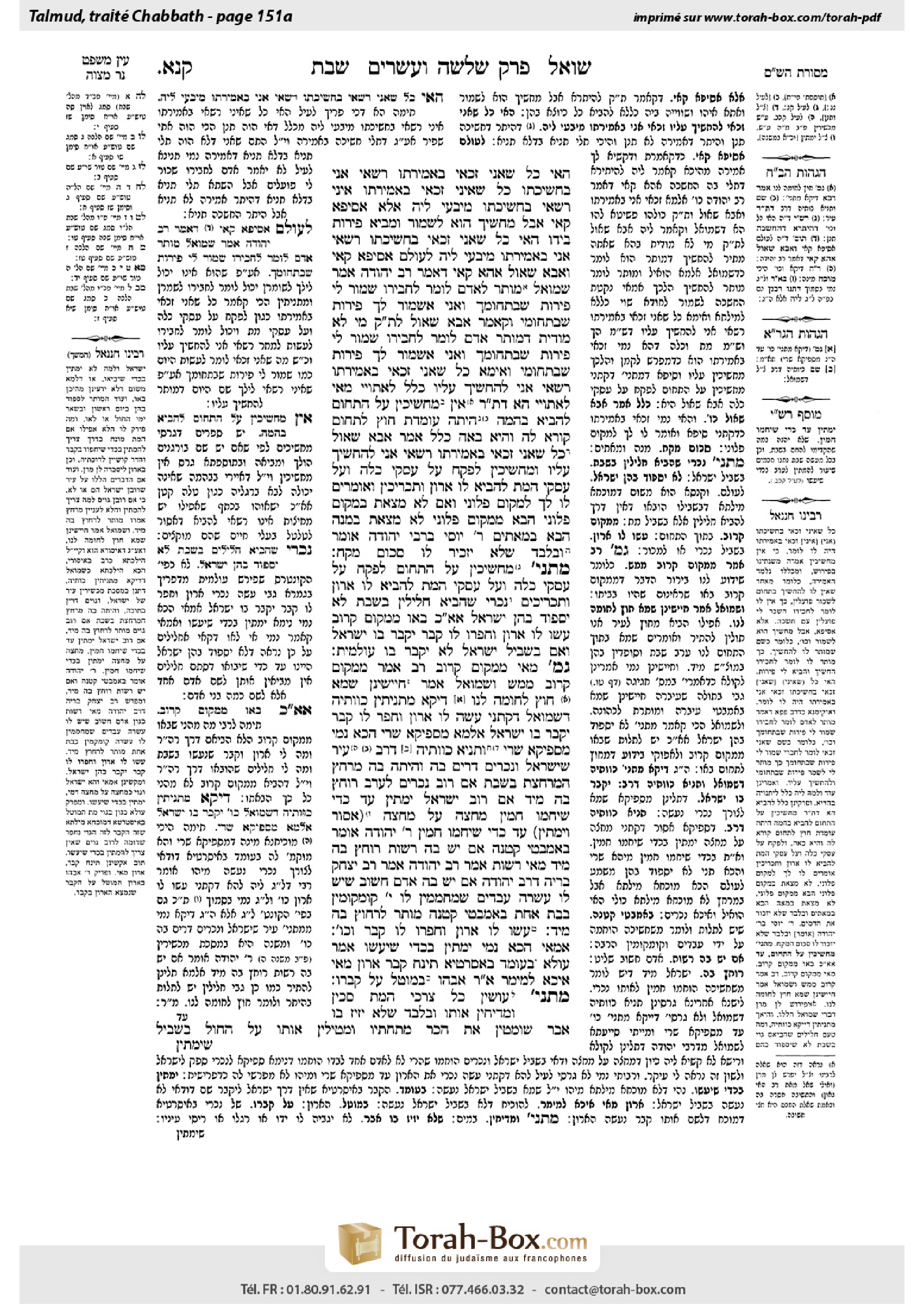
Shabbat 151a: Talmud study for Daf Yomi
Daf Yomi is the daily study of one Talmud folio. Explore 37 tractates with scans, Hebrew text, Sefaria English and AI-generated French translations where annotated.
Passage selection and English or AI-generated French translation are available where the scan has annotations. Daf Study is independent of Torah-Box and Sefaria.
Browse Shabbat · שבת · All tractatesShabbat 151a text and translations
This page of Shabbat includes the Aramaic text, an English translation and an AI-generated French translation, alongside the scan above.
שבת קנ״א א · Aramaic and Hebrew text
הַאי ״כׇּל שֶׁאֲנִי זַכַּאי בַּאֲמִירָתוֹ רַשַּׁאי אֲנִי בַּחֲשִׁיכָתו״? ״כׇּל שֶׁאֵינִי זַכַּאי בַּאֲמִירָתוֹ אֵינִי רַשַּׁאי בַּחֲשִׁיכָתוֹ״ מִיבְּעֵי לֵיהּ! אֶלָּא אַסֵּיפָא קָאֵי: ״אֲבָל מַחְשִׁיךְ הוּא לִשְׁמוֹר וּמֵבִיא פֵּירוֹת בְּיָדוֹ״ — הַאי ״כׇּל שֶׁאֲנִי זַכַּאי בַּחֲשִׁיכָתוֹ רַשַּׁאי אֲנִי בַּאֲמִירָתוֹ״ מִיבְּעֵי לֵיהּ!
לְעוֹלָם אַסֵּיפָא קָאֵי, וְאַבָּא שָׁאוּל אַהָא קָאֵי דְּאָמַר רַב יְהוּדָה אָמַר שְׁמוּאֵל: מוּתָּר לָאָדָם לוֹמַר לַחֲבֵירוֹ ״שְׁמוֹר לִי פֵּירוֹת שֶׁבִּתְחוּמְךָ, וַאֲנִי אֶשְׁמוֹר לְךָ פֵּירוֹת שֶׁבִּתְחוּמִי״. וְקָאָמַר אַבָּא שָׁאוּל לְתַנָּא קַמָּא: מִי לָא מוֹדֵית דְּמוּתָּר אָדָם לוֹמַר לַחֲבֵירוֹ: ״שְׁמוֹר לִי פֵּירוֹת שֶׁבִּתְחוּמְךָ וַאֲנִי אֶשְׁמוֹר לְךָ פֵּירוֹת שֶׁבִּתְחוּמִי״.
וְאֵימָא: ״כׇּל שֶׁאֲנִי זַכַּאי בַּאֲמִירָתוֹ — רַשַּׁאי אֲנִי לְהַחְשִׁיךְ עָלָיו״. ״כְּלָל״ לְאֵתוֹיֵי מַאי? לְאֵתוֹיֵי הָא דְּתָנוּ רַבָּנַן: אֵין מַחְשִׁיכִין עַל הַתְּחוּם לְהָבִיא בְּהֵמָה. הָיְתָה עוֹמֶדֶת חוּץ לַתְּחוּם — קוֹרֵא לָהּ וְהִיא בָּאָה. כְּלָל אָמַר אַבָּא שָׁאוּל: כׇּל שֶׁאֲנִי זַכַּאי בַּאֲמִירָתוֹ — רַשַּׁאי אֲנִי לְהַחְשִׁיךְ עָלָיו.
וּמַחְשִׁיכִין לְפַקֵּחַ עַל עִסְקֵי כַּלָּה וְעַל עִסְקֵי הַמֵּת לְהָבִיא לוֹ אָרוֹן וְתַכְרִיכִין. וְאוֹמְרִים לוֹ: ״לֵךְ לְמָקוֹם פְּלוֹנִי, וְאִם לֹא מָצָאתָ בְּמָקוֹם פְּלוֹנִי — הָבֵא מִמָּקוֹם פְּלוֹנִי״. ״לֹא מָצָאתָ בְּמָנֶה — הָבֵא בְּמָאתַיִם״. רַבִּי יוֹסֵי בְּרַבִּי יְהוּדָה אוֹמֵר: וּבִלְבַד שֶׁלֹּא יַזְכִּיר לוֹ סְכוּם מִקָּח.
מַתְנִי׳ מַחְשִׁיכִין עַל הַתְּחוּם לְפַקֵּחַ עַל עִסְקֵי כַּלָּה, וְעַל עִסְקֵי הַמֵּת לְהָבִיא לוֹ אָרוֹן וְתַכְרִיכִים. גּוֹי שֶׁהֵבִיא חֲלִילִין בְּשַׁבָּת — לֹא יִסְפּוֹד בָּהֶן יִשְׂרָאֵל, אֶלָּא אִם כֵּן בָּאוּ מִמָּקוֹם קָרוֹב. עָשׂוּ לוֹ אָרוֹן וְחָפְרוּ לוֹ קֶבֶר — יִקָּבֵר בּוֹ יִשְׂרָאֵל. וְאִם בִּשְׁבִיל יִשְׂרָאֵל — לֹא יִקָּבֵר בּוֹ עוֹלָמִית.
גְּמָ׳ מַאי מִמָּקוֹם קָרוֹב? רַב אָמַר: מִמָּקוֹם קָרוֹב מַמָּשׁ. וּשְׁמוּאֵל אָמַר: חָיְישִׁינַן שֶׁמָּא חוּץ לַחוֹמָה לָנוּ.
דַּיְקָא מַתְנִיתִין כְּווֹתֵיהּ דִּשְׁמוּאֵל, דְּקָתָנֵי: ״עָשָׂה לוֹ אָרוֹן וְחָפַר לוֹ קֶבֶר — יִקָּבֵר בּוֹ יִשְׂרָאֵל״. אַלְמָא מִסְּפֵיקָא שְׁרֵי, הָכָא נָמֵי מִסְּפֵיקָא שְׁרֵי.
וְתַנְיָא כְּווֹתֵיהּ דְּרַב: עִיר שֶׁיִּשְׂרָאֵל וְגוֹיִם דָּרִים בָּהּ, וְהָיְתָה בָּהּ מֶרְחָץ הַמַּרְחֶצֶת בְּשַׁבָּת, אִם רוֹב גּוֹיִם — לָעֶרֶב רוֹחֵץ בָּהּ מִיָּד. אִם רוֹב יִשְׂרָאֵל — יַמְתִּין עַד כְּדֵי שֶׁיֵּחַמּוּ חַמִּין. מֶחֱצָה עַל מֶחֱצָה — אָסוּר וְיַמְתִּין עַד כְּדֵי שֶׁיֵּחַמּוּ חַמִּין. רַבִּי יְהוּדָה אוֹמֵר: בְּאַמְבָּטִי קְטַנָּה, אִם יֵשׁ בָּהּ רְשׁוּת רוֹחֵץ בָּהּ מִיָּד.
מַאי ״רְשׁוּת״? אָמַר רַב יְהוּדָה אָמַר רַב יִצְחָק בְּרֵיהּ דְּרַב יְהוּדָה: אִם יֵשׁ בָּהּ אָדָם חָשׁוּב שֶׁיֵּשׁ לוֹ עֲשָׂרָה עֲבָדִים שֶׁמְּחַמְּמִין לוֹ עֲשָׂרָה קוּמְקוּמִין בְּבַת אַחַת בְּאַמְבָּטִי קְטַנָּה — מוּתָּר לִרְחוֹץ בָּהּ מִיָּד.
עָשׂוּ לוֹ אָרוֹן וְחָפְרוּ לוֹ קֶבֶר וְכוּ׳. אַמַּאי? הָכָא נָמֵי יַמְתִּין בִּכְדֵי שֶׁיֵּעָשׂוּ! אָמַר עוּלָּא: בְּעוֹמֵד בְּאַסְרַטְיָא. תִּינַח קֶבֶר, אָרוֹן מַאי אִיכָּא לְמֵימַר? אָמַר רַבִּי אֲבָהוּ: בְּמוּטָל עַל קִבְרוֹ.
מַתְנִי׳ עוֹשִׂין כׇּל צׇרְכֵי הַמֵּת: סָכִין וּמְדִיחִין אוֹתוֹ, וּבִלְבַד שֶׁלֹּא יָזִיז בּוֹ אֵבֶר. שׁוֹמְטִין אֶת הַכַּר מִתַּחְתָּיו, וּמְטִילִין אוֹתוֹ עַל הַחוֹל בִּשְׁבִיל
Shabbat 151a · English translation
this phrase: Anything that I am permitted to discuss on Shabbat I am permitted to wait for nightfall for its sake, is not appropriate. Rather, the mishna should have formulated the principle in the negative: With regard to anything that I am not permitted to discuss on Shabbat, I am not permitted to wait for nightfall for its sake, similar to the phraseology at the beginning of the mishna. Rather, it is referring to the latter clause of the mishna, which taught: But he may wait for nightfall in order to guard his produce, and he may bring produce in his hand. But even if this is correct, the phraseology does not fit. It should have said the opposite: Anything for which I am permitted to wait for nightfall I am permitted to discuss.
The Gemara explains: Actually, it is referring to the latter clause of the mishna, and Abba Shaul relates to this statement that Rav Yehuda said that Shmuel said: It is permitted for a person to say to another on Shabbat: Guard my produce that is in your boundary for me, and I will guard your produce in my boundary for you. And this is what Abba Shaul said to the first tanna: Do you not agree that it is permitted for a person to say to another: Guard my produce that is in your boundary for me, and I will guard your produce that is in my boundary for you? It is in such a case that Abba Shaul permitted waiting for nightfall at the edge of the Shabbat boundary in order to guard produce.
The Gemara still finds this difficult: And say simply: With regard to anything that I am permitted to discuss, I am permitted to wait for nightfall for its sake. When Abba Shaul stated that his ruling was a general principle, what did that come to include? The Gemara answers: It comes to include that which the Sages taught in the Tosefta: One may not wait for nightfall at the Shabbat boundary in order to bring an animal immediately after Shabbat. If the animal is standing right outside of the boundary, one may call it so that it will come to him. Abba Shaul said a general principle: With regard to anything that I am permitted to discuss on Shabbat, I am permitted to wait for nightfall for its sake. Here, since it is permitted to call to the animal, it is also permitted to wait for nightfall in order to retrieve it.
The Sages also said: And all agree that one may wait for nightfall to attend to the needs of a bride and the needs of a corpse, such as to bring it a coffin and shrouds. And one may say to him, to one’s messenger, on Shabbat: Go to such and such place to buy them, and if you do not find them in that place, bring them from such and such a place. Similarly, one may instruct one’s messenger: If you do not find them for one hundred dinar, buy them for two hundred. However, Rabbi Yosei, son of Rabbi Yehuda, says: One is permitted to give instructions to a messenger on Shabbat, provided one does not mention to him a specific monetary amount to spend on the transaction.
MISHNA: One may wait for nightfall at the Shabbat boundary to attend to the needs of a bride and the needs of a corpse, such as to bring him a coffin and shrouds. If a gentile brought flutes on Shabbat in order to play music during the eulogy and funeral procession, a Jew may not eulogize with them as accompaniment, unless they were brought from a nearby location within the Shabbat boundary and transporting them did not include any violation of halakha. If gentiles made someone a coffin and dug him a grave on Shabbat, and they then changed their minds and decided to give it to someone else, a Jew may be buried in it. However, if it was initially intended for a Jew, a Jew may never be buried in it.
GEMARA: The mishna taught that if a gentile brought something from a nearby location on Shabbat, a Jew is permitted to make use of it. The Gemara asks: What exactly is considered to be from a nearby location? Rav said: Something that is from a location that is actually nearby, meaning that we know with certainty where the object was brought from. And Shmuel said: Even if we do not know exactly where it was brought from, we are concerned that it may have stayed overnight just outside the city wall, which is still within the Shabbat boundary, and no prohibition was violated for the sake of the object. Therefore, it would only be prohibited to use such an object if it was known with certainty that it had been brought from outside the Shabbat boundary. Thus, Rav and Shmuel disagree with regard to a situation in which we do not know where the object was brought from on Shabbat.
The language of the mishna is precise according to Shmuel’s opinion, as it teaches: If a gentile made someone a coffin and dug him a grave on Shabbat and then changed his mind and decided to give it to someone else, a Jew may be buried in it. Consequently, we can derive that if it is uncertain whether the coffin and grave were made for a Jew, it is permitted. Here, too, in a case in which a gentile brings flutes, if it is uncertain whether their transportation was in violation of halakha, it is permitted.
And a baraita was taught in accordance with the opinion of Rav: In the case of a city in which both Jews and gentiles live and in which there is a bathhouse that functions on Shabbat, if there is a majority of gentiles in the city, the halakha is that in the evening, after Shabbat, a Jew may bathe in it immediately. If there is a majority of Jews in the city, a Jew must wait until the amount of time necessary to heat up water after Shabbat has passed, so that one will not benefit from the fact that the water was heated on Shabbat. If the population of the city is half Jewish and half gentile, it is prohibited to bathe there immediately after Shabbat, and one must wait until the amount of time necessary to heat up water after Shabbat has passed. Rabbi Yehuda says: In the case of a small bath, if there is a ruling power in the city, a Jew may bathe in it immediately after Shabbat.
The Gemara asks: What is the meaning the phrase: A ruling power? Rav Yehuda said that Rav Yitzḥak, son of Rav Yehuda, said: It means that if there is an important person in the city who has ten slaves who heat ten water jugs [kumkumin] for him at once in a small bath, it is permitted for a Jew to bathe in it immediately after Shabbat. This is because this bath may have been heated immediately after Shabbat for the use of this important person, rather than on Shabbat itself.
The mishna taught that if gentiles made someone a coffin and dug him a grave and then changed their minds and decided to make it available to someone else, it is permitted for a Jew to be buried in it. The Gemara asks: Why? Here, too, one should at the very least have to wait after Shabbat the amount of time necessary for them to do the work after Shabbat. The Gemara answers: Ulla said: The mishna is addressing a case in which the grave is located in a public street. This indicates that it was intended for a gentile because Jews are not usually buried there. The Gemara asks further: Granted, in the case of a grave, the halakha is understandable. However, in the case of a coffin, what is there to say? Why isn’t a Jew required to wait after Shabbat for the amount of time it would take to make the coffin? Rabbi Abbahu said: The mishna addresses a case in which the coffin was already placed over the grave of a gentile, which proves that it was intended for him.
MISHNA: One may perform all of the needs of the dead on Shabbat. One may smear oil on the body and rinse it with water, and all of this is permitted provided that one does not move any of its limbs, which would constitute a violation of the laws of set-aside objects. When necessary, one may also remove a pillow from beneath it and thereby place it on cold sand in order
Shabbat 151a · Traduction française (IA)
Cette formulation — « Tout ce dont j’ai le droit de parler le Chabbat, j’ai le droit d’attendre la tombée de la nuit pour m’en occuper » — ne convient pas. La Michna aurait plutôt dû énoncer le principe à la forme négative : « Pour tout ce dont je n’ai pas le droit de parler le Chabbat, je n’ai pas le droit d’attendre la tombée de la nuit pour m’en occuper », à l’image de la formulation du début de la Michna. Il faut plutôt comprendre que cela se rapporte à la dernière partie de la Michna, qui enseigne : « Mais il peut attendre la tombée de la nuit pour garder ses produits, et il peut rapporter des produits à la main. » Mais même ainsi, la formulation ne convient pas. Elle aurait dû dire le contraire : « Tout ce pour quoi j’ai le droit d’attendre la tombée de la nuit, j’ai le droit d’en parler. »
La Guemara explique : En réalité, cela se rapporte à la dernière partie de la Michna, et Abba Shaoul se réfère à cette déclaration de Rav Yehouda, qui a dit au nom de Shmuel : Il est permis à une personne de dire à une autre, le Chabbat : « Garde pour moi mes produits qui se trouvent dans ton domaine, et je garderai pour toi tes produits qui se trouvent dans mon domaine. » Et voici ce qu’Abba Shaoul a dit au premier tanna : « N’es-tu pas d’accord qu’il est permis à une personne de dire à une autre : “Garde pour moi mes produits qui se trouvent dans ton domaine, et je garderai pour toi tes produits qui se trouvent dans mon domaine” ? » C’est dans un cas de ce genre qu’Abba Shaoul a autorisé à attendre la tombée de la nuit à la limite du domaine du Chabbat afin de garder des produits.
La Guemara trouve encore cela difficile : Il suffisait de dire simplement : « Tout ce dont j’ai le droit de parler, j’ai le droit d’attendre la tombée de la nuit pour m’en occuper. » Qu’est-ce que la déclaration d’Abba Shaoul, selon laquelle il s’agit d’un principe général, vient inclure ? La Guemara répond : Elle vient inclure ce que les Sages ont enseigné dans la Tossefta : On ne peut pas attendre la tombée de la nuit à la limite du domaine du Chabbat afin d’aller chercher un animal immédiatement après le Chabbat. Si l’animal se trouve juste à l’extérieur de cette limite, on peut l’appeler pour qu’il vienne à soi. Abba Shaoul a énoncé un principe général : « Tout ce dont j’ai le droit de parler le Chabbat, j’ai le droit d’attendre la tombée de la nuit pour m’en occuper. » Dans ce cas, puisqu’il est permis d’appeler l’animal, il est également permis d’attendre la tombée de la nuit afin de le récupérer.
Les Sages ont également dit : Tous sont d’accord qu’on peut attendre la tombée de la nuit pour s’occuper des besoins d’une fiancée et de ceux d’un défunt, par exemple pour lui apporter un cercueil et des linceuls. On peut dire à son émissaire, le Chabbat : « Va à tel endroit pour les acheter ; si tu ne les trouves pas là-bas, apporte-les de tel autre endroit. » De même, on peut dire à son émissaire : « Si tu ne les trouves pas à cent dinars, achète-les pour deux cents. » Rabbi Yossei, fils de Rabbi Yehouda, dit toutefois : Il est permis de donner des instructions à un émissaire le Chabbat, à condition de ne pas lui indiquer une somme précise à dépenser pour la transaction.
MICHNA : On peut attendre la tombée de la nuit à la limite du domaine du Chabbat pour s’occuper des besoins d’une fiancée et de ceux d’un défunt, par exemple pour lui apporter un cercueil et des linceuls. Si un non-Juif a apporté des flûtes le Chabbat afin d’accompagner la lamentation et le cortège funèbre, un Juif ne peut pas faire son éloge funèbre avec cet accompagnement, à moins qu’elles n’aient été apportées d’un endroit proche, situé dans les limites du domaine du Chabbat, et que leur transport n’ait impliqué aucune transgression de la halakha. Si des non-Juifs ont fabriqué un cercueil pour quelqu’un et lui ont creusé une tombe le Chabbat, puis ont changé d’avis et décidé de le donner à quelqu’un d’autre, un Juif peut y être enterré. En revanche, si le cercueil et la tombe étaient dès le départ destinés à un Juif, un Juif ne pourra jamais y être enterré.
GUEMARA : La Michna a enseigné que si un non-Juif a apporté quelque chose d’un endroit proche le Chabbat, un Juif est autorisé à s’en servir. La Guemara demande : Qu’entend-on précisément par « d’un endroit proche » ? Rav dit : D’un endroit effectivement proche, c’est-à-dire que nous savons avec certitude d’où l’objet a été apporté. Shmuel dit : Même si nous ne savons pas exactement d’où il a été apporté, nous craignons qu’il ait passé la nuit juste à l’extérieur des murs de la ville, ce qui se trouve encore dans les limites du domaine du Chabbat, et qu’aucune interdiction n’ait été transgressée pour apporter l’objet. Par conséquent, l’usage d’un tel objet ne serait interdit que si l’on savait avec certitude qu’il a été apporté de l’extérieur des limites du domaine du Chabbat. Rav et Shmuel sont donc en désaccord dans le cas où l’on ignore d’où l’objet a été apporté le Chabbat.
La formulation de la Michna est précise selon l’opinion de Shmuel, car elle enseigne : « Si un non-Juif a fabriqué un cercueil pour quelqu’un et lui a creusé une tombe le Chabbat, puis a changé d’avis et décidé de le donner à quelqu’un d’autre, un Juif peut y être enterré. » On peut donc en déduire que si l’on ne sait pas avec certitude si le cercueil et la tombe ont été faits pour un Juif, cela est permis. De même ici, lorsqu’un non-Juif apporte des flûtes, si l’on ne sait pas avec certitude si leur transport a impliqué une transgression de la halakha, cela est permis.
Une baraïta a été enseignée conformément à l’opinion de Rav : Dans une ville habitée à la fois par des Juifs et des non-Juifs, où se trouve un bain public qui fonctionne le Chabbat, si les non-Juifs sont majoritaires dans la ville, un Juif peut s’y baigner dès la fin du Chabbat. Si les Juifs sont majoritaires dans la ville, un Juif doit attendre que se soit écoulé le temps nécessaire pour chauffer de l’eau après le Chabbat, afin de ne pas tirer profit du fait que l’eau a été chauffée le Chabbat. Si la population de la ville est composée à parts égales de Juifs et de non-Juifs, il est interdit de s’y baigner immédiatement après le Chabbat ; il faut attendre que se soit écoulé le temps nécessaire pour chauffer de l’eau après le Chabbat. Rabbi Yehouda dit : Dans le cas d’un petit bain, s’il y a une autorité dirigeante dans la ville, un Juif peut s’y baigner immédiatement après le Chabbat.
La Guemara demande : Que signifie l’expression « une autorité dirigeante » ? Rav Yehouda a dit que Rav Yitzḥak, fils de Rav Yehouda, a dit : Cela signifie que s’il y a dans la ville une personnalité importante qui a dix esclaves chauffant simultanément dix cruches d’eau [kumkumin] pour lui dans un petit bain, un Juif peut s’y baigner immédiatement après le Chabbat. En effet, ce bain a peut-être été chauffé après le Chabbat pour cette personnalité importante, et non le Chabbat même.
La Michna a enseigné que si des non-Juifs ont fabriqué un cercueil pour quelqu’un et lui ont creusé une tombe, puis ont changé d’avis et décidé de les mettre à la disposition de quelqu’un d’autre, un Juif peut y être enterré. La Guemara demande : Pourquoi ? Ici aussi, il faudrait au minimum attendre après le Chabbat le temps qu’il leur aurait fallu pour effectuer ces travaux après le Chabbat. La Guemara répond : Oulla dit que la Michna parle d’une tombe située dans une voie publique. Cela indique qu’elle était destinée à un non-Juif, car les Juifs ne sont généralement pas enterrés là. La Guemara demande encore : Pour une tombe, la halakha se comprend. Mais qu’en est-il du cercueil ? Pourquoi un Juif n’est-il pas tenu d’attendre après le Chabbat le temps qu’il aurait fallu pour fabriquer le cercueil ? Rabbi Abbahou dit : La Michna parle d’un cas où le cercueil avait déjà été placé au-dessus de la tombe d’un non-Juif, ce qui prouve qu’il lui était destiné.
MICHNA : On peut accomplir tous les soins nécessaires à un défunt le Chabbat. On peut lui enduire le corps d’huile et le rincer à l’eau ; tout cela est permis, à condition de ne bouger aucun de ses membres, ce qui constituerait une transgression des lois relatives aux objets mouktsé. Si nécessaire, on peut également retirer un coussin placé sous lui et le poser ainsi sur du sable froid afin de
Traduction française générée par IA à partir de l’édition anglaise de Sefaria. Vérifie toujours un passage avec le texte source.
Text from Sefaria: William Davidson Edition - Vocalized Aramaic (CC BY NC); William Davidson Edition - English (CC BY NC).